NB: Email subscribers- please click on the ‘Read on Blog’ link at the top of the email to enjoy the benefit of the formatted blog rather than the WordPress newsletter version.
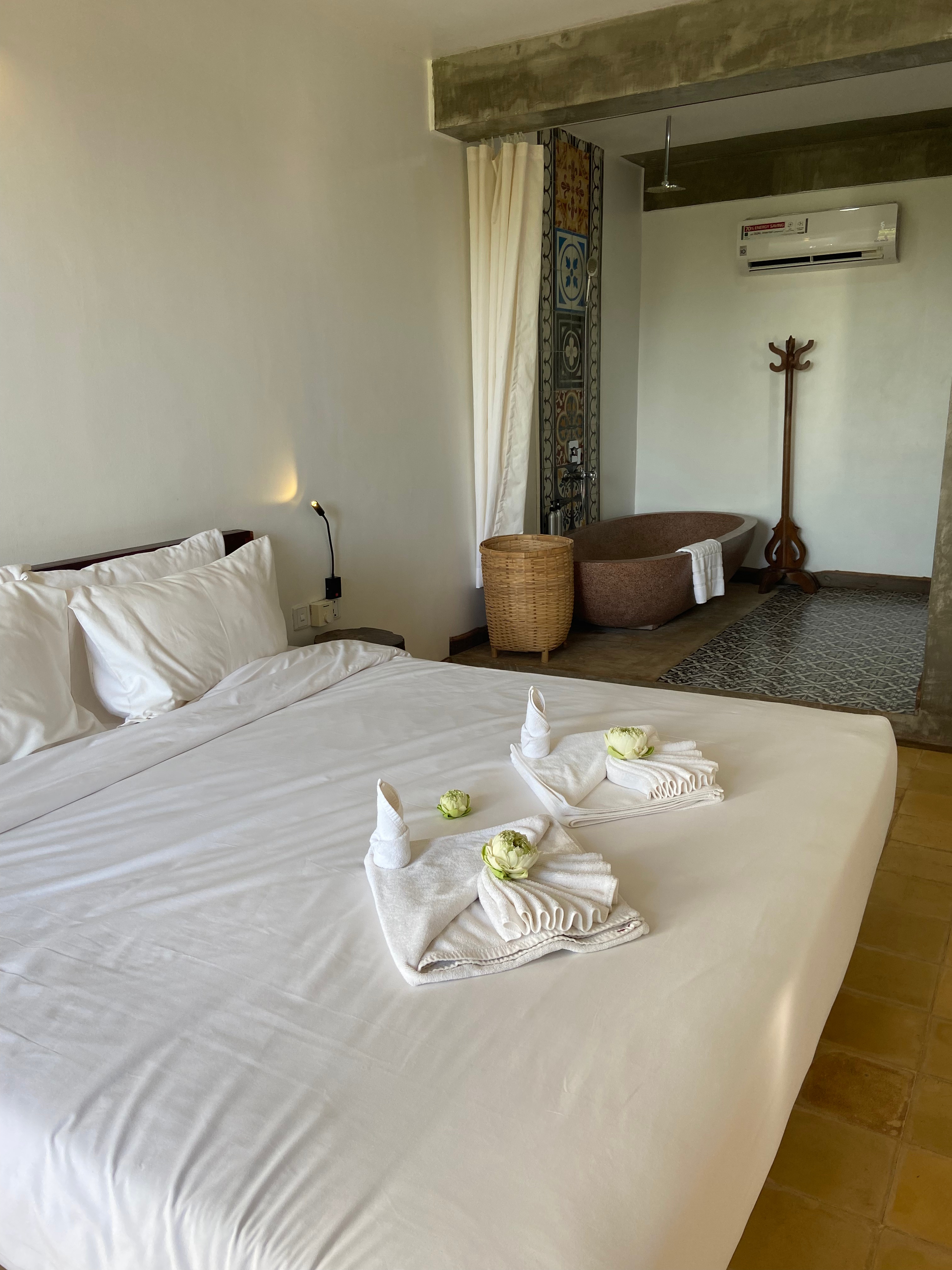
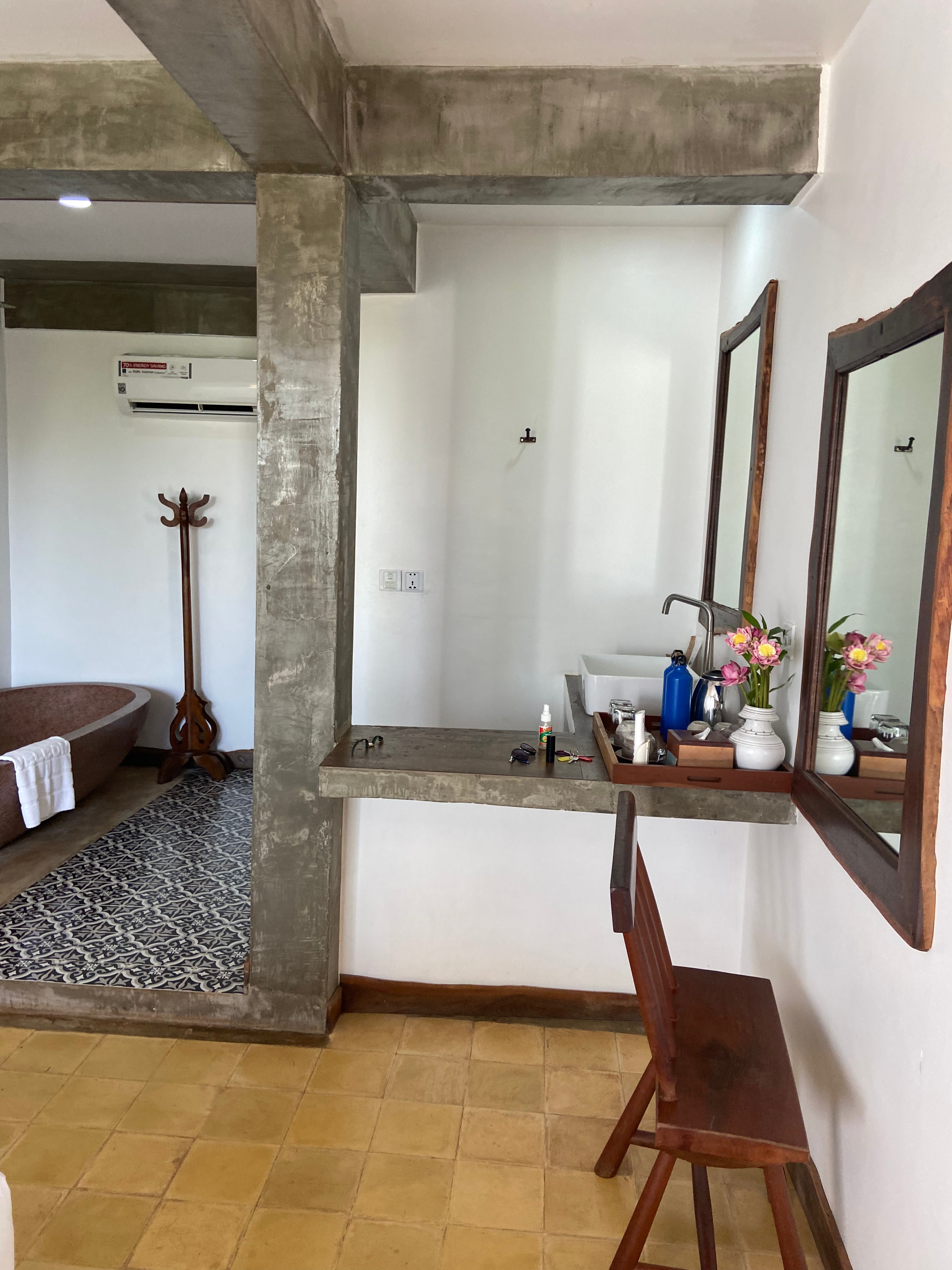
Having left Battambang around lunchtime, we arrived at our Siem Reap accommodation – The Nature – mid-afternoon. It’s not the easiest place to find – it’s in a semi-rural setting (my mozzie radar was on high alert!) about 2.5km from the hubbub of touristy Pub Street and the Night Market in the town centre.
The Nature is set among the trees, and all the furniture is made from wood and natural materials with chunky chairs and tables in the restaurant hewn from tree trunks. Our rooms were adjoining – with a kitchen in between – on the top floor accessed via a steep wooden staircase with a rope bannister (you’d not want to climb these under the influence of several margaritas!). The beds were super hard – especially for this Princess and the Pea – like sleeping on a board. It didn’t really help making a roll out of the duvet for extra padding and sleeping on one half – plus it made it way too hot.
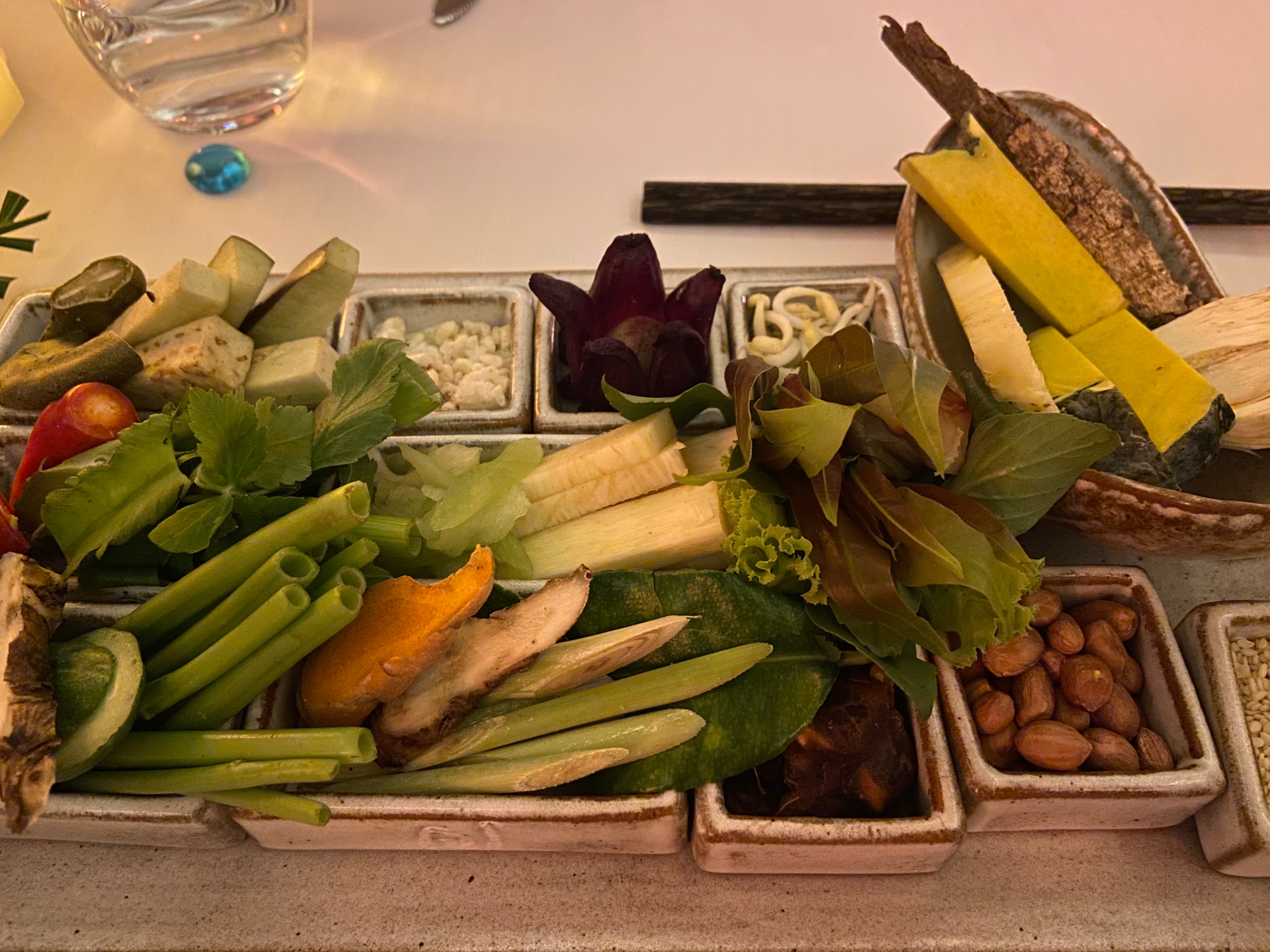
Our first night, we’d arranged to have dinner with friends of Di’s at The Embassy, an all-female restaurant in a mostly male-dominated industry. It’s a pretty special place – head chef Kimsan Pol showcases traditional recipes which she unearthed by researching the national archives. It’s a set 7-course banquet – and the range of flavours, textures, combinations, colours and the presentation – each dish a work of art – was truly extraordinary. To start with, they bring a basket laden with seasonal and local fruits, vegetables and spices and explain what all the ingredients are.

As the only newbie to Embassy, I was keen to savour every mouthful. The food was exquisite, but I felt we didn’t focus enough on what we were eating – it became the backdrop to a lot of chat about mid-century architecture – Di’s friends were in the process of building their dream home – which I know nothing about! All the talking meant that they ate slowly and the cumulative result over seven courses – the staff couldn’t clear our plates away till everyone had finished – meant it was a LONG dinner. I started to long to get back to my brick-like bed ahead of an early start the next day…
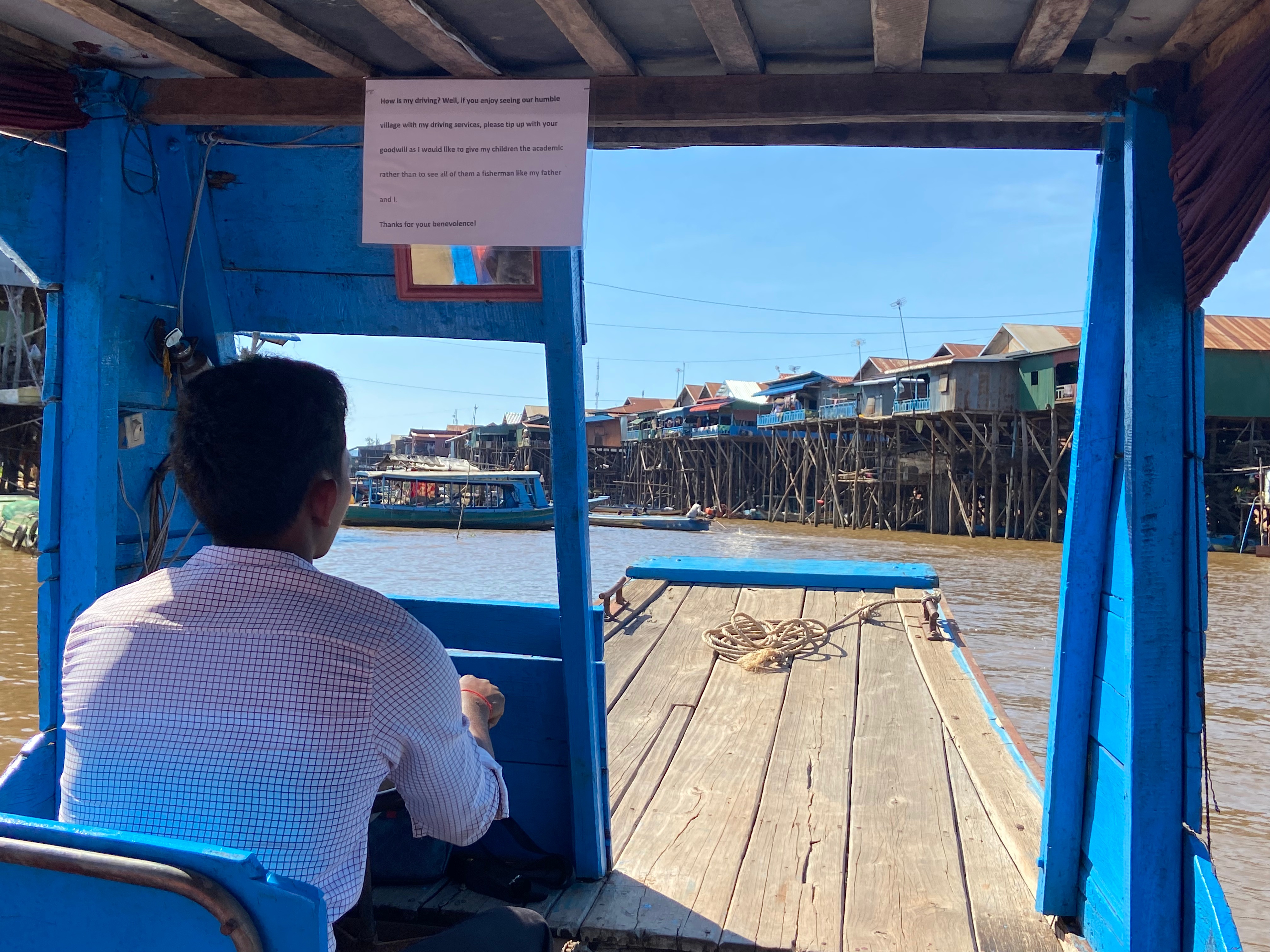
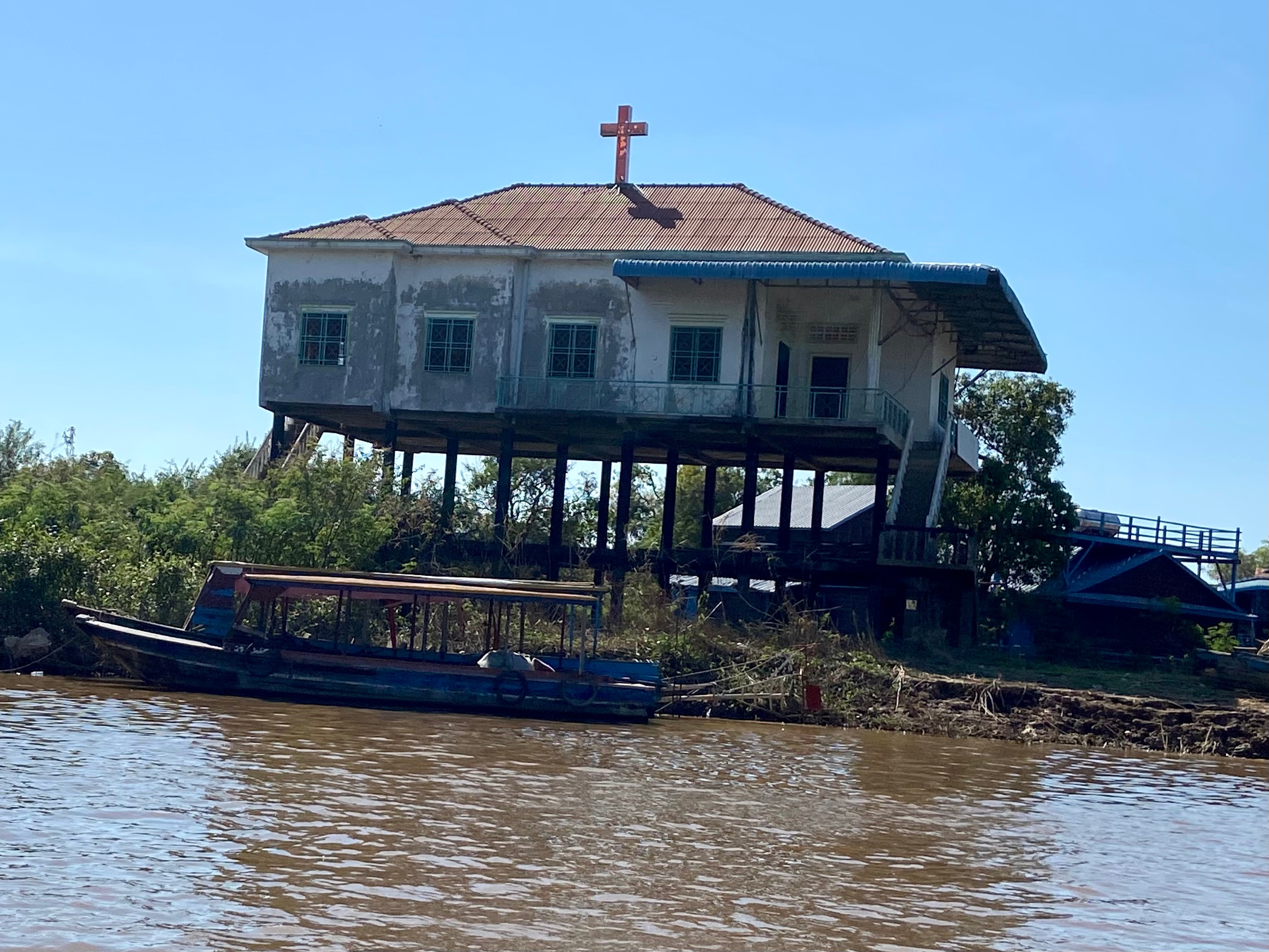
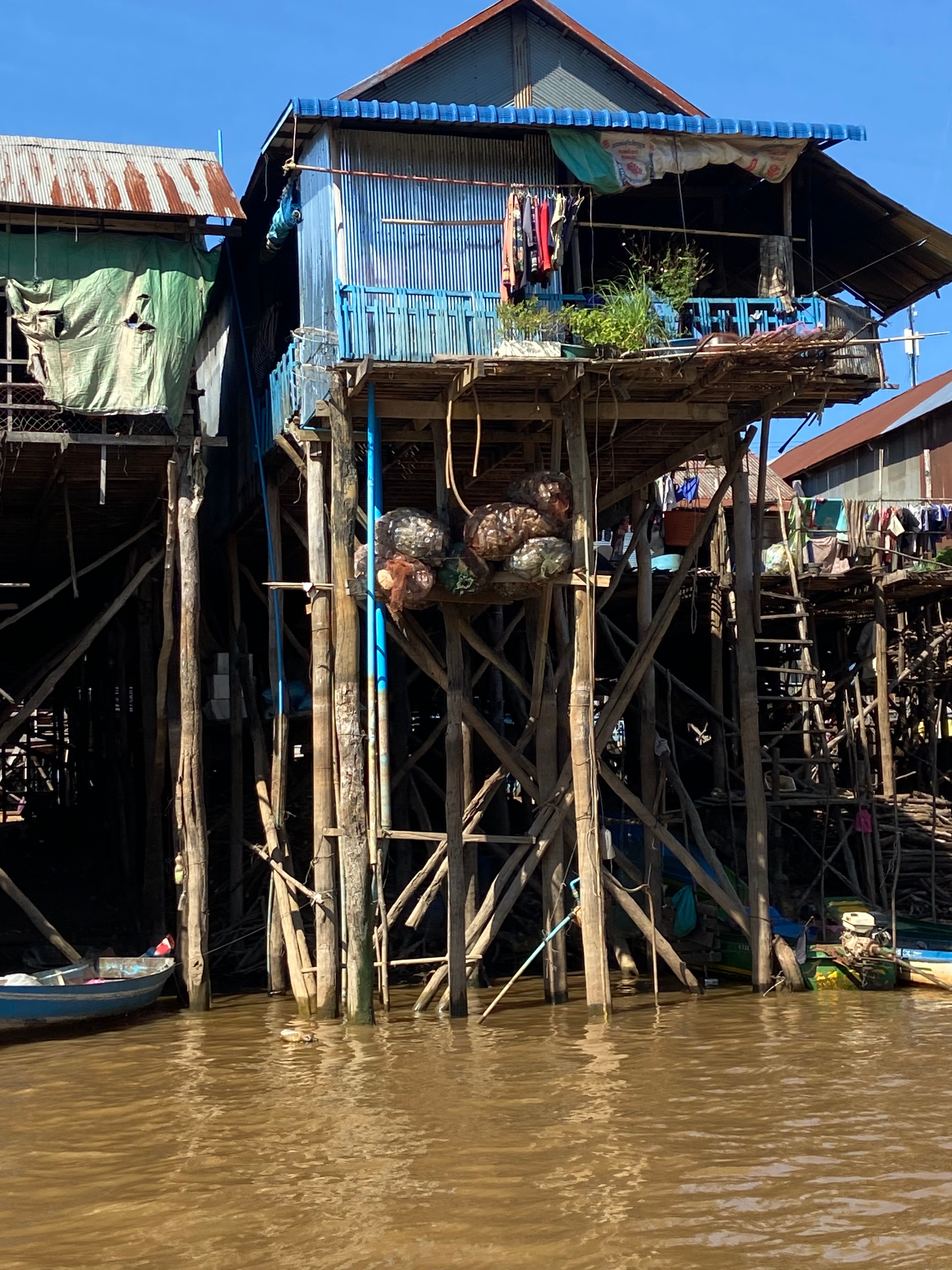
We got back to The Nature at midnight with very full bellies and were up again at 7am as Theary was meeting us at 8’ish to go to Kampong Phluk, a floating village on Tonle Sap Lake. On the approach there were rice fields either side of the river and men up to their shoulders in the river, fishing. We did a boat tour with a local guide through the houses on stilts, most of them ramshackle, part wood, part corrugated iron, washing drying and potted plants on the verandahs, and some with mezzanine layers that are only accessible in the dry season (November to April). Fishing is the main livelihood, and some houses have small fenced-off fish farms. It’s a fully functioning community – we passed a floating restaurant that operates throughout the year, a floating grocery store selling biscuits, bananas and coconuts, an ornate Buddhist temple situated on one riverbank and a church on stilts on another.
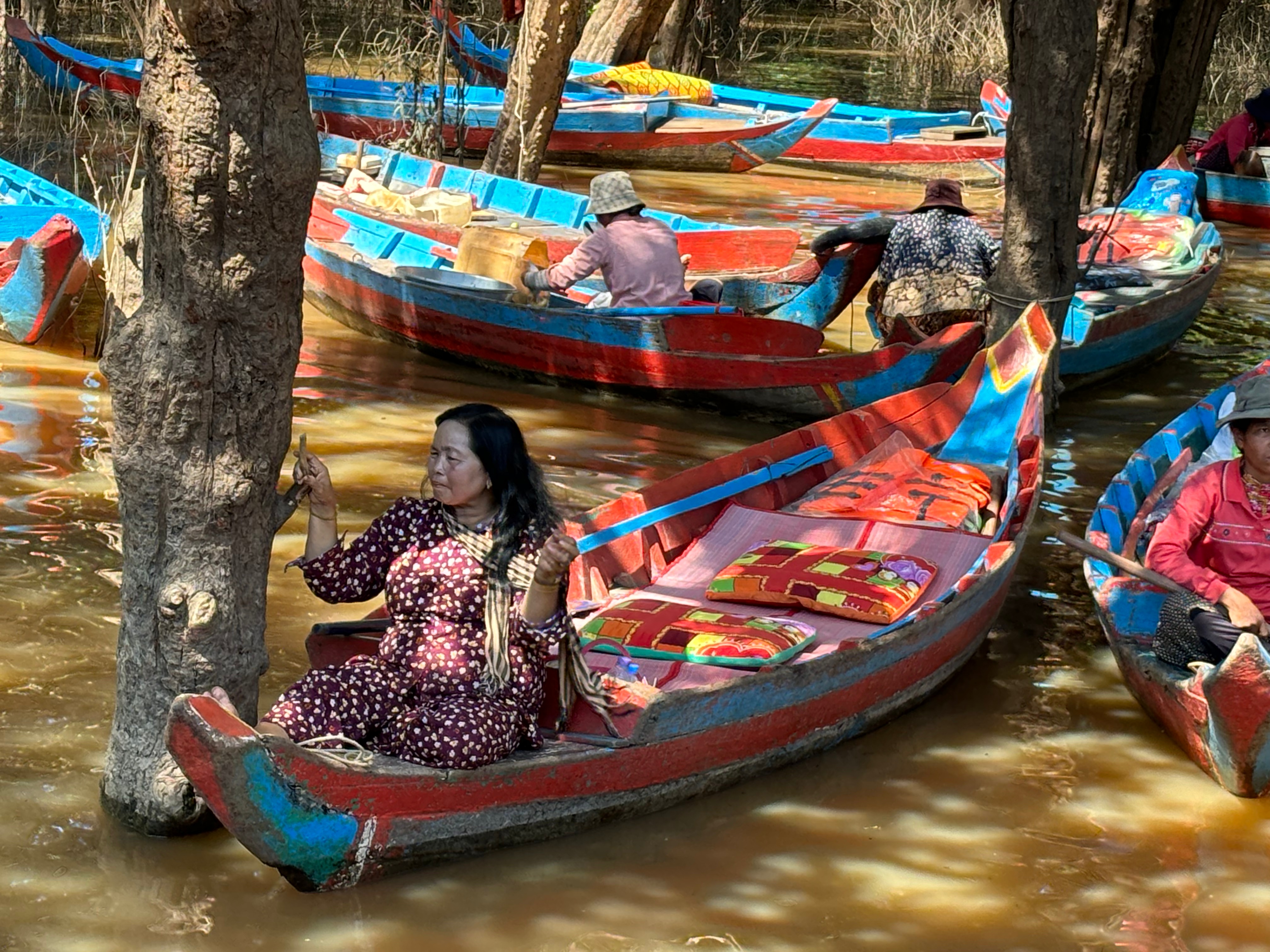
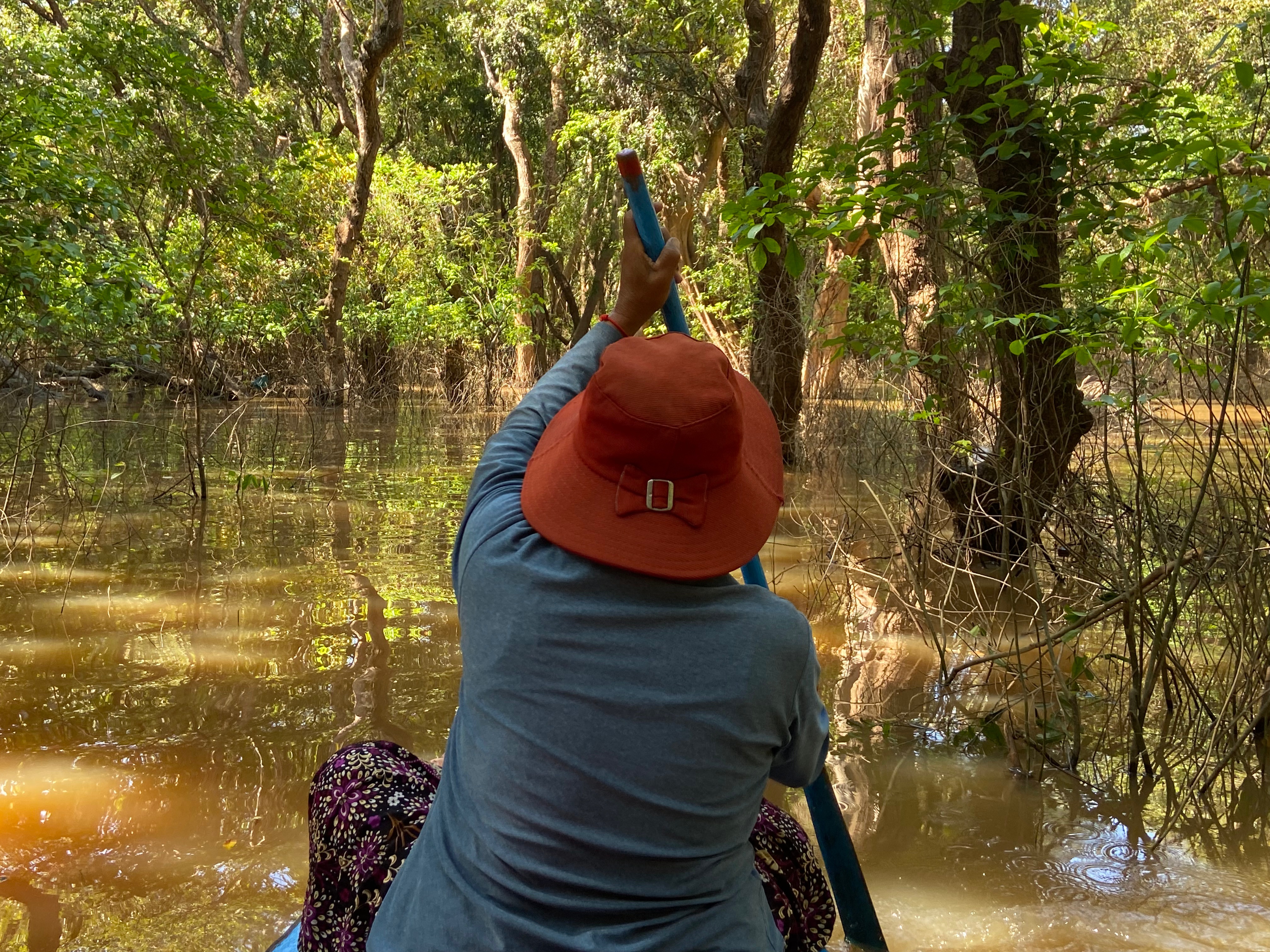
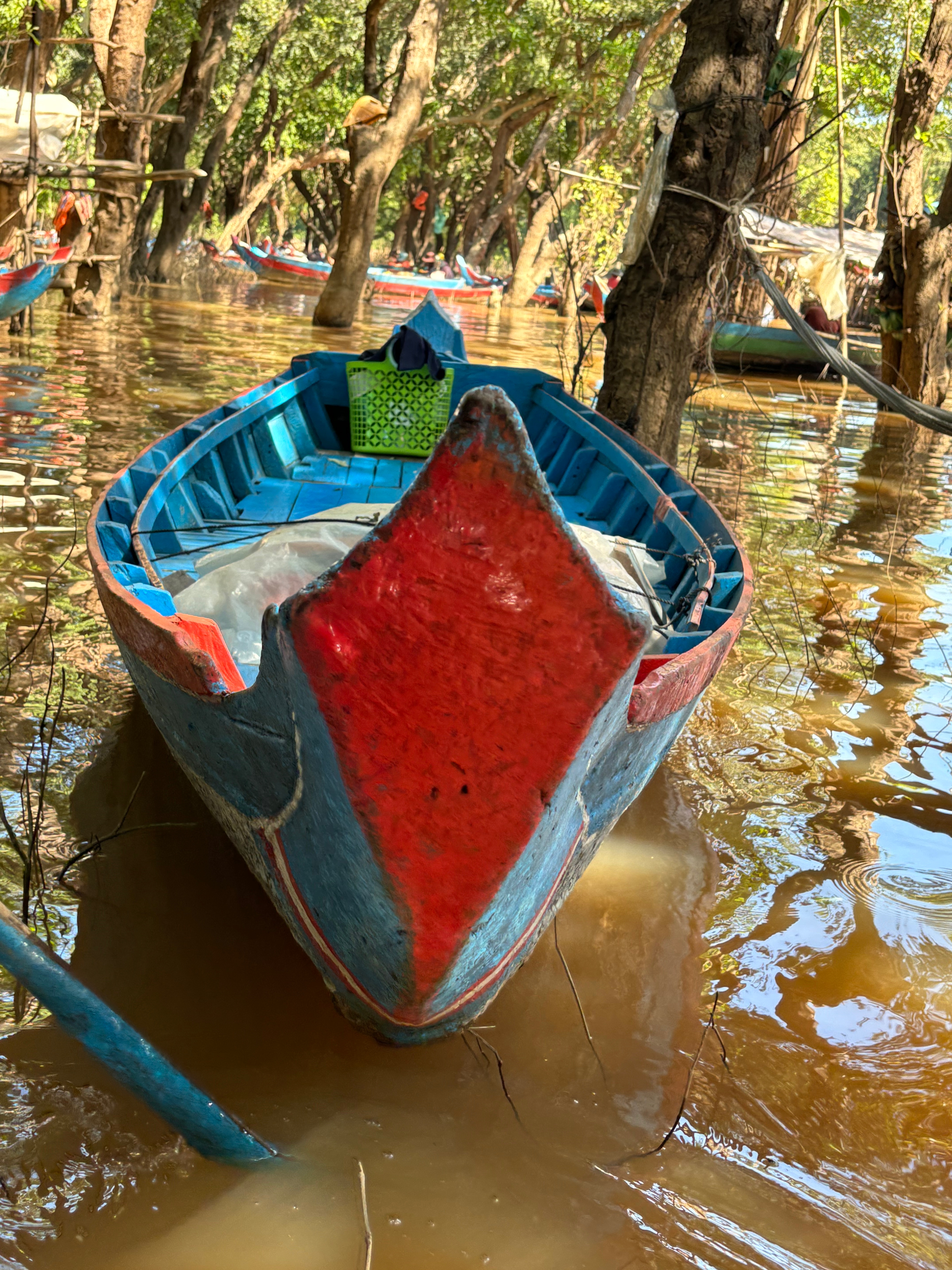
After our lake trip we decanted into a smaller brightly painted rowboat and were taken through the mangroves by a boatwoman. Immersed in birdsong and close enough to the vegetation to pluck the occasional flower, it was wonderfully peaceful, paddling through the water.
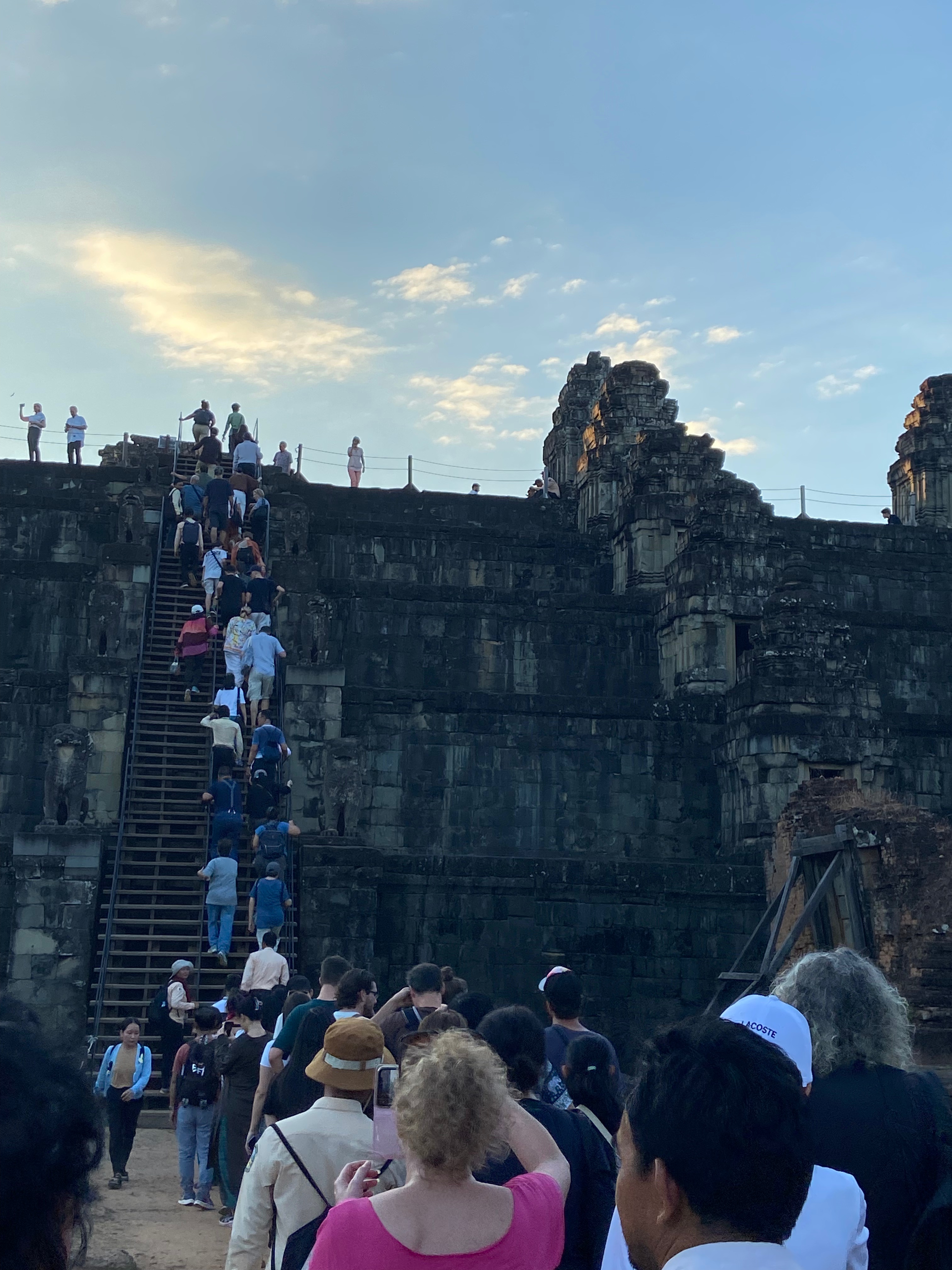
In the late afternoon we purchased our one-day tickets for the Angkor temple complex for the following day. This is how it works – you buy tickets the afternoon before so you can see that evening’s sunset and the next day’s sunrise. Towards sunset we climbed up to Phnom Bakheng Temple (a Hindu and Buddhist temple) built at the end of the 9th century.
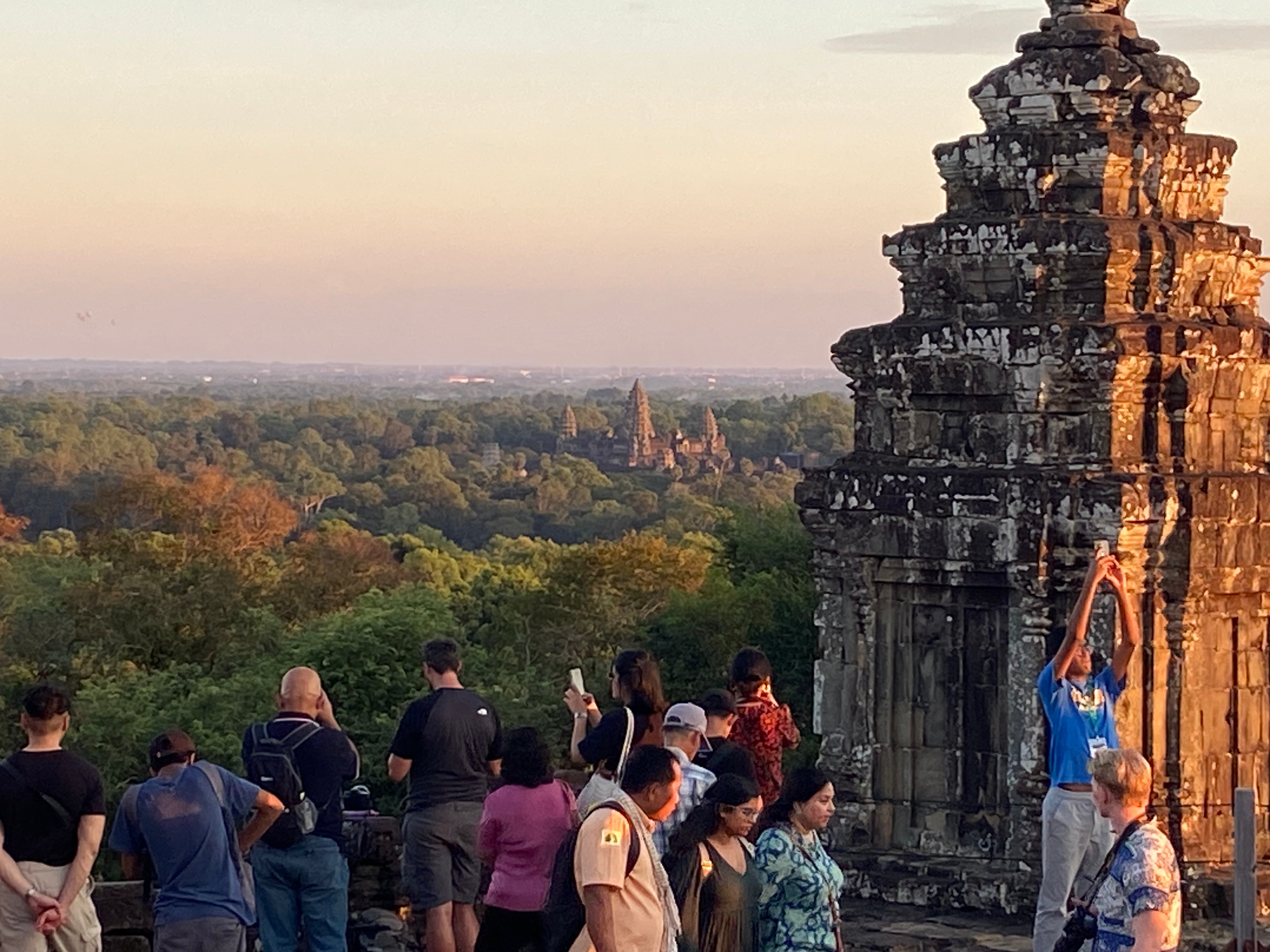
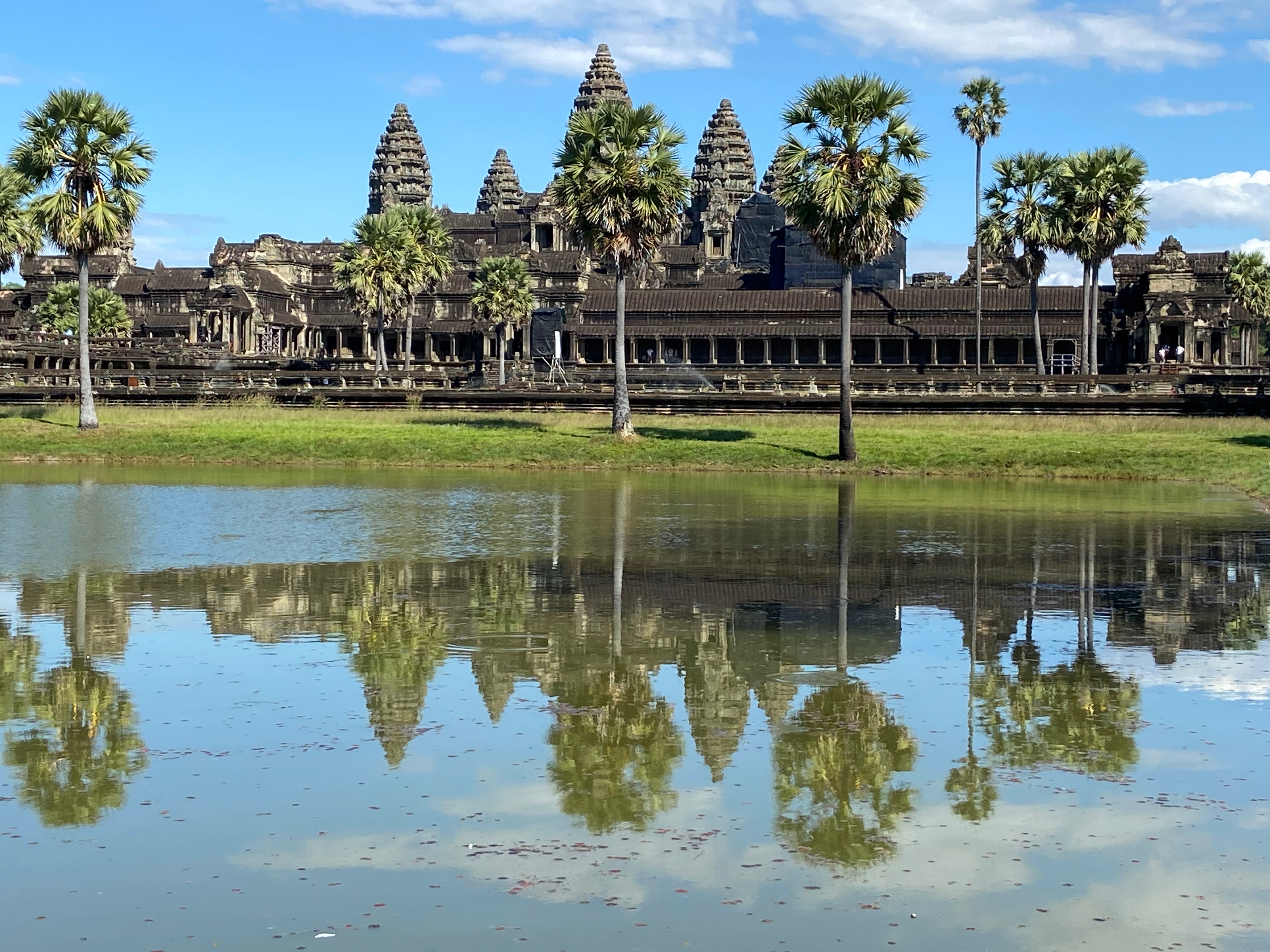
When you get to the summit, it’s crowded! Everyone is waiting for a picture-perfect sunset. We looked over at Angkor Wat (see middle picture)– a preview of what was to come the next day but decided to go to a look-out halfway down to avoid the scrum. We almost missed the sun setting – it’s so fleeting – but the way the light fell on the stone was worth the climb and we heard geckos calling out GECKO, GECKO – I’ve never heard that before.
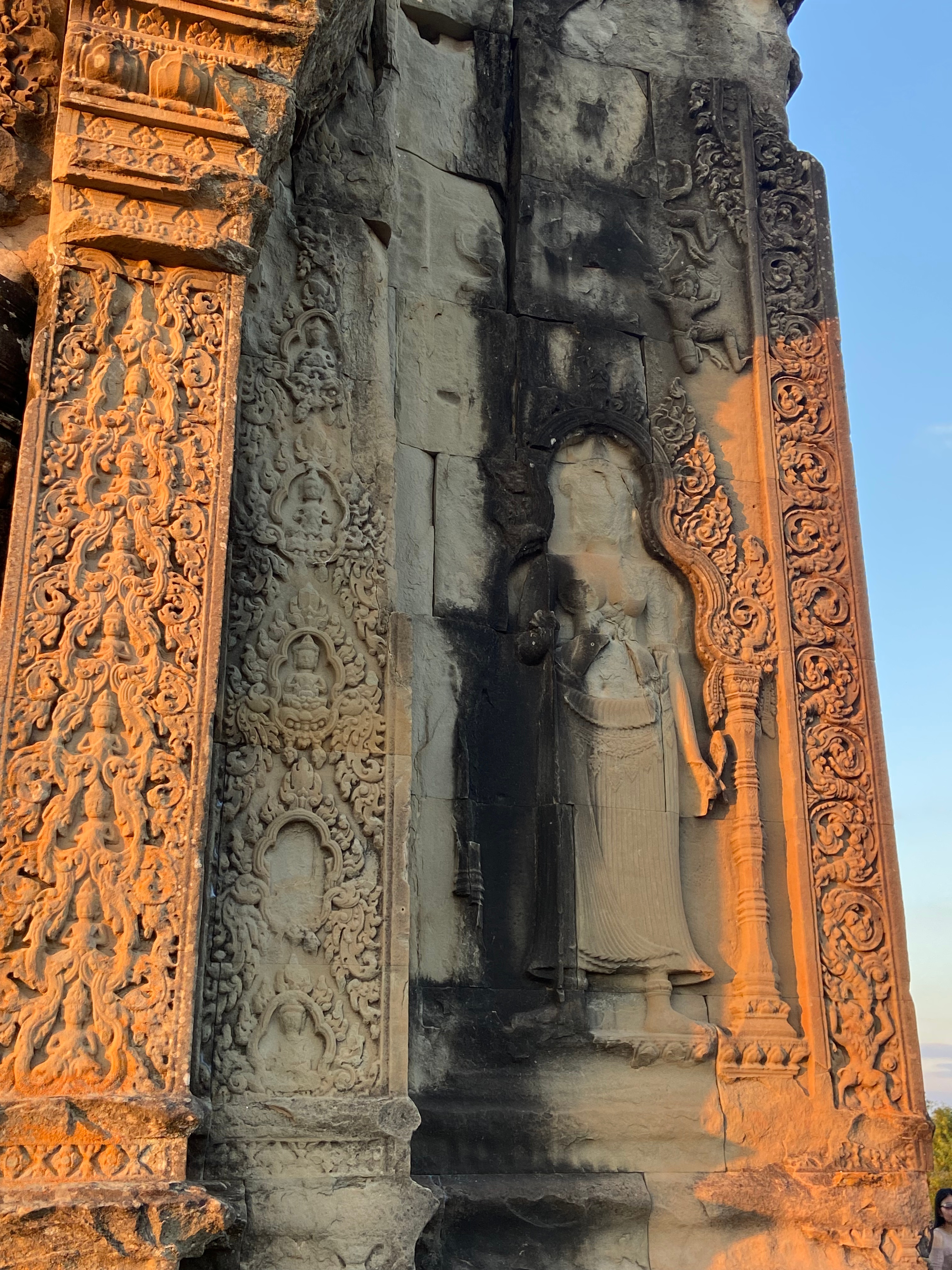
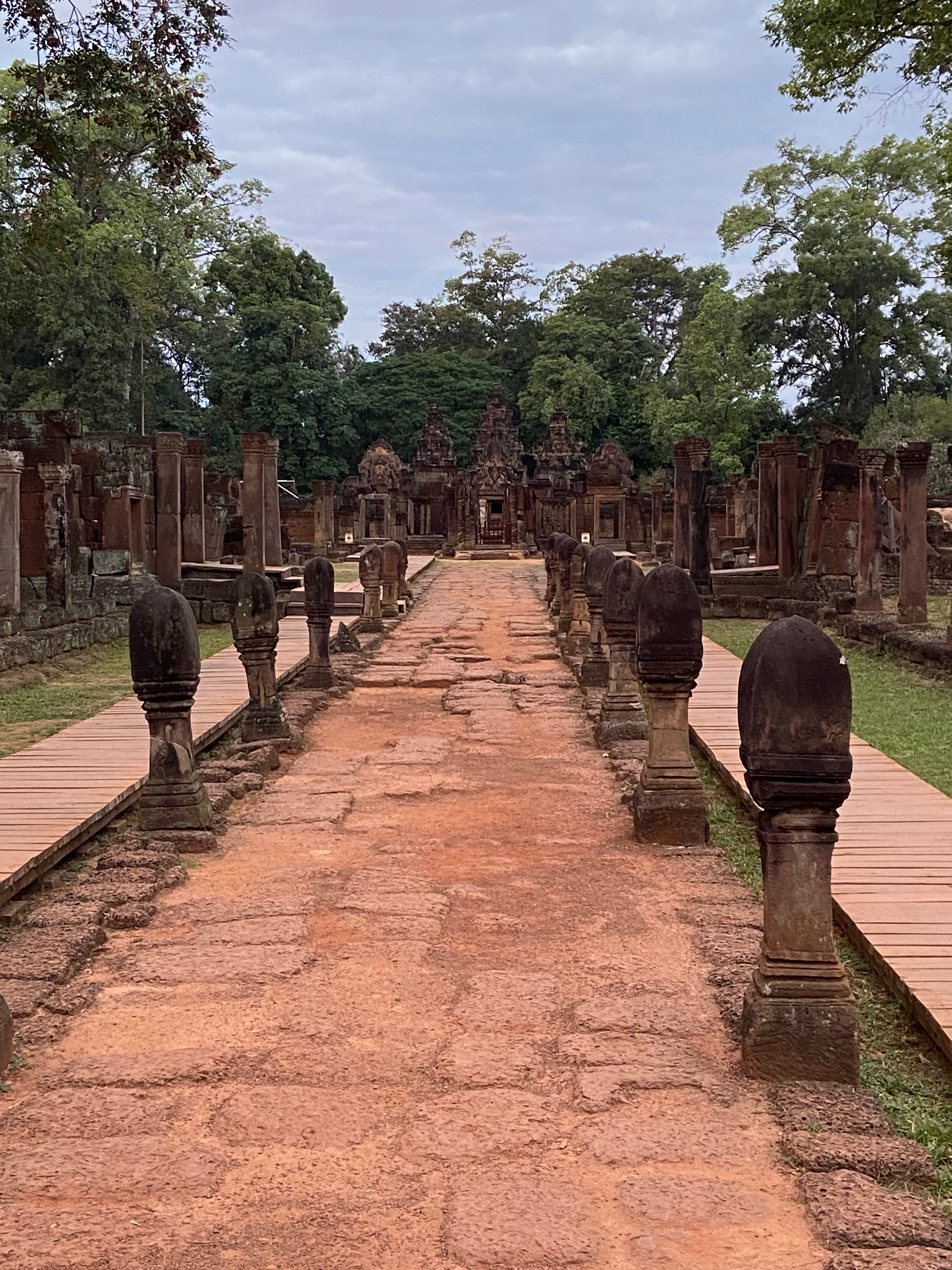
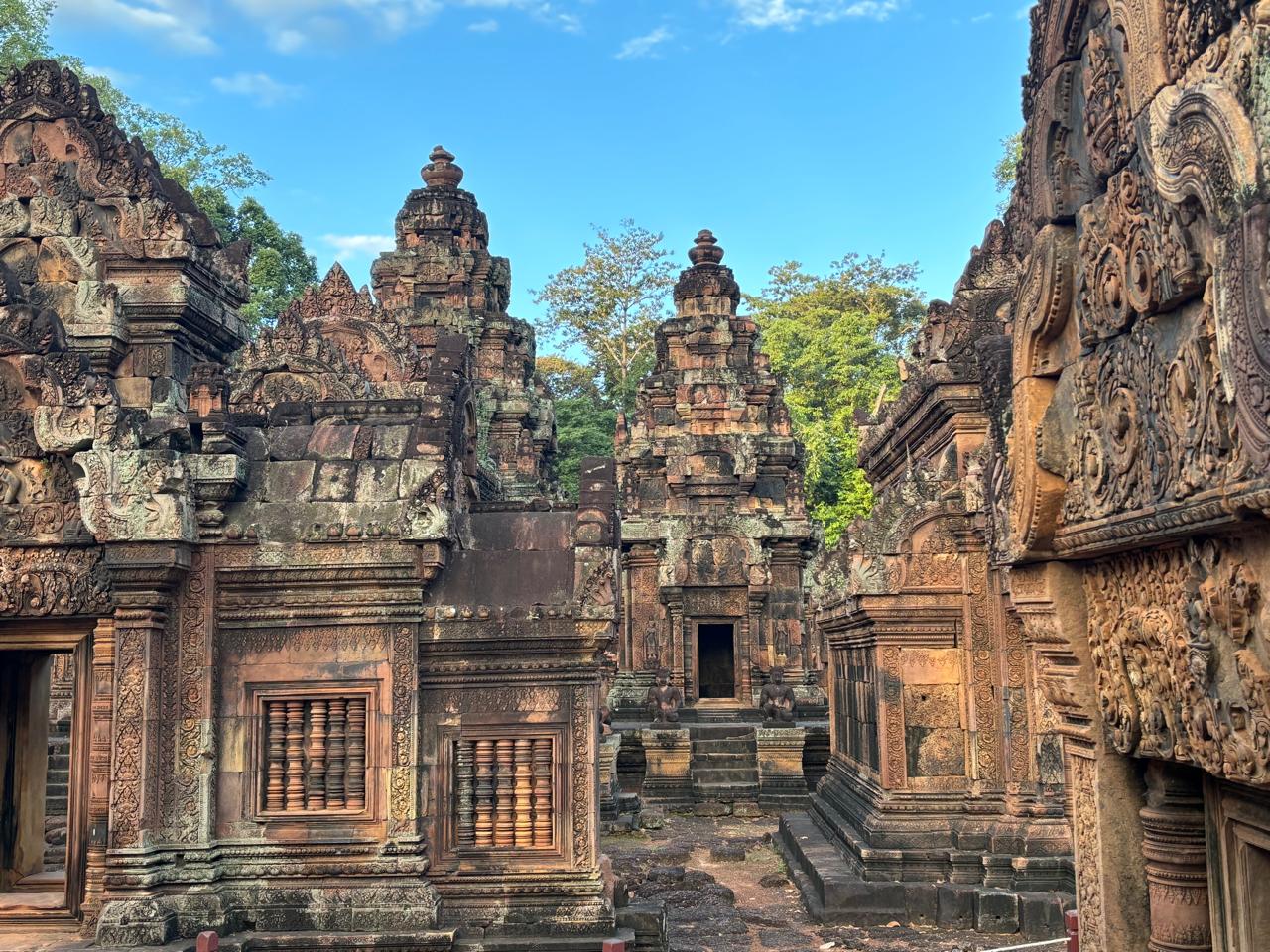
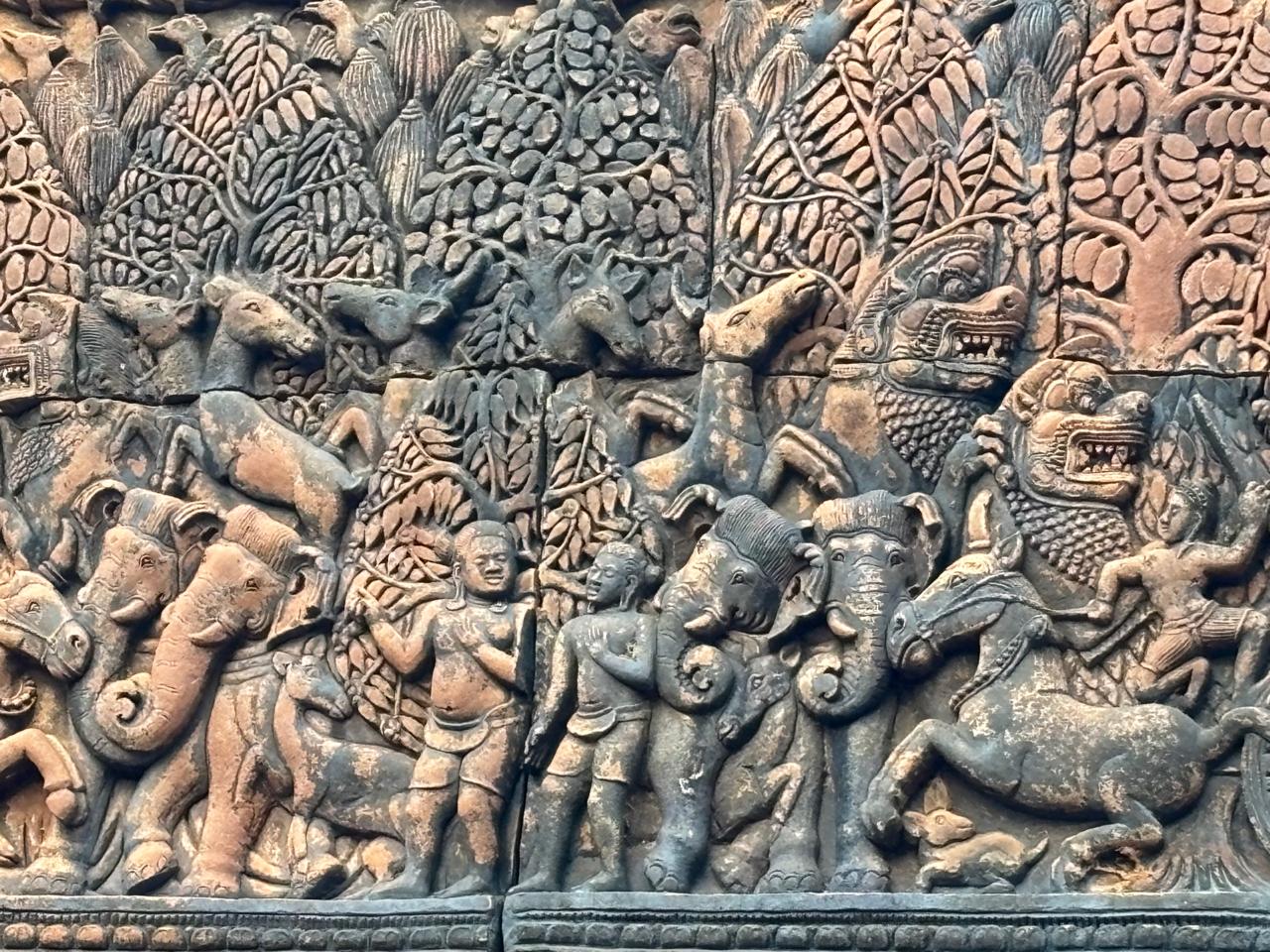
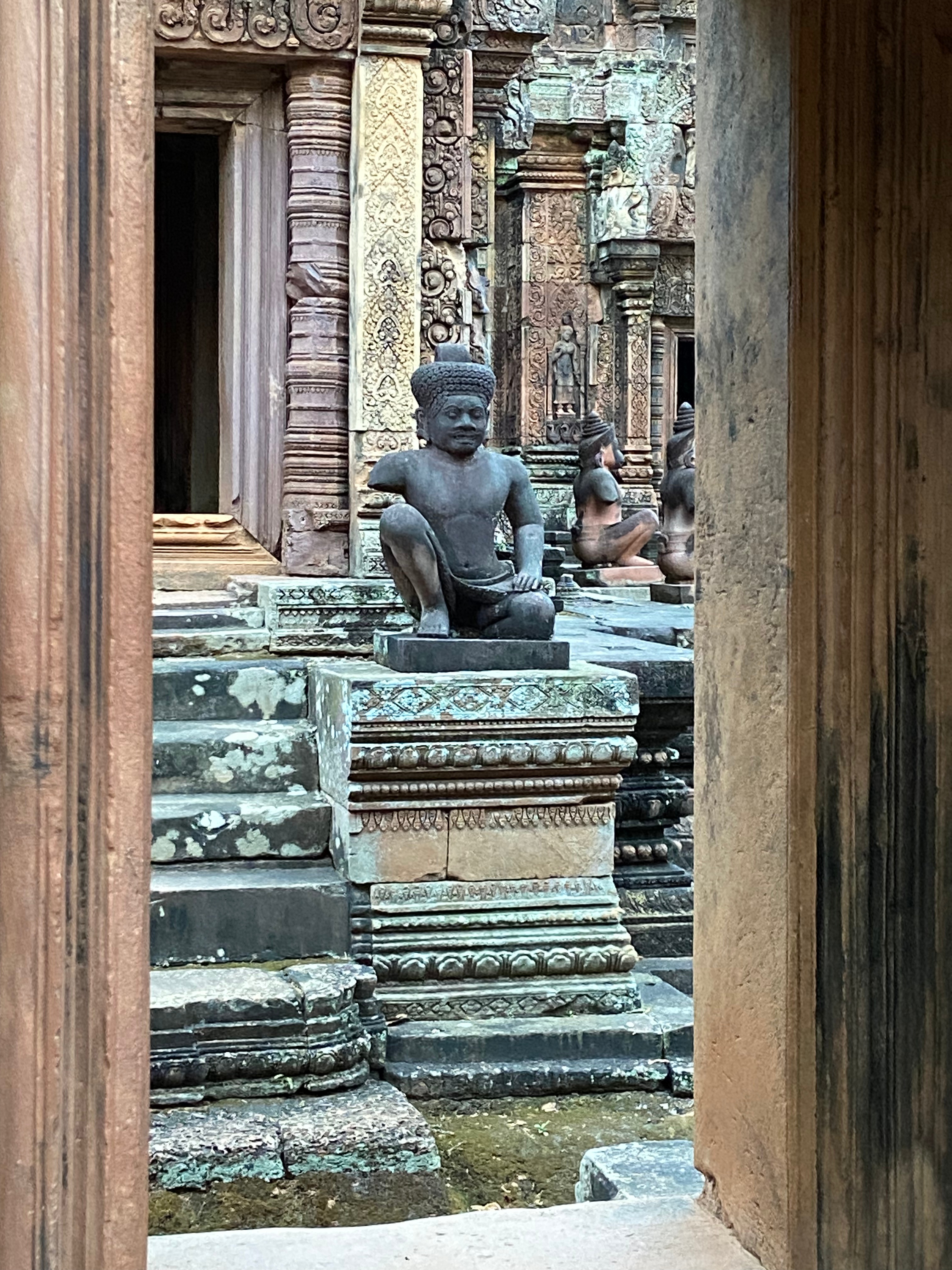
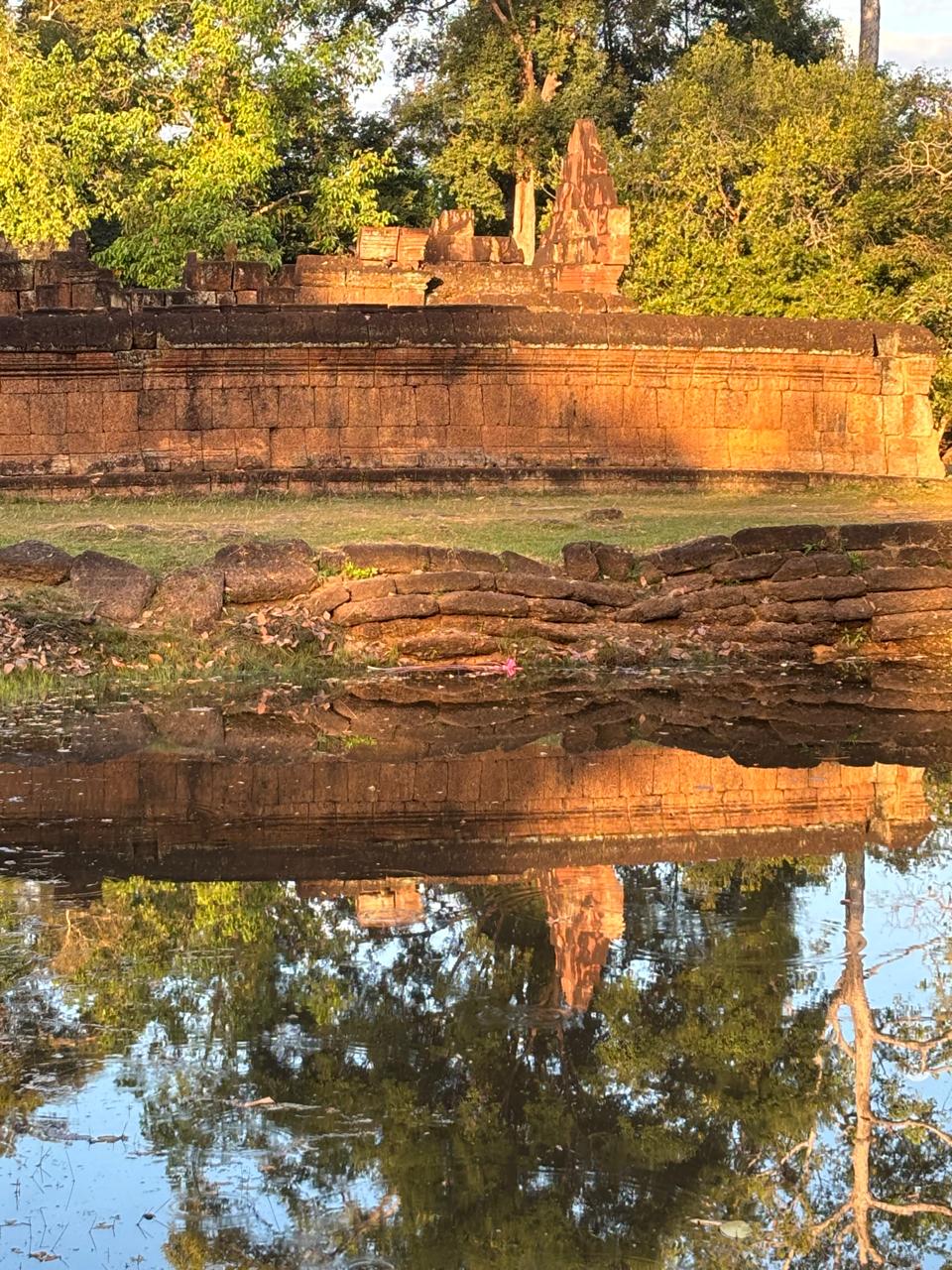
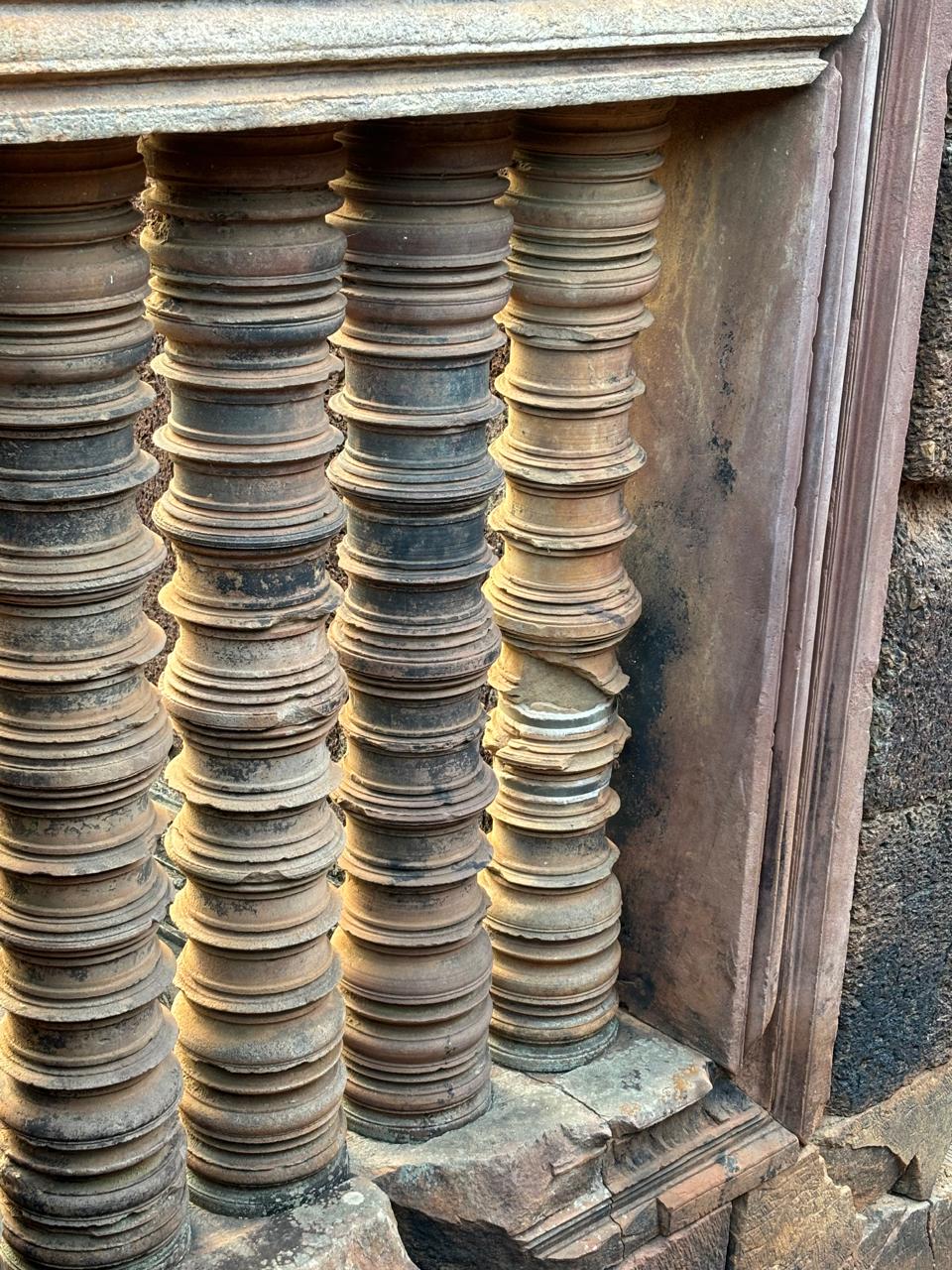
On ‘Temple Day’ Theary collected us at 5.30am, and rather than follow the crowds to Angkor Wat – how lucky was I have Di as my guide, she knows her temples – our first stop was Banteay Srey which means ‘Citadel of the Women’. Banteay Srey is said to have been built by a woman as the delicate carvings are considered too fine to have been crafted by any man. We were there at 6.30am only to find it didn’t officially open till 7.30am but there was nothing to stop us going in so we did and we had the place to ourselves, just us, birdsong and the rising sun casting a golden light on the stone. Magical. A grumpy official found us around 7am and ticked us off for entering before opening time. Like naughty schoolgirls we muttered ‘too late’ and carried on with our tour, enjoying breaking the rules! With its reddish and pinkish stone and intricate carvings – such as scenes from the Ramayana adorning the library pediments – this was my favourite of all the temples.

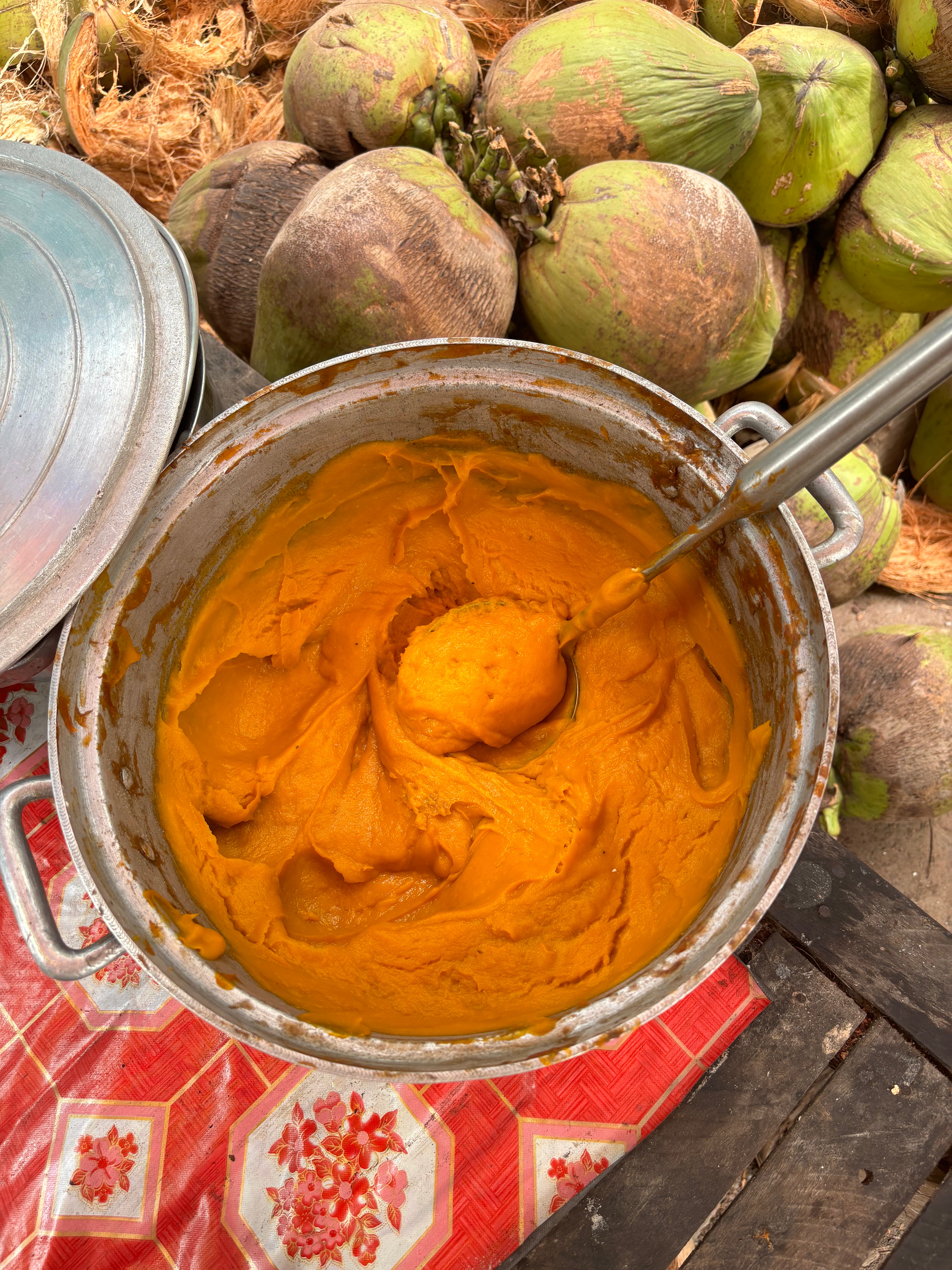
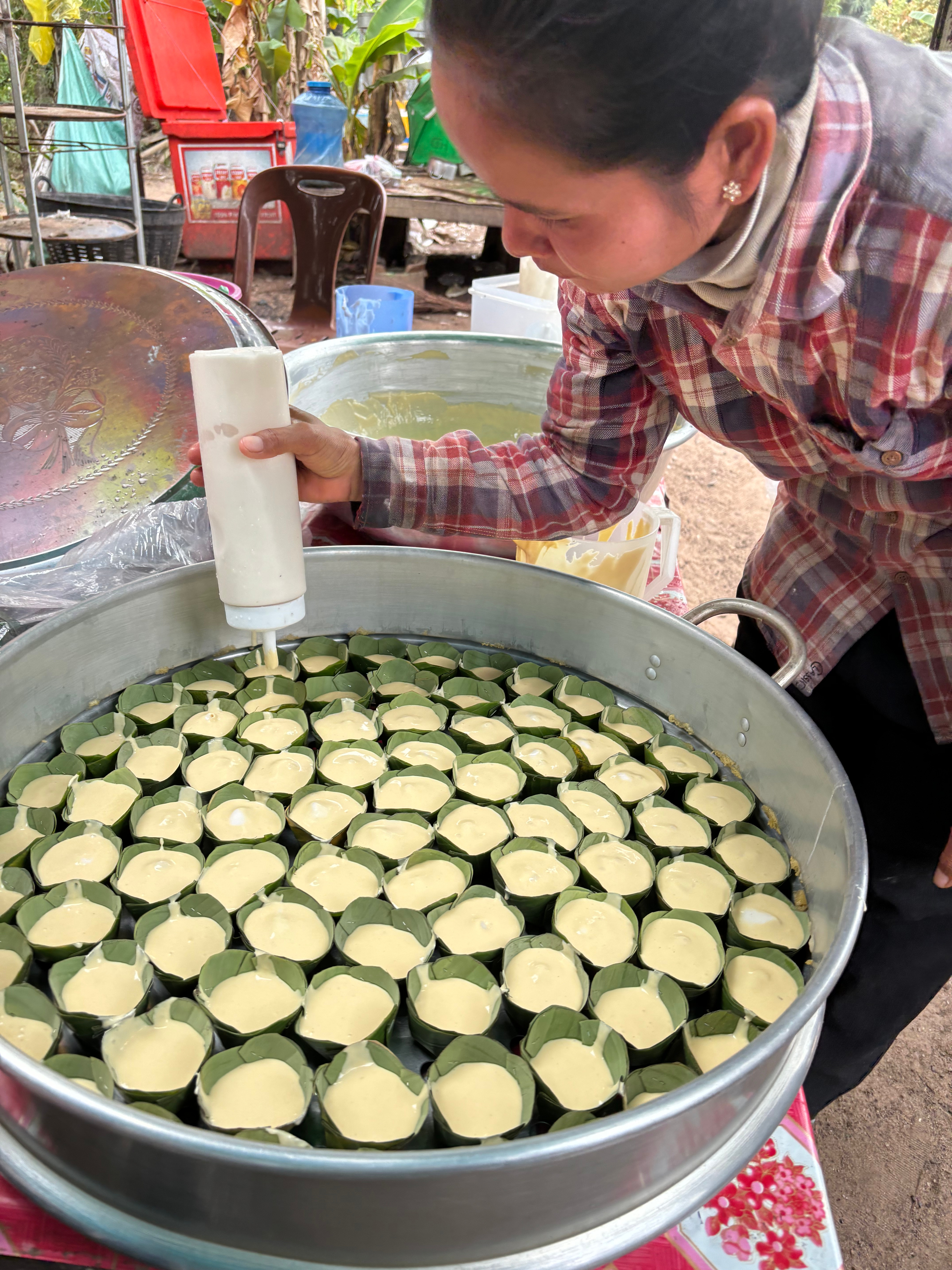
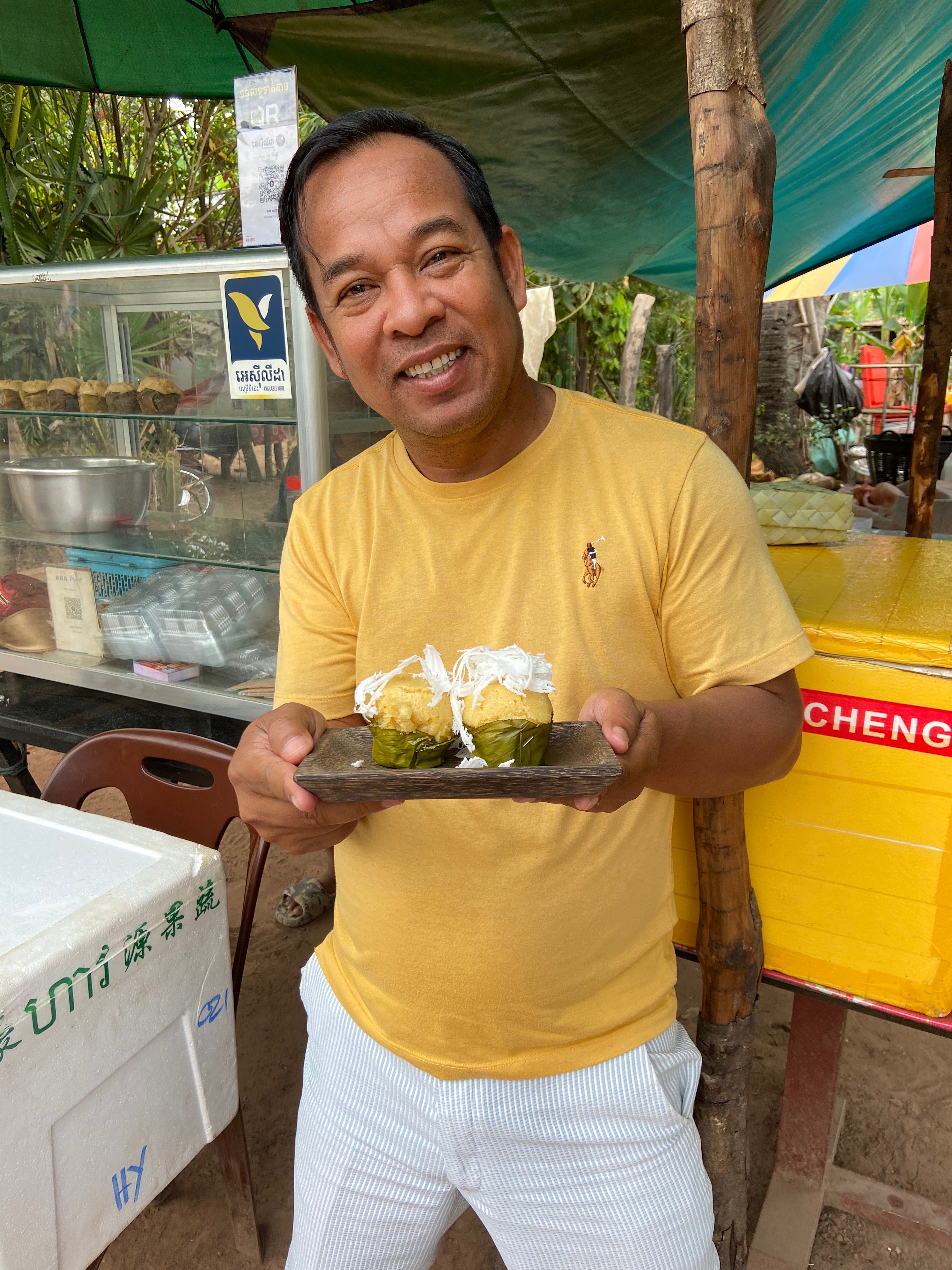
After breakfast at Banteay Srey, Theary picked us up and we continued with our temple tour. Along the way we came across a bunch of roadside stalls selling among other things palm fruit cakes, made from palm fruit puree (it looks like pumpkin puree but is sharper and has a more defined fruity flavour), eggs and palm sugar and steamed in a pandan leaf. They are served with coconut cream in the middle and fresh coconut on top. Well, this was ONE OF THE MOST DELECTABLE THINGS I HAVE EVER EATEN! I can highly recommend.
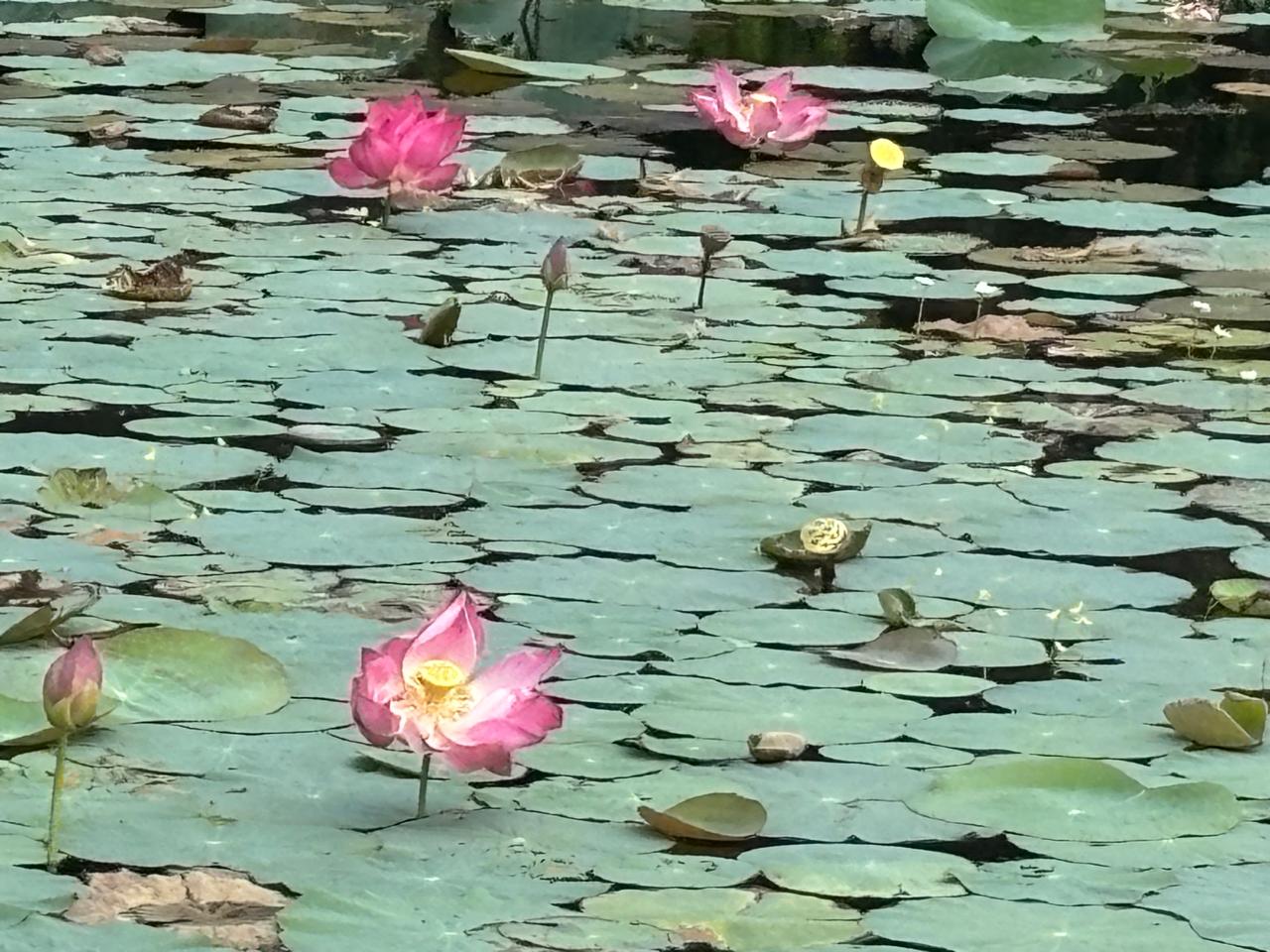
Our next stop before Angkor Wat was Neak Pean, a temple built on an artificial island with a Buddhist temple in the middle. It’s divided into four enclosures in the shape of a cross and all of them have beautiful bas-relief carvings. But what I remember most is the approach via the causeway, which is dotted with lotus flowers and lotus seed pods, the latter dotted with holes reminding me of watering can spouts.
You’ll be familiar with pictures of Angkor Wat, and much has been written about it – but by way of a summary: Angkor Wat was originally a Hindu temple and later converted to a Buddhist temple. It’s on the UNESCO World Heritage List, the world’s largest religious monument, a highpoint of Khmer architecture built in the 12th century.
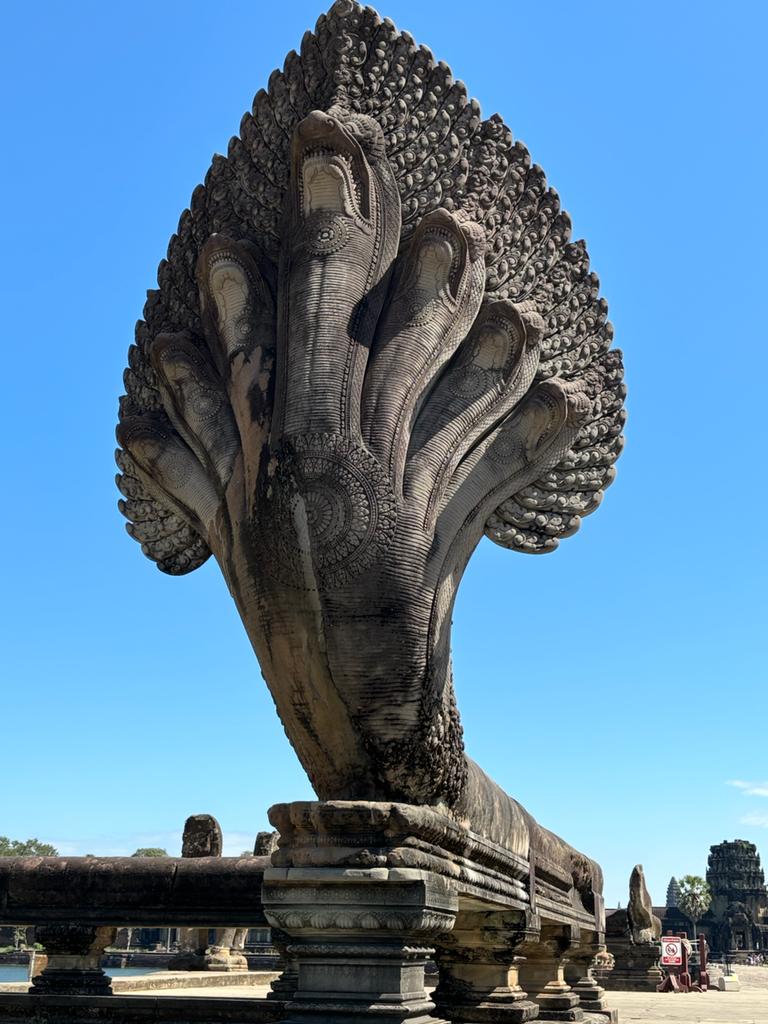
It’s surrounded by a vast moat and wall, and you approach by a long sandstone causeway guarded by the seven-headed serpents or nagas. The temple is on three levels, the tiered layout representing Mount Meru, the mythical home of the gods in Hindu cosmology. It’s a steep climb up to the top terrace but it’s well worth it for the views back over the complex.
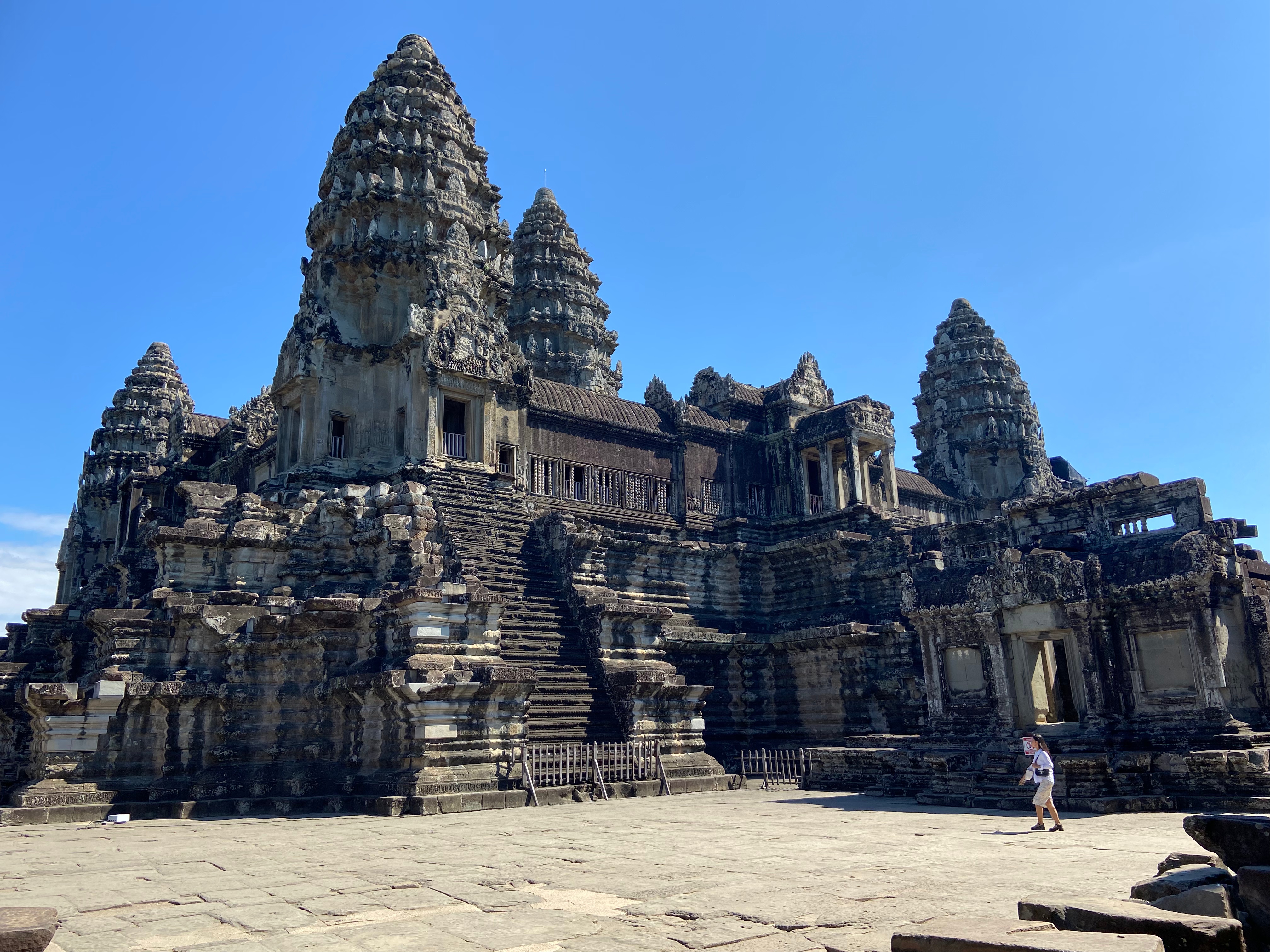
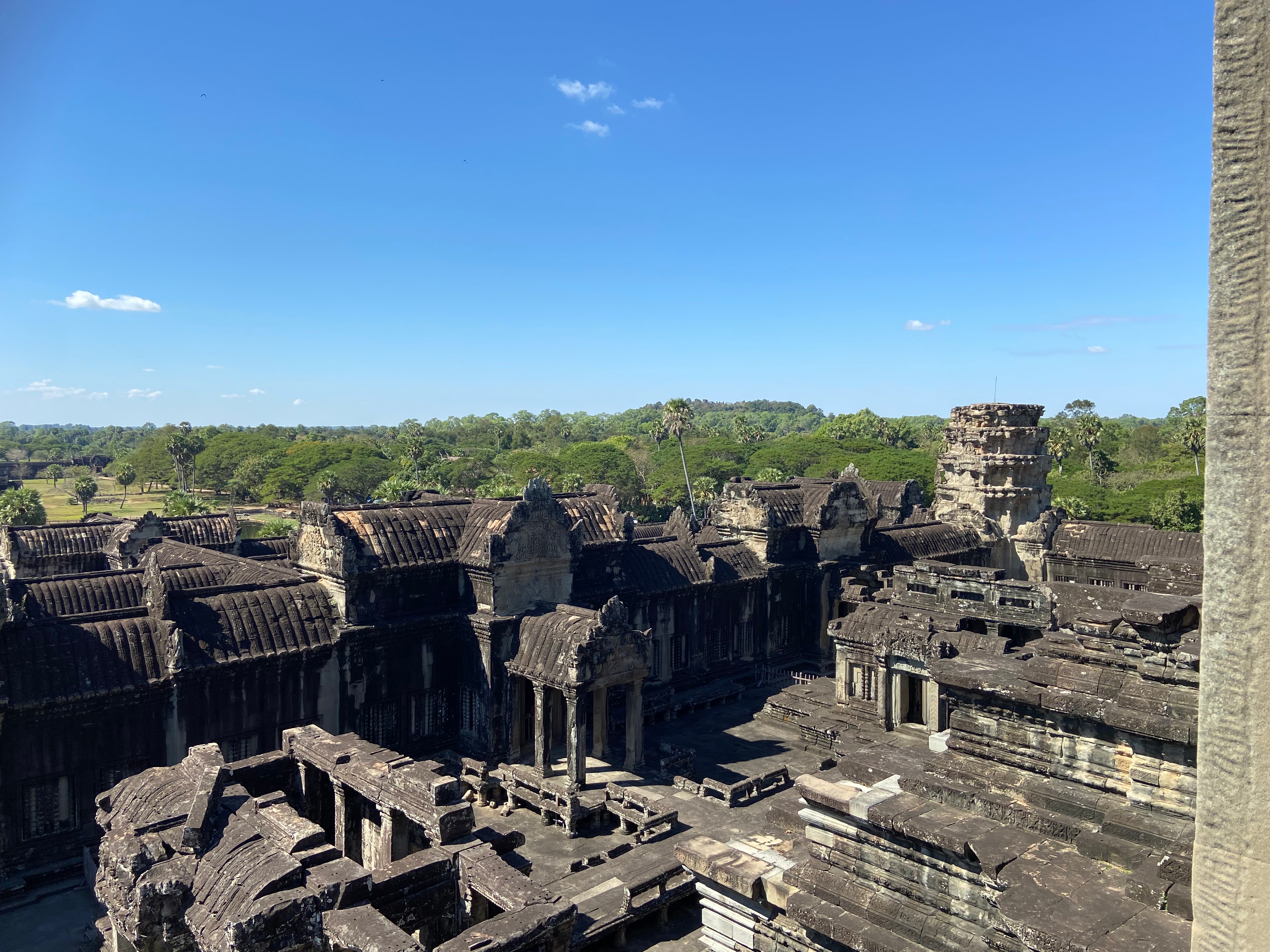
We went round with a local guide and there was so much to learn that I failed to retain much of it! But you don’t need to understand all the layers of history, interpretation, mythology and meaning to experience a sense of awe at its sheer size and complexity – the city of Angkor served as the royal centre from which a dynasty of Khmer kings ruled one of the largest kingdoms in the history of Southeast Asia.
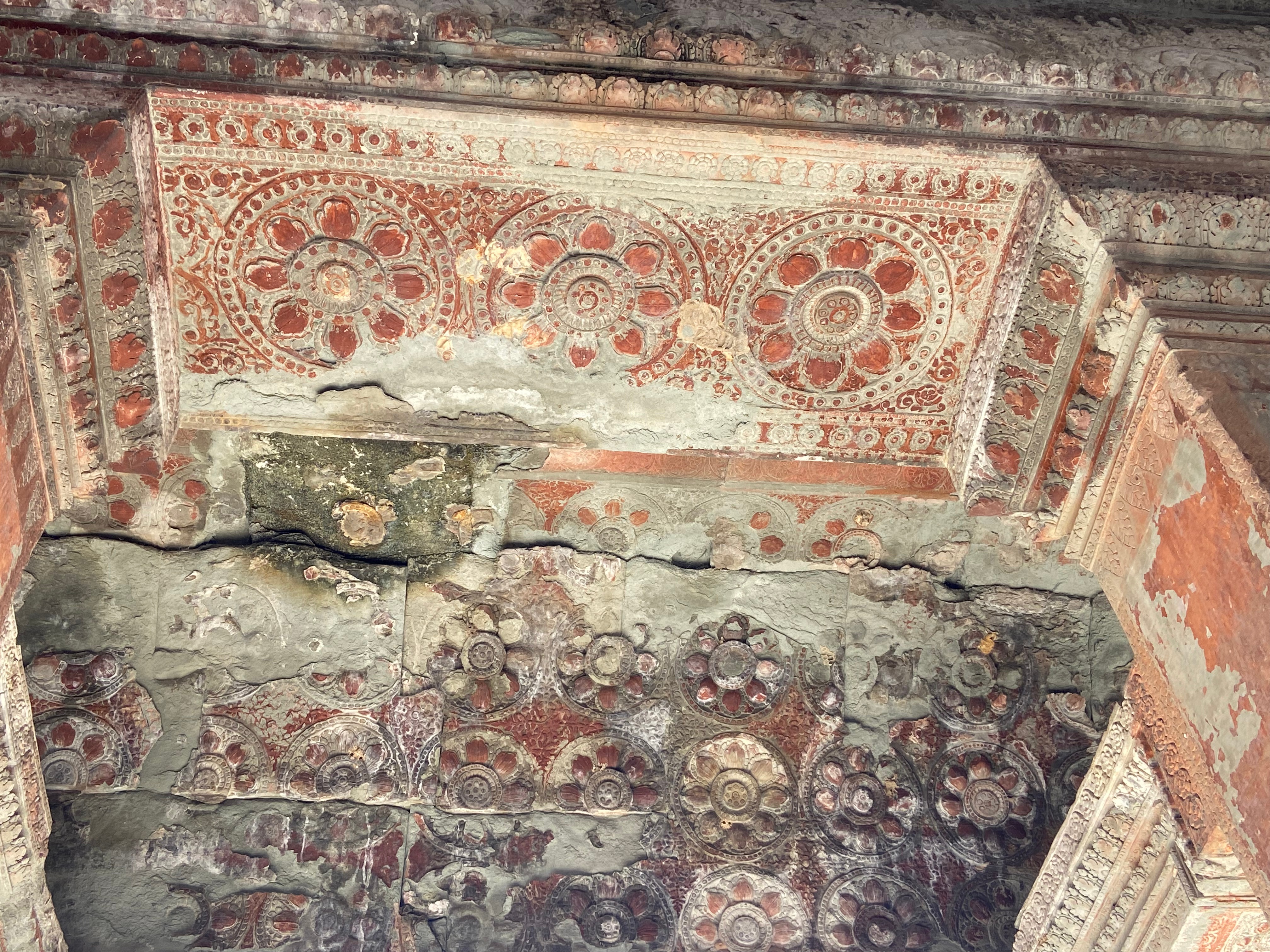
On the second level of the temple is the Gallery of a Thousand Buddhas which, while largely devoid of Buddhas – they were either removed for conservation or destroyed by the Khmer Rouge – has detailed carvings depicting scenes from Hindu mythology and sections where pigment from the original red paint is still visible on the rosettes carved into the roof beams. Close by is the Hall of Echoes – so-named because the stone picks up the vibration of sound. We tested it out by standing with our back to the wall and thumping our chest while saying OM – it’s meant to clear your karma!
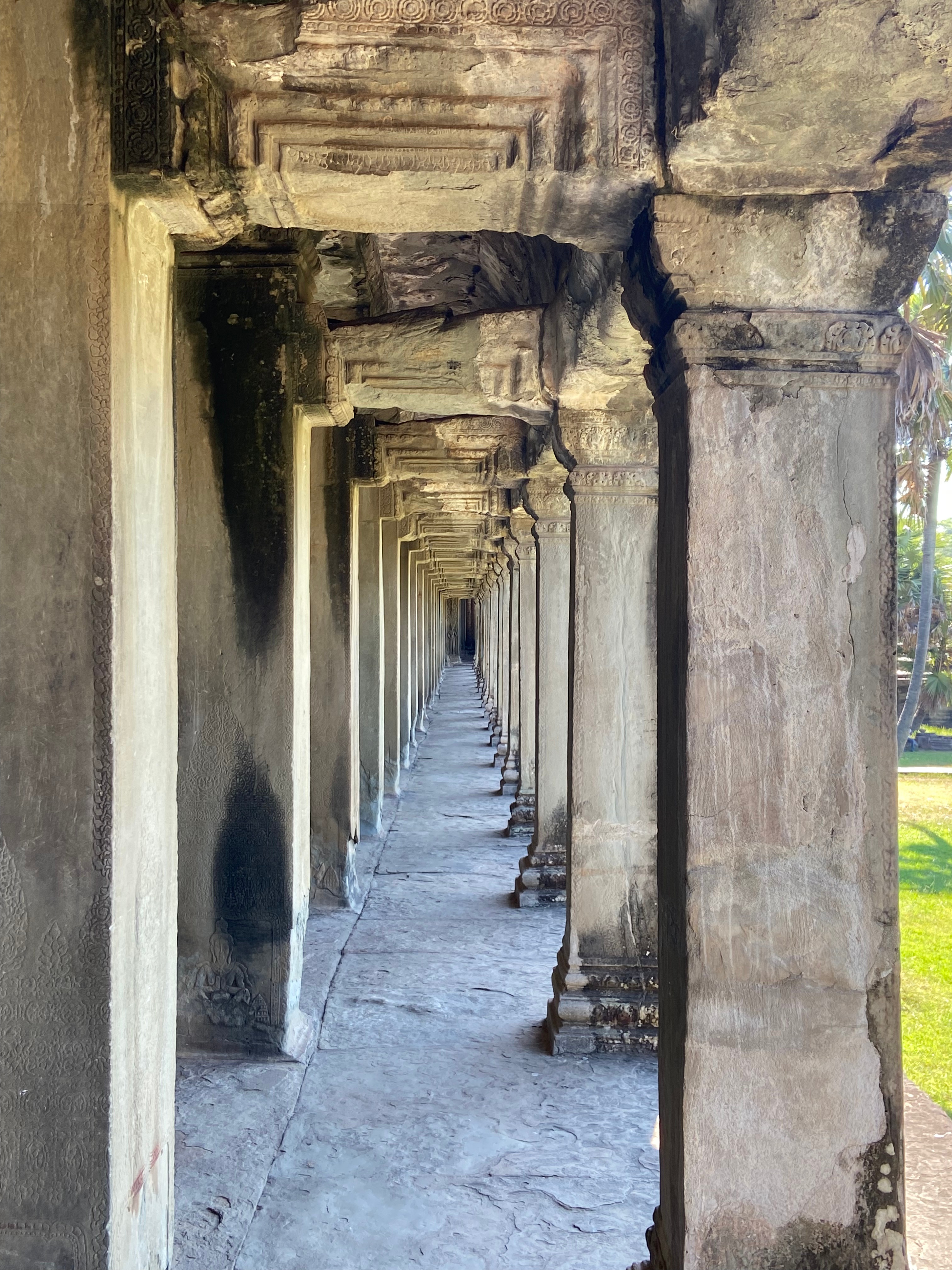
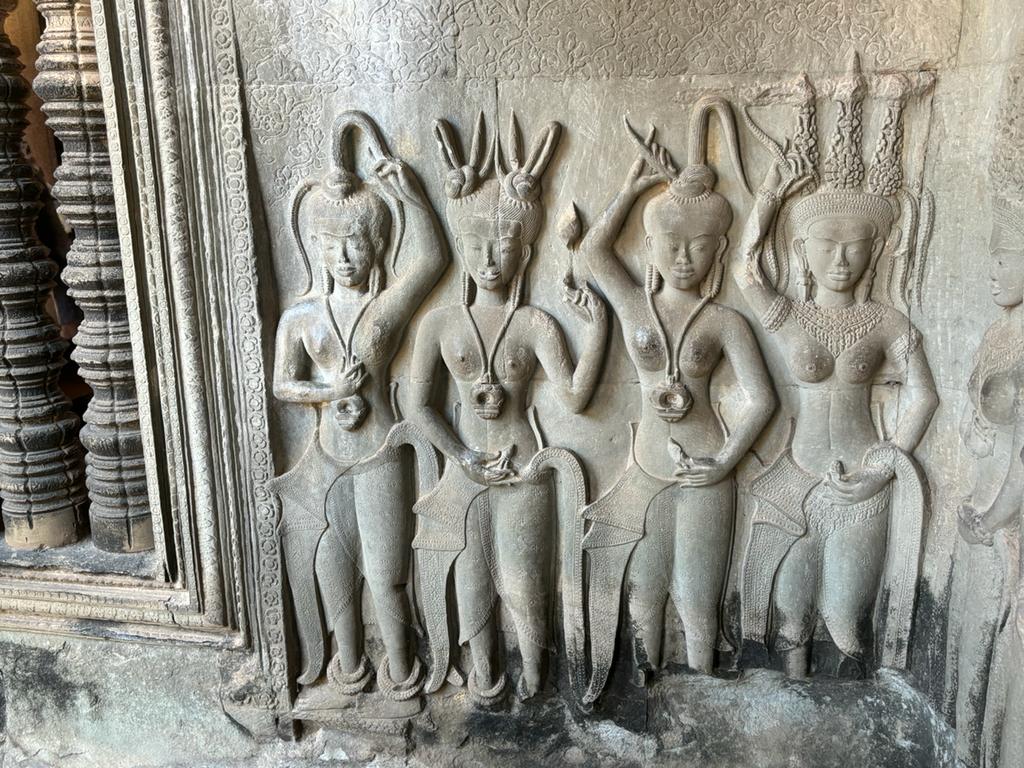
In the East Gallery is the famous 160-foot-long Churning of the Ocean of Milk bas-relief depicting a momentous event in Hindu Mythology – the very brief version of which is that the Ocean of Milk is churned by gods and demons (the struggle of good versus evil) to generate Amrita, the elixir of life. The level of detail is quite extraordinary, mesmerising.
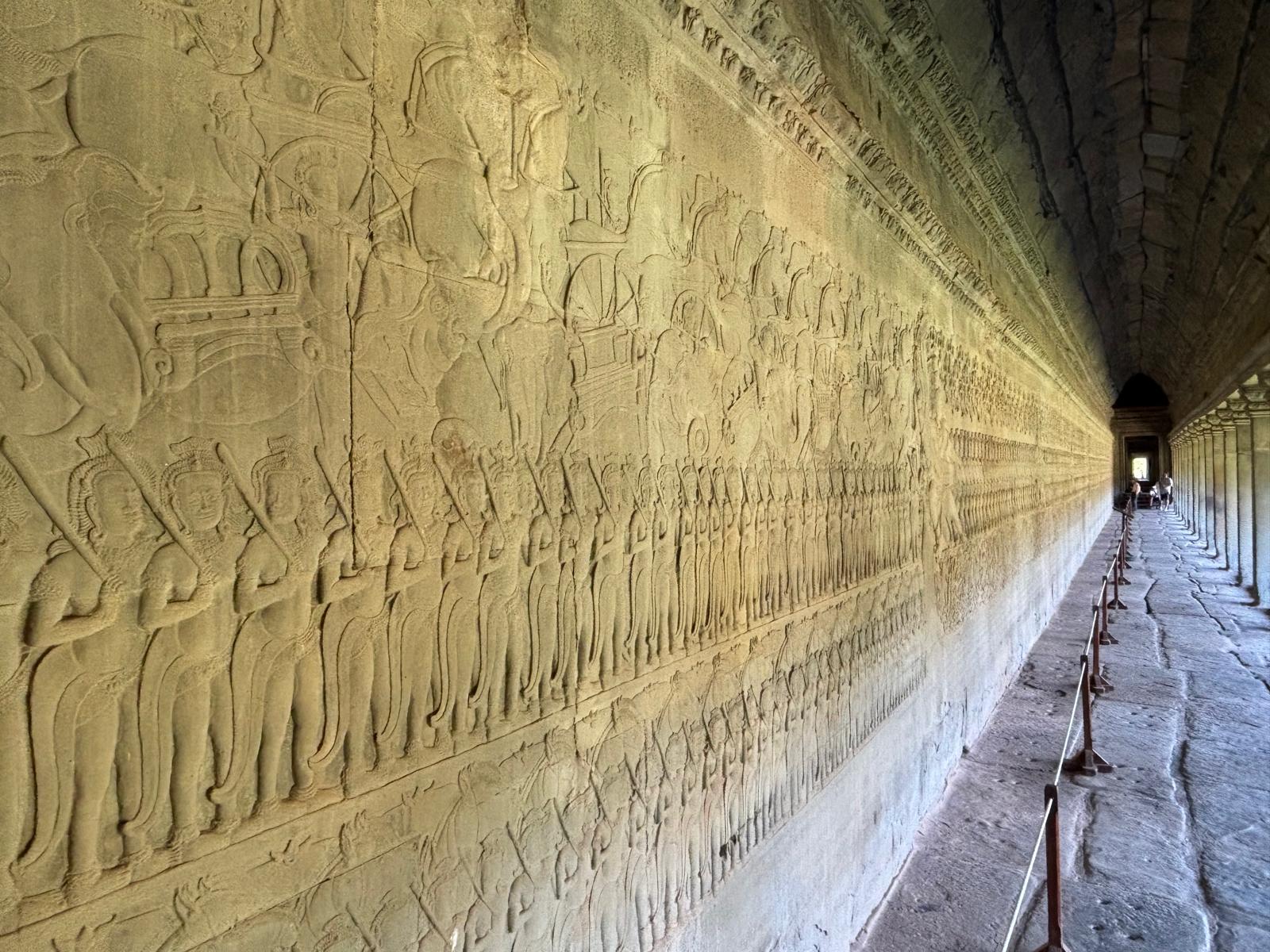
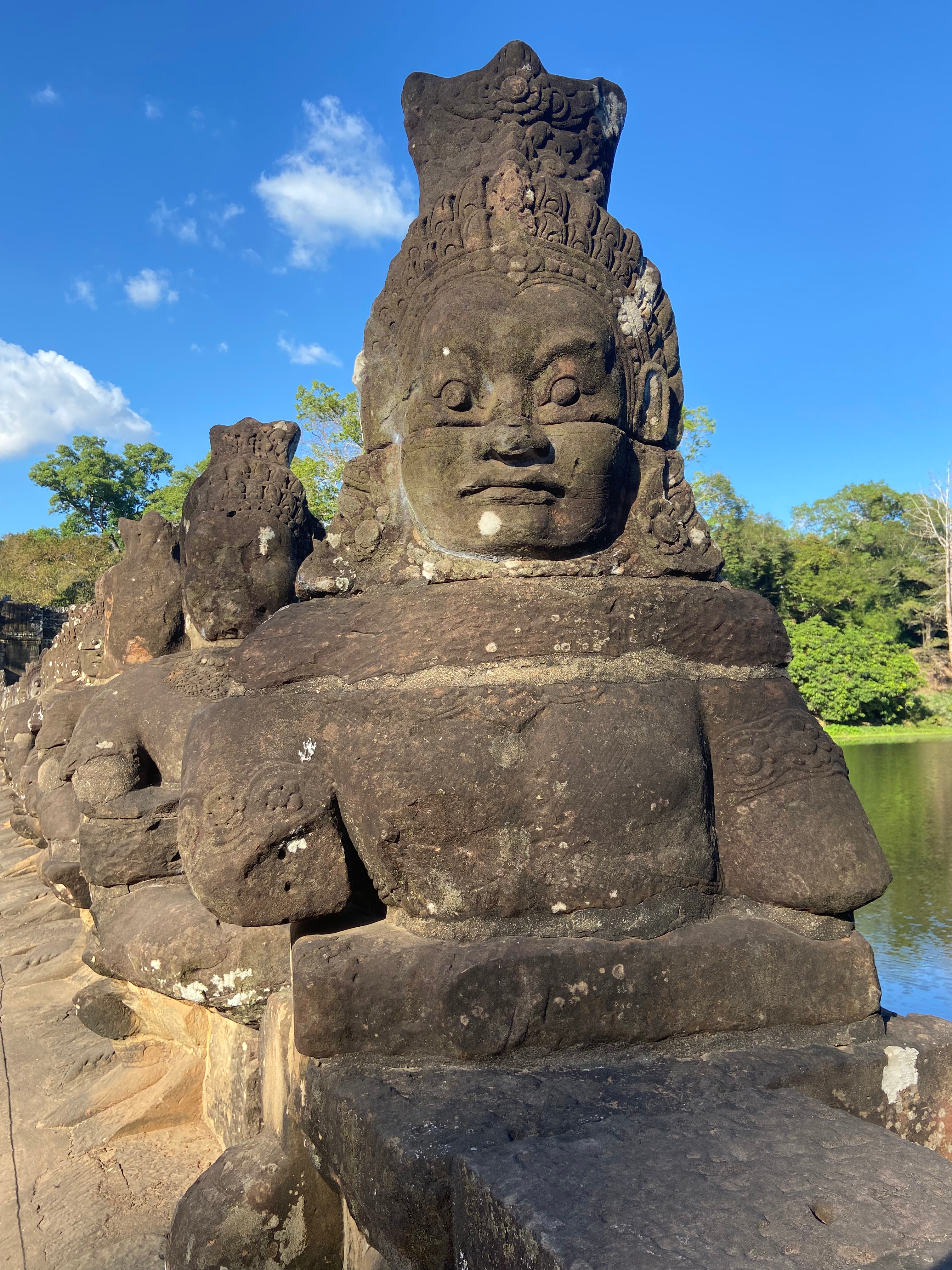
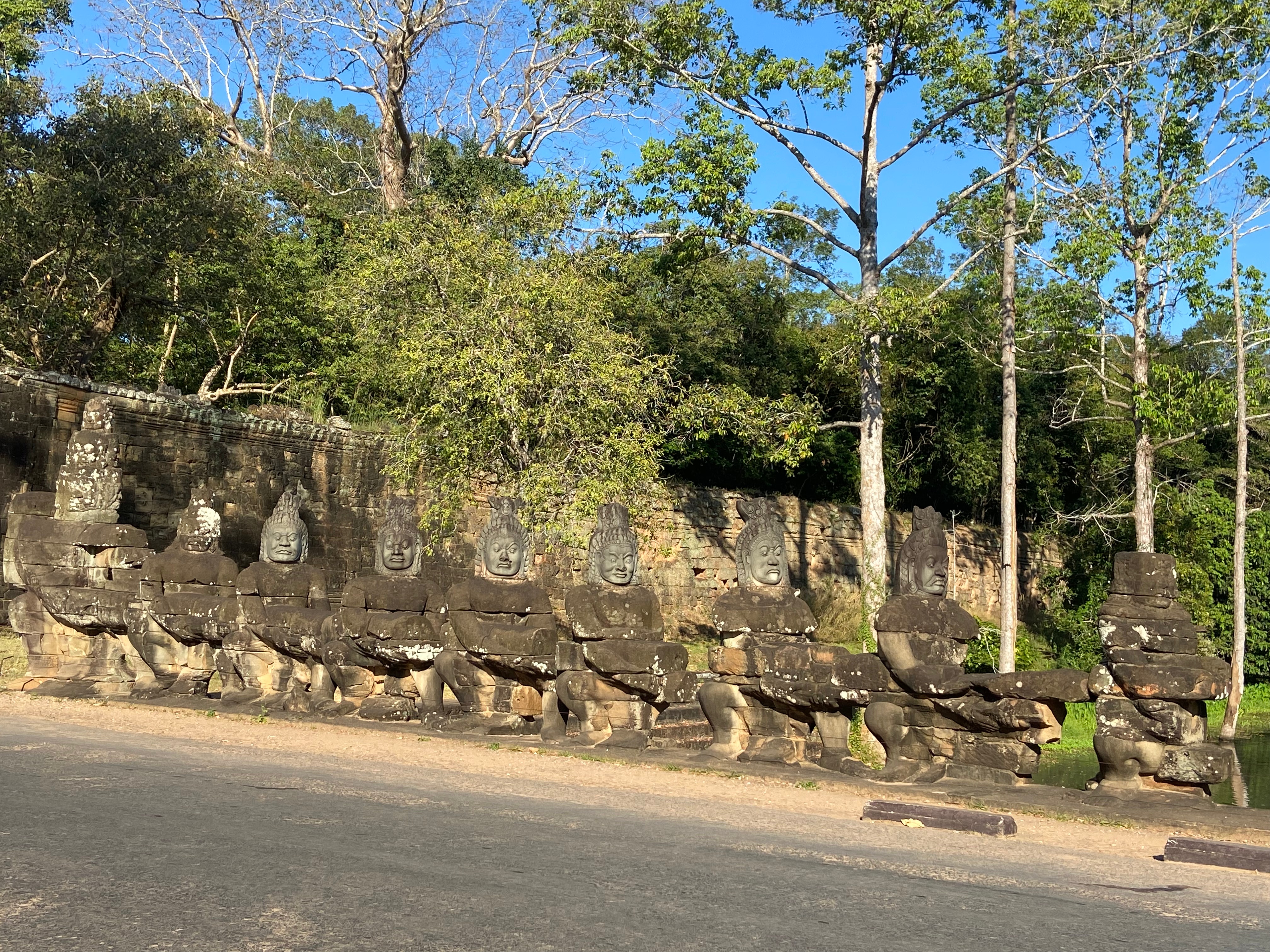
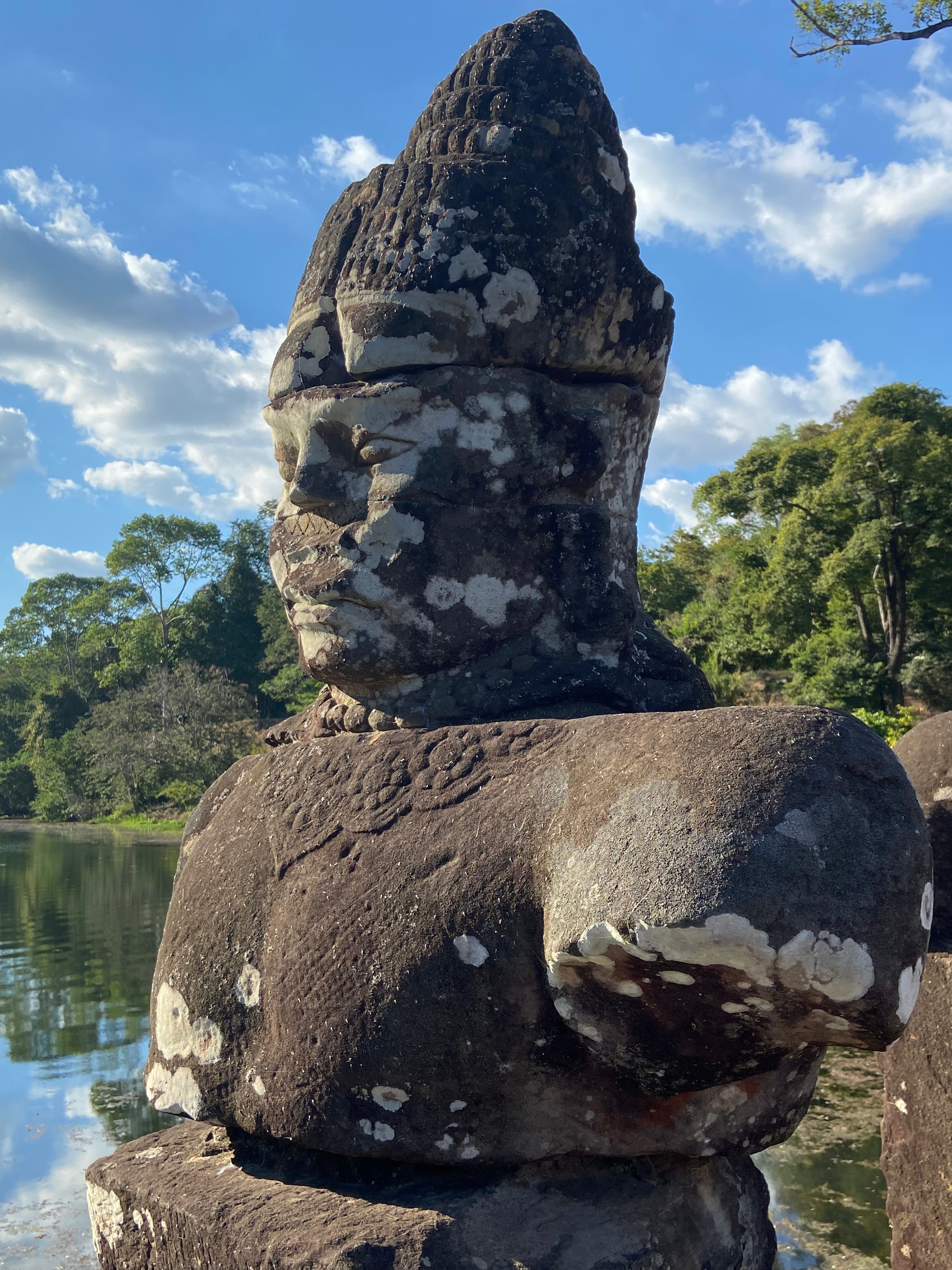
We were ready for a break at lunchtime and snacked on chicken spring rolls and banana flower salad with seafood in the café at Angkor Wat. Suitably restored we then walked across the South Gate of Angkor Thom – one of the entrances to the ancient city of Angkor – on our way to Bayon Temple. If you think we’d have exhausted our capacity to be wowed, think again. I loved this causeway lined with giant statues – 54 gods and 54 demons pulling on the body of a giant Naga serpent, another tug of war between good and evil.
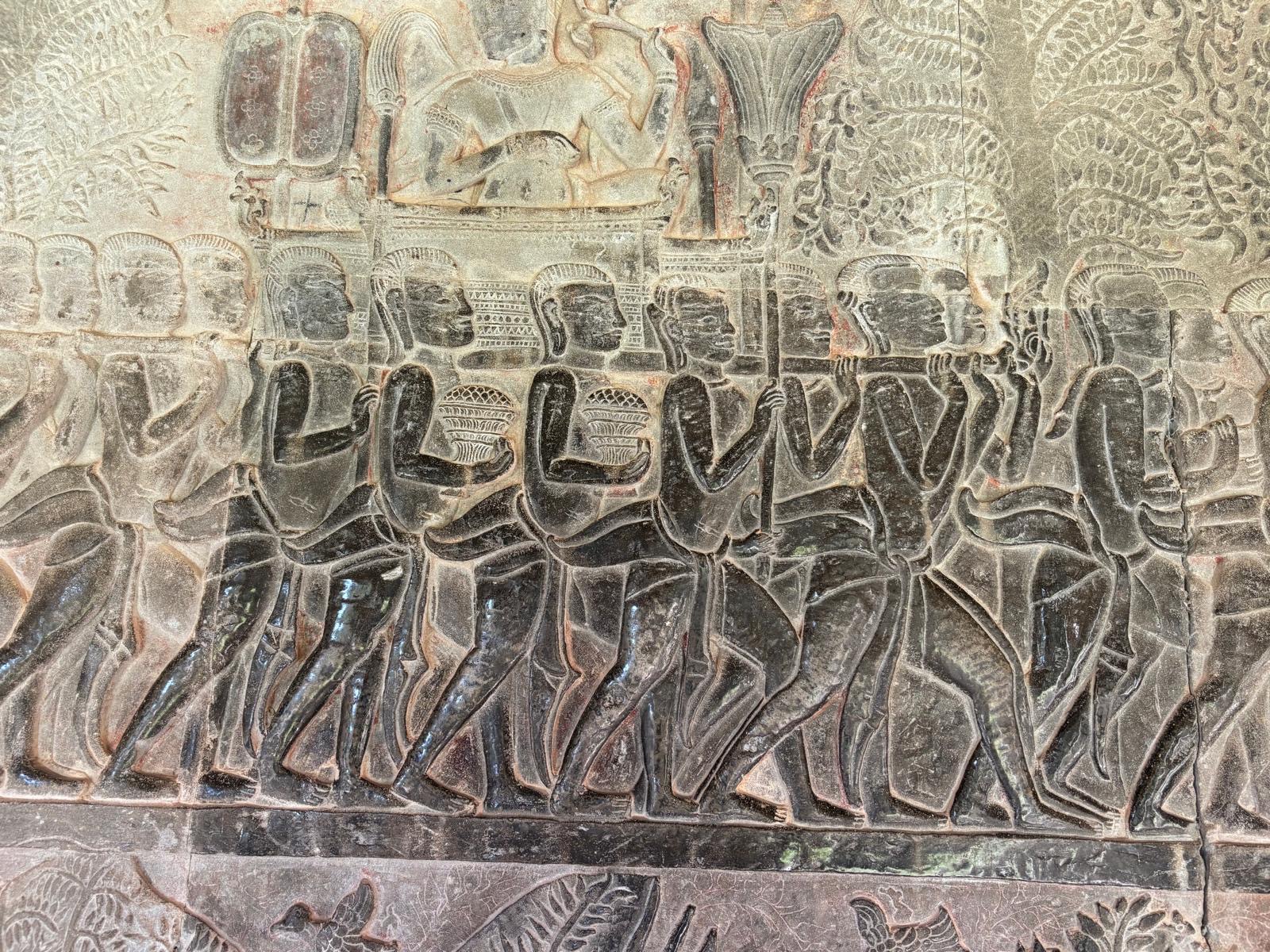
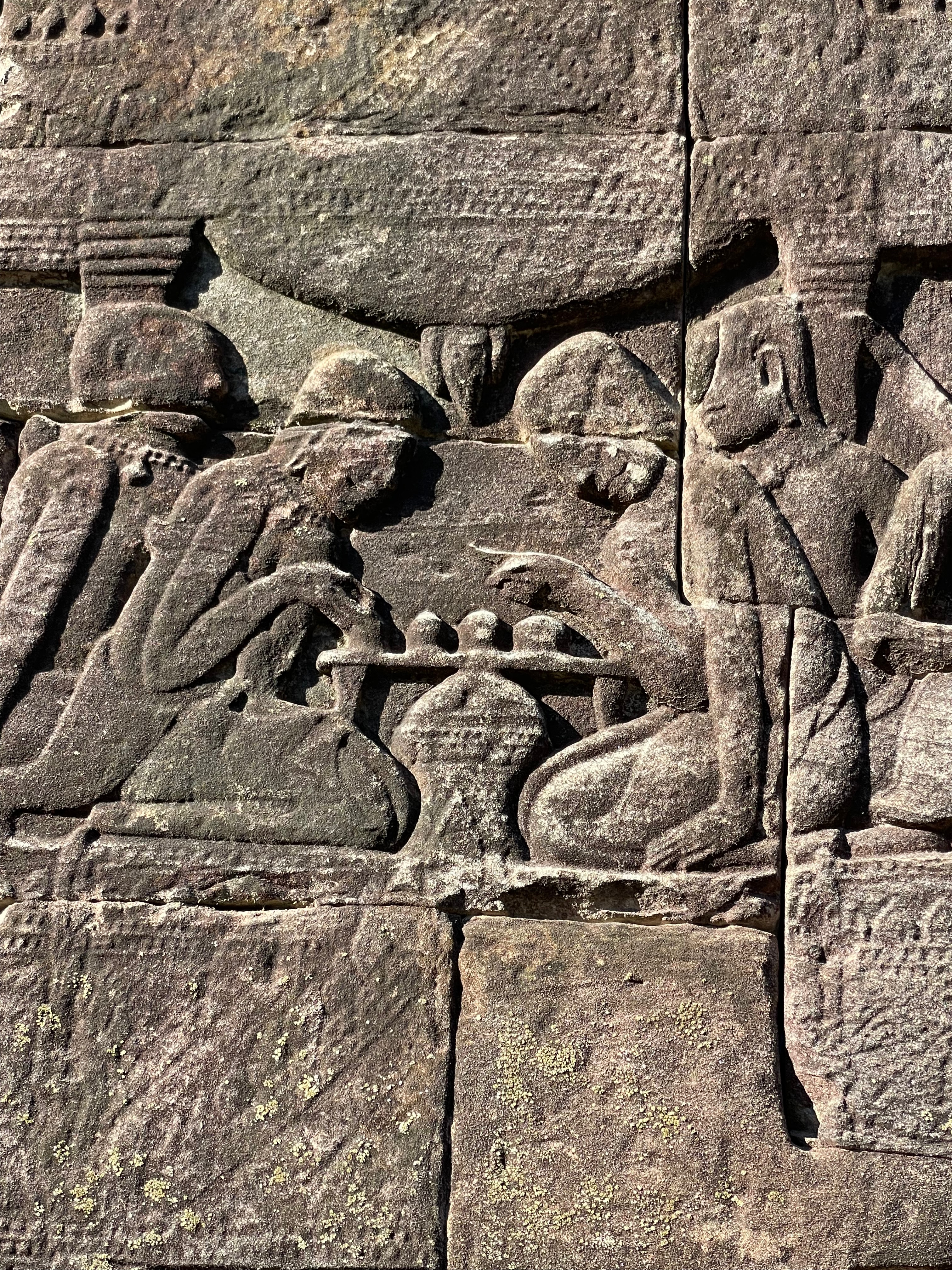
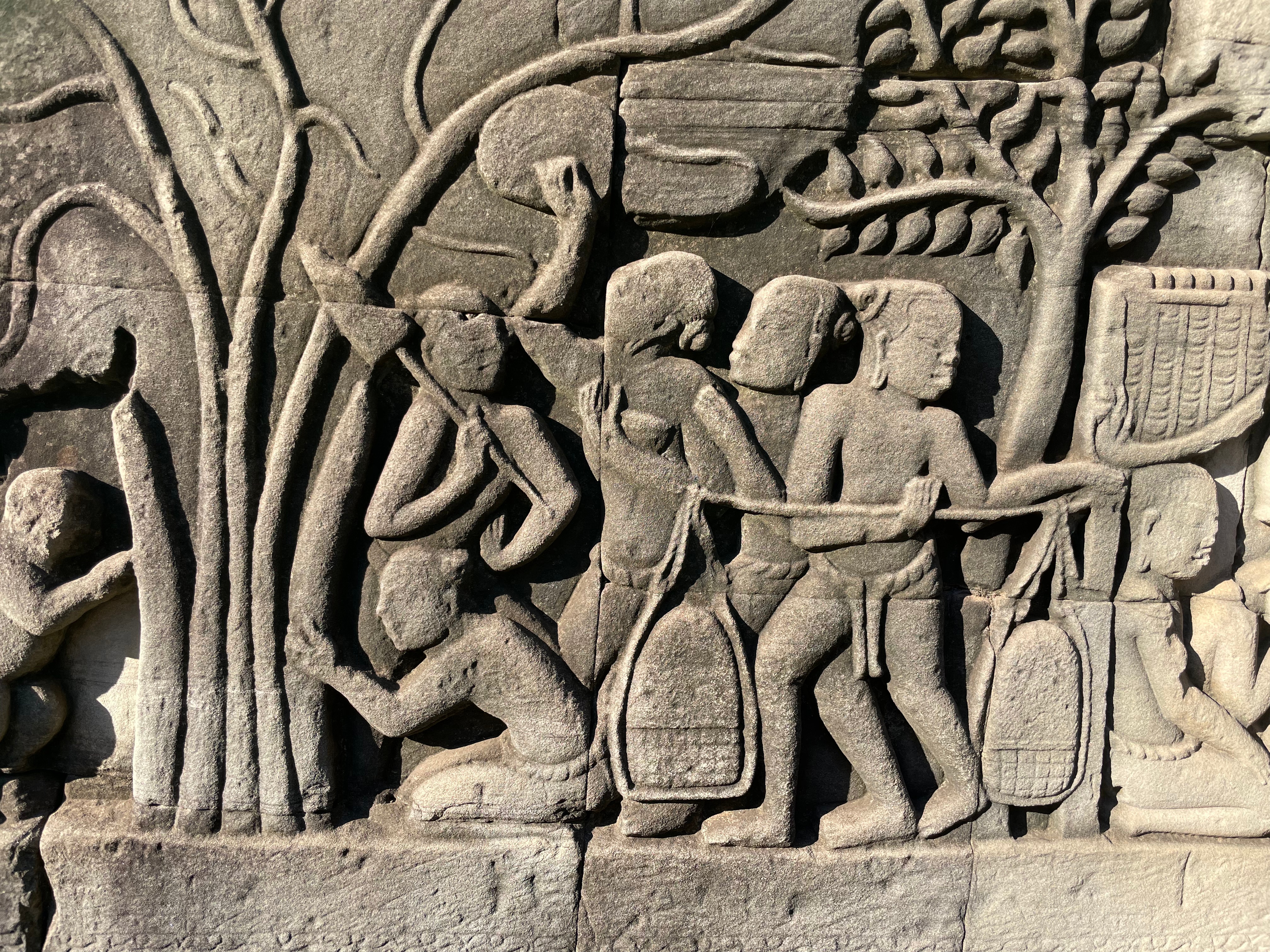
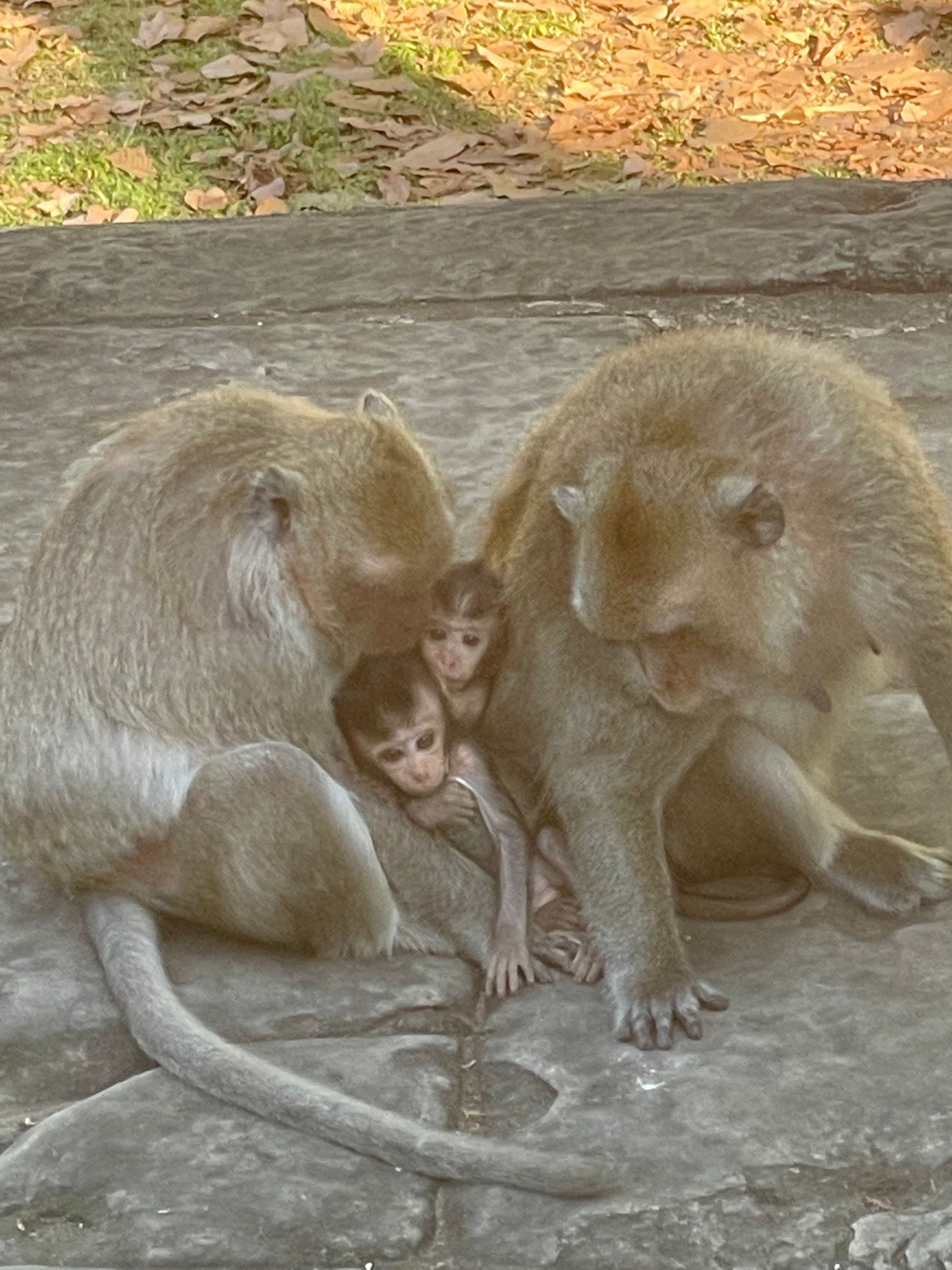
At Bayon, we focussed on the intricate and highly detailed carvings in the outer gallery portraying scenes of everyday life (working, playing, shopping at the market, food preparation etc) – quite a contrast to the focus on spiritual themes at the other temples. And we saw a monkey family with two newborn babies – gosh, they looked so human!
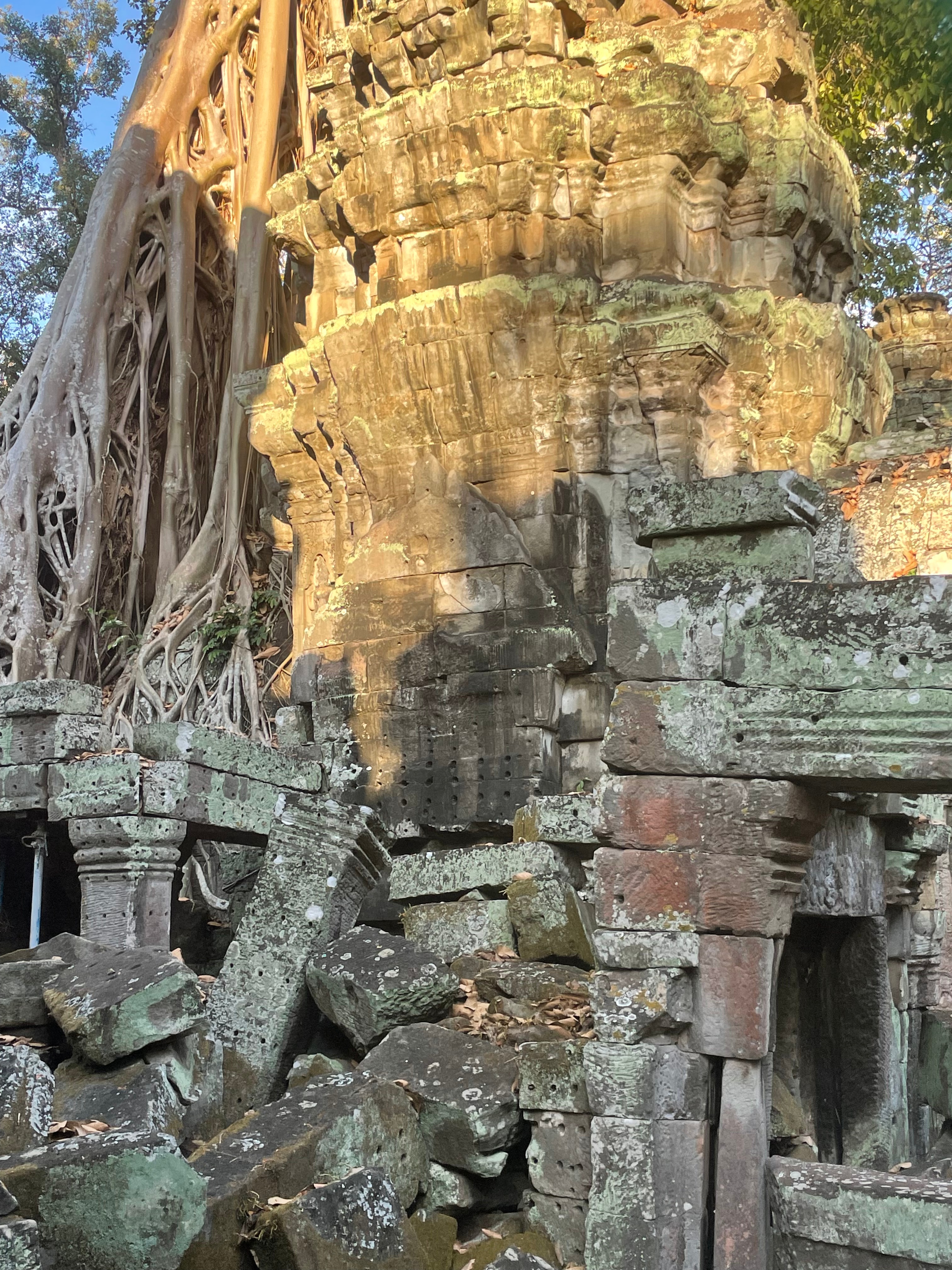
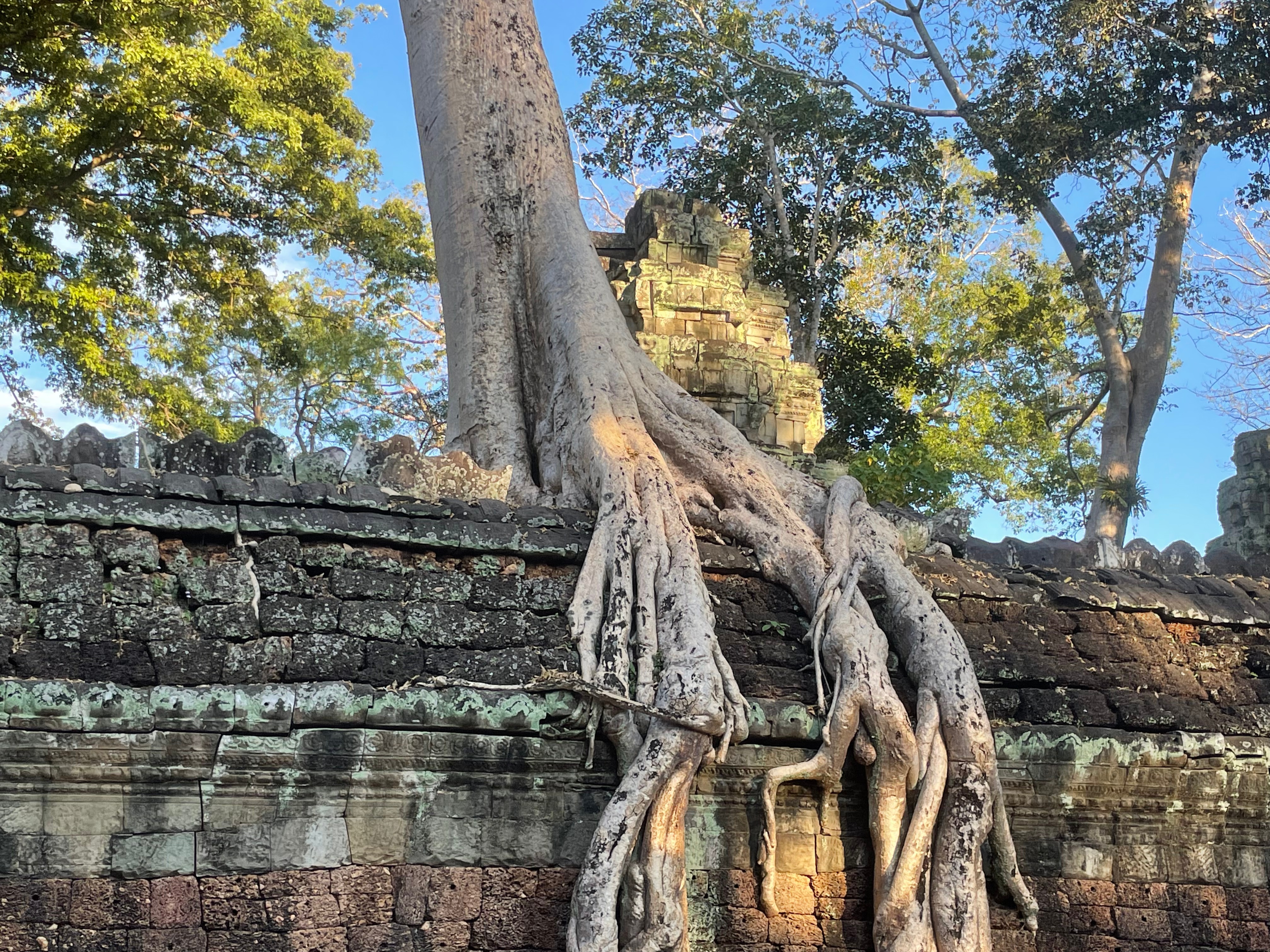
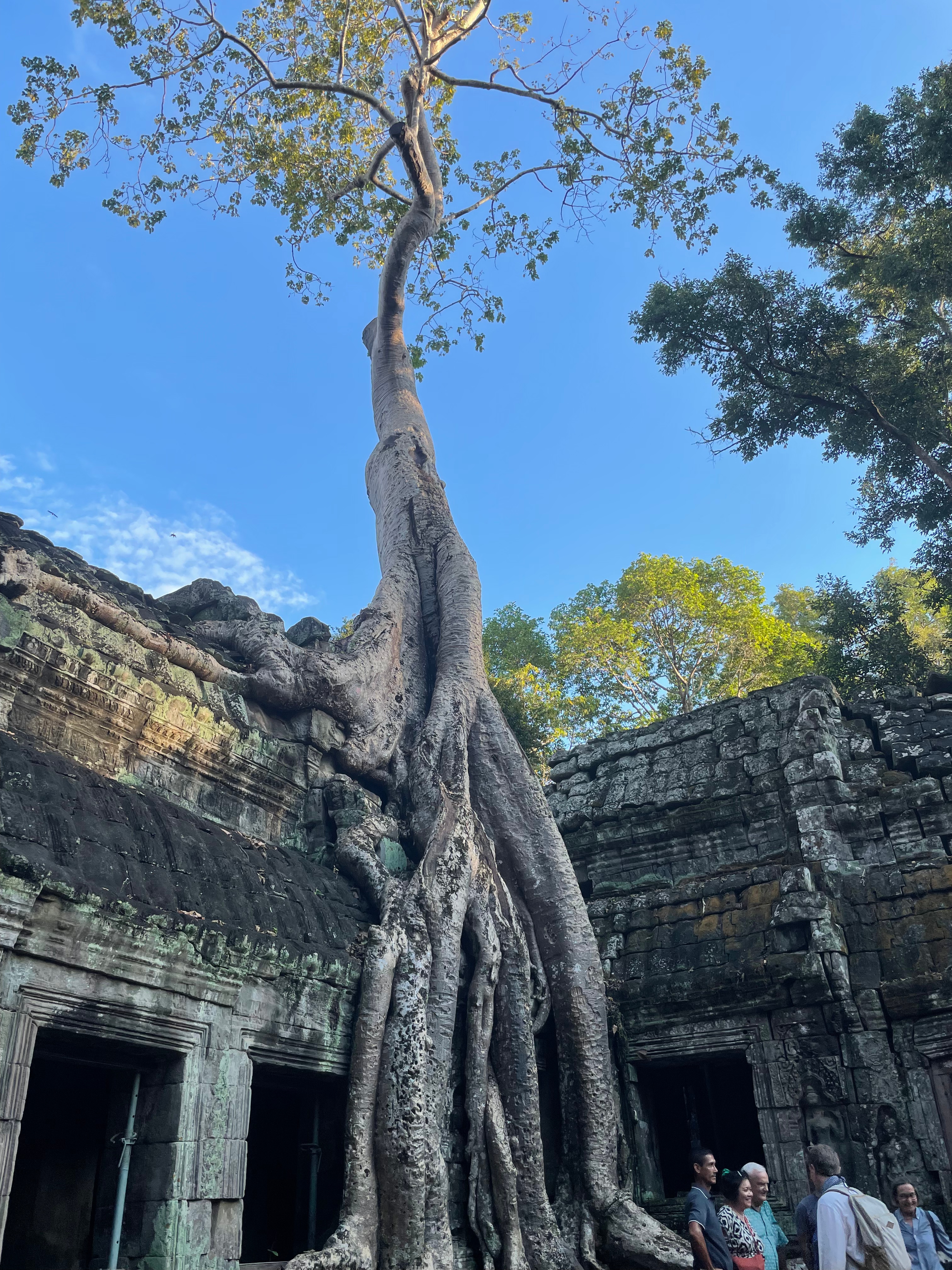
Last but not least we got to Ta Prohm, the temple that featured in Tomb Raider, as the sun was beginning to go down. Ta Prohm fell into disrepair in the 15th Century after the fall of the Khmer Empire and nature has reclaimed its supremacy here – the silk-cotton and strangler fig trees have spread their rope-like roots far and wide, uprooting stones and columns and spreadeagling across buildings as if part of the architectural design. It’s carefully curated chaos, though; ongoing conservation work aims to maintain the stability of the remaining towers, walkways and galleries at the same preventing further root damage. Watching the evening light on this post-apocalyptic-like landscape – it reminded me a bit of Chernobyl – was a fitting bookend to an extraordinary day.
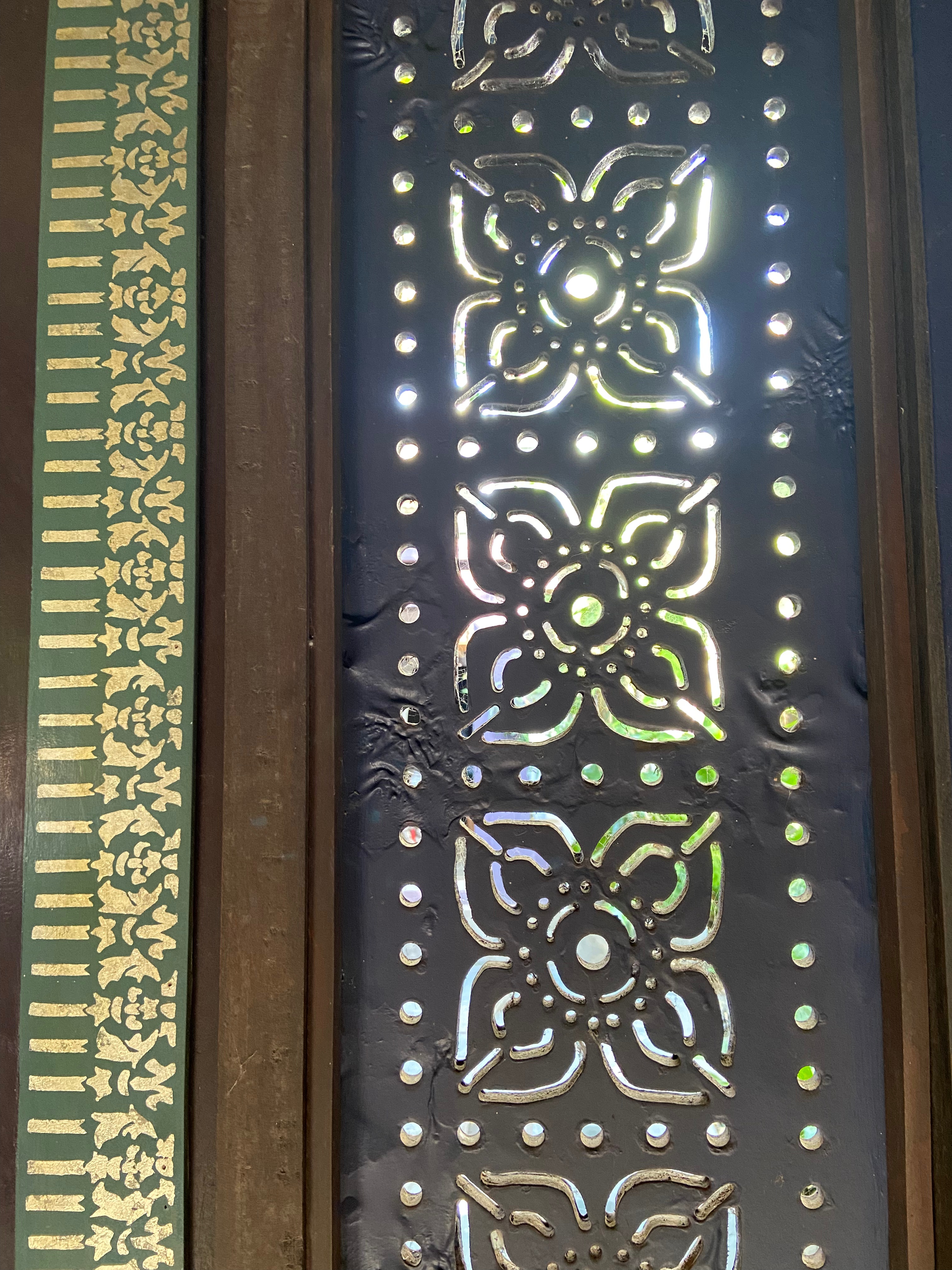
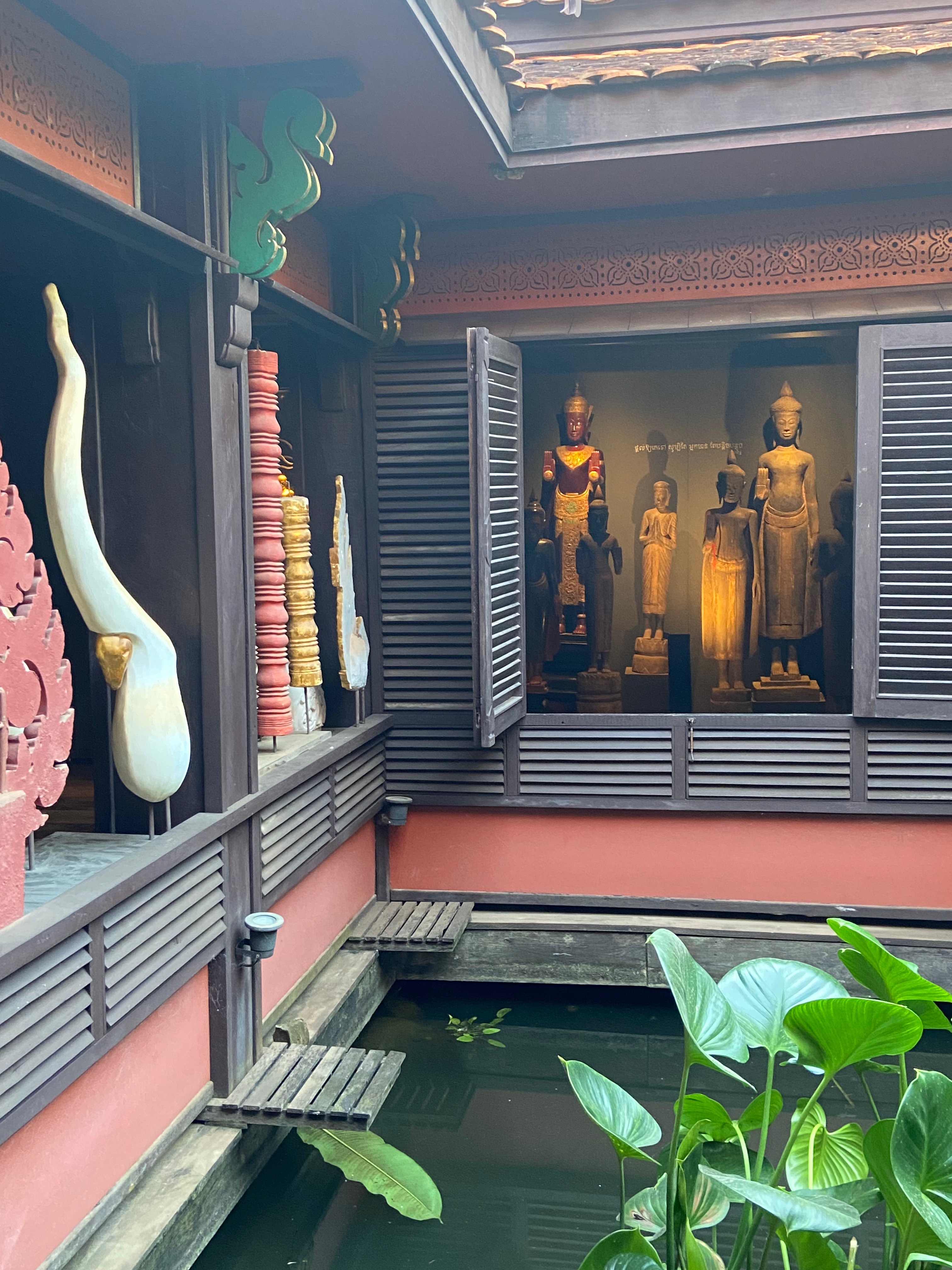
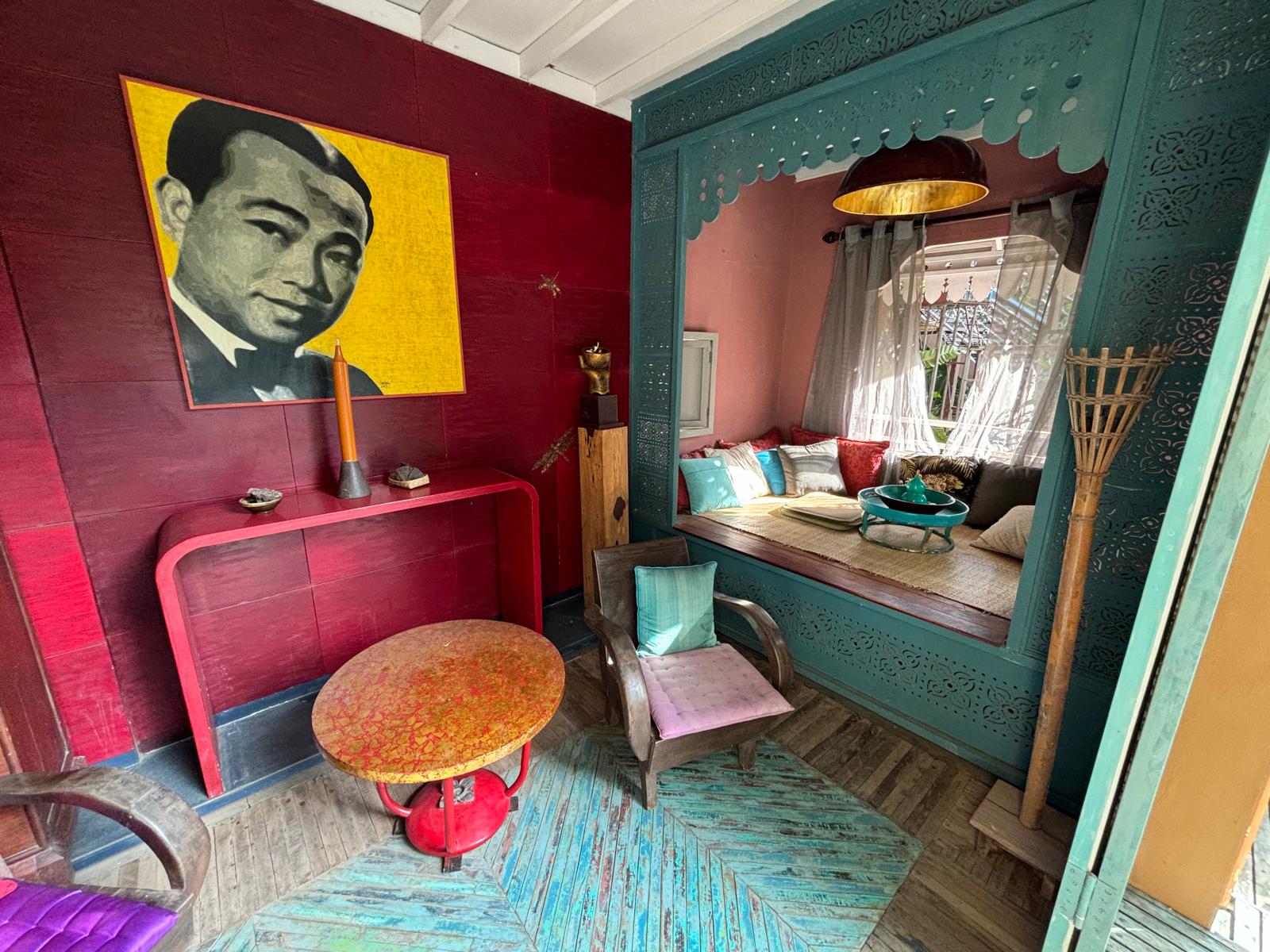
There’s of course more to Siem Reap than temples. One place well worth a visit is Theam’s Gallery, which is the home, atelier, and gallery of Master Cambodian Artist, Lim Muy Theam. It’s part workshop, part shop and part series of rooms and pavilions housing Theam’s collection of art and artefacts and in the middle there’s a garden shaped by the five elements and a Banyan Tree. The pavilions include a collection of historic instrument and bronzes of dancer’s hands with stylised dancers’ wrists and fingers. And I particularly loved the pavilion with the Buddhas, and the wooden shutters painted with gold scrolls and flowers looking out onto the garden. Also delightful was a small room – a bit like a cocktail lounge with – a picture of Sinn Sisamouth ‘Cambodia’s Elvis’, a famous 1960s singer.
Discover more from This Quirky Life
Subscribe to get the latest posts sent to your email.
 This Quirky Life
A wonderful read, full of colour, vibrancy and packed with information. I might have been in your pocket. Well done you xxx
LikeLiked by 1 person
Thank you for reading! I know it was a longish post!! Xxx
LikeLike