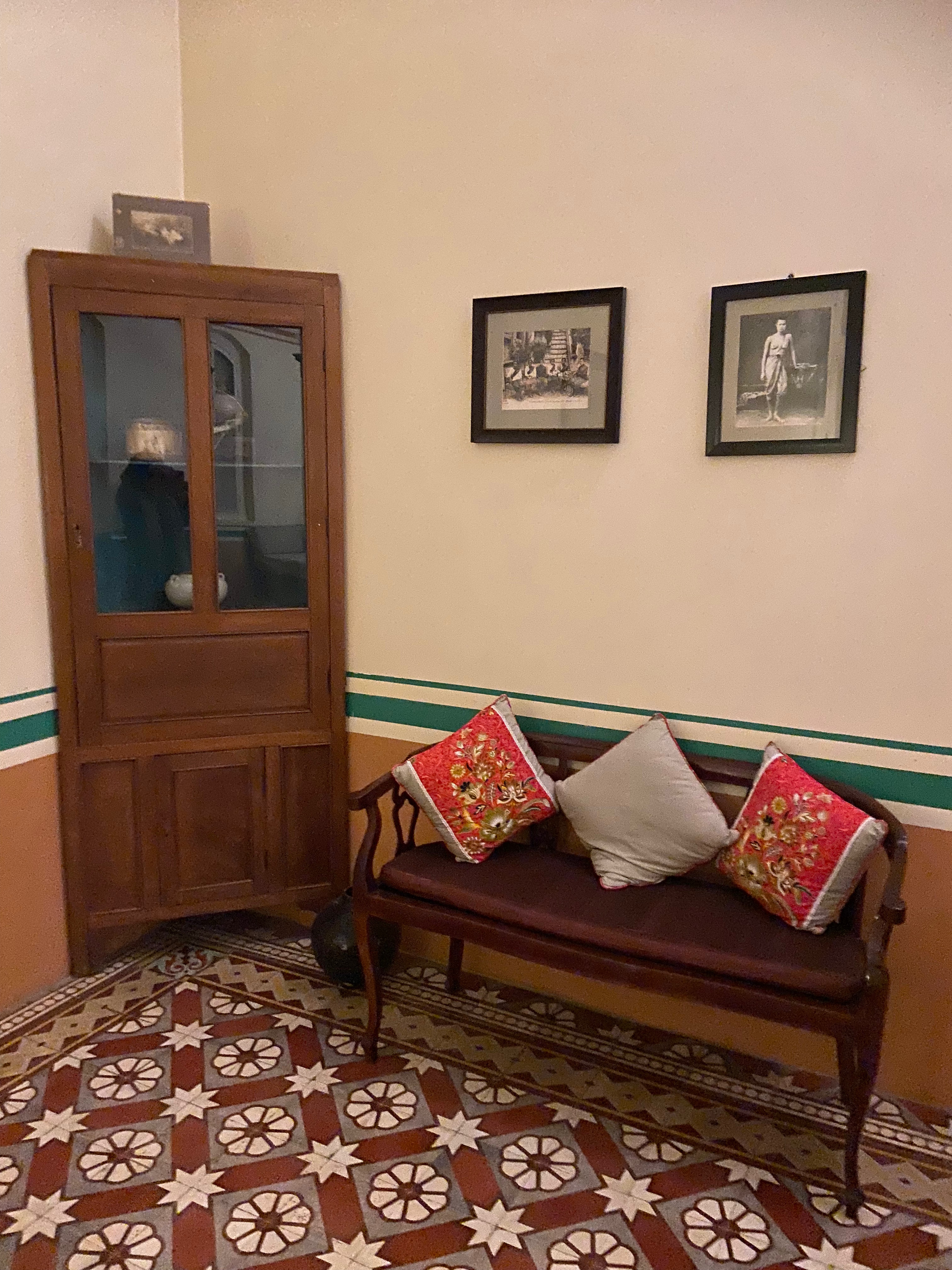
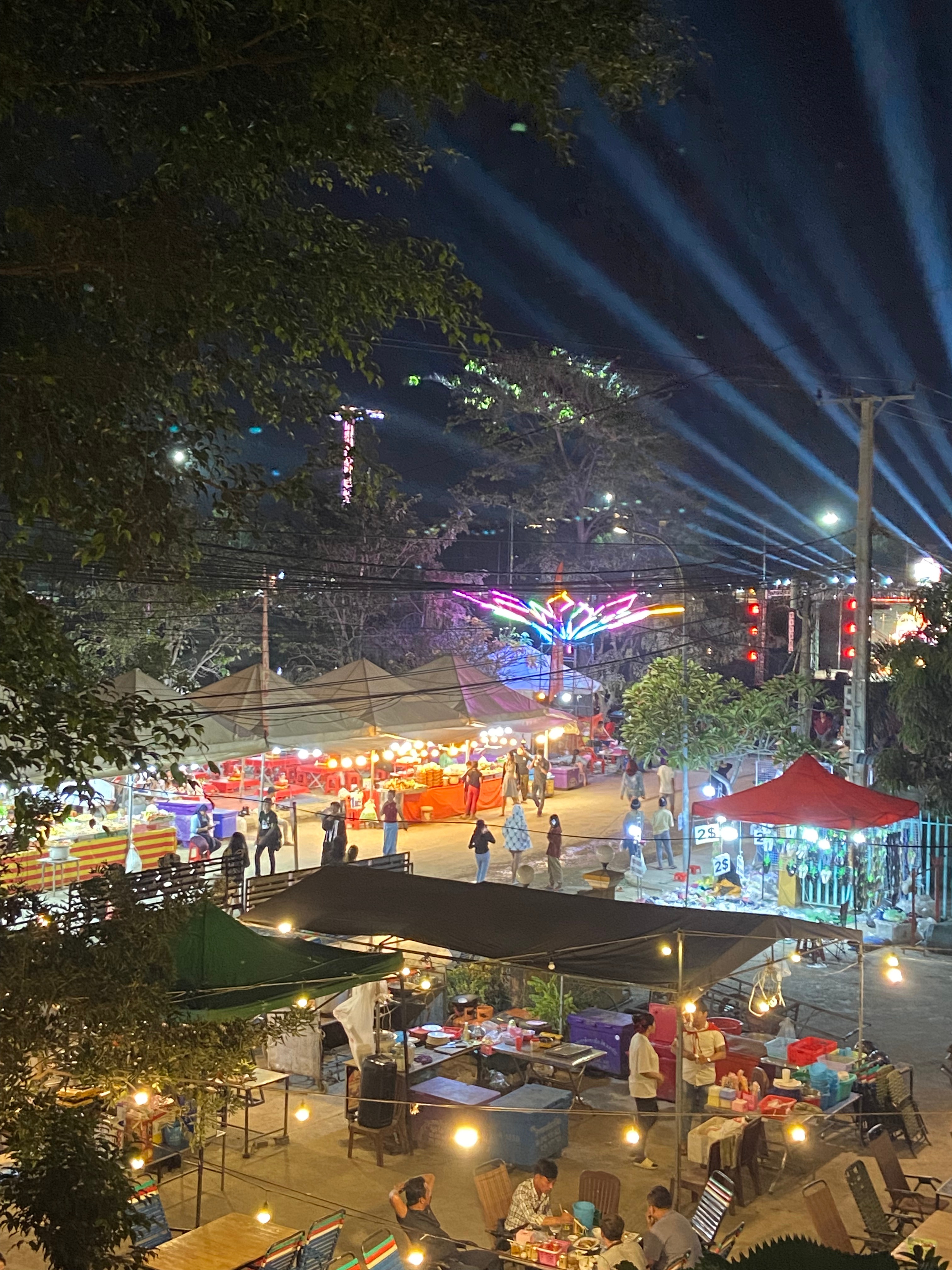
Cambodia Part 2/3 – Siem Reap – Embassy Restaurant, Angkor-wat Temples and Theam’s Gallery

NB: Email subscribers- please click on the ‘Read on Blog’ link at the top of the email to enjoy the benefit of the formatted blog rather than the WordPress newsletter version.

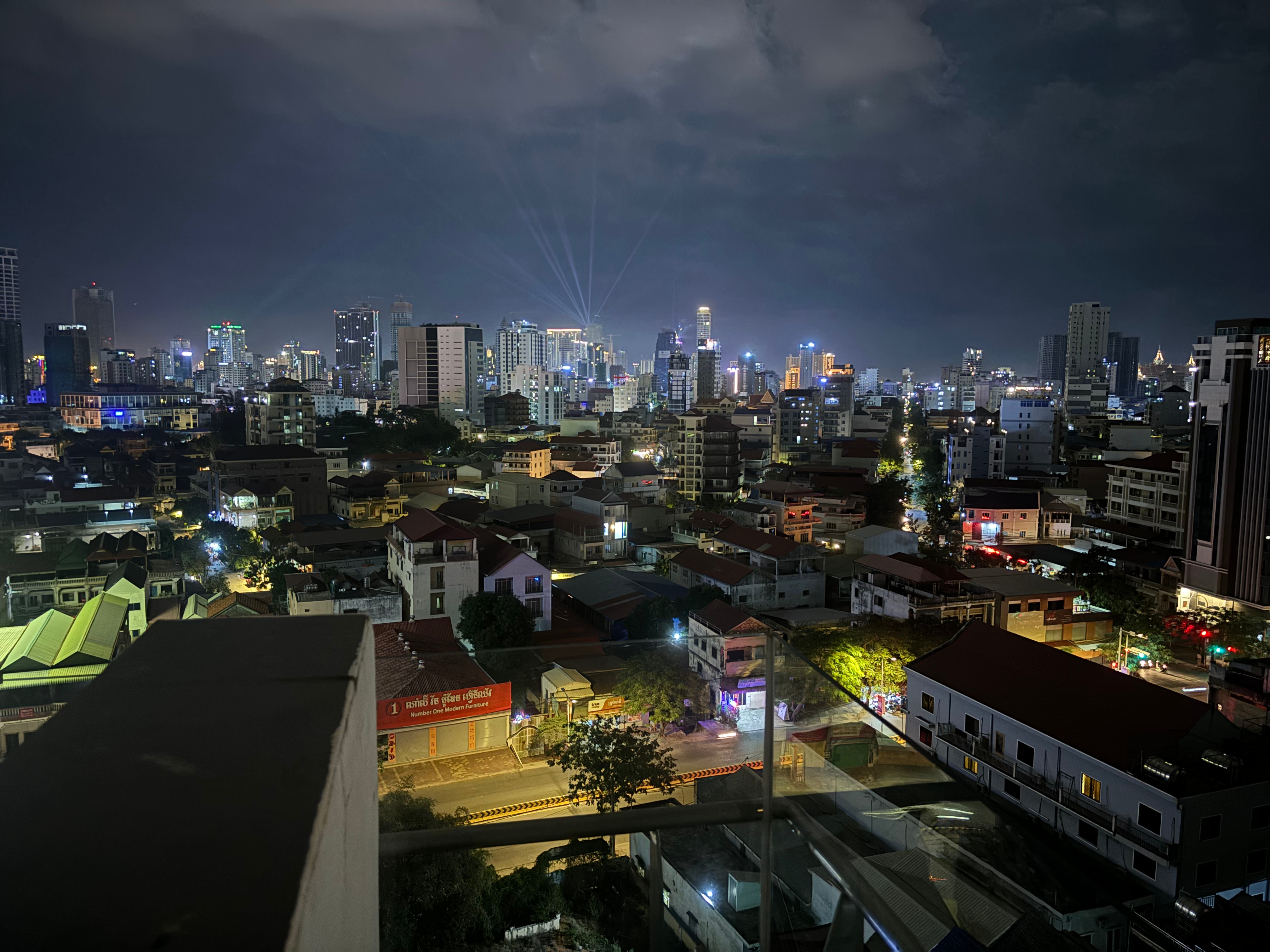
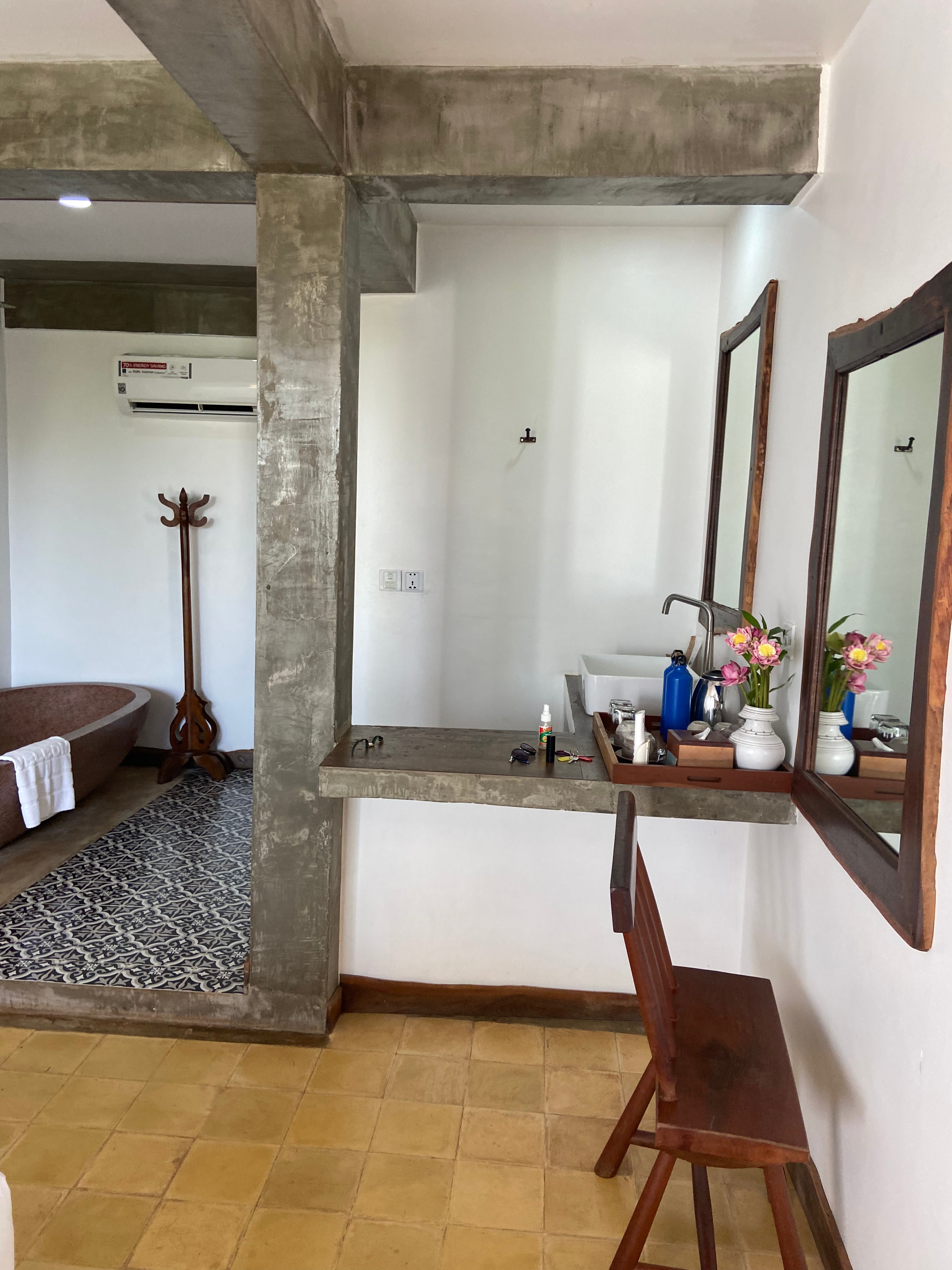
Having left Battambang around lunchtime, we arrived at our Siem Reap accommodation – The Nature – mid-afternoon. It’s not the easiest place to find – it’s in a semi-rural setting (my mozzie radar was on high alert!) about 2.5km from the hubbub of touristy Pub Street and the Night Market in the town centre.

The Nature is set among the trees, and all the furniture is made from wood and natural materials with chunky chairs and tables in the restaurant hewn from tree trunks. Our rooms were adjoining – with a kitchen in between – on the top floor accessed via a steep wooden staircase with a rope bannister (you’d not want to climb these under the influence of several margaritas!). The beds were super hard – especially for this Princess and the Pea – like sleeping on a board.  It didn’t really help making a roll out of the duvet for extra padding and sleeping on one half – plus it made it way too hot.  

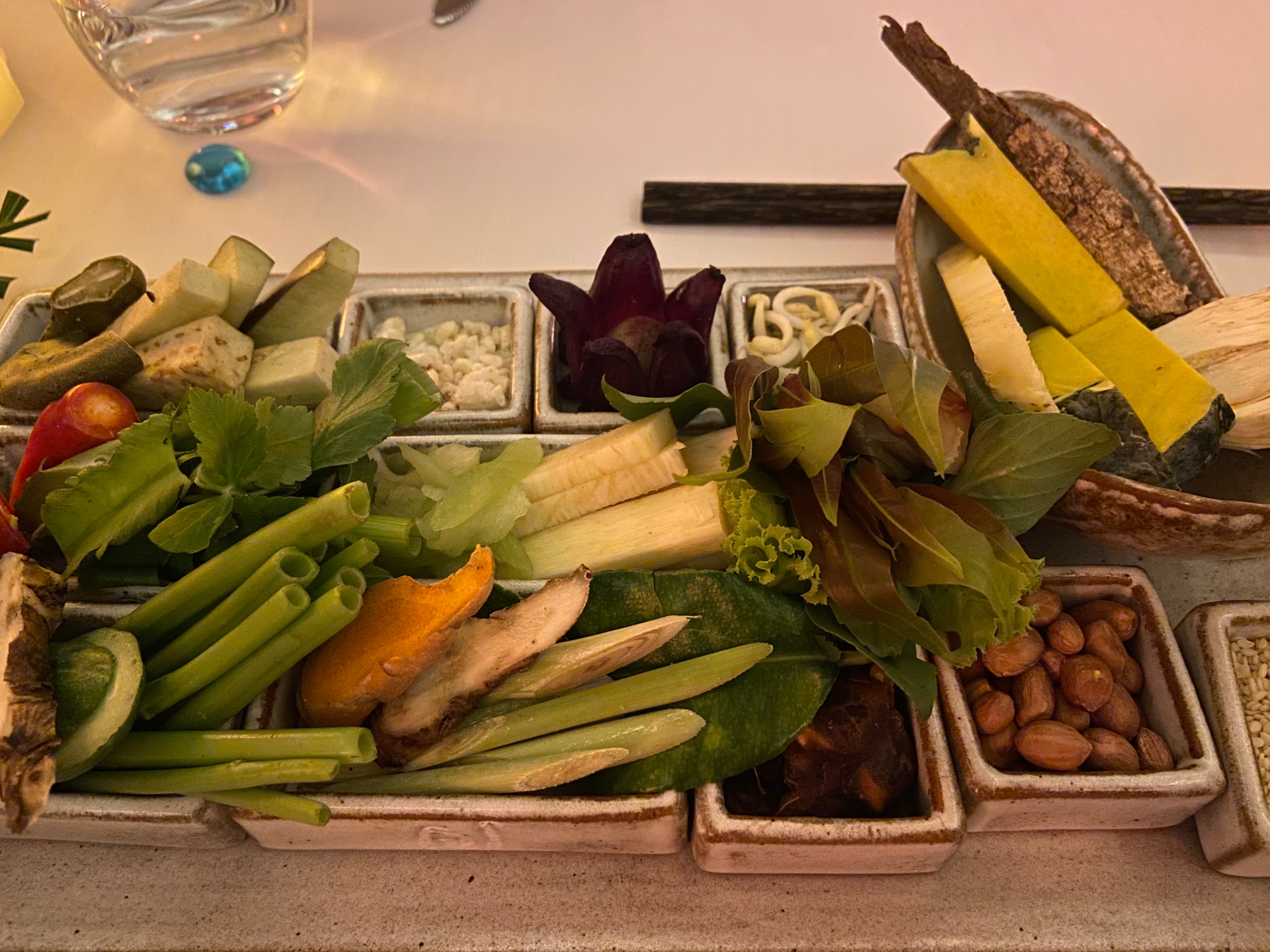
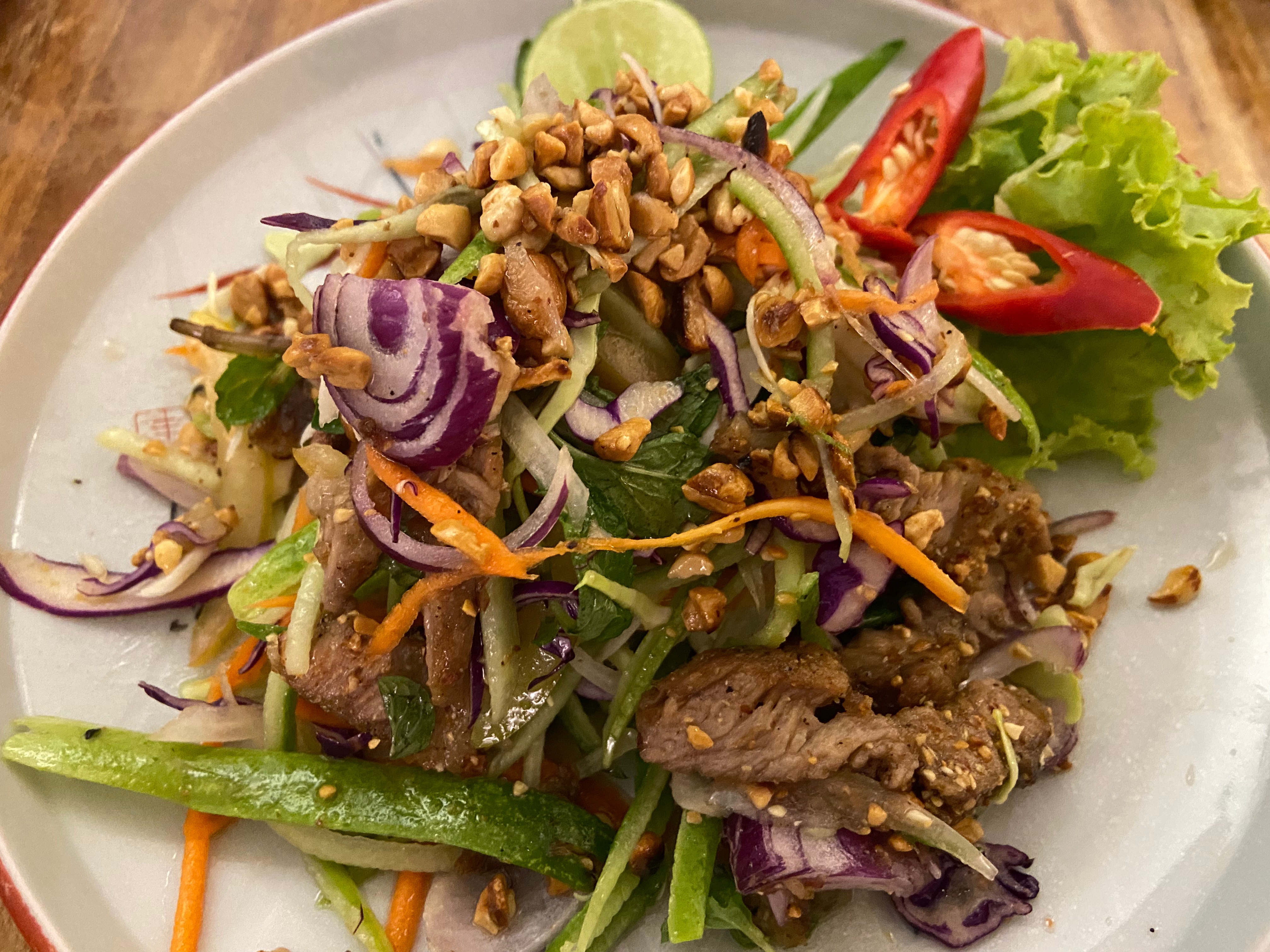
Our first night, we’d arranged to have dinner with friends of Di’s at The Embassy, an all-female restaurant in a mostly male-dominated industry.  It’s a pretty special place – head chef Kimsan Pol showcases traditional recipes which she unearthed by researching the national archives. It’s a set 7-course banquet – and the range of flavours, textures, combinations, colours and the presentation – each dish a work of art – was truly extraordinary. To start with, they bring a basket laden with seasonal and local fruits, vegetables and spices and explain what all the ingredients are.

As the only newbie to Embassy, I was keen to savour every mouthful. The food was exquisite, but I felt we didn’t focus enough on what we were eating – it became the backdrop to a lot of chat about mid-century architecture – Di’s friends were in the process of building their dream home – which I know nothing about! All the talking meant that they ate slowly and the cumulative result over seven courses – the staff couldn’t clear our plates away till everyone had finished – meant it was a LONG dinner.  I started to long to get back to my brick-like bed ahead of an early start the next day…

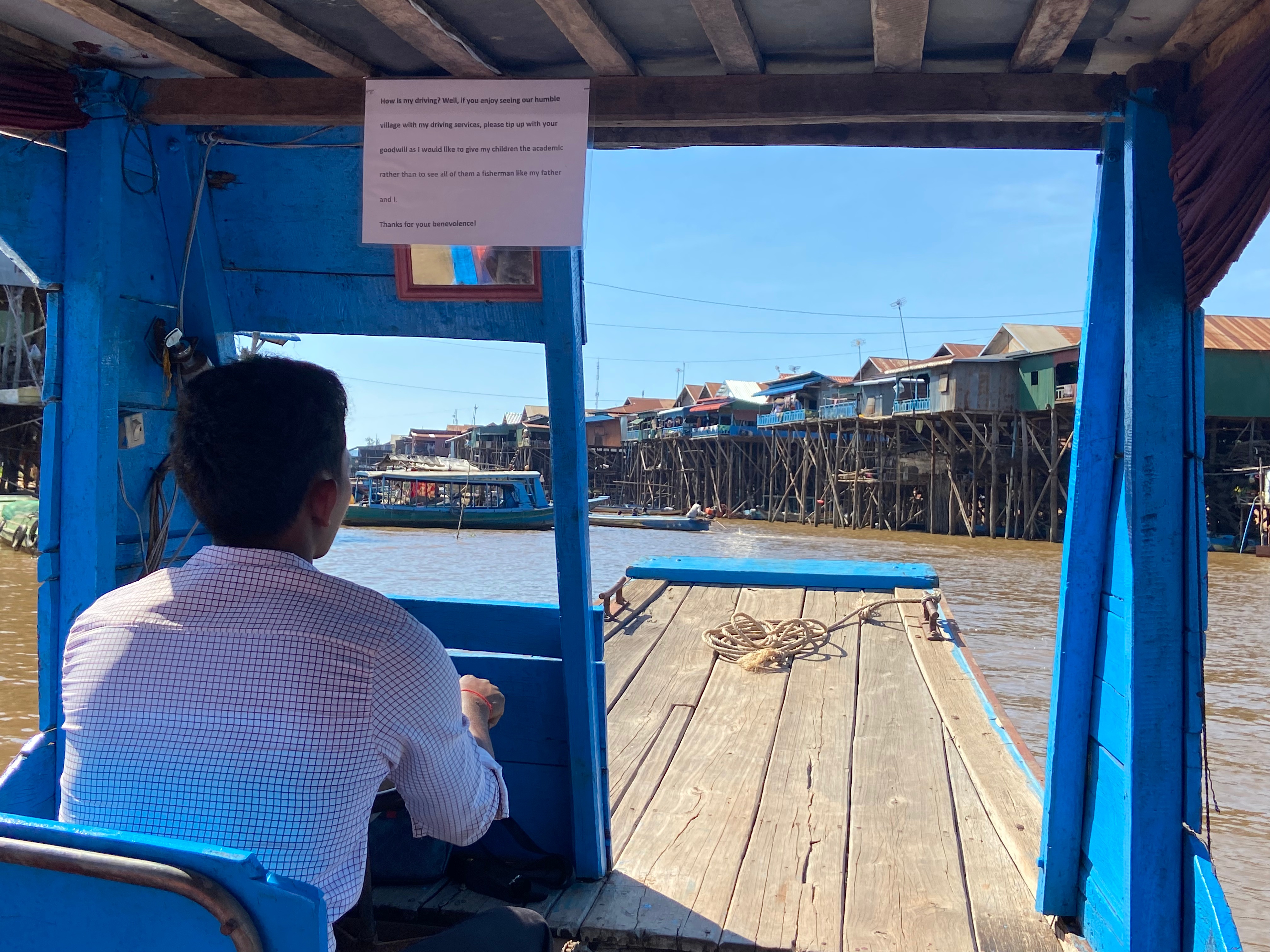
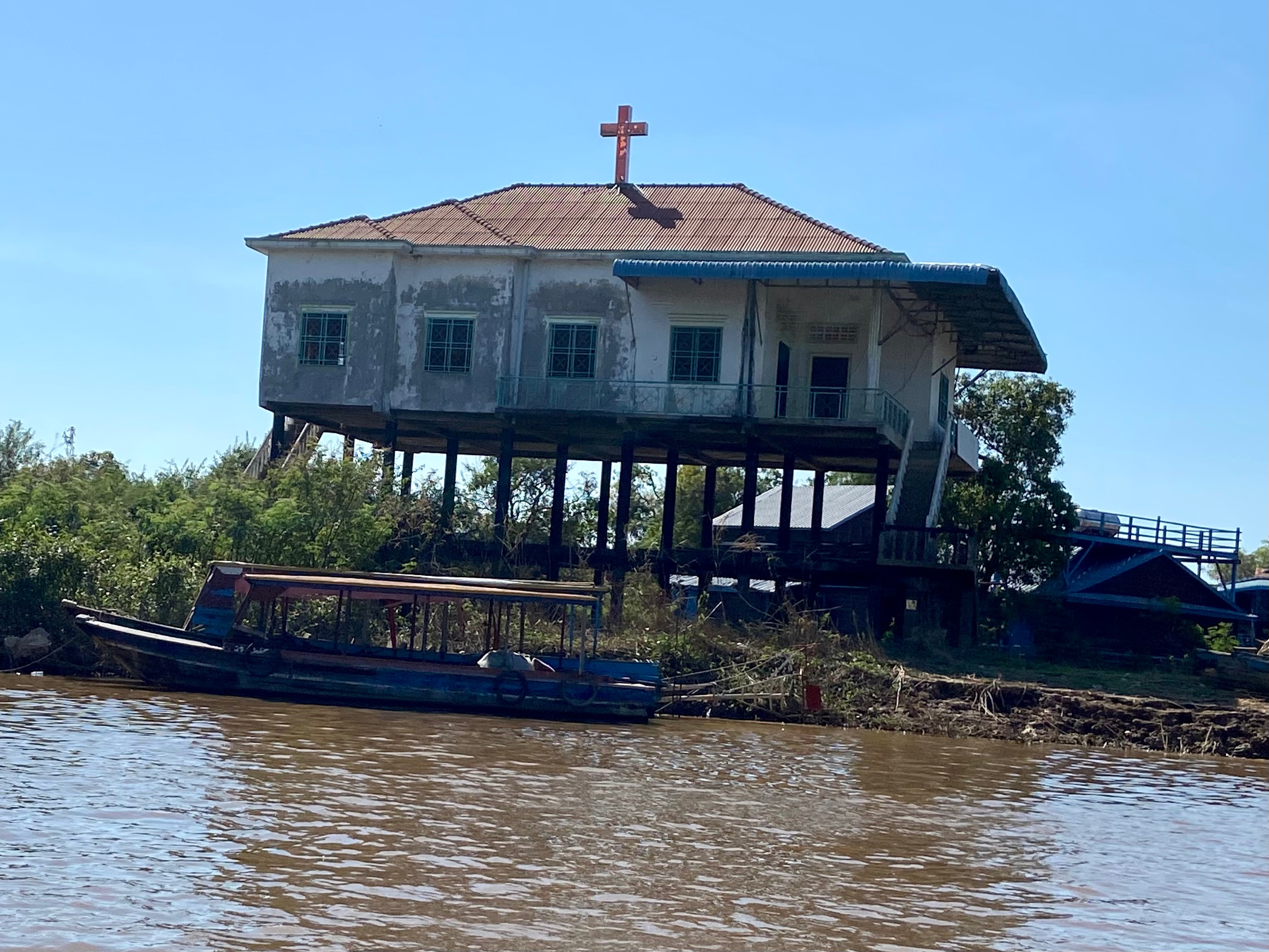
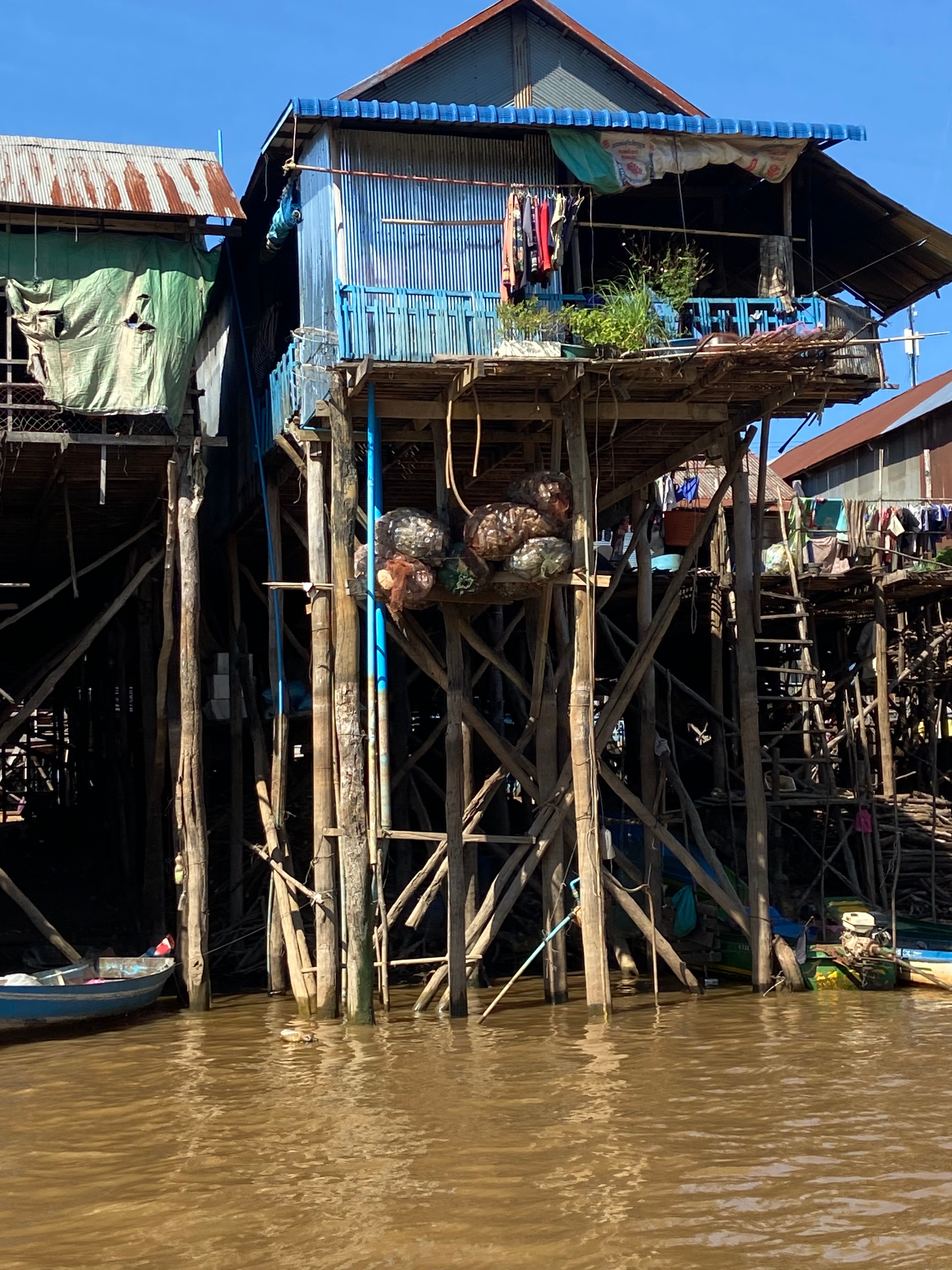
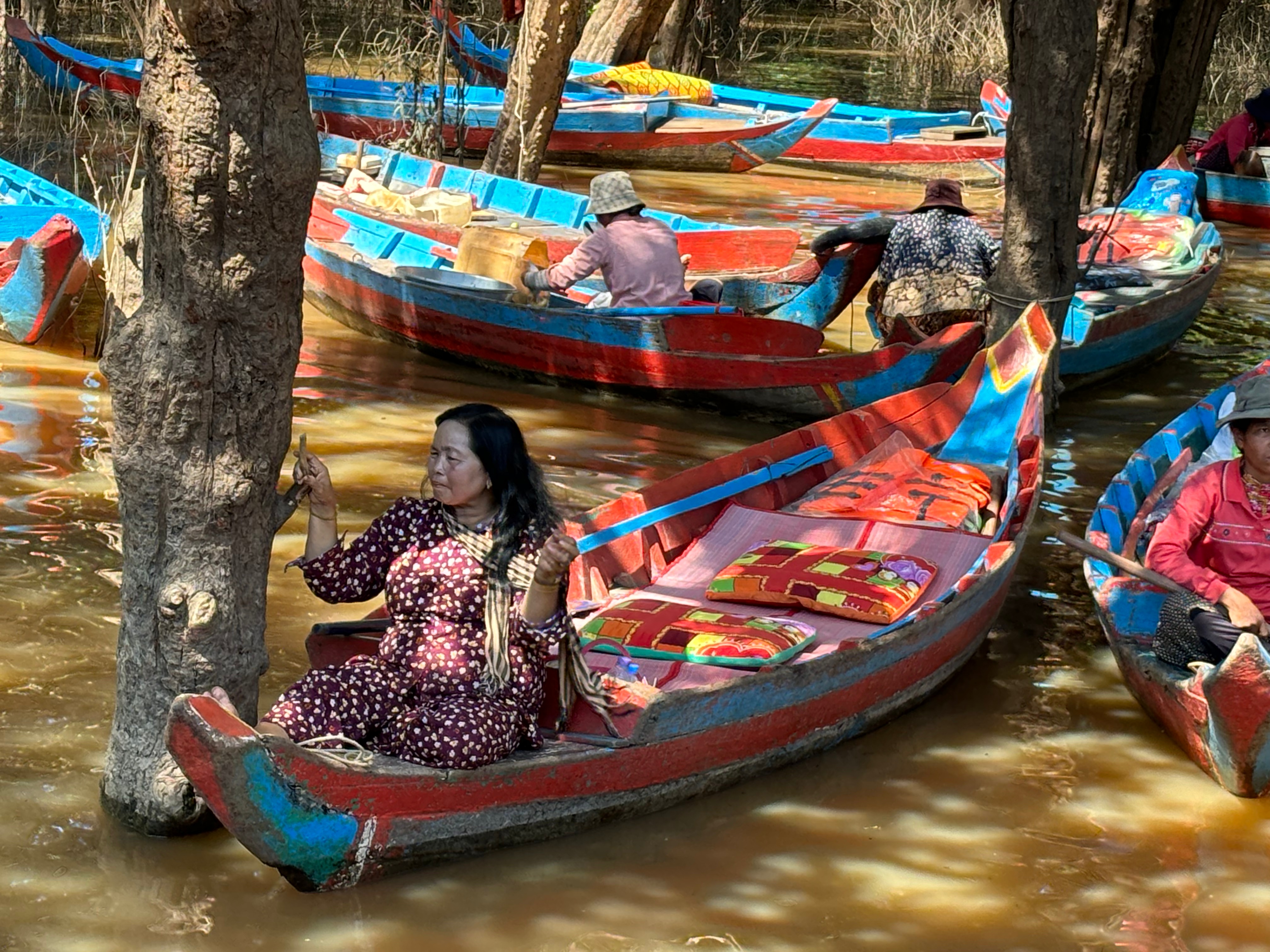
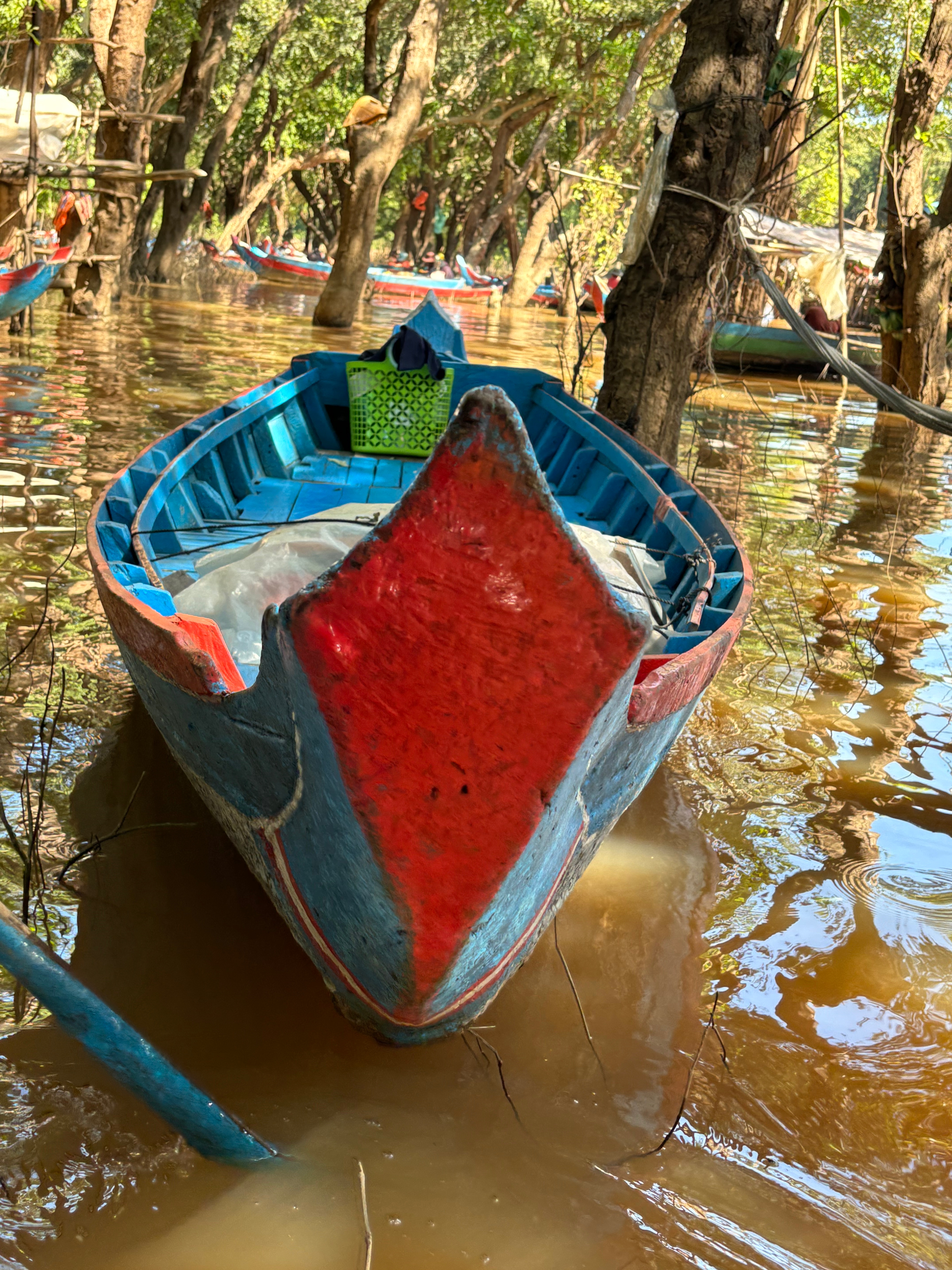
We got back to The Nature at midnight with very full bellies and were up again at 7am as Theary was meeting us at 8’ish to go to Kampong Phluk, a floating village on Tonle Sap Lake. On the approach there were rice fields either side of the river and men up to their shoulders in the river, fishing. We did a boat tour with a local guide through the houses on stilts, most of them ramshackle, part wood, part corrugated iron, washing drying and potted plants on the verandahs, and some with mezzanine layers that are only accessible in the dry season (November to April). Fishing is the main livelihood, and some houses have small fenced-off fish farms. It’s a fully functioning community – we passed a floating restaurant that operates throughout the year, a floating grocery store selling biscuits, bananas and coconuts, an ornate Buddhist temple situated on one riverbank and a church on stilts on another.

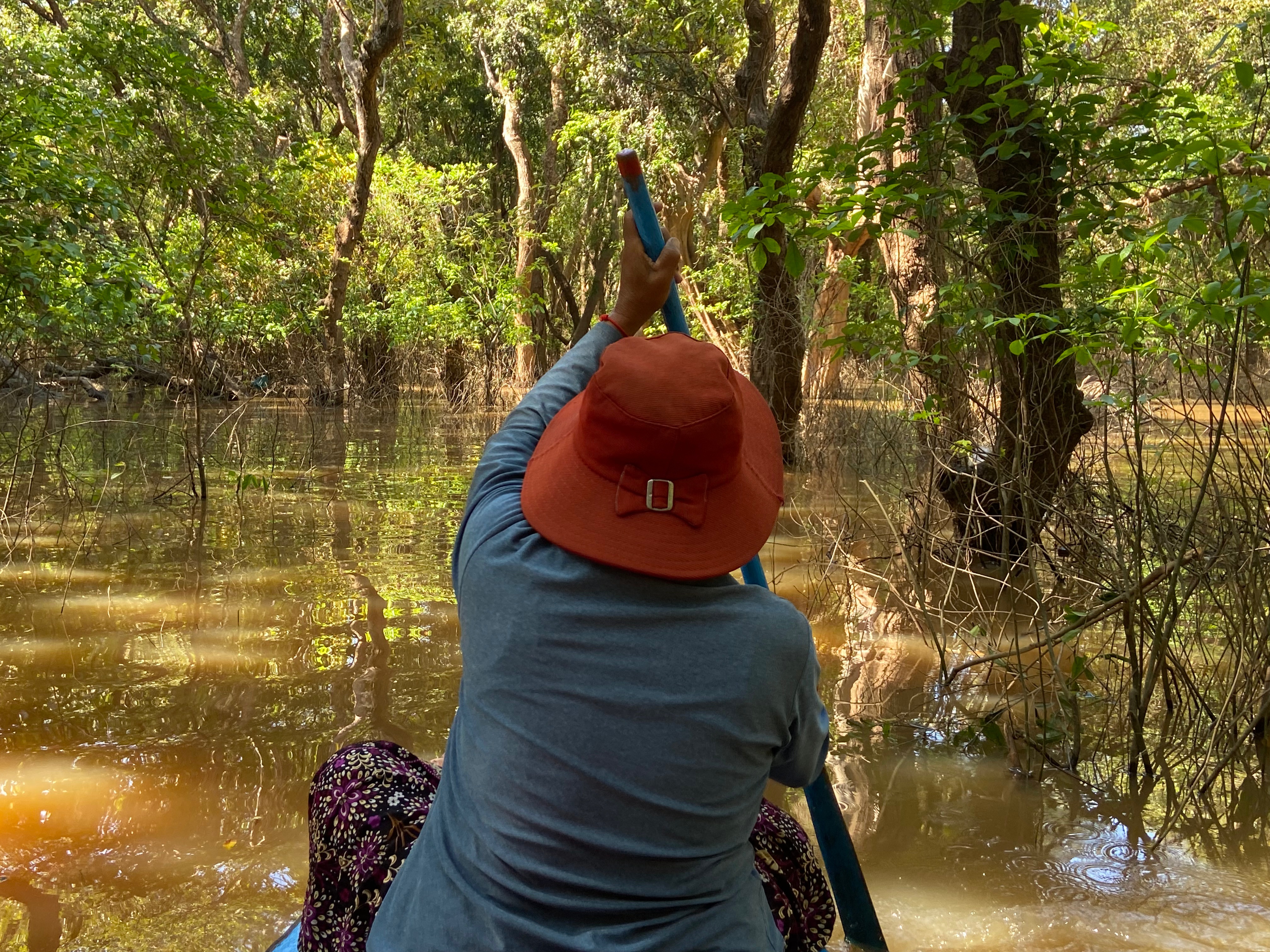
After our lake trip we decanted into a smaller brightly painted rowboat and were taken through the mangroves by a boatwoman. Immersed in birdsong and close enough to the vegetation to pluck the occasional flower, it was wonderfully peaceful, paddling through the water.

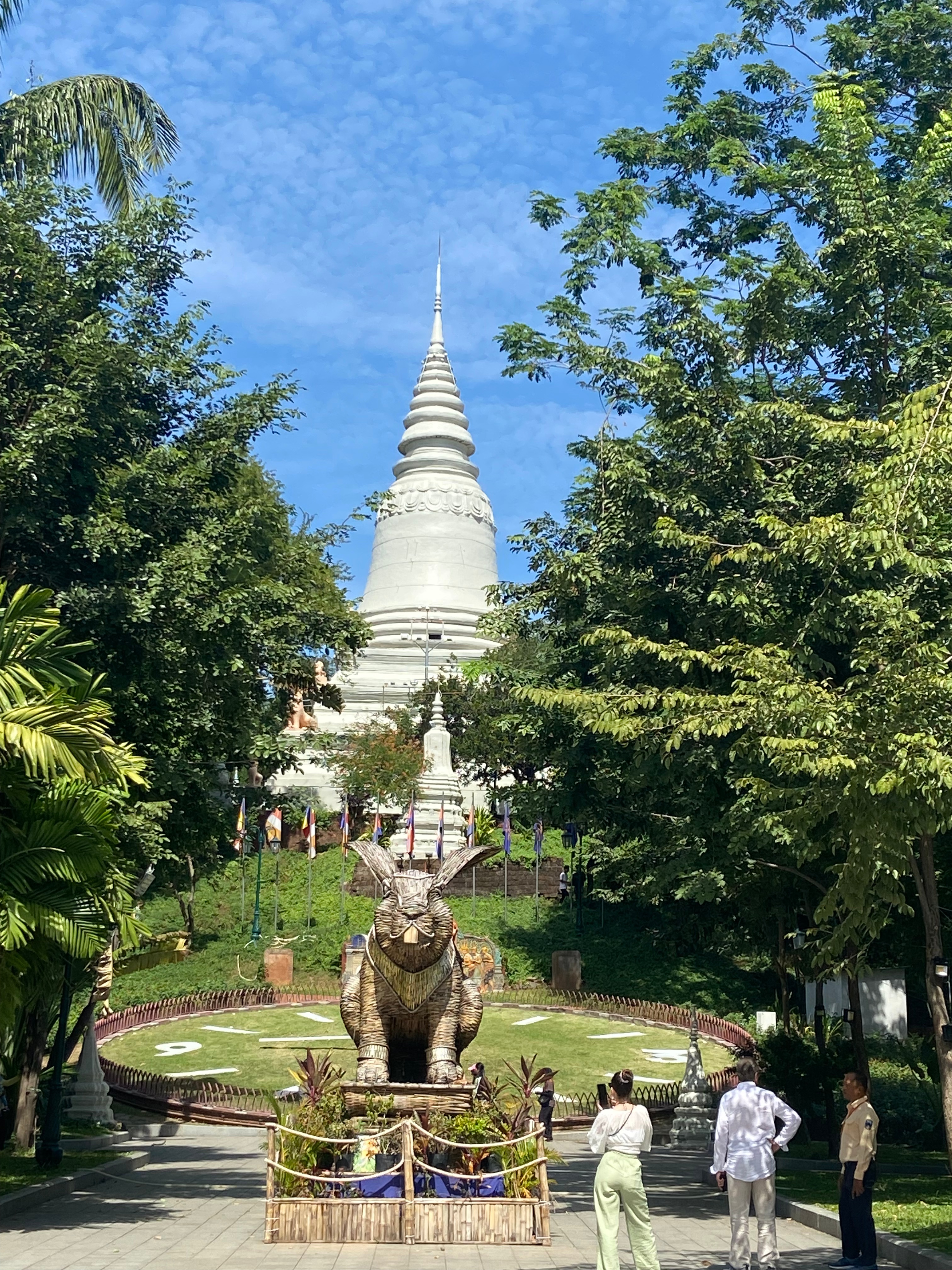
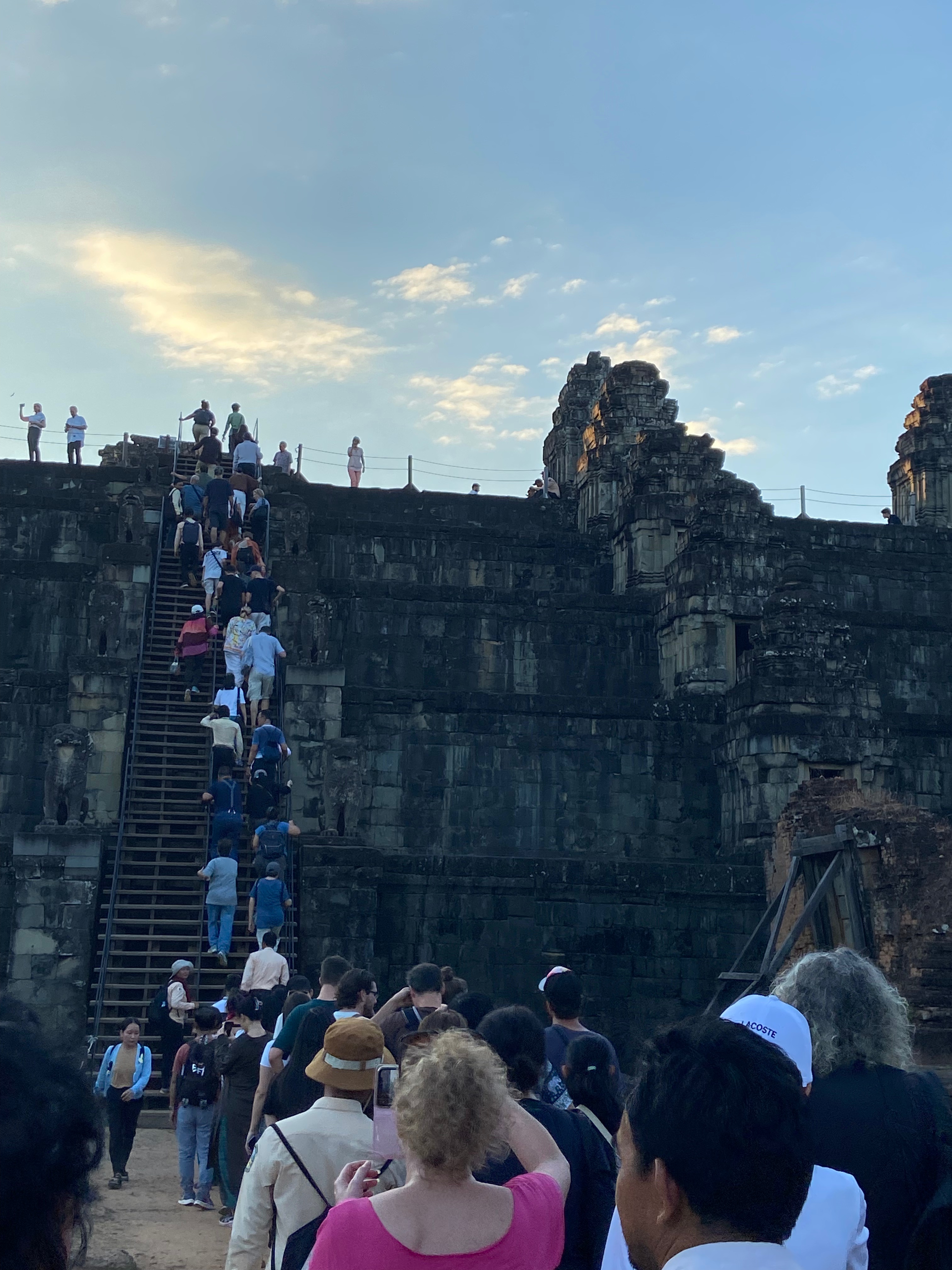
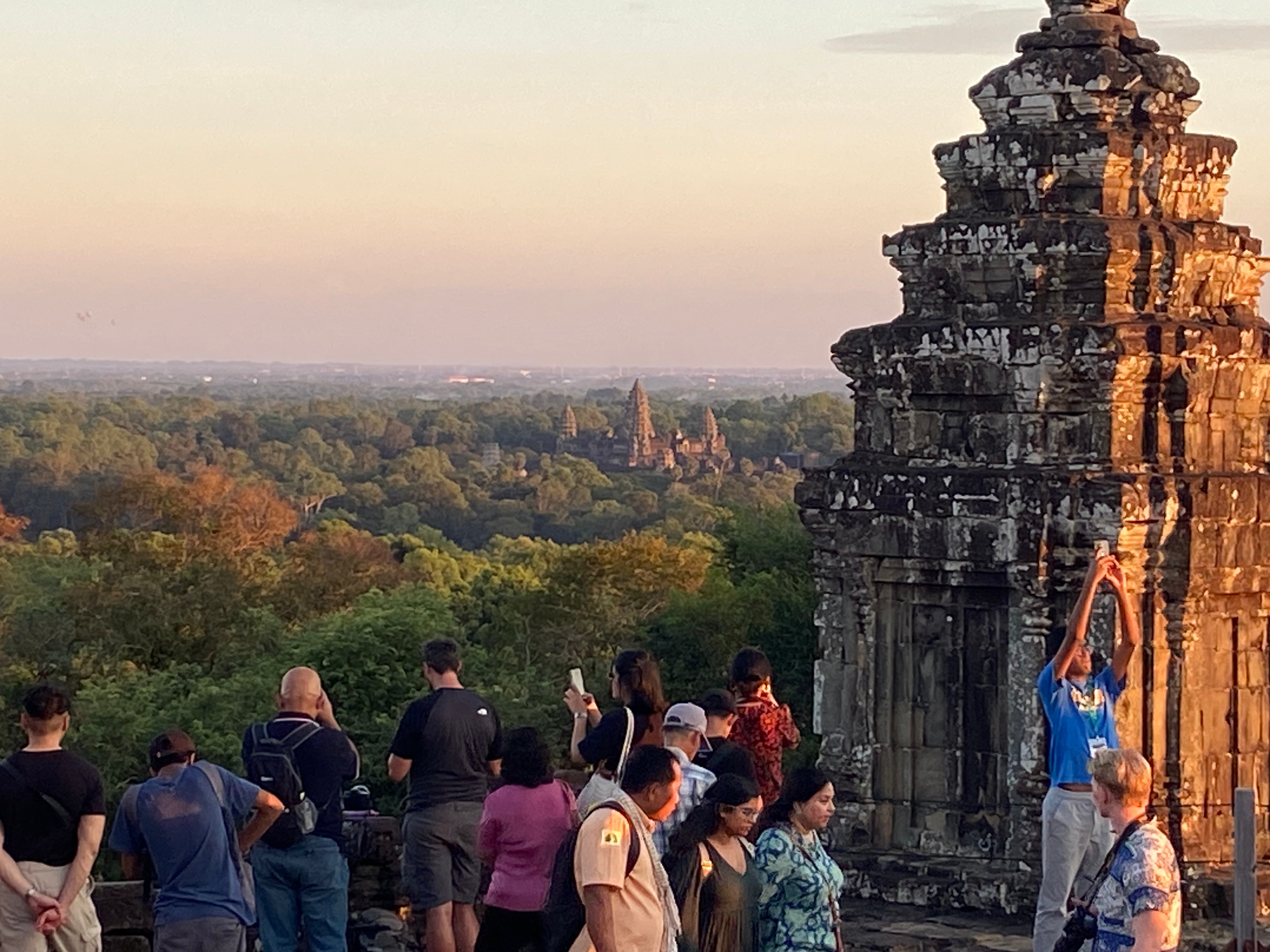
In the late afternoon we purchased our one-day tickets for the Angkor temple complex for the following day. This is how it works – you buy tickets the afternoon before so you can see that evening’s sunset and the next day’s sunrise.  Towards sunset we climbed up to Phnom Bakheng Temple (a Hindu and Buddhist temple) built at the end of the 9th century.
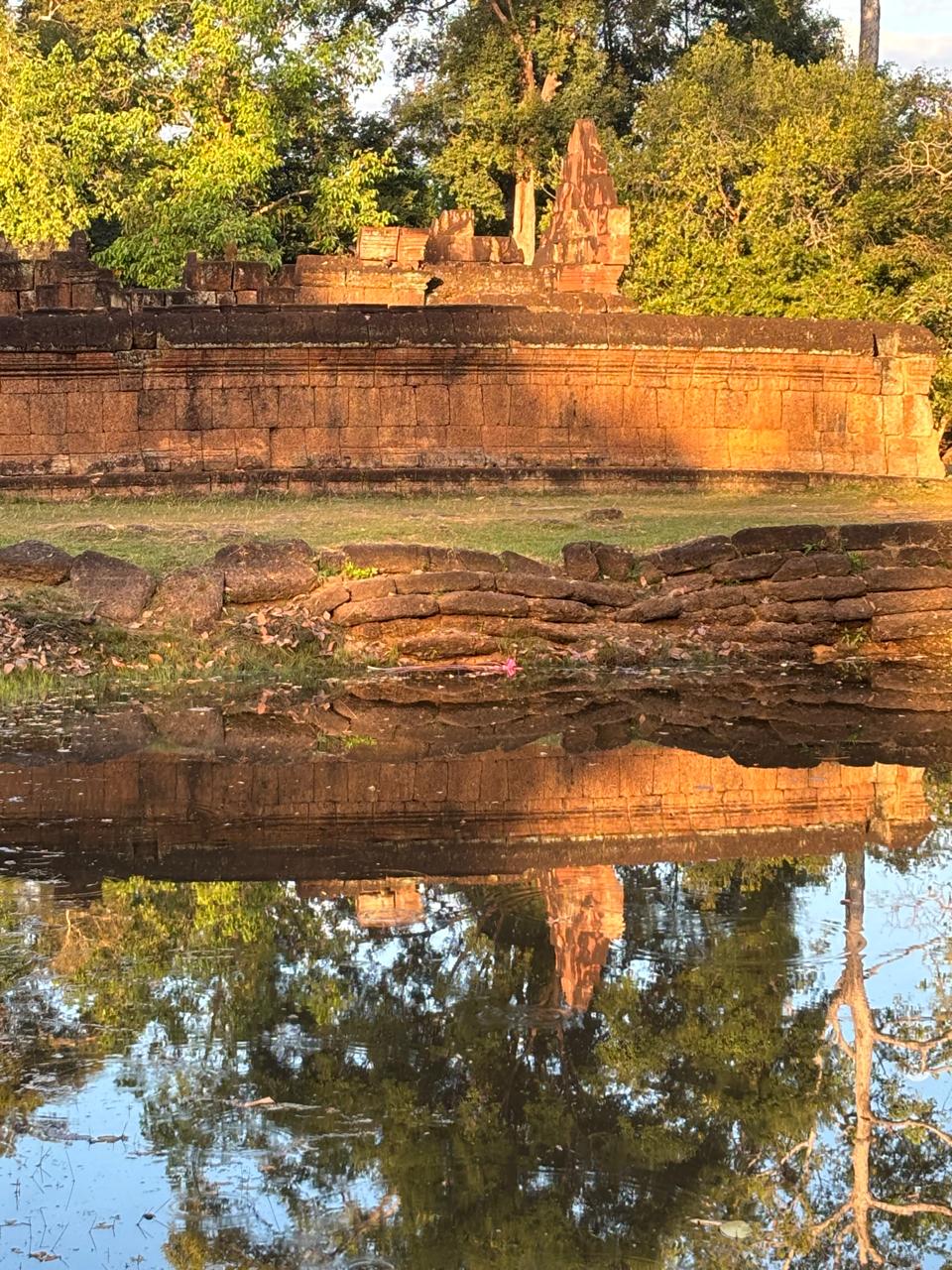
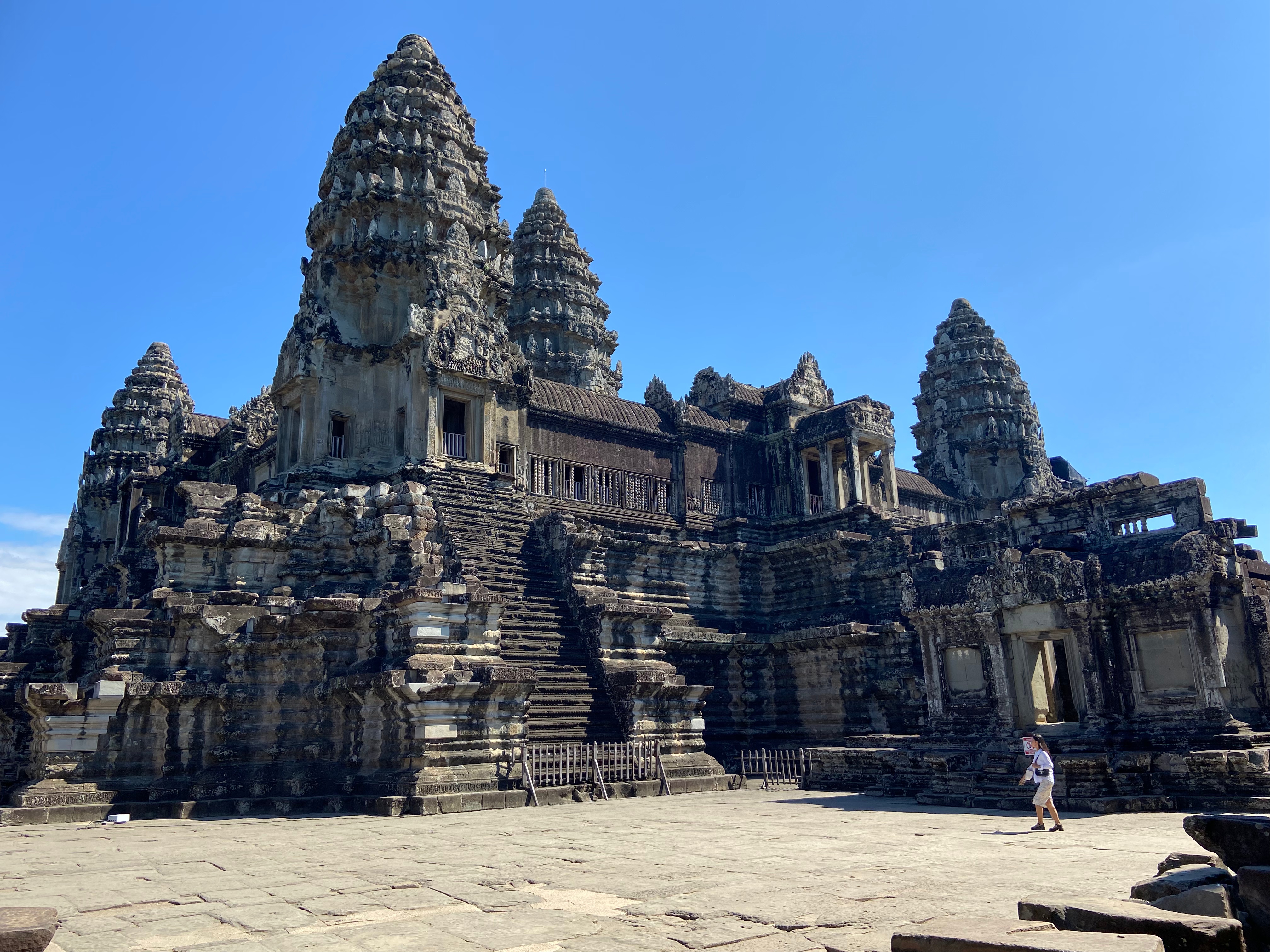
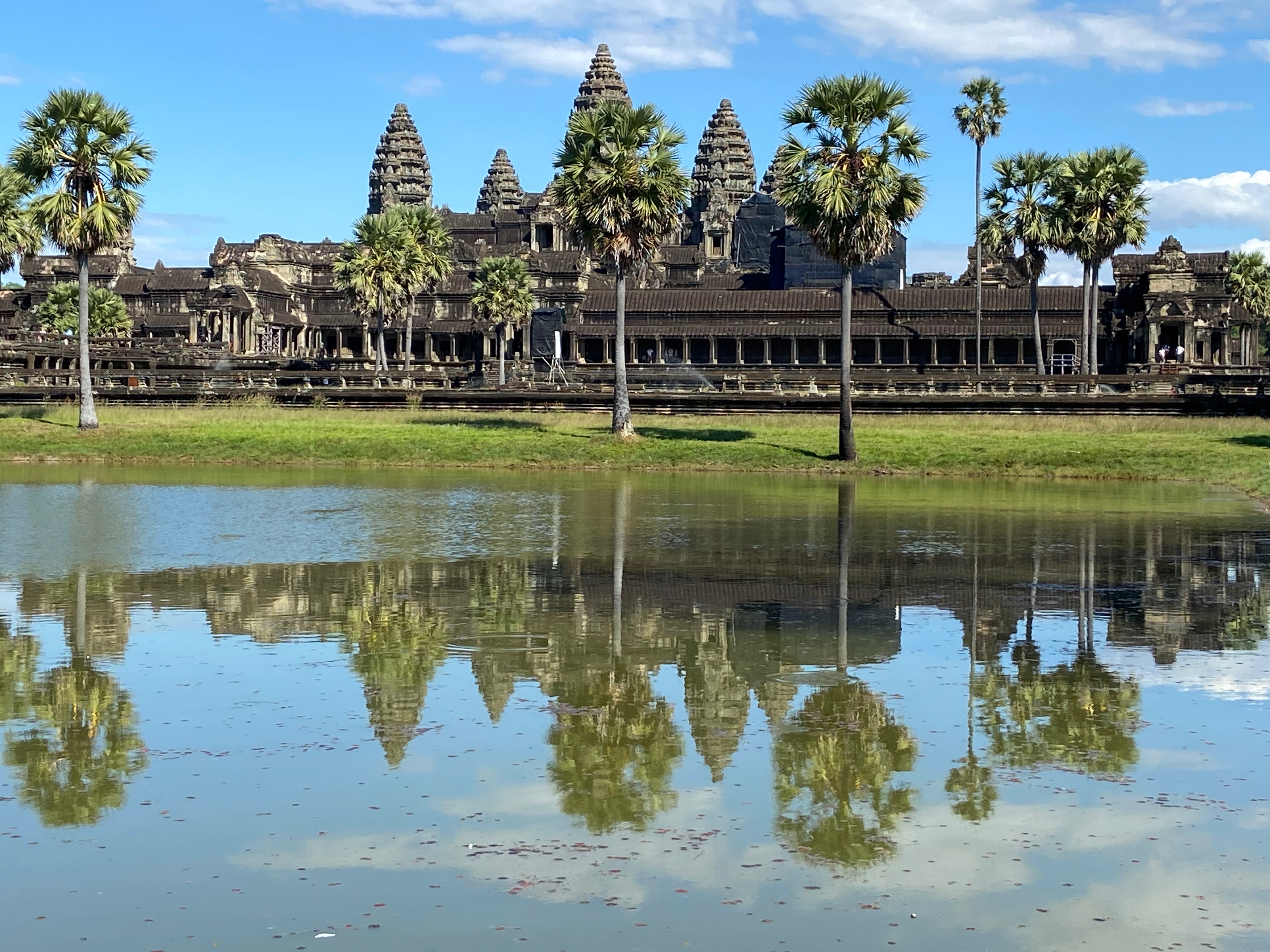
When you get to the summit, it’s crowded! Everyone is waiting for a picture-perfect sunset. We looked over at Angkor Wat (see middle picture)– a preview of what was to come the next day but   decided to go to a look-out halfway down to avoid the scrum. We almost missed the sun setting – it’s so fleeting – but the way the light fell on the stone was worth the climb and we heard geckos calling out GECKO, GECKO – I’ve never heard that before.

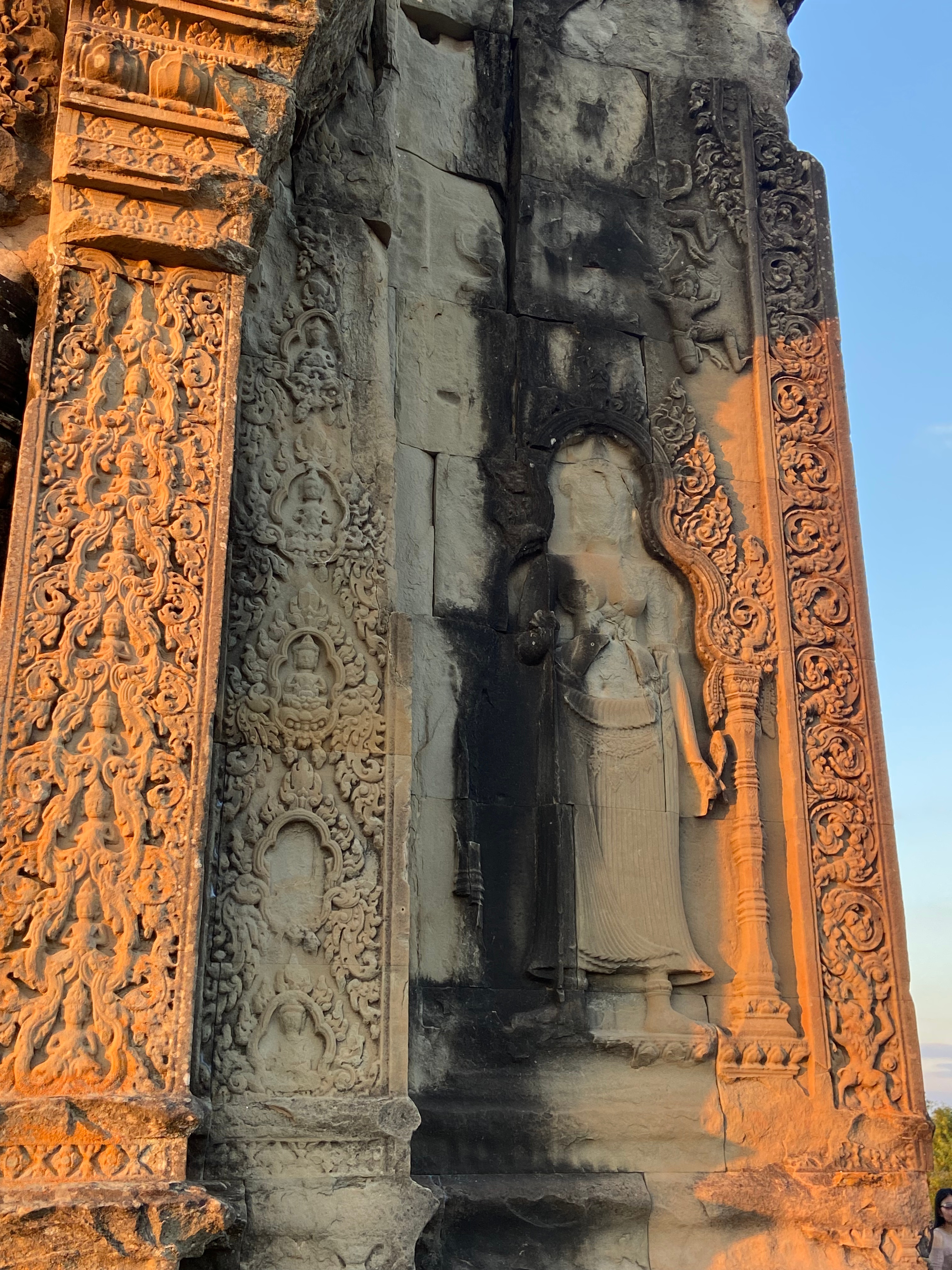
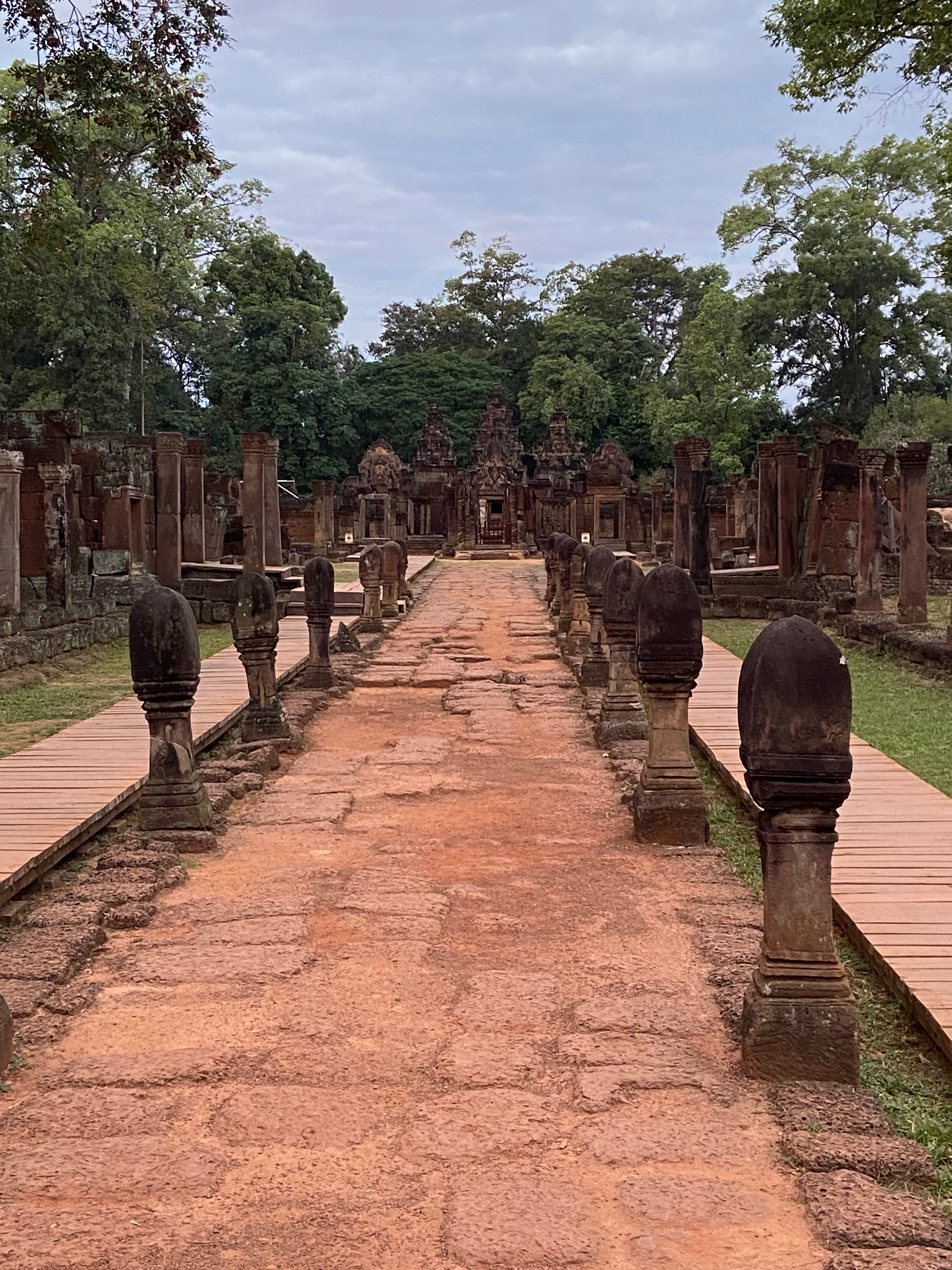
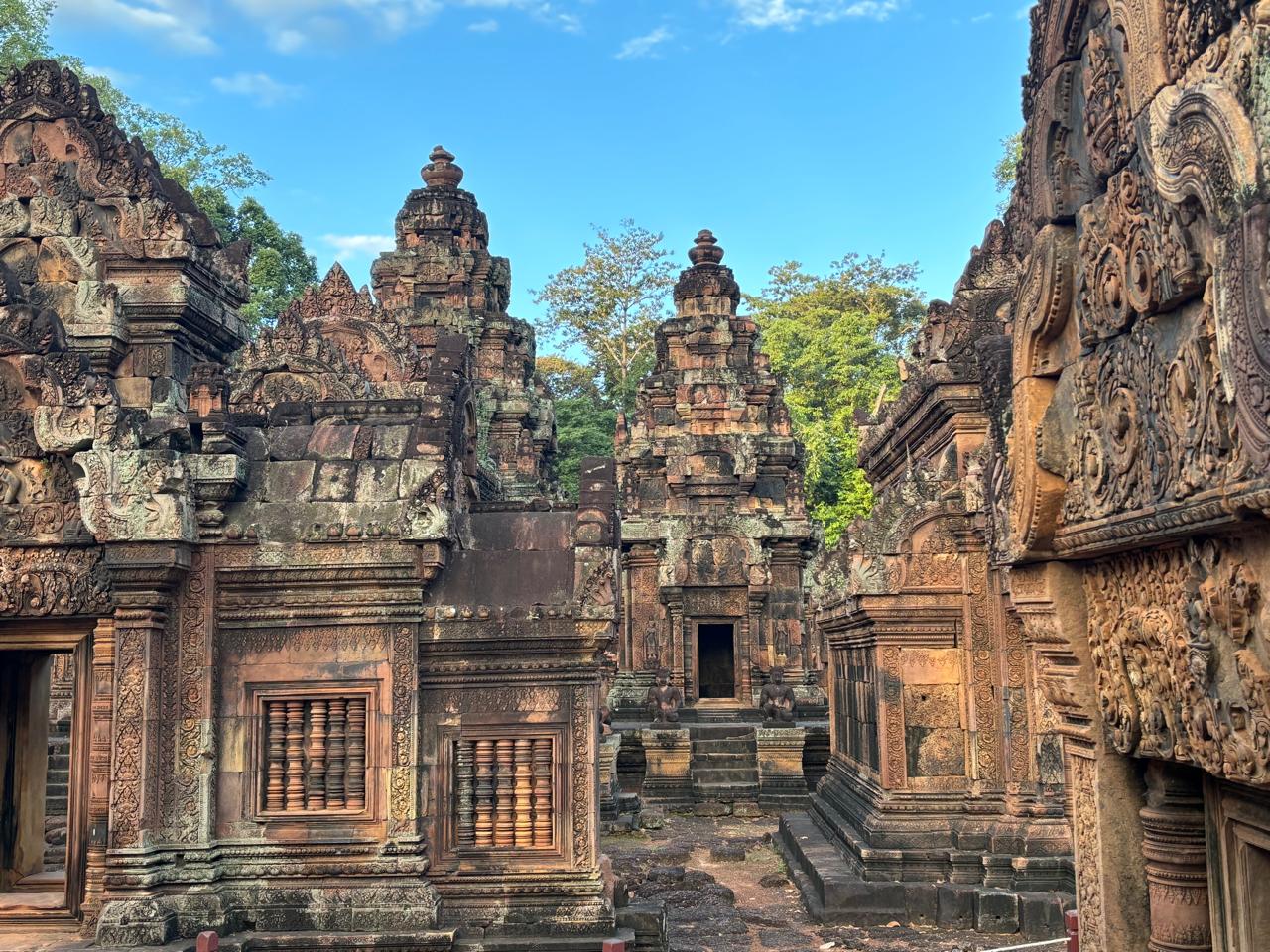
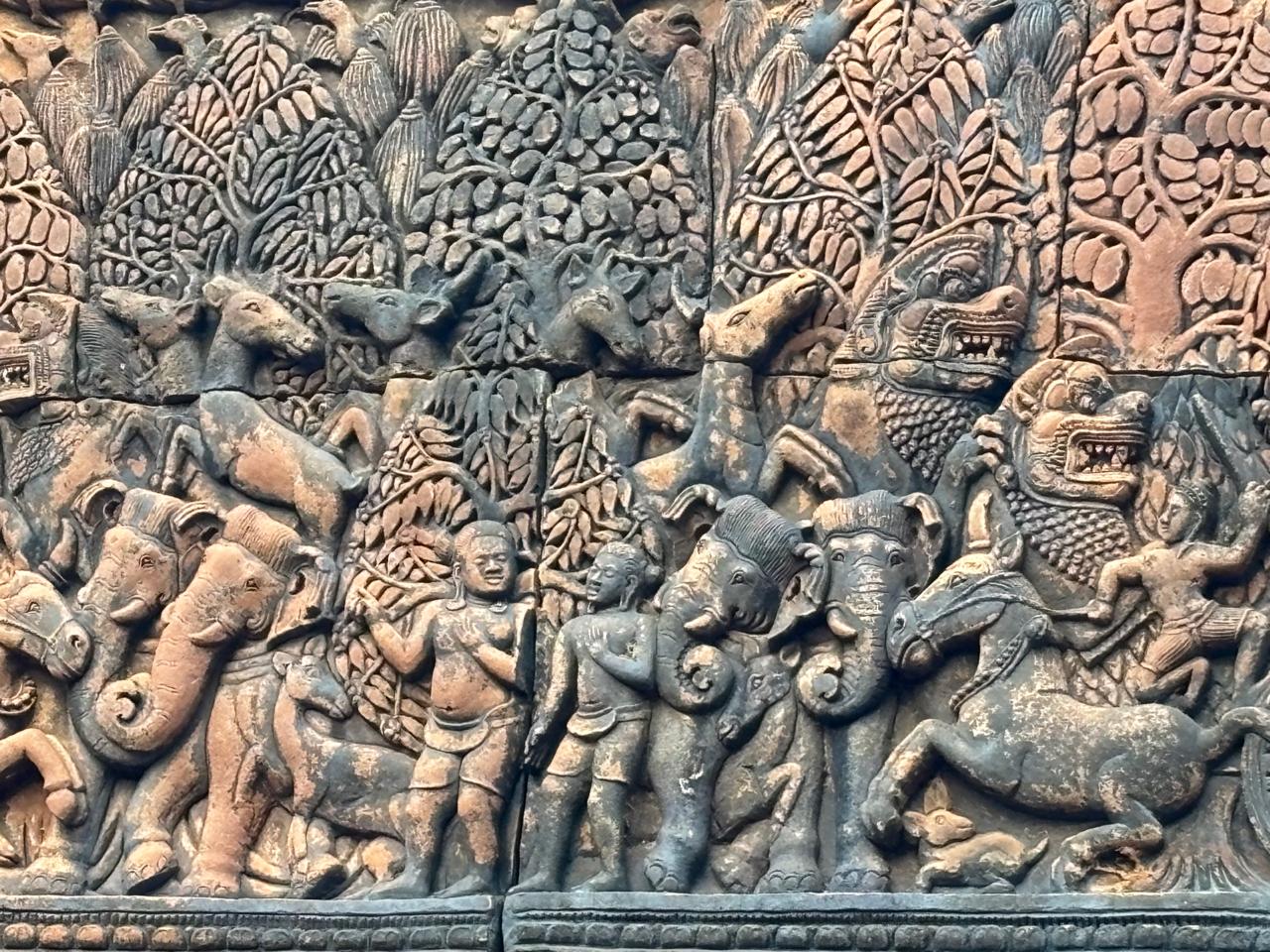
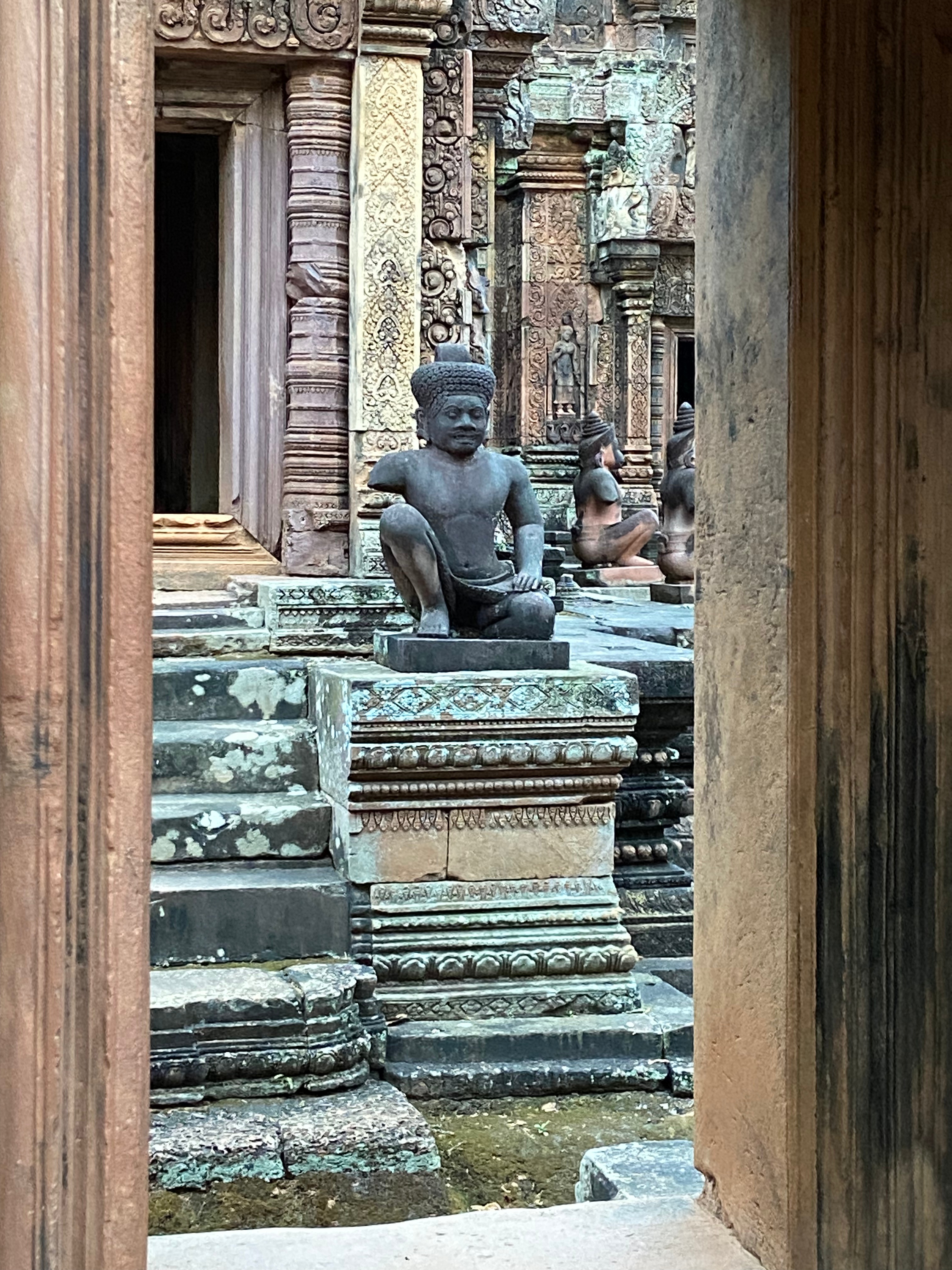
On ‘Temple Day’ Theary collected us at 5.30am, and rather than follow the crowds to Angkor Wat – how lucky was I have Di as my guide, she knows her temples – our first stop was Banteay Srey which means ‘Citadel of the Women’. Banteay Srey is said to have been built by a woman as the delicate carvings are considered too fine to have been crafted by any man. We were there at 6.30am only to find it didn’t officially open till 7.30am but there was nothing to stop us going in so we did and we had the place to ourselves, just us, birdsong and the rising sun casting a golden light on the stone. Magical. A grumpy official found us around 7am and ticked us off for entering before opening time. Like naughty schoolgirls we muttered ‘too late’ and carried on with our tour, enjoying breaking the rules!  With its reddish and pinkish stone and intricate carvings – such as scenes from the Ramayana adorning the library pediments – this was my favourite of all the temples.

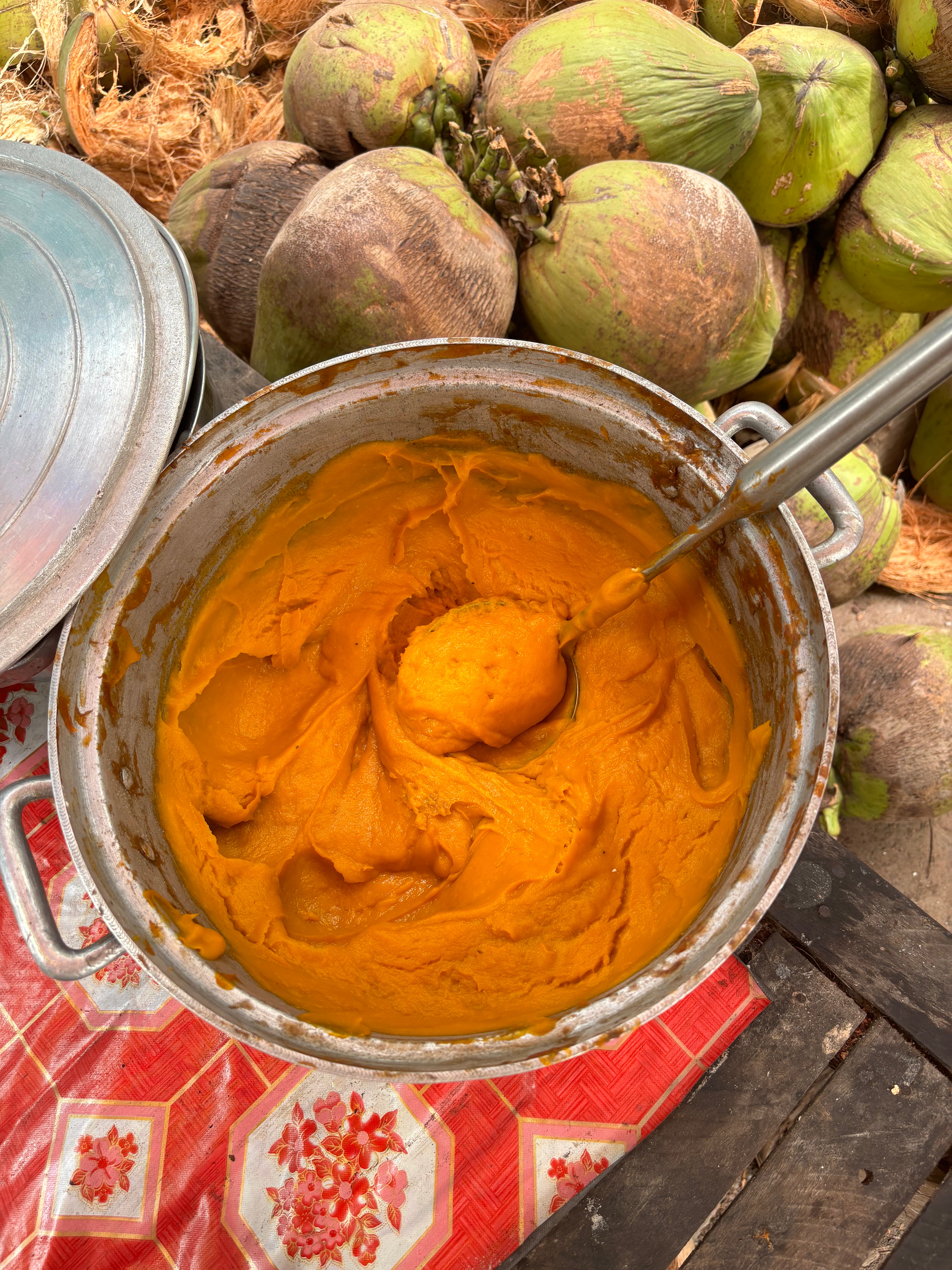
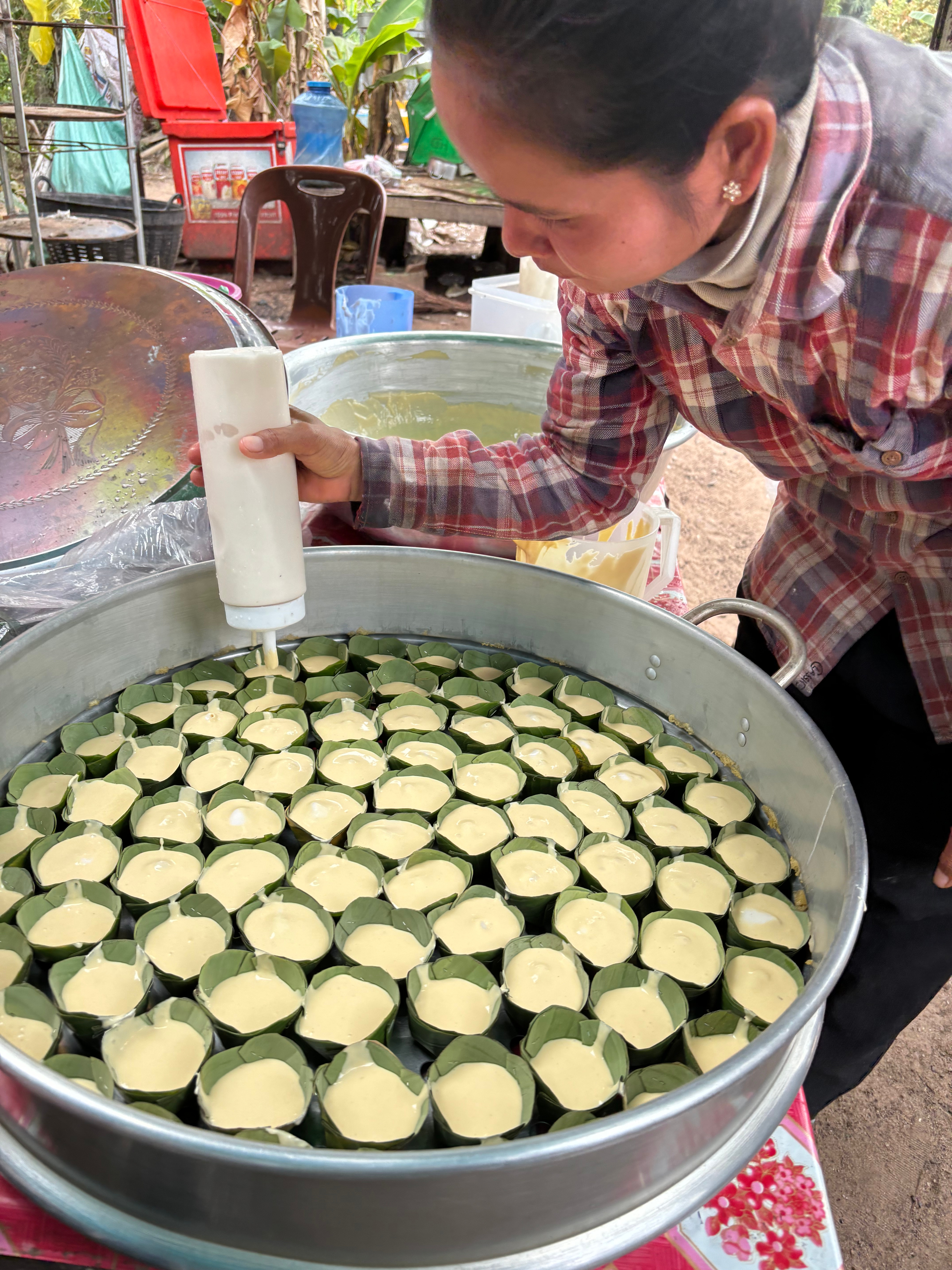
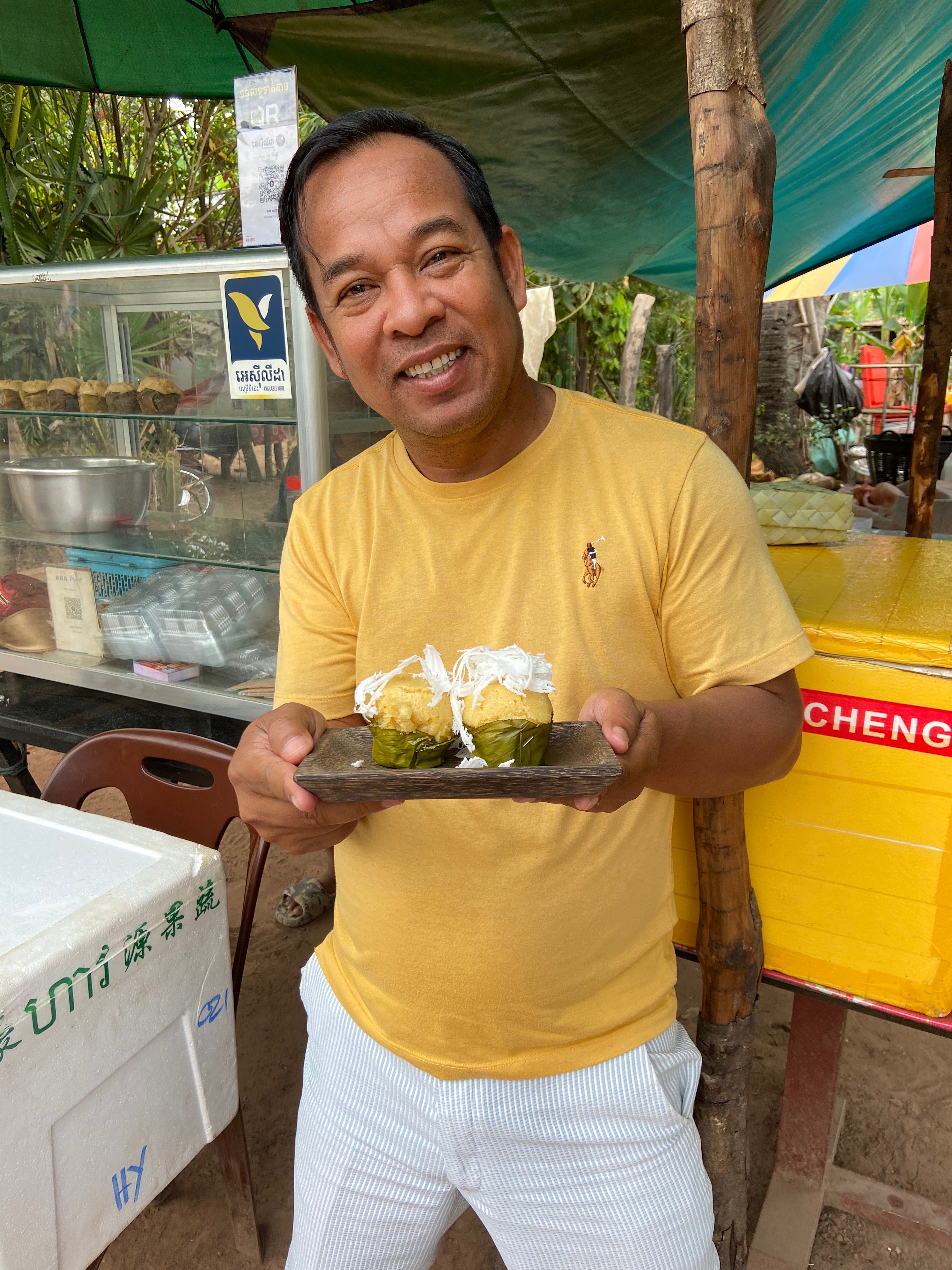
After breakfast at Banteay Srey, Theary picked us up and we continued with our temple tour. Along the way we came across a bunch of roadside stalls selling among other things palm fruit cakes, made from palm fruit puree (it looks like pumpkin puree but is sharper and has a more defined fruity flavour), eggs and palm sugar and steamed in a pandan leaf. They are served with coconut cream in the middle and fresh coconut on top. Well, this was ONE OF THE MOST DELECTABLE THINGS I HAVE EVER EATEN! I can highly recommend.

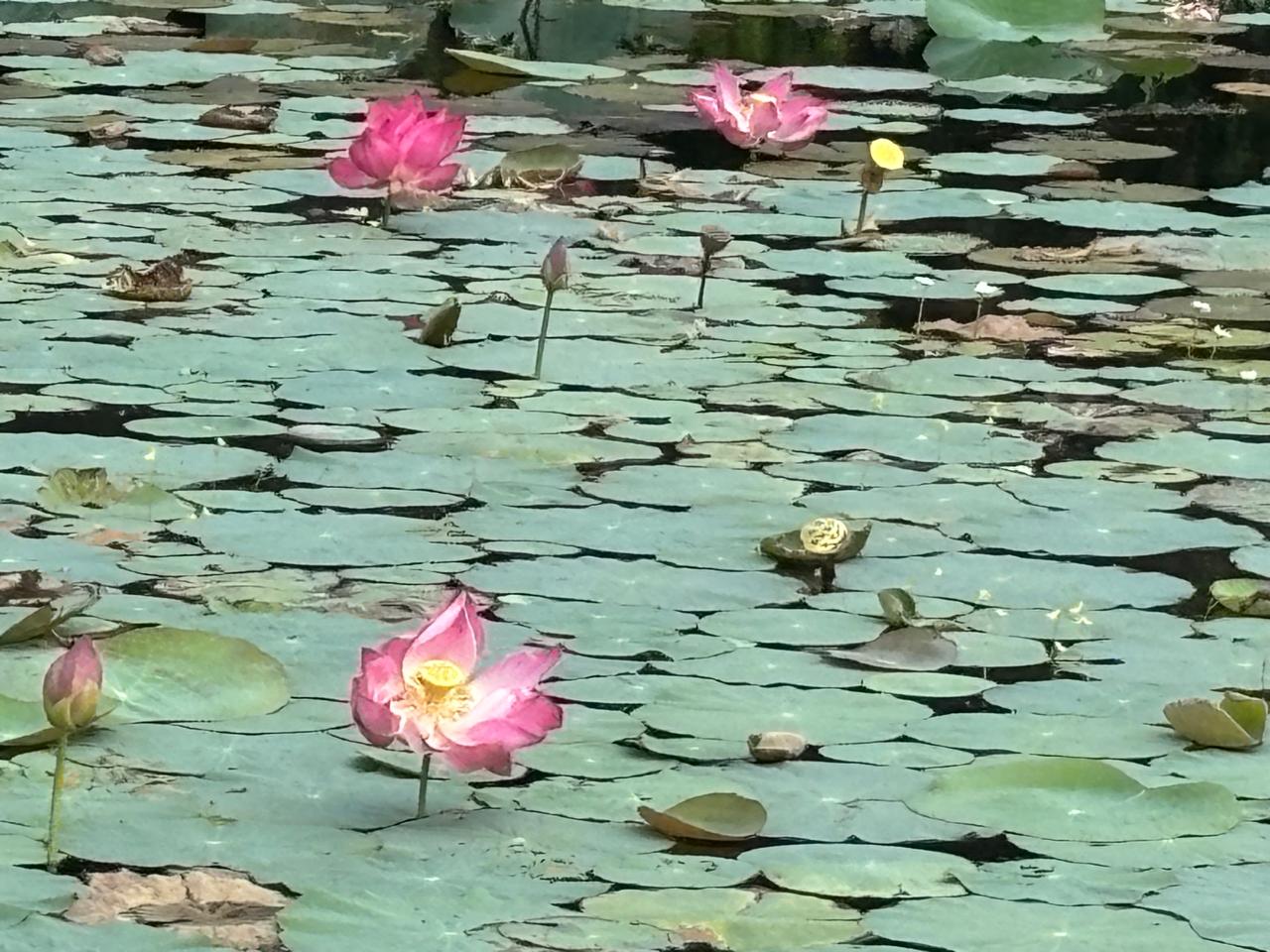
Our next stop before Angkor Wat was Neak Pean, a temple built on an artificial island with a Buddhist temple in the middle. It’s divided into four enclosures in the shape of a cross and all of them have beautiful bas-relief carvings. But what I remember most is the approach via the causeway, which is dotted with lotus flowers and lotus seed pods, the latter dotted with holes reminding me of watering can spouts.

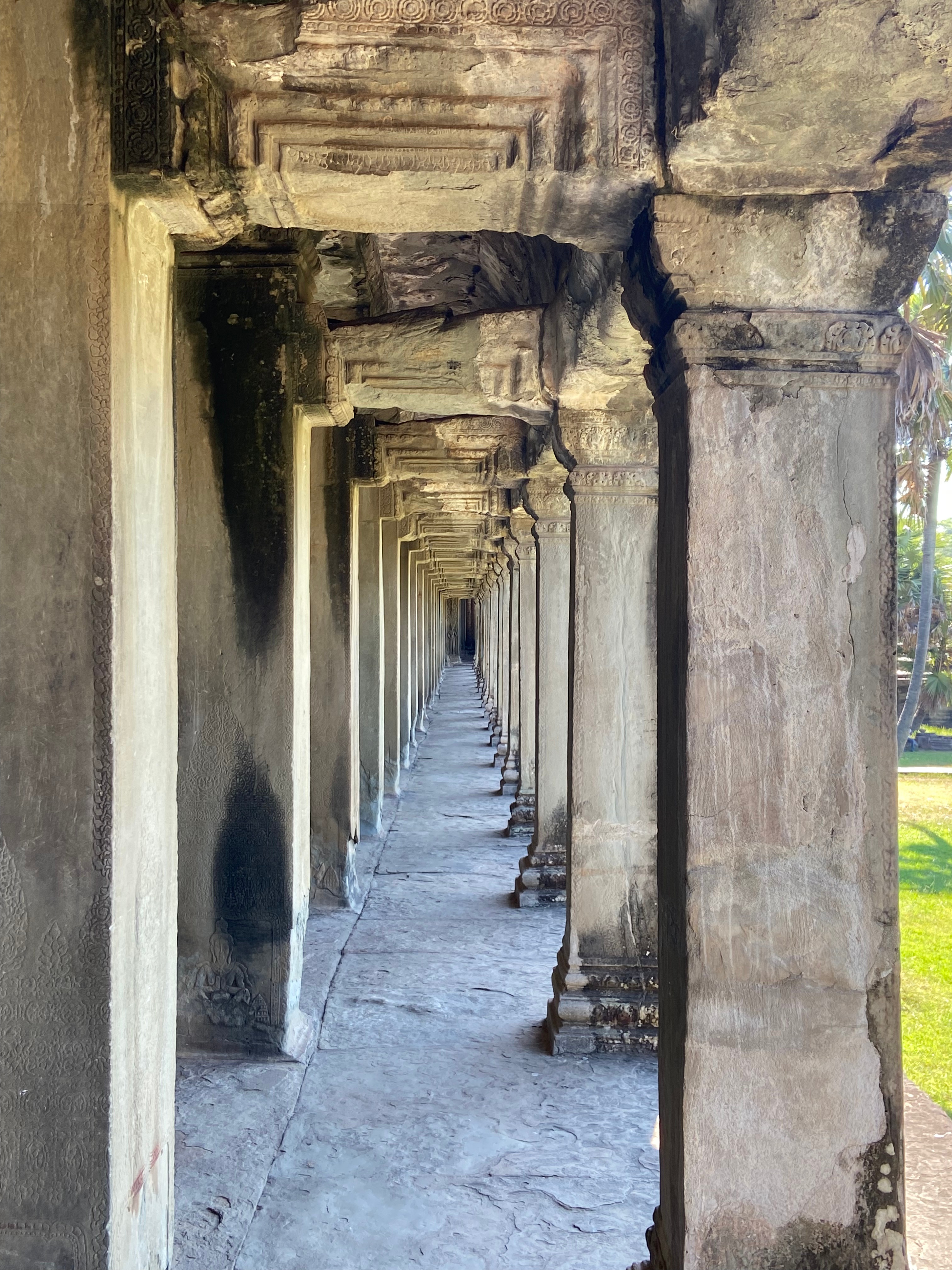
You’ll be familiar with pictures of Angkor Wat, and much has been written about it – but by way of a summary: Angkor Wat was originally a Hindu temple and later converted to a Buddhist temple. It’s on the UNESCO World Heritage List, the world’s largest religious monument, a highpoint of Khmer architecture built in the 12th century.
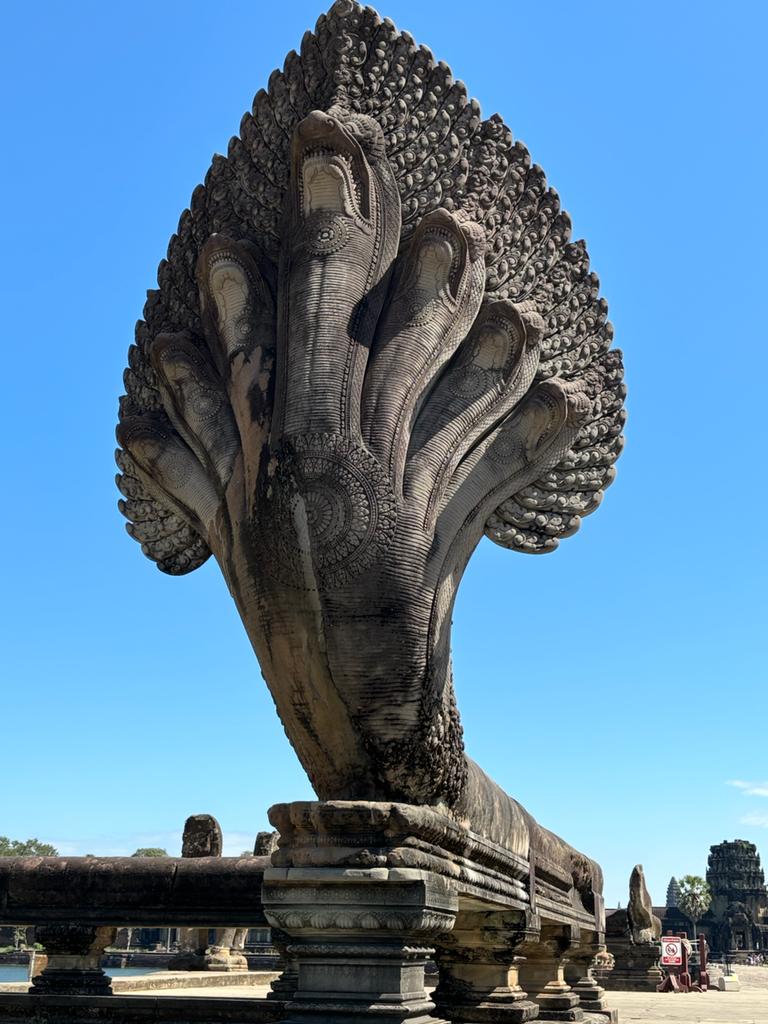
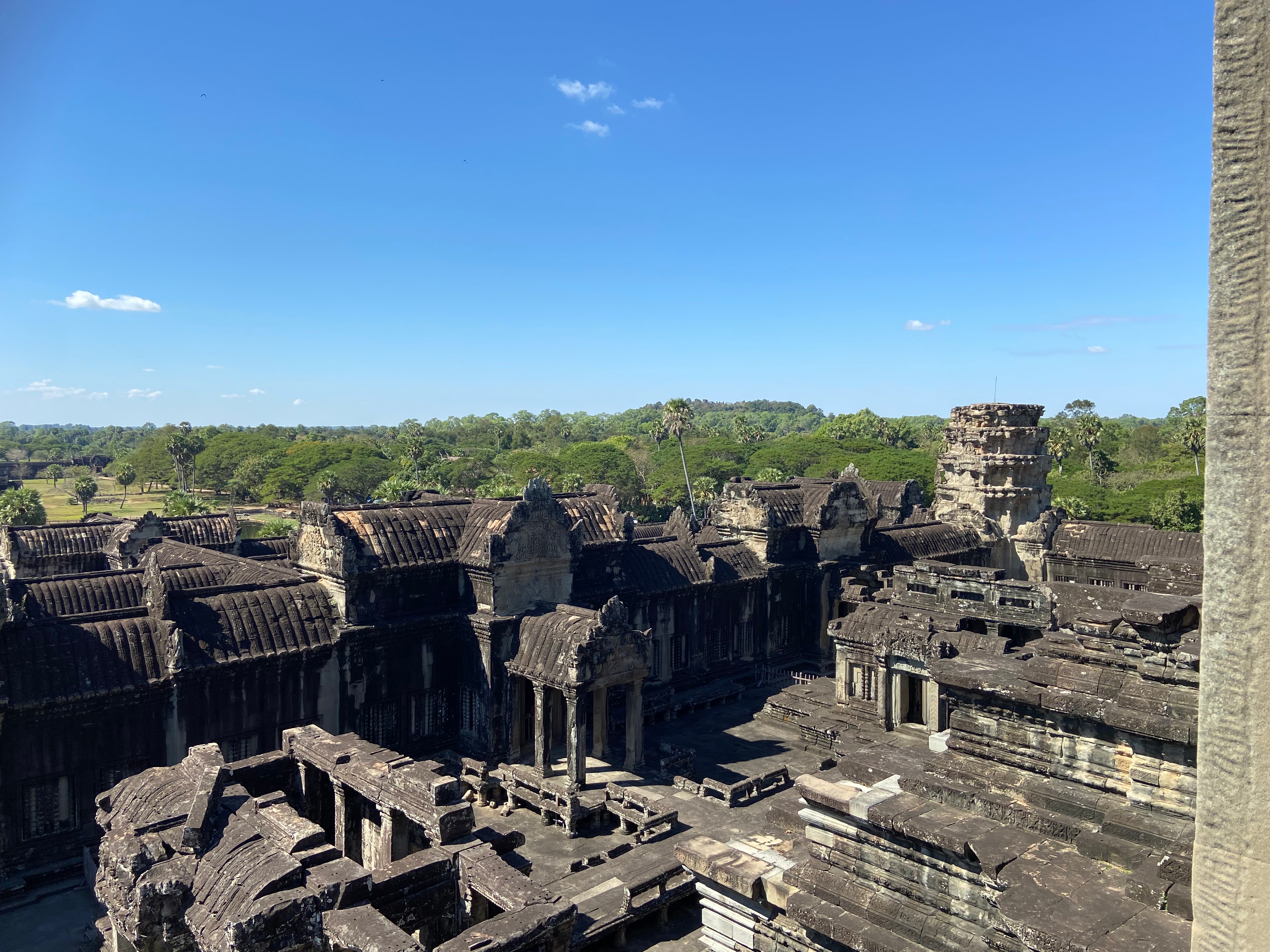
It’s surrounded by a vast moat and wall, and you approach by a long sandstone causeway guarded by the seven-headed serpents or nagas. The temple is on three levels, the tiered layout representing Mount Meru, the mythical home of the gods in Hindu cosmology. It’s a steep climb up to the top terrace but it’s well worth it for the views back over the complex.

We went round with a local guide and there was so much to learn that I failed to retain much of it! But you don’t need to understand all the layers of history, interpretation, mythology and meaning to experience a sense of awe at its sheer size and complexity – the city of Angkor served as the royal centre from which a dynasty of Khmer kings ruled one of the largest kingdoms in the history of Southeast Asia.

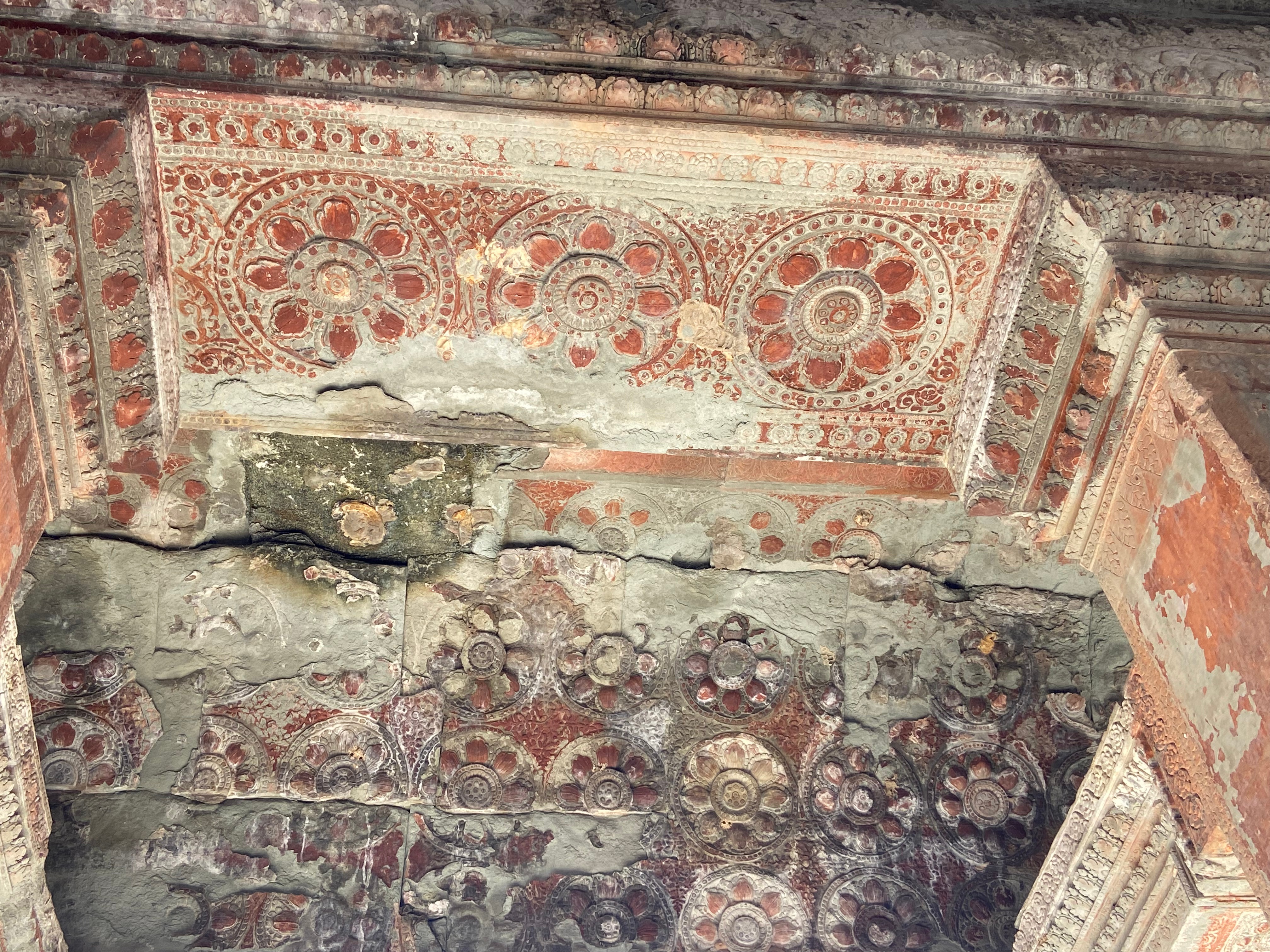
On the second level of the temple is the Gallery of a Thousand Buddhas which, while largely devoid of Buddhas – they were either removed for conservation or destroyed by the Khmer Rouge – has detailed carvings depicting scenes from Hindu mythology and sections where pigment from the original red paint is still visible on the rosettes carved into the roof beams. Close by is the Hall of Echoes – so-named because the stone picks up the vibration of sound. We tested it out by standing with our back to the wall and thumping our chest while saying OM – it’s meant to clear your karma!

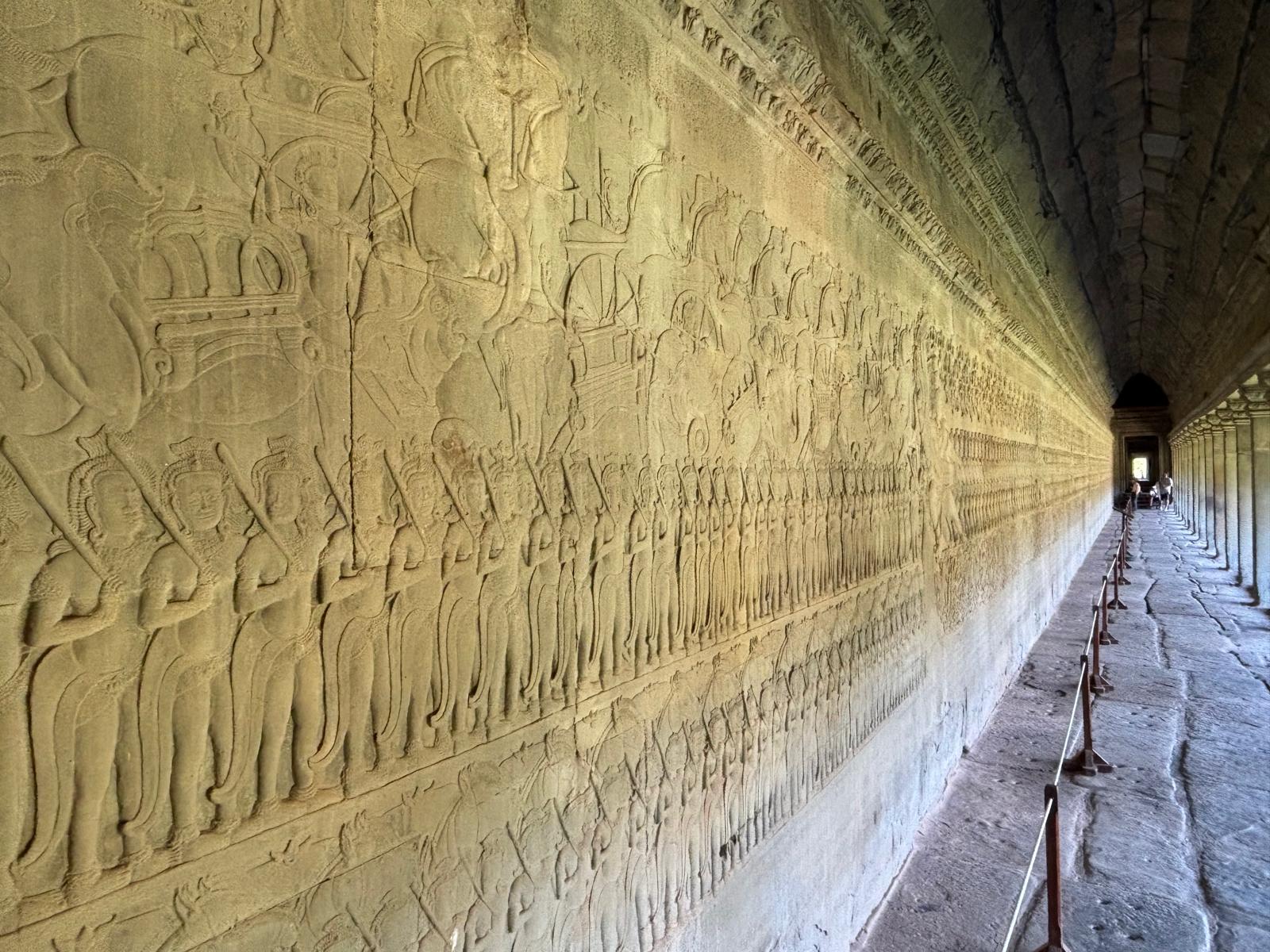
In the East Gallery is the famous 160-foot-long Churning of the Ocean of Milk bas-relief depicting a momentous event in Hindu Mythology – the very brief version of which is that the Ocean of Milk is churned by gods and demons (the struggle of good versus evil) to generate Amrita, the elixir of life. The level of detail is quite extraordinary, mesmerising.

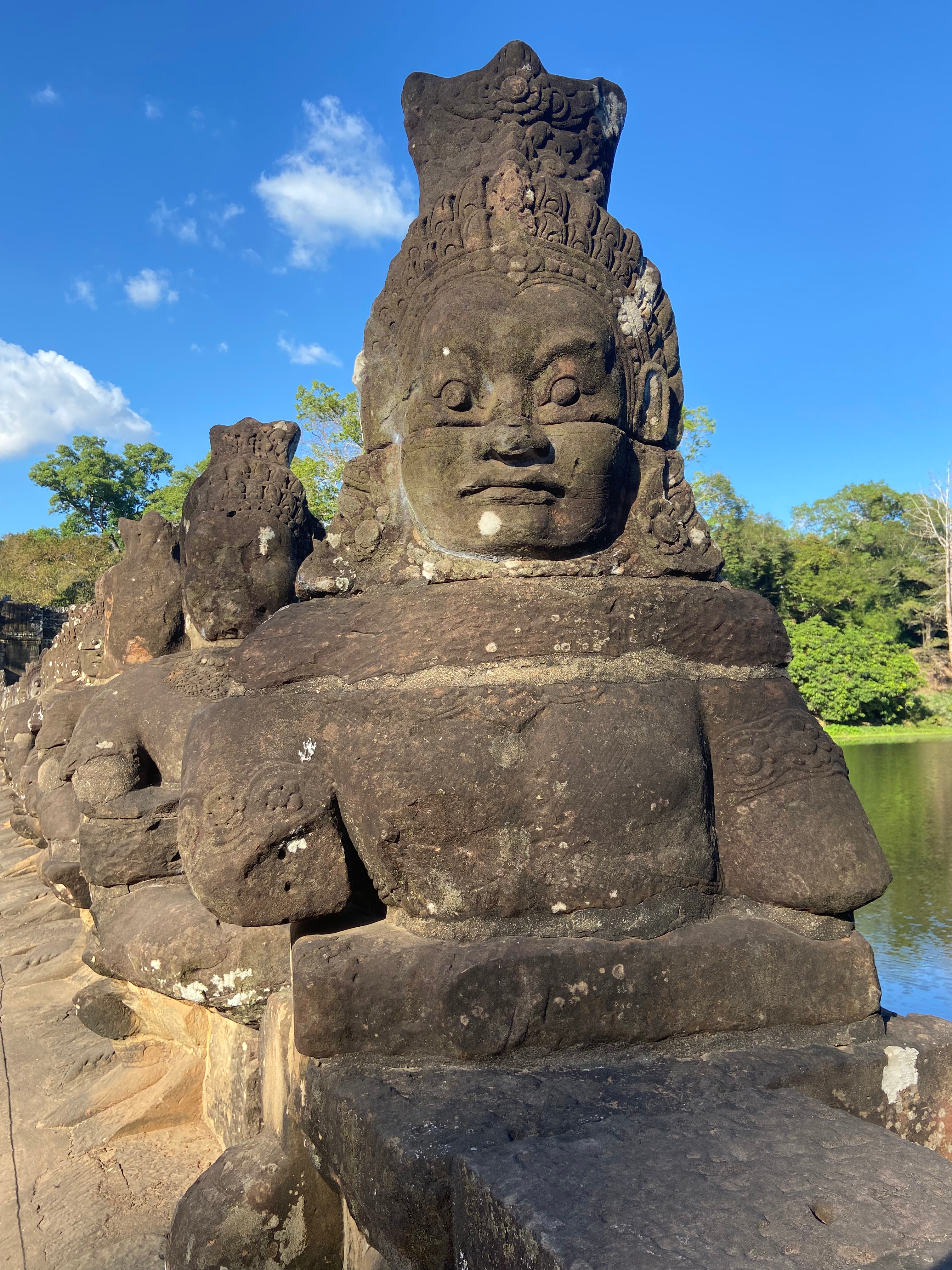
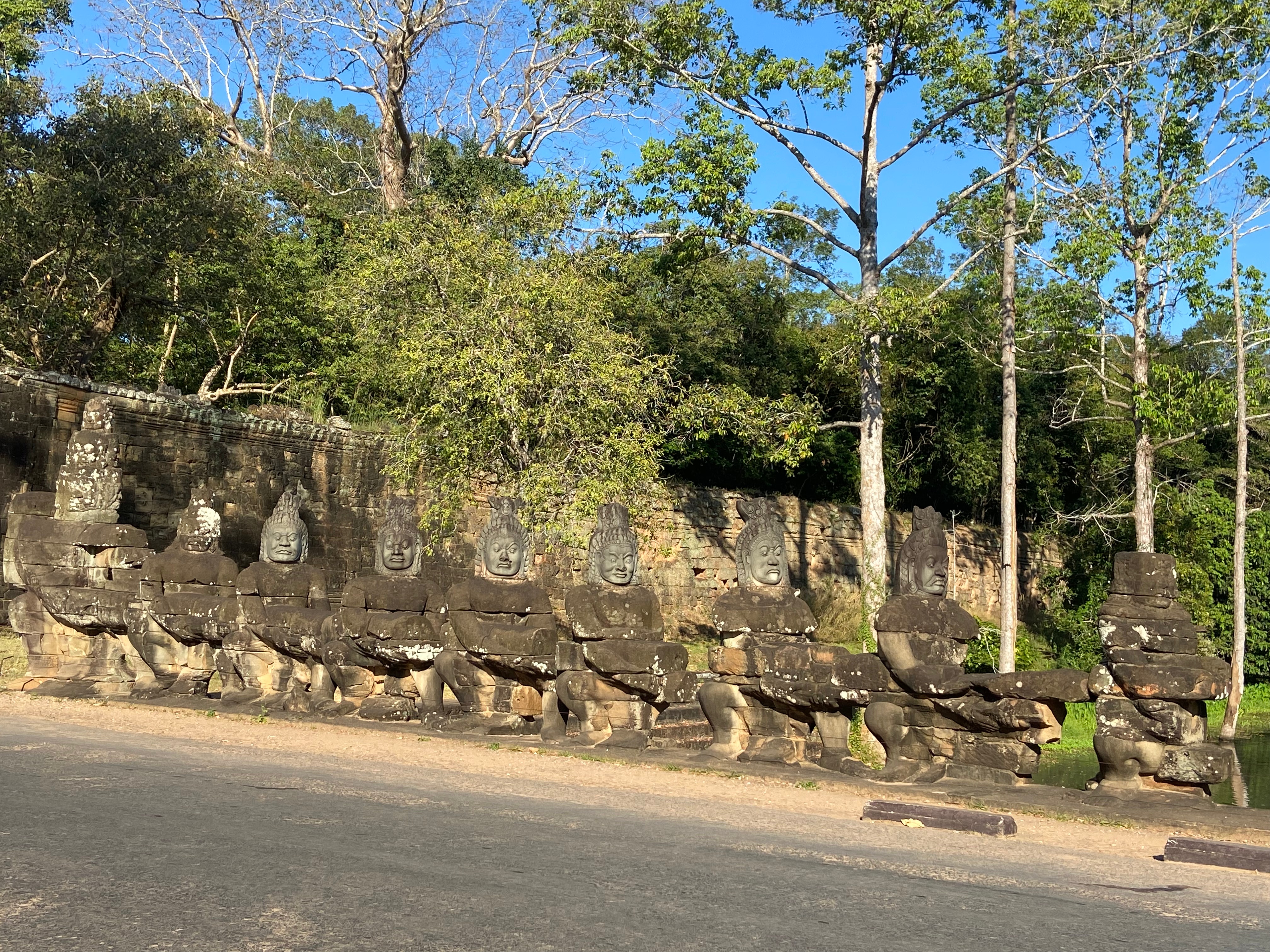
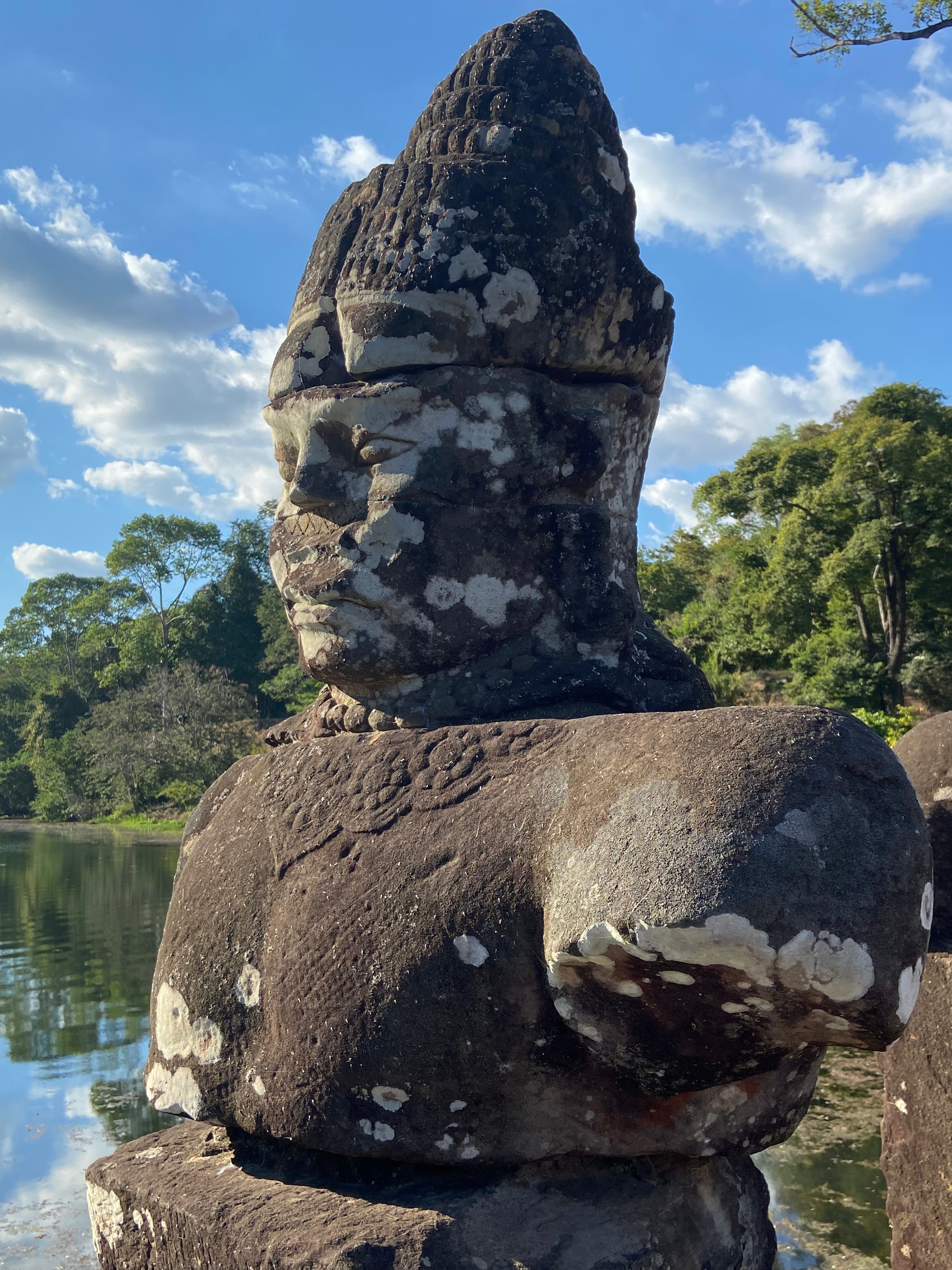
We were ready for a break at lunchtime and snacked on chicken spring rolls and banana flower salad with seafood in the café at Angkor Wat. Suitably restored we then walked across the South Gate of Angkor Thom – one of the entrances to the ancient city of Angkor – on our way to Bayon Temple.  If you think we’d have exhausted our capacity to be wowed, think again.  I loved this causeway lined with giant statues – 54 gods and 54 demons pulling on the body of a giant Naga serpent, another tug of war between good and evil.

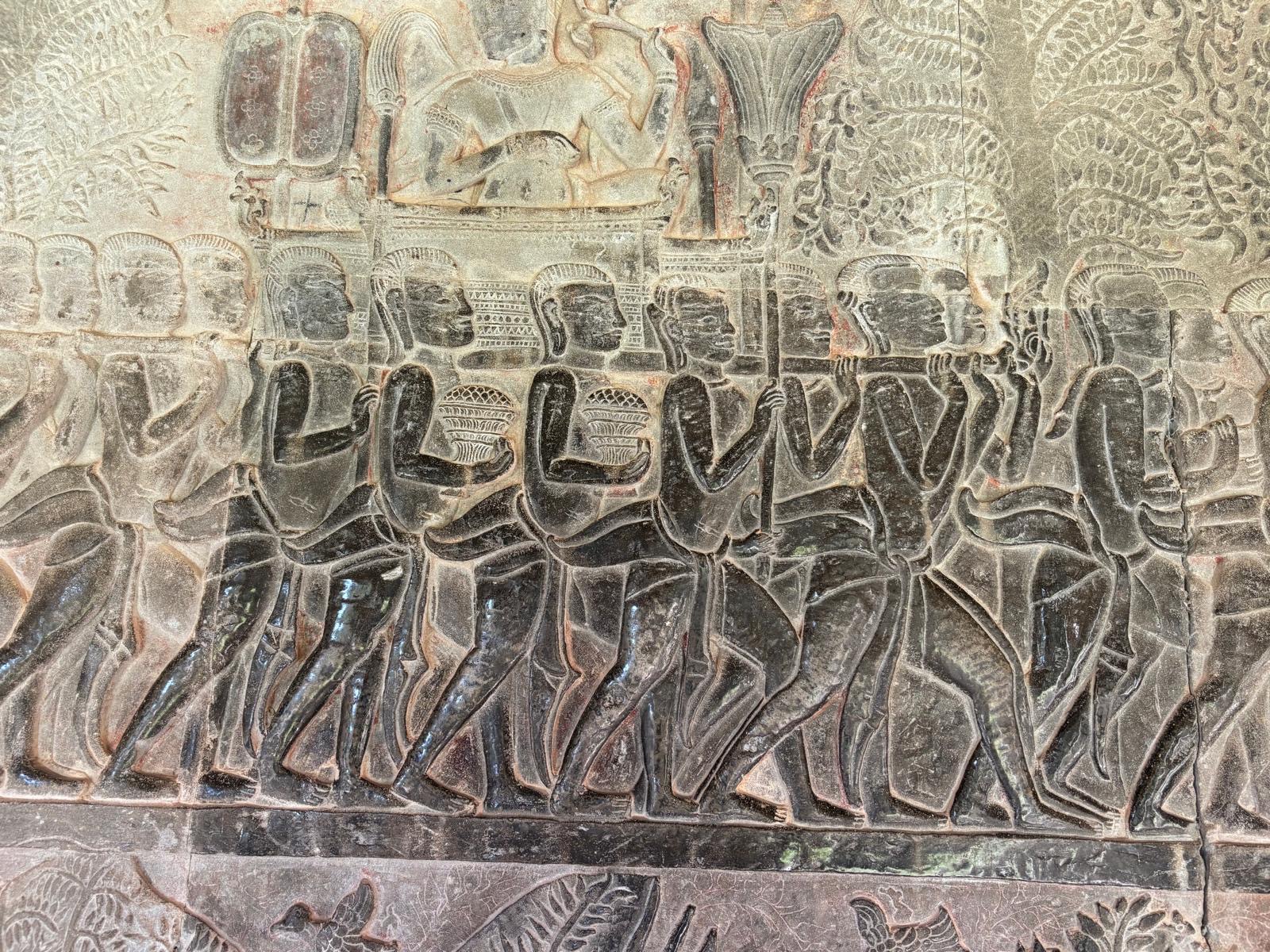
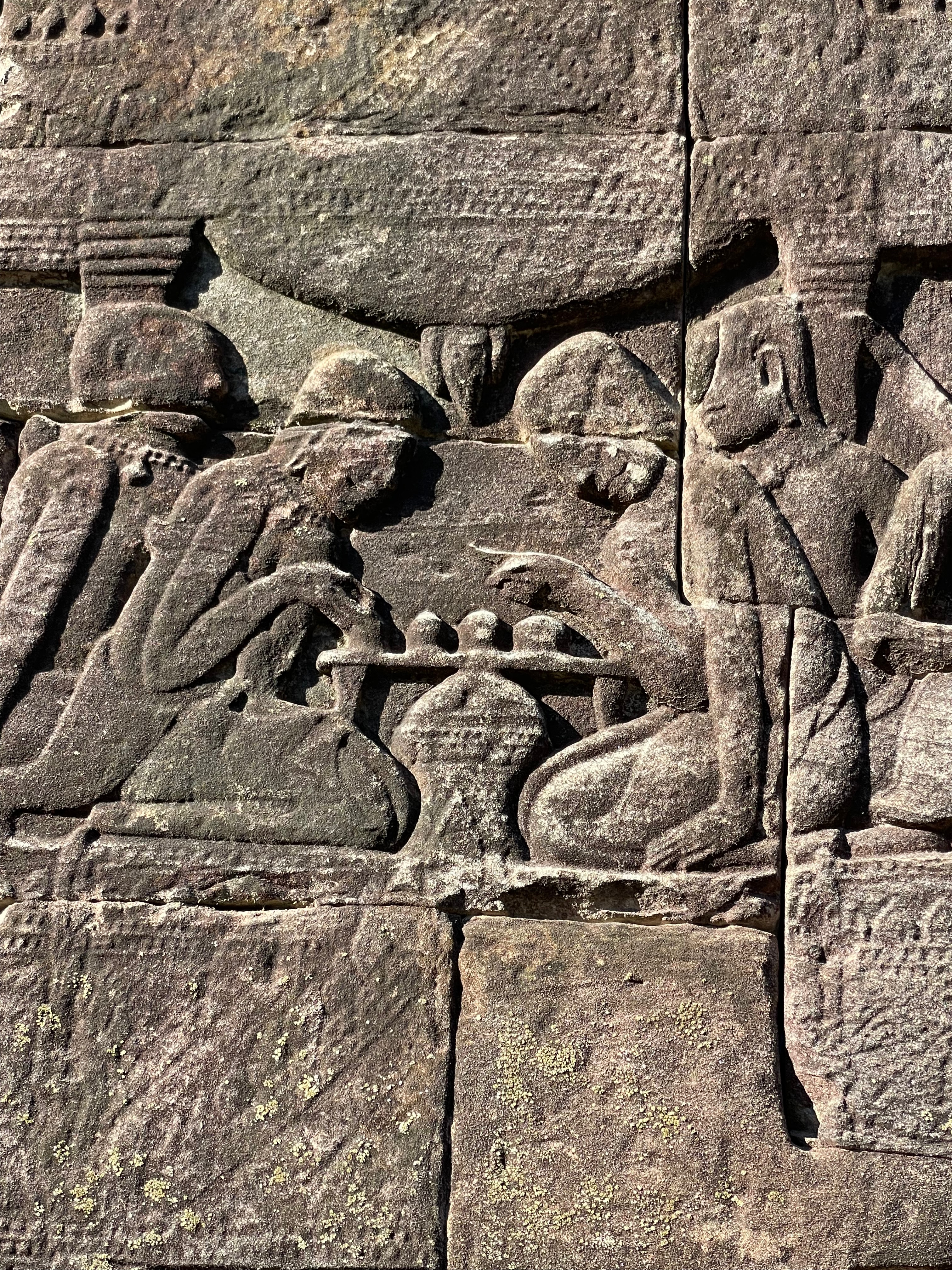
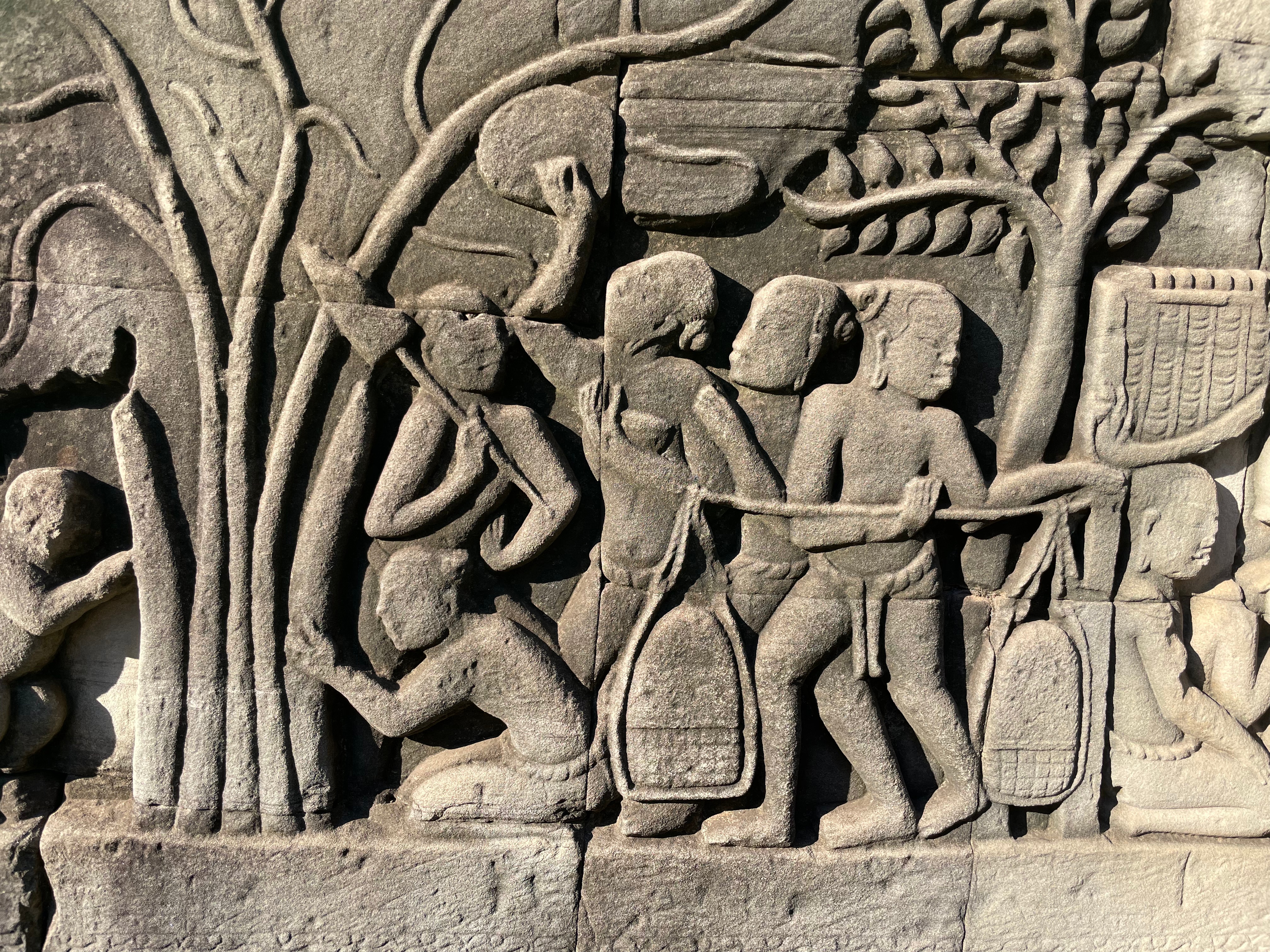
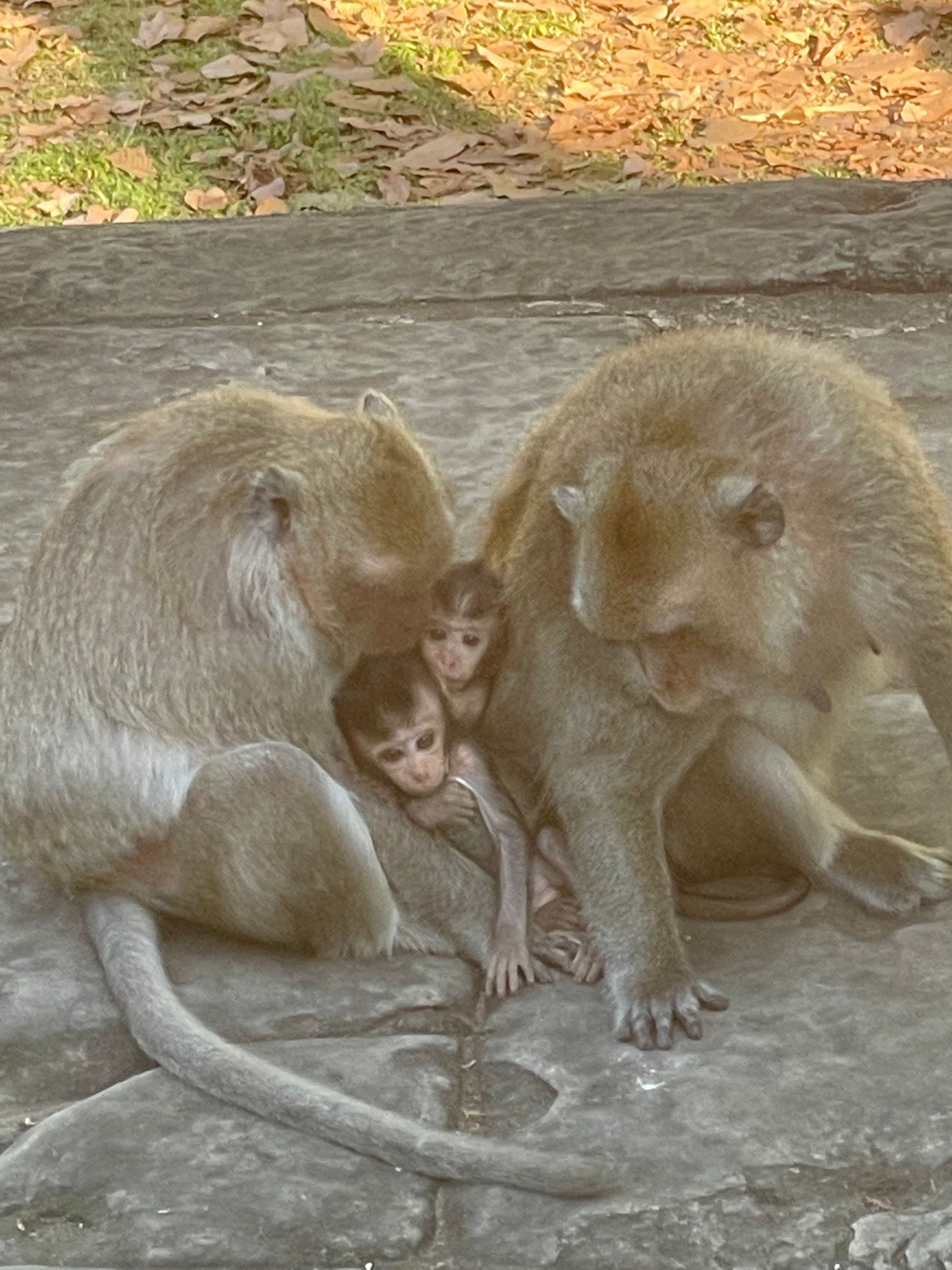
At Bayon, we focussed on the intricate and highly detailed carvings in the outer gallery portraying scenes of everyday life (working, playing, shopping at the market, food preparation etc) – quite a contrast to the focus on spiritual themes at the other temples. And we saw a monkey family with two newborn babies – gosh, they looked so human!

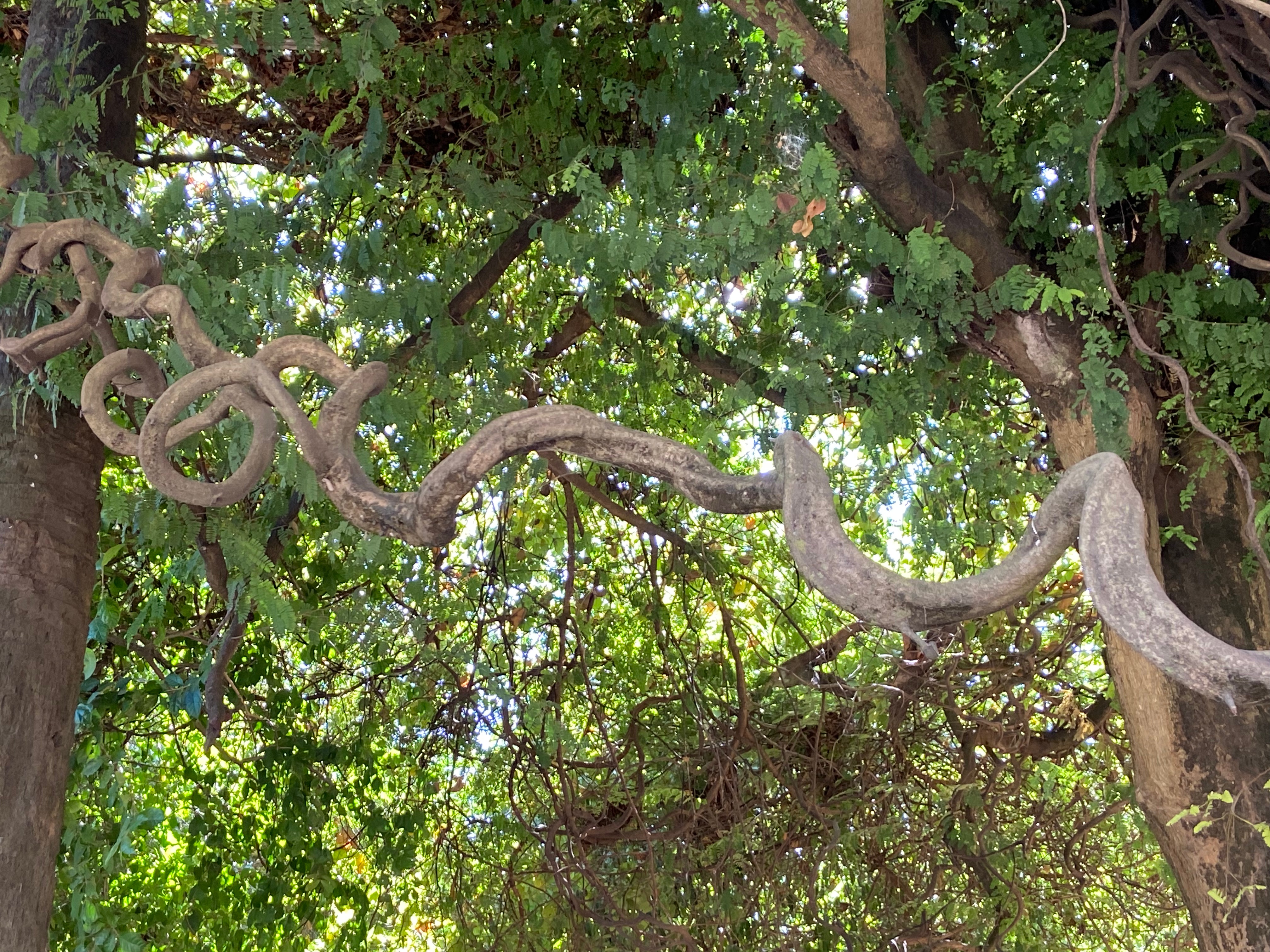
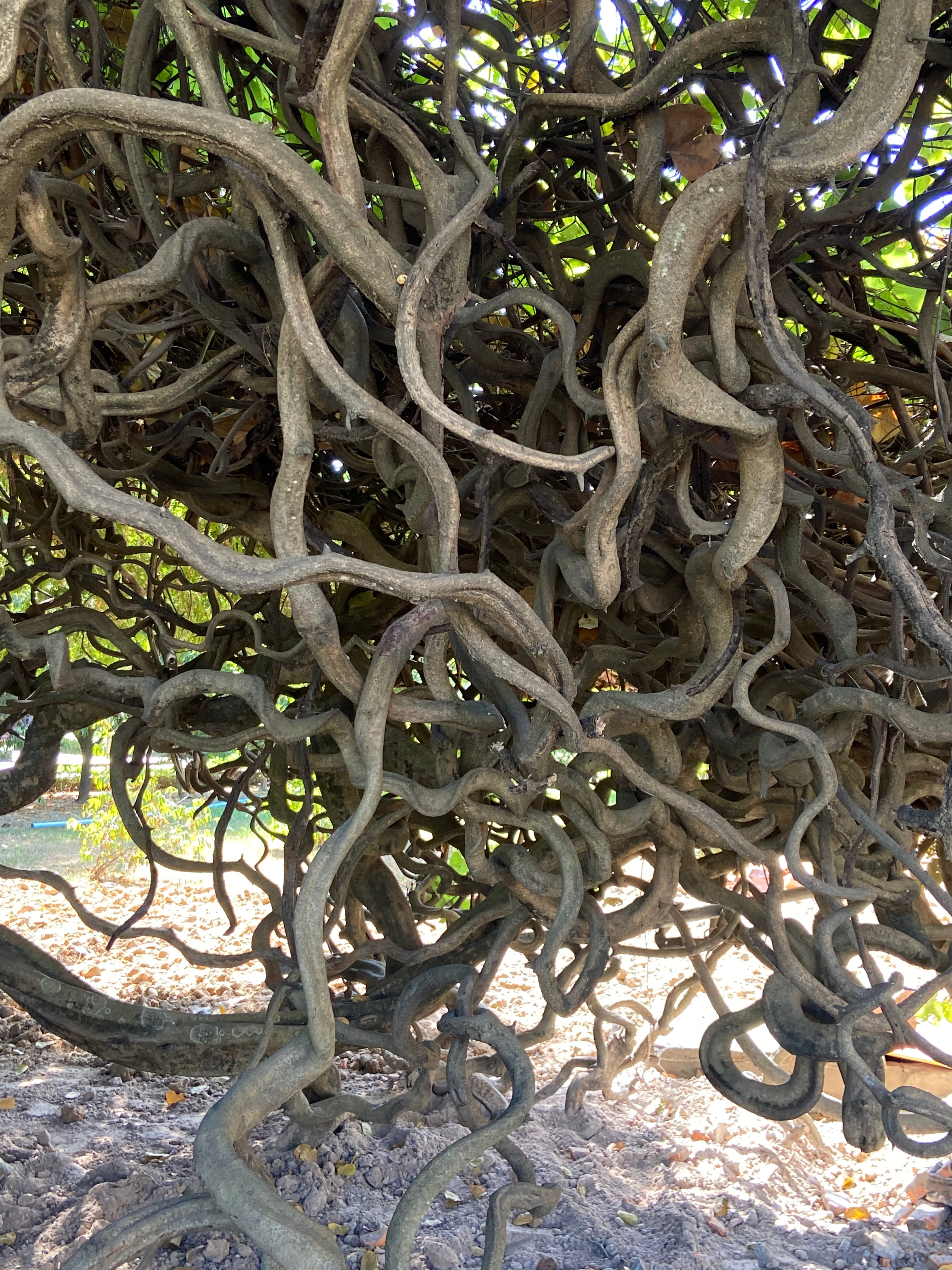
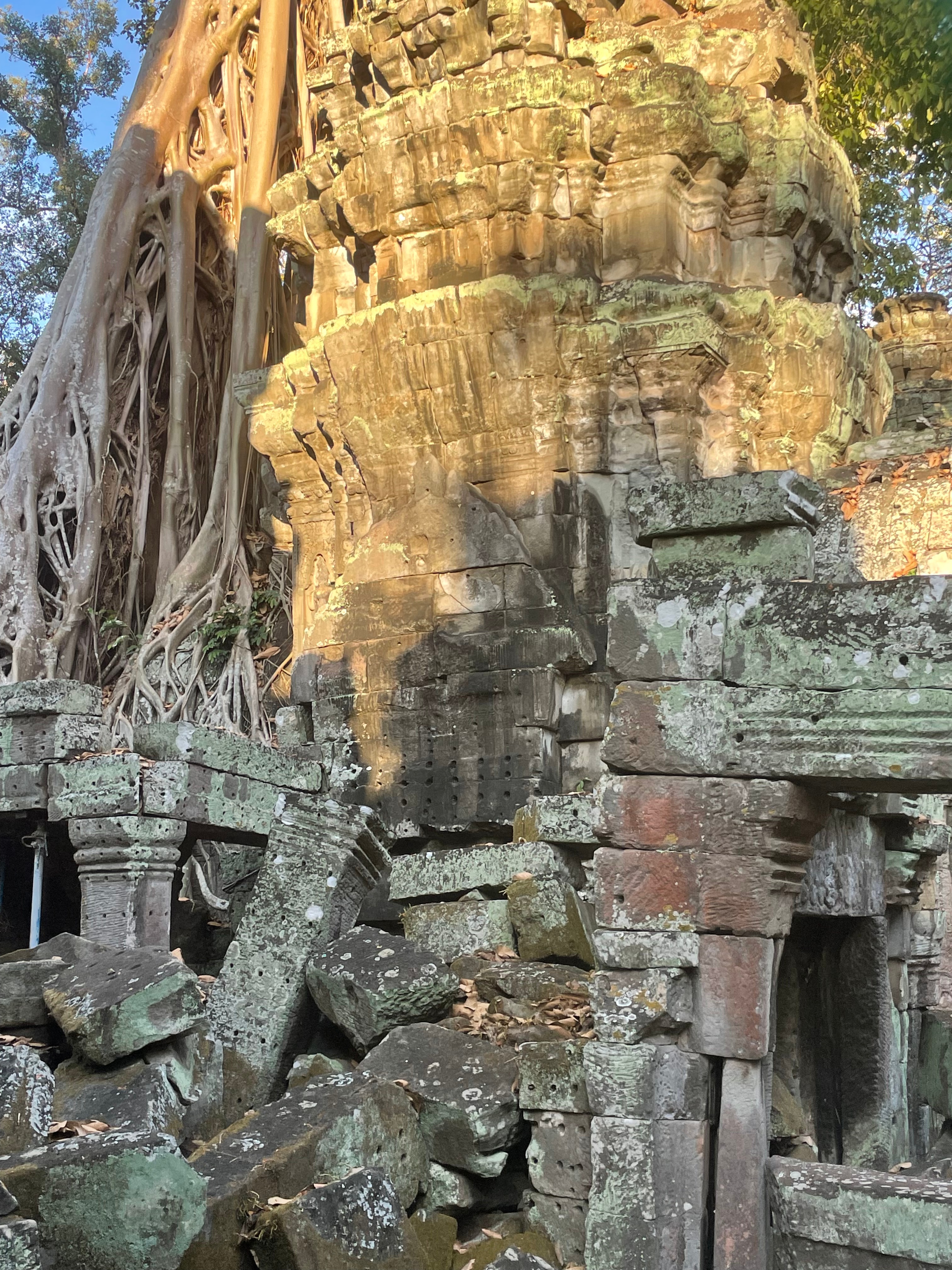
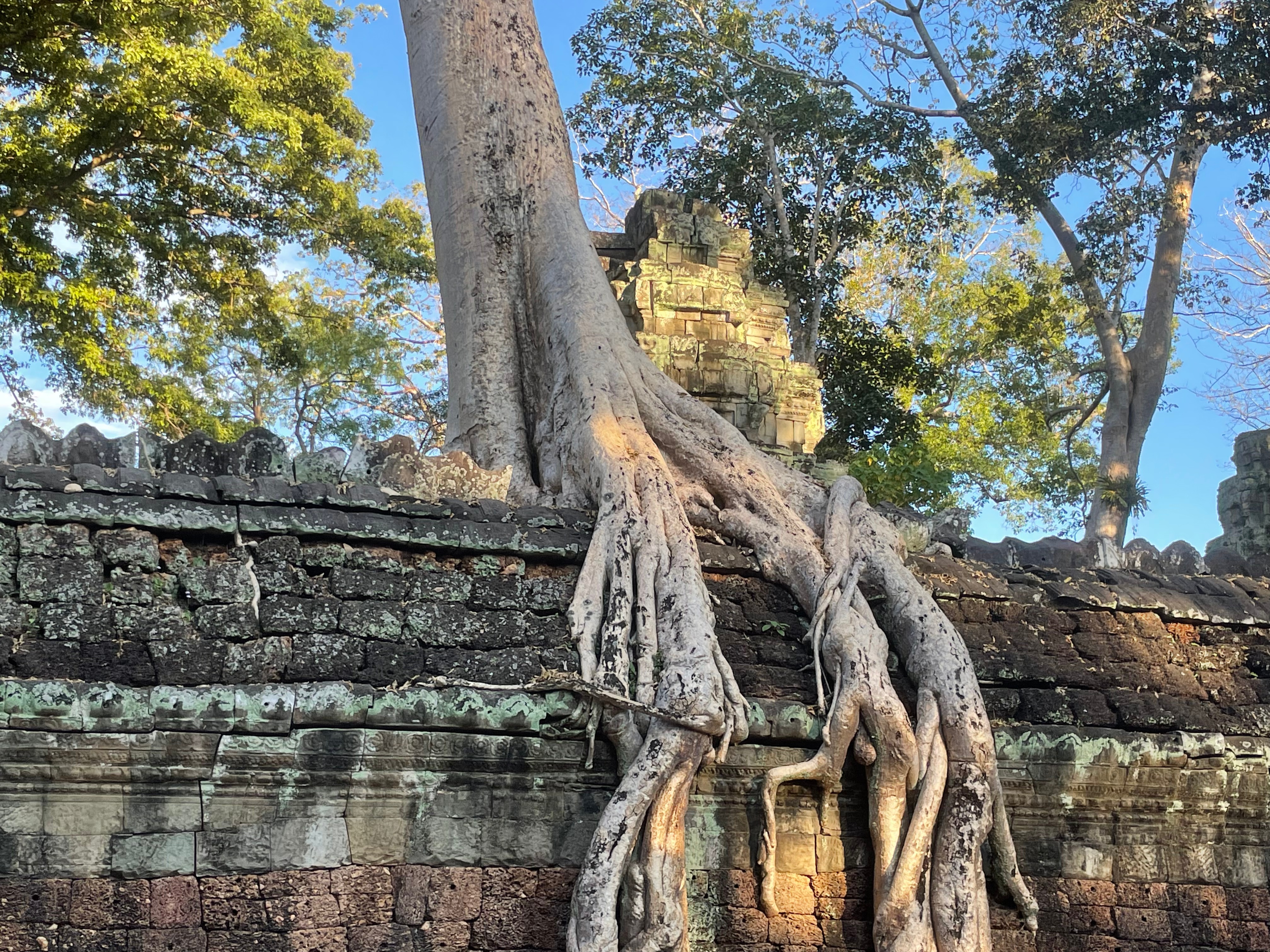
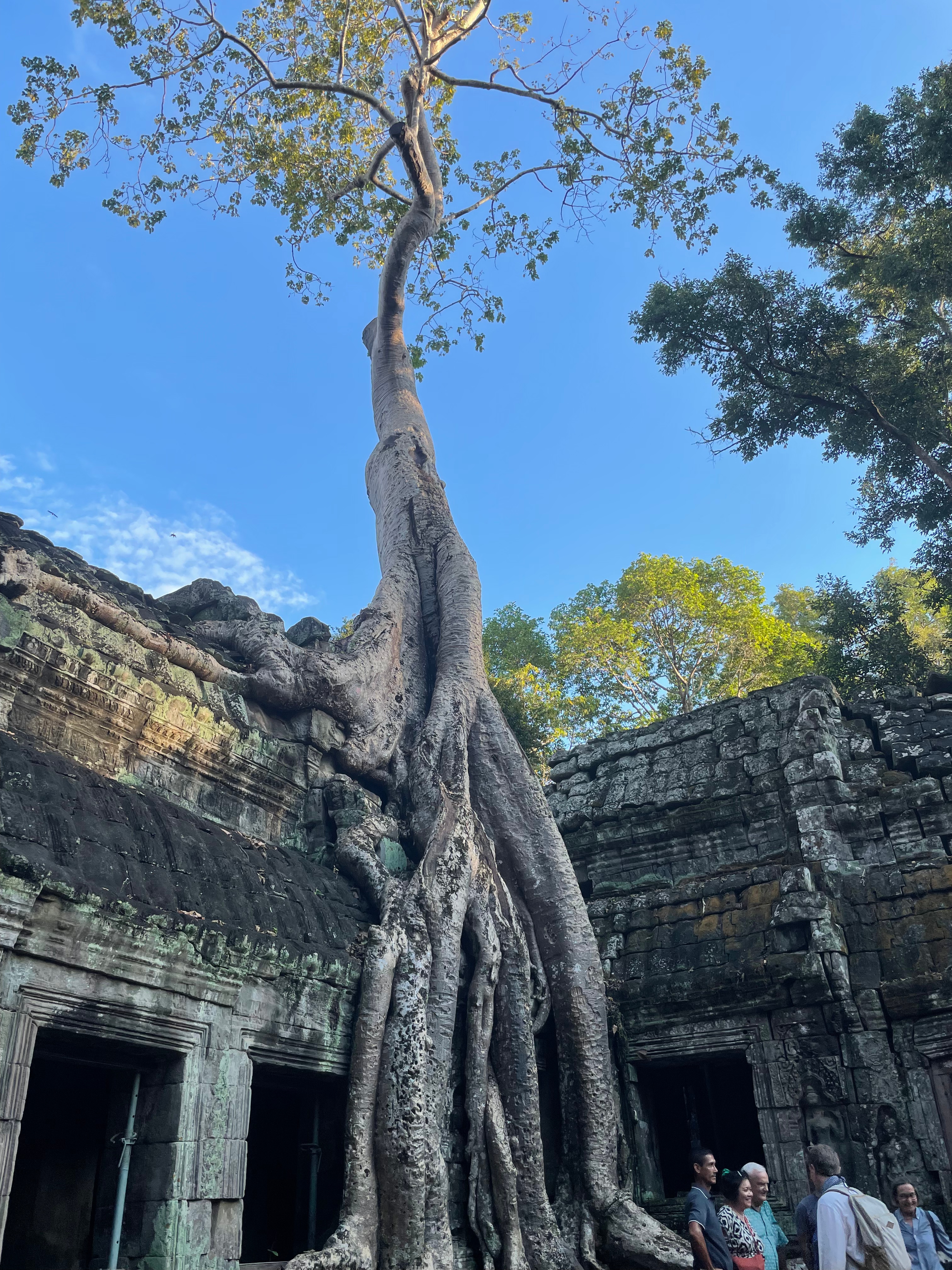
Last but not least we got to Ta Prohm, the temple that featured in Tomb Raider, as the sun was beginning to go down. Ta Prohm fell into disrepair in the 15th Century after the fall of the Khmer Empire and nature has reclaimed its supremacy here – the silk-cotton and strangler fig trees have spread their rope-like roots far and wide, uprooting stones and columns and spreadeagling across buildings as if part of the architectural design. It’s carefully curated chaos, though; ongoing conservation work aims to maintain the stability of the remaining towers, walkways and galleries at the same preventing further root damage. Watching the evening light on this post-apocalyptic-like landscape – it reminded me a bit of Chernobyl – was a fitting bookend to an extraordinary day.

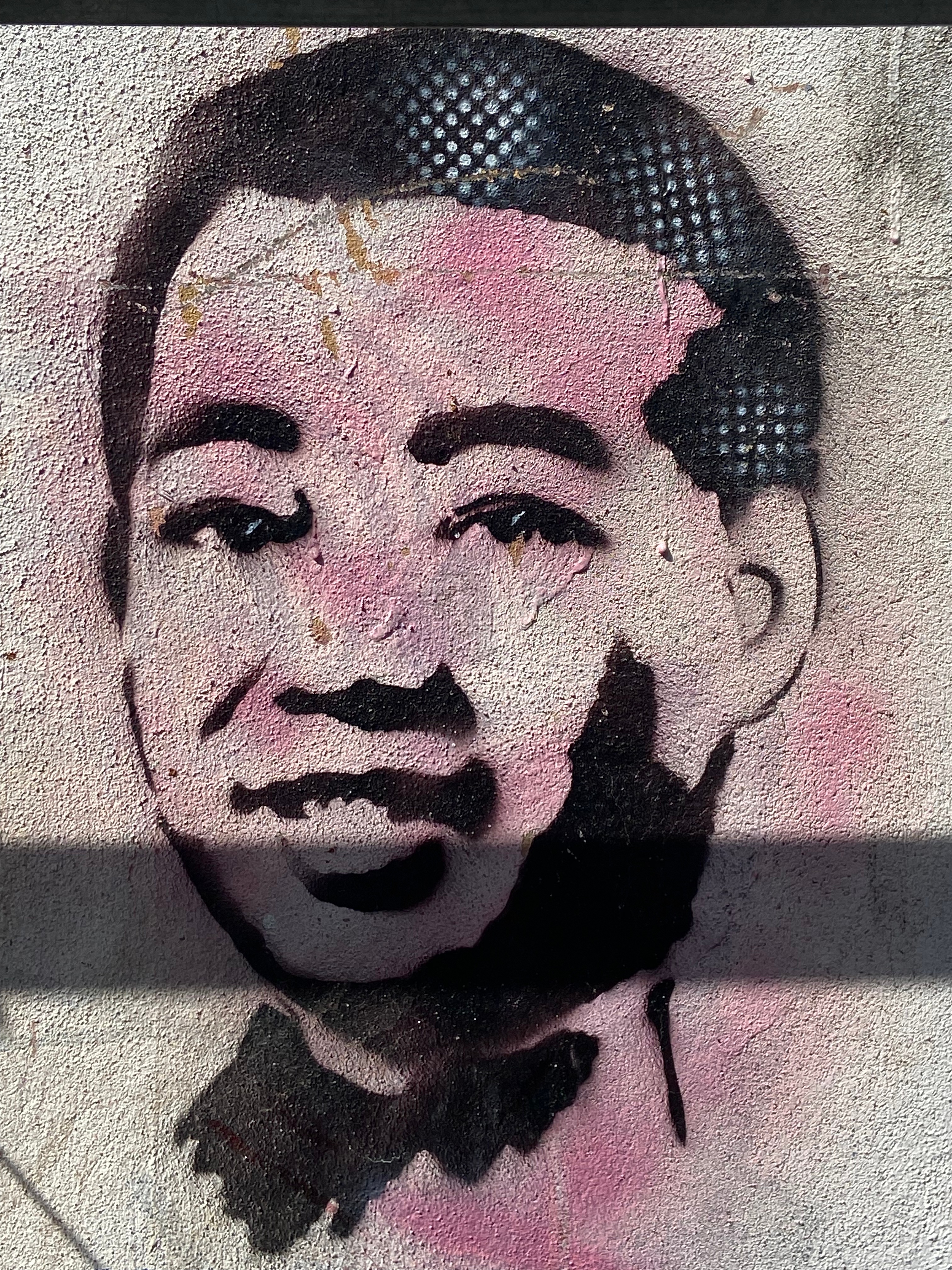
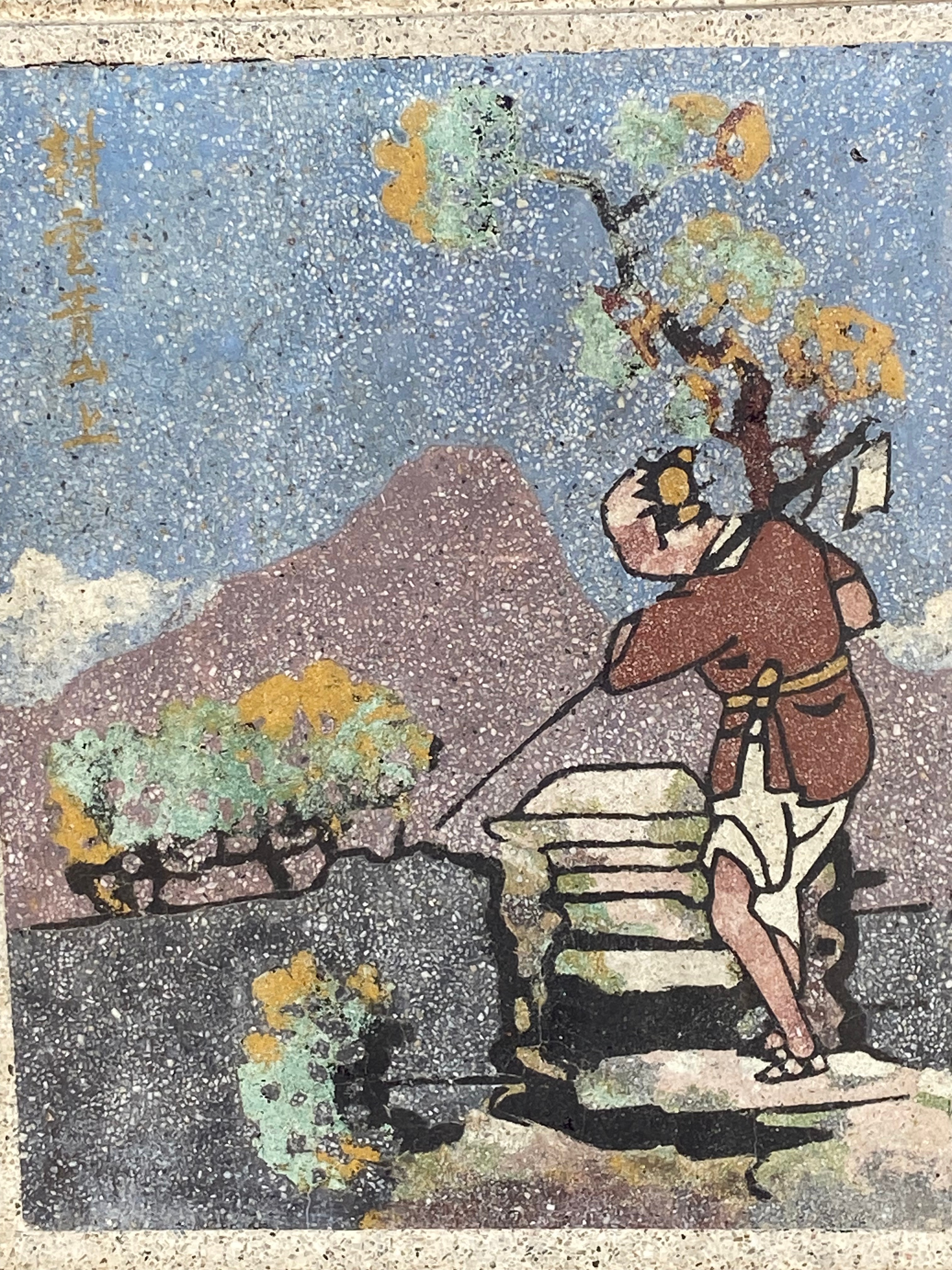
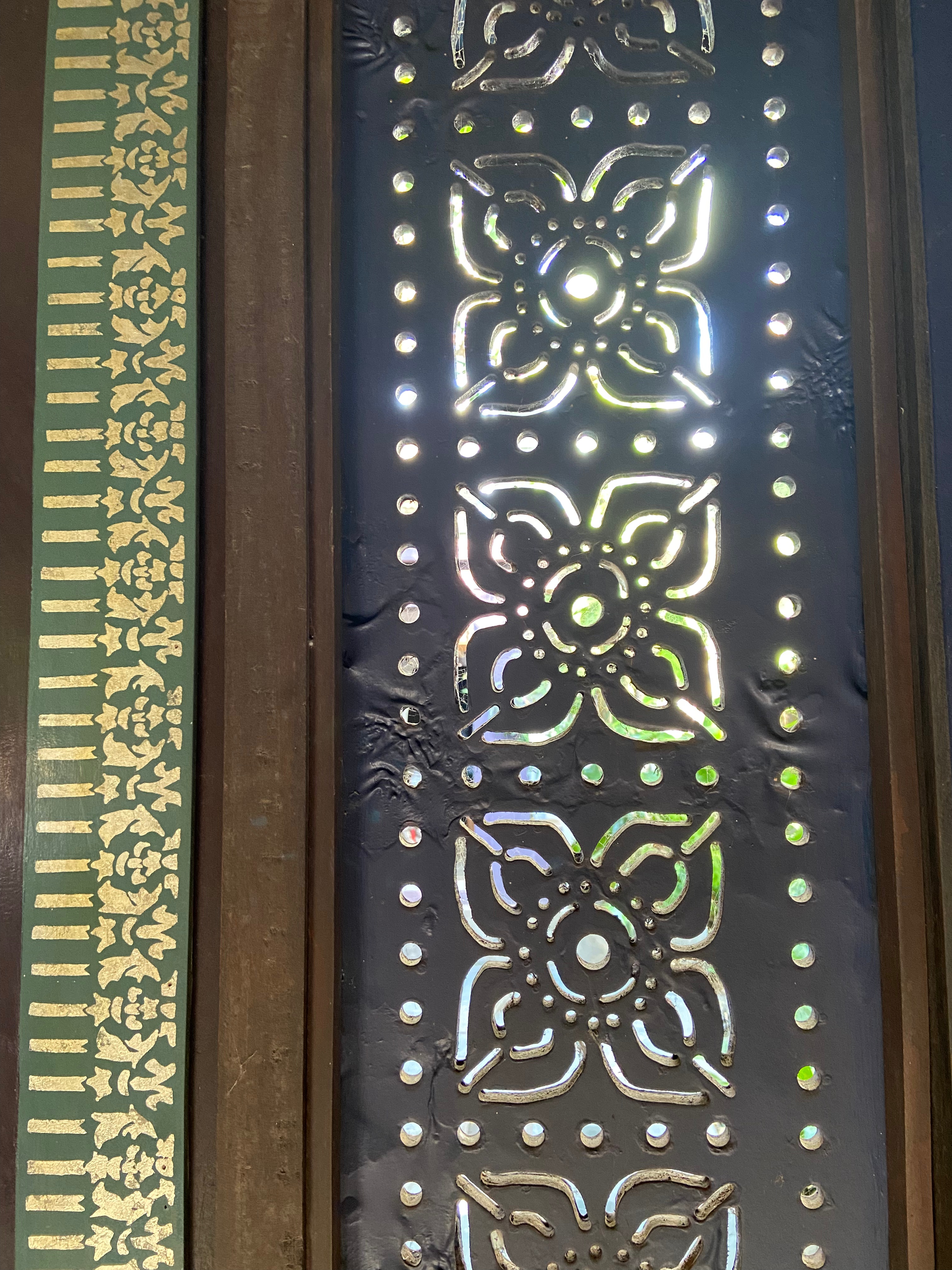
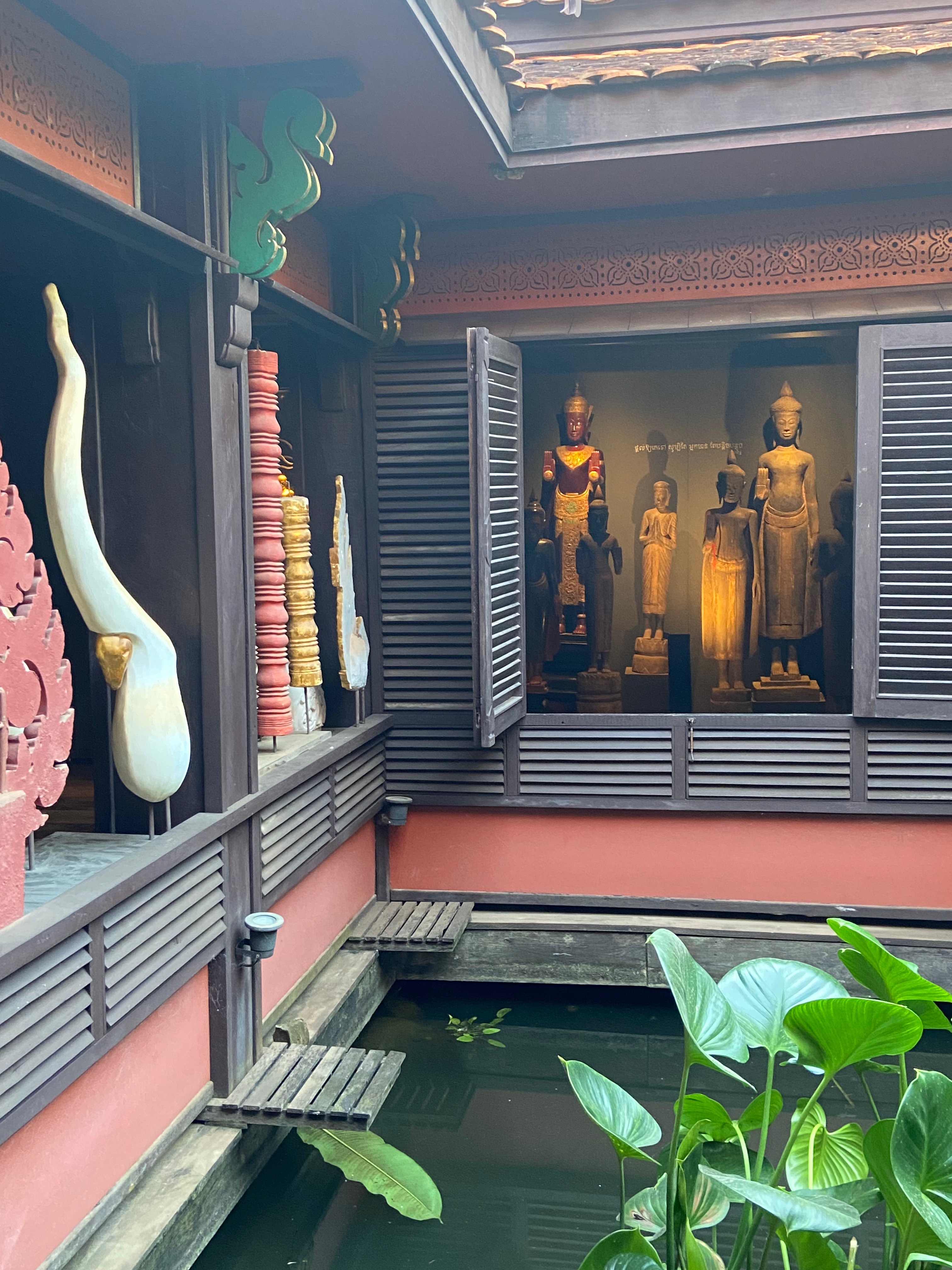
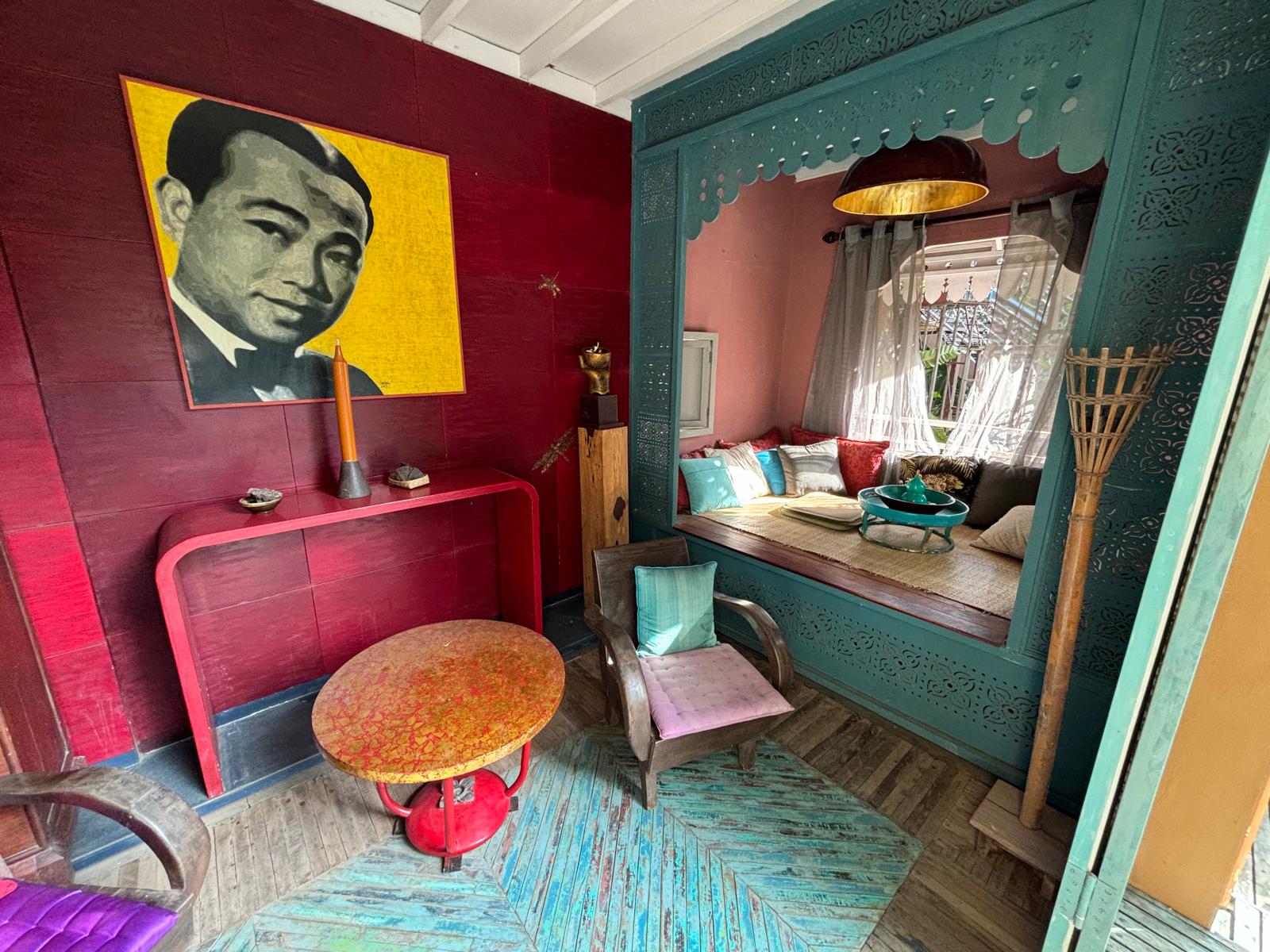
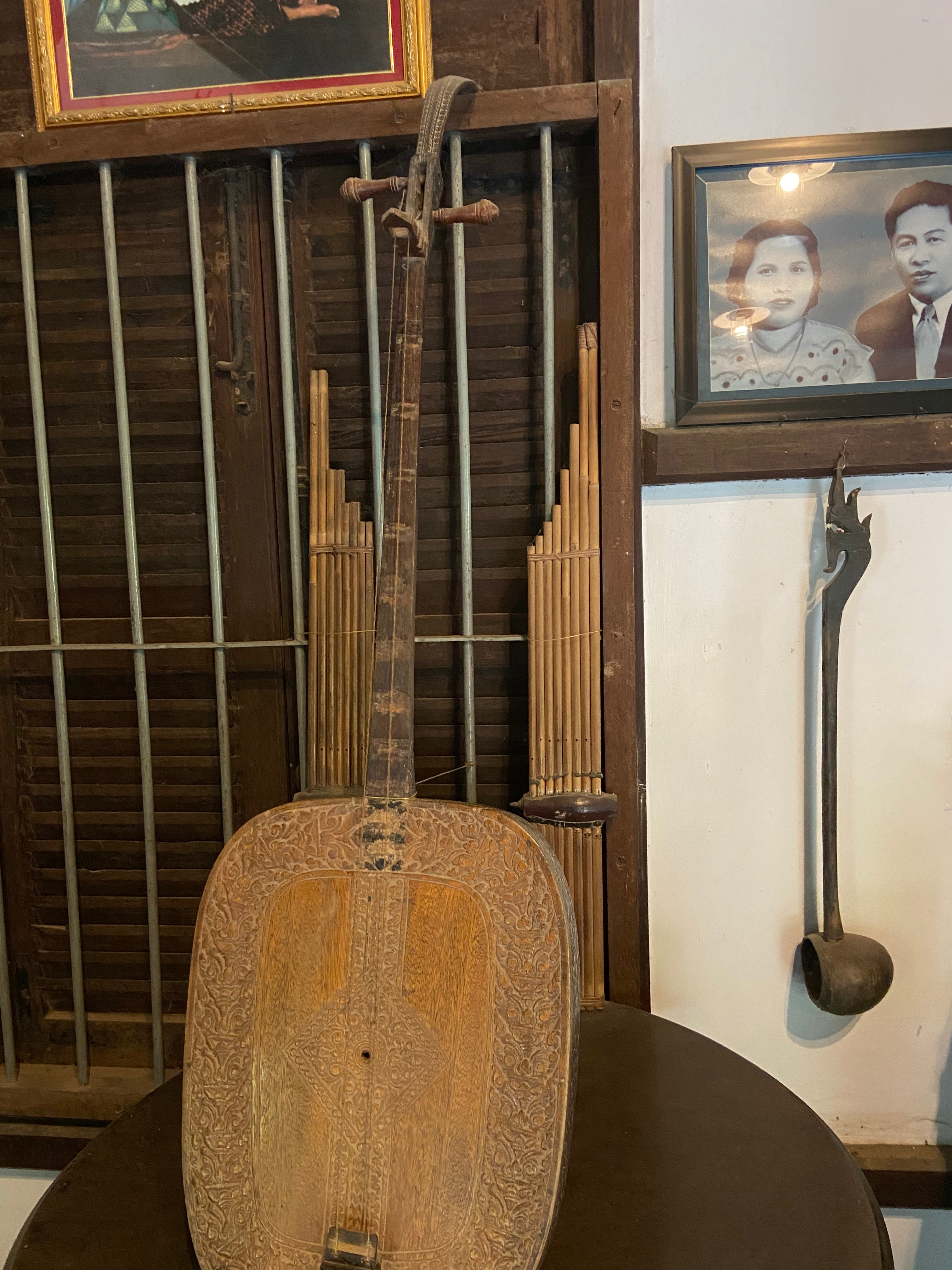
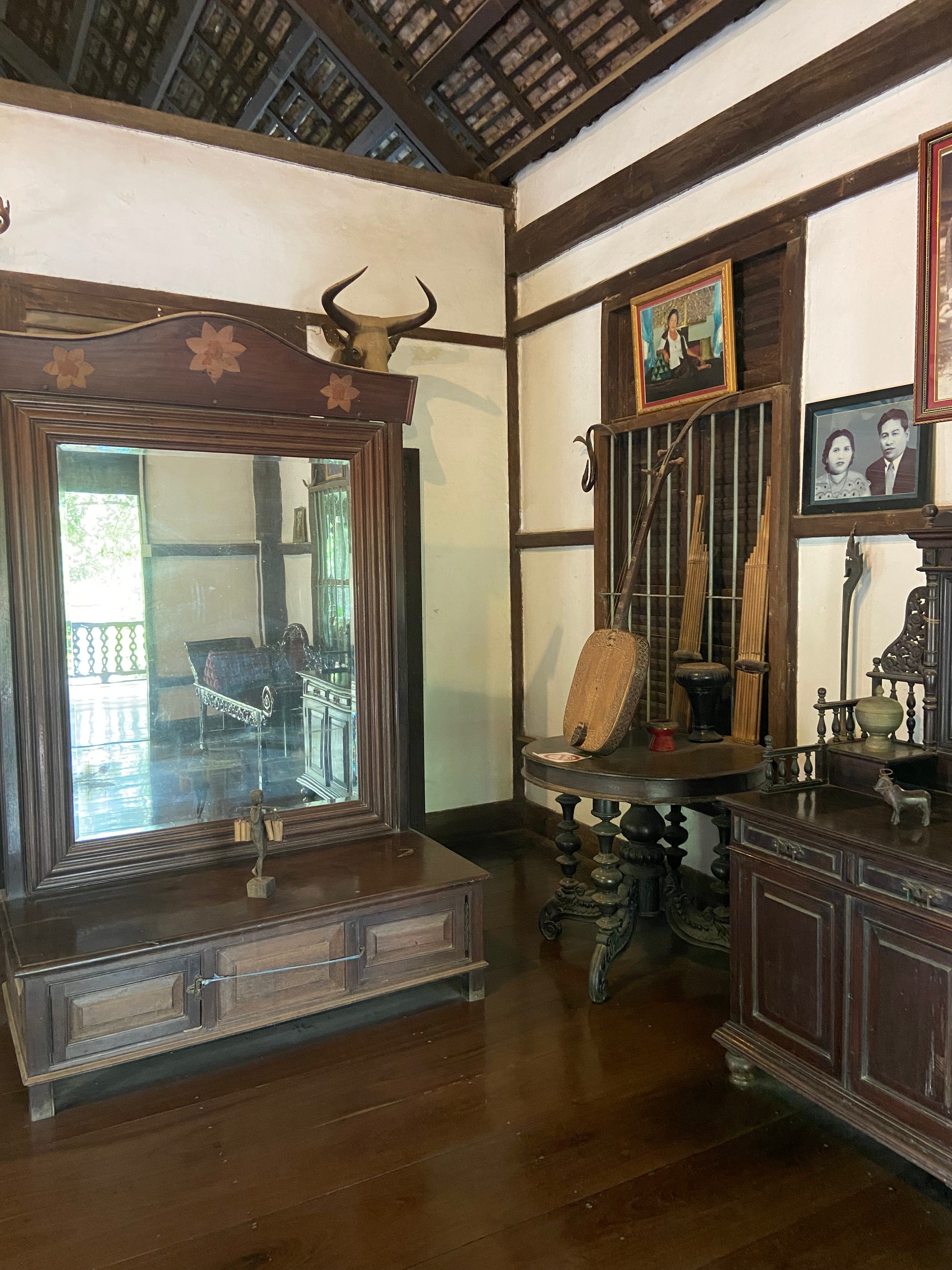
There’s of course more to Siem Reap than temples. One place well worth a visit is Theam’s Gallery, which is the home, atelier, and gallery of Master Cambodian Artist, Lim Muy Theam. It’s part workshop, part shop and part series of rooms and pavilions housing Theam’s collection of art and artefacts and in the middle there’s a garden shaped by the five elements and a Banyan Tree. The pavilions include a collection of historic instrument and bronzes of dancer’s hands with stylised dancers’ wrists and fingers. And I particularly loved the pavilion with the Buddhas, and the wooden shutters painted with gold scrolls and flowers looking out onto the garden.  Also delightful was a small room – a bit like a cocktail lounge with – a picture of Sinn Sisamouth ‘Cambodia’s Elvis’, a famous 1960s singer.

Fun, festivities and flavours in Cambodia: Phnom Penh and Battambang – Part 1 of 3

NB: Email subscribers- please click on the ‘Read on Blog’ link at the top of the email to enjoy the benefit of the formatted blog rather than the WordPress newsletter version.

On Christmas Day in 2023 my friend Di and I were sitting outside at a roadside restaurant in Cambodia, the occasional ant dropping on us from an overhead tree and supping on a tasty broth made with pieces of pork, wrinkly skinned tofu and vegetables followed by a delicious omelette filled with dried fish. If I had to sum up my trip to Cambodia in one word it would be immersive. So many sights, sounds, colours, flavours, spices, sensations and the constant hustle and bustle of tuk-tuks, survival-of-the fittest traffic, street dogs, repair shops, roadside food stalls and sidewalks sizzling with frypans.

I’d been rather anxious in the lead-up to my trip – finishing work, getting my house, garden and dog ready for the dog-sitters not to mention packing, worrying about getting food poisoning and feeling somewhat hysterical about the prospect of being zapped by a mozzie carrying Dengue fever.

But when I landed on 22nd December to a laughing and smiling Di – she’s currently living and working in Cambodia – and her lovely driver Theary, a beautiful soul and a very gentle man – all my fears started to dissipate. And Di and I were soon giggling with joy, something we often do when together.  

I jumped straight into it all on my first night and we walked out to a seafood restaurant – crossing a busy main road, one that Di must navigate daily. I have not travelled much in Asia so had no experience in wading out into the traffic – no one seems to follow any rules – and hoping the Red Sea would part. Yikes!

We ate at Nesat Seafood where I had stir-fried squid with vegetables and green Kampot pepper – young green pepper corns that have a zesty bite, a new flavour sensation for me. We also had margaritas – something that became an almost daily ritual over the 12 days of my trip.  

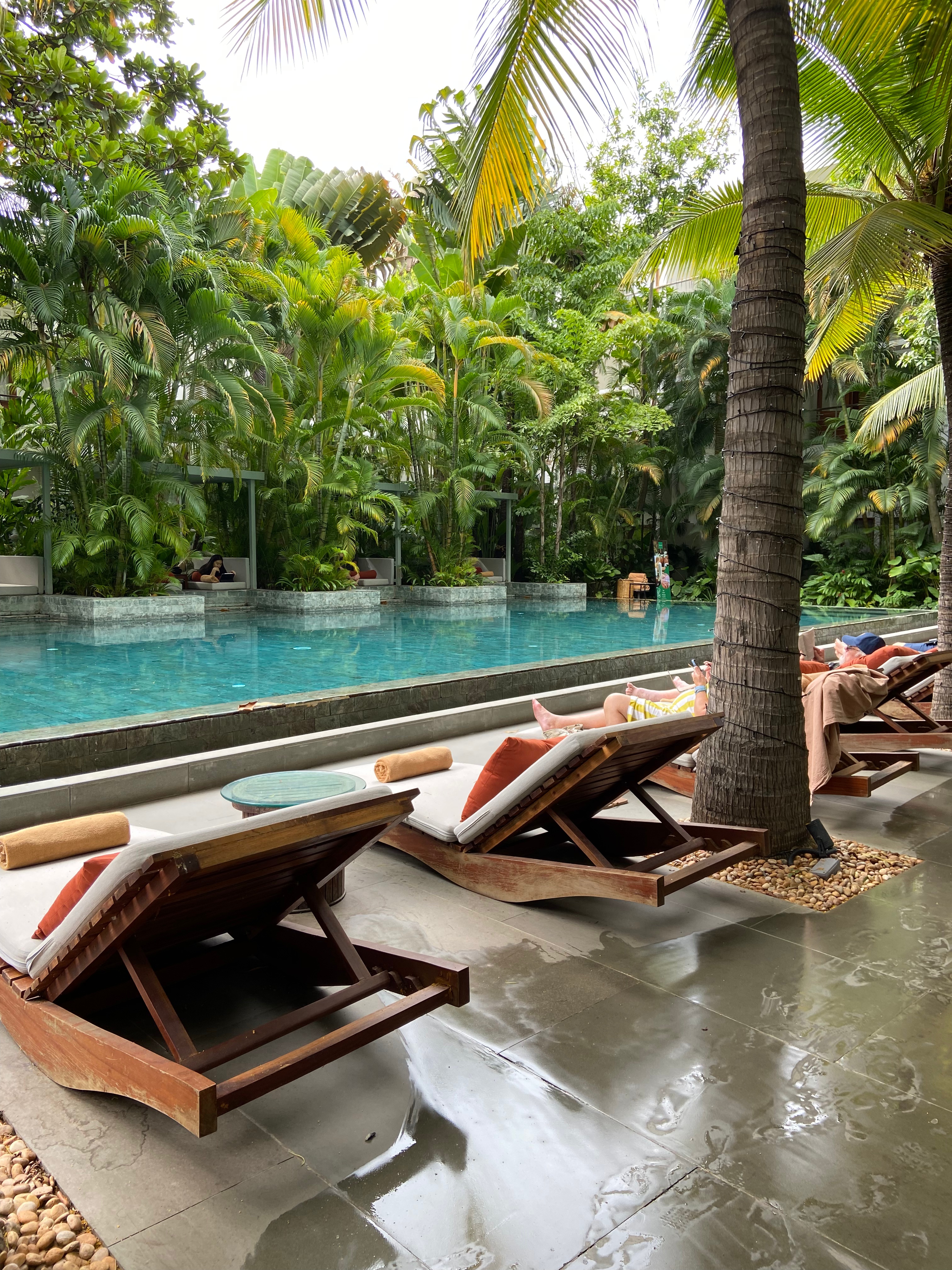
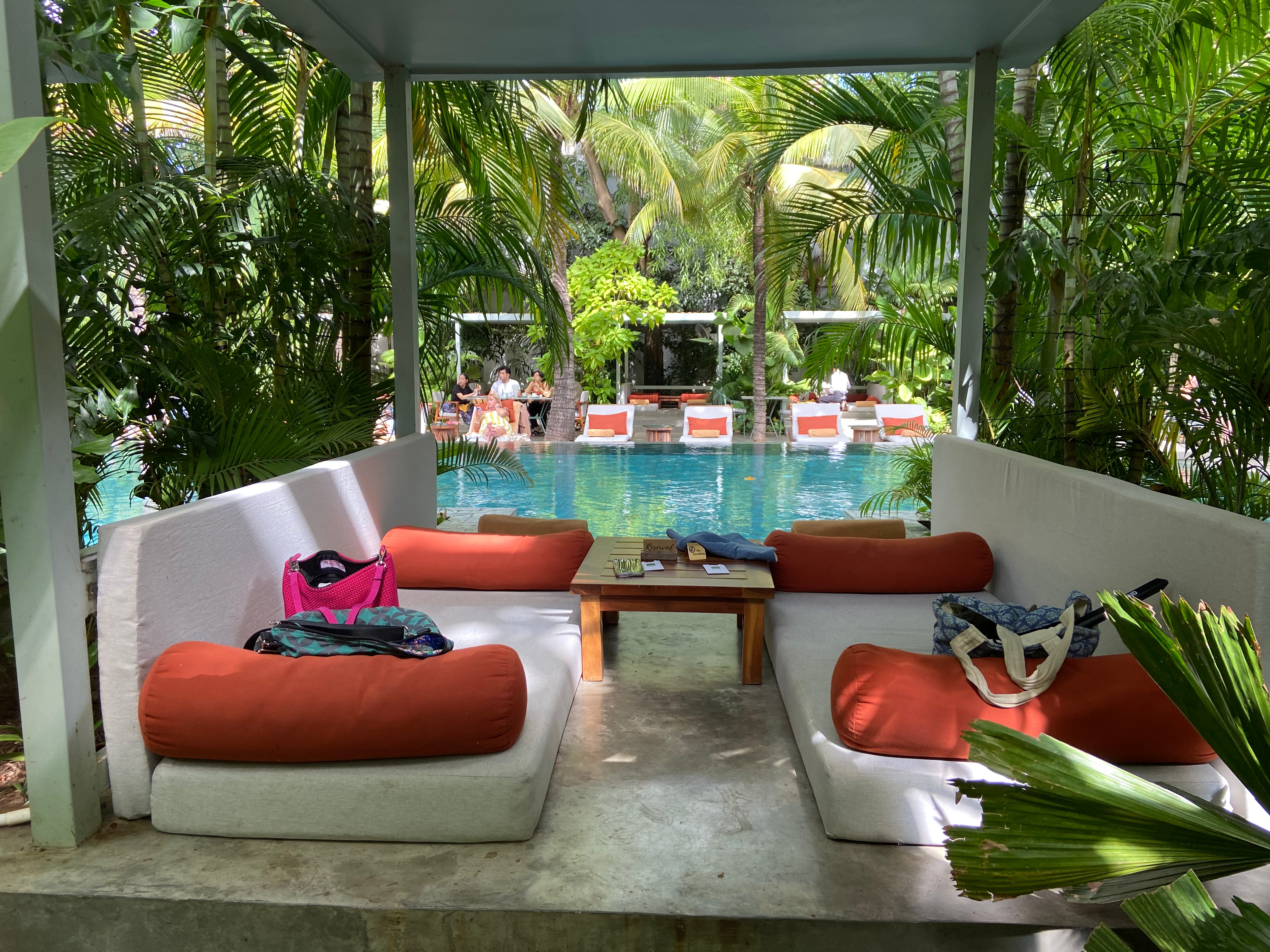
I had had a milestone birthday in October 2023, and Di’s present to me was an overnight stay and pamper session at the Plantation, an urban resort and spa in the middle of Phnom Penh. You approach via a courtyard with pillars and arches showing local art and a carp-filled pond in the middle guarded by dragon statues. The tree in the centre of the lily pond was adorned with lanterns with the addition of red baubles for Christmas. We each had a room overlooking the pool – beautifully landscaped by trees and lush greenery.
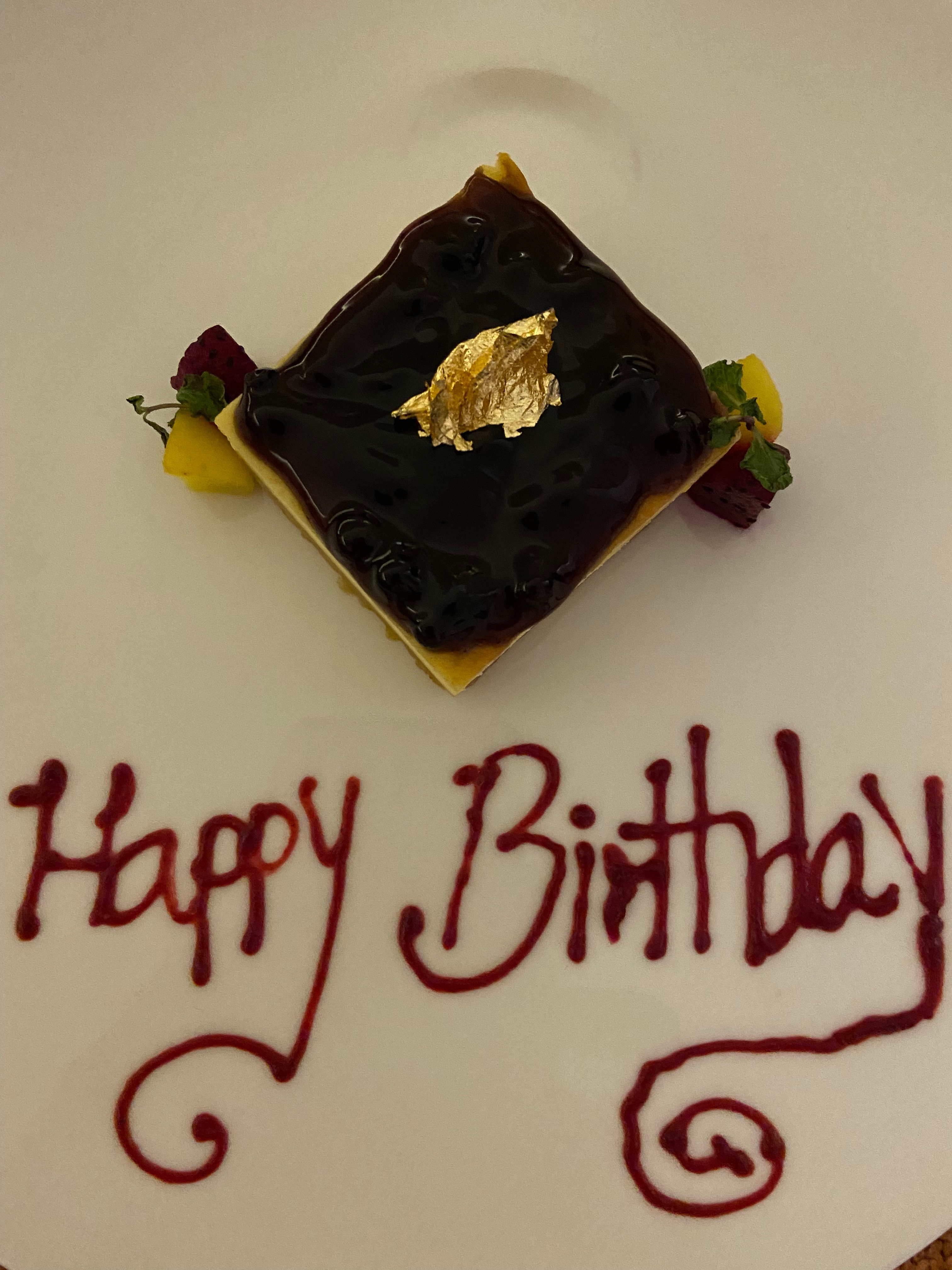
In the afternoon I enjoyed a two-hour Khmer massage with a hot compress packed with herbs including turmeric, galangal and lemongrass. Although I didn’t fall asleep as such – the compress was very hot, sometimes almost too hot – I emerged feeling wonderfully rejuvenated, my muscles warmed up and everything flowing.  Soon after my massage, one of the staff knocked on my door and presented me with a piece of cheesecake topped with a bit of gold leaf and Happy Birthday written in berry coulis.  Tempting as it looked, part of my birthday treat was dinner at a French restaurant so eating cheesecake beforehand was not an option.  The plate wouldn’t fit in the minibar fridge so I scooped it up in a plastic shower cap so it would go in – waste not, want not!

After breakfast the next day, a spot of poolside lounging in a cabana and a brisk swim in the pool – it was a coolish 23 degrees, windy and cloudy – we set off to explore Phnom Penh. We walked along ‘no traffic’ street and Street 246, before heading along the river. Di pointed out some of the architectural features – from a coffin shop to art deco and colonial buildings on the opposite side of the river. And the Chaktomuk Theatre (now a conference centre) built in the ‘60s (a golden era in Cambodia) with its fan-shaped structure referencing a palm leaf. It was designed by Vann Molyvann, the architect who pioneered the New Khmer Architecture, combining modernism and Khmer tradition.

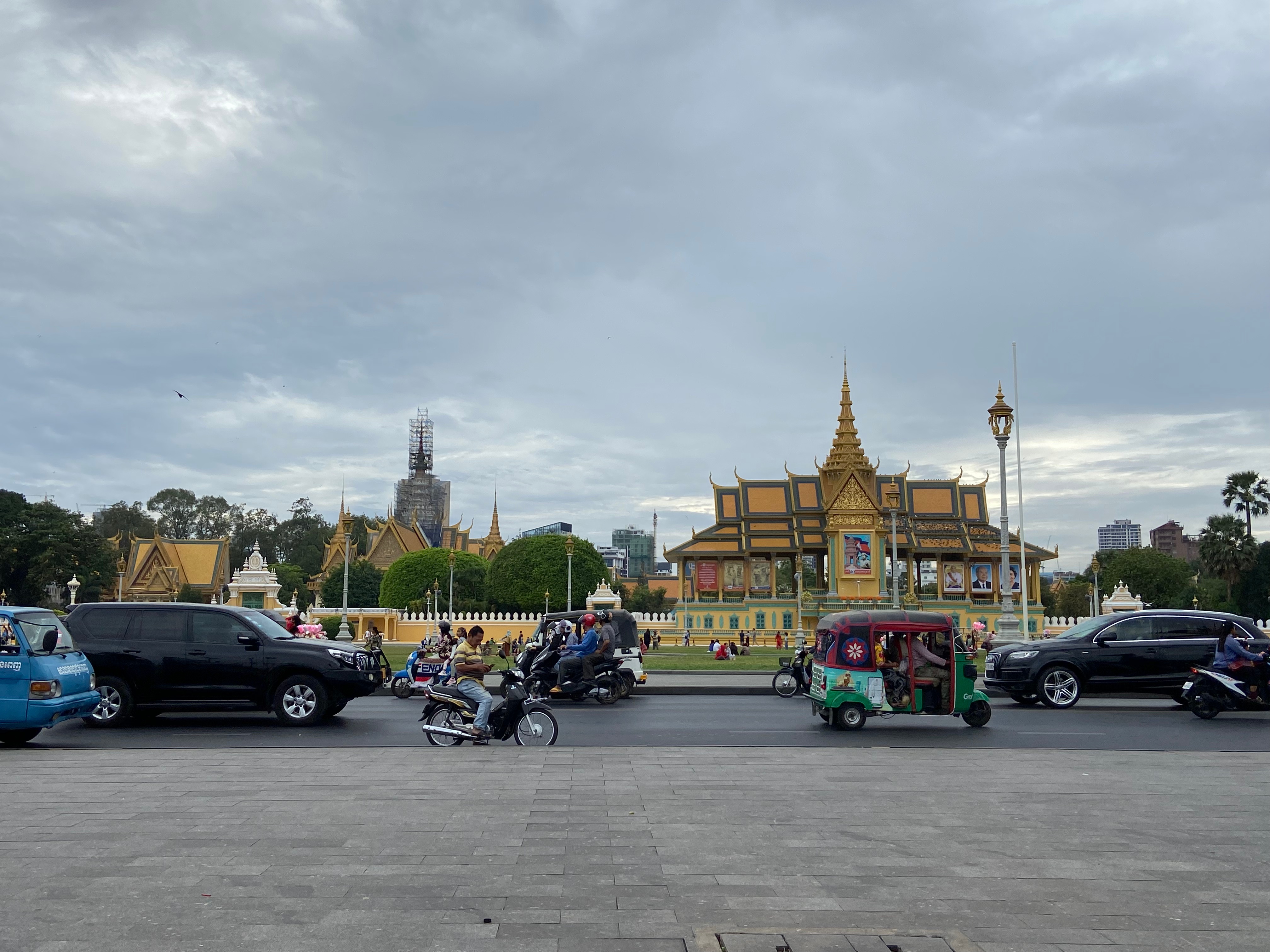
Walking on along Sisowath Quay – with great views of the Royal Palace over the road – we passed a group of people playing a Cambodian ball game – the idea is to keep the ball in the air using arms, legs, head, thighs, hands – whatever! Quite fascinating to watch. Then there were the usual food vendors, fortune tellers with their packs of cards and the Preah Ang Dorngkeu Shrine where people were buying lotus flowers, candles and incense sticks. Around 2pm we stopped and snacked on ham and cheese that we had snaffled from the breakfast buffet followed by the shower cap cheesecake, the latter rather gloopy and over-sweet. But at least we ate some of it!

In the distance we looked over at the Independence Monument built in 1958 to celebrate the day the Cambodians won back their independence from the French protectorate on 9th November 1953. The 20-meter-high monument was also designed by Vann Molyvann and is shaped in the form of a lotus.

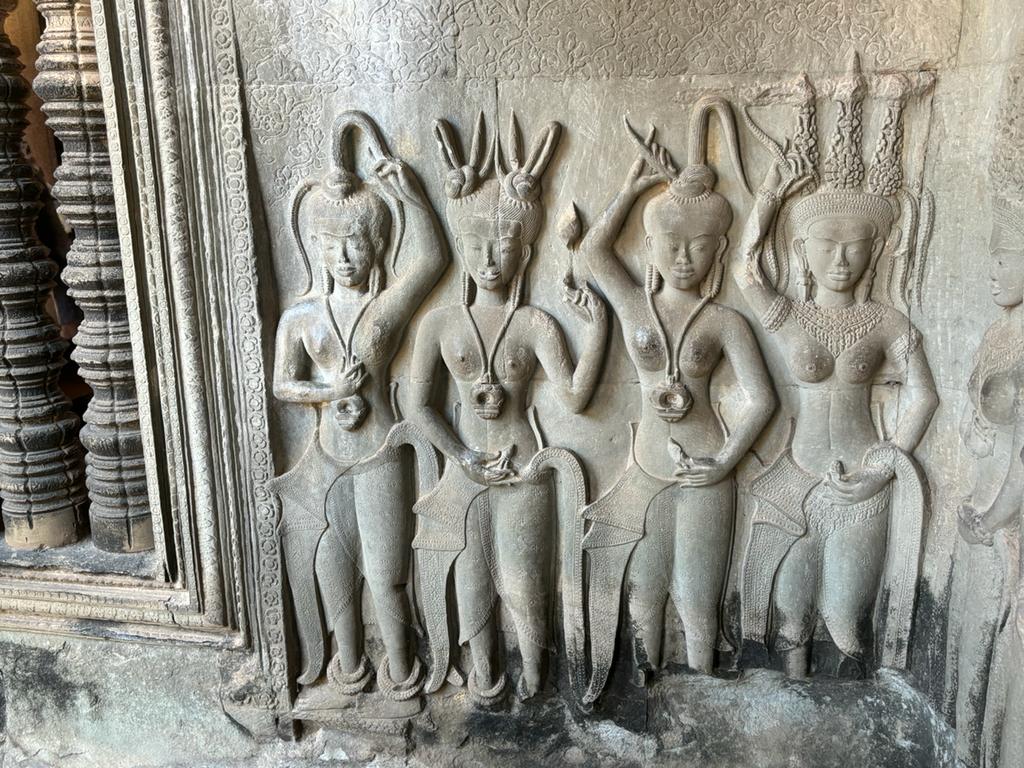
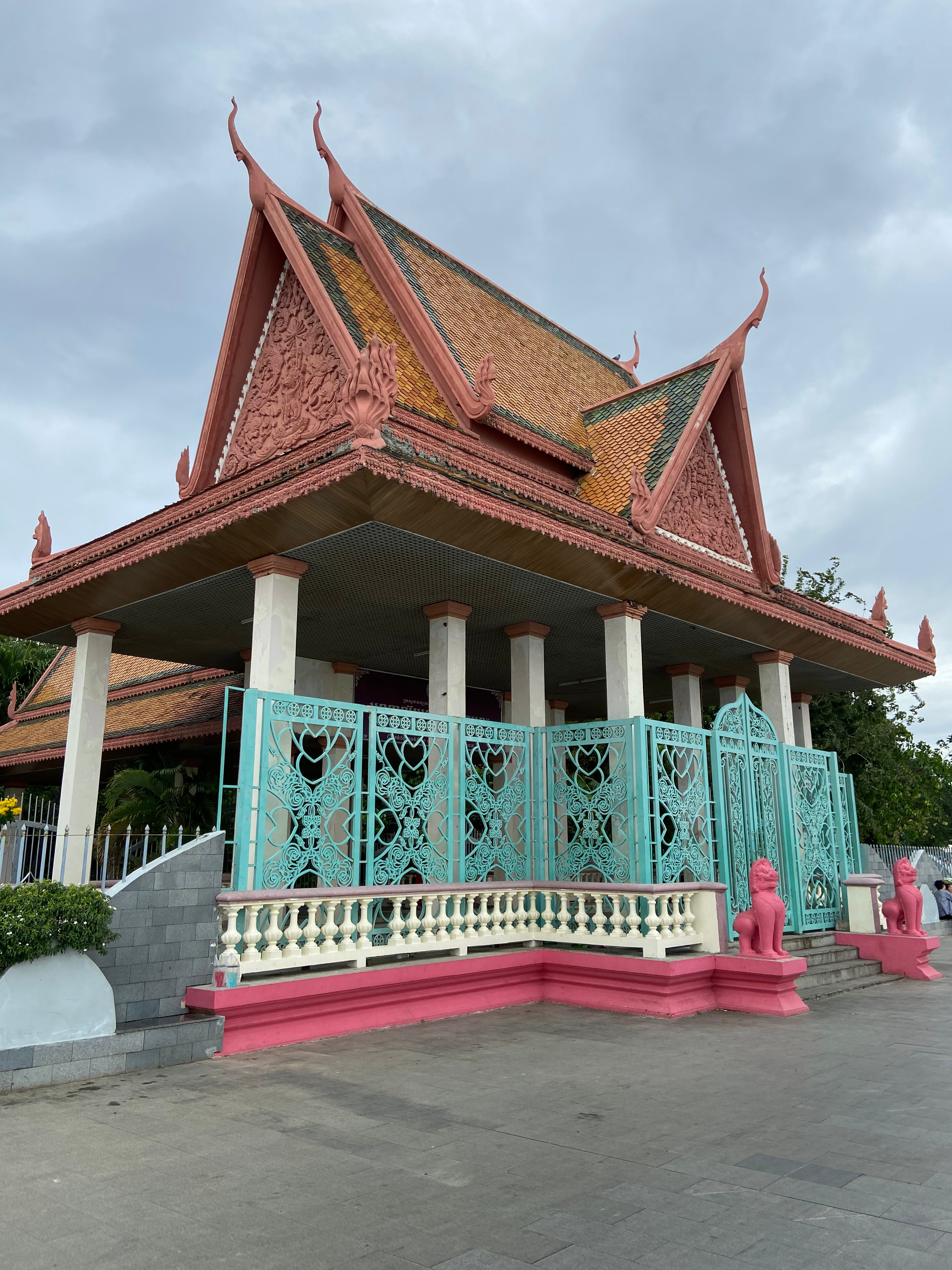
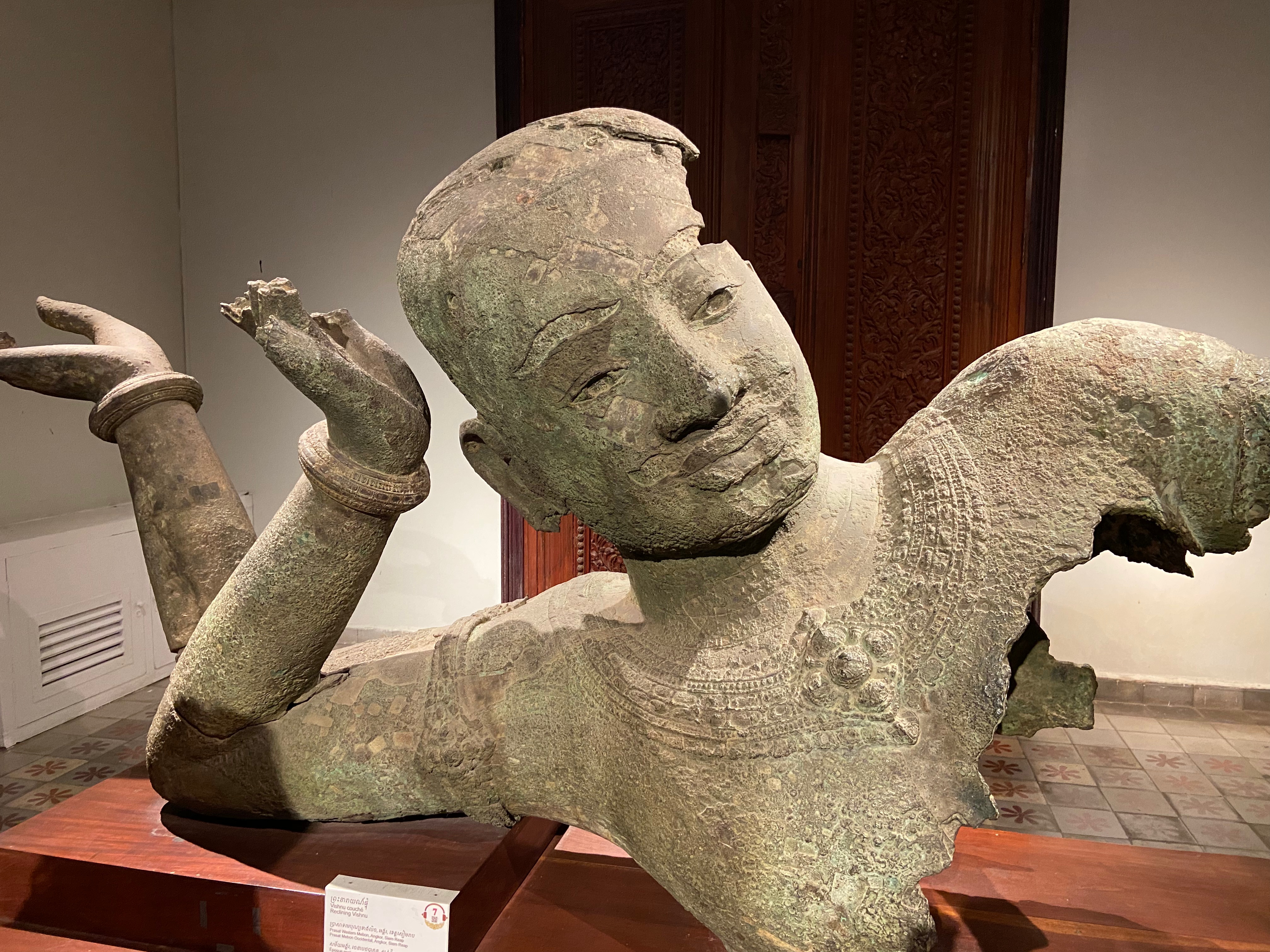
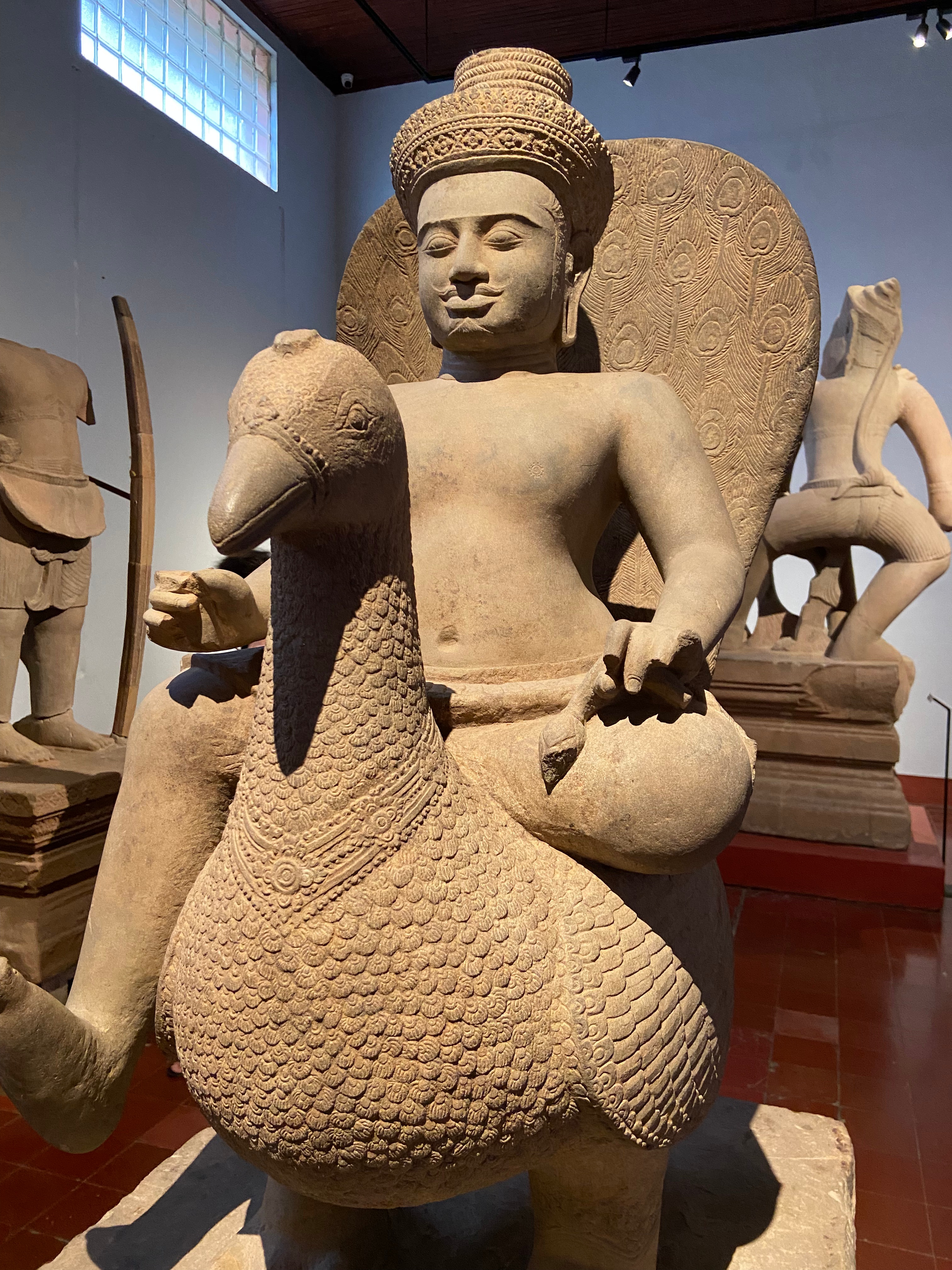
We spent the afternoon visiting the National Museum of Cambodia, built in the traditional Khmer style with tiered roofs and spires. The museum houses one of the world’s largest collections of Khmer art, over 14,000 items from prehistoric times to periods before, during and after the Khmer Empire which, in its heyday, extended from Thailand, across current day Cambodia to southern Vietnam.  Some of my favourite items were huge sets of bronze bells that were used for tracking elephants and sandstone carved Buddhas seated on peacocks, Garudas (eagle-like Divine creatures) and Apsaras – these are female celestial spirits in Hindu and Buddhist mythology who dance and entertain the gods.   I’d see many more representations of apsaras at the temples in Siem Reap (coming in Part 2).  

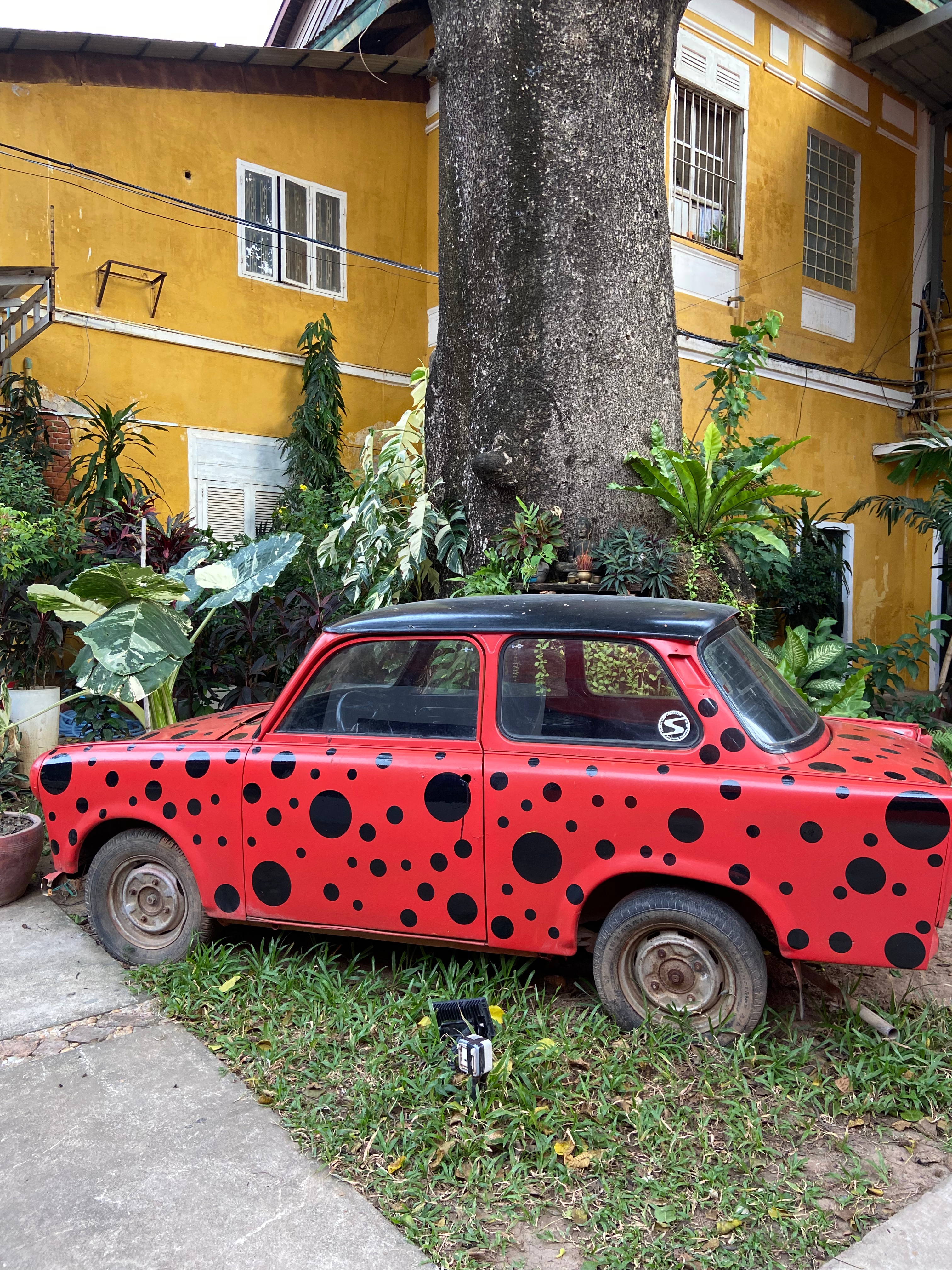
We then walked onto Friends Future Factory, which was a complete contrast, a striking barn-like building with curved orange bands forming a suspended half roof. A social enterprise, there’s a farmers’ market at weekends, designer clothing, photo and art exhibitions and a Trabant painted red with black spots – I loved that quirky touch.

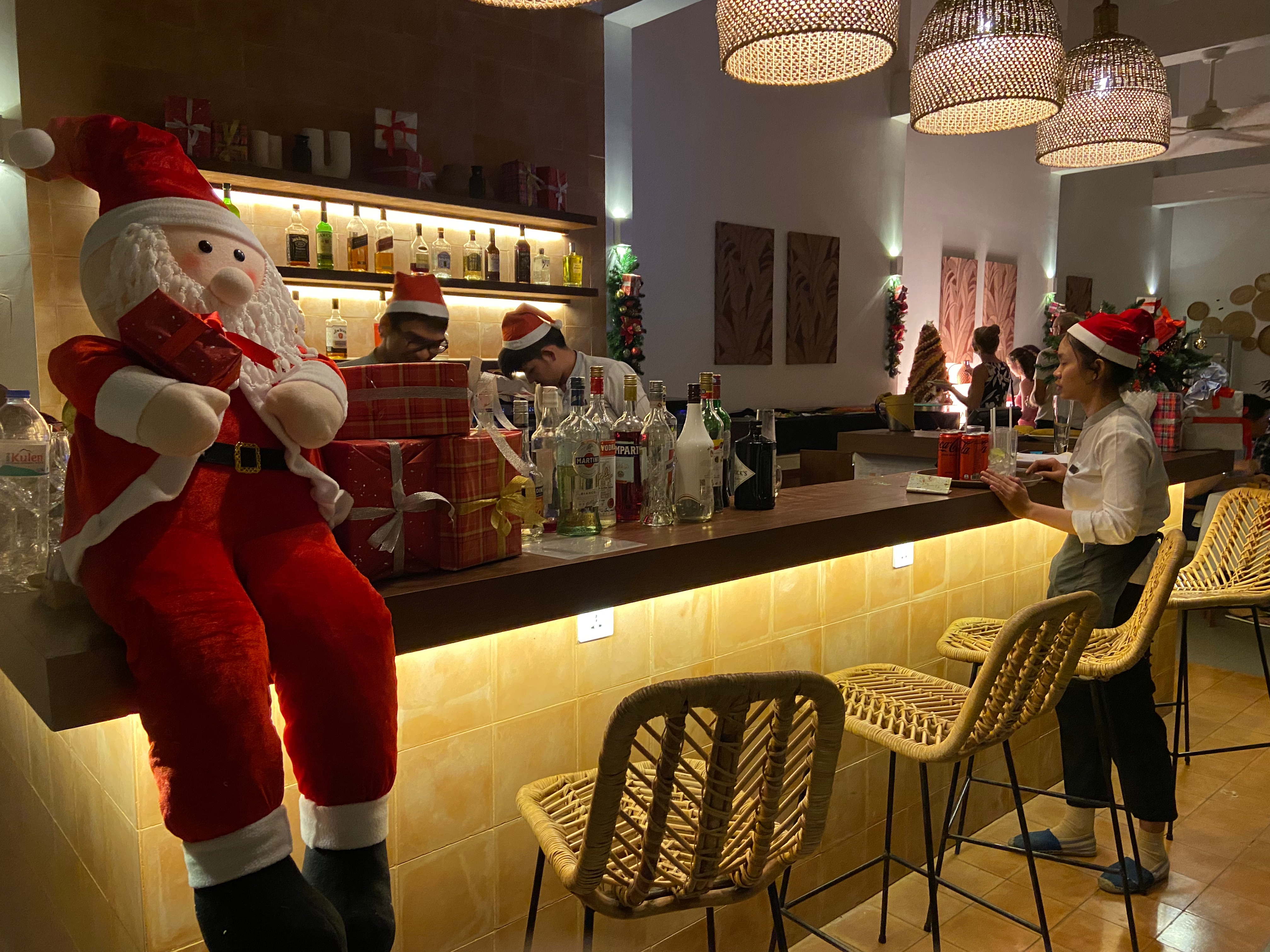
We took a tuk-tuk to the Rosewood Hotel and drank Christmas Eve cocktails –mine was an exquisite mix of rum and lychee – at the rooftop bar with views over Phnom Penh. Although we were not spending a second night at the Plantation we returned there for a western-style Christmas Eve pool-side buffet. For the modest sum of US $30, there was a lavish spread of seafood and roast meats, salads and puddings galore. What’s more there was a stuffed Santa sitting on the bar, red tea lights floating on the pool, dried orange, clove and cinnamon scrolls on the table and a choir of children singing Jingle Bells.

On the 25th itself Theary picked us up in the morning and we headed out to Battambang, the third largest city in Cambodia. In honour of Christmas Day Di and I spent a good hour singing through our joint – and pretty extensive – repertoire of carols. Although we didn’t know the words of many of them, we had a lot of fun, and Theary complemented us on our singing!

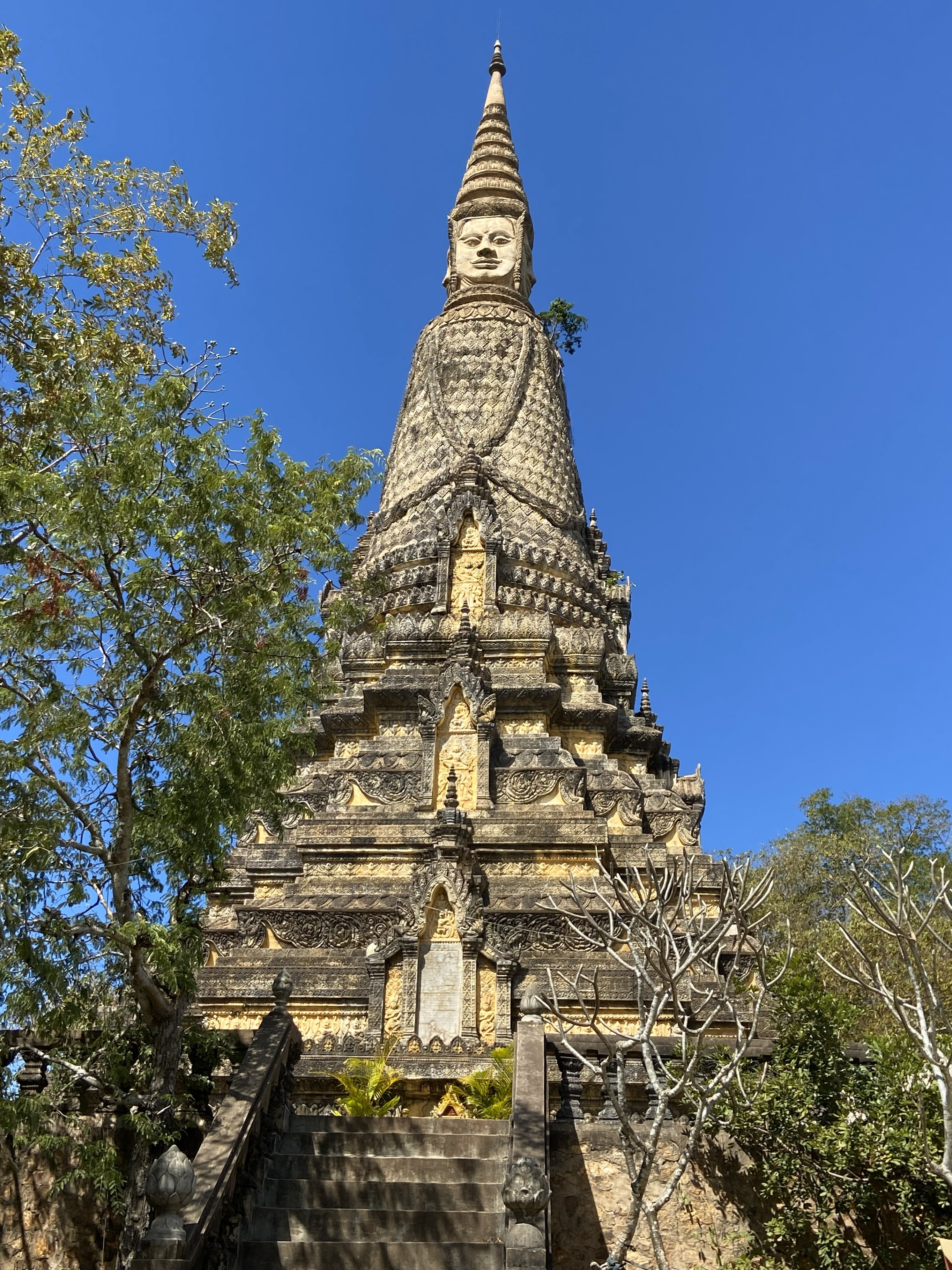
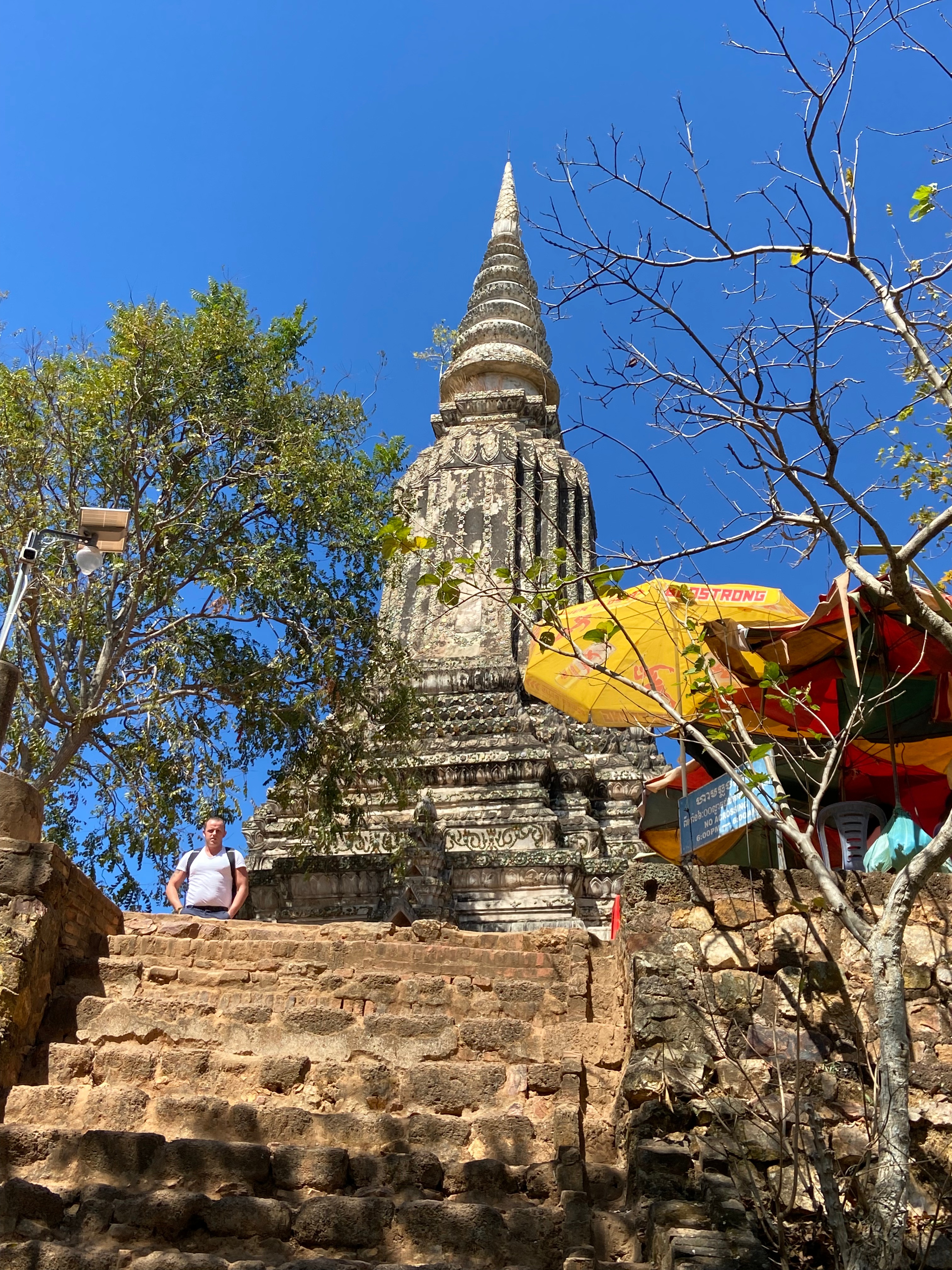
Our first stop was in Oudong, the original Cambodian capital (1618-1866) before Phnom Penh. Perched on top of a mountain, Oudong consists of a cluster of stupas (monuments housing sacred relics – in this case – of past kings of Cambodia).  There are three main stupas – the second, Ang Duong, is decorated with colourful tiles and the third stupa, Mukh Proum is very striking with four faces looking outwards towards the four cardinal directions, which made me think of a Russian doll, maybe because of the conical shape.

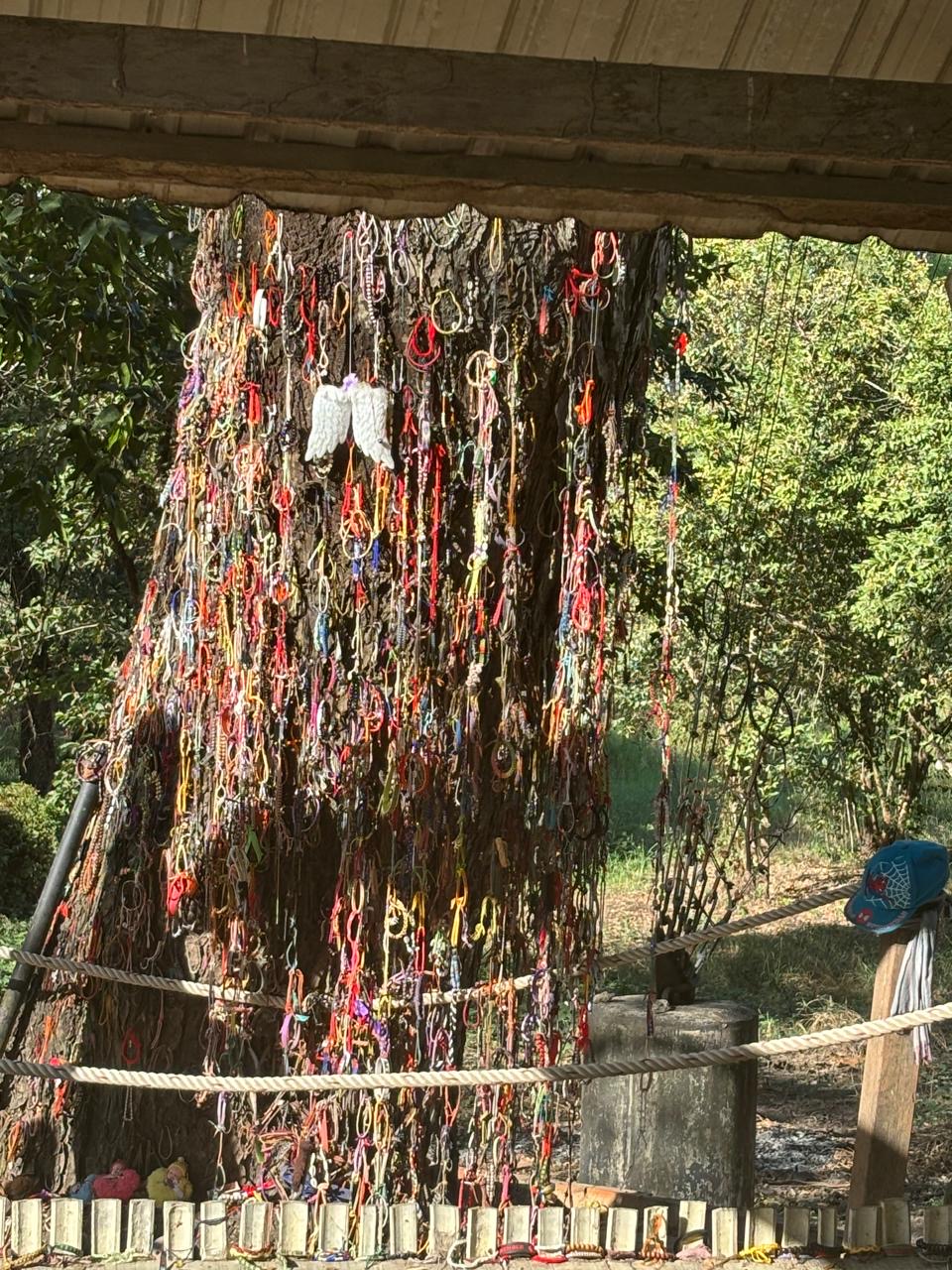
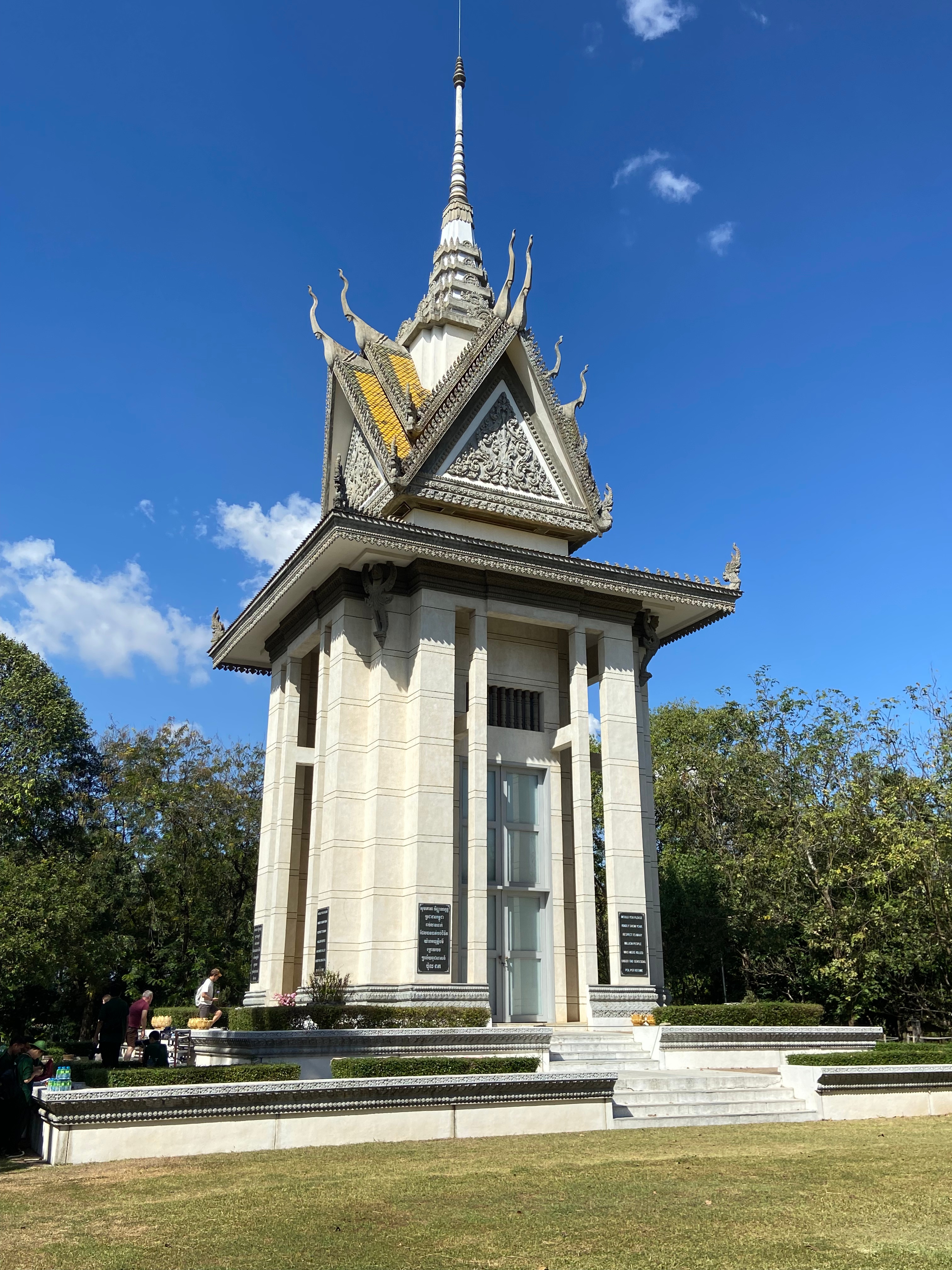
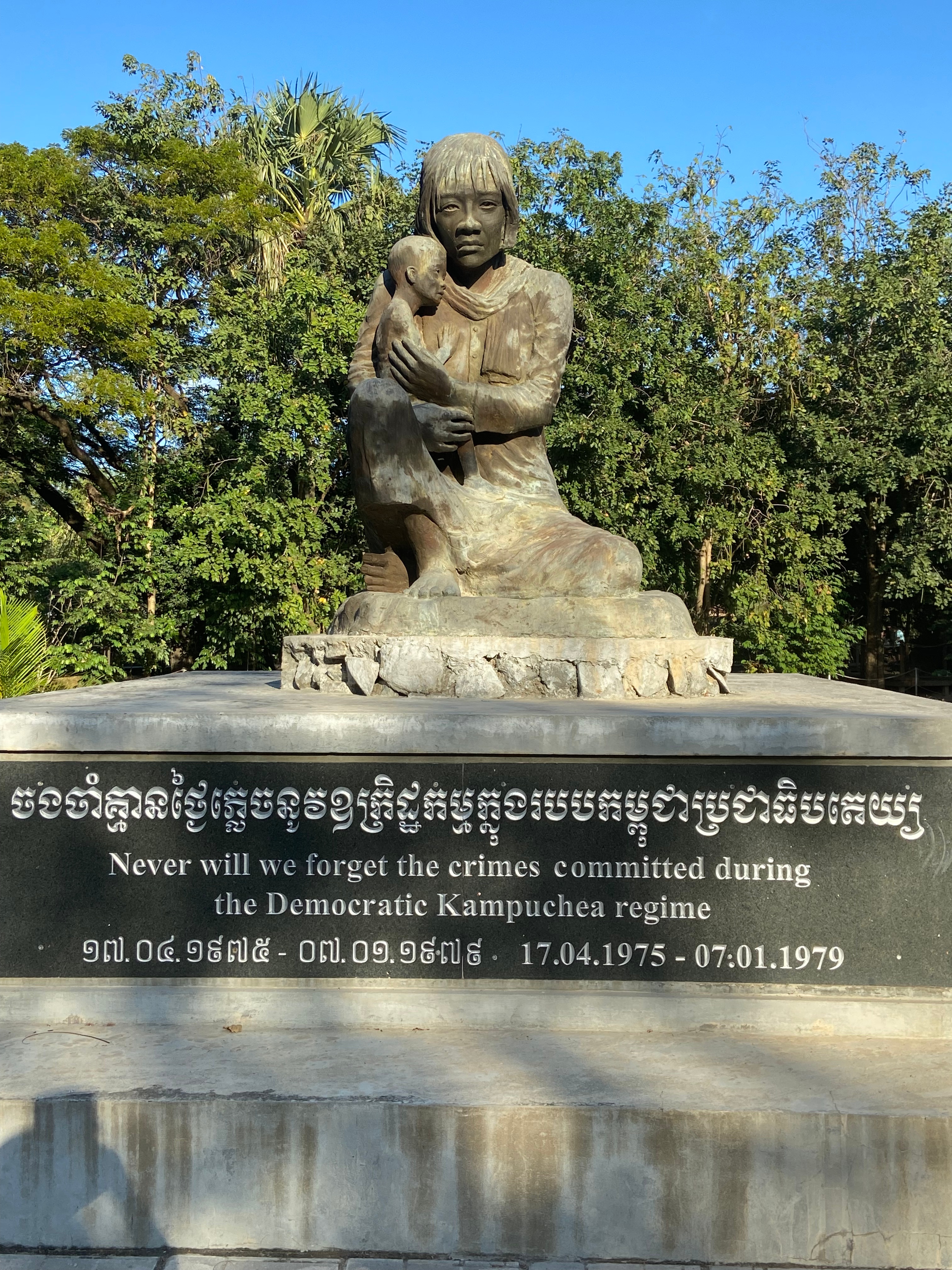
What we didn’t realise – I had a fair bit of muscle fatigue and twitching after descending the 509 steps – is that at the base of the mountain near the path, is a memorial buried with the bones of hundreds of bodies exhumed from one of the Khmer Rouge killing fields. You cannot go to Cambodia without coming up against the horrors of the Pol Pot regime and the legacy of trauma and grief. In Part 3, I will share my experience of visiting the Choeung Ek Genocidal Center in Phnom Penh.  

After our Christmas lunch under the ant-ridden tree, we arrived in Battambang around 5pm to be met with what I can only describe as a hellish racket.  A Christmas and New Year fair with music and stalls was going on right outside our hotel, La Villa, which overlooked the river – well it would have done if the fair hadn’t obscured the view!

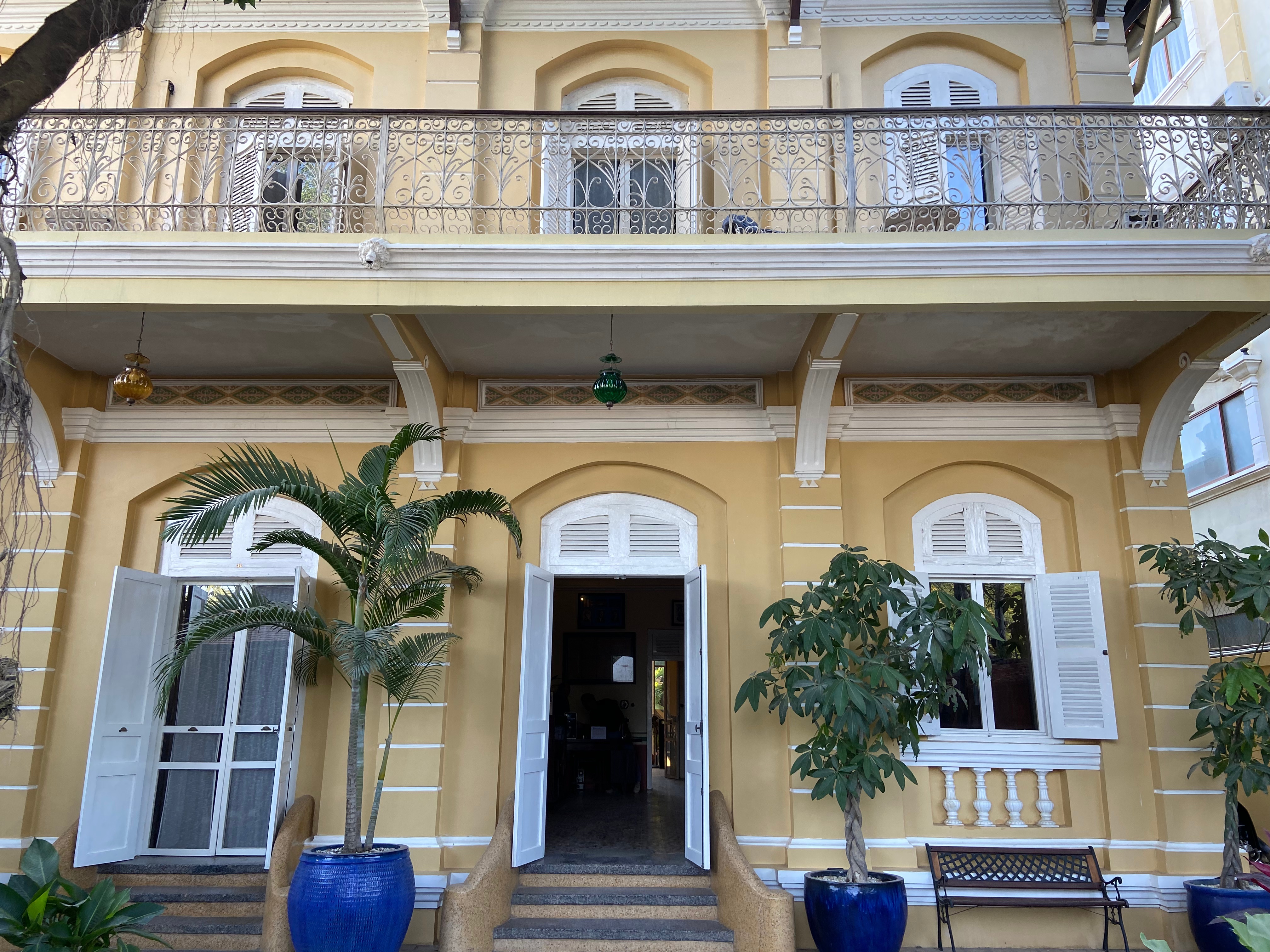
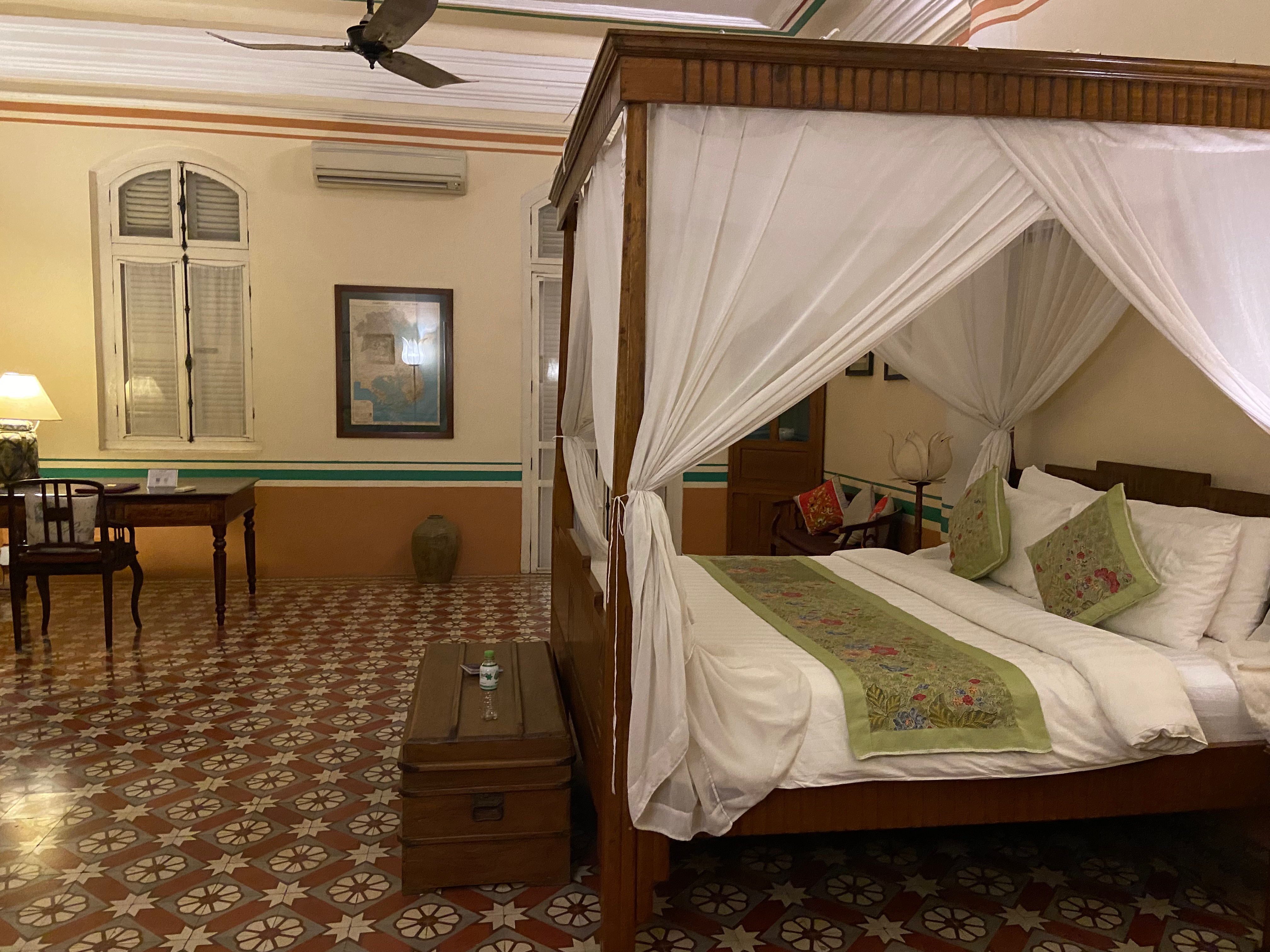
La Villa was my choice. It has an old-world vibe – our first-floor rooms were each furnished with four poster beds draped with a mosquito net, a writing desk, a mini chaise longue and shuttered windows. We had drinks and dinner in the art deco bar and eating area furnished with a gramophone and old-fashioned ear-piece phones.  And we savoured another very flavoursome dinner – Beef Lok Lak, a peppery beef stir-fry (which Google describes as a comforting Cambodian dish) and very good sticky rice and mango for pudding.  

It sounds blissful, doesn’t it? The only problem was that the noise of the fair was all pervasive with tinny, screechy pop music blaring out from a floodlit stage right by the hotel which went onto until the small hours and shouty voices – the compères sounded like game show hosts having a heated argument. Lying in my four-poster bed that night, the bed at least softer than the one at Di’s apartment, the music not only made the windows and shutters vibrate, it went right through my body. I rammed in my ear plugs and eventually tuned it out.
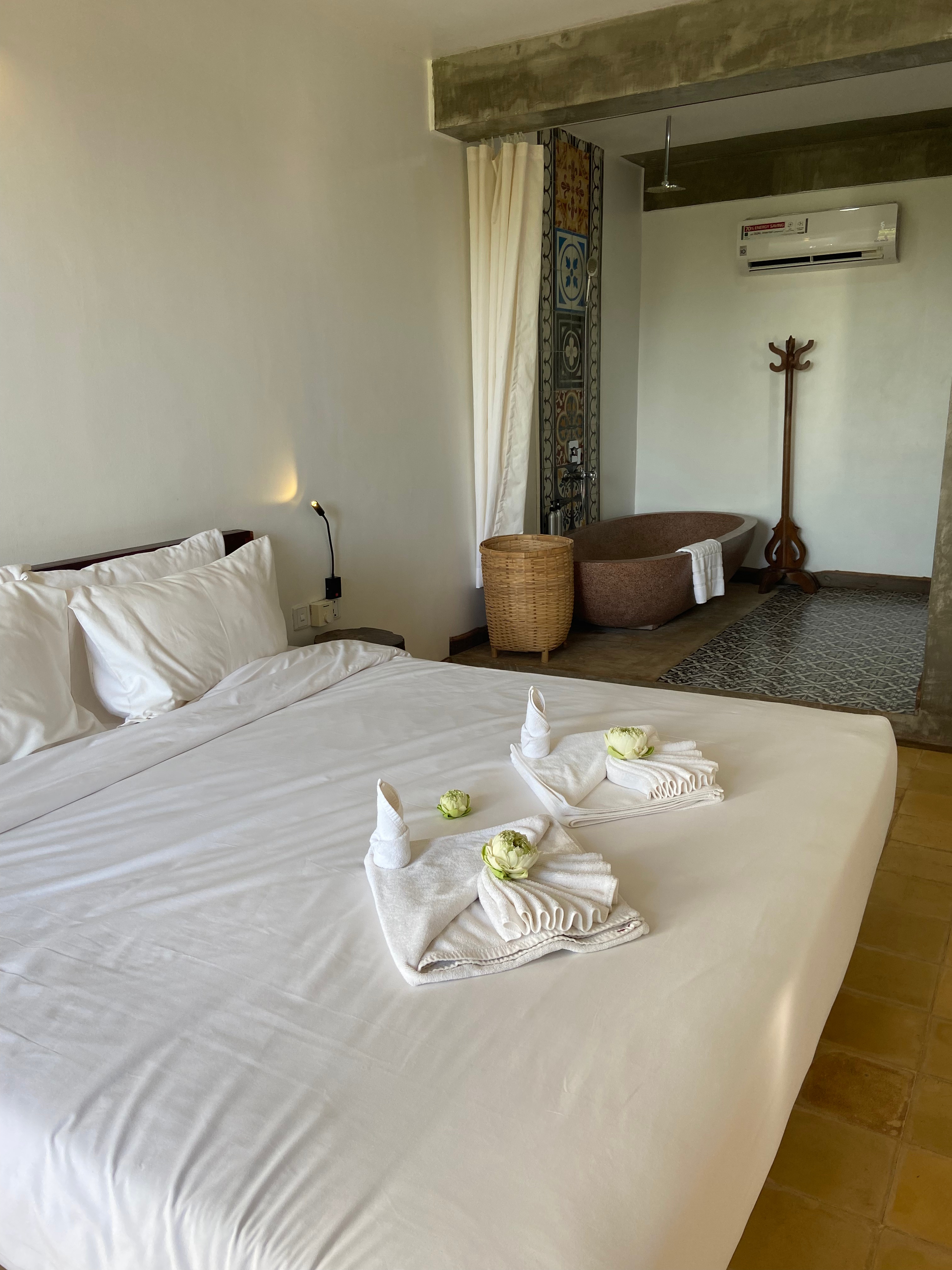
The next morning Theary took us to Wat Kor village, about 2km outside Battambang, where we visited the temple and soaked up the peace and quiet in the company of some friendly temple dogs.  Our second stop was Mrs Bun Roeung’s Ancient House – an old-style wooden house built in 1920 (that survived the Khmer Rouge) and is still in the same family four generations later. It is furnished with highly polished heavy hardwood furniture such as a chaise longue, family portraits, musical instruments and mirrors cleverly positioned so people in the room could see who was coming in and out – whether friend or foe. And, most fascinating of all, a description of what the walls are made of – dried cow dung, straw, fermented sticky rice, palm sugar, limestone and stone.

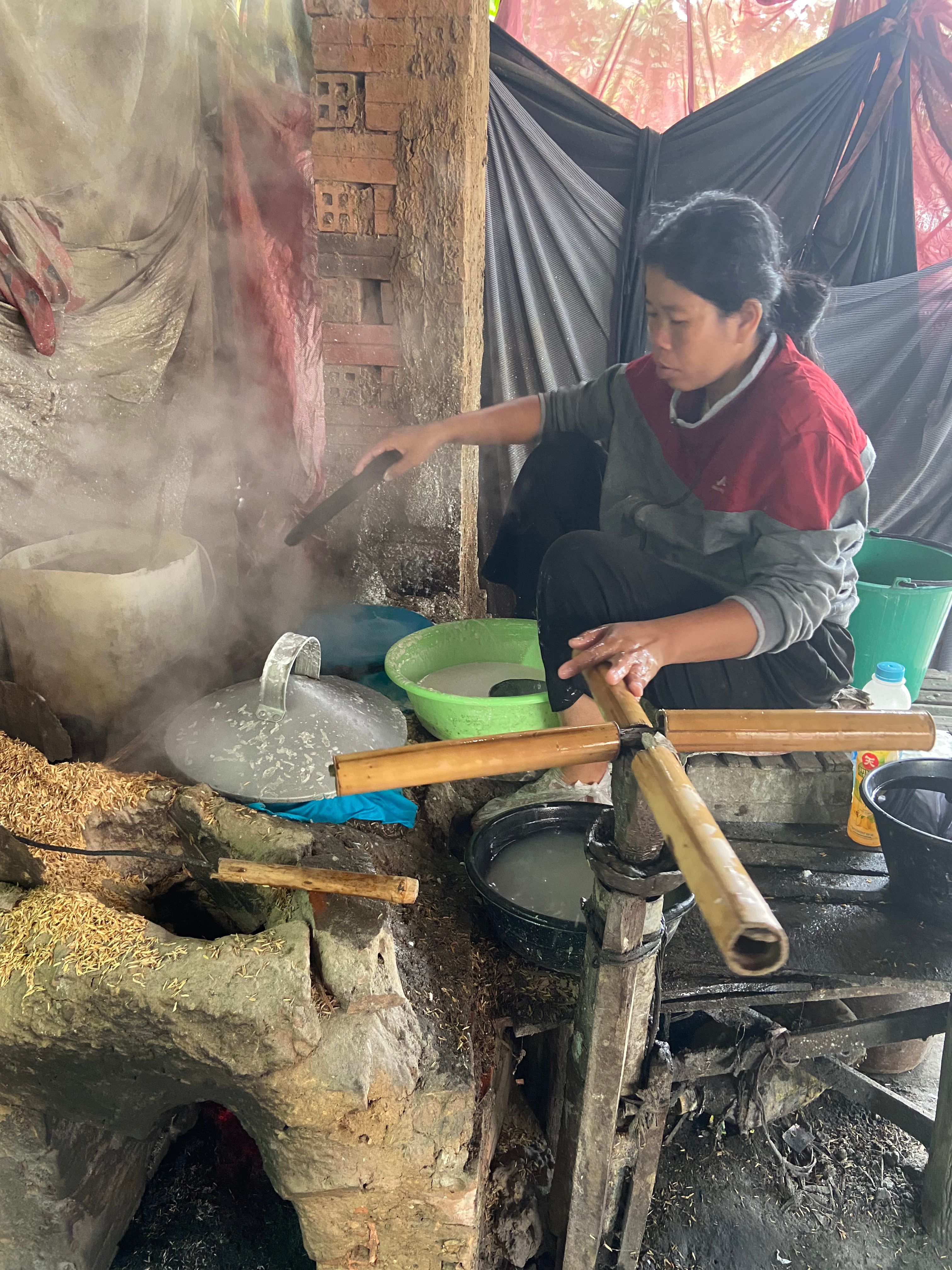
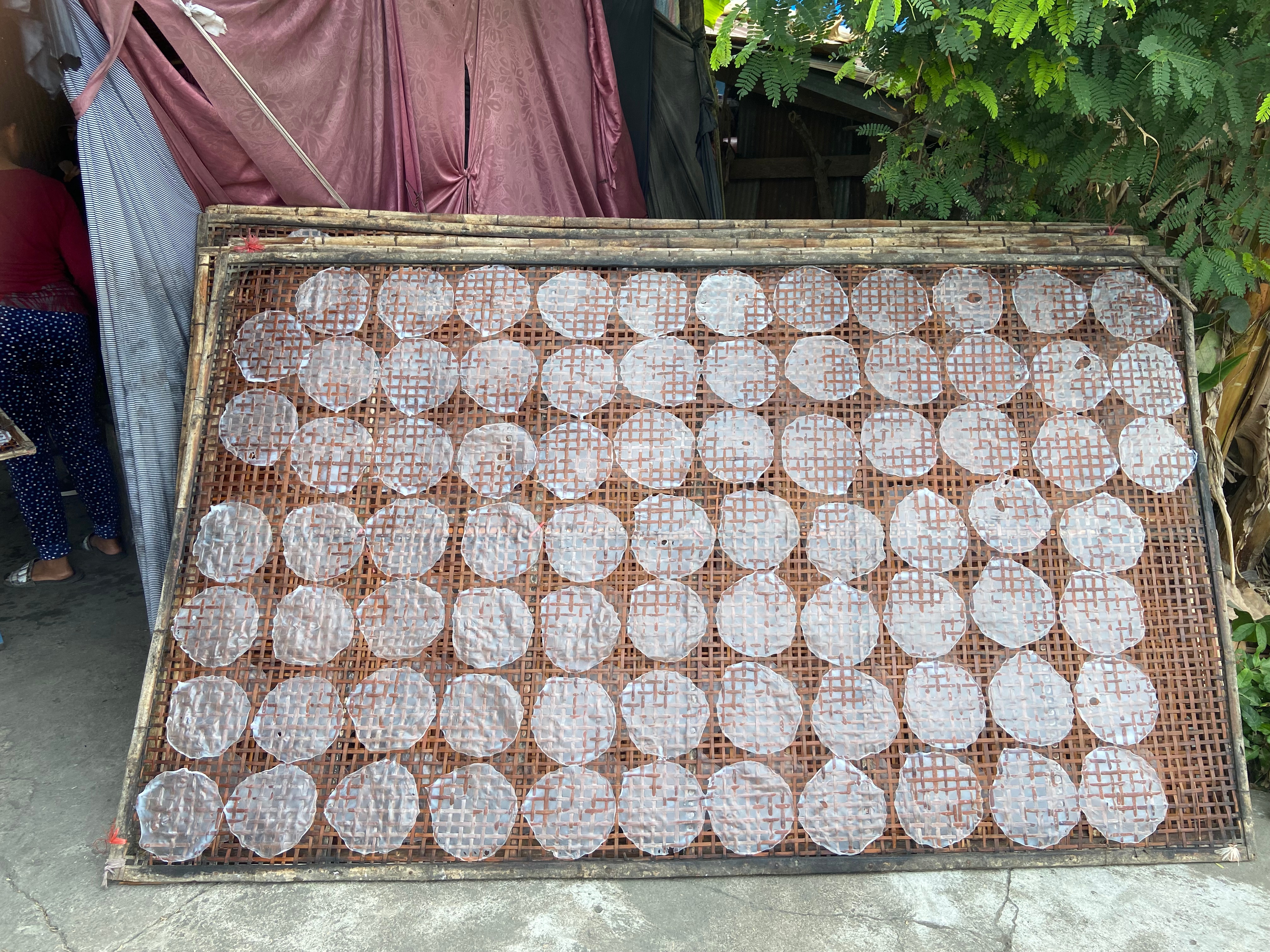
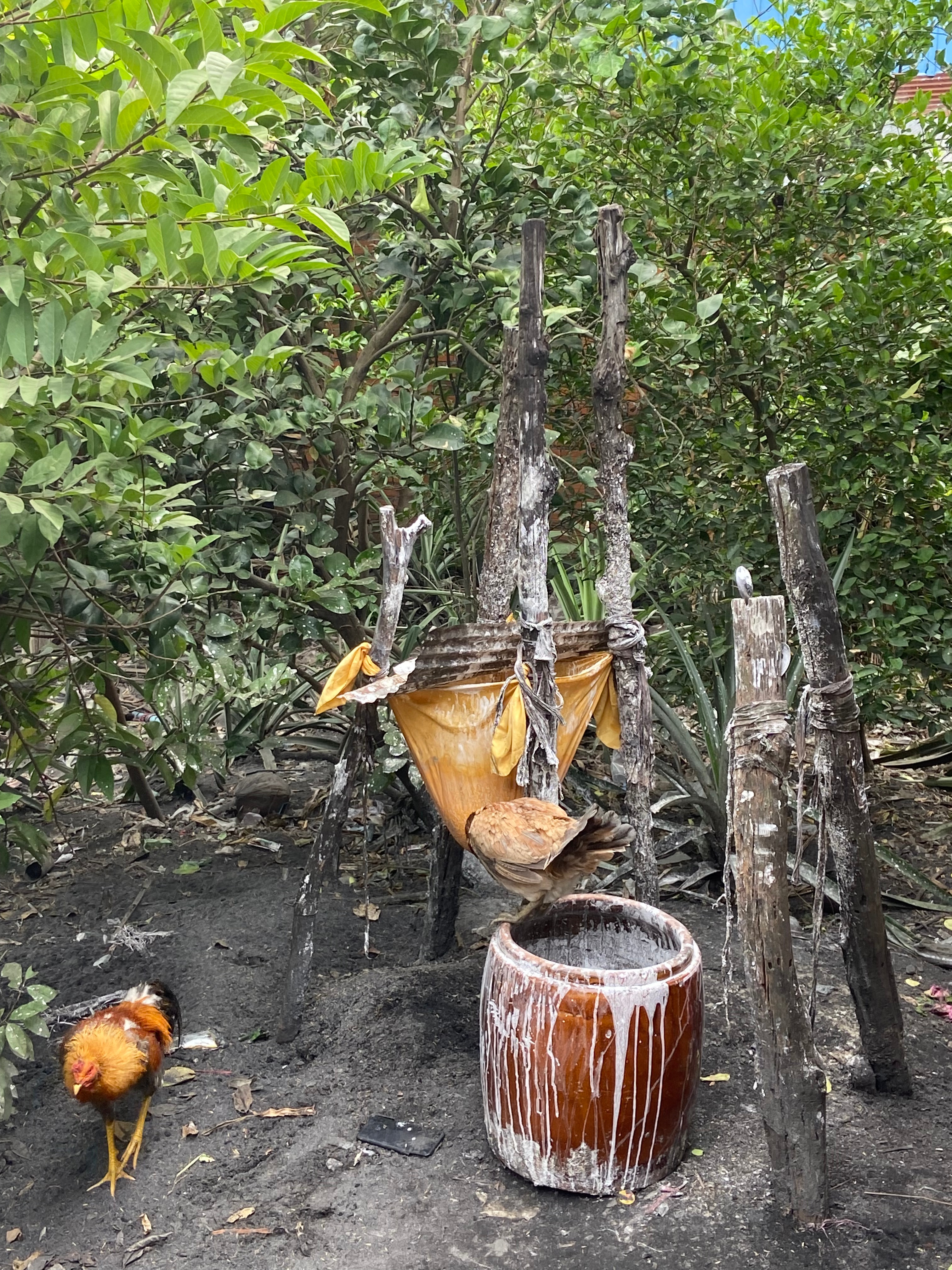
Next, we travelled on to see rice paper rolls being made by grinding up rice and water to make a pulp which is thinly spread across a layer of muslin above a pot of steaming water and then put on a rack to dry. Two women were working away sitting by the steaming pot, their feet encased in polythene bags. How uncomfortable must that be? And to think we complain about RSI from sitting at our computers. Try making rice paper rolls all day!  A couple of chickens were scratching around, a couple of kids playing, and what I presumed to be the husband was snoozing in a hammock… This is why Di’s work is needed – she works in community development and gender equality.
Our last stop of the morning was the Romcheik 5 Artspace and café, an independent gallery where four young artists, who were all trafficked across the Thai border as children, have a permanent exhibition space. Their paintings are haunting, challenging and beautiful and reference trauma, the apocalypse, impermanence, a Buddhist between-worlds landscape and some of the all-too-common social problems in Cambodia – poverty, prostitution, child trafficking and abuse.

That afternoon we swam in the pool at La Villa enjoying the quiet before the music started up again in the evening.  Dinner that evening was at the Jaan Bai restaurant, another social enterprise. Margaritas followed by turmeric pork and Tofu with Kampot pepper.

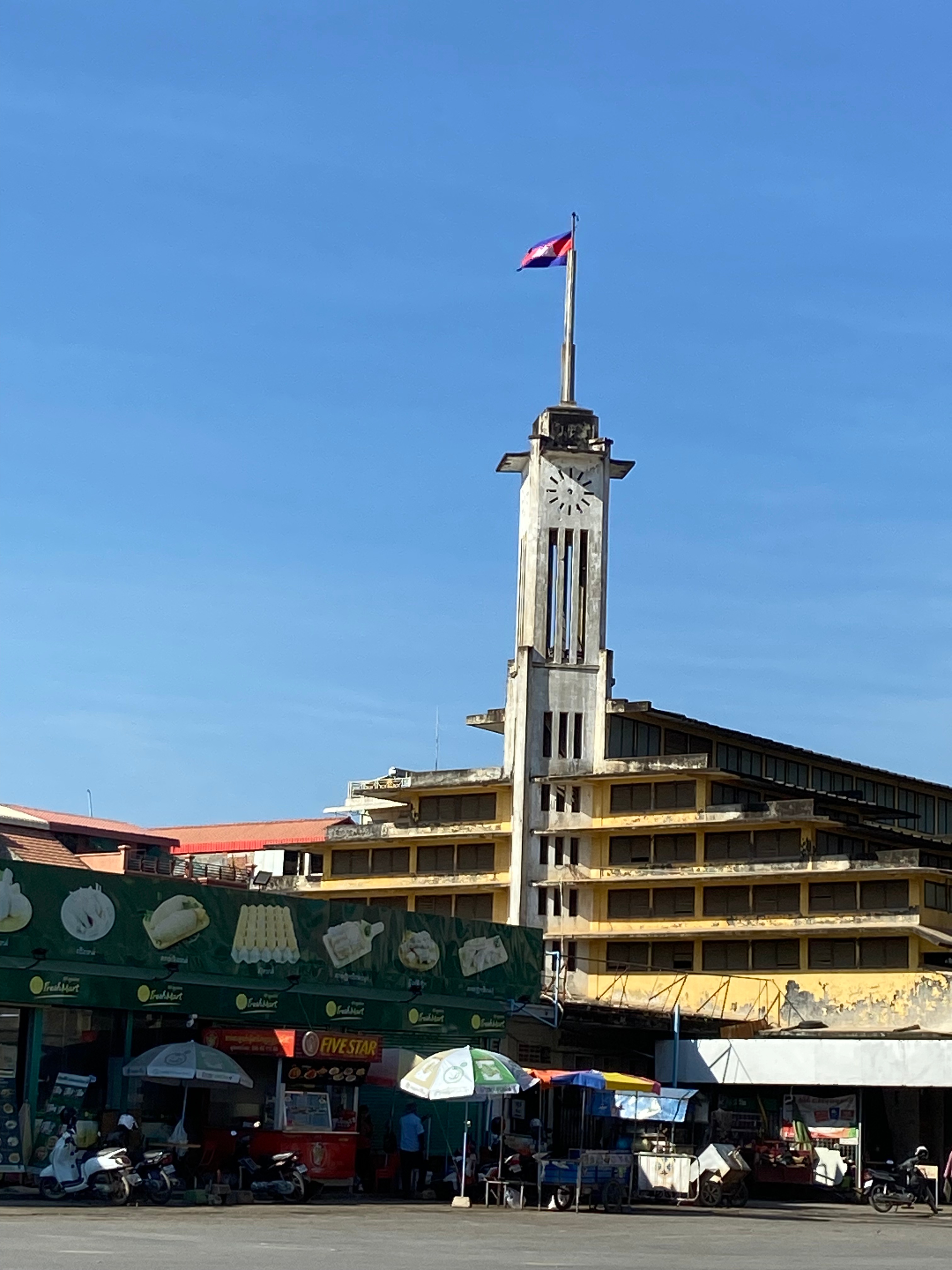
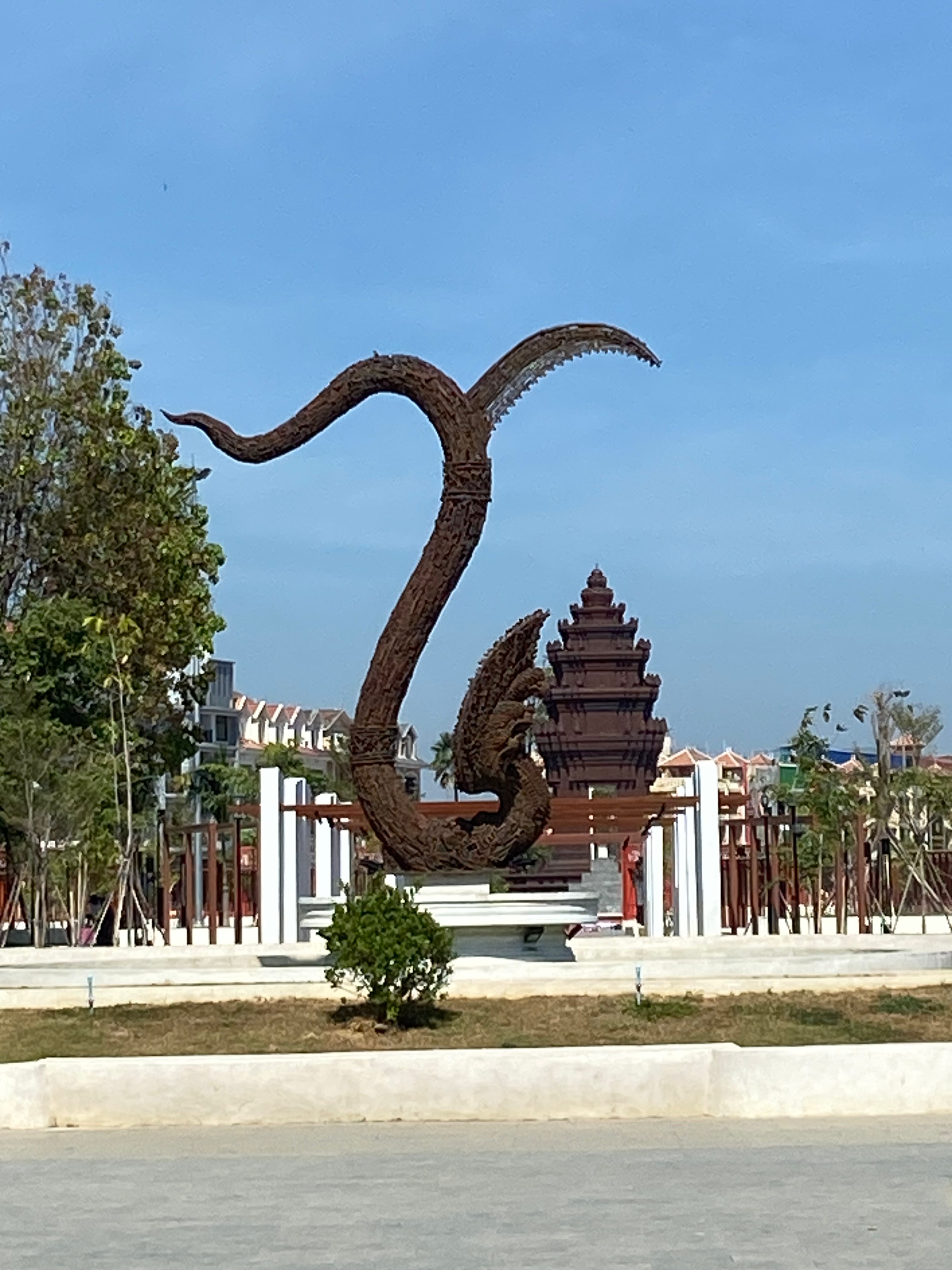
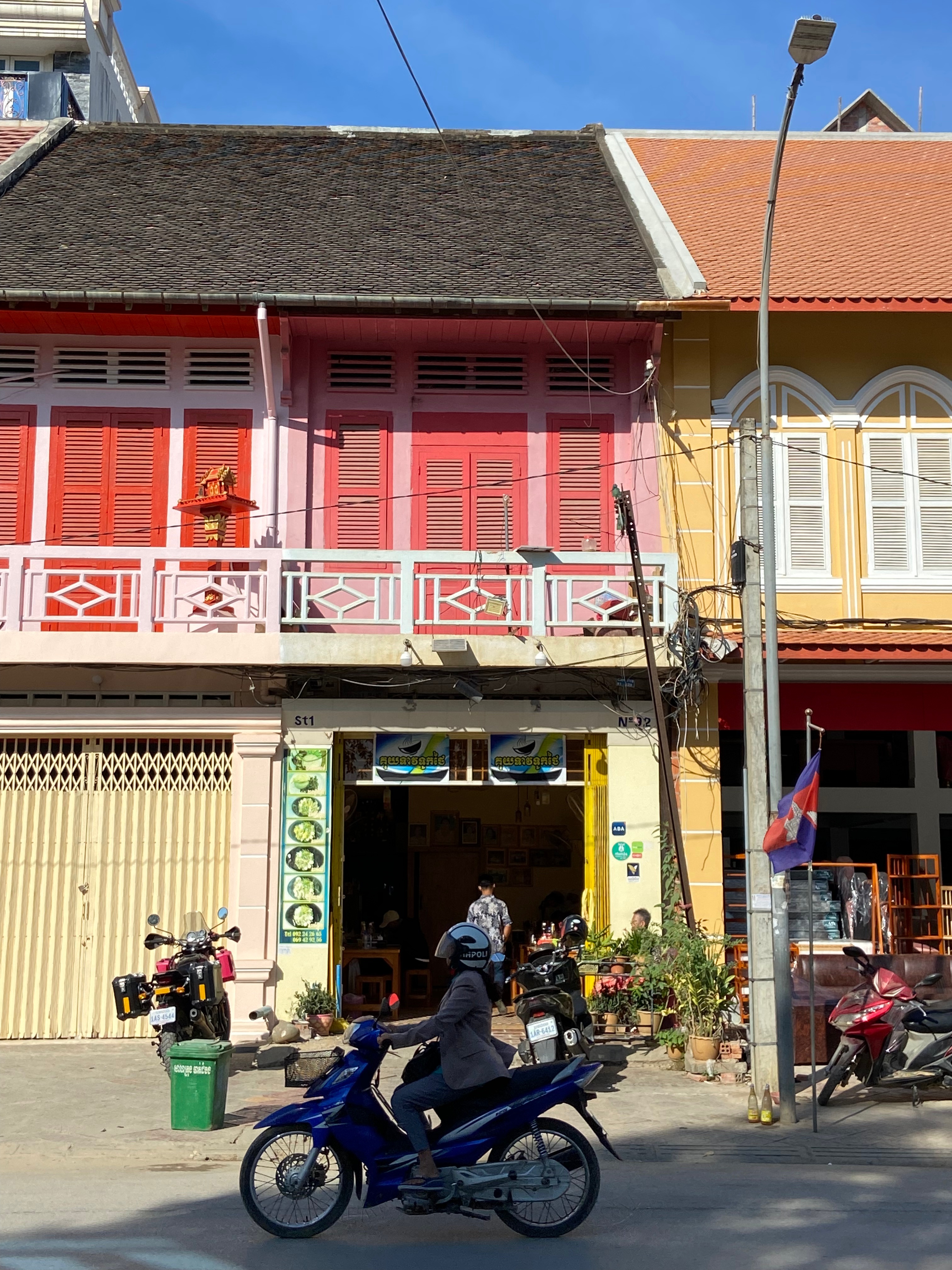
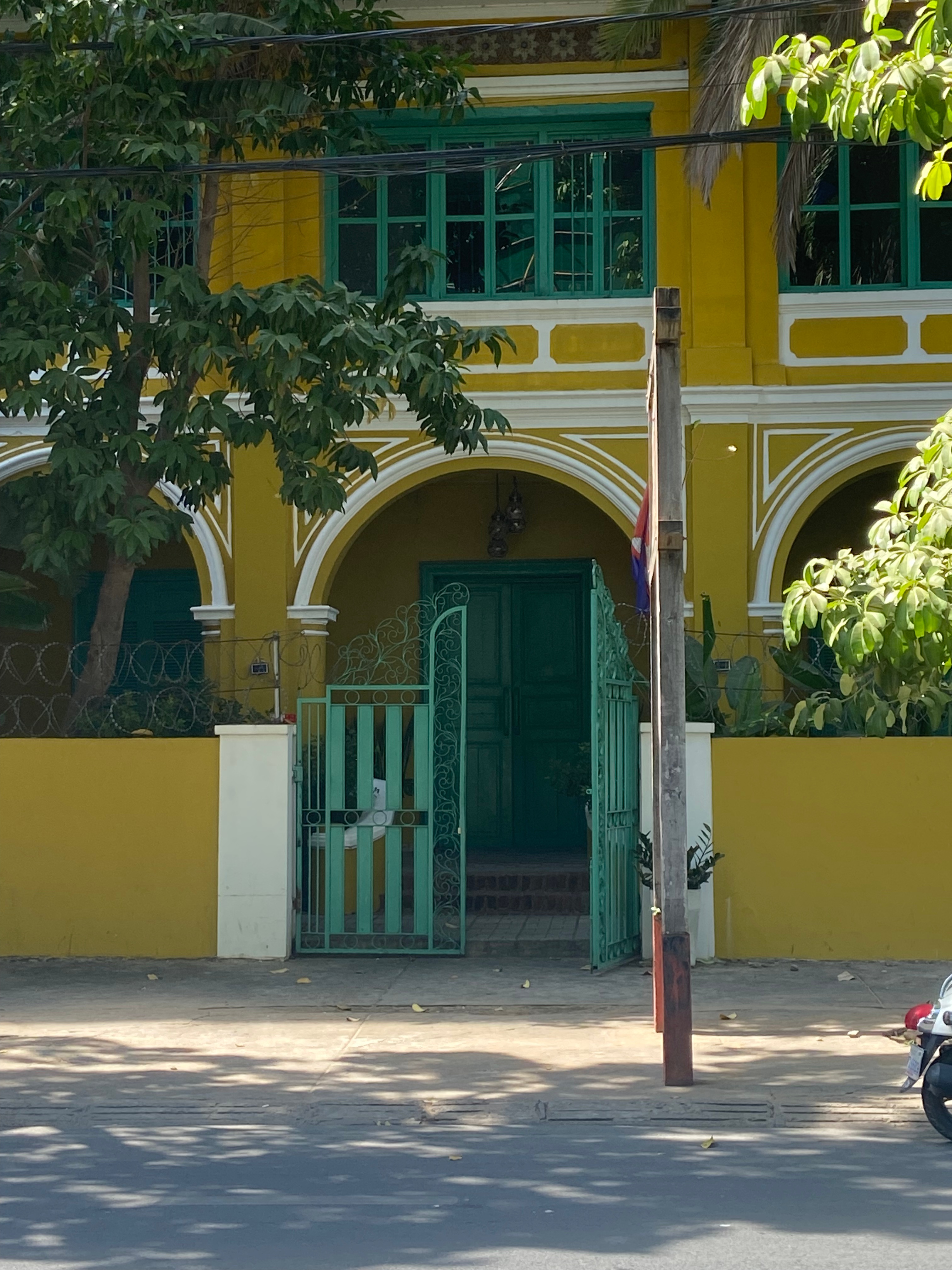
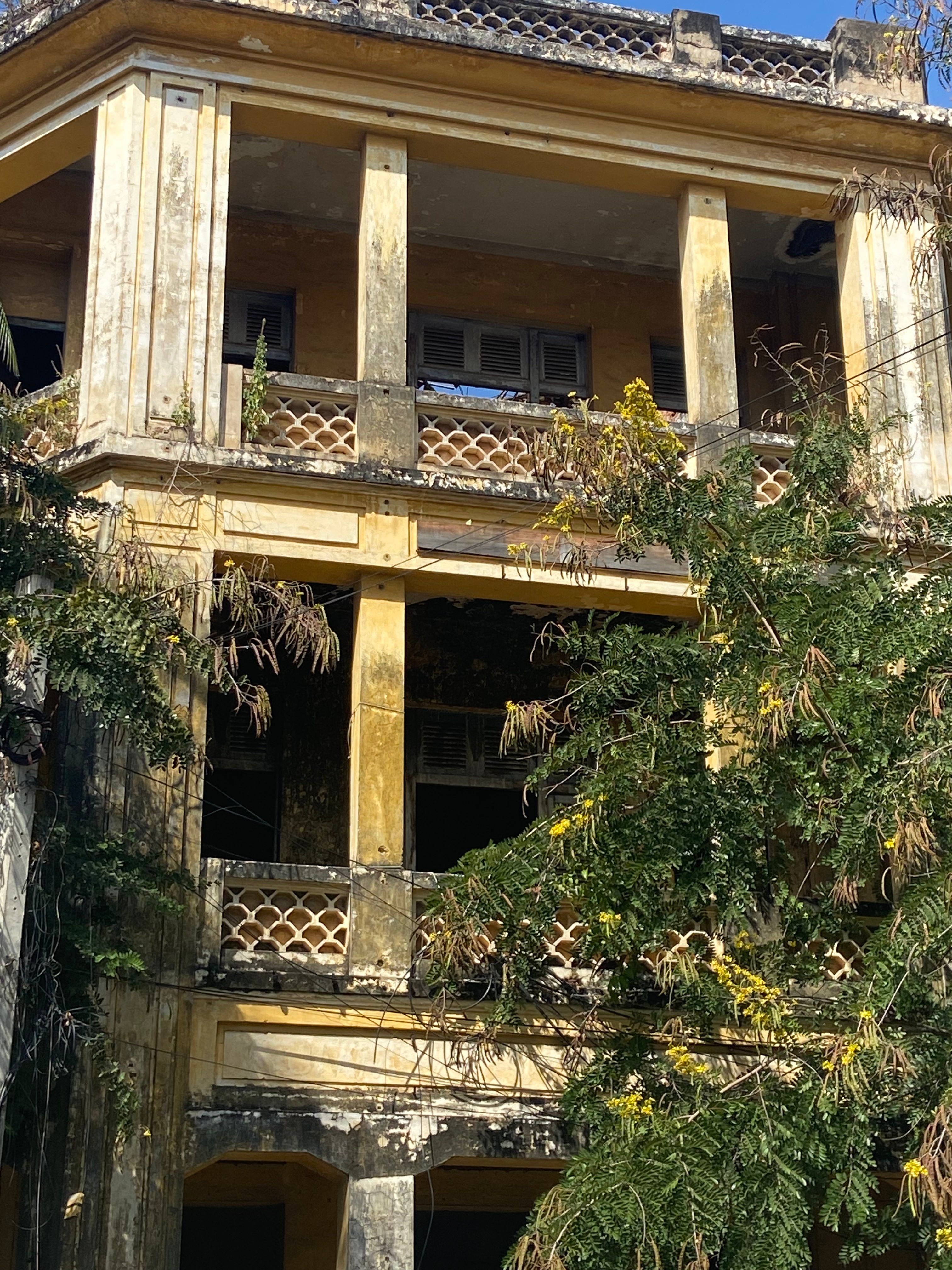
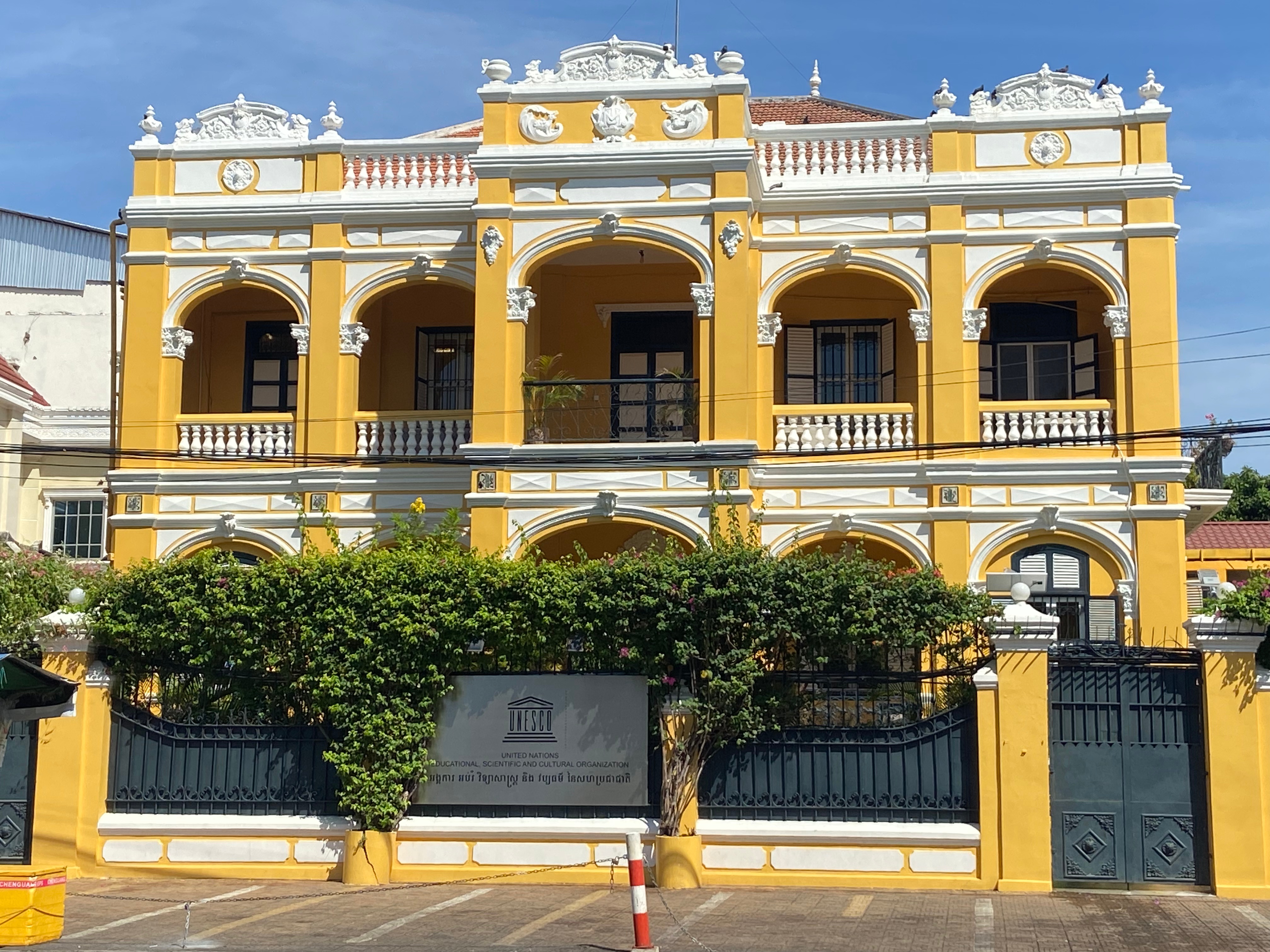
After checking out of La Villa the next morning we had a final walk around Battambang, taking in the art deco market (stocking up on snacking bananas) with its central clock tower, the Governor’s residence built by an Italian architect, a yellow building with white shutters from the early 1900s, the Independence monument, a newly built landmark  (inaugurated August 2023) reflecting Khmer heritage and serving as a focal point for historical commemoration,  and then back along by the river lined with colonial-style houses in reds and yellows, reminding me of the Peranakan houses in Singapore.

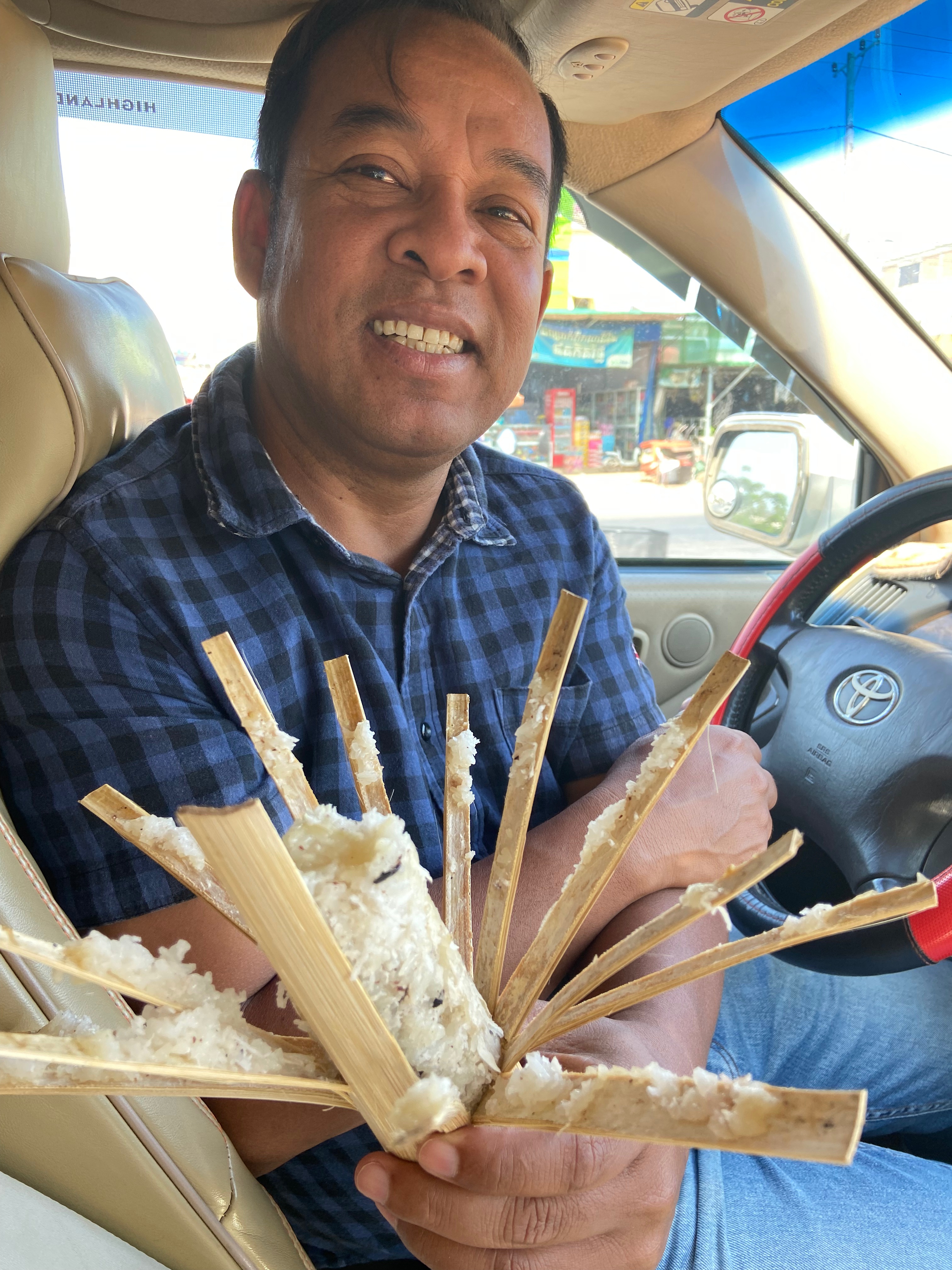
Theary picked us about 1pm and lunch was nuts and bananas on route to Siem Reap. Friends in Melbourne had insisted I try sticky rice in a bamboo tube, so I was delighted when Theary spotted a roadside stall. And, let me tell you, it’s one of the most delicious things. It’s a salty-sweet rice (but not over sweet) with little black beans and you peel back the bamboo to eat it. Forget salted caramel – this is way superior.

In part 2 of my Cambodian travel trilogy I will be taking you to Siem Reap, home of the Angkor Wat temple complex and much more. Stay tuned…

Paris Part 2: Musée Jacquemart-André, Le Grand Mosquée, Saint Mammes, the Seine and soggy knickers…

First of all a PS to those who subscribe by email – please click on the ‘Read on Blog’ link at the top of the email to enjoy the benefit of the formatted blog rather than the WordPress newsletter version.

Picking up where I left off in my last post, I started off slowly on day two in Paris. After a bit of unpacking and general faffing, I enjoyed a good breakfast at my hotel, the Holiday Inn, Gare de Lyon. Others might not get excited about apple compote, but I love it (especially when I haven’t had to peel and stew the apples) and it’s not something you often find on breakfast bars! Combined with creamy yoghurt dispensed from a machine by pulling on a lever – which reminded me of Mr Whippy ice cream – and topped with nuts and seeds, it was a winner.  I also enjoyed one of the best gluten-free bread rolls I’ve had in a while with some fresh figs and goat’s cheese.

It was a fine morning, and once again I set off for the Jacquemart-André Museum, this time by metro, criss-crossing my way to Miromesmil.  I arrived to find there was a queue to get in unless you had already reserved tickets. The wait time was advertised as at least an hour thanks to a once-in-thirty-year retrospective of paintings by Georges de la Tour (1593-1652), a chiaroscuro painter influenced by Caravaggio.  Thank Goodness I hadn’t slogged my way there the night before only to be turned away – no room at the inn – and refused entry.  

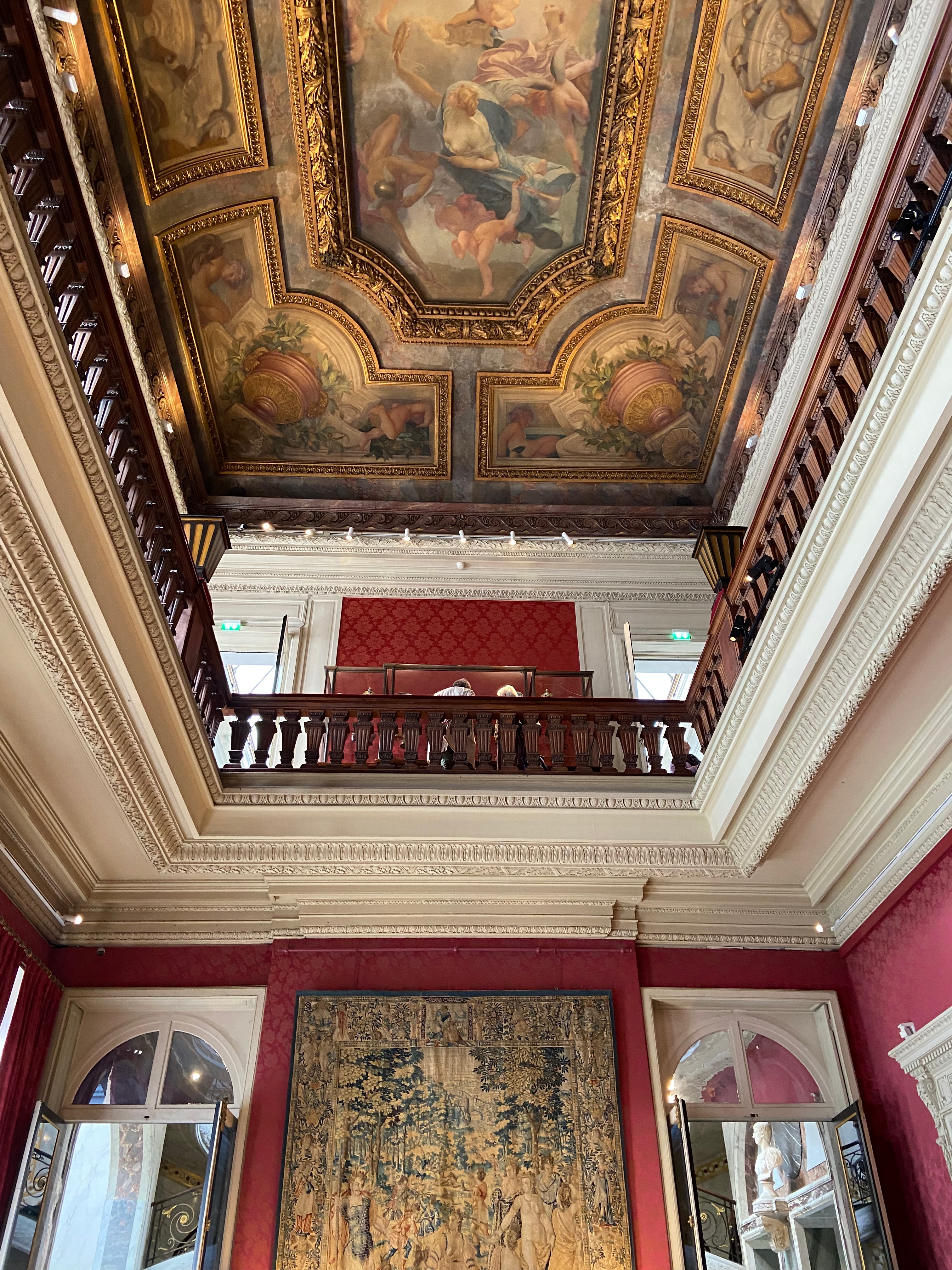
In just under an hour, I had a ticket in my hand and was inside. The Jacquemart-André Museum is a sumptuous Belle Époque private mansion built at the end of the 19th century by wealthy banker Edouard André and his wife society portraitist Nélie Jacquemart. They married in 1888, did not have children and were avid collectors of fine art and treasures from around the world.  The museum is described as the finest private collection of artworks in Paris – and that’s no exaggeration.  

The place is full of big name artists from across the centuries. Right at the start of the tour in the Picture Gallery are two Canaletto paintings of Venice, in Nélie’s boudoir there are paintings by Gainsborough and Reynolds, and the library walls are hung with paintings by Dutch masters including Rembrandt, Franz Hals and Van Dyck.

Paintings in Nelie’s boudoir reflected in a mirror

There are no less than three works by Tiepolo:  a fresco at the top of the double marble staircase and a ceiling painting on the roof the mansion’s dining room, the Salon de Nélie. Both were transposed from a Venetian villa. The third Tiepolo is a ceiling painting in the study, a room furnished with chairs covered with Aubusson tapestries, a Japanese lacquer writing desk and a Louis XV desk stamped by the king’s favourite cabinetmaker.

Tiepolo ceiling painting in the Salon de Nelie

Edouard and Nélie loved to entertain – the picture gallery leads into the Grand Salon where the partition walls could be lowered into the ground via a hydraulic system that converted the Picture Gallery, the Grand Salon and the adjacent Music Room (and musician’s gallery above) into a single space – catering for up to a thousand guests. You can almost hear the frou frou of opulent gowns, lace and silk, the hum of chatter and the clink of champagne flutes.  And you can picture the men retiring to the smoking room which is furnished in the ‘Oriental’ style with treasures from Persia.

To keep their entertaining space unimpeded, Nélie and Edouard departed from the norm of having a centrally situated staircase – the double marble staircase is no less magnificent, but it’s located to the side of the building. To the left of the staircase is the Winter Garden, a status symbol at the time, a place to showcase plants from around the world.

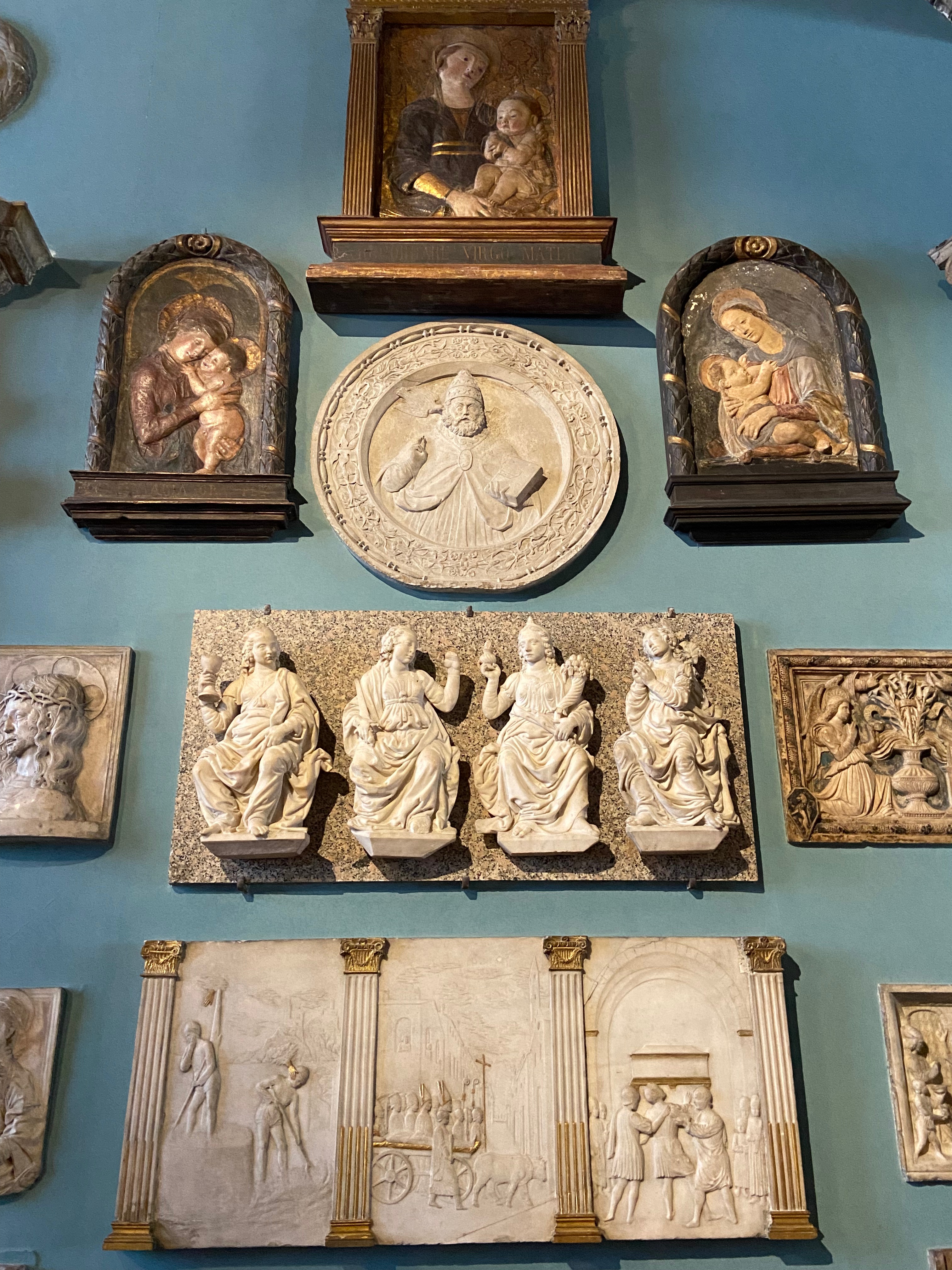
The Italian galleries – the Venetian and the Florentine – are crammed with treasures: 15th century sculptures, bas-reliefs and paintings by the likes of Uccello and Botticelli.  I had a little break at lunchtime and managed to get a spot in the Salon de Nélie, in the annex overlooking the courtyard.

After lunch, I enjoyed browsing some of the 40 Georges de la Tour paintings. He focused on portraits of saints and people on the margins of society – blind musicians, beggars, old men and women, capturing them in a moment in time, his subjects imbued with grace and dignity, and often illuminated by a single candle flame or a shaft of light. I could have spent longer but it was getting towards mid-afternoon and I was due to meet friends from Oxford for drinks at 4.45pm. Time waits for no man not even Georges de la Tour, so I ran back to Miromesmil, sped-walked along the long passageways (if you want to get your steps up, travel on the Paris Metro!) connecting with the M1 line back to the Gare de Lyon. From there I dashed to the hotel to change and then, with a swipe of lippy, was back underground on my way to Châtelet where I changed line to get to Cité and to our meeting place near Notre Dame. I just made it.

It was pure chance that I overlapped with Hilary and John for one night in Paris and pure joy to see them and catch up on two year’s chat over drinks and pommes frites. To add to the fun, my niece, Georgie, a wonderful conversationalist and all-round bright spark, joined us just as the heavens opened and the wind picked up. We were sitting outdoors so we huddled under the awning but were soon rewarded with exquisite light and a double rainbow. From there, Georgie and I walked back to the Gare de Lyon and to Ground Control, a warehouse space behind the station with food stalls, bars, vintage fashion, a book stall and alive with the buzz of chatter from children, families, the lot. We drank a Hugo cocktail and tucked into a tasty and generous Greek share platter.

The next morning, Sunday, I was back at the Gare de Lyon, now my second home, and took a train out towards Fontainebleu to spend a day with Georgie, her husband Manu and the three boys. She met me at the station in Moret-Veneux with three-year-old Ralphie in tow. From there, it was a short drive to Veneux -les-Sablons, where we walked across an arched suspension bridge at the confluence of the Seine and the Loing over to the town of Saint-Mammès, which has a vibrant Sunday market with lots of local and organic produce and an entire stall devoted to goat’s cheese – heaven!

The rest of the day was spent with the family in Thomery, a wonderful spot on the Seine, known for its history of viticulture and use of walled vineyards. It’s forty-five minutes on the train from Paris but a hundred times more peaceful. No suitcases, sirens or heavy ‘circulation’! Georgie and Manu are renovating their house bit by bit – it’s full of character – and they live a very eco-oriented life.  

The long garden complete with Granny Flat (la dépendance), veggie patch, walnut trees and mown paths slopes down in the direction of the river.  It’s a bucolic idyll and the three boys – Ralphie’s twin brothers are now six – charge around the garden, their playground. So far, they are living a screen-free life (not even a TV), which I so admire, their imaginations free to roam, their attention unshackled by technology.

We all did a bit of drawing after lunch. Even I, who can’t draw a stick man, managed a decent flamingo thanks to a book that steps you through the process. A delightfully bonding family day – good for the soul – and I have bagged a spot in the dépendance for future trips. And next time I’m eager to try the walnut wine which was still at the macerating stage when I visited.

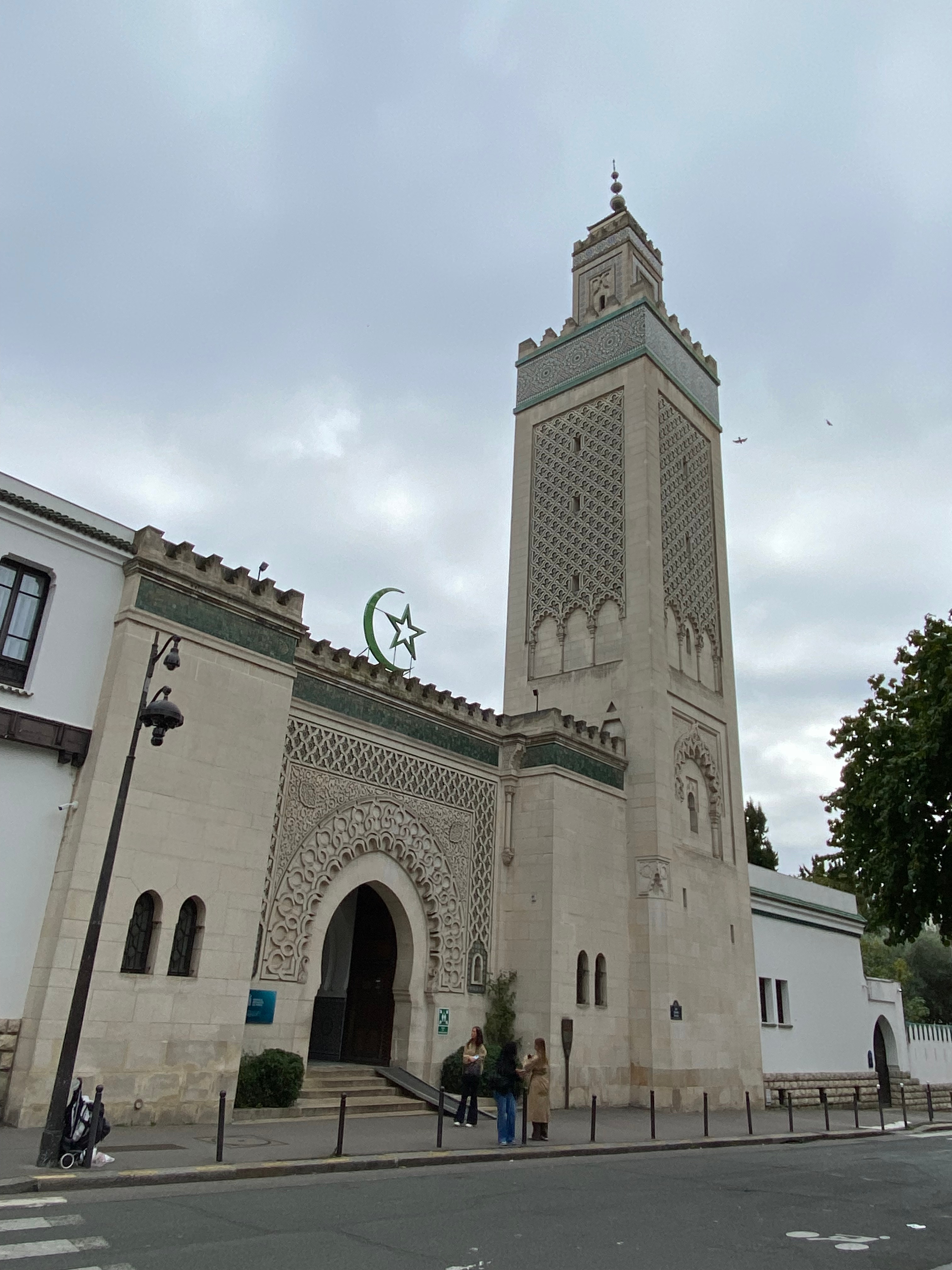
Monday, my last day in Paris, I explored Le Grand Mosquée, which is in the Latin Quarter near the Jardin des Plantes, the Botanic Garden.  It was built to honour the African, mostly Muslim, soldiers who fought in the First World War and was inaugurated in July 1926.   

Reminding me of my March trip to Malaga and visit to the Alcazaba, the Grand Mosque is built in the Hispano-Moorish style with the familiar arches, decorative tiles, Arabic calligraphy, intricate geometric patterns, Mahgrebin carved cedar wood and lush courtyard garden with fountains. It’s wonderfully peaceful, a place for quiet contemplation and, unlike the museums, not crowded. I was flagging by lunchtime – jetlag maybe – so rather than have lunch at the mosque’s café, where you can get a full meal – tajines, couscous etc., – or mint tea and Arabic sweet treats, I decided to visit the ladies only hammam (steam bath).

In keeping with the mosque, the hammam is a tranquil space with detailed mosaics, arches and ornate plasterwork. Years ago, I was scrubbed to smithereens in a Moroccan hammam so this time I opted for a simple steam bath without the ‘gommage’ option (exfoliation).  The dress code is bathers or a bikini – topless is fine but you need some form of ‘bottoms’. I hadn’t planned to go to the hammam so didn’t have either – spontaneity has its drawbacks! So here I was topless in a Turkish bath trying – in faltering French – to navigate how it all worked and in what order – from the difficult-to-shut 1 Euro lockers to the wrist tag, plastic slippers and showering protocol.

I got myself into the main room which has a long marble ledge running down each side, divided into three alcoves for sitting or lying in and furnished with buckets and water taps. I lay down and semi-relaxed but it would have been better to have a friend to lounge about and laugh with. After a while I graduated to the furthest room, which is more like a sauna with stepped ledges – the higher you go the hotter it gets – and a cold-water dipping pool. This is where my M & S undies got the full immersion treatment!

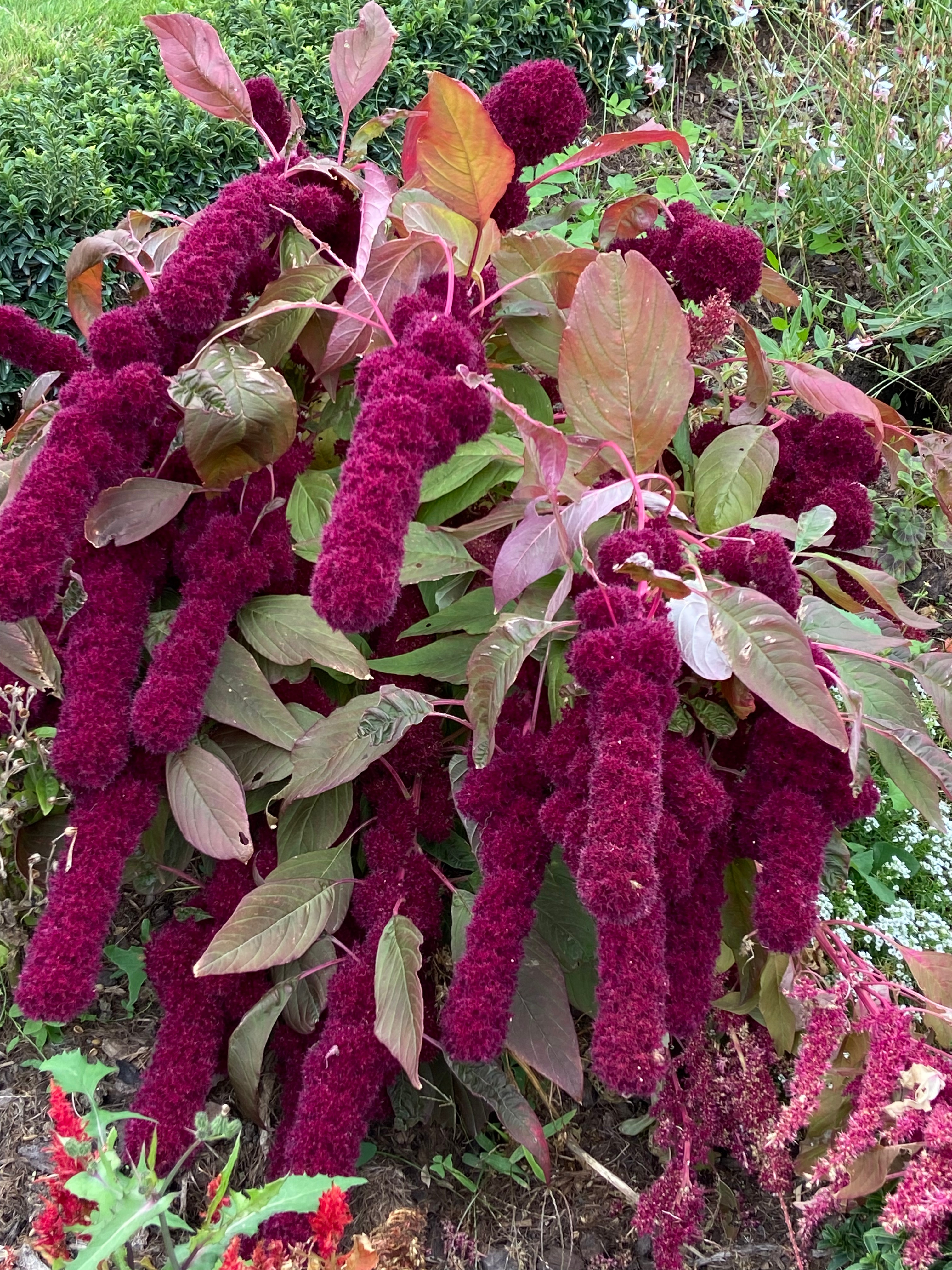
Once I was fully steamed and cooked, I progressed to an anteroom, where they bring you mint tea, which, although teeth-squeakingly sweet, is refreshing. I emerged feeling rejuvenated but, with damp knickers and damp hair, I soon lost the glow and warmth of the steam room as I was walking around the nearby Jardin des Plantes. On went the fingerless gloves and then I found a small café where I had a very overpriced but warming cup of tea, enough for me to enjoy all the autumn colours, pumpkin displays and curious woolly plants while I dried out!

Within three and a half hours of stepping off the plane from Australia via Hong Kong to Paris, I was shuffling along in the queue (which moved surprisingly fast) outside Notre Dame. Time-travel at its best, I had left Melbourne on a Thursday afternoon in the spring to arrive in Paris on a Friday morning, a warmish autumn day, shifting culture, language and centuries as I gazed up at the façade of one of the world’s most famous gothic cathedrals, the first stone of which was laid in 1163 during the reign of Louis VII.

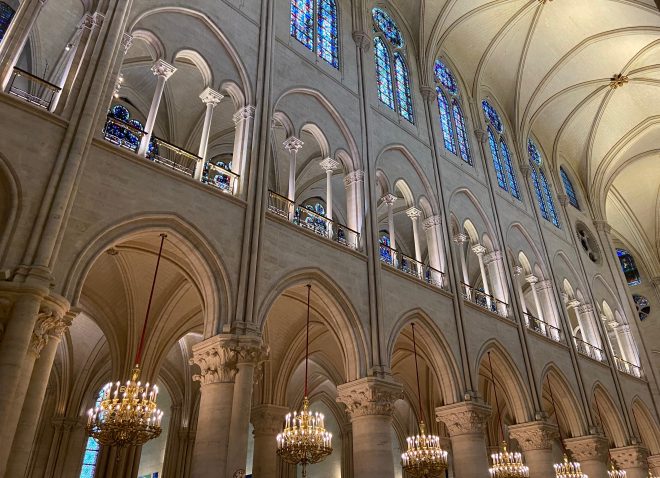
What a way to ‘land’ in Europe! Stepping through one of the intricately carved portals, the first thing I noticed was the quality of light – the resplendent nave and vaulted ceiling, the whiteness of the newly cleaned stone, the sparkling stained-glass windows – the reds and blues standing out in particular.  Reading up on Notre Dame, purists argue that it’s now too squeaky clean without centuries of accumulated candle smoke and grime, but I disagree. The restoration is – and continues to be – a triumph thanks to the craftmanship and expertise of the many artisans, conservationists, sculptors, stonemasons, stained-glass artists, carpenters and experts involved, not to mention the sourcing of 1,000 oak trees from approximately 200 forests across France for the roof and spire. The restoration is due to be completed in 2026.

I’m straying into cliché now but arriving during a service, the organ playing – incidentally all 8000 pipes were individually cleaned – and following along to the Lord’s Prayer in English – was a beacon of light moment, of hopefulness, in our ever more troubled and conflict-ridden world. The restoration of Notre Dame following the 2019 fire is an encouraging reminder of what can be achieved when political will combined with public, private and business funding unite around a single vision. And the fire has served as a reminder for us all – witness the queues to get in – how precious these ancient monuments are. I don’t know about you, but I took Notre Dame for granted – I certainly didn’t visit it last time I went to Paris in 2019.

Being a bit of a swot, I rented an audio guide covering Notre Dame’s history. I discovered that the north rose window with its central image of Mary with the Christ Child still has most of the 13th century glass intact – extraordinary. The original Crown of Thorns is believed to reside at Notre Dame, brought to Paris from Jerusalem in 1263. The Crown of Thorns survived the fire, but its glass case was broken. The new reliquary designed by French artist Sylvain Dubuisson is stunning. I could have stayed for the monthly veneration service of the Holy Crown of Thorns but the jetlag was beginning to bite so I carried on with my tour admiring the contemporary tapestries hanging in the side chapels in the north aisle – my favourite Polynesia, the Sky and Polynesia, the Sea, woven in 1972 after the cut papers by Henri Matisse,  before moving onto the 14th century sculpted wall scenes from the life of Christ in the choir enclosure.

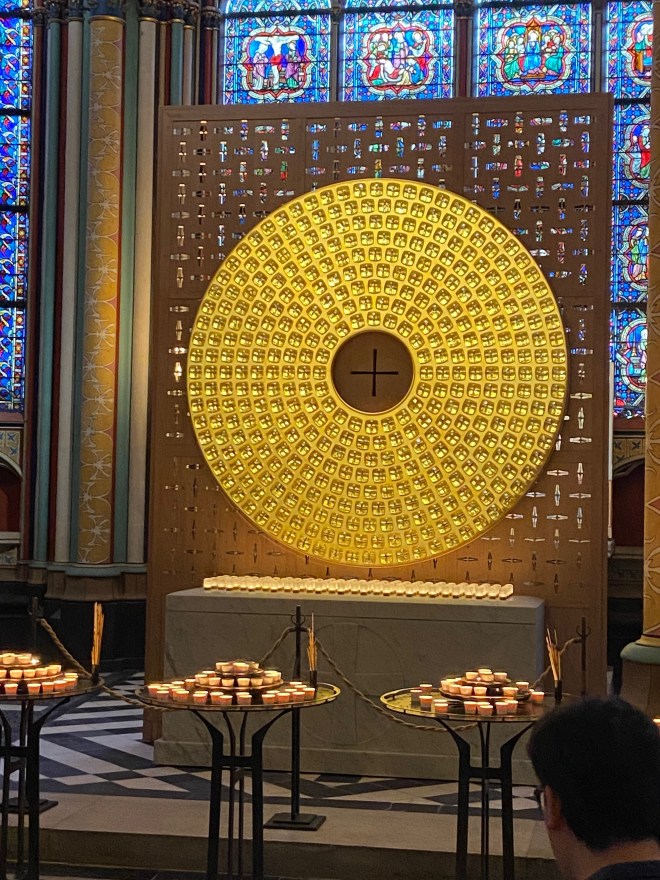
I was drawn to the newly created chapel for Eastern Christians (this was not included in my audio guide, but I have since learnt it was inaugurated in May 2025) displaying the eight icons that pay tribute to the founding figures of the great Eastern Churches. But I have to admit to not being sure about the new modern altar – a bronze bowl-like structure which looked more like a bath to me and had nothing of the sacred about it.

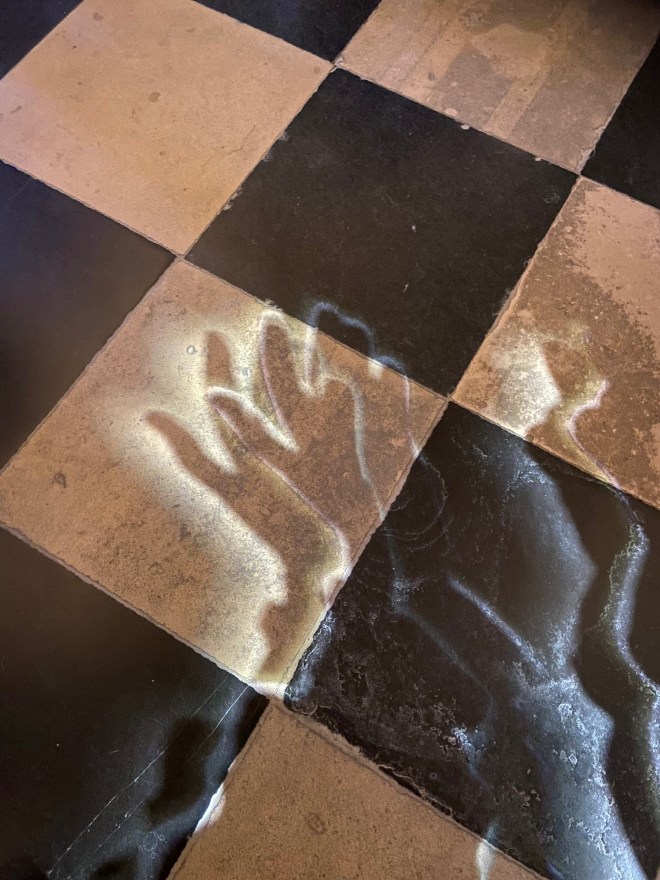
Much more mysterious was the how the play of light around the sculpture of the Virgin Mary holding the dead body of Jesus in her lap at the High Altar cast an almost spectral silhouette of Mary’s hands onto the black and white flagstones.  Similarly, the statue of Joan of Arc and the statue of the Virgin Mary, both of which avoided the fire, seemed to be ringed with an auric kind of white light. Quite magical.

After a pitstop in a café near Notre Dame – where a local told me I had to shut my menu to signal I had made my choice before anyone would take my order (great intel!) – I had a bit of a rest back at the Holiday Inn Gare de Lyons, where I was staying gratis thanks to my brother generously donating his points.

My plan for the evening was to visit the Jacquemart-André Museum in the Boulevard Haussman in the 8th arrondissement.  They have late night openings on Fridays with drinks and platters on offer at Le Nélie, the salon de thé.  I had it all mapped out, except I didn’t…

I had read that the nearest RER station was Charles de Gaulle-Étoile, which is true, but there’s a much closer metro stop. The best laid plans and all that… A transport volunteer at Charles de Gaulle-Étoile told me the museum was a good half-hour’s walk, or I could take the 22 bus. It was pouring with rain but, determined to get there, I went on up to street level and discovered I was at the Champs-Élysées, which was gridlocked with rush hour traffic. I found the 22 bus and jumped aboard only to find I needed to be ‘de l’autre côté’ but which autre côté? The Champs-Élysées roundabout is hectic at the best of times, and amid the cacophony of coups de klaxon (cue a smug moment remembering the words for car horn from my schoolgirl French), I felt I couldn’t distract the driver by asking which side he meant.

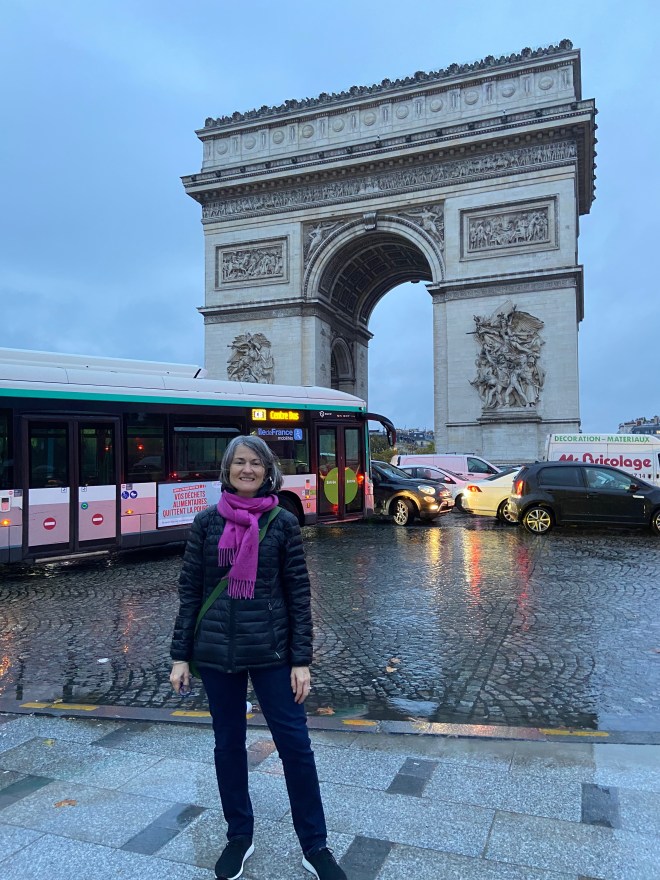
I got off the bus and back into the sheeting rain, where I took an “I woz ‘ere” photo for some fellow tourists and asked them to do the same for me. Then I took a deep breath and thought through my options. It was now getting towards 7.30pm – even if I found the right bus, the traffic was at a standstill and I’d be unlikely to get there till after 8pm. This was overly ambitious for my straight-off-the-plane day one.  Too hard basket was the conclusion. I retraced my steps and went back to the Gare de Lyon area where I indulged in a spot of people-watching over a simple but delicious dinner and a glass of rosé at a local bistro. A good decision move as it turns out. You’ll find out why in Part 2.

(more…)

A short sojourn in Paris Part 1: Notre Dame resplendent and risen from the ashes

How making the most of a Melbourne winter saved me from travel envy

Over the winter friends and family have shared northern hemisphere holidays photos – lots of wish-you-were-here vibes. There’ve been pictures of sardines grilling in Southern Spain, Gothic churches in Germany, flower-lined canals in Utrecht, dazzling white-washed vistas in Santorini, yodel-inducing Swiss alpine scenes, lush green coastal paths in Devon, quirky markets and Lord’s Cricket Ground in London and windswept beaches at the northernmost tip of Denmark.

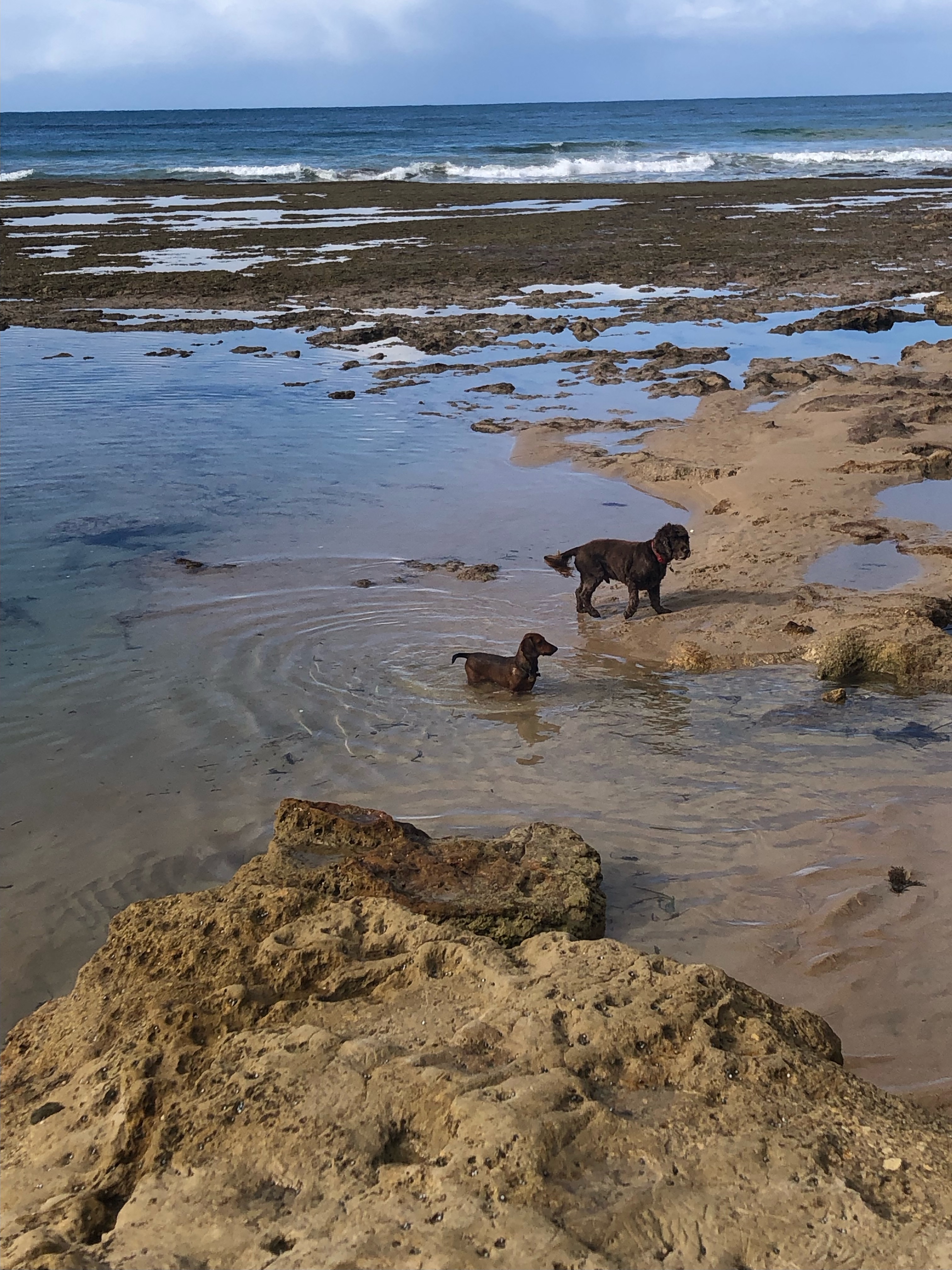
I’ve enjoyed looking at the pictures and have imagining myself there in mind and body, but I haven’t felt an ounce of envy. I’ve been just fine and dandy staying put in Melbourne. The Melbourne winter can bite, especially the wind, but it’s mild compared to a UK winter. Although I feel the cold, there’s nothing more energising than a rain- and wind-lashed walk on the beach with the dog children – Rupert, the dachsie, my canine nephew, has ‘over-wintered’ with me and Bertie.

I enjoy the seasonal variation – summer can be very intense requiring a lot of sunscreen slip, slop, slap – and finding warmth in soups, stews, candles, hot baths and snuggling with the dogs on the sofa. There are grey days in the mix which make me feel right at home but there are also some glorious sunny days in the high teens, when there’s no better place to hang out than in my courtyard garden.

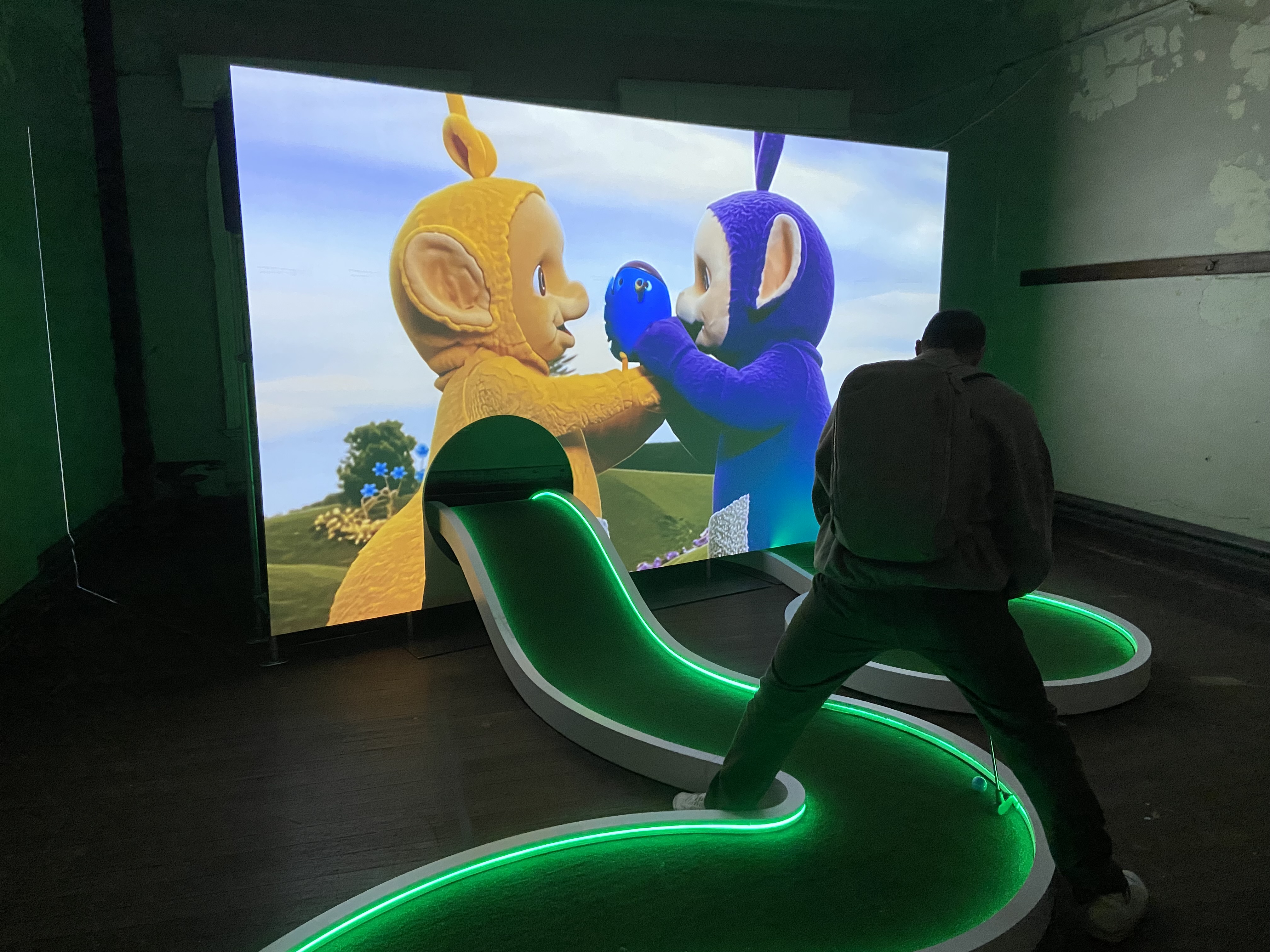
Immersing myself in artsy things has provided another form of nourishment these last few months. One of the zanier exhibitions my friend Kaliopi and I went to was Swingers – The Art of Mini Golf. I had no idea that mini golf had its origins in feminism. In the 19th Century a group of Scottish women, rebelling at being told that swinging a golf stick was unladylike, commissioned a 9-hole putting-only course which became known as the Himalayas due to the uneven terrain. The course still exists today, alongside St Andrews Golf Course near Edinburgh.

Swingers is an interactive exhibition staged in the former Victorian Rail Institute ballroom upstairs at Flinders Street Station. We navigated the nine-hole golf course created by nine female and gender-diverse artists. My favourite was the first hole, a big, bold and colourful desert scene by Yankunytjatjaraartist Kaylene Whiskey, complete with Greyhound bus and featuring Cathy Freeman and Dolly Parton. Putting is harder than it looks – you’re never going to get me playing golf – but we navigated the course as best we could.

Other works included videos of the Teletubbies, an eerie Carnival Clown face, spooky scenes reminiscent of the Mexican Day of the Dead and, at one of the holes, we had to attach a latex animal tail and swing it with our bodies to putt the ball. Well, what can I say, maybe if you’re as flexible as a hula hoop dancer… Much hilarity ensued but it did nothing for our technique.

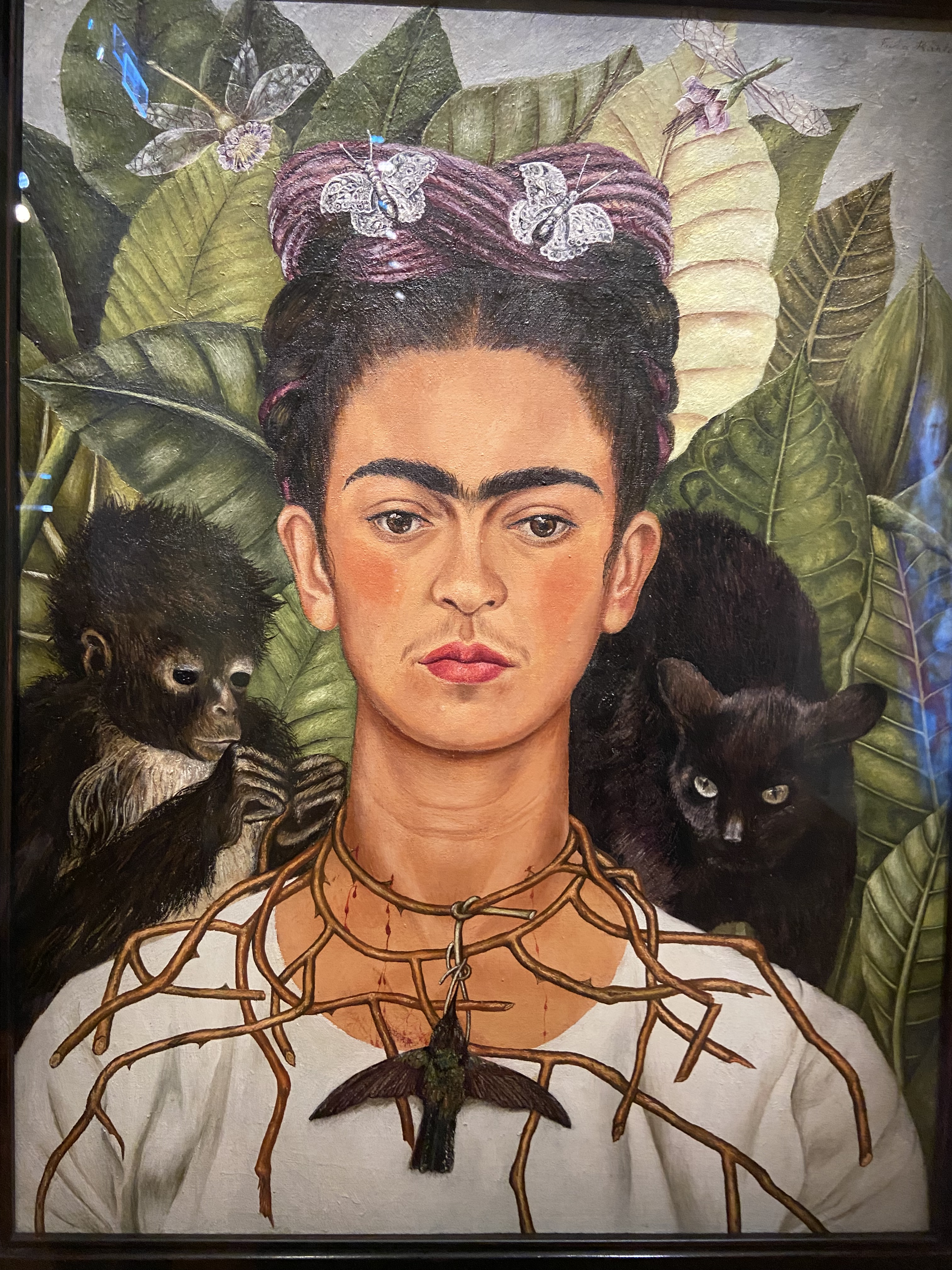
Another big pop of colour came courtesy of another feminist – in July I went up to Bendigo in regional Victoria to see Frida Kahlo: in her own image. As well as her paintings, self-portraits and the fabulous costumes, jewellery and flowers that she wore are some of her personal items that were sealed in a bathroom for 50 years after her death. These include lipsticks, powder compacts, medicines and herbal tinctures. As well as polio aged six, she suffered a horrendous accident in 1925 leading to life-long injuries when a streetcar collided with the bus she was travelling in. During her recovery she began to paint and used mirrors and an easel positioned over her bed. She underwent multiple surgical interventions, lived with chronic pain and had to wear a corset every day from 1944.

What shines through is her resilience, her deep love of animals and the natural world, her courage not only to channel her pain and disability into art but her readiness to challenge the prevailing societal and political norms. She was the daughter of a German/Hungarian father and a Mexican mestiza mother and, rather than follow the European-influenced fashions of the time, she honoured her Indigenous heritage and wore the traditional blouses, skirts and shawls from the Tehuantepec Isthmus, a matriarchal society. And although her life was cut short by gangrene in 1953, she lived to the full. She and Diego Rivera had an up and down marriage, they both had affairs – Frida even had a brief affair with Leon Trotsky. She was a member of the Mexican Communist party and painted one of her plaster corsets with a hammer and sickle.

Continuing with all things Hispanic, and following my March trip to Malaga, I saw five exquisite films at the Spanish Film Festival and luxuriated in the cadence and rhythms of the language. My two favourites were Wolfgang, a warm-hearted comedy about a nine-year-old highly intelligent boy with autism spectrum disorder, who re-establishes a relationship with his father following the death of his mother. And Ocho, a love story set across eight decades and eight defining moments in Spain’s history including the Civil War which split friends and families apart. A masterful and magical movie from the 2025 Malaga Film Festival.

A creole mass – Missa Criolla by Argentinian Ariel Ramirez – in a city church was a revelation. In place of the traditional Latin Mass, this was a folksy mass featuring dance, instrumental and song forms from Argentina blending Indigenous, African and European influences. The concert included other gems ranging from Spanish classical guitar pieces and a Peruvian hymn in the Quechua language to an Afro-Brazilian chant by Villa-Lobos, and Libertango, a piece composed by Argentinian tango composer Piazzolla. You’ll likely know the famous instrumental version, but we heard the choral adaption by Oscar Escalada with voices playing the parts of instruments.

I came out of the concert with an Andean beat pulsing in my veins, the maracas sounding in my ears and added South America to my travel wish list.  There’s been a strong Hispanic thread this winter. A few months ago, I went to a jazz club in north Melbourne to hear the Brazjaz Ensemble headed up by Carlos Ferreira, a Samba specialist from Rio de Janeiro. It was the real deal – mellow, moody and intense – and the newly graduated (2022) flautist, Yael Zamir, gave an extraordinary performance. The set included about five songs, two of which I recognised from a CD I used to play in my London days in the 90s.  

I’m a big fan of escapist musicals – it’s easier than meditation – that transport me to a make-believe world. Beetlejuice with Eddie Perfect was no exception. It’s a dark comedy about ghosts, zombies, life and death with a great score including a couple of Harry Belafonte favourites – Day-O and Shake Senora.

I went with my friend Angela and her daughter Alice, and we indulged in a Beetlejuice-themed high tea beforehand which included ghoulish lime green cocktail, black and white sugar snakes, dark chocolate and pepper scones, shrunken head tarte and a smoking concoction that added to the mystique.

This Sunday, I celebrated the last day of winter by going up to Kyneton to see Alice – a rising star – perform in Mary Poppins with Sprout Theatre, a youth musical company in the Macedon Ranges.  A wonderfully high energy production performed by a cast of talented young people ranging from tiny tots in the junior class to teenagers in the senior classes. Beautifully staged and choreographed, it was a knockout with great singing and dancing including coordinated moves and can-can kicks that must have taken a fair bit of rehearsing. As a two left feet person, I was impressed.  Absolutely supercalifragilisticexpialidocious!

Mary Poppins is one of my all-time favourite musicals, and its story and messages are as relevant today as they ever were; family is more important than work and money, find the silver linings and positives “Just a spoonful of sugar”, and believe in the power of creativity and imagination: “Anything can happen if you let it.” Sound advice!

Vale Connie – a tribute from Charlottie

I’ve already written about how I first met Connie in 1995 when I was travelling in Australia – I was in my 30s and Connie in her 60s (see https://thisquirkylife.com/2017/09/12/how-spiders-got-me-writing/). In summary, I was taking time out between jobs and had been offered the use of a cottage in Noojee in Gippsland. Picturing a quaint, rose-covered dwelling where I’d have time to do my own thing, write poetry, meditate and relax, I had eagerly accepted.

It didn’t turn out like that – the cottage was more of a shack. And as I got ready for bed on night one, I noticed a large black shape on my bed. I now know it was a huntsman but back then I thought all Australian spiders were deadly. And this one, large, rubbery and hairy, was unlikely to be an exception. After dispatching the spider to the afterlife, I lay tensely on my mattress on the floor flinching every time the loose spidery threads of the coverless duvet brushed against with my face and arms. And looking around the room, I noticed spider webs decorating the windowsills and skirting boards like a dusting of snow.  Suffice it to say I had no sleep, not a wink. And stepping into the shower the next morning, there was a spider dangling from the bare light bulb. It started to feel positively Hitchcockian.

I decided flight was the only option. Rather than return to the safety and comfort of suburbia, and my brother’s house and pool in Bayside, I got out my notebook with phone numbers of friends of friends and rang Connie from a phone booth. My dear friend Helen in the UK had met Connie and Norman in a camp site in Darwin in the late ‘80s and given me their contact details.

Hearing the high-pitched hysteria in my voice and my garbled tale about killer spiders, Connie gently said: “Would you like to come and stay?”  And so it was that I was soon on a train to Kyneton (Central Victoria) where Connie met me off the train with a big hug as if we’d know each other for years. And we never looked back.

I was embraced by Connie and her husband Norman as one of the family from the get-go and joined in the rhythm of their daily life, mainstays of which included porridge and poached eggs for breakfast, drinks and nibbles in the evening and roasts for dinner. I am indebted to Connie, an excellent (and published) writer herself, for encouraging me to write my first short story, and for believing in me as a writer. It was winter and she set me up with a table and typewriter with an oil-filled radiator for warmth. I still have the story – The Swim – typed up on now-yellowing paper.

And in 2009 when I was making a living, albeit a modest one, from writing travel and lifestyle articles, she helped me edit my article about fishing on the UK’s River Test entitled Duffer’s Day Out for the travel section of The Australian.

I’ve never forgotten my stay with Connie and Norman in Kyneton. It was where I first tuned into Australian birds; they had a bird bath in the drive outside the kitchen window, and Connie identified the lorikeets, crimson rosellas, Australian magpies, wattle birds and pied currawongs. I learnt that the Australian magpie is not of the crow family like its Eurasian counterpart. And I grew to love its melodic warbling song, so unlike the cackling of the magpies I had grown up with. To do this day, I always think of Connie and tap into something grounding and quintessentially Australian when I hear the magpie’s song.  

After moving to Australia in 2004 I visited Connie and Norman several times in their new home in Shoalhaven Heads in NSW. And once again I slipped into their way of life, comforted by the unchanging routine of porridge and poached eggs for breakfast– often on the balcony in the early morning sun. Connie and I talked about family, books and writing, Norman tinkered with his boat, and I went for walks to the beach armed with a stick that Norman made for me to scare off any snakes that might be dozing nearby. Connie and I also went into Sydney to the Art Gallery of New South Wales.  I don’t remember exactly what we saw – it may have been paintings in the permanent collection – but it was a treat as Connie knew her art and helped me view the pictures from a more informed perspective.   

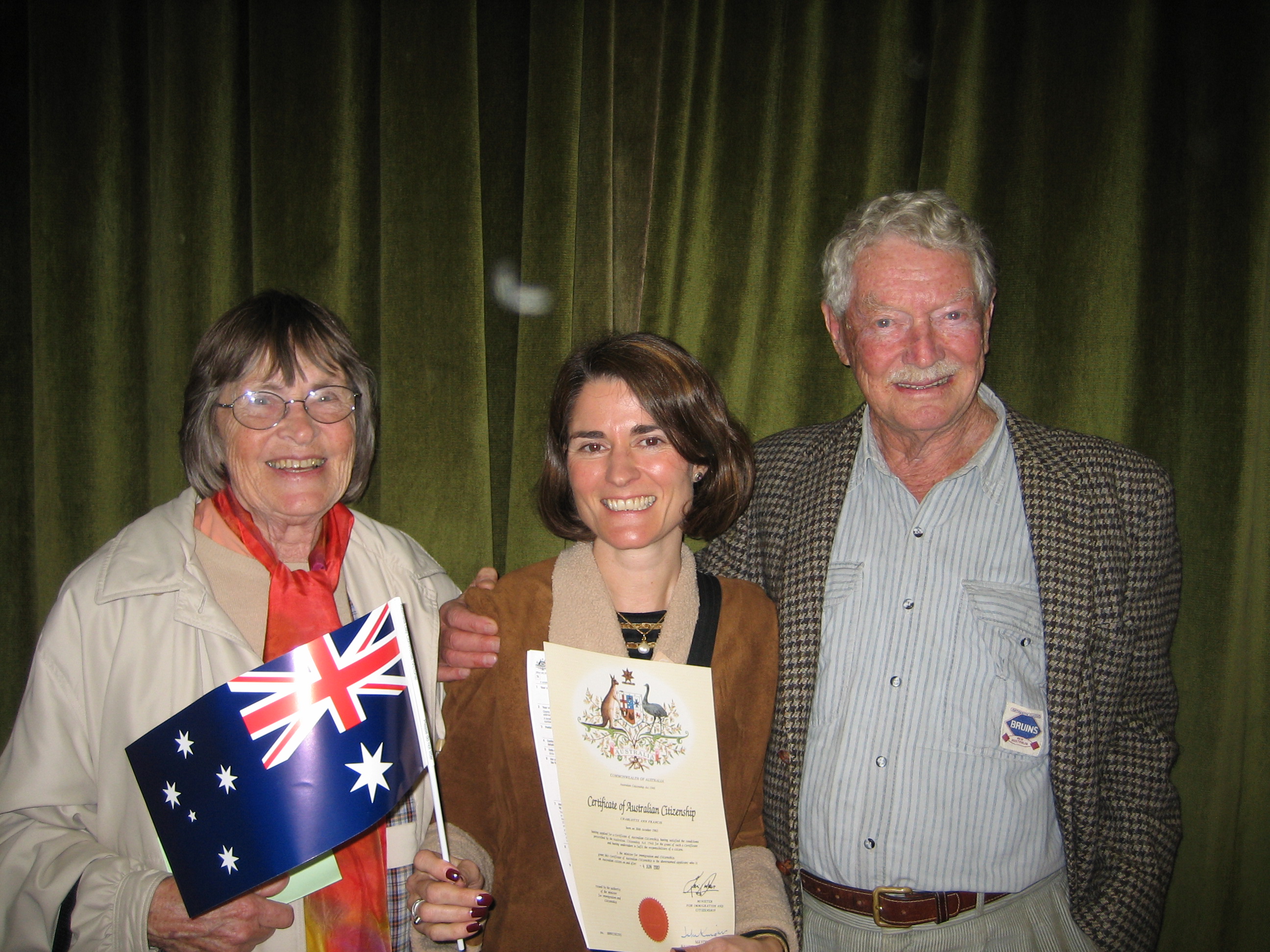
It was entirely fitting that Connie and Norman, such an integral part of my Australian ‘journey’, attended my Australian Citizenship Ceremony in June 2007. Other shared milestone celebrations included Norman’s 90th birthday party in Melbourne – a wonderful gathering of the family and extended family clan. And, over time, I can’t pinpoint exactly when, Connie began to call me Charlottie, a fitting hybrid name used exclusively by the Tout-Smith family. We also had fun and a lot of giggles playing with various English regional dialects and came up with Noite Loite, which is night light spoken with a West Country accent! Noite Loite became something of a recurring refrain in our conversations.

I last saw Connie in March 2024 in Adelaide where she had moved to live with her daughter Lynda. She was frail and suffering from cancer, and I knew it might be the last time I would see her. We played the game Bananagrams – Connie still a woman of letters and a dab hand at building words. At the same time, I felt that in Connie’s memory Helen and I may have become one and the same person – there was an element of confusion, one that presented an elegant closure of the circle. “I always did love you,” said Connie, and I, biting my lip not to cry, accepted her heartfelt words for both of us. Helen had her own formative experiences with Connie during an extended stay in Kyneton. Under Connie’s care and guidance, she encouraged Helen to join the local writer’s group and also to practise her art – one of her works was shown at an outdoor exhibition in Melbourne.

When her daughter Deb rang to tell me in late February that Connie had died peacefully in the early morning surrounded by her family, I recalled how I’d been spellbound on my dog walk that morning at the sight of several hot air balloons silhouetted against the rose-pink sky. Looking back, it feels like it was Connie’s spirit soaring home. I won’t say heavenwards as, although Connie was the daughter of a Reverend who served as a missionary in Fiji and Rotuman, she wasn’t religious.  

I was deeply saddened by the news of her death, but I was thrilled to be invited to Connie’s Celebration of Life event in mid-May. The event was held in Campbelltown, NSW, in the aged care facility where Connie’s 93-year-old sister lives.

With photographs from Connie’s life rotating on the screen – wonderful shots of her as a girl and beautiful young woman that I had never seen before – family and friends came together to celebrate all that she was and all that she contributed to the world.

I already knew Connie as an accomplished writer, a regular diarist, a keen reader, a cryptic crossword solver, a connoisseur of art, a good cook, a wife, mother, grandmother, sister, aunt and friend, a generous spirit with the warmest of smiles and biggest of hearts, but I hadn’t realised the depth of her creative life. And that’s, I suspect, because Connie was extremely modest. In Deb’s beautiful tribute I discovered that Connie was a talented piano player and received a diploma from the Associate in Music, Australia (AMusA), an award for outstanding candidates. And in later life she embarked on a Master of Fine Art at Melbourne University. While illness prevented her from completing it, she was able to use her expertise as a volunteer guide at Melbourne’s National Gallery of Art.

When her nephew reminisced about visits to Connie and Norman and mentioned the pattern of their lives – morning poached eggs and all – I reflected just how lucky I was that I had known Connie and Norman and been part of the family. Vale Connie.  I dedicate this blog to you as my dear friend, writing muse and inspiration. May you rest in peace.

Back in England: family, fine art, an old flame, a (very) old tree and teeth on the table

A highlight of this trip was meeting up with an old flame for the first time in over 25 years. We met in the ‘80s in London when I was his lodger and the world was a very different place. After years of communicating via Christmas cards between America and Australia, we were, at last, going to be in London at the same time. The anticipation and getting ready were half the fun. Limited to a travel wardrobe and my hair out of shape, my beloved sister came to the rescue. Despite our combined age of just over 130, we were like teenagers again. She helped me get ready, backcombed my hair, lent me a coat and scarf and some jazzy earrings. It was wonderfully bonding.

Lance and I met at the Cavalry and Guards Club in Piccadilly. Honouring the Club’s formal dress code, he was wearing an elegant blue suit and orange silk tie – the word dashing comes to mind. He’d hardly changed at all, and we effortlessly took up where we left off in what proved to be a fun and fond evening. Dining on the best of British at the wonderfully-named Noble Rot in Mayfair, we reminisced, caught up on all the years in between and shared unrealistic ex-pat dreams – he and his family now live in San Francisco – about how nice it’d be to own a pad in London and to stay for three months every year.

He remains a stalwart drinker, a bon viveur, a keen golfer and, while politically poles apart from me, he’s stylish, has artistic sensitivity and impeccable taste. He always did have a dry sense of humour. Quote of the evening had to be “Well, Cha (he’s the only person in the world who calls me Cha) it’s good to know, as a former lover, that you have found happiness with a dog.”

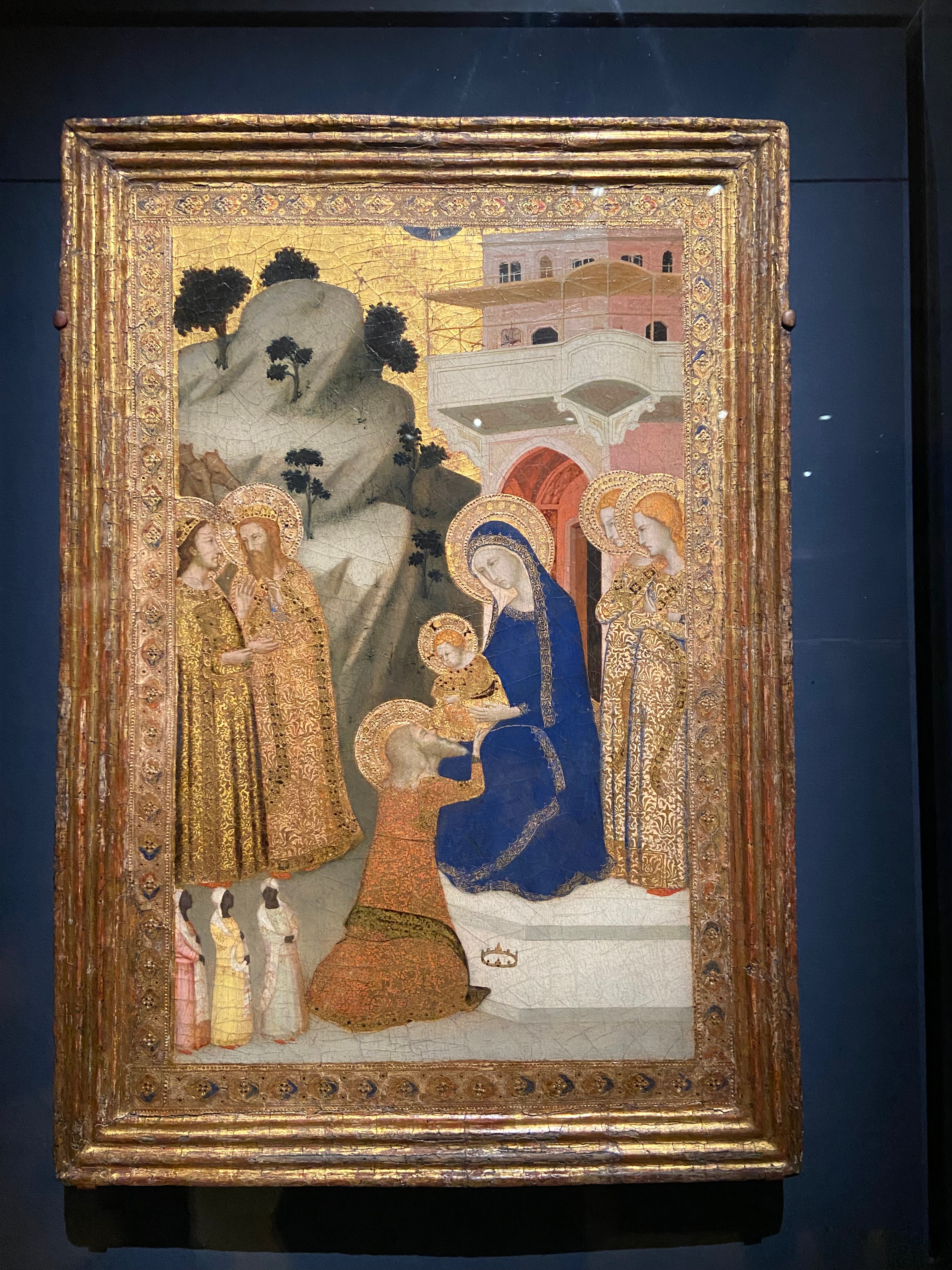
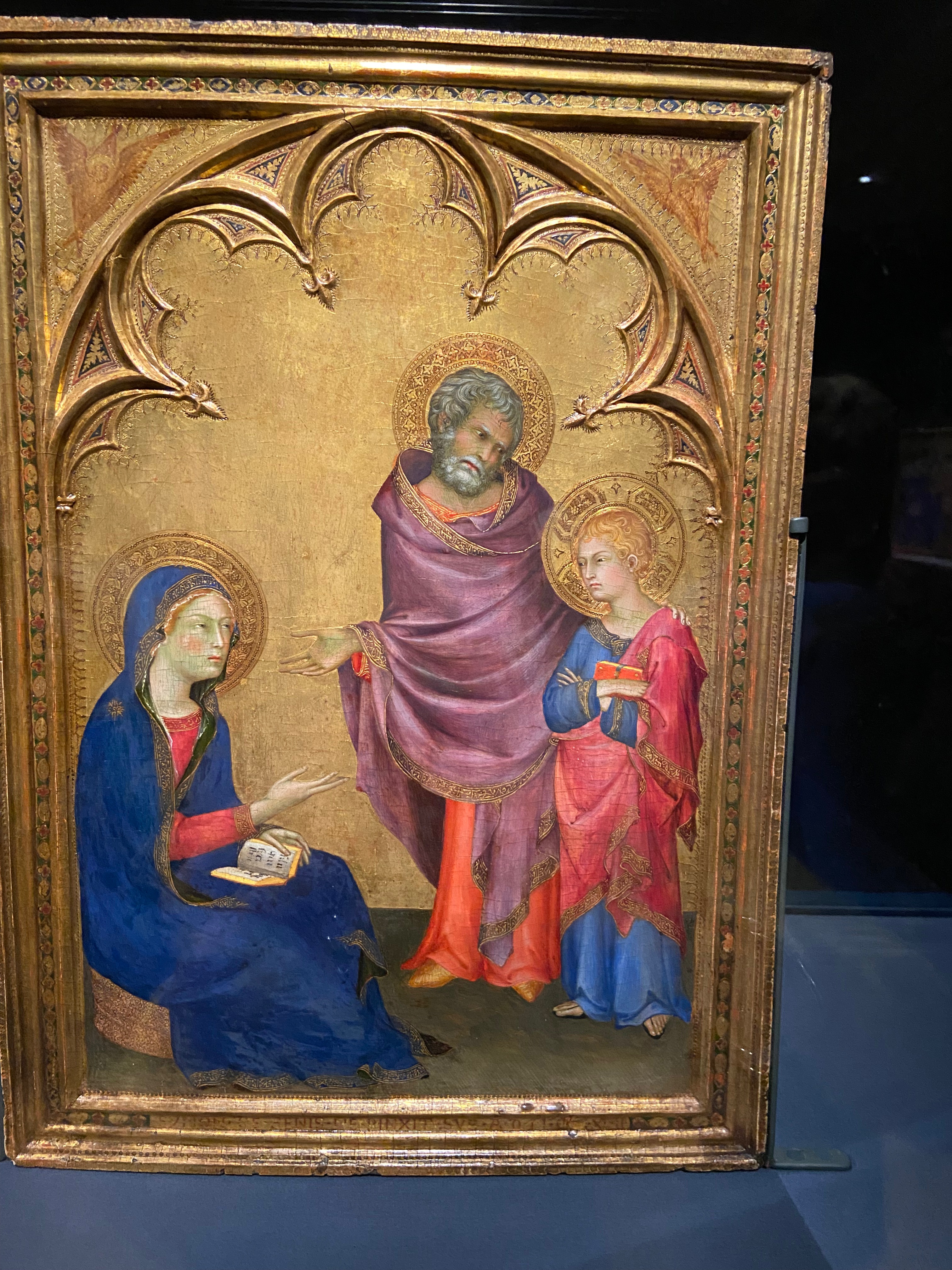
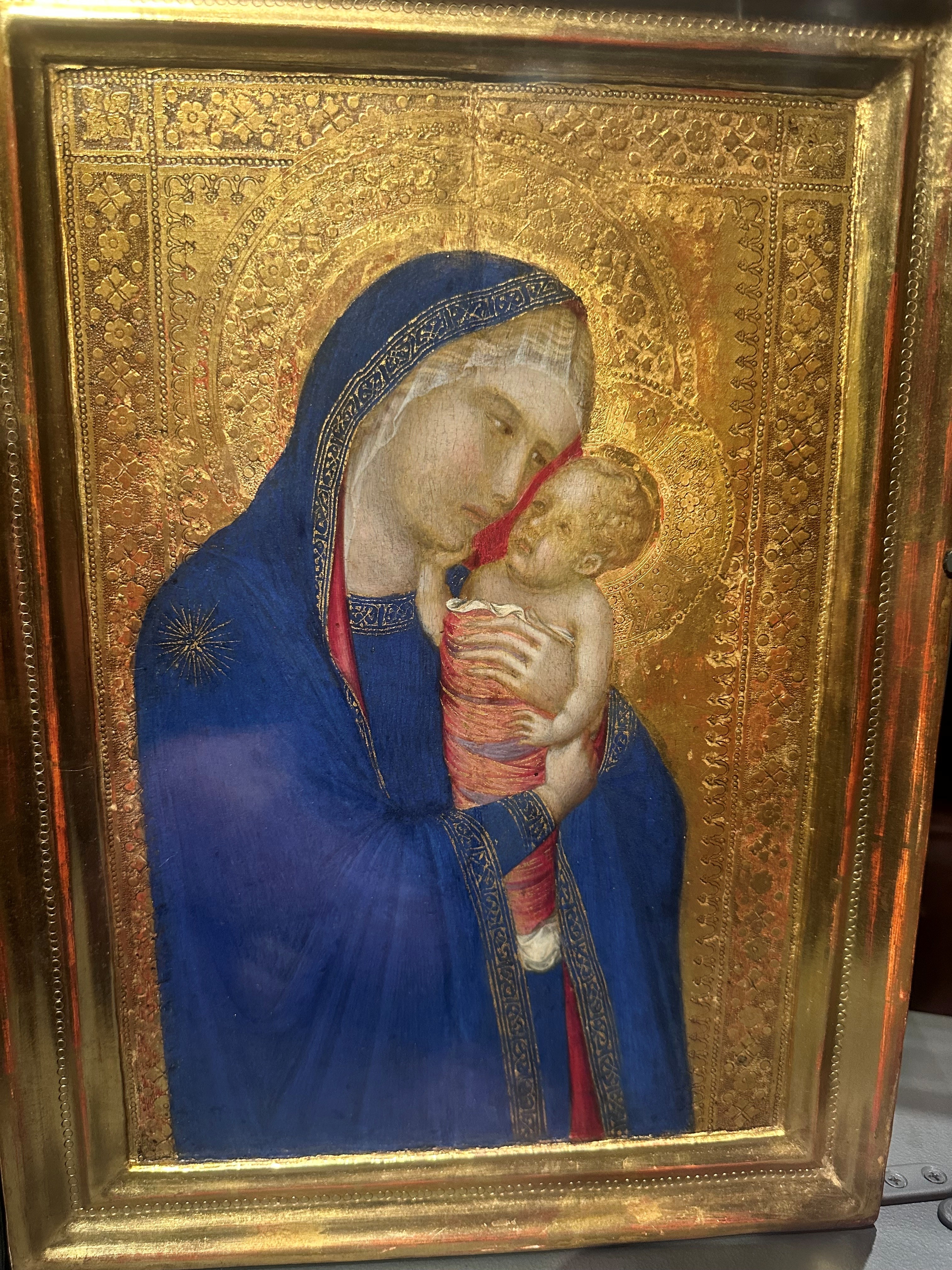
In a small world moment, Lance had seen the exhibition Siena: The Rise of Painting 1300-1350 at the Met that I was about to see at the National Gallery. In fact, some of the photos I am sharing are his.  It was an exquisite exhibition, and an extraordinary one with many of the works reassembled for the first time in centuries.

To quote from the National Gallery:

Simone Martini’s Orsini polyptych, split between Antwerp, Paris and Berlin is together again. His panels for the Siena’s Palazzo Pubblico altarpiece are reunited. 

Panels from Duccio’s Maestà, one of the largest and most complex altarpieces ever produced, on loan from Madrid, Fort Worth, New York and Washington and his ‘Virgin and Child’ and ‘Crucifixion’ triptychs come together.

Siena, I learnt, was one of the world’s richest cities and a major centre for artistic innovation and experimentation before the Italian Renaissance and up till the outbreak of the Black Death in 1348.  

What I loved was the sweep of the exhibition from the large, commissioned altarpieces, shimmering gold, to smaller paintings as well as ivory carvings, intricate enamelled boxes, reliquaries with fragments of bones, silks and textiles from Iran and Turkey, marble and wooden sculptures and illustrated manuscripts. The level of detail and the vividness of the colours – particularly the  blues, oranges, reds, purples and pinks – pulled me in as did the emotion and humanity in many of the pictures; the tender face of Mary, baby Jesus reaching up to pull aside the veil from his mother’s face and, my favourite, a picture of Jesus as a boy being told off by his parents and sporting a sulky teenage face and crossed arms.

Seeing great nephews and nieces is always a joy on my UK trips, the catch being that it’s all or nothing, and I miss out on many of their milestones from trip to trip. I enjoyed reading Hairy Maclary to Dougie, who is now coming up for two, walking, talking and being schooled in the art of calling me Lot-Lot.

Up in Nottinghamshire with Mum, I caught up with my great nieces – Millie and Imogen from Yorkshire. Millie at 14 months was too young to recognise me but I got a great welcome Imogen, who is nearly five. I’d decorated the dining room with bunting and balloons, but much more exciting was doing the washing up standing on the step and playing peek-a-boo through the (rather old-fashioned) serving hatch between kitchen and dining room. That and ragging around with my eldest brother, the most devoted grand-father ever.

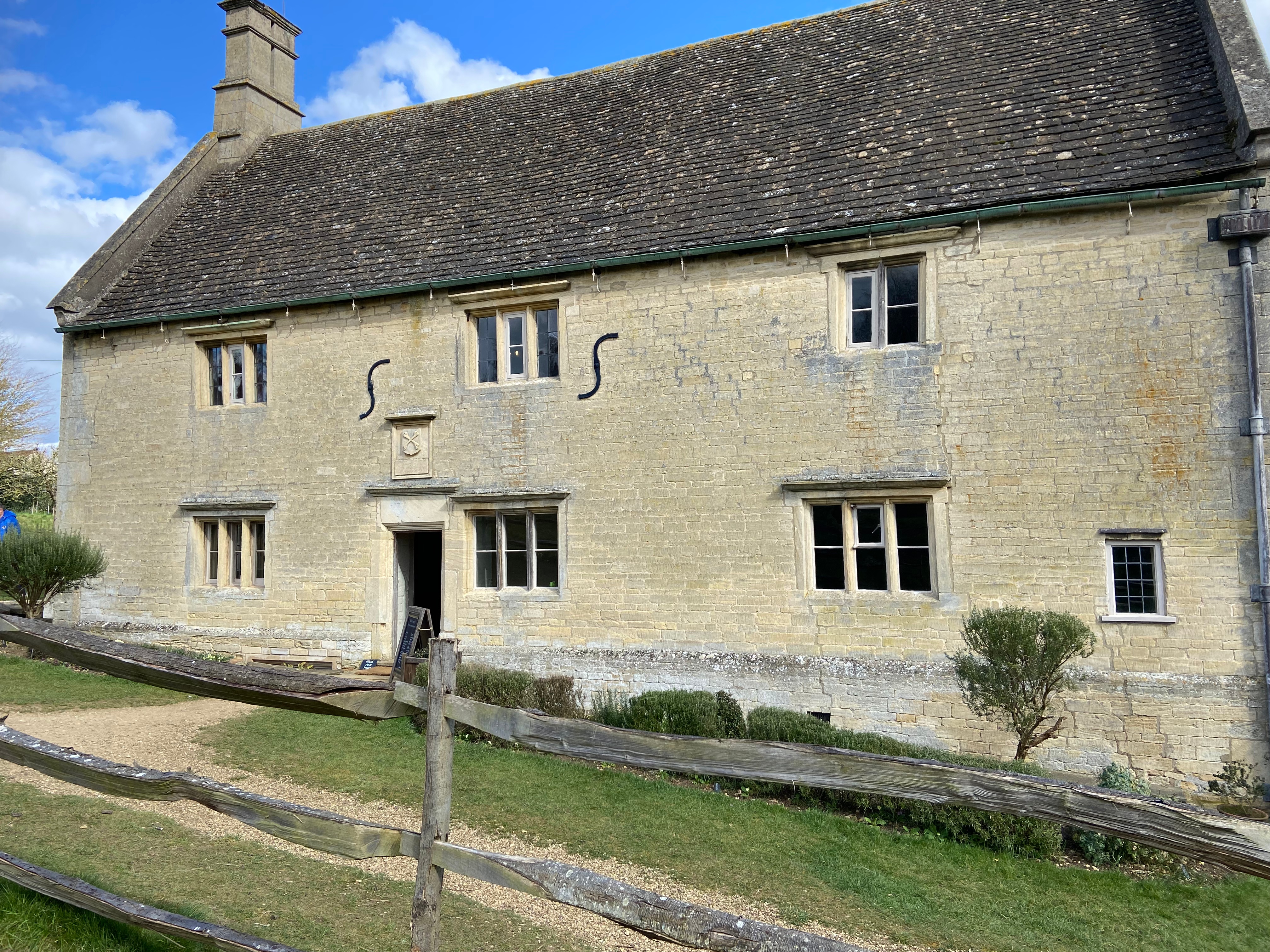
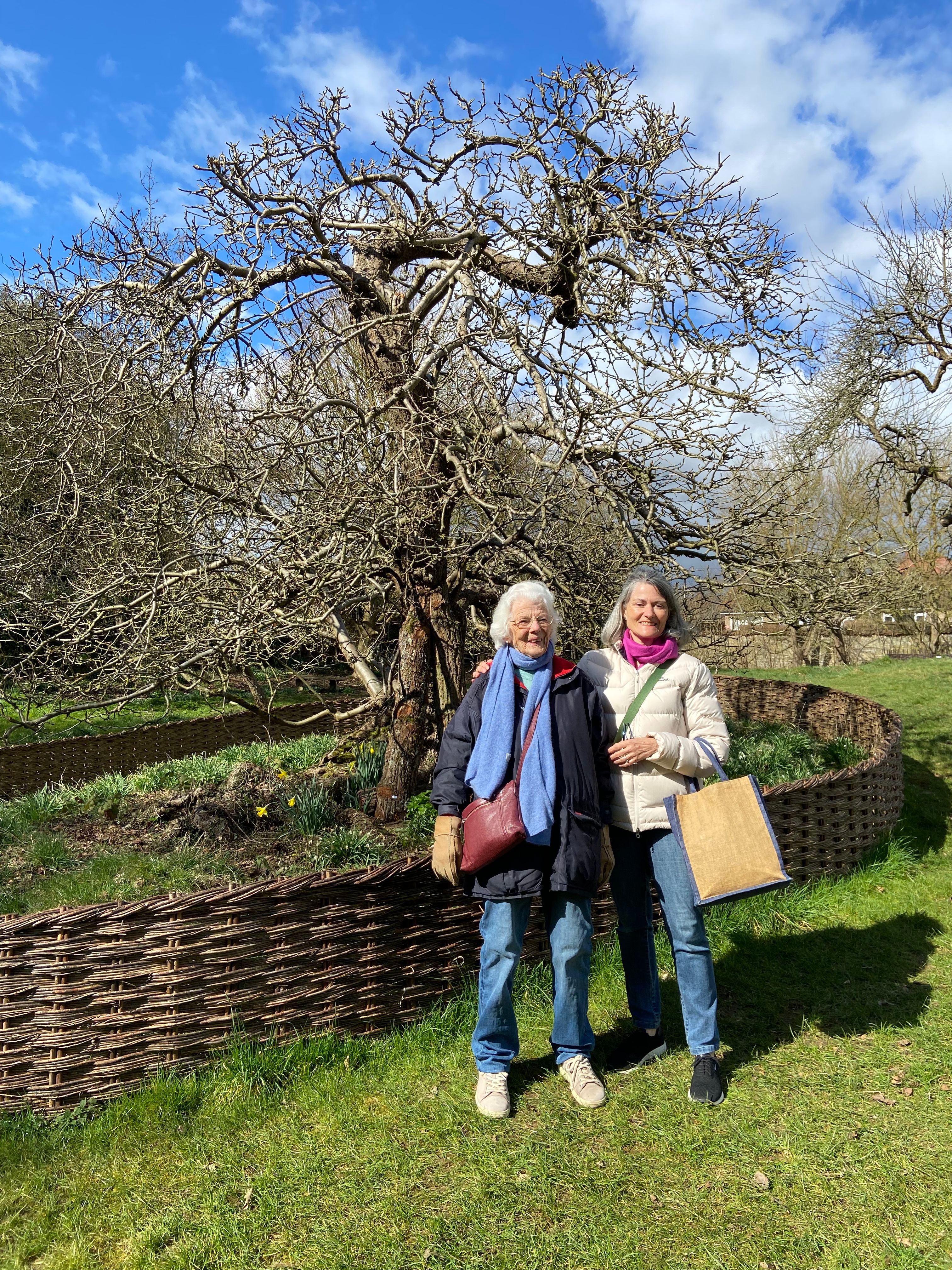
Mum had a rocky start to the year but has fought back amazingly well. So it was a triumph to manage a fun day out together and lay down new memories. At 93 it’s a case of carpe diem. We went down the A1 to Lincolnshire to see a heritage-listed tree – not just any old tree but possibly the oldest known apple tree in the world. The tree where Isaac Newton had his aha gravity moment.

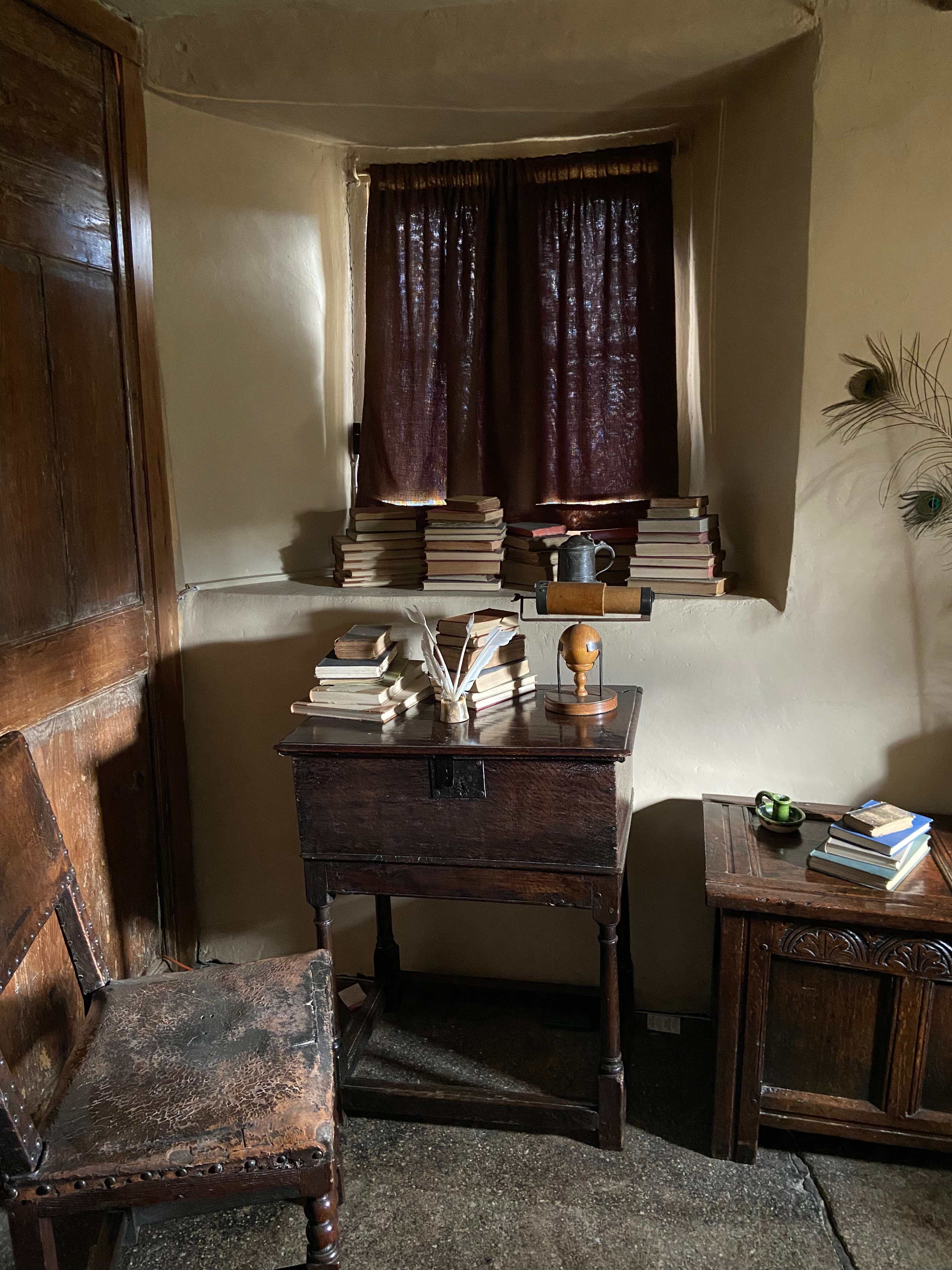
The tree is in the garden of the Woolsthorpe Manor (now a National Trust property) where Newton was born in 1643. Inside the house is the room where he conducted his experiments on light using a prism, a recreated dining room, kitchen and bedroom with lots of heavy oak furniture, and exhibition on the 17th Century uses of urine. These ranged from mouth wash, skin softening, reducing wrinkles (I’m not up for trying it on the crow’s feet!) and stain removal to making gunpowder and warding off witches. It was also prized as a valuable side-hustle commodity you could sell to soap-makers and tanners – there was no Airbnb and Uber back then.

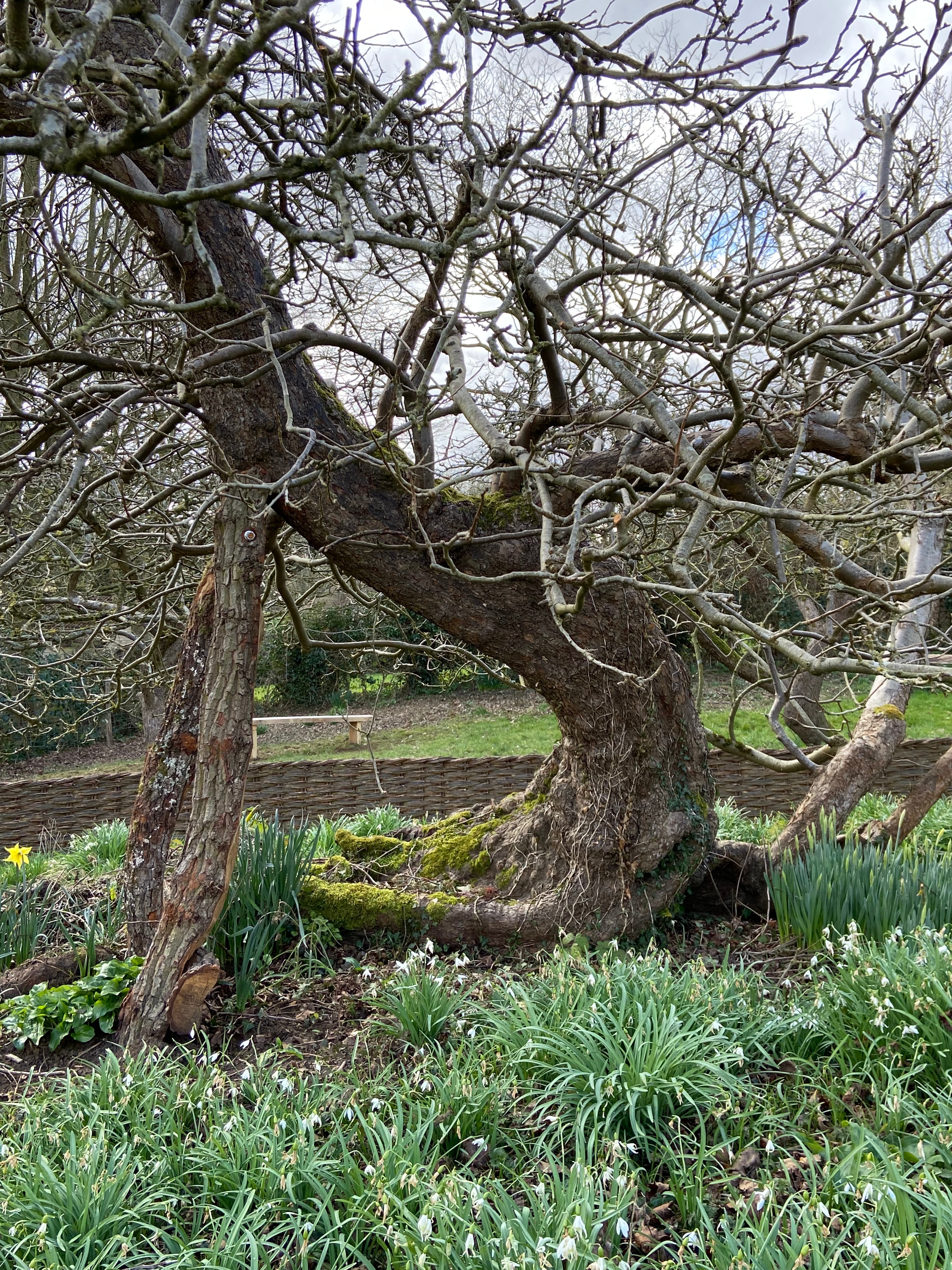
The apple tree, somewhat gnarled and bent, has proved amazingly resilient and survived being felled by a major storm in 1820. And, even better, the tree has offshoots all around the world including in Canada, the US, Argentina, Germany, South Africa, Korea, Japan and Australia. And the tree’s Australian descendants are not far from where I live.  

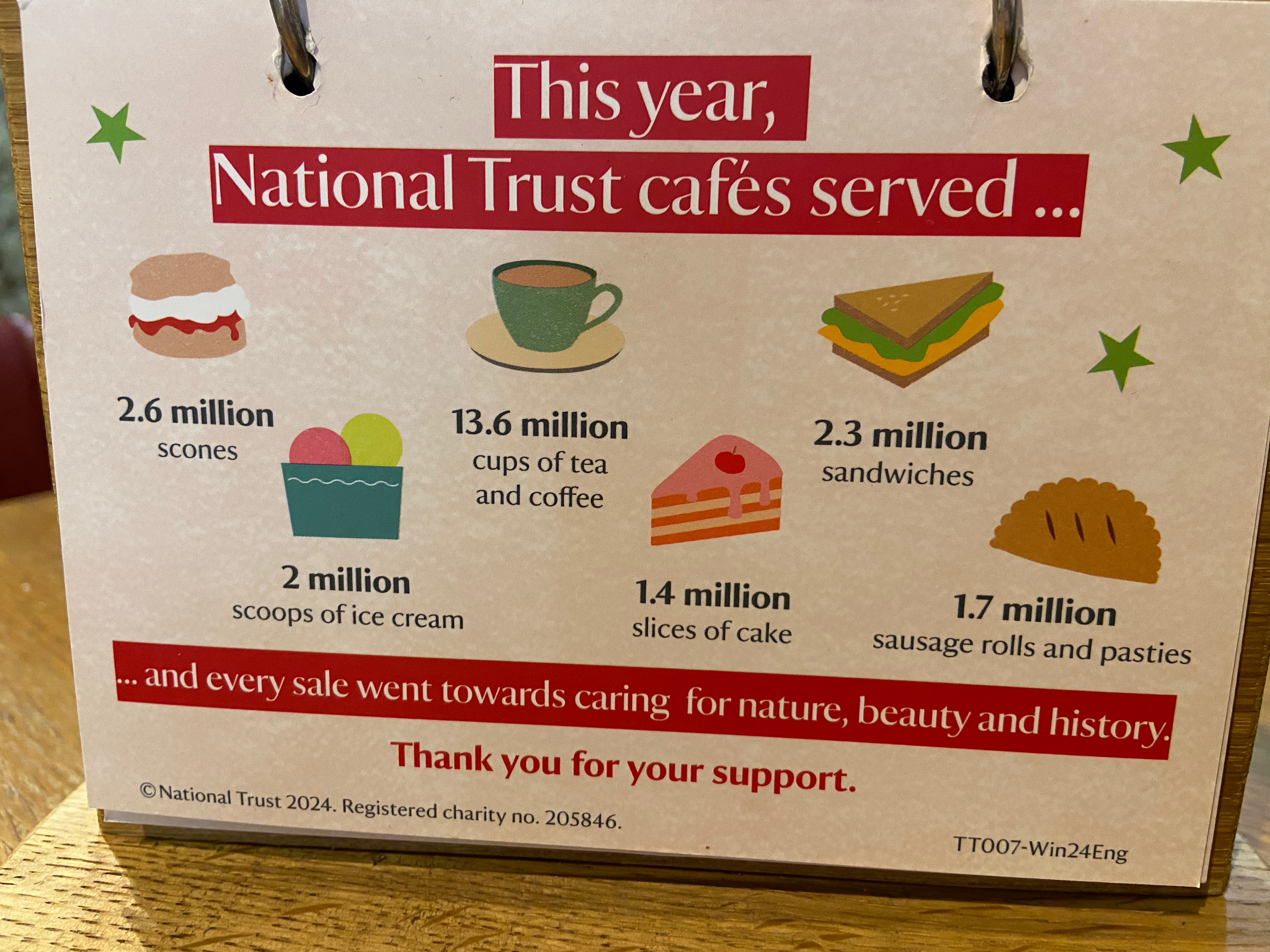
We enjoyed the spring sun but there was a biting wind, so we warmed up with a sandwich lunch in the barn and I enjoyed a nice British cuppa, one of 13.6 million served in National Trust cafés annually!

The weeks with Mum in her village near Retford in Nottinghamshire had some surprisingly busy days whether it was medical appointments, relatives coming over, neighbours popping in and out, the window cleaner appearing at the top windows early one morning when we were only half dressed, the boiler being serviced, supermarket shop-ups, a trip to the tip to get rid of rubbish from the garage – and managing all the things old age throws at you.

Mum and I had a few fraught moments due to an unholy alliance of old age irritations – hearing, digestion, eyes, poor sleep and anxiety topped off with a very nasty cold which we both succumbed to. Mum had two macular eye injections in one week, and for one of them I managed to leave all forms of payment behind on the kitchen table. Emerging from the injection feeling wobbly and seeing black dots, Mum wasn’t best pleased that I had no means of paying for the parking, which would likely result in a written penalty. You’re never too old to get a good ticking-off.  Luckily a kind-hearted woman gave us the £1.75.

However, that evening dinner was a disaster. I’d managed to make the sausage skins tough and the broccoli too crunchy (Goldilocks would have had a field day). Mum, cross and tired and unable to chew adequately, took out her dental plate and put it on the table where it sat accusingly. Mum’s teeth were out, and mine were firmly clenched. A bit of a Swords at Dawn moment!

Needless to say, we’d moved on by the next morning and, girls together, we both had 10.30am hair appointments – nothing like a haircut to make you feel better. Adjacent basins wondered my brother? Not quite but that’d be a good title for an Alan Bennett play!

I timed my trip to include Mother’s Day on my last weekend, and my sister came up from London to join us. Flowers, chocolates, coffee by the canal in Retford and roast chicken in the Aga. And time to read Mum a few more stories from Craig Brown’s A Voyage around the Queen, an entertaining biography with a difference. I bought it on the strength of this review from The Times:  “An unconventional tribute that offers a snapshot of almost a century of social history with a mix of royal insanity, and superior anecdotes, from farts and corgis to Paul McCartney and poets laureate.” And it absolutely delivered; Mum, I’ll be back to read you more extraordinary Royal tales (and tails) before you know it.

Rediscovering Spain (Part 1 of 2) – Madrid to Malaga

It had been a long time since I last visited Spain – probably back in the ‘90s when I made a couple of brief visits for work during my publishing days. Many moons ago I studied Spanish (and German) at university, and even tuning into the children’s cartoons playing above the luggage carousel at Madrid airport was exciting; just as well as my case took nearly an hour to appear!

Despite the bracing early March weather, eight degrees and wet and windy (it was mid-20s when I left Melbourne), I was off and out the minute I’d checked into my hotel, keen to make the most of my afternoon and evening in Madrid.

I was staying in the Barrio de las Letras, the literary quarter, home to many of Spain’s writers from the 17th-century Golden Age, a deliberate choice as my degree was largely literature-based. All the names came flooding back, Cervantes (Don Quixote), Lope de Vega and Tirso de Molina who, in his play El Burlador (seducer) de Sevilla), introduced the world to Don Juan, the charming hero-villain, a character with folk legend status made famous by Mozart’s opera Don Giovanni and the subject of many books, plays and films since.  I was in my element walking along elegant, cobbled streets dotted with early spring blossoms in the company of these literary greats who were variously honoured in colourful tiled mosaics, street signs, cafés, Metro Station names and quotations engraved on the pavements.  

I barely noticed the cold and that my feet were soaked through to my socks. Such was the excitement and cultural immersion. I had a few pit stops – an arty café where I dipped into a slim novella, Réquiem Por Un Campesino Español, one of my university books, first published in 1950, and a few tapas in a thronging and lively covered market.

Further on I stumbled on a rehearsal for Semana Santa (Holy Week) which will be in full flow as I write this over Easter.  14 men from a cofradía (a fraternity/brotherhood) were bearing a float weighed down with suitcases in preparation for the Holy Week processions. All wearing white runners, they performed a kind of slow-shoe-shuffle in time to the recorded music, their heads covered in a white cloth, a stand-in for the capirote, a hood with a conical tip, a symbol of penance, that conceals the face. I admired their dedication turning out on a cold and wet Saturday afternoon!

A few days later in Malaga, I peeked through the heavy wooden doors of a cofradía and saw the bulky shapes of sculptures (most likely Christ, the Virgin Mary and various saints) covered in cloth and mounted on a float, awaiting the Easter processions. These brotherhoods are Catholic organisations made up of lay people (men and women) who carry out charitable and religious works and events in the community. They play a key role during Semana Santa.

This was just one of many examples of timelessness and enduring tradition that I was delighted – and reassured – to find still in existence in Spain today. It’s 40 years since I spent four or so months in Granada as part of my Spanish degree – way before the distracted digital age of everything being available at the swipe of a screen.

I took the train to Malaga from Madrid’s Atocha Station the next morning. Atocha is a destination in itself with its glass and iron-clad domed roof – an old trainshed – complete with tropical garden. I was on a no-frills ticket, and it’s a three-and-a-half-hour journey from the centre of Spain down to Andalucia in the South. There wasn’t much to look at on the way but I got chatting to a young female student and soon realised how rusty my Spanish was!

My goal was to get to Malaga in time for the Entierro del Boquerón (burial of the sardine), an annual ritual on the last Sunday of Carnaval, when festivalgoers mark the end of Carnaval. I had missed the midday jamboree of music in Calle Lario (I was still on the train) but got down to Malagueta Beach by 5pm and was surrounded by revellers in their costumes, tears painted on their faces, marking sorrow that the fun was ending and the sobriety of Lent fast approaching. Nobody quite knows how the sardine tradition came about – maybe it’s a nod to Malaga’s maritime heritage – but the message is clear, it’s about closure.  

I stood on the wall overlooking the beach to get a better look. Delightfully irreverent, the sardine sat atop a float, flashed its blue and green-glinting scales and sported a jester’s hat. From what I could see the fish was made of metal and layers of fabric and paper – perfect combustible material. Although the weather was squally, the fish was set alight, and clouds of black smoke blew back towards the city. In no time at all, all that remained were the spines of the fish.  Buried indeed. What joy to be part of the action. I felt as if I had time-travelled to another world.

Just back from Malagueta Beach is Malaga’s Pompidou Centre. I had no idea that the Paris Museum has a Spanish branch. But you can’t miss it with its Mondrian-style brightly coloured squares. It was open till 8pm so I drifted in and went to an excellent exhibition called Place-ness: Inhabiting Space, that explored how humans relate to (and ruin!) their environment. There were many references to exploiting the natural environment for productivity and profit, and a section with paintings and photographs exploring the impact of industrialisation including ‘non-places’ such as shopping malls, motorway interchanges, abandoned shipyards and airports. Some of my favourite pieces include an idyllic Alpine landscape with a shower and tap attached like an elephant’s trunk in the centre of the painting reminding city dwellers of the source of their water supply, and a pair of Armani suit trousers hanging on a clothesline, the pockets filled with plants and earth, an allegory by the Romanian artist about the immigrant experience in Italy and being uprooted.

For dinner, I found a delightful restaurant with earthy home-cooked food near to where I was staying and away from the city centre. Reminding me of carpet sellers in a souk, the more touristy restaurants have hawkers stationed outside brandishing menus printed in three languages. It’s all too pushy for me.

Small and cosy with the menu on the blackboard and small chalk-painted wooden tables and retro chairs, restaurant Oliva was a great find. The welcome tapa- served with a drink – was an exquisite flavoursome stew of chickpeas made with a hint of chorizo and lots of vegetables and cooked slowly for hours. Other delicacies included roasted padrón peppers, eggs with asparagus and jamón and a cheesecake made with Queso Manchego. Delicioso!

Such richness on all levels, a feast for body, mind and soul – and I was only just over 24 hours into my Spanish sojourn en route to the UK. Spain Part 2 coming next week.  

In praise of the arts: hope, healing and humanity

Last (Australian) summer I got completely spooked by reading an apocalyptic novel – Leave the World Behind – by Rumaan Alam. Not my usual literary genre of choice, I had picked it up at my brother’s holiday house and couldn’t stop reading. It’s the story of a mysterious blackout along the East Coast of America and the collapse of civilisation. After finishing it I had a sleepless night worrying about the state of the world – everything from climate change, wars, plastics in the environment (and our bodies) to Trump getting back into the White House and AI into the wrong hands.

For me one of the best antidotes to Weltangst and negativity is engaging in the arts.  The arts connect us to joy, inspiration, beauty, creativity and to one another, expand our understanding of the world and humanity, enable us to dream and soar above the everyday – even if fleetingly. We may laugh, we may cry or be filled with awe and wonder.  The arts can also shock, provoke and act as a call to action.

During the endless Melbourne COVID lockdowns, tapping into all the wonderful plays, operas and musicals streamed free from the world’s stages was a silver lining. It also gave me hope and restored my faith in humanity, which was challenged by all the fear-mongering and survival of the fittest behaviours – remember the loo paper hoarding?!

An emerging body of research, strengthened since COVID, highlights the link between engaging/participating in the arts and mental health benefits. It makes it all the more regrettable that public arts funding gets slashed during periods of economic downturn. The cultural sector in the UK, for example, is suffering huge cuts. Interestingly – according to my research – Finland has the highest per capita public arts spending, and is also the country that ranks highest in the UN World Happiness Report – I rest my case.

There’s also opportunity for arts to inform and be integrated into social policy.  A good example of how this can work in action is Streetwise Opera, a UK charity that connects those living with homelessness with world-class artists to co-create bold new works, bringing together diverse voices and stories, improving the wellbeing, confidence and social connectedness of participants. It’s a great example of how an otherwise elite art form can be reinterpreted for social good.  See: https://streetwiseopera.org/

Another immersive, affordable and accessible way to experience the arts across multiple genres is to attend a Fringe Festival. In 2019 I happened to visit Avignon during the Avignon Festival in July and was drawn to Avignon Le Off (their name for the Fringe). I dashed around seeing French theatre (dusting off my A’level French), watching a naked yoga dance (which was rather beautiful and not remotely salacious), a clown-like comedy set in a barber’s shop, and a brilliant and hugely powerful two-person play written and performed by Tim Marriott (of Brittas Empire fame) about Mengele meeting the angel of death on a Brazilian beach. And everywhere I turned there was this artsy soup of drag queens, artists riding unicycles, singers, street artists and acrobats. Some of the works I saw there happened to be Adelaide Fringe shows. And in the magical way the universe works, a year later I ended up doing grant-seeking and advisory work for them.  

Fast forward a few years to August 2023, and I met a colleague from the Adelaide Fringe in Edinburgh when the Festival and Fringe were in full flow. Of course, Edinburgh is where the Fringe movement was born in 1947, when eight theatre groups turned up uninvited to perform at the Edinburgh International Festival.

While I mainly focussed on Fringe shows, I also attended a couple of Festival events. A standout was a chat between Iván Fischer, Director of the Budapest Festival Orchestra (BFO), and Edinburgh Festival Director, Nicola Benedetti, in the Usher Hall. We – the audience – lay or sat on the floor on bean bags and heard Fischer talk about – and demonstrate – how an orchestra can maintain contemporary relevance away from the formal staging of a classical concert.  Many of the musicians in the BFO play other forms of music, and we heard a selection: Monteverdi madrigals (with instrumentalists singing in the chorus), Argentinian Tango, Klezmer music and rousing wedding music from Transylvania.  An absolute treat.  

Other favourites were a one-man play, In Loyal Company, a true story of missing WWII soldier Arthur Robinson, written and performed by his great-nephew David William Bryan. A hugely energetic, visceral and totally captivating performance, you’re on board his ship in Singapore when it gets bombed, you sweat and shiver through dysentery in Malaya, and feel gutted when he finally returns to Liverpool after the war to find life has moved on in his absence.  Another very poignant play – Shanti and Naz –was about two best friends, one Hindu and one Sikh, during the time of partition in India. By complete contrast A Migrant’s Son (an Adelaide Fringe production) presents a true-life story of the Greek migrant experience to Australia. It’s a musical journey created and sung by Michaela Burger and is full of humour, heart and a few horrors along the way. Burger has a fabulous voice and was joined by a community choir as the chorus.

The New Revue was a sharp satire on (mainly British) current affairs which back then featured Rishi Sunak, BoJo, Keir Starmer, Suella Braverman and Paddington Bear.  How fortunate are those of us who live in democratic societies and enjoy freedom of speech and self-expression. A healthy and vibrant arts scene encourages the exchange of ideas, the exploration of stories and different art forms. There are all too many examples past and present of autocratic regimes suppressing the arts and subverting them for state propaganda.

I loved being in Edinburgh: the buzz and festival vibe; the many tartan and shortbread shops; the whisky; people-watching; pop-up shows and street artists; bagpipes; summer chill and cloud; ancient stone and cobbles; and, towering over it all, the great bastion of the castle. I reconnected with friends I hadn’t seen for many years and stayed in their delightfully rambling house in Morningside. I also stayed with Australian friends in the Borders, and probably drove them mad running around to so many shows.  

I did the same thing in Adelaide in February, partly as my clients at Adelaide Fringe generously gave me a bunch of comp tickets and also because it was Writers’ Week. I ran between the two – literally!

Highlights included a magic show, Charlie Caper, how DID he do it?  I strained to see the tricks and shortcuts but couldn’t. I loved the show and the old world feel conjured up (haha!) by his Fedora, three-piece suit, bow tie and the tasselled lamps. A stand-up comedy session in a converted railway carriage was raw and vulnerable while a Japanese circus, YOAH, was highly stylised and silent – all black and white and techno. Lolly Bag, a one-woman show by the talented Hannah Camilleri was a delight. Very quick, very original, and very funny, she played a whole a range of characters from a curmudgeonly car mechanic to a frazzled Year 8 class teacher, mixing improv and audience participation to great effect.  

Charlie Caper’s Magic Show

I also had the pleasure of seeing two more Tim Marriott plays – we have stayed in touch since I got chatting to him, his wife and dogs in Avignon. Appraisal was a gripping all-too-realistic and, in parts, darkly funny, two-person play about a toxic work culture, the abuse of power and position.  Watson, The Final Problem is based on Sir Arthur Conan Doyle’s Sherlock Holmes stories. With Big Ben chiming in the background and a Victorian-era room complete with hat stand, wooden chest, chair, desk and diary, we were transported to London, where Dr Watson looks back on his life and friendship with Sherlock Holmes. Tim Marriott’s masterful monologue took us on a rollercoaster ride culminating in the final demise of the detective at the hands of Moriarty at the Reichenbach Falls.

Cramming in – you know me – Writer’s Week events, it was a delight listening to Irish writer Anne Enright talking about families, Irish mothers and poets in relation to her new book The Wren, The Wren, and hearing what broadcasters Leigh Sales and Lisa Miller had to say about storytelling. I also attended an event at the Town Hall, where a group of writers each read a piece about family. My absolute favourite was by Martin Flanagan.  

On this 66th birthday he went back where he was born, the Queen Victoria hospital in Tasmania (now offices), to write a letter to his late mother. Warm, moving, fond and funny, it was clearly part of an ongoing conversation with her.  He recalled his friend Michael Long saying: “the silliest thing white fellas say is that you can’t talk to the dead.” Michael, whose mother died with he was 13, has a cup of tea with his mother every day. Martin concluded his birthplace reflection by saying to his mother: “I knew I’d find you here.” I found an extract from this tribute online if you’d like to read more. Go to: https://footyology.com.au/martin-flanagan-talking-to-mum/

That’s what I love about the arts, it all comes down to storytelling in one form or another: . “You’re never going to kill storytelling, because it’s built in the human plan. We come with it.” – Margaret Atwood,

Dresden: Part 3/3 – Final reflections and scorecard: Culture 8/10, Food 5/10, Historical interest 10/10, Livability 7/10

If you’ve slogged through my last two blogs on Dresden, well done!! Apologies if I lost you in all the detail; such was my fascination with its history that I did lots of research on my return to Australia making my blog posts rather information heavy!  “You really have to concentrate,” commented my sister… This final Dresden post is more personal and less driven by facts and figures.

You’ll notice I didn’t mention food in my previous posts. To be honest, neither food nor drink were highlights of my Dresden trip. Not to stereotype German food, but I’m not so into bread, beer and sausage. I was wandering round the various stalls and wooden huts of the Spring Market one evening and felt my stomach turn at the fatty-looking potato cakes and greasy Currywurst bubbling away in a large pot.

And eating out in the Old Town – close to my hotel – was very expensive; I was paying a premium for the location. Interestingly, though, the meals with a view were somewhat marred by surly and, in some cases, outright bossy service; no frills or niceties whatsoever. After my long day visiting Loschwitz, the castles on the Elbe and the Stasi Detention Centre (see blog post 2), I stopped off for dinner in the Neustadt – the ‘new town’ on the opposite bank of the Elbe from the Old Town.

Here the vibe was quite different: trendy, younger, student-y and ethnically diverse as evidenced by the different cuisine offerings – from Turkish, Greek and Middle Eastern to French, Vietnamese and more. And the shops! I window-shopped my way past some of the most fun and original retro, vintage and niche interest shops I’ve seen in a while. Just as well I had zero room in my case, and it was anyway approaching closing time.  

However, my chief mission was to find the Kunsthofpassage (KHP)– a series of funky interlinked courtyards in Görlitzerstrasse that were jazzed up about 20 years ago with art and wall sculptures. The one I loved best was the building with the musical drainpipes set against a turquoise painted façade. I’d love to be there when it rains and the water plays through the trumpet-shaped pipes. The courtyard of the animals is fun too with monkey, giraffe and bird bas-reliefs on a lime green wall.  Elsewhere there’s a floating sculpture made of woody stems and climbing red geraniums set off a blue front door.

Among the KHP’s arty shops, chocolaterie and other offerings I found a restaurant called Lila Sosse (Lilac Sauce) that drew me in with its wooden tables, menu on the blackboard and desserts in glass jars. Away from all the Old Town Baroque bling, the wait staff were friendly and down to earth, and I had the best meal of my stay – an asparagus, beetroot and feta risotto – and at a reasonable price. Still recovering from the Stasi Museum experience earlier in the day, I also treated myself to a stiff vodka and tonic. Chin up and all that.

Keeping on the food theme, I opted for the hotel breakfast the next morning – my last full day in Dresden. The previous mornings I’d gone for the cheapskate option and made tea in my room (I had to request a kettle as there was only a coffee machine) and eaten yoghurt and fruit purchased at REWE. And I am glad I did.

Having looked forward to my 29 Euro breakfast, I was disappointed! I’ve come to the conclusion that buffet breakfasts are not all they are cracked up to be – no egg pun intended! In fact, they are the supermarket of breakfasts: it’s self-service, involves queueing and you have to wander around to find everything you want in a mass-produced environment. You find the fruit but not the yoghurt and granola – they are at a different ‘station’, then you line up at the coffee machine looking for the hot water button to pour onto a tea bag in a cup. And, if you’re like me, you stuff it up and the hot water spills over or, even better, you press the wrong button and get cappuccino on your Earl Grey. But if you do manage a cup of tea, you take it back to the table with your fruit only to realise you forgot the milk. Up you get again and around you go.  

After the fruit and yoghurt, you venture off to the hot food station where eggs and bacon sweat over bain-maries. By the time you get back to the table, the tea is stewed and cold. And then there’s the toast to organise… And that involves waiting for it to cook on one of those cake-walk-type toasters (all the while your hot food is congealing on the plate) that spits out the toast at the end. All far too much juggling and faffing.

However, there were a few silver linings. I stocked up on Sunday papers which I am still reading (the Frankfurter Allgemeiner is quite dense!), I made myself some rolls for lunch, and I got chatting to the (German) couple sitting at the table next door.  We got into conversation because I mistook the guy for a waiter (he was wearing black trousers and a black shirt) and I asked him to bring me a pot of tea. A short but sweet friendship forged over laughter.

My final destination was Pillnitz Castle. You may recall that Andreas from the Antique Shop in Loschwitz recommended that, given my interest in East/West Politics, I should visit a special exhibition about chairs made in the GDR in the 1970s and 1980s.

I got a tram and a bus out to Schloss Pillnitz, which once housed one of August the Strong’s (remember him from the first blog?) mistresses. It has three main buildings, two of them Baroque with Chinoiserie elements and the Neues Palais, in the Neoclassical style.

The furniture exhibition was in the Wasserpalais, the Riverside Palace, and there was something wonderfully mismatched about staging an exhibition about polyurethane chairs in a Baroque castle. The brightly coloured “Känguruh-Stuhl” (Kangaroo chair) and the “Garten-Ei” the Garden Egg chair are thought to be icons of East German design. But it turns out that the East Germans had a bit of help from their frenemies.

Part of a worldwide boom after the second world war, cheap to make and mass-produce, plastics were attractive to the GDR, but production in the East lagged behind the West, where production and innovation were supported by private sector investment.  A bit of a When Harry Met Sally situation, the East wanted what the West had. The exhibition documented the subterfuge and political machinations that lay behind the GDR becoming a major centre for polyurethane plastic (PUR) furniture.

Unbeknown to the citizens of East Germany, their government was involved in clandestine trade with West German companies from whom they purchased know-how, machines, foam moulds and design licenses.  In the 1970/80s more PUR furniture was made in the GDR than anywhere else in the world, and this widescale production was outwardly hailed as a sign of socialist progress. The cross-border skulduggery was well covered up. Fascinating stuff.

Pillnitz is surrounded by lush green parkland – Englisher Garten-style – has a glass house (complete with Australian natives!) an orangery, several pavilions and a camellia tree that is more than 230 years old. Reputedly brought out from London’s Kew Gardens in the 1770s, the tree is protected during the winter months by a movable glass house that sits on rails. The tree is MASSIVE and the hexagonal glass house structure is a stunning piece of modern design.  I was lucky enough to catch the azaleas and rhododendrons in flower and ate my breakfast rolls sitting in the sun on a park bench surrounded by reds, purples and pinks.

One place I hadn’t managed to visit while in Dresden was the nearby town of Meissen, famous – since the 1700s – for the manufacture of porcelain.  Anyone who has visited my house will know I am a seasoned collector of china, particularly cups and saucers. And so it was with FOMO-assuaging delight that I got to see some fine examples of Meissen figurines and tableware wandering through the state rooms of one of the other Pillnitz palace buildings.

On the way back to Dresden I got a ferry over the Elbe, cutting off a corner, and linking to a tram back into the city. The ferryman was a jovial kind of guy with a big smile and twinkle (of the right kind) in his eye. He complemented me on my German detecting only a light English accent – which was flattering, (who doesn’t love a bit of encouragement?!) – and let me cross for free. And into the bargain I got a great view of the riverfront side of Schloss Pillnitz. A good end to a richly varied and fascinating four days.

As a postscript, I play a ‘could I live here?’ game whenever I travel. On the downside, there are still post-war political tensions, and quite a significant neo-Nazi and far right faction in Dresden. The week I was there an SPD politician was attacked and badly injured by a group of men, and shortly before this incident, a member of the Green Party had been attacked putting up posters. Dresden also feels a bit off the beaten track – the kind of place where opinions can harden. However, I reckon I’d enjoy hanging out there for a few months, especially in the summer months doing artsy things and speaking German. When I am less engaged in working for a living, Dresden might be one of my house-sit destinations.