Back in Blighty

Well, I made it over here in one piece. The flight was LONG as it always is but I stuck to my plan of seeing it as a mini holiday. The food was pretty mediocre but I watched three films, a light Spanish comedy, Ocho Apellidos Vascos, Words and Pictures, a rather hard work film with Clive Owen and Juliette Binoche, and The Grand Budapest Hotel, which I loved. I also continued to read Slipstream, Elizabeth Jane Howards’s autobiography. Howard, who died recently, was an author married to the naturalist Peter Scott and then, latterly, after multiple affairs with married men, to Kingsley Amis. The book is full of encounters with literary figures, artists, playwrights and the like – from Charlie Chaplin, Laurie Lee, John Betjeman, Laurens Van der Post, members of the royal family and other glitterati. The rest of the time I slept and dozed and longed to lie down. I’m normally very organised but had run around all day like a mad thing only taking Bertie to the dog sitter a few hours before I was due to leave so I was still watering my lemon tree and washing up when the taxi came. No wonder I felt a bit tense and stiff by the time I got on the plane!

I’m now back in Nottinghamshire, the county we’ve all heard of thanks to the forest-dwelling tax evader, Robin, he of the Hoodie, with my parents. I did spend some of my childhood years in Nottinghamshire, but I don’t feel any particular allegiance to it or that it’s what the Spanish call ‘mi tierra’, which, literally translated, means my homeland or my country, but on a deeper level conveys a sense of soul connection with a place.

I flew into Manchester airport, where Eddie from Mum’s village met me, along with his dear little dog Scruffy who was rescued from a Spanish village. We travelled over the Pennines (following at one point the Tour de France route) passing through wild expanses of moorland cloaked in bracken and heather, now turning brown and gold as autumn moves into winter. It was unseasonably mild and sunny and the trees look magnificent in shades of russet, copper and gold. We passed through tiny villages with names such as Tintwhistle and Stone and past fields bordered by hedgerows and dry stone walls. I’d forgotten about hedges but now I’ve seen and remembered them, I realise how much I’ve missed them! Hedges are havens for wildlife – according to the Royal Society of the Protection of Birds, Hedges may support up to 80% of British woodland birds, 50% of British mammals and 30% of butterflies.

A good native hedgerow is made up of a mix of plants such as Hawthorn, Blackthorn, Crab apple, Guelder rose, Dog rose, Wild privet, Honey suckle, Hazel, Field maple and Holly. As a child I used to look for birds’ nests in the hedges and watch the parents flying in and out until the babies flew. Even in my mother’s garden we get a great selection of birds; this morning we saw goldfinches, blue tits, robins and green finches all darting around on her bird feeders. Although Australia has a rich diversity of birds, I only seem to get mynas, an introduced species, wattle birds (they can be very noisy too) and pigeons in my Melbourne suburban garden.

Much as I love Australia, the life I have created there and all my wonderful friends, I really miss the British countryside. It’s definitely mi tierra, my spiritual home. There’s something about the soft, green, gently rolling landscape that gets under my skin; it reminds me of family walks on Sunday afternoons, picnics by rivers, bike rides along country lanes, village fetes with tombolas and teas and long summer evenings when it’s light till ten o’clock.

I read an article a few years back about Sidney Nolan who moved to England in 1955 and then to the borders of Wales where he settled in 1983. He painted Australian landscapes from afar, but also travelled widely outside Europe to Africa, China and Antarctica, returning regularly to Australia to connect with the quality of light and the shape of the trees. When people talk of homesickness, perhaps what they are really getting at is a yearning for the topography of their native country. Every time I return to English I feel like doing a Pope John Paul II and kissing the ground.

I have very intermittent internet access and so am writing this from the library in Retford near where my mother lives. It’s a small market town, worlds apart from Melbourne in every way, but I’m rather fond of it. There are no shops to speak of – not even a Marks and Spencers – but there is a great little market on Thursdays and Saturdays. On Saturday I bought a wonderful 1950s style cloche hat with a flower on the front ready for Krakow and Zurich, and a red leather collar for Bertie. The hat cost just £10 and the collar £3.50; everything seems much cheaper here. My brother tells me that the cost of living is indeed higher in Australia but so are wages. Not mine, I fear! Next time I come over I’m going to bring an empty suitcase and load up with goodies.

I’ve had a win!

I am very excited to share that my short story ‘A Brief Encounter’- adapted from my book Slowing in the Fast Lane: From Adventure to Zen and Everything in Between has been published on the Radio National website as part of their ‘Pocketdocs’ competition. The guidelines were that it had to be a story on the theme “I met a stranger” and be less than 500 words. The story I sent in was adapted from my D is for Dogs chapter, and, like all the stories in my humorous, memoir-style collection, is true and unembellished in any way.

You can read it here:

http://www.abc.net.au/radionational/programs/360/projects/pocketdocs-2014/5768322

Like many writers I spend hours tapping away into the silence, into the void, racked with self-doubt so successes like this really encourage me to keep going and to honour my voice and way of writing. The RN editor commented on my strong voice.

What’s more, a good fried of mine, Felicity, herself a published author (mentioned in an earlier post on bee-keeping), recently read my book from beginning to end and really loved it. Armed with these two pieces of positive feedback, I am inspired to have another go at getting it published or to self-publish. Watch this space!

A meeting of hearts


“The best and most beautiful things in this world cannot be seen or even heard, but must be felt with the heart.” Helen Keller

I aim to live as much from my heart – feeling my way through life – as from my (very busy) head . But, inevitably, living in such a mind-dominant world, my head often wins out. And I’m definitely with the Ancient Greeks who thought that the heart was the seat of intelligence and organ closest to the soul. On a physical level, our hearts are one of the most important organs in the body beating approximately 72 times per minute moving blood, oxygen, nutrients and waste materials in and out of our cells. But how many of us take our hearts for granted? I know I do.

So you can imagine how humbling it was to meet a young boy not yet six years old, let’s call him Tom, who recently had a heart transplant at the Royal Melbourne Children’s Hospital. Tom was born with what’s known as a TGA heart, TGA meaning transposition of the great arteries. In other words the right side of his heart was doing what the left side should have been doing and vice versa.

This brave little heart warrior (that’s what HeartKids call children with congenital heart defects) underwent major open heart surgery just a few weeks after being born. His young life has been filled with trips to doctors, specialists and hospitals in a constant round of check-ups, cardiographs, echocardiograms, radiography and blood tests. By 2013 he had undergone four lots of surgery, the last one to replace a smaller pacemaker with a larger one.

But earlier this year his heart was showing signs of failure and Tom and his family moved into Ronald McDonald House in Melbourne to wait for a donor heart to come up. I am happy to report that a heart did become available and the operation was successful. Tom has now had two clear biopsies and might soon be able to go home and start school.

I met Tom’s grandmother, Susie, when visiting mutual friends at the end of last year. So when she called and asked to come and stay for a few weeks during Tom’s recovery phase I was only too happy to help out. In fact, she was my first post-renovation guest and so my small but perfectly formed spare bathroom came into play. And, this last weekend Susie brought Tom to stay for a night. It was a short visit – and Bertie dog had to go for a sleepover with his cousin, my brother’s dog, Rocky – but one I will treasure for a long time.

I had seen pictures of Tom before his operation and he looked frail, pale and delicate. So how wonderful it was to see a strong young boy now weighing about eight more kilos and bursting with strength and energy. This little man is a solid mass of muscle and, I kid you not, could easily wrestle me to the ground. Not that we put it to the test.

Instead we got straight down to the important things in life and played games and ordered fish and chips for dinner. My mother laughed at me when I shipped over some of my childhood books and games from England: “What will you do with them?” she asked. “They’re for when little people come to visit, of course,” I replied rather impatiently. Tom loved my game Mousie-Mousie (vintage 1960s) even if half the counters were missing, the mice now have rather twisted tails and we made up the rules. Tom had his own games too, all packed in his Thomas the Tank Engine suitcase along with this Spiderman PJs, and so we played Snakes and Ladders and Monkeys before nipping out to the fish shop.

photo (6)
Before breakfast the next morning, I read to Tom and reconnected to some of the wonderful books published by Frances Lincoln Ltd, in London where I worked back in the 90s. Animal Parade is wonderful read-aloud animal alphabet book and The Leopard’s Drum, a stunningly illustrated African creation story.
photo (3)

Tom tucked into a cooked breakfast of bacon, eggs and mushrooms and was as bright as a button. He kept up a steady stream of questions – how old was I? (THAT old, he questioned, adding a nine for good measure), where did I work? (home? Why didn’t I work at Woollies? I think he must have been chatting to my family who don’t think freelance writing is a proper job!) and when would he see me again? Tom and his family had travelled to Melbourne from out of state, so it may be a while before I get to play Snakes and Ladders with him again.

He gave me a big kiss and a hug when he said goodbye and when I went back into my house, I shed a little tear (well quite big actually) for all that he’s gone through, for all that he is and for all that is growing up to be; a fabulous and spirited little boy.

Life Lessons at the School of Life

“Lost for words, copywriter ditches job and calls it a day.”

I wrote this mock headline as part of a wonderful class – How to Stay Calm – at the School of Life in Melbourne. The exercise was to coin a headline summarising a situation where we lost our cool and did more than just feel our anger, we acted upon it.

For those who haven’t come across it before, the School of Life was started by philosopher, TV presenter and author Alan de Botton and has its headquarters in London. To quote from their website: The School of Life is devoted to developing emotional intelligence through the help of culture. We address such issues as how to find fulfilling work, how to master the art of relationships, how to understand one’s past, how to achieve calm and how better to understand and, where necessary change, the world.

Melbourne’s School of Life is located at the Spencer St end of Bourke St and has a small cafe framed by natural wood bookshelves stacked with everything from the classics and contemporary literature to self-help, philosophy and the humanities. The lecture-style classroom leads off the cafe and is also book-lined, intimate and inviting.

Copyright: School of Life

Copyright: School of Life

For three hours last Wednesday Elise Bialylew, founder of Mindful in May (www.mindfulinmay.org), led us in a wonderfully rich discussion drawing on the works of some of the great philosophers and thinkers from Kierkegaard to Buddha as well as contemporary thinkers, psychologists, neuroscientists, futurists and researchers.

I’ve explored all sorts of therapies, attended different types of retreats and experimented with various styles of meditation and ways to stay balanced, but there’s always more to learn and re-learn. It’s not as if we were taught how to manage or relate to our emotions at school or university, at least not when I was in the education system. Elise reminded us that emotional wellbeing is a skill and takes practice just like a sport. So, as well as going to the gym, we need to make time for training our minds.

OLYMPUS DIGITAL CAMERA

Emerging research shows that mindfulness – training our minds to focus on one thing at a time and staying in the present moment – can actually develop our pre-frontal cortex. This is heartening as our brains haven’t kept up with the pace of change and evolved to cope with the demands of modern life. But a little mind training can help update the software. Want to know more? Try reading Daniel Siegel’s The Mindful Brain or do what I did and download some guided meditations onto my phone. I love guided meditations as I find it much easier to still my mind and focus.

During the class we also reflected on what it is to be human, and the fears that we all share. According to Buddhism, mankind’s five greatest fears are: fear of death; fear of illness; fear of losing your mind; fear of loss of livelihood; and fear of public speaking. Who hasn’t experienced one or all of those at some stage in their life?

Given our inherent human vulnerability – it’s time we learnt to listen to the likes of researcher and author Brené Brown who writes that owning our vulnerability can be a strength and actually connects us to others – the last part of the class focused on five key prescriptions for living. (If you’ve not yet discovered Brené Brown, I highly recommend one of her TEDTalks http://www.ted.com/talks/brene_brown_listening_to_shame?language=en) –

The Five Prescriptions

1. Acceptance – survival stories – Elise recounted the story of a shipwreck survivor entitled the Sinking of the Trashman which is part of a collection of extraordinary stories called The Moth (more about the Moth in a future blog). What emerged from this tale of survival was a belief in a higher power, a conscious choice of focus (expressed as a sense of wonder at the sky, the stars etc), a talisman (she threw a black pearl into the sea as kind of offering), a determination to focus on positive memories even in the face of death (two crew members were eaten by sharks), a great deal of resilience and lots of common sense practicality; for example, she used seaweed for insulation.

2. Discernment – mindful awareness – a recent study showed that five hours of mindfulness actually changed the body’s genetic expression and can help with inflammation and chronic pain. What’s more, it can even boost production of an enzyme that protects against ageing. Forget botox and collagen…

3. Surrender to the Ascetic or Aesthetic – perhaps losing oneself in nature or becoming absorbed in a work of art.

4. Compassion – empathy and identifying with others – which can sometimes mean simply holding the space for another person rather than trying to fix them. But equally important – and it’s not valued in our culture – is self-compassion. How can be kind to others when we insist on beating ourselves up and criticising ourselves?

5. Communion and Connection –this is about connecting to others. I’m reminded of that famous John Donne poem – ‘No Man is an Island’. Where would we without friends and community?

No man is an island,
Entire of itself,
Every man is a piece of the continent,
A part of the main.

Bee Amazed

I always used to be terrified of yellow and black insects that buzzed and had a sting. Growing up in England, wasps were a constant menace in the summer invading picnics, walks, sunbathing sessions or flying through an open window and buzzing angrily around the house.

I still have vivid memories of unlocking the door to a hotel room in France and finding three hornets (and they can really sting, and multiple times) flying around. Even after the concierge had dispatched them to the next life with several applications of spray, I felt compelled to check there weren’t more of them hiding under the bed, under the pillow, in the cupboard or down the loo. And on holiday in France in 2003, there was a swarm of wild bees in the attic above my room. Although it was unlikely they would drop through the beams and descend on me in the night, I found it hard to relax with the intense humming-kind of sound going on above me. It was all a bit too reminiscent of one of Roald Dahl’s Tales of Unexpected.

I’ve got much less hysterical about wasps which is just as well as I get as many in my Melbourne garden as I did in London or Oxford. And I’ve recently learnt a lot about bees and developed a great respect for these magnificent creatures – thanks to my friends Felicity and Marc in Anglesea. Felicity is a writer and illustrator and she is currently working on a marvellous children’s book, Bye Bye Honey Bee. Check out her website at http://www.felicitymarshall.com.

I returned to Anglesea last weekend and visited Felicity and Marc’s beehive for the second time. What a deeply humbling experience it is to get up close and personal with bees and to observe how they work as a community, every member doing their bit for the whole. And, needless to say, it’s the girls who do all the work. In a typical colony there’s one queen bee, approximately one thousand male drones whose only job is to inseminate the queen, and about 60,000 female workers who are responsible for all the feeding, cleaning and nursing jobs and for defending the hive – unlike the boys, the girls do have stingers. Go girls…

Before I visited the hive for the first time back in May, I underwent an induction into the world of all things bee-related. Incidentally, there isn’t an adjective that describes or relates to bees. There’s apiary meaning a collection of beehives or apiarist meaning a beekeeper but no handy world like apian to sit alongside feline (beeline being already taken), canine, leonine, avian etc. Anyway, back to the story. Felicity and Marc lent me two fabulous documentaries: Queen of the Sun by Taggart Siegel (the director of the Real Dirt on Farmer John) and More than Honey by Markus Imhoof. There’s so much to learn about bees and their role in food production and the health of our environment. Sadly, the bottom line is that bees are the canary in the coal mine when it comes to environmental Armageddon. But before I get too bogged in the problems of industrialised farming, let me take a minute to wow you with some amazing bee facts.


Yours Truly in a bee suit

Yours Truly in a bee suit

Did you know that:

  •  One third of all food wouldn’t exist without bees
  •  Correctly stored, honey never goes off. Sealed honey vats found in Tutankhmun’s tomb were STILL edible despite being buried under the     sand for over 2,000 years.
  •  Bees have to visit approximately 2 million flowers and fly 55,000 miles (approx 88,500 km) to make one pound of honey.
  •  Worker bees perform a waggle dance which is a figure-eight dance that indicates to other bees in the hive where and how far the best sources of nectar are. If I had to choose a favourite bee factoid it would be this one: it’s so clever, it’s like a ‘beeline’ GPS system.

Continue reading

Tales of a Dog Walker

You never know who you are going to meet when you’re out dog walking. I once read, for example, that actor Bill Nighy is a dog lover. He was quoted in the Age as saying: “I’m one of those people who stop in the street if they see an attractive dog.” I used to be like that before I got my own dog.

Since Bertie came along, dog walking is part of my daily routine. I haven’t met any actors let alone Bill Nighy (shame) but I have had fun people-watching in the various parks and dog-walking areas.

Dendy Park is a large off-leash area and seems to attract gaggles of gossiping dog owners who stand around while their dogs amuse themselves. There’s a lot of talking and very little walking. I like to stride out and get a bit of exercise (especially as I’m not a gym-going, pilates-practising, yoga-loving, marathon-running woman) but I find that I get pulled into conversations and can’t extricate myself.

Walking up to my local dog oval is the easiest and most convenient option, but one I only choose in extremis. There’s quite an eclectic mix here: still a few stand-arounders – either chatting, on the phone or occasionally throwing a ball for Fido; then there’s the old dears with little dogs in coats; a couple of prancing poodles with bows in their hair; a few boisterous Labradors and a few men in suits in deep communion with their phones – perhaps checking the share price – while the rest of us do laps. It never ceases to amaze me that this heavily peed and pooed upon patch of earth doubles up as a football pitch in winter and a cricket pitch in summer; an unholy alliance, I say. You see, this park is full of dog poo. And that’s because people are too busy chatting, texting or phoning to keep an eye on their dogs. That’s why I hardly ever go there. I did once fantasize about putting up a sign: Life is karmic: what goes around comes around. Shit happens to those who don’t pick up after their dog. But I thought better of it.

Just one suburb away is Elsternwick Park, a large open area with a couple of lakes, a children’s playground and, on Sundays, a strange phenomenon in the form of Pug Wood. This is where a group of pug lovers and owners plant a flag and gather round to talk all things pug. Unfortunately, I was a bit too far away to get a good picture, but you get the idea.

A Pug Wood Gathering

A Pug Wood Gathering


Elsternwick Park attracts more arty types than my own suburb which is full of dyed blondes with 4-wheel drives. Here the men wear bandanas and John Lennon glasses, a cigarette in one hand and a cup of coffee in the other. The park has a distinctly grungy feel with a higher quota of rescue dogs.

My favourite place to walk Bertie is along the beach. Just a five-minute drive from my house is Melbourne’s iconic (and much photographed) beach hut beach. The world feels much less cluttered down by the sea; there’s plenty of sky and space, but it’s also a great place to meet people from all walks of life, whether it’s tourists snapping away at the huts, a bride and groom having their wedding photos taken, joggers decked out in matching lycra and the latest Nike running shoes or ordinary folk like me in jeans, fleecy jacket and much-worn lesser-brand runners.

Brighton2[1]
The social networking opportunities are second to none. Most mornings I meet Harley Davidson Man (HDM)walking his dogs sparky and chispa (like HDM I speak Spanish and so know that his dogs share the same name; chispa meaning spark in Spanish), a local builder who is busy buying and selling properties, a fellow writer whose first book has been published to great critical acclaim, fellow ex-pats, ladies who lunch and ladies who work or strive to change the world, retirees and lots of Asian tourists taking selfies and group shots in front of the beach huts.

I’ve found a wonderful new hairdresser through my beach friends, been invited to Bridge lessons, drinks, lunch and dinner, swapped recipes, publishing contacts and dog trainers. In fact, tomorrow Bertie and I are having our first one on one dog training session. I’m keen to stop him jumping up when people come to the door but, more than that, I want to get him to the required standard of obedience for us to take part in Story Dogs. Suzanne, the writer, helps to run the local Story Dogs scheme and told me about it. Story Dogs started in the USA and is a volunteer-run literacy program that helps children to read by teaming them up with a volunteer and a dog. The idea is that the children feel relaxed reading to a dog in a non-judgemental environment. A scheme that involves dogs and literacy gets my vote. It may be a little while before Bertie and I become accredited but we’re working towards it. All sorts of new worlds open for me at the beach.
OLYMPUS DIGITAL CAMERA

Homeward bound

I’m beside myself with excitement! I’m planning a trip back to England in October to see my parents and family and then tacking on an eight-day European adventure. It’s such fun organising it all and I have already imagined myself sitting in atmospheric cafes, walking along cobbled streets, wandering around ancient churches, tuning into different languages, browsing street markets and more. Although living in Australia I’m next door to Asia, it’s Europe that steals my heart.

I haven’t been over to the Northern Hemisphere since December 2012 when I spent three nights in Copenhagen on my way to England. It was December and yuletide was in full swing. I felt as if I were in a Winter Wonderland and relished every minute.

This time I had planned to return via Ljubljana, the capital of Slovenia. A small and compact city, it would have been perfect for strolling around and soaking up the Central European vibe, but the flight times from London were limited and at anti-social hours. So where else? Berlin continues to be all the rage but I wanted somewhere that wouldn’t bring on a full-blown attack of guidebookitis. (see my post: https://thisquirkylife.com/2013/10/12//).

Then I remembered that I had read about Krakow being the 7th and newest UNESCO City of Literature joining Melbourne, Edinburgh, Iowa City, Dublin, Reykjavík and Norwich. And, of course, it’s Poland’s second largest city and stuffed with historic interest and significance – from the largest medieval plaza in Europe and Kazimierz (the old Jewish quarter) to countless churches and ancient tombs, a vibrant arts scene, a still-functioning salt mine and, of course, Auschwitz nearby.

I managed to get the second last thirty pound fare on Ryanair from London and, through Airbnb, I’ve booked into an artsy and affordable attic room in a share house in the old part of town. One of the hosts is training in Traditional Chinese Medicine (right up my street) and dances the Tango in his spare time, and the other is a landscape architect specialising in community projects. Reading the many enthusiastic reviews they sound like wonderful people to engage in conversation, but they also appreciate peace and quiet and do yoga in the mornings. I know I am going to love it there.

From Krakow I am heading to Vienna for just under 24 hours and from there I will get the train to Zurich. Researching hotels in Vienna and what’s on at the Opera brought back all sorts of bittersweet memories from my au-pairing days in 1982. When I worked in publishing in London in the 90s, I contrived to spend a day in Vienna after a sales trip to Germany. I think I met with a couple of publishers and then found time to go back to the street where my erstwhile employers lived. With a thumping heart I rang the doorbell but no one was home. Perhaps just as well. After all, we didn’t get on that well; I gave my notice in half way through and then had to grovel my way back a week later when things with a new family across town didn’t go so well. Although they had seemed much more fun, less stodgy and starchy, and the children were older and capable of more sophisticated games than Mr Wolf, I hadn’t reckoned on a fur-shedding cat taking up residence on my bed or that a very bossy and imperious cook with orange hair and thick blue eye shadow ruled the roost and wrote all the rules. I was highly allergic to cats in those days, something the red-haired cook used to her advantage. That and endlessly comparing me, unfavourably, to the previous au pair. According to my research on Google the father of my original employers is still living in Reisnerstrasse, but this time, inspired by a phrase a friend sent me: “the past is for reference not residence,” I won’t be retracing my footsteps.

The girls I looked after in Vienna

The girls I looked after in Vienna

Instead I’m staying in a wonderful-sounding old-style hotel called Pension Suzanne right in the centre of Vienna opposite the Opera House. I’m really curious to see what modern day Vienna is like. Is it still a bastion of stiff manners, etiquette, snobbery (the family I worked for were minor aristocracy) baroque interiors, quartets playing Mozart and lots of strudel, noodle soups and sachertorte? And are the Viennese of a certain class still wearing the green Loden coats and hats with brushes on? Scanning what’s on in November, I see there’s still plenty of theatre, opera and classical music performed in historic costumes in ornate salons, but there’s also Mamma Mia, Mary Poppins and Lady Gaga. I think I’m going to find Vienna much changed!

img-thing[1]

The lure of the past

When the going gets tough there’s no better distraction than escaping back into a rose-tinted version of the past via a soak in my aforementioned claw-foot bath.

I’ve had some tricky work on of late; the kind of work that turns into an all consuming worry, so much so that it’s almost impossible to do your best work. A bit like the housemistress at boarding school who shone a torch in my eyes to check I was asleep, the manager of one particular job made me feel a bit like the proverbial rabbit in the headlights.

And so I’ve been climbing into a Time Machine most evenings and reading favourite books from my childhood (what could be more soothing?) such as Sheila Burnford’s The Incredible Journey, Kipling’s Just So Stories and The Adventure of Hadrian Hedgehog by Candida Lycett Green (John Betjeman’s daughter):

And that, said Lady Hedge-Hog
Pointing at a shrivelled shrew,
Is the Minister of birds-nests
Who likes a drink or two.
And over there, behind the flowers,
Lord Tortoise of that Ilk
Is making wild advances
At a shrimp in watered silk.

Don’t you just love it?

Then I went back to Vienna as there was more to explore. This time I found sachets of sugar brought back from a trip to Hungary along with some pretty stamps and a map of Lake Balaton, a flyer from Cafe Schwarzenberg in central Vienna where a friend and I once forgot to pay for our hot chocolates and never went back to correct the error (tut, tut), tickets from the opera (it seems I upgraded from a Stehplatz (standing place) to a 50 Schilling seat with a restricted view on one occasion, a beer mat from a restaurant in the shape of a fish, and a brochure of the beautiful Gmundner Keramik range (http://www.gmundner.at/en) – I gave my mother a jug in their Streublumen pattern back in 1982. Only last year I found two matching pieces in the trash and treasure market in Bentleigh – a napkin holder and a candle holder. How small the world can seem.

Image (2)

Then there were more letters – from a boy who had met me in a plane on the way to a French exchange in Paris and wrote to me a year later because he was bored, from Jerry with whom I had my first kiss. He was mad about me and maddening with it. Everything in his world was either goofy or neat and he would score things out of ten on a goof-o-meter or a neat-o-meter. Needless to say, a P.S. on his letter dated 18th August 1978 ran: You’re very neat – 10 out of 10 on the neat-o-meter.

I think I would have been very happy as a museum curator poring over historical documents, objects, letters and eye-witness accounts of lives and events. I think I may have found it more fulfilling than working as a freelance writer where every assignment involves writing to order and strict word counts and deadlines; it’s all so very straight-jacketing and left brain.

And it’s a shame I’m not famous because I have enough letters, diaries and journals to write a memoir or series of memoirs. I had such fun last reading snippets of travel diaries: “For lunch we had very French prawns as their uncle had caught them and they were boiled alive.” (I was 14); “V.brash people on the plane – as soon as we were in the air they got out their booze and got rather pissed and smoked in the non-smoking areas. One man came and plonked himself on Dad’s knee.” (This on a trip to Southern Spain with Mum and Dad in the 1979/80). On that same trip the oven blew up singeing the front of Mum’s hair and we were offered the ubiquitous flan, as in crème caramel, for dessert every night!

Then in 1995 on an organised tour of “Middle Eastern Highlights” I got a bit stuck with Pete from Sarfend (Southend) – “Pete danced just like a hippy, holding onto his belt and diving forwards or playing an imaginary guitar.” I also mention a character called David, a teacher from a smart boys’ school who wore his jacket and tie teamed with a woolly hat even when we went on rugged walks. But most annoying of all was Bob who, swot-like, had read up on all the Dead Sea Scroll literature, barged into every conversation, demanded ketchup on his eggs every morning and insisted on ordering beef at every restaurant as he couldn’t eat it back home due to the BSE scandal.

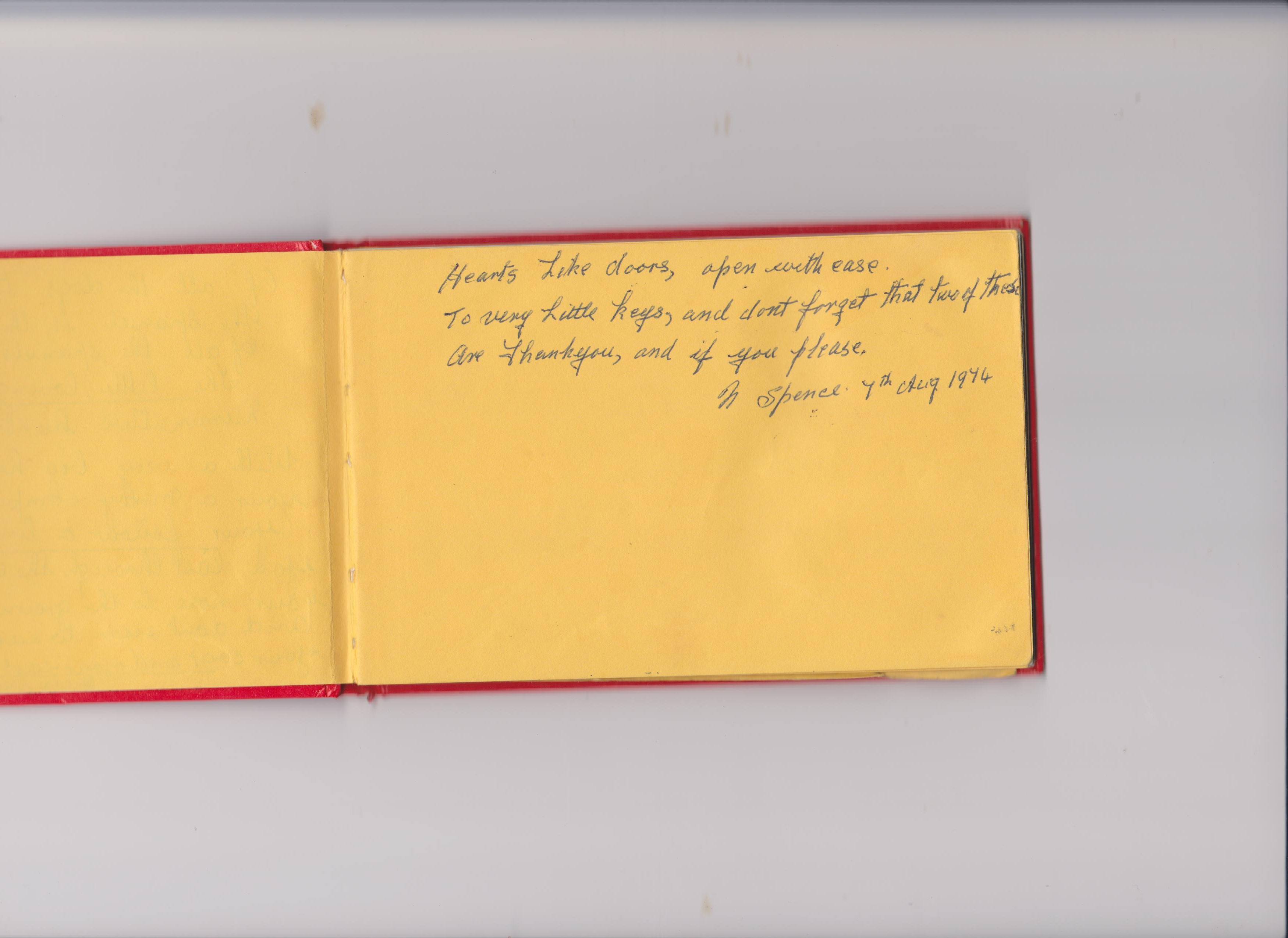
But the thing I enjoyed most in my home-made museum was my autograph book from the 70s. We all used to write poems and witty verses in each other’s books. I suppose that today we would be uploading pictures to Facebook and madly liking each other’s posts. How much more treasured is a little book with orange-coloured pages filled with signatures of my erstwhile classmates and people around me than a here-today-gone-tomorrow online post? Most of the rhymes concerned lavatories, lovers and garden gates (love may be blind but the neighbours ain’t), boys, the physics teacher or worse, but they were all harmless and affectionate fun. One of my favourites is from an elderly man who lived in our village – Norman Spence.

Autograph book

A trip down memory lane

At last I return to my blog. This time it was work that stopped play. I’ve had a couple of assignments that have proved tricky and overwhelming. From an article on aged care legislation to a government tender and a newsletter for a university, they’ve all been a bit dense, brain-clogging and writers’ block-inducing. Anyway, today I’ve come up for air and, so far, have celebrated by going out for lunch at one of my favourite cafes and reading the paper over a bacon and egg sandwich. There’s some so comforting about bacon and eggs – I think it must hark back to childhood.

Talking about childhood, I’ve now got to the fun bit of my home renovations and am unpacking boxes of ‘stuff’ (there is no better word) that I shipped from the UK about 18 months ago. As well as books, plates, ornaments and decorative bits and bobs, there’s quite a bit of memorabilia. The Life Laundry gurus might disapprove but I’m really happy that I held onto some treasured items before I moved to Australia. Unpacking them years later (I was too deluged with work to celebrate but, as of last Wednesday, 9th July, I’ve been in Australia for ten years) I’ve smiled, laughed, cried, felt amazed, incredulous and deeply respectful for times past.

I’ve got quite a few letters spanning about three decades – remember those beautiful hand-written items we used to pop in post boxes before electronic communications took over? I’ve got some of the first letters I wrote to my parents in the late 60s when they were away and I was staying with family friends. The spelling is atrocious, there are no punctuation marks anywhere and the words on the page are jumbled reminding me of magnetic scrabble letters on a fridge. But I’d been to the sea and thrown sticks for the dogs and was excited about going with Susie and Gillie to the laundrette and having hot chocolate from a machine. Then there are letters I wrote home from my brief stay at boarding school (where I was miserable) telling my parents: “I love Queenswood. It’s just at night the people in my dormitory talk till about half past ten and when the horrid old house mistress, who is equal to the size of four elephants, comes along at night she says I should be asleep otherwise I’ll have to go to the doctor for some tablets.” Later on I insist: “I am extremely happy here,” and I concluded another letter by saying: “Don’t forget I’m tremendously happy here.” Methinks that I did protest far too much.

1960s letter>

Letters from both grandmothers brought tears to my eyes. My maternal grandmother told me she was expecting lots of guests over the summer and shared her menu plans with me. Memories of her signature dishes came flooding back. I must ask Mum for the recipe for Granny’s Bombe Surprise made with blackcurrants. A tactful letter from a boy I had a crush on in my teens let me down gently by asking about my love life and sharing holiday plans to go to America where there would be “lots of lovely girls!!.” Another male friend (I wonder if he ever realised I had a thing about him?!) wrote me a long, long letter in 1978 full of his pre-university adventures (toad racing, potato picking and meat packing) travelling up the East Coast of Australia. He sent me a special full-colour fold-out souvenir of the Great Barrier Reef (when it was still pristine) and apologised for his writing style: “Out here everything is said backwards or abbreviated.” He was in Queensland at the time… Little did I ever dream that I would end up living in Australia! Back then it was a faraway land, dry and dusty, and full of kangaroos called Skippy.

I’ve also got many of the letters I wrote from Vienna in 1982 when I was an au-pair girl for a family. A bit like at boarding school, I was terribly, terribly homesick not helped by the crushing routine of having to walk the two little girls every morning in the Stadt Park whether it was minus five or plus 30 degrees. But I did enjoy Vienna itself and still have programs from the Opera House (Carmen, La Bohème, Arabella etc) complete with the playlist for that day. You could get a standing ticket for six Austrian Schillings – a bargain! I’ve also got programs from the Volksoper (the less fancy ‘people’s opera’ where I went to operettas by the likes of Offenbach), brochures from Schönbrunn Castle, a poster advertising a Festival of Clowns, a postcard of the Prater (the famous Ferris Wheel) and a glossy program from the Spanish Riding School (those wonderful Lipizzaner horses).

The Opera House Vienna - this postcard looked dated even in the 80s!

The Opera House Vienna – this postcard looked dated even in the 80s!

The Spanish Riding School, Vienna

The Spanish Riding School, Vienna

There are years of diaries in my boxes including a lockable five-year diary that I wrote for three years, love letters, papers and magazines marking special occasions such as Royal Weddings and much more. Some of it will undoubtedly end up in the attic or the shed and I’m not mourning the things I threw out – such as folder of beer coasters and matchboxes of every restaurant I went to in California in 1984 – but I’m happy to have created a small and meaningful time capsule.

A Stay of Execution

I was due to go back to my newly renovated house in Melbourne today and had been gearing up for a while, bracing myself even for the rigours of city life. But when I learnt that the painting was way behind schedule and that one of the shower screen panels and a pedestal basin had to be replaced, I was only too happy to postpone my return for another week. Well, what could I do? How would I manage the increasingly bumptious Bertie (all the beach romps and sea air are making him super fit and harder to tire out) around paint pots and wet surfaces? I was envisaging white paint on his paws and nose and chocolate brown hairs trapped in newly painted walls.

So, I’m still here with the pounding of the ocean my bedtime lullaby, the chatter of birds my morning wake-up call and starlit skies unblemished by light pollution my night-time vista. And this week’s full moon sunsets have coloured the sky magnificent shades of purple and pink. Gaining an extra week here feels like precious time I have stolen back. You see, I’ve rather fallen in love with life on the Surf Coast and haven’t really missed city life at all. OLYMPUS DIGITAL CAMERA

Life is gentler here, quieter, slower and calmer and it feels GOOD. I’m not missing the traffic, the cacophony of caffeinated chatter and clattering of coffee cups in Melbourne’s many ‘go-to’ cafes, nor the one-upmanship and competitiveness about who is busiest or the most tired, the running around from thing to thing, the tail chasing and endless pursuit of the latest thing in retail, culture, sport, fashion or food. It’s easy to get trapped in wanting to keep up with it all and follow the crowd.

Here my phone rings less, I write fewer lists, am less wakeful in the night and am more focused in my work. Some of the concrete-like tension in my neck and shoulders has softened, and I’ve become fitter, even running (well more or less) up the steep beach steps and doing mini jogs with Bertie. I’ve had moments of feeling like I did when I was a child; more carefree and in the moment without one eye constantly on tomorrow.
OLYMPUS DIGITAL CAMERA

There’s a more laidback vibe here what with all the surfer dudes, coastal dwellers and retirees, and things are less of a drama without the intensity of urban living. The other day, for example, I lost my internet connection and didn’t know why. I was working on a big project with a tight deadline but took it all in my stride. I drove up the hill to see if it was a signal problem (it wasn’t), so then rang my ISP provider and finally Telstra – whose 4G WI-FI device I am using here – only to find out I had run out of credit! It turns out that video calls on Skype gobble up lots of data. Lesson learned. Anyway, I lost about half a day but remained unperturbed, instead of going into a spin and wasting time and energy.

Yes, I know, I’m being escapist and can’t run away from my other life forever. If I had moved here permanently, I would no doubt have regretted it by now, and felt I was missing out on the many advantages of city living. I’m talking as someone who has had a brief taste of country/coastal life and enjoyed it knowing my other life and everyone in it would still be there when I got back.

But I think it goes deeper. I grew up in small rural villages in England or on the edge of small towns. Rolling green fields, country walks, dogs, tuning in to the seasons, peace and quiet were all part of my landscape – all low key stuff rather than the high-jinx and high-life. I think perhaps I’m a sociable loner who needs regular periods of solitude, preferably in nature, in between interacting with others.

That’s why I so enjoyed reading Ailsa Piper’s account of walking the Camino (Sinning Across Spain) and her quest for solitude. Many fellow walkers wanted to be her friend and to barge in on her space. Ailsa was one of the writers at the recent Lighthouse Literary Fest in Fairhaven. She talked about the city as having no gaps and compared it to music in elevators; one of the many ways we block out silence.

I’m going to luxuriate in the space, silence and serenity of my coastal surrounds this weekend. But, and here’s the social loner in action, there are a few excitements planned as well. A trip to Torquay tonight to see the local acting troupe in Twelve Angry Jurors, dinner with a writer and wine-maker tomorrow night and an opportunity to get up close and personal with a bee hive on Sunday.