Every cloud – or cough – has a silver lining

I never got to the memoir-writing weekend workshop! Bertie came down with canine cough the day before. Poor boy he sounded as if he had something stuck in his throat and had been smoking Gauloise cigarettes! Apart from the hacking cough, he brought up endless amounts of frothy mucous – sorry too much detail – which he managed to deposit on my bed, his bed, the living room rug, carpets and floors. Luckily that phase of the virus has passed but he’s still coughing and so dog parks are out of bounds (canine cough is highly contagious) as is contact with other dogs. Try telling that to a two-year old… We sneak round the block for a very much reduced version of our normal walks, madly dodging other dogs by criss-crossing the road. And, before you ask, yes he was vaccinated but, like human flu, there are lots of different strains which can slip through the net.

As I couldn’t leave him with the dog-sitter (she has two dogs of her own), I tried to get someone to come and look after Bertie at home but it was too short notice. So that was that: workshop plans aborted. Although I had been very much looking forward to the weekend, I was pretty philosophical about having to cancel. Que sera, sera – and things often have an uncanny way of working out. In fact, the prospect of a weekend at home with no plans or deadlines was pretty attractive. Regular readers will be familiar with my ranting on about time or lack of it and my seemingly never-ending to-do list. So here was a chance for me to slow down a bit.

Needless to say, I filled up my time and studiously avoided writing. Because the truth is that I can’t think how or where to start with Project Rewrite! So I took myself off to a shopping mall, something I do very rarely – I think the last time was August 2014 – armed with the $50 voucher I received in lieu of soon-to-expire air miles. I needed some new winter boots and found the perfect pair on sale. While I was at it, I bought some heavily reduced pumps and sandals ready for next summer – there’s nothing like planning ahead. I also got some bits and pieces in a closing down sale and treated myself to some speciality teas, my favourite a crème brûlée black tea, and purchased new hair dryer at Kmart for my Airbnb guests

I also had a bit of a cook-up – soups and stews and poached fruits, all perfect for chilly autumn days. On Sunday night I invited a girlfriend and made slow-cook lamb shank soup which we ate with crusty bread. For dessert I stewed apple and blackberries which I served with the plum ice cream I had made over Easter; a perfect combination even if I say so myself!

On Monday I got in touch with the workshop facilitator, Spiri, who offered me a refund or the option of having a one on one meeting with her about my book and 3-4 follow-up phone or email mentoring sessions. I toyed with the idea of engaging a mentor a while back but then saw the workshop and booked on that instead. In truth, a few individual sessions will probably be far more valuable to me than a more generic group approach. What a bonus! Thank you, Bertie, for bringing that about!

You may delay but time will not (Benjamin Franklin)

Deciding to return to my book – a memoir-style life adventure arranged as an A-Z – is the easy bit. Finding the time to get to it is the challenge. The motivational coach giving the ‘Beginners Guide to Becoming an Author’ workshop encouraged us to get into the habit of writing 500 words a day. Surely we could find half an hour? That sounds reasonable but it often takes longer to write 500 words – depending on the space you’re in – and I don’t know about you, but sometimes that free half hour gets pushed back to the end of the day once all the must-dos have been accomplished, and the only thing that beckons is sleep.

I seem to have been chasing my tail for the last six weeks – Bertie and I have so much in common – trying to create space for some stillness where I can come back to neutral and just be. Once I get into that state, it’s easier to gain clarity and direction not to mention inspiration. I’m mulling over whether to convert my episodic A-Z into a more formal memoir or whether to flesh out the current structure and, as a friend suggested, top and tail the existing alphabetic entries to give the book more flow and continuity.

I tell myself that my new job will lose some of its newness and become a little easier and more manageable after the Easter break. I’ve had about 15 days there spread across two and a half days a week and have been head down from start to finish each time. No lunch breaks, faffing or chatting for me, a challenge in itself as I work in a very chatty office. I’ve been going a million miles an hour to get it all done – it’s called adrenalin.

In between the other bits of work and welcoming Airbnb guests, I spend a fair bit of time cleaning my house, making beds, re-potting plants, pruning enthusiastic shrubs that entwine themselves around my washing line, weeding, walking Bertie, washing Bertie (he does so love rolling in stinky stuff on the beach), cleaning my car (the worst job of all as it takes ages and is hard to do well – think smeary windows) and attending to all the other admin and household tasks we all have to contend with. Oh, and then there’s the socialising which has taken a back seat to everything else recently.

Anyway, today started well enough; I enjoyed a mini lie-in, something past eight instead of something past seven and had a cup of tea and a piece of toast with my guests. But Bertie had another agenda and was conducting a silent but messy protest at the later start and delayed walk. No wonder he was so quiet. He had chewed a hole in his mat and was pulling out the green filler. Never mind, the beach was glorious when we got there and Bertie had a ball in more ways than one.

IMG_2319

Back home, I had a cuppa, watered the garden and put on a load of washing before sitting down to do a little outdoor meditation. Another one of those habits that we’re encouraged to fit into our day along with preparing healthy food, exercising, stretching, keeping up with social media and writing in our Gratitude Journal. Just ten minutes of this and that can change our life…. or make us late for work…

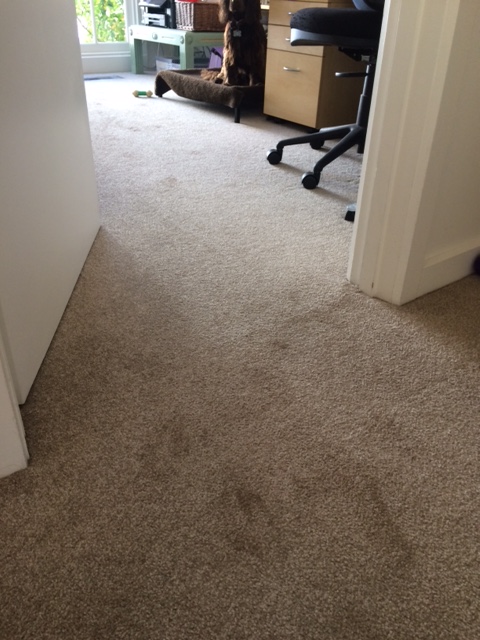
But here I was creating a bit of down time – at last. Peace and quiet. Stillness. Feet on the Ground. Deep Breath. No Agenda. No rushing. Soon, however, the dog child was up to more tricks. He was paddling around in the just-watered flower beds chewing sticks, growling and barking at something – perhaps a bird– and trying to jump onto my knee with muddy paws. I am breathing in, I am breathing out, I said silently in my head, ignoring him. Then I heard the dog flap open and close and realised he had gone inside. The next thing I heard was a scrabbling chasing kind of sound as he ran round in circles in my study spreading the love – and the mud.

IMG_2379

He’s now worn himself out and is fast asleep on his bed – the one he didn’t chew up. And I have shown up at my desk. OK, so I will have to vacuum the floor but after that no more sabotaging the writing!

I’m currently reading a wonderful book called The Anchoress by Robyn Cadwaller, which is the story of an anchoress, a holy woman, in medieval England who chooses to ‘die’ to the material world and devote herself to prayer and to God. At the tender age of 17, she goes – with the door nailed shut – into a small stone hermitage attached to the village church. I’m not advocating total withdrawal from the world but writing is a discipline – for me anyway – that requires time and space away from other distractions. So I’ve booked onto a wonderful sounding memoir-writing workshop in Aireys Inlet, just down the road from my old haunt Anglesea, in April. What a treat to get away and be in the company of other writers with nothing but a blank sheet of paper and the opportunity to let the ideas flow. I think it was author Cate Kennedy who was quoted as saying: “Take the page and wreck it.” I intend to do just that.

Getting back to business

It’s been a long time between blogs! I started a new job a month ago which, although part-time, has taken up a lot of my energy and headspace. Since 2007, I’ve worked mainly freelance from home, so adjusting to the environment of an office – the politics, the gossip, the rules, procedures, policies and timesheets, KPIs and performance appraisals, crazy workload and deadlines, meetings and the need for frequent injections of caffeine and sugar – felt a bit like going back to school. I make sandwiches and pack my satchel the night before and make sure I have done my homework. Because part-time jobs always spill over into non-work time. Especially in the not-for-profit sector.

Having said all that it’s an interesting role in the fundraising department of one of Melbourne’s best-loved charities, one that has been looking after the homeless and disadvantaged for over 30 years. As I’m covering for someone on maternity leave, I’m only there for six months so I was in at the deep end from day one. It was super intense to begin with as I gave myself a crash course in everything from their systems, databases, computer idiosyncrasies (don’t get me started…) and programs to the people I would need to get on-side.

images[7]

Now I’ve learnt Google Mail (not nearly as efficient as Outlook), a new database and figured out how the online timesheets work, not to mention the phones, things are beginning to calm down and I am no longer working like a headless chicken. In fact, I worked so fast and furiously to start with that I wrote down my bank details incorrectly, which meant that my first pay cheque bounced. Perhaps it was a Freudian slip and I’ve got stuck in lack mode. Poor me…

But no! Something seems to have shifted in the last few days. I feel a need to discard things, habits and behaviours that are no longer serving me and to challenge some of the limiting beliefs standing in my way. It’s the old head versus heart argument. It’s great to be in a good job, writing funding submissions but what happened to the calling of the soul aka creativity? It’s definitely time to pick up my book again – I keep getting little nudges from the universe.

A friend recently invited me to a motivational workshop entitled: “The Beginner’s Guide to Becoming an Author.” The focus was not on the writing itself but on developing the discipline of writing and of creating a clear vision of the published book, then working out what steps you need to take to achieve that goal. One of the steps is to identify any negative beliefs getting in the way. You know the ones: What will people think?; I’m not good enough; Who would want to read my story?; I don’t have enough time; I’ll never make it and so on.

As we went through the exercise of dumping unhelpful beliefs in an imaginary bin, I had an aha moment! I realised why I had abandoned my book a couple of years ago. I got as far as finishing it and submitting it to publishers and nearly made it over the line. But despite some of the very encouraging and positive feedback I received, I only listened to the rejections. It all seemed too hard and I gave up.

Soon after the motivational workshop a friend emailed me a link to a book that is about a woman coming out of her shell. She said it reminded her of me and that I should not give up on my book. Then this week I had a kinesiologist staying as an Airbnb guest. I mentioned my book – en passant – and the following day she said she had a strong feeling I should persevere with it. She also very generously gave me a treatment as she sensed that I had a few ‘blocks’ she could help to clear. How lucky am I?! Marie is hugely intuitive and picked up on all sorts of aspects of my life, past and present. That is what’s so wonderful about kinesiology – it’s not a talk therapy; instead it works on muscle testing and feedback from the body. AND the body never lies.

So this week I’m going to dive back in to my book –as in getting back to the REAL business – and follow the advice of my friend in Felicity. Throw caution to the wind, write as if no one is looking or listening and see what comes out. Don’t think about the reader, just write. As if to underline that message I saw a great Natalie Goldberg quote this week: “Play around. Dive into absurdity and write. Take chances. You will succeed if you are fearless of failure.”

Top Dogs and Holistic Hounds

It was a relief to get up and find that my home-made flea trap had taken no hostages overnight. Not that I thought we had pests in the house, but I wanted to be doubly sure. After all, a female flea lays up to 50 eggs in a day. And adult fleas tuck themselves into a cocoon and lurk in your carpet or in between your floorboards for months – years if necessary – until the conditions are right for hatching. Yuk!

It all started when I sat down to read one of my Christmas presents: Top Dog by Kate Bendix. Bendix is a dog lover who got fed up with (and I quote the blurb) “the multinational gravy train that is the global pet market” and decided to find a more holistic way of looking after her dog. Top Dog is all about prevention rather than cure and looks at ways you can improve your dog’s diet and health. She attributes most canine health problems to a poor (over-processed) diet and other contributory factors such as lack or exercise or stimulation.
top dog

Like a convert to a new religion I devoured the book and was soon baking special biscuits with oat flour, bananas, peanut butter, mint, parsley and egg (they soon went mouldy as I forgot to put them in the fridge), stocking up on anti-bacterial colloidal silver to clean Bertie’s ears and scouring the internet for herbal flea prevention treatments. All good fun for those of us who would do ANYTHING for our pets. “Filtered water for Bertie?” asked my brother incredulously. “He’s a dog for God’s sake!” “Precisely”, I said, “he’s an organic, living being like us so why bombard him with chlorinated water when I have a filter tap on my sink?” I mean, hello…

And that’s one of the key points of the book. Dogs, like us, are sensitive to chemicals, pesticides, additives and food laden with sugar and salt (read the list of ingredients in some of your dog foods and you’ll be horrified). They can get yeast infections, allergies, depression, dental decay, arthritis, dermatitis and more.

Anyway, back to fleas – are you itching yet?! When I first got Bertie I used a liquid flea-killing preparation which you smear between the shoulder blades. It stinks, is poisonous, full of heavy duty chemicals and enough to give anyone an asthma attack. Bertie hated it and would writhe around on the floor trying to rub it off. Now I give him a pill as the lesser of two evils; it does the same thing from the inside out, but is still full of pesticides. Top Dog recommends a herbal flea treatment available in the UK called Billy No Mates , but I couldn’t find anything similar here and don’t fancy concocting my own remedy with neem oil (which she seems to recommend for just about every complaint) fenugreek, seaweed and other smelly substances.

Making the flea trap, however, was easy. You simply fill a shallow dish with water and liquid detergent, swish the water around and then leave the dish under a night light before you go to bed. Fleas will be drawn to the light and will hop in the water and drown. Thankfully, I only caught a small fly.

The chapter on what to feed your dog is excellent. She outlines the pros and cons of dry and wet foods, home-made and raw, or various combinations thereof. In our 20 months together Bertie has been through intestinal parasites, tummy upsets and a vicious virus which caused projectile ‘emissions’. After much experimentation, we’re now going well (meaning perfect poos) on a diet based on kibble which I supplement variously with soaked oats, raw carrot, some cooked veggies or a bit of kangaroo mince. When he starts devouring large chunks of grass in the park or gobbles up the pansies in my courtyard, I know I need to step up the green stuff in his diet. After reading the book, I also changed the brand of food he was on. Instead of the big name American product with an ingredient list that started with fillers like soy, corn, beet pulp and animal derivatives, he’s now on an all Australian product, which has a much more wholesome list of ingredients such as chicken, brown rice and oats. AND it happens to be cheaper.

Bertie also gets a raw chicken wing several times a week. He’s an exceptionally greedy dog and swallows his kibble without chewing. So the chicken wings give his jaws a work-out and help to remove plaque. I also give him dried kangaroo tendons (all natural) to chew on and tartar control biscuits containing bicarbonate of soda at bedtime. Anything to avoid cleaning his teeth with an old sock soaked in colloidal silver and/or doggie toothpaste.

It’s enough of a battle trying to groom him. That’s because he thinks he’s top dog. He doesn’t just think it, he knows it. “What was that about discipline?” he seems to ask, sitting regally on my bed, forelock flopped forward, eyes pleading and paw strategically placed over one of my slippers.

IMG_2259

But that’s all about to change. We’ve just had the most brilliant training session – mostly focused on leadership, space access and boundaries. Dogs need to know the rules and where they stand. If you want a dog in tip top condition, he needs to know that you are Top Dog.

Stories of Moving and Migrating

I’m always fascinated by other people’s stories: where they come from; their cultural heritage; and the experiences that have shaped how they think and act. Last week I attended a talk at a local library, “Migrant Stories: Arnold Zable in conversation with Rose Stone and Rita Price”. For those that don’t know Arnold, he is a published and much-loved author, storyteller, educator and human rights advocate. I love how he described story-telling as the most inclusive of all art forms. That’s so true; all you need is a voice and the confidence to let your voice be heard.

The first speaker/storyteller, Rose Stone, certainly had no issues with confidence. At 93 she has a remarkably strong voice and great sense of humour. She came to Australia aged 16 as the war in Europe loomed. She migrated from Poland, where her grandfather was a tailor. Alone and with no knowledge of the English language, she went straight into a job at a Jewish factory where she spoke Yiddish. She learnt English phonetically, going on to do her HSC later in life and then joining a U3A writing group.

She shared a wonderful tale from a collection she has written. It was about her father or grandfather (my notes are incomplete) expressing his distaste for the chicken soup served by his wife on the Sabbath. And not just as a one-off but a few Fridays in a row. It transpired that the kerosene lamp – perhaps part of the Shabbat table decoration – was dripping into his soup. The way she wove together the characters, the food, the flavours and the humour was masterful and very much in the folk tale tradition.

The other writer, Rita Price, was born in Melbourne to Sicilian parents, who came to Australia after the war seeking a better life. Her parents bought the Princes Pier Cafe (sadly no longer) in Port Melbourne. Rita’s book Cafe at the Edge of the Bay celebrates the first fifteen years of her life when her parents and grand-parents ran the cafe. Interestingly, they served Australian food – pie, steaks and chips – rather than Italian-style food. She recalls that her parents had very limited English but could read, write and add up, and her grand-parents were illiterate but great story-tellers.

Arnold compared the immigrant experience to a play in Three Acts. Act One is where the person lived before they migrated, Act Two represents the move or ‘the rupture’, a momentous decision which can be a journey in itself, and which often originates in horrific events such as the Holocaust or current day religious and political persecution. Act Three is about assimilation, the rest of your life. For some this is the hardest part and they never cease to yearn for their homeland.

I migrated to Australia from the UK ten years ago motivated by a sense of adventure and in search of a new life. I had been through a tough patch and the only thing I was escaping were the demons in my own head! How lucky was I to move here by choice, at a time of fast and reliable e-enabled global communications, knowing that my decision was reversible. Nevertheless, I did move to the other side of the world alone , and it was rather a blind date. Although my brother lived here, I didn’t have a job, man or private income to get me started!

The first few months were hell. Shortly after moving to Melbourne, I dreamt that England and Australia were geographically joined at the hip and that you could easily drive from one to the other. Clearly, I was homesick and missing family and friends.

I arrived in winter and struggled to find furnished accommodation (my furniture was on the High Seas). I ended up renting a sunless flat with an oven that wouldn’t turn off, taps that dripped endlessly and a vacuum cleaner that belched out more vomit-scented dust than it sucked up. Then there was the married man (a friend of friends in the UK) who hit on me: “Would you like to have an affair?” he asked point blank. And this hot on the heels of dinner with him and his wife where they waxed lyrical about how they first met and got together. He and his wife ran a B & B in the CBD and he had taken me out to lunch to discuss whether I was interested in providing occasional weekend relief. He gave me a lift after lunch, and so we were driving along Beach Road in St Kilda when he popped the question.

Manipulative and hugely chauvinist, he took my (equally point blank) refusal badly. I was glad to get out of the car and went into Safeway to do my groceries, pretending nothing had happened as I filled my basket with broccoli and other veggies. The next day the stress caught up with me, and when my computer froze for the umpteenth time as I was searching online for jobs, I threw it across the room in a fit of frustration. That was the end of my (luckily second-hand) computer but only just the beginning of Act Three of my story, which, I am happy to say, got a lot easier as time went on.

Ohh Vienna – tra la la

I am very excited about going to Vienna. On a whim, before I left Melbourne, I wrote to the father of the family I au-paired for back in the 80s and, to my surprise, he replied by email. Sadly his wife died in 2009 but he still lives at the same address and his daughters, one of whom is married with children and one of whom is engaged, are both living in Vienna. I was in two minds whether to get in touch; looking after those girls wasn’t the easiest of gigs. But, thirty-odd years later, I’ve rather forgotten about the homesickness, the sometimes stifling routine and general stuffiness of a titled Viennese family and am left with a sense of gratitude that I had the experience – horsehair mattress, dumpling soup, tweedy relatives with leather-patched jackets and all.  I lived pretty centrally in the 10th district where all the embassies are situated and was right near the Stadt Park with its statues of Strauss, Schubert and other well-known artists. I got a bit bored endlessly playing catch or Mr. Wolf with the children, but as far as playgrounds go, this was a pretty glamorous and stylish one.

As I have written before, the family also introduced me to opera and I grew to love it. I would rush off after giving the children their tea and bath and get a standing place for just 12 Austrian Schillings. So, with just one night in this venerable city, I am treating myself to a good seat in the stalls at the Opera House.  I will be seeing Janacek’s The Cunning Little Vixen, an opera that is somewhere between a fairy tale and a folk tale. As the name suggests, Janacek was Czech and his work incorporates Moravian folk music and weaves in themes on man’s connection with nature, love, the cyclical nature of life and death and even has a bit of a socialist agenda. The Cunning Little Vixen has got all the ingredients you might expect: a forester, the forester’s buxom wife, a poacher, a cast of woodland animals including the two foxes and more.  To quote from the Welsh National Opera:

“The score contains some of Janáček’s most enchanting music. Dream sequences, the wedding march of the foxes, and the magnificent finale of ‘When evening arrives’ paint a glorious picture of the countryside Janáček loved so much.” 

There’s something magical and majestic about the Vienna Opera House. From what I recall, it’s all gold, gilt, splendour and sumptuousness with glittering lights and sweeping staircases. It belongs to a bygone era of men in top hats and ladies in fine dresses, hats and gloves, their horse and carriage waiting outside.

Talking of a bygone era, another thing on my list for my 23-hour stop in Vienna is to visit the Palais Ephrussi, one of the properties originally owned by the Ephrussi family, a wealthy Jewish banking dynasty who made their money as grain merchants in Odessa. The story of their demise at the hands of the Nazis and the fate of a family collection of 264 netsuke ( intricately carved  miniature Japanese figures made of ivory), is captured in Edmund de Waal’s brilliant family memoir The Hare with the Amber Eyes (winner of the 2010 Costa Biography Award). After the war in 1945 one of the Ephrussi family returned to find the Palais Ephrussi severely damaged but their maid, Anna, had managed to save the netsuke from the Gestapo. It’s a wonderful story and told with such grace, humility and sensitivity. The building is situated opposite the Votivkirche (church) on the Ringstrasse with its imposing, imperial-style showy buildings. The Ephrussi Palace building is now owned by Austrian Casinos so is still clearly in the business of making money!

From Darkest Peru to Central London

I adored Paddington Bear as a child – and still do. There’s something incredibly endearing about the marmalade sandwich-eating bear with the duffel coat and bush hat who arrived as a stowaway from Lima and ended up living with Mr and Mrs Brown at No. 32 Windsor Gardens.

So I was delighted to read in the weekend papers that Paddington will hit the big screen in a feature-length film (opening in Britain on 28thNovember) starring Hugh Bonneville (Lord Grantham in Downton Abbey), Jim Broadbent, Nicole Kidman and a CGI bear voiced by Ben Whishaw. It opens in the US on Christmas Day so I am hoping that the same goes for Australia.

But the excitement doesn’t end there. Paddington’s author Michael Bond, who is now 88, has written a new book which comes out on Thursday. Titled Love from Paddington, it’s a series of letters penned by the bear to his Aunt Lucy in Lima.

Interviewed on the eve of the film’s release Bond explains that Paddington came about in 1957 at Christmas time when he was searching for a present for his wife. It was snowing and so he went into Selfridges to shelter and found himself in the toy department. There was one lone bear sitting on the shelf so he bought it. The rest is history: apart from the Paddington books which have sold more than 35 million copies worldwide and been translated into 40 languages, there are soft toys and other Paddington merchandise, a bronze statue of the Peruvian bear at Paddington Station, and from 4th November 50 different representations of Paddington will be dotted around London.

Each one has been designed by a celebrity and is part of a fundraising effort to support Action Medical Research, the NSPCC (National Society for the Prevention of Cruelty to Children) and Childline with many of the creations due to be auctioned by Christies in December. Visit London have created a Paddington Bear trail and some of the sites include Selfridges (The Golden Paddington), a Rolls-Royce Paddington in Berkeley Square and Sherlock Bear (designed by Benedict Cumberbatch) at the Museum of London. The capital’s mayor Boris Johnston has chosen a bear decorated with iconic London scenes, a nod to the author with a Tube sign saying Bond Street, and, perhaps unsurprisingly,a blond tousle-haired figure riding a Boris bike. But precise locations of most of the bears are not being published as it’s a treasure hunt designed to get people involved and raise funds and awareness for the charities involved.

I’m off to London to stay with my sister next weekend. I don’t know what she has planned but I might just have to weave in a bear hunt! And I’m even a little tempted to have a go at writing a children’s book.

IMG_1707.JPG

Back in Blighty

Well, I made it over here in one piece. The flight was LONG as it always is but I stuck to my plan of seeing it as a mini holiday. The food was pretty mediocre but I watched three films, a light Spanish comedy, Ocho Apellidos Vascos, Words and Pictures, a rather hard work film with Clive Owen and Juliette Binoche, and The Grand Budapest Hotel, which I loved. I also continued to read Slipstream, Elizabeth Jane Howards’s autobiography. Howard, who died recently, was an author married to the naturalist Peter Scott and then, latterly, after multiple affairs with married men, to Kingsley Amis. The book is full of encounters with literary figures, artists, playwrights and the like – from Charlie Chaplin, Laurie Lee, John Betjeman, Laurens Van der Post, members of the royal family and other glitterati. The rest of the time I slept and dozed and longed to lie down. I’m normally very organised but had run around all day like a mad thing only taking Bertie to the dog sitter a few hours before I was due to leave so I was still watering my lemon tree and washing up when the taxi came. No wonder I felt a bit tense and stiff by the time I got on the plane!

I’m now back in Nottinghamshire, the county we’ve all heard of thanks to the forest-dwelling tax evader, Robin, he of the Hoodie, with my parents. I did spend some of my childhood years in Nottinghamshire, but I don’t feel any particular allegiance to it or that it’s what the Spanish call ‘mi tierra’, which, literally translated, means my homeland or my country, but on a deeper level conveys a sense of soul connection with a place.

I flew into Manchester airport, where Eddie from Mum’s village met me, along with his dear little dog Scruffy who was rescued from a Spanish village. We travelled over the Pennines (following at one point the Tour de France route) passing through wild expanses of moorland cloaked in bracken and heather, now turning brown and gold as autumn moves into winter. It was unseasonably mild and sunny and the trees look magnificent in shades of russet, copper and gold. We passed through tiny villages with names such as Tintwhistle and Stone and past fields bordered by hedgerows and dry stone walls. I’d forgotten about hedges but now I’ve seen and remembered them, I realise how much I’ve missed them! Hedges are havens for wildlife – according to the Royal Society of the Protection of Birds, Hedges may support up to 80% of British woodland birds, 50% of British mammals and 30% of butterflies.

A good native hedgerow is made up of a mix of plants such as Hawthorn, Blackthorn, Crab apple, Guelder rose, Dog rose, Wild privet, Honey suckle, Hazel, Field maple and Holly. As a child I used to look for birds’ nests in the hedges and watch the parents flying in and out until the babies flew. Even in my mother’s garden we get a great selection of birds; this morning we saw goldfinches, blue tits, robins and green finches all darting around on her bird feeders. Although Australia has a rich diversity of birds, I only seem to get mynas, an introduced species, wattle birds (they can be very noisy too) and pigeons in my Melbourne suburban garden.

Much as I love Australia, the life I have created there and all my wonderful friends, I really miss the British countryside. It’s definitely mi tierra, my spiritual home. There’s something about the soft, green, gently rolling landscape that gets under my skin; it reminds me of family walks on Sunday afternoons, picnics by rivers, bike rides along country lanes, village fetes with tombolas and teas and long summer evenings when it’s light till ten o’clock.

I read an article a few years back about Sidney Nolan who moved to England in 1955 and then to the borders of Wales where he settled in 1983. He painted Australian landscapes from afar, but also travelled widely outside Europe to Africa, China and Antarctica, returning regularly to Australia to connect with the quality of light and the shape of the trees. When people talk of homesickness, perhaps what they are really getting at is a yearning for the topography of their native country. Every time I return to English I feel like doing a Pope John Paul II and kissing the ground.

I have very intermittent internet access and so am writing this from the library in Retford near where my mother lives. It’s a small market town, worlds apart from Melbourne in every way, but I’m rather fond of it. There are no shops to speak of – not even a Marks and Spencers – but there is a great little market on Thursdays and Saturdays. On Saturday I bought a wonderful 1950s style cloche hat with a flower on the front ready for Krakow and Zurich, and a red leather collar for Bertie. The hat cost just £10 and the collar £3.50; everything seems much cheaper here. My brother tells me that the cost of living is indeed higher in Australia but so are wages. Not mine, I fear! Next time I come over I’m going to bring an empty suitcase and load up with goodies.

I’ve had a win!

I am very excited to share that my short story ‘A Brief Encounter’- adapted from my book Slowing in the Fast Lane: From Adventure to Zen and Everything in Between has been published on the Radio National website as part of their ‘Pocketdocs’ competition. The guidelines were that it had to be a story on the theme “I met a stranger” and be less than 500 words. The story I sent in was adapted from my D is for Dogs chapter, and, like all the stories in my humorous, memoir-style collection, is true and unembellished in any way.

You can read it here:

http://www.abc.net.au/radionational/programs/360/projects/pocketdocs-2014/5768322

Like many writers I spend hours tapping away into the silence, into the void, racked with self-doubt so successes like this really encourage me to keep going and to honour my voice and way of writing. The RN editor commented on my strong voice.

What’s more, a good fried of mine, Felicity, herself a published author (mentioned in an earlier post on bee-keeping), recently read my book from beginning to end and really loved it. Armed with these two pieces of positive feedback, I am inspired to have another go at getting it published or to self-publish. Watch this space!

Life Lessons at the School of Life

“Lost for words, copywriter ditches job and calls it a day.”

I wrote this mock headline as part of a wonderful class – How to Stay Calm – at the School of Life in Melbourne. The exercise was to coin a headline summarising a situation where we lost our cool and did more than just feel our anger, we acted upon it.

For those who haven’t come across it before, the School of Life was started by philosopher, TV presenter and author Alan de Botton and has its headquarters in London. To quote from their website: The School of Life is devoted to developing emotional intelligence through the help of culture. We address such issues as how to find fulfilling work, how to master the art of relationships, how to understand one’s past, how to achieve calm and how better to understand and, where necessary change, the world.

Melbourne’s School of Life is located at the Spencer St end of Bourke St and has a small cafe framed by natural wood bookshelves stacked with everything from the classics and contemporary literature to self-help, philosophy and the humanities. The lecture-style classroom leads off the cafe and is also book-lined, intimate and inviting.

Copyright: School of Life

Copyright: School of Life

For three hours last Wednesday Elise Bialylew, founder of Mindful in May (www.mindfulinmay.org), led us in a wonderfully rich discussion drawing on the works of some of the great philosophers and thinkers from Kierkegaard to Buddha as well as contemporary thinkers, psychologists, neuroscientists, futurists and researchers.

I’ve explored all sorts of therapies, attended different types of retreats and experimented with various styles of meditation and ways to stay balanced, but there’s always more to learn and re-learn. It’s not as if we were taught how to manage or relate to our emotions at school or university, at least not when I was in the education system. Elise reminded us that emotional wellbeing is a skill and takes practice just like a sport. So, as well as going to the gym, we need to make time for training our minds.

OLYMPUS DIGITAL CAMERA

Emerging research shows that mindfulness – training our minds to focus on one thing at a time and staying in the present moment – can actually develop our pre-frontal cortex. This is heartening as our brains haven’t kept up with the pace of change and evolved to cope with the demands of modern life. But a little mind training can help update the software. Want to know more? Try reading Daniel Siegel’s The Mindful Brain or do what I did and download some guided meditations onto my phone. I love guided meditations as I find it much easier to still my mind and focus.

During the class we also reflected on what it is to be human, and the fears that we all share. According to Buddhism, mankind’s five greatest fears are: fear of death; fear of illness; fear of losing your mind; fear of loss of livelihood; and fear of public speaking. Who hasn’t experienced one or all of those at some stage in their life?

Given our inherent human vulnerability – it’s time we learnt to listen to the likes of researcher and author Brené Brown who writes that owning our vulnerability can be a strength and actually connects us to others – the last part of the class focused on five key prescriptions for living. (If you’ve not yet discovered Brené Brown, I highly recommend one of her TEDTalks http://www.ted.com/talks/brene_brown_listening_to_shame?language=en) –

The Five Prescriptions

1. Acceptance – survival stories – Elise recounted the story of a shipwreck survivor entitled the Sinking of the Trashman which is part of a collection of extraordinary stories called The Moth (more about the Moth in a future blog). What emerged from this tale of survival was a belief in a higher power, a conscious choice of focus (expressed as a sense of wonder at the sky, the stars etc), a talisman (she threw a black pearl into the sea as kind of offering), a determination to focus on positive memories even in the face of death (two crew members were eaten by sharks), a great deal of resilience and lots of common sense practicality; for example, she used seaweed for insulation.

2. Discernment – mindful awareness – a recent study showed that five hours of mindfulness actually changed the body’s genetic expression and can help with inflammation and chronic pain. What’s more, it can even boost production of an enzyme that protects against ageing. Forget botox and collagen…

3. Surrender to the Ascetic or Aesthetic – perhaps losing oneself in nature or becoming absorbed in a work of art.

4. Compassion – empathy and identifying with others – which can sometimes mean simply holding the space for another person rather than trying to fix them. But equally important – and it’s not valued in our culture – is self-compassion. How can be kind to others when we insist on beating ourselves up and criticising ourselves?

5. Communion and Connection –this is about connecting to others. I’m reminded of that famous John Donne poem – ‘No Man is an Island’. Where would we without friends and community?

No man is an island,
Entire of itself,
Every man is a piece of the continent,
A part of the main.