Walk like a Victorian: A trip down memory lane at York’s Castle Museum

How often in life do we get the opportunity to reminisce about something from our childhood and then to step back into that treasured memory and find it still exists in time and place?  

This was my experience at the Castle Museum in York. When planning my trip I remembered being enchanted, probably aged around ten or so, by Kirkgate, the museum’s recreation of a Victorian Street. I was thrilled to discover it’s still there; and not only still there but significantly enhanced after a major restoration in 2012.

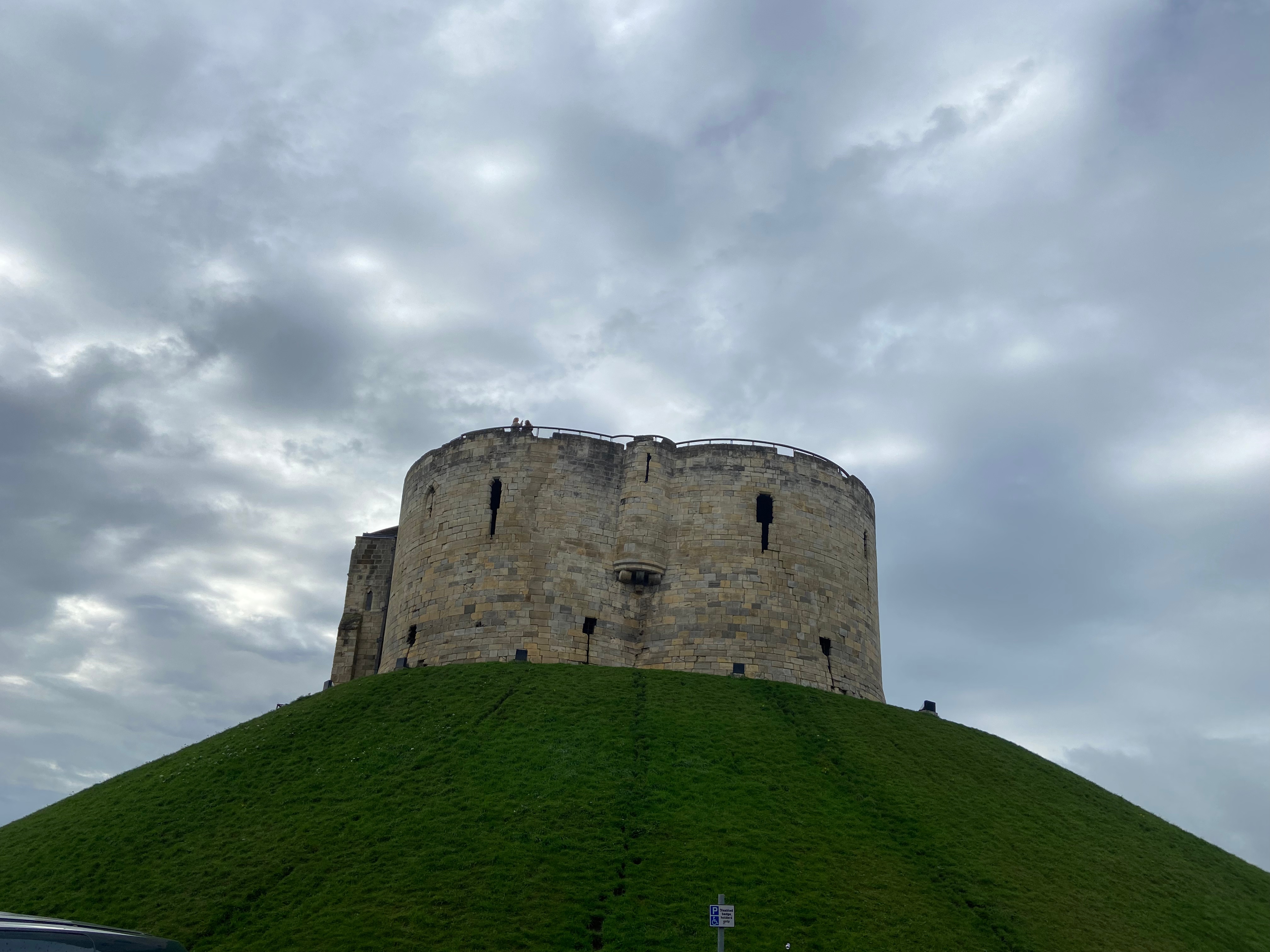
The museum is housed in what was formerly the female prison, situated in the Norman Castle complex, and is located directly opposite Clifford’s Tower, the largest surviving part of York Castle, northern England’s greatest medieval fortress.

The Castle Museum was founded in 1938 by Dr Kirk, a practising medic who lived in nearby Pickering. Some of his patients were unable to pay his fees and so he would accept an ornament or object of interest in lieu of payment leading some people to hide their family heirlooms before one of his visits! By the 1930s he needed somewhere to display his extensive collection and the idea for the museum was born. The Castle Museum was the first in Britain to have room and street recreations rather than just display cabinets.

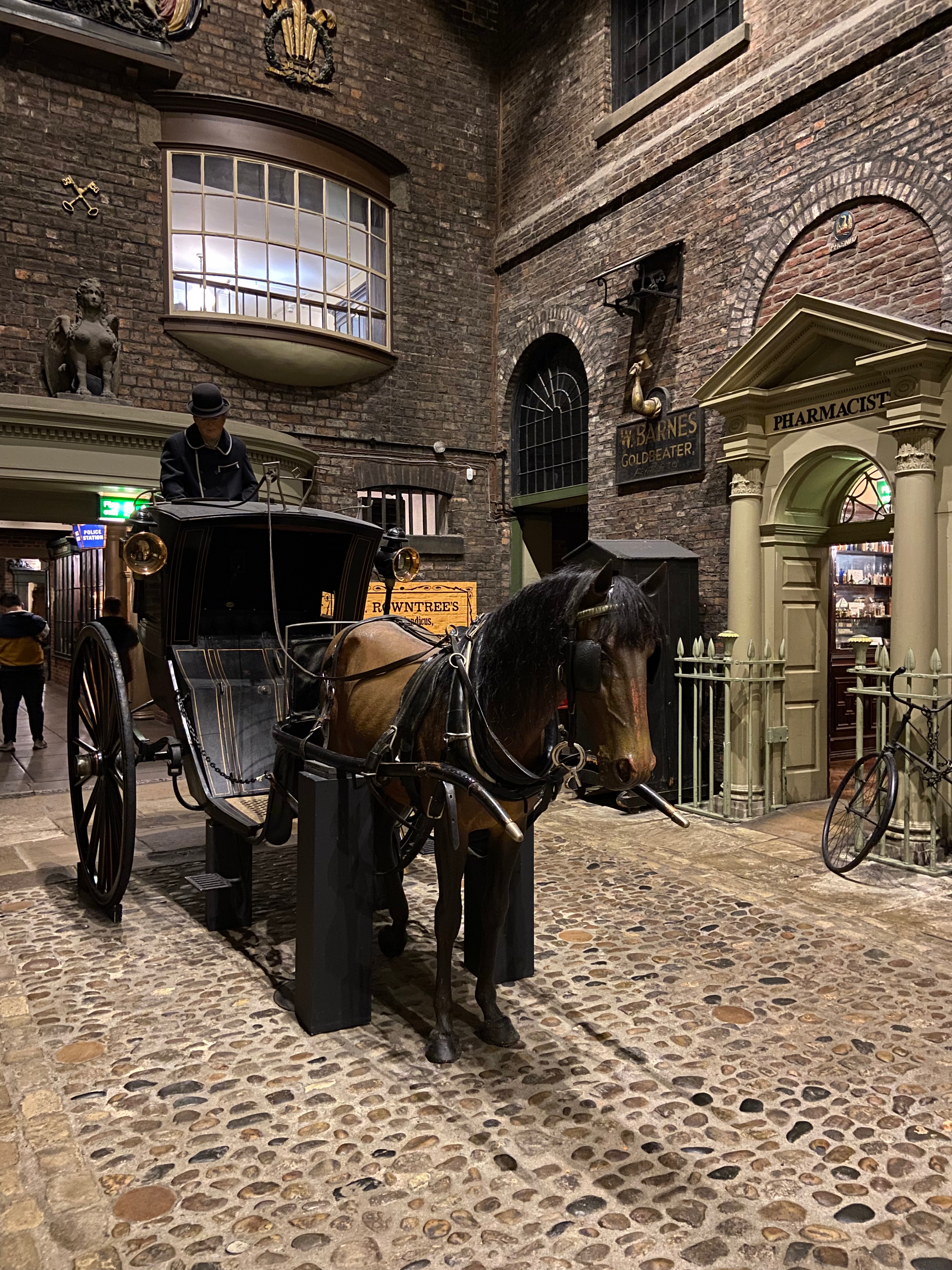
What I remembered most vividly was a carriage, coachman and (very) lifelike model horse.  Looking down on Kirkgate from an upper level of the museum, I spotted the very same hansom cab, horse and coachman that I had seen in the 1970s. Thrilled to find it still there, I was off to a good start! Not only that but I discovered that the carriage – like most of the other items in the street – the lampposts, horse troughs and shopfronts are nearly all originals.  

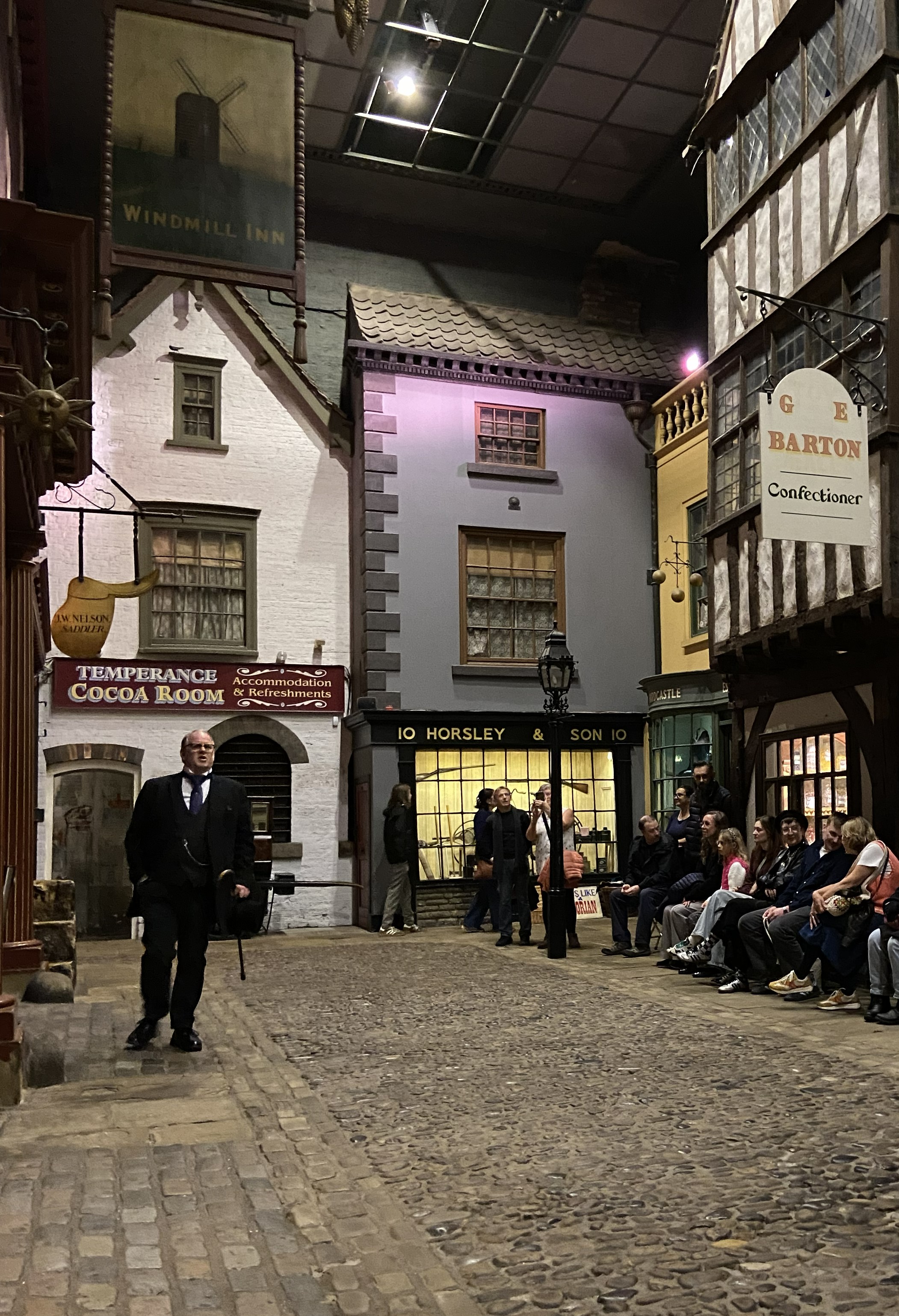
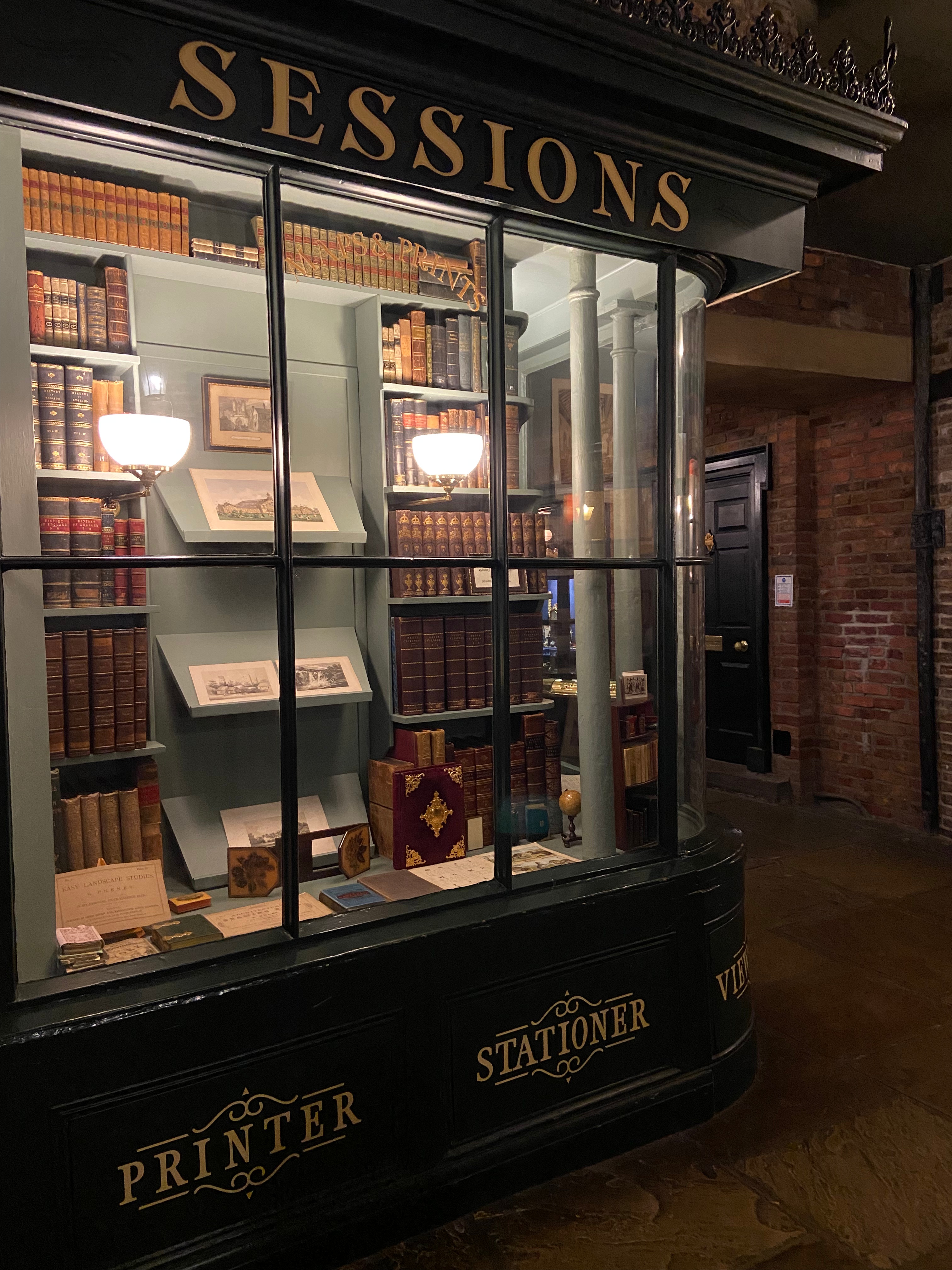
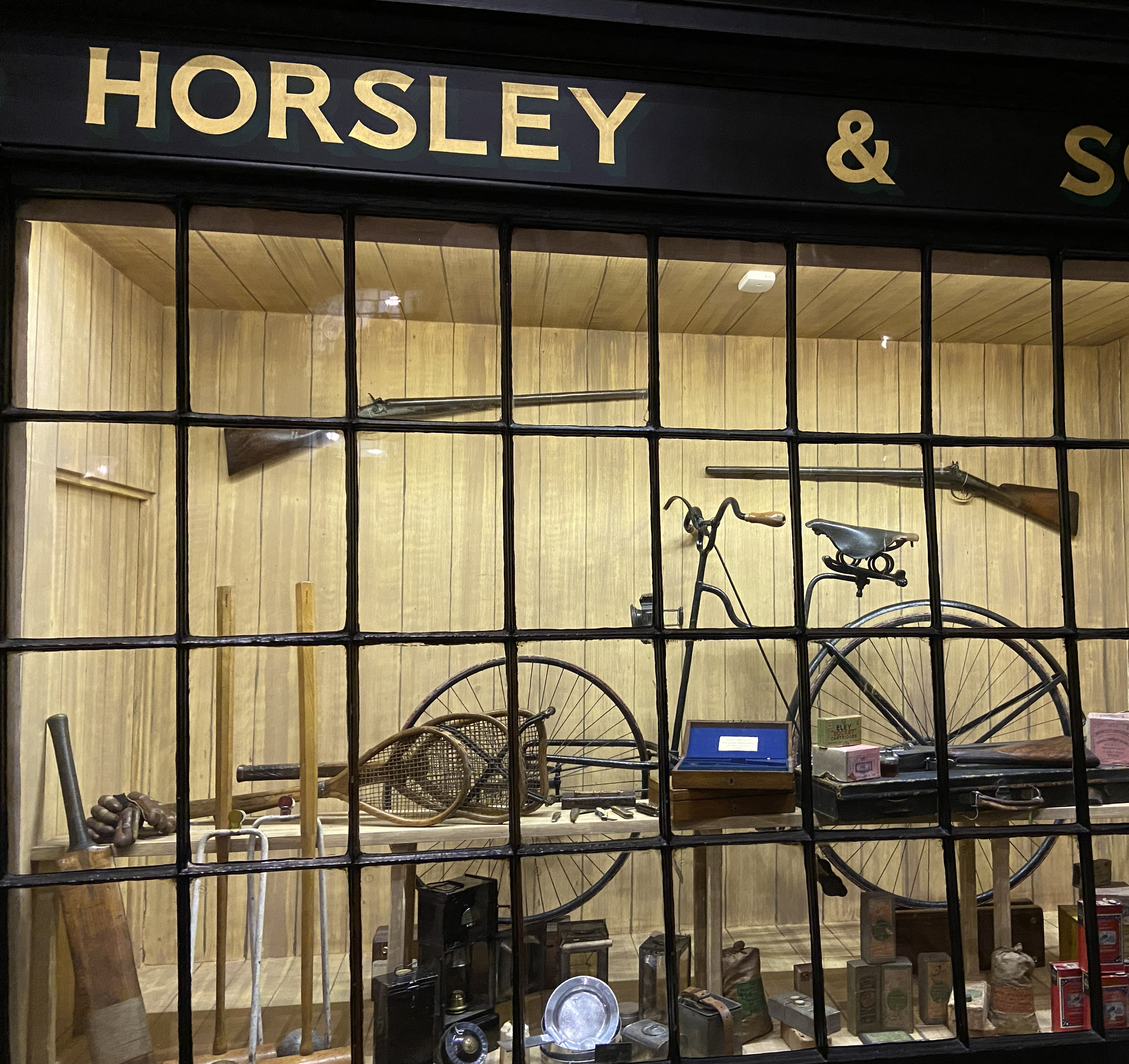
When Kirkgate was restored, the focus shifted to the later years of the Victorian era – 1870 to 1901, and  the attention to detail is meticulous – the cobblestones, soundtrack of clopping horses, the dim Dickensian lighting, the buildings and the presentation of the shopfronts – each shop and business is named after a real business that operated in late Victorian York. There’s Horsleys, Gunsmiths, George Britton Grocers and importers of fine tea and coffee (such as Liptons), J W Nelson, Saddler, G E Barton confectioner, named after a Victorian confectioner and baker, Saville’s pharmacy and Leak and Thorp Drapers shop. Sessions Printers with its beautiful display of leather-bounds books and historic prints is still in operation today!

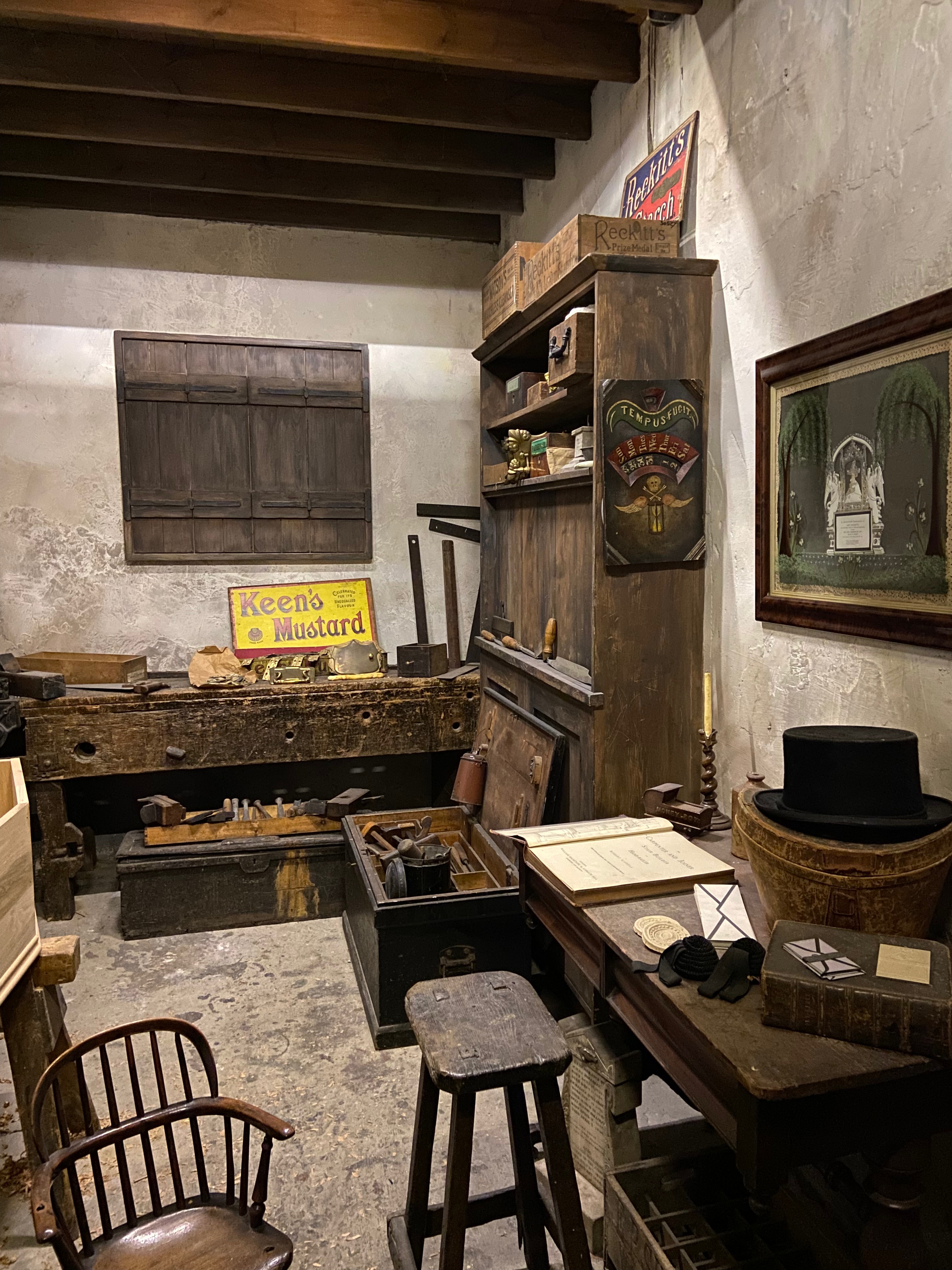
A coffin-makers shop displays handmade wooden coffins, an advert for Keen’s Mustard propped against one wall and a reminder that life is short – tempus fugit – hanging beside the desk, alongside chisels, hammers, brass plaques and handles. Similarly, next to the clockmaker’s is a studio with all the tools of the trade laid out on a bench.  

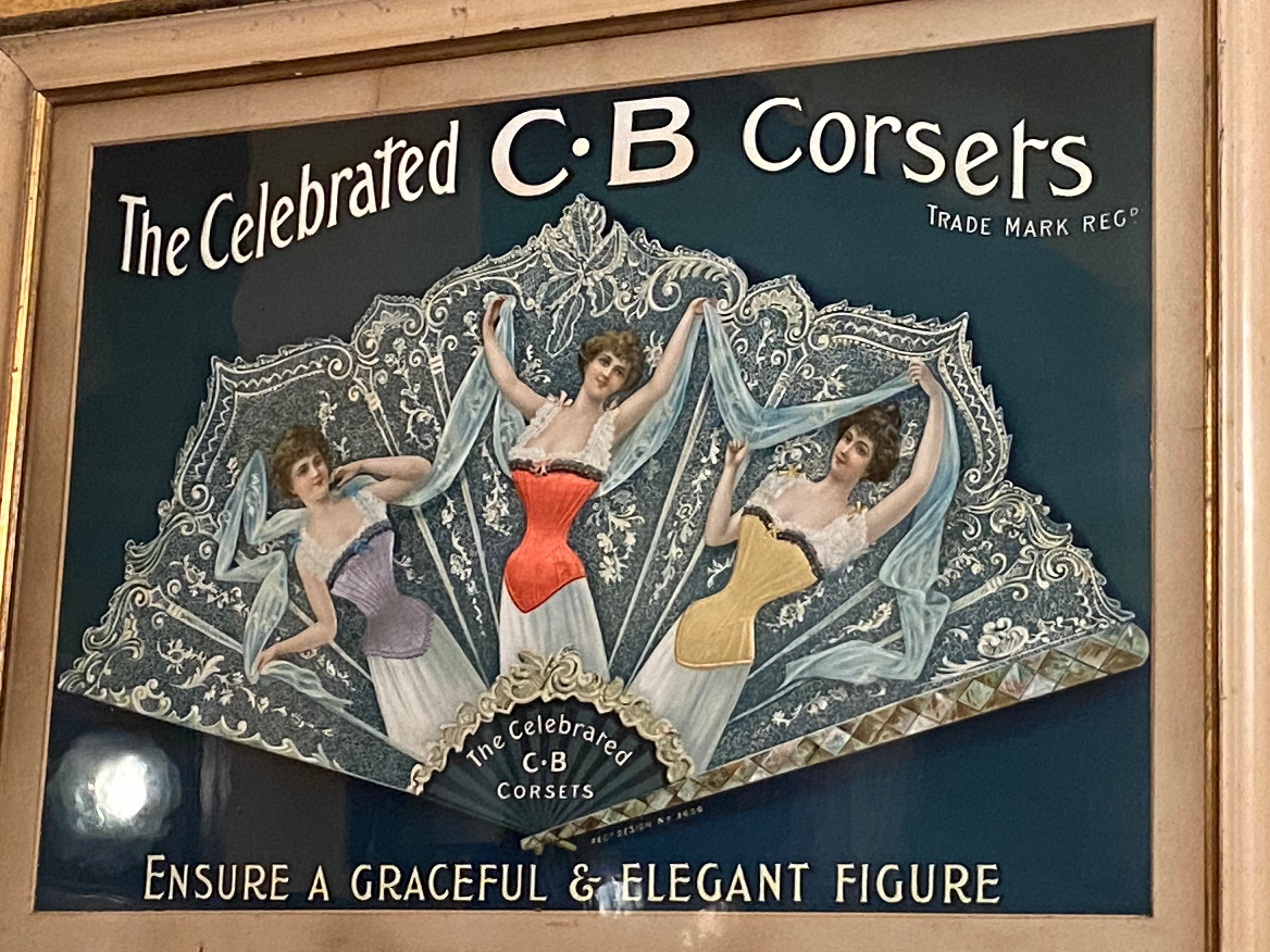
I marvelled at the bolts of cloth at the drapers; the dress pattern, the fans and a poster advertising corsets – “Ensure a Graceful and Elegant Figure”. Reading Ruth Goodman’s How to be a Victorian, I learnt that corset-wearing was a mark of social respectability and corsets were deemed to protect a woman’s delicate internal organs, and to keep them warm. Corsets, properly worn, were thought to promote a whole range of health benefits including good posture. Being encased in a corset, ribs compressed, swathed in layers of petticoats and skirts and then caged in by a crinoline, forcing you to perch on the edge of your chair to do your needlework, must have been very restricting and uncomfortable! These were the days when women were considered the weaker sex – physically, intellectually and emotionally. Did you know that The Great Reform Act of 1832 excluded women from the electorate by defining voters as ‘male persons’? It wasn’t until 1928 that gender equality in voting was achieved.

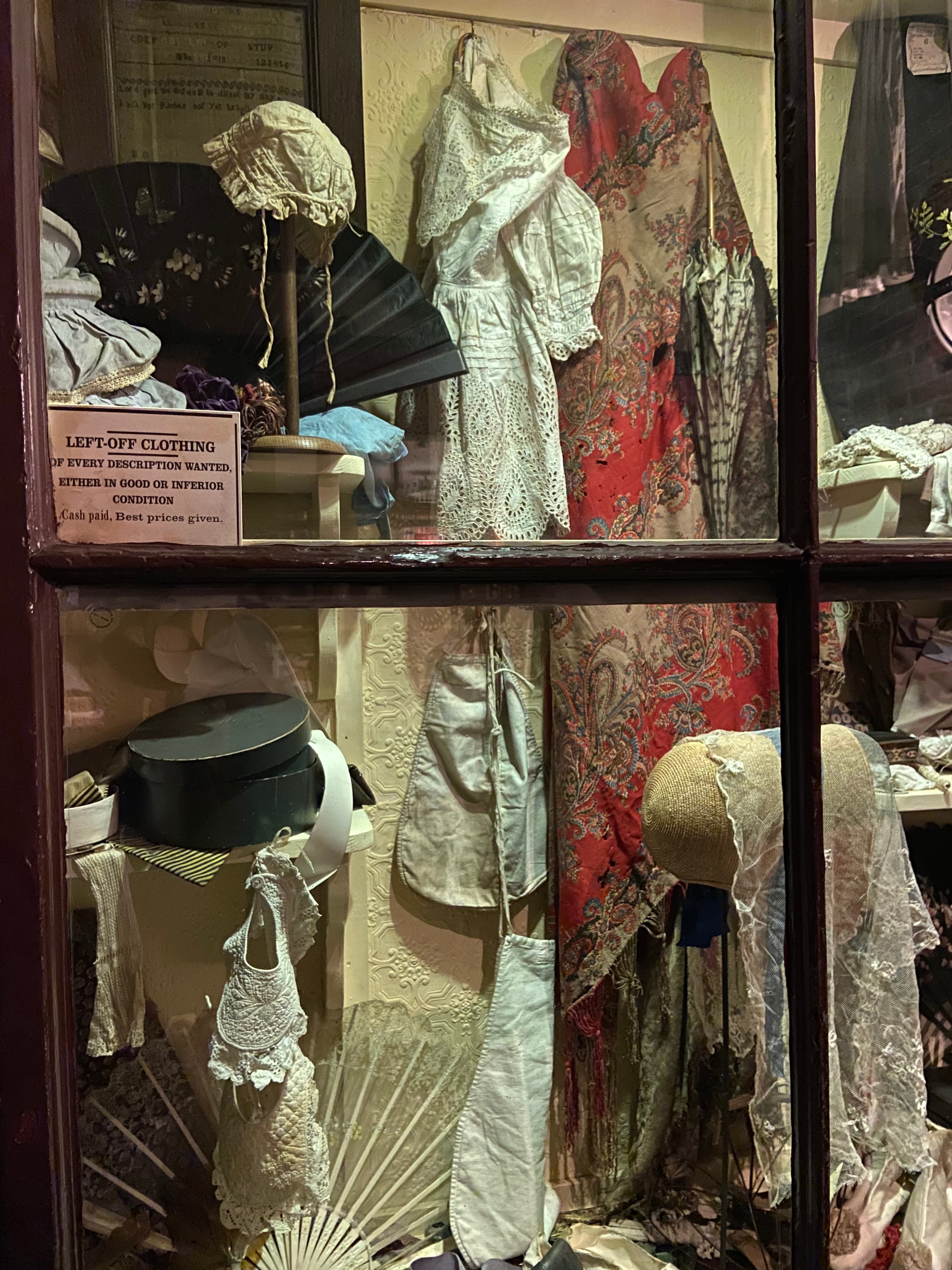
There’s even a ‘second-hand’ shop in Kirkgate with a sign in the window requesting “left-off” clothing. The Victorians were recyclers and upcyclers – fabric costs were high and many families lived in poverty. Garments were “turned” with the outside becoming the inside to make them last longer or were remade and reworked to adapt to changing fashions.

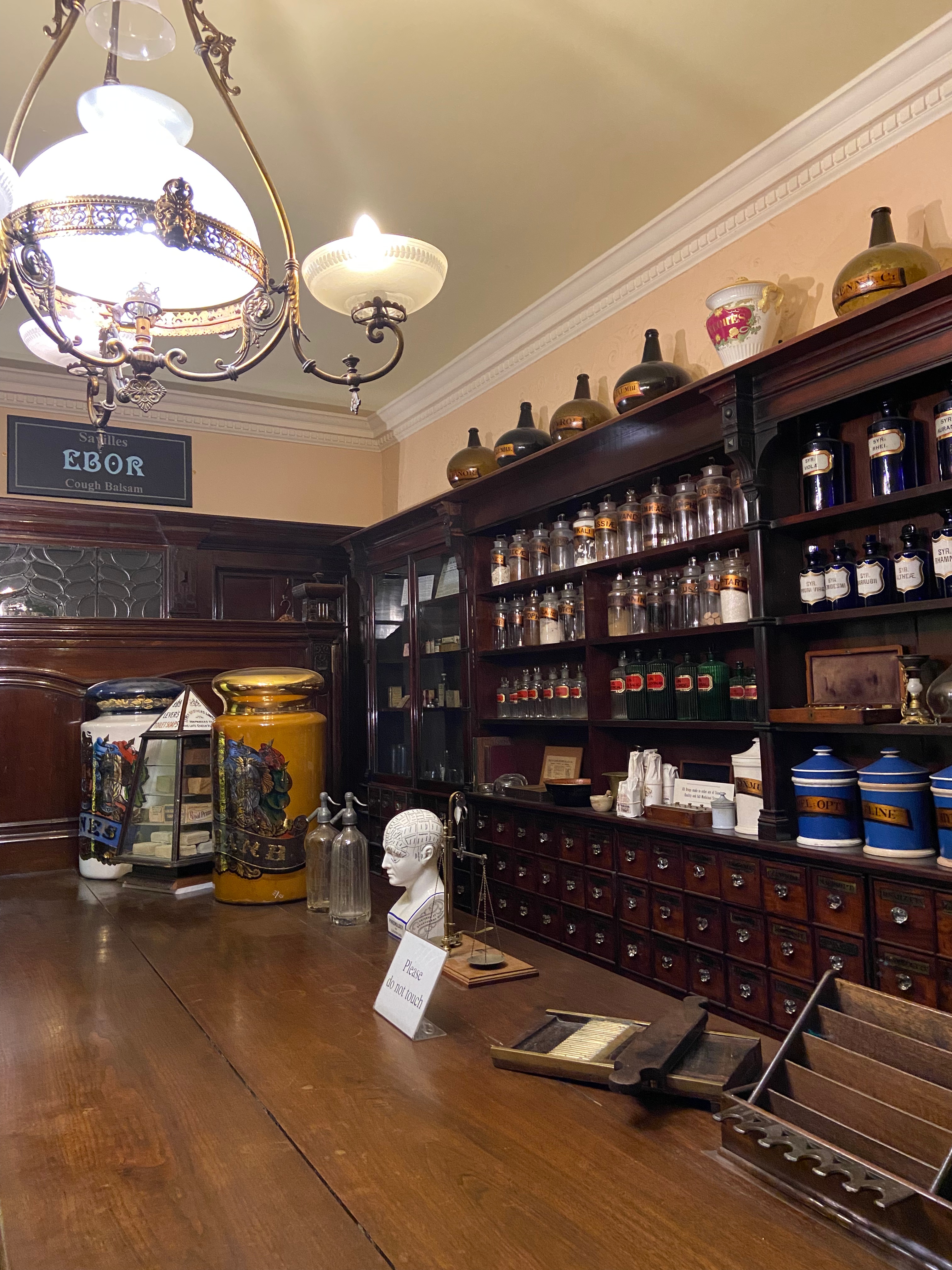
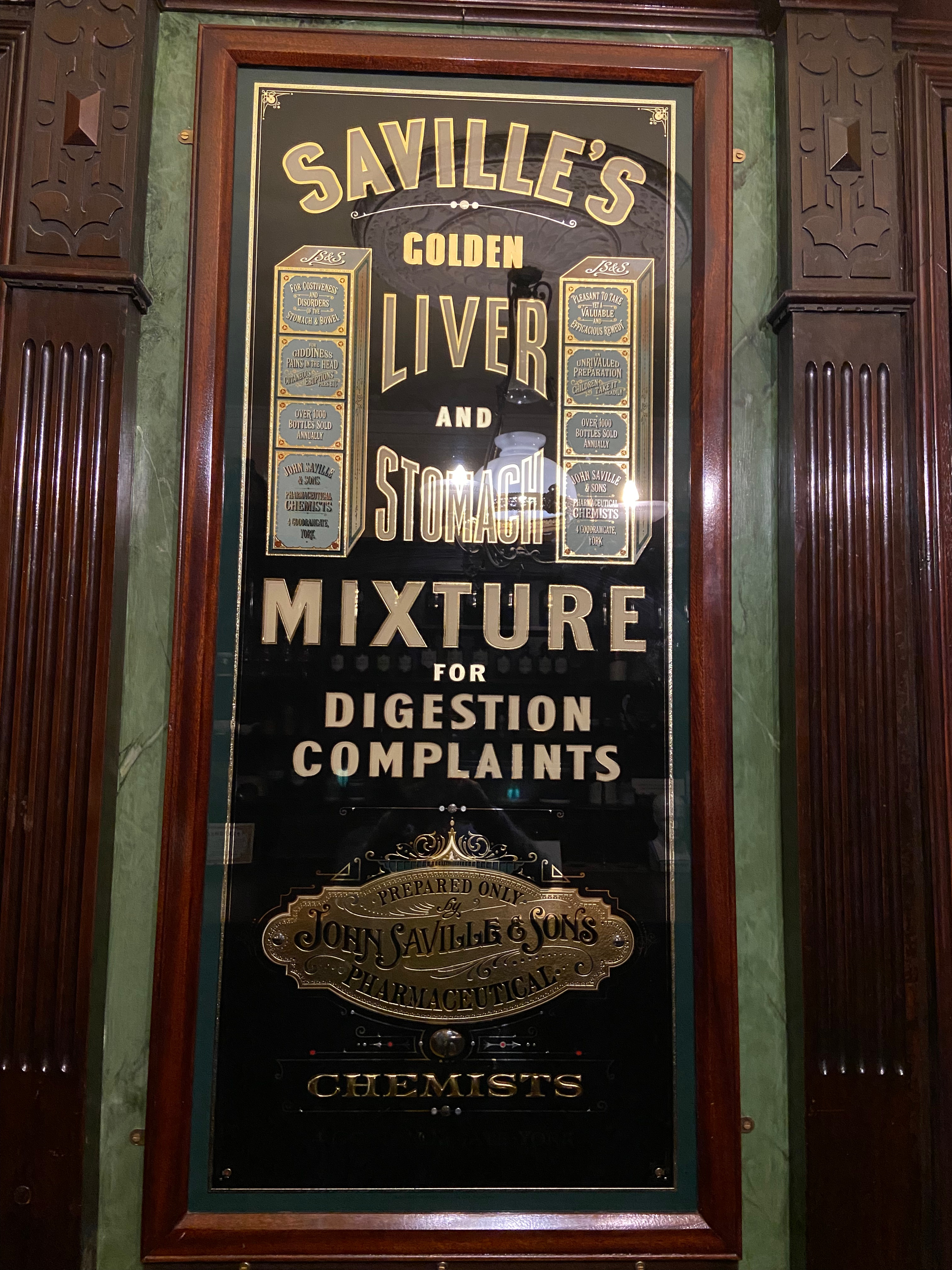
The pharmacy was another source of fascination with its panelled wooden shelves lined with glass jars, canisters and curiously named perfumes such as Rough and Ready and Jockey Club Bouquet. Saville’s Golden liver and stomach mixture seems to have been a bit of a cure-all, treating “costiveness and disorders of the stomach and bowel, giddiness, pains in the head and cutaneous eruptions.”  Although germ theory was gaining traction from the 1860s onwards, in the early part of Victoria’s reign disease was believed to be carried out in evil miasmas in the air, requiring poisons, waste matter and the noxious substances of disease to be expelled from the body. Bloodletting, leaches, lancing and purging were all in vogue and, in the absence of affordable doctors, housewives would often have a stock of drugs at home – many marketed with far-fetched claims, the pharmacy industry lacking any regulation. Beecham’s pills, for example, were made from aloes, ginger and soap – nothing to harm you, but nothing to heal you either. Other preparations contained opiates such as laudanum and there was widespread use of laxatives – senna, Epsom salts, syrup of figs and castor oil.

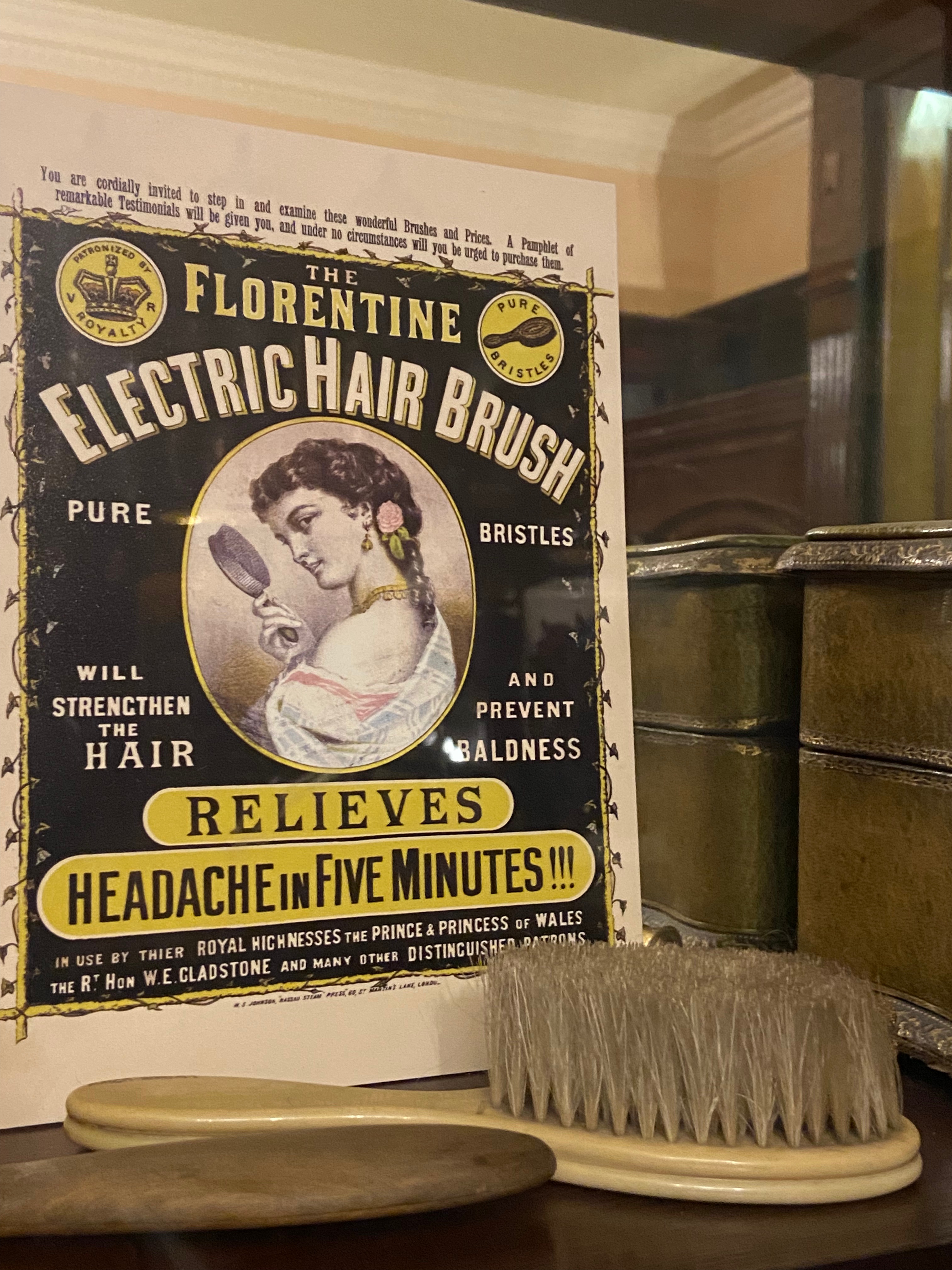
An electric hairbrush is advertised as strengthening hair, preventing baldness and relieving headaches in five minutes. If you Google head-massagers, you’ll see the Victorians were ahead of their time!  When it comes to health and wellness, you could argue not much has changed in this respect:  we still hanker after miracle cures and are vulnerable to marketing claims.  And headaches and digestive problems are still very common – check out the shelves at any pharmacy!

Some of the facades, whether a business or a private residence, have fire plaques indicating the owner had taken out insurance, which entitled them to receive priority treatment. This was a time of marked social division, poverty, child labour, hunger, disease, overcrowded housing and overwork. A guide dressed in Victorian garb told us that the Rowntree Report, published in 1901, revealed that 27% of the population in York were living in insanitary conditions with one drop toilet to 52 people – a grim thought given the obsession with laxatives and bowel function!

The advent of the railways transformed York – in 1877 it boasted the largest station in the world – supporting tourism, communications and the confectionary industry. The railways also lead to the standardisation of time across Britain, replacing local time in different cities. The clock on the wall in Kirkgate would have been on Greenwich Mean Time, adopted in 1880.

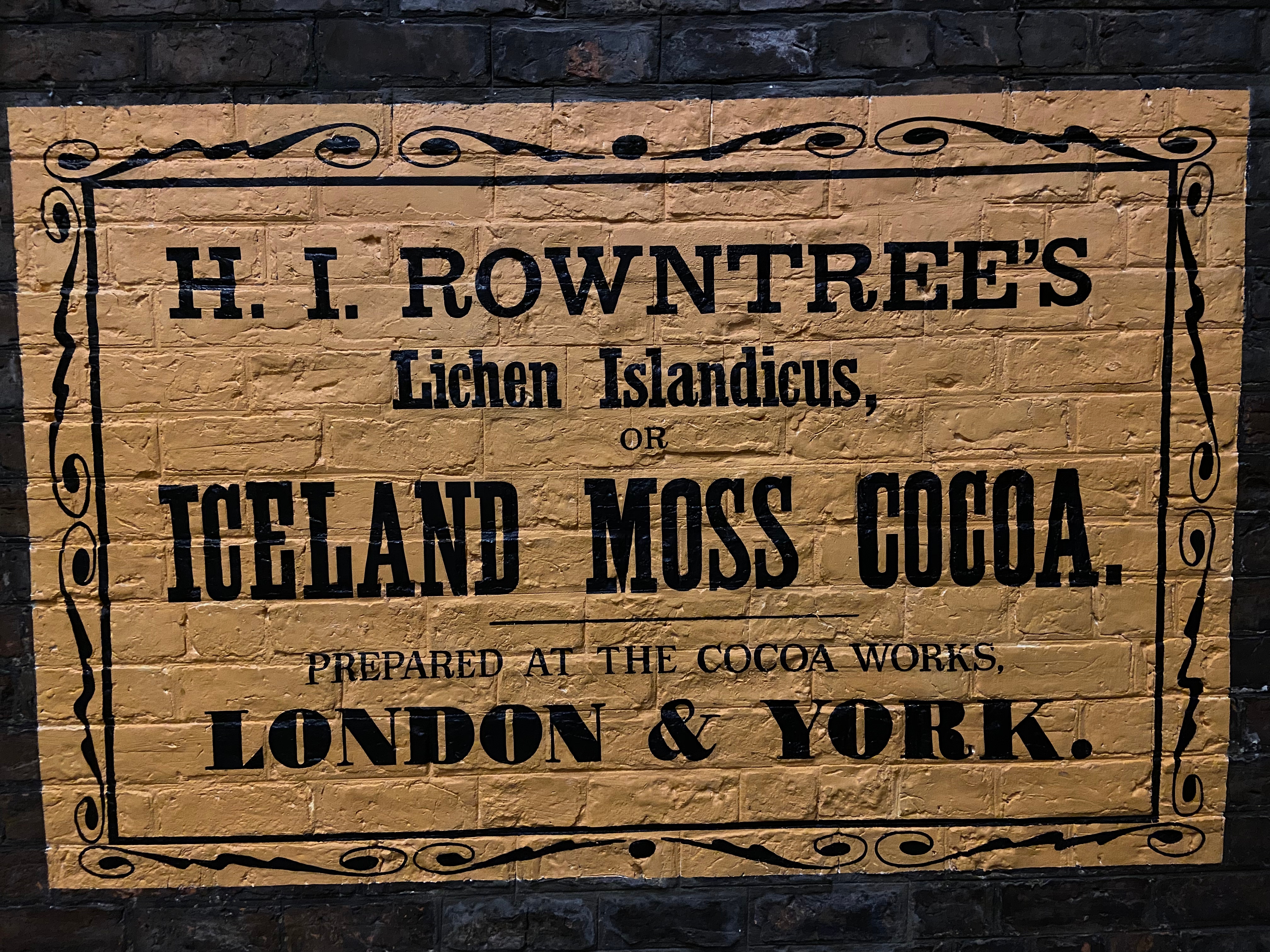
Rowntree, a Quaker company with a social and ethical conscience was founded in York in the 1860s.  Making chocolates and later fruit pastilles, Rowntree’s were enlightened employers provided affordable housing and medical care for their workers. There’s a Temperance Cocoa Room in Kirkgate – the Rowntree family, like many Quakers, attributed many of society’s problems to alcohol and encouraged people to avoid the temptations of alcohol by drinking cocoa instead.  What would they make of Baileys Chocolate Liqueur? An aberration that would no doubt make them turn in their graves!

Talking of turning in graves, my next blog will be on Treasury House in York, a house built directly over one of the Roman roads that led northwards out of York. Several ghosts are reputed to haunt the house.

Back in Blighty 2: Village Life

Although I grew up in various English villages, both in the North and South, I never really thought about the nature of small communities. I just took it from granted. On my recent trip to the UK, I was reminded how delightfully timeless and whimsical village life can be, and looked at it with fresh eyes.

In Devon I stayed with my friends Monica and Jonathan in Chawleigh in the heart of Devon. It’s a small village with two pubs and a shop surrounded by tiny lanes with high hedges; I am glad I wasn’t driving – all that reversing to a passing spot requires a very flexible neck! I didn’t explore the village as such – we only had one fine day in three (the UK experienced its wettest July for years!), and that was spent doing a glorious circular walk on Dartmoor.

But their house is a voyage of discovery in itself. The Grade II listed farmhouse, with its smart thatched roof,  dates from the 17th century – some of the house possibly earlier – and, atop the front door, is the crest of the Earl of Portsmouth – the house would once have been part of his estate. Walking into the house you get a visceral sense of the palimpsest of history: flagstones worn by footsteps over the ages; the sloping and uneven floors; the heft of the of the cob walls (walls made from mud, chopped straw and horse hair, a common practice before 1850); the elegant 12- and 8- pane sash windows; the 19th century glazing evident in the whorls and imperfections and the thin glass (modern sashes have thicker glass); and the early 17th Century plank-and-muntin screens.

Now I don’t know about you, but I’d never heard of these screens. The name alone is fascinating – Google informs me that muntin is a corruption of montant and, in some early spellings, mountain, a word applied to various upright dividers. That makes sense, these screens are an early form of partition wall. The screens in Monica and Jonathan’s house are made of oak and full of holes – and, to add to the intrigue, on the screen by the front door there are initials carved into the wood dated 1941 – most likely by some evacuees.

Then there’s the outdoor privy with an adult-sized seat and a child-sized one – that made me smile – a barn, a well and a former piggery. The apertures carved into the cob wall under the thatch were for pigeons to nest, and are known as pigeon boles. Back in the day, pigeon meat and eggs featured on the dining tables of the gentry.

What an experience it was staying there. It’s the kind of place where things could go bump in the night. Unfortunately, Monica was chatting to me about a podcast about ghosts and mentioned something about a ghost cat and the study door slamming shut. That was enough to fire my fertile imagination. Lying in bed, I kept bobbing up and and down like a meerkat, craning my neck around as if to challenge any spectral forms!

A country fair has taken place in the neighbouring village of Chulmleigh every year following King Henry III’s approval in 1253. What luck that this year’s fair coincided with my visit. We arrived in time to see the procession of vintage tractors and cars filing through the bunting-lined streets. Modern tractors just don’t have the same class as the old ones, their sputtering, chugging engines evoking days of yore. And the cars, among them, Austin Healeys, Triumph Heralds and Stags, Wolseleys, Hillmans and Morgans all belong to an era of fine craftmanship before the production line and robots took over.  Wonderful stuff.

As the rain advanced, we headed out of the village to the cricket field where all the tractors and vintage cars were lined up for closer inspection, and a DJ was playing Golden oldie hits – I couldn’t resist singing along to the Beatles Ob-La-Di, Ob-La-Da. I got cornered by a farmer telling me how much his badger-faced breeding sheep cost – alas, I was not in the market, but I enjoyed watching them being assessed by the judges. I felt I’d walked onto the set of All Creatures Great and Small...

Given the wet conditions we grabbed some lunch from one of the food vans and sheltered in the main tent where all sorts of home-grown, home-bottled and home-baked produce was on display to be judged – from rhubarb vodka to heritage tomatoes, Victoria sponge cakes and scones. In the crepe queue, I got talking to a local, a woman probably in her mid to late 60s, who has lived in Switzerland and Australia but now calls Chulmleigh home. She was waxing lyrical about the activities on offer in the village – the historical society, keep-fit and line-dancing, you name it!

While I’d probably love all the activities and goings-on, there’s nowhere to hide in a small village, everyone knows your business, and there are not that many people to go round. Good boundaries would be essential. Even so, you could quite quickly get Cabin Fever.

That can be the drawback. In my mother’s village in Nottinghamshire there is a village hall but no shop or pub and there’s not much going on. Mum’s house is down a lane leading to the surrounding fields, and she notes the various comings and goings and who’s who. Her running commentary, while not scripted, brings to mind Alan Bennett’s TV Monologues, Talking Heads, which all all feature single women – one a vicar’s wife (that one is quite dark), one a poison pen letter-writer, and one recently widowed woman – you get the drift. Thankfully Mum’s narratives, while full of conjecture and a bit curtain twitchy, tend to be highly amusing.

Evening view over the fields

There’s the man over the road who lovingly cleans his car daily, and takes an elderly relative out for trips, an immediate neighbour who endlessly practises his golf strokes in the garden (the ball making an irritating click noise) while his wife sunbakes on garishly coloured plastic sun loungers in between putting out the washing. The absence of washing on the line usually means they’ve taken off to somewhere in the Mediterranean in search of more reliable sun. That and the dust gathering on their car bonnets in the driveway. Similarly, Mum works out when the people behind her house are away as there’s no noise from the kids and their searchlight doesn’t beam into her bedroom at night. As it happens, she was convinced the light was some kind of special heat lamp on a timer for their chickens, but it turns out it’s just a very sensitive sensor light triggered by a gust of wind or a bird. Then if the lovely neighbours on the other side don’t draw back their hall curtains, she worries one of them must be ill. What again? I say, incredulous. You thought they were ill last week too – maybe they are just feeling private!

But curtains have their uses. Mum always draws the curtains on her top landing which faces the street. Three very kind neighbours know that if those curtains ever remain drawn during the day there’s a problem. It’s a very simple form of Neighbourhood Watch, the kind you only get in small, tight-knit communities. I find it comforting to know they are looking out for her.

This post is dedicated – with great love and affection – to Mum who turns 92 today, 12th September, 2023. Despite battling the frustrations and degenerative effects of old age, she’s going strong and living independently. She doesn’t even have a cleaner! And two weeks ago she was in London helping out with my sister’s grandsons, Mum’s great-grandsons, bathing them and reading stories etc. Go Mum! Go Granny! Go Great Granny! We love you.