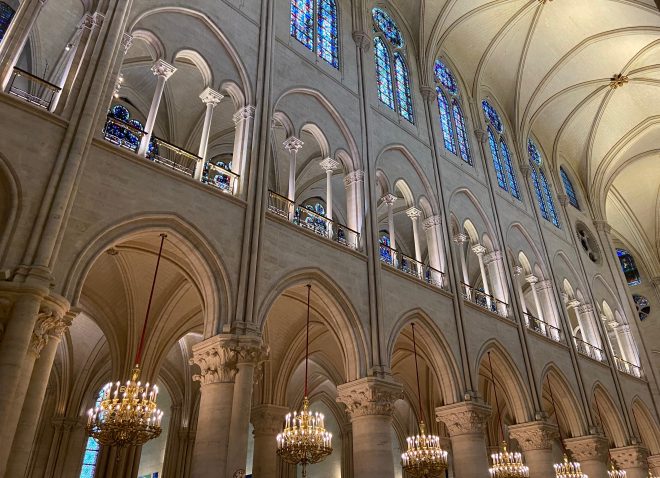
Within three and a half hours of stepping off the plane from Australia via Hong Kong to Paris, I was shuffling along in the queue (which moved surprisingly fast) outside Notre Dame. Time-travel at its best, I had left Melbourne on a Thursday afternoon in the spring to arrive in Paris on a Friday morning, a warmish autumn day, shifting culture, language and centuries as I gazed up at the façade of one of the world’s most famous gothic cathedrals, the first stone of which was laid in 1163 during the reign of Louis VII.

What a way to ‘land’ in Europe! Stepping through one of the intricately carved portals, the first thing I noticed was the quality of light – the resplendent nave and vaulted ceiling, the whiteness of the newly cleaned stone, the sparkling stained-glass windows – the reds and blues standing out in particular.  Reading up on Notre Dame, purists argue that it’s now too squeaky clean without centuries of accumulated candle smoke and grime, but I disagree. The restoration is – and continues to be – a triumph thanks to the craftmanship and expertise of the many artisans, conservationists, sculptors, stonemasons, stained-glass artists, carpenters and experts involved, not to mention the sourcing of 1,000 oak trees from approximately 200 forests across France for the roof and spire. The restoration is due to be completed in 2026.

I’m straying into cliché now but arriving during a service, the organ playing – incidentally all 8000 pipes were individually cleaned – and following along to the Lord’s Prayer in English – was a beacon of light moment, of hopefulness, in our ever more troubled and conflict-ridden world. The restoration of Notre Dame following the 2019 fire is an encouraging reminder of what can be achieved when political will combined with public, private and business funding unite around a single vision. And the fire has served as a reminder for us all – witness the queues to get in – how precious these ancient monuments are. I don’t know about you, but I took Notre Dame for granted – I certainly didn’t visit it last time I went to Paris in 2019.

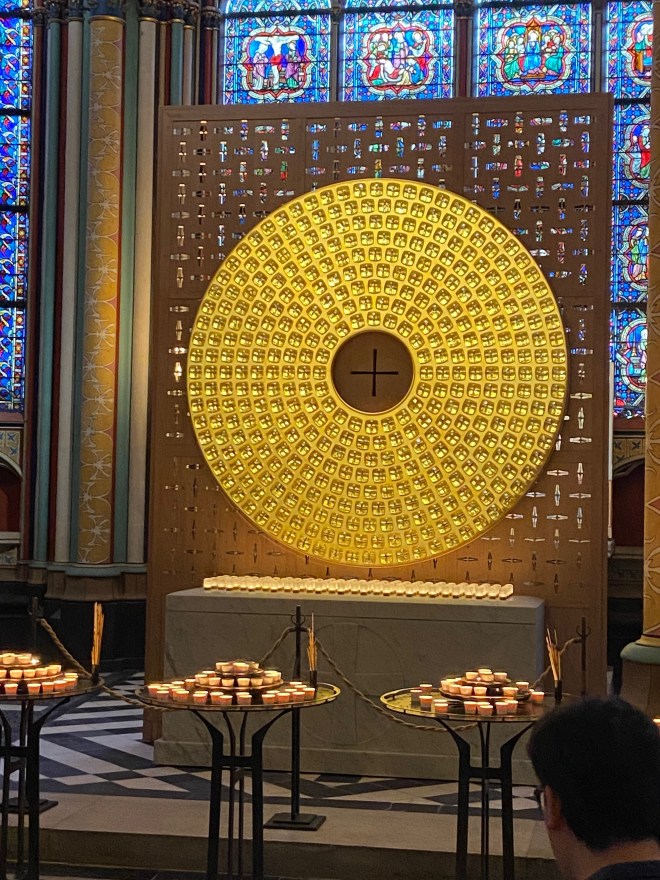
Being a bit of a swot, I rented an audio guide covering Notre Dame’s history. I discovered that the north rose window with its central image of Mary with the Christ Child still has most of the 13th century glass intact – extraordinary. The original Crown of Thorns is believed to reside at Notre Dame, brought to Paris from Jerusalem in 1263. The Crown of Thorns survived the fire, but its glass case was broken. The new reliquary designed by French artist Sylvain Dubuisson is stunning. I could have stayed for the monthly veneration service of the Holy Crown of Thorns but the jetlag was beginning to bite so I carried on with my tour admiring the contemporary tapestries hanging in the side chapels in the north aisle – my favourite Polynesia, the Sky and Polynesia, the Sea, woven in 1972 after the cut papers by Henri Matisse,  before moving onto the 14th century sculpted wall scenes from the life of Christ in the choir enclosure.

I was drawn to the newly created chapel for Eastern Christians (this was not included in my audio guide, but I have since learnt it was inaugurated in May 2025) displaying the eight icons that pay tribute to the founding figures of the great Eastern Churches. But I have to admit to not being sure about the new modern altar – a bronze bowl-like structure which looked more like a bath to me and had nothing of the sacred about it.

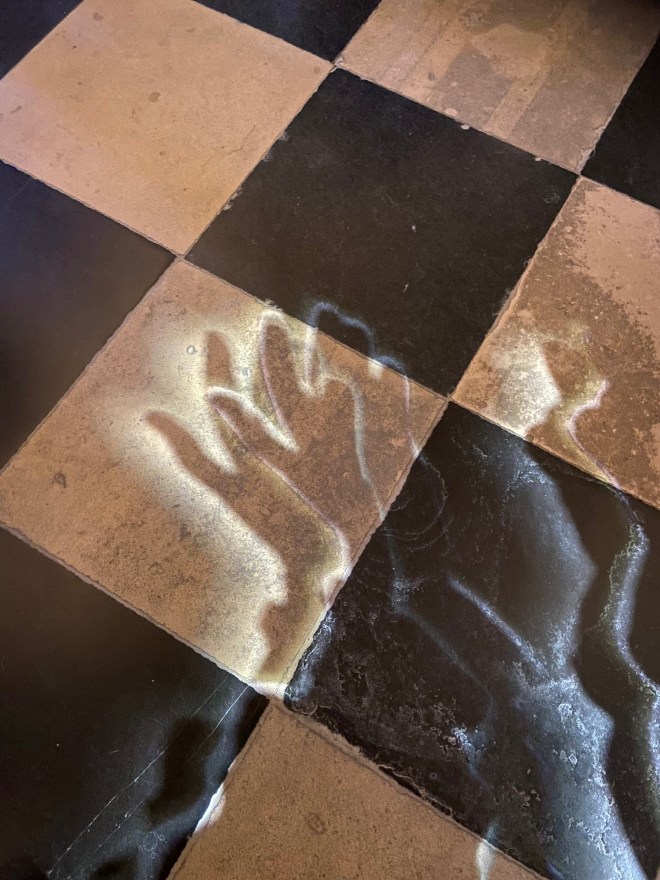
Much more mysterious was the how the play of light around the sculpture of the Virgin Mary holding the dead body of Jesus in her lap at the High Altar cast an almost spectral silhouette of Mary’s hands onto the black and white flagstones.  Similarly, the statue of Joan of Arc and the statue of the Virgin Mary, both of which avoided the fire, seemed to be ringed with an auric kind of white light. Quite magical.

After a pitstop in a café near Notre Dame – where a local told me I had to shut my menu to signal I had made my choice before anyone would take my order (great intel!) – I had a bit of a rest back at the Holiday Inn Gare de Lyons, where I was staying gratis thanks to my brother generously donating his points.

My plan for the evening was to visit the Jacquemart-André Museum in the Boulevard Haussman in the 8th arrondissement.  They have late night openings on Fridays with drinks and platters on offer at Le Nélie, the salon de thé.  I had it all mapped out, except I didn’t…

I had read that the nearest RER station was Charles de Gaulle-Étoile, which is true, but there’s a much closer metro stop. The best laid plans and all that… A transport volunteer at Charles de Gaulle-Étoile told me the museum was a good half-hour’s walk, or I could take the 22 bus. It was pouring with rain but, determined to get there, I went on up to street level and discovered I was at the Champs-Élysées, which was gridlocked with rush hour traffic. I found the 22 bus and jumped aboard only to find I needed to be ‘de l’autre côté’ but which autre côté? The Champs-Élysées roundabout is hectic at the best of times, and amid the cacophony of coups de klaxon (cue a smug moment remembering the words for car horn from my schoolgirl French), I felt I couldn’t distract the driver by asking which side he meant.

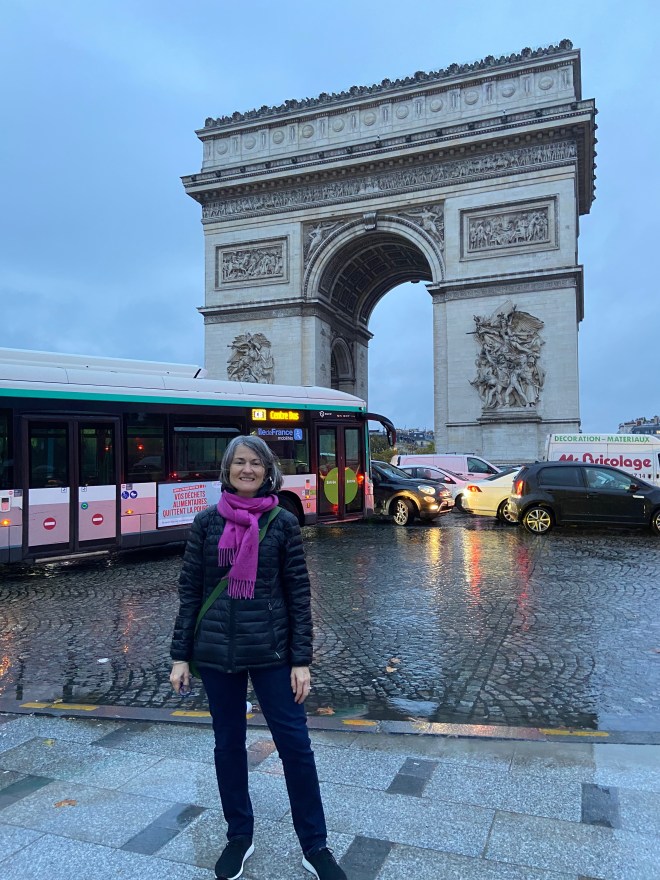
I got off the bus and back into the sheeting rain, where I took an “I woz ‘ere” photo for some fellow tourists and asked them to do the same for me. Then I took a deep breath and thought through my options. It was now getting towards 7.30pm – even if I found the right bus, the traffic was at a standstill and I’d be unlikely to get there till after 8pm. This was overly ambitious for my straight-off-the-plane day one.  Too hard basket was the conclusion. I retraced my steps and went back to the Gare de Lyon area where I indulged in a spot of people-watching over a simple but delicious dinner and a glass of rosé at a local bistro. A good decision move as it turns out. You’ll find out why in Part 2.

(more…)

A short sojourn in Paris Part 1: Notre Dame resplendent and risen from the ashes

How making the most of a Melbourne winter saved me from travel envy

Over the winter friends and family have shared northern hemisphere holidays photos – lots of wish-you-were-here vibes. There’ve been pictures of sardines grilling in Southern Spain, Gothic churches in Germany, flower-lined canals in Utrecht, dazzling white-washed vistas in Santorini, yodel-inducing Swiss alpine scenes, lush green coastal paths in Devon, quirky markets and Lord’s Cricket Ground in London and windswept beaches at the northernmost tip of Denmark.

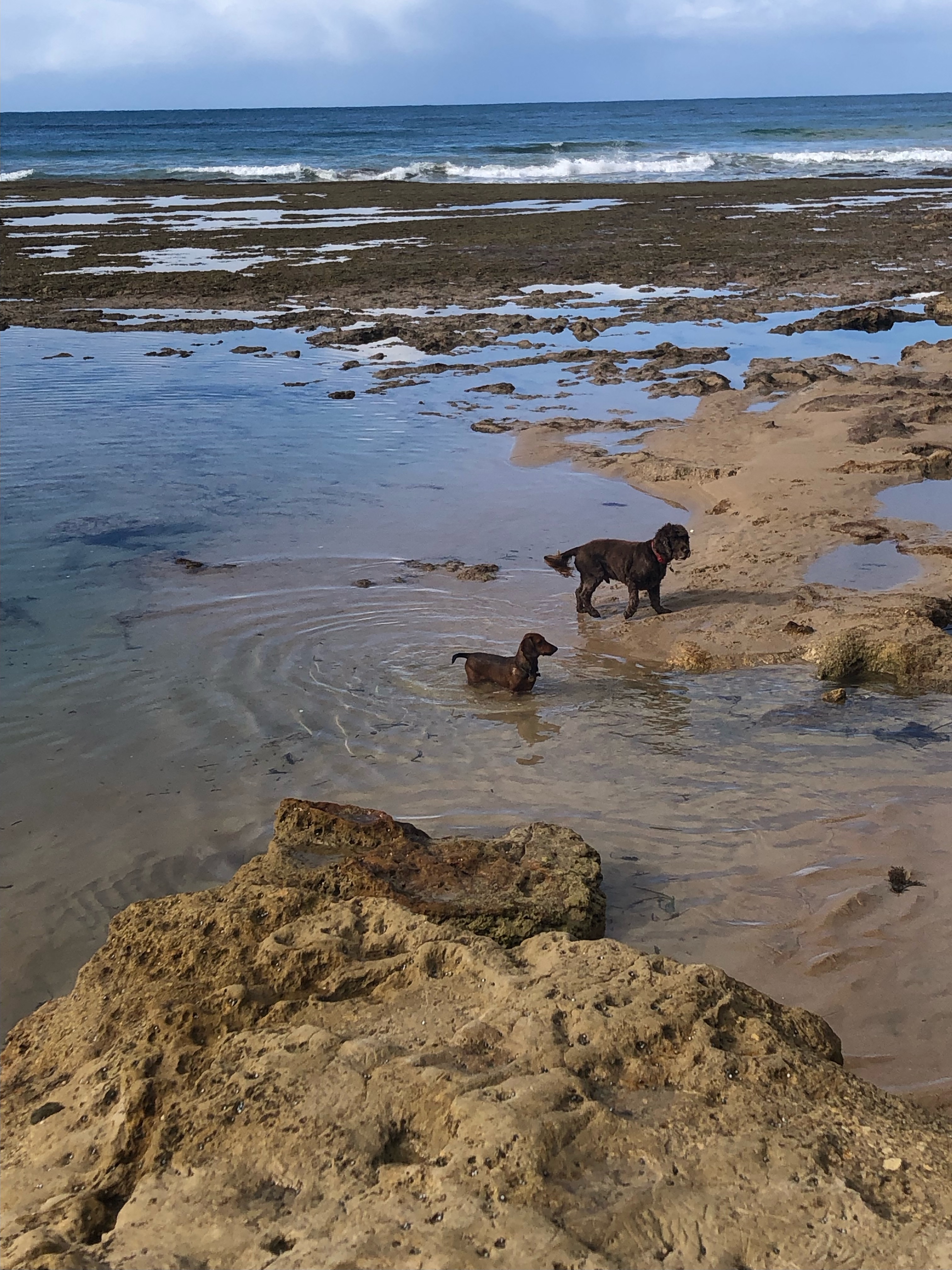
I’ve enjoyed looking at the pictures and have imagining myself there in mind and body, but I haven’t felt an ounce of envy. I’ve been just fine and dandy staying put in Melbourne. The Melbourne winter can bite, especially the wind, but it’s mild compared to a UK winter. Although I feel the cold, there’s nothing more energising than a rain- and wind-lashed walk on the beach with the dog children – Rupert, the dachsie, my canine nephew, has ‘over-wintered’ with me and Bertie.

I enjoy the seasonal variation – summer can be very intense requiring a lot of sunscreen slip, slop, slap – and finding warmth in soups, stews, candles, hot baths and snuggling with the dogs on the sofa. There are grey days in the mix which make me feel right at home but there are also some glorious sunny days in the high teens, when there’s no better place to hang out than in my courtyard garden.

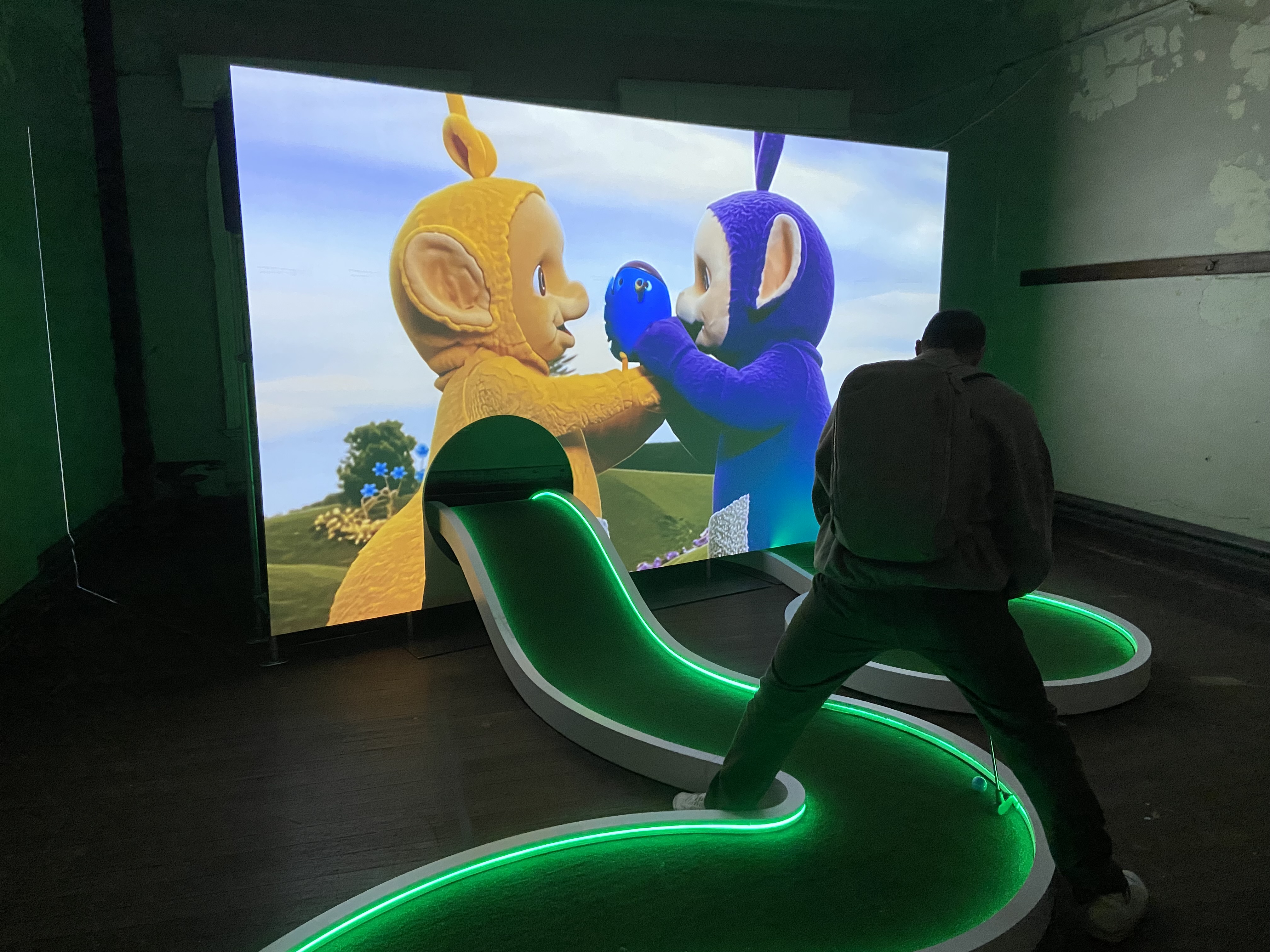
Immersing myself in artsy things has provided another form of nourishment these last few months. One of the zanier exhibitions my friend Kaliopi and I went to was Swingers – The Art of Mini Golf. I had no idea that mini golf had its origins in feminism. In the 19th Century a group of Scottish women, rebelling at being told that swinging a golf stick was unladylike, commissioned a 9-hole putting-only course which became known as the Himalayas due to the uneven terrain. The course still exists today, alongside St Andrews Golf Course near Edinburgh.

Swingers is an interactive exhibition staged in the former Victorian Rail Institute ballroom upstairs at Flinders Street Station. We navigated the nine-hole golf course created by nine female and gender-diverse artists. My favourite was the first hole, a big, bold and colourful desert scene by Yankunytjatjaraartist Kaylene Whiskey, complete with Greyhound bus and featuring Cathy Freeman and Dolly Parton. Putting is harder than it looks – you’re never going to get me playing golf – but we navigated the course as best we could.

Other works included videos of the Teletubbies, an eerie Carnival Clown face, spooky scenes reminiscent of the Mexican Day of the Dead and, at one of the holes, we had to attach a latex animal tail and swing it with our bodies to putt the ball. Well, what can I say, maybe if you’re as flexible as a hula hoop dancer… Much hilarity ensued but it did nothing for our technique.

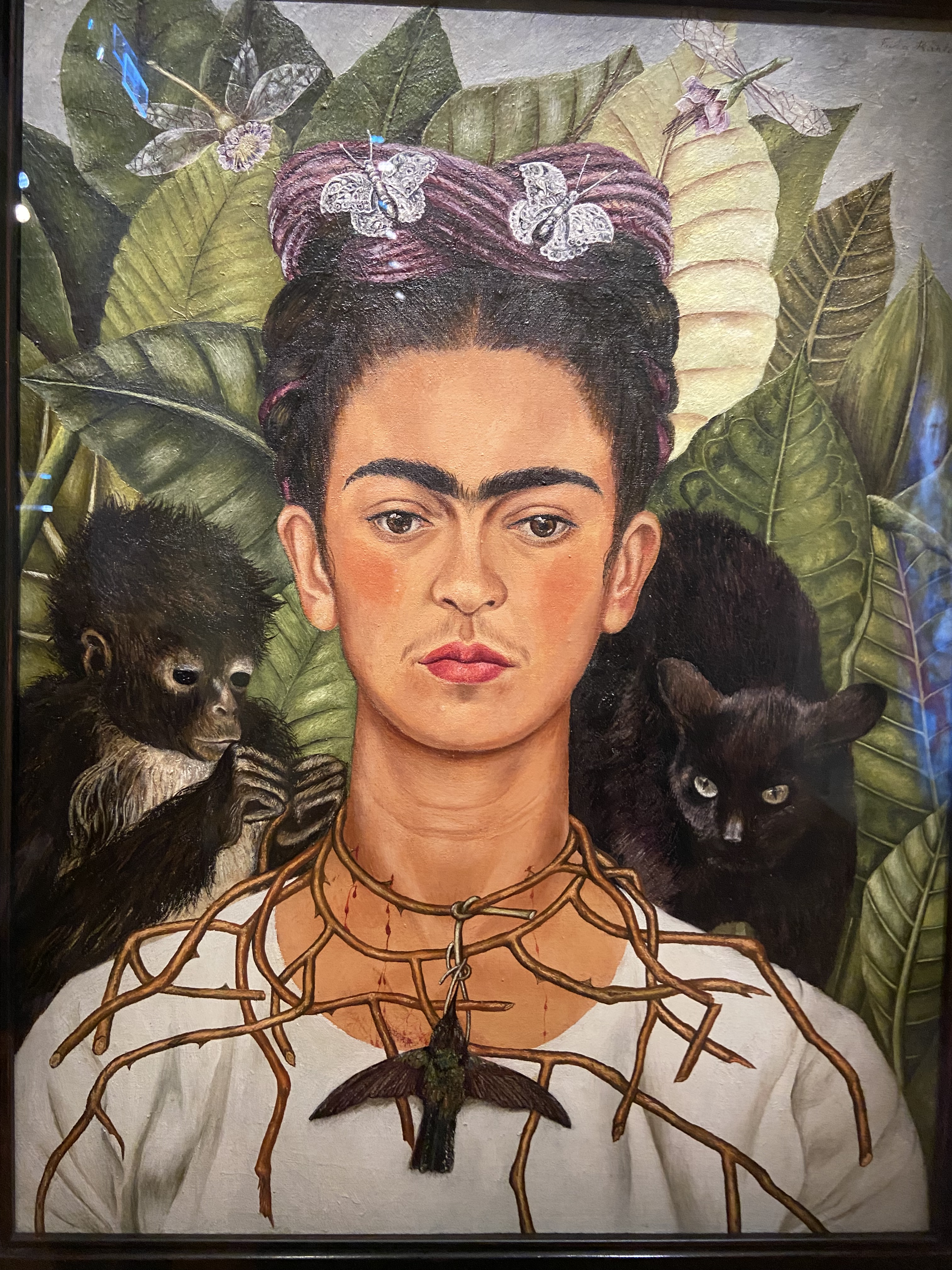
Another big pop of colour came courtesy of another feminist – in July I went up to Bendigo in regional Victoria to see Frida Kahlo: in her own image. As well as her paintings, self-portraits and the fabulous costumes, jewellery and flowers that she wore are some of her personal items that were sealed in a bathroom for 50 years after her death. These include lipsticks, powder compacts, medicines and herbal tinctures. As well as polio aged six, she suffered a horrendous accident in 1925 leading to life-long injuries when a streetcar collided with the bus she was travelling in. During her recovery she began to paint and used mirrors and an easel positioned over her bed. She underwent multiple surgical interventions, lived with chronic pain and had to wear a corset every day from 1944.

What shines through is her resilience, her deep love of animals and the natural world, her courage not only to channel her pain and disability into art but her readiness to challenge the prevailing societal and political norms. She was the daughter of a German/Hungarian father and a Mexican mestiza mother and, rather than follow the European-influenced fashions of the time, she honoured her Indigenous heritage and wore the traditional blouses, skirts and shawls from the Tehuantepec Isthmus, a matriarchal society. And although her life was cut short by gangrene in 1953, she lived to the full. She and Diego Rivera had an up and down marriage, they both had affairs – Frida even had a brief affair with Leon Trotsky. She was a member of the Mexican Communist party and painted one of her plaster corsets with a hammer and sickle.

Continuing with all things Hispanic, and following my March trip to Malaga, I saw five exquisite films at the Spanish Film Festival and luxuriated in the cadence and rhythms of the language. My two favourites were Wolfgang, a warm-hearted comedy about a nine-year-old highly intelligent boy with autism spectrum disorder, who re-establishes a relationship with his father following the death of his mother. And Ocho, a love story set across eight decades and eight defining moments in Spain’s history including the Civil War which split friends and families apart. A masterful and magical movie from the 2025 Malaga Film Festival.

A creole mass – Missa Criolla by Argentinian Ariel Ramirez – in a city church was a revelation. In place of the traditional Latin Mass, this was a folksy mass featuring dance, instrumental and song forms from Argentina blending Indigenous, African and European influences. The concert included other gems ranging from Spanish classical guitar pieces and a Peruvian hymn in the Quechua language to an Afro-Brazilian chant by Villa-Lobos, and Libertango, a piece composed by Argentinian tango composer Piazzolla. You’ll likely know the famous instrumental version, but we heard the choral adaption by Oscar Escalada with voices playing the parts of instruments.

I came out of the concert with an Andean beat pulsing in my veins, the maracas sounding in my ears and added South America to my travel wish list.  There’s been a strong Hispanic thread this winter. A few months ago, I went to a jazz club in north Melbourne to hear the Brazjaz Ensemble headed up by Carlos Ferreira, a Samba specialist from Rio de Janeiro. It was the real deal – mellow, moody and intense – and the newly graduated (2022) flautist, Yael Zamir, gave an extraordinary performance. The set included about five songs, two of which I recognised from a CD I used to play in my London days in the 90s.  

I’m a big fan of escapist musicals – it’s easier than meditation – that transport me to a make-believe world. Beetlejuice with Eddie Perfect was no exception. It’s a dark comedy about ghosts, zombies, life and death with a great score including a couple of Harry Belafonte favourites – Day-O and Shake Senora.

I went with my friend Angela and her daughter Alice, and we indulged in a Beetlejuice-themed high tea beforehand which included ghoulish lime green cocktail, black and white sugar snakes, dark chocolate and pepper scones, shrunken head tarte and a smoking concoction that added to the mystique.

This Sunday, I celebrated the last day of winter by going up to Kyneton to see Alice – a rising star – perform in Mary Poppins with Sprout Theatre, a youth musical company in the Macedon Ranges.  A wonderfully high energy production performed by a cast of talented young people ranging from tiny tots in the junior class to teenagers in the senior classes. Beautifully staged and choreographed, it was a knockout with great singing and dancing including coordinated moves and can-can kicks that must have taken a fair bit of rehearsing. As a two left feet person, I was impressed.  Absolutely supercalifragilisticexpialidocious!

Mary Poppins is one of my all-time favourite musicals, and its story and messages are as relevant today as they ever were; family is more important than work and money, find the silver linings and positives “Just a spoonful of sugar”, and believe in the power of creativity and imagination: “Anything can happen if you let it.” Sound advice!

Back in England: family, fine art, an old flame, a (very) old tree and teeth on the table

A highlight of this trip was meeting up with an old flame for the first time in over 25 years. We met in the ‘80s in London when I was his lodger and the world was a very different place. After years of communicating via Christmas cards between America and Australia, we were, at last, going to be in London at the same time. The anticipation and getting ready were half the fun. Limited to a travel wardrobe and my hair out of shape, my beloved sister came to the rescue. Despite our combined age of just over 130, we were like teenagers again. She helped me get ready, backcombed my hair, lent me a coat and scarf and some jazzy earrings. It was wonderfully bonding.

Lance and I met at the Cavalry and Guards Club in Piccadilly. Honouring the Club’s formal dress code, he was wearing an elegant blue suit and orange silk tie – the word dashing comes to mind. He’d hardly changed at all, and we effortlessly took up where we left off in what proved to be a fun and fond evening. Dining on the best of British at the wonderfully-named Noble Rot in Mayfair, we reminisced, caught up on all the years in between and shared unrealistic ex-pat dreams – he and his family now live in San Francisco – about how nice it’d be to own a pad in London and to stay for three months every year.

He remains a stalwart drinker, a bon viveur, a keen golfer and, while politically poles apart from me, he’s stylish, has artistic sensitivity and impeccable taste. He always did have a dry sense of humour. Quote of the evening had to be “Well, Cha (he’s the only person in the world who calls me Cha) it’s good to know, as a former lover, that you have found happiness with a dog.”

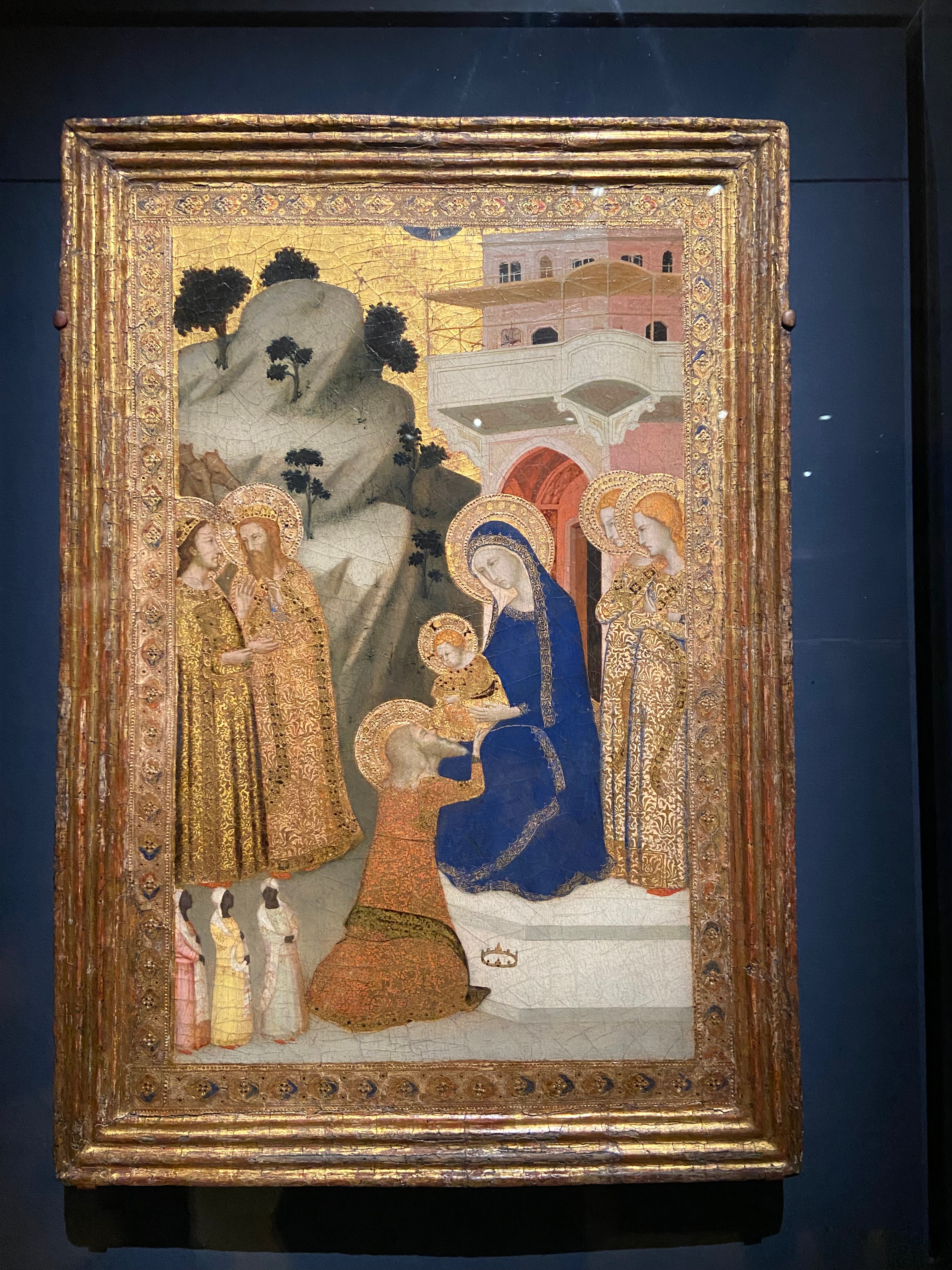
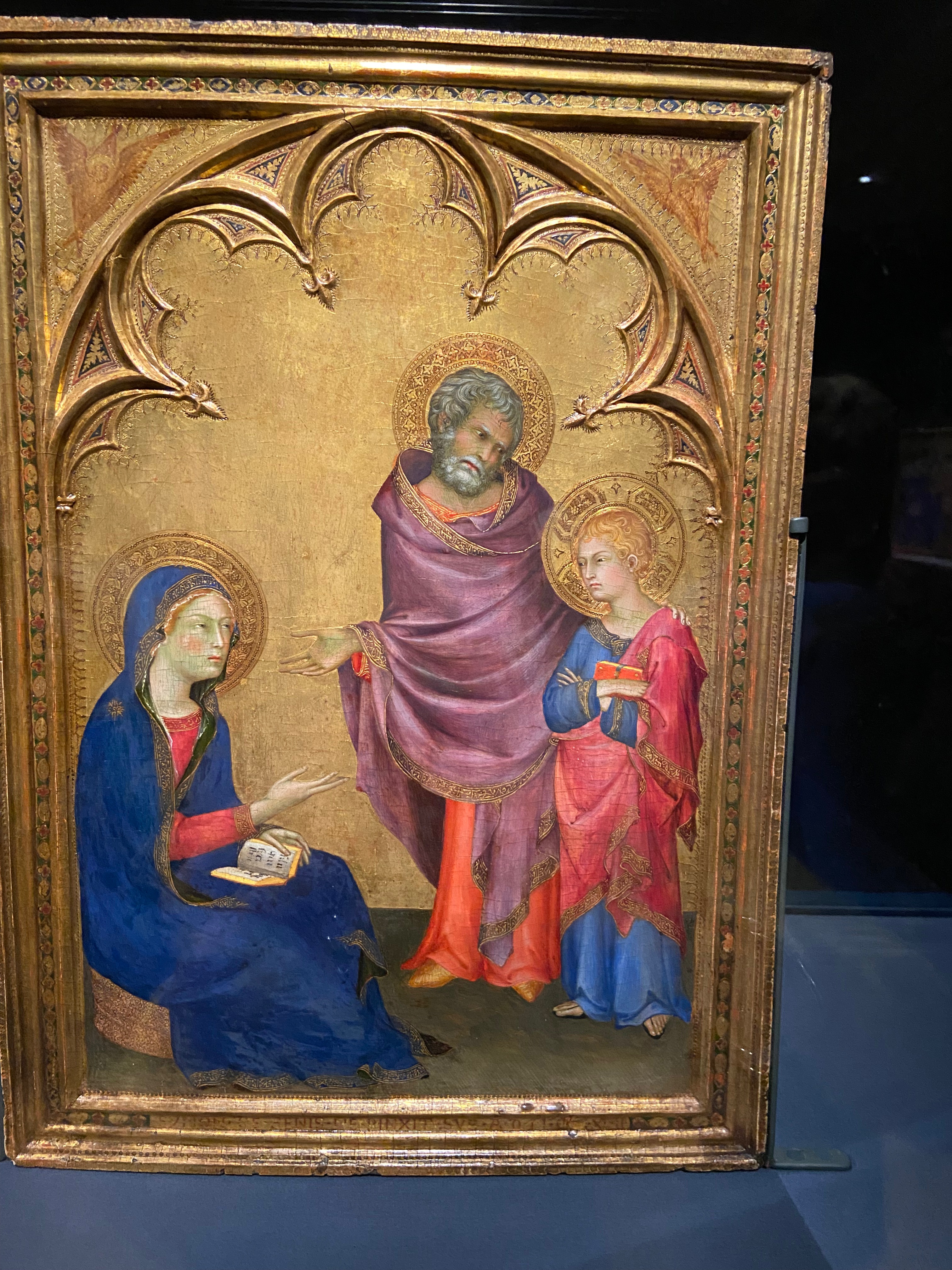
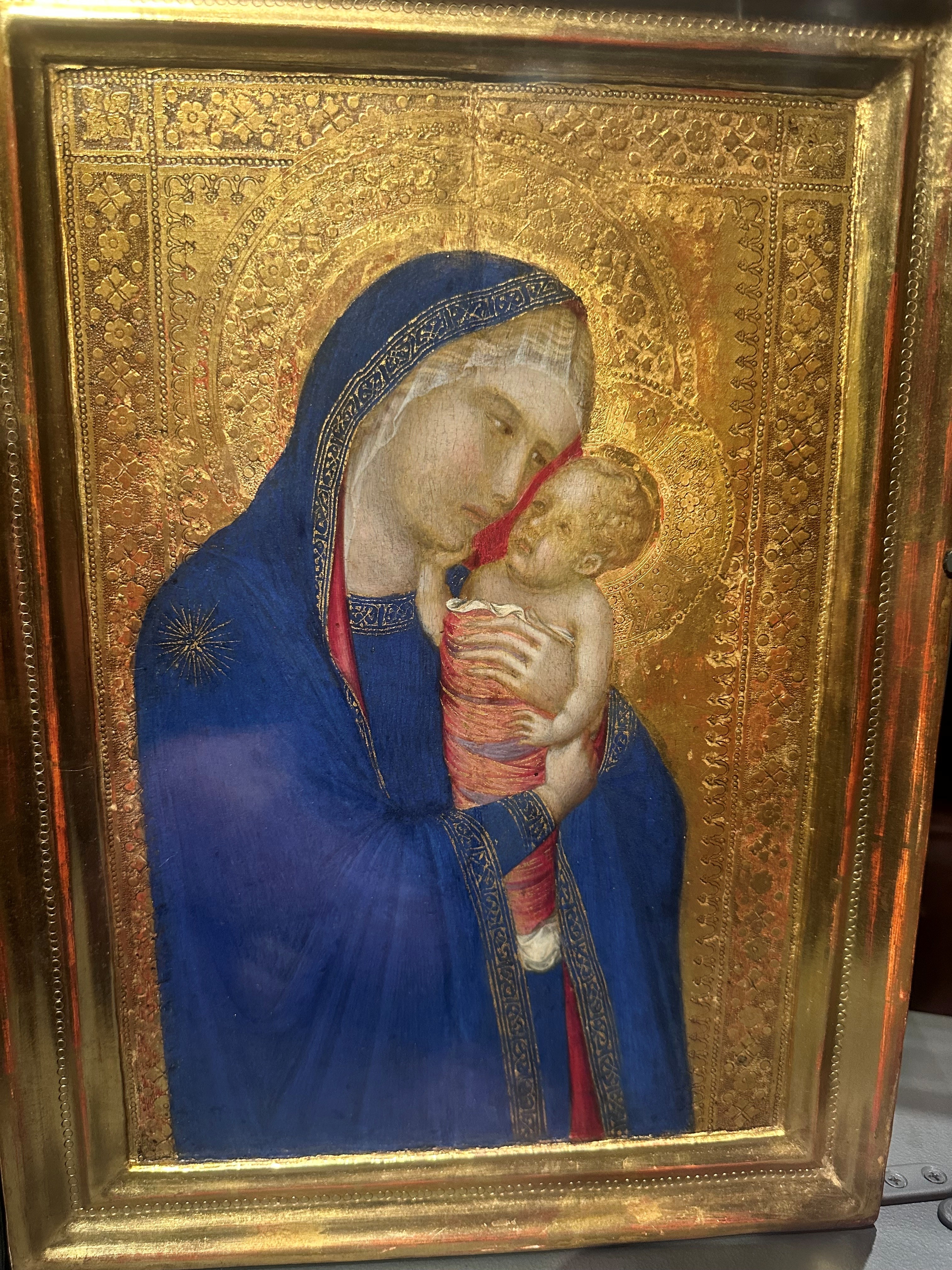
In a small world moment, Lance had seen the exhibition Siena: The Rise of Painting 1300-1350 at the Met that I was about to see at the National Gallery. In fact, some of the photos I am sharing are his.  It was an exquisite exhibition, and an extraordinary one with many of the works reassembled for the first time in centuries.

To quote from the National Gallery:

Simone Martini’s Orsini polyptych, split between Antwerp, Paris and Berlin is together again. His panels for the Siena’s Palazzo Pubblico altarpiece are reunited. 

Panels from Duccio’s Maestà, one of the largest and most complex altarpieces ever produced, on loan from Madrid, Fort Worth, New York and Washington and his ‘Virgin and Child’ and ‘Crucifixion’ triptychs come together.

Siena, I learnt, was one of the world’s richest cities and a major centre for artistic innovation and experimentation before the Italian Renaissance and up till the outbreak of the Black Death in 1348.  

What I loved was the sweep of the exhibition from the large, commissioned altarpieces, shimmering gold, to smaller paintings as well as ivory carvings, intricate enamelled boxes, reliquaries with fragments of bones, silks and textiles from Iran and Turkey, marble and wooden sculptures and illustrated manuscripts. The level of detail and the vividness of the colours – particularly the  blues, oranges, reds, purples and pinks – pulled me in as did the emotion and humanity in many of the pictures; the tender face of Mary, baby Jesus reaching up to pull aside the veil from his mother’s face and, my favourite, a picture of Jesus as a boy being told off by his parents and sporting a sulky teenage face and crossed arms.

Seeing great nephews and nieces is always a joy on my UK trips, the catch being that it’s all or nothing, and I miss out on many of their milestones from trip to trip. I enjoyed reading Hairy Maclary to Dougie, who is now coming up for two, walking, talking and being schooled in the art of calling me Lot-Lot.

Up in Nottinghamshire with Mum, I caught up with my great nieces – Millie and Imogen from Yorkshire. Millie at 14 months was too young to recognise me but I got a great welcome Imogen, who is nearly five. I’d decorated the dining room with bunting and balloons, but much more exciting was doing the washing up standing on the step and playing peek-a-boo through the (rather old-fashioned) serving hatch between kitchen and dining room. That and ragging around with my eldest brother, the most devoted grand-father ever.

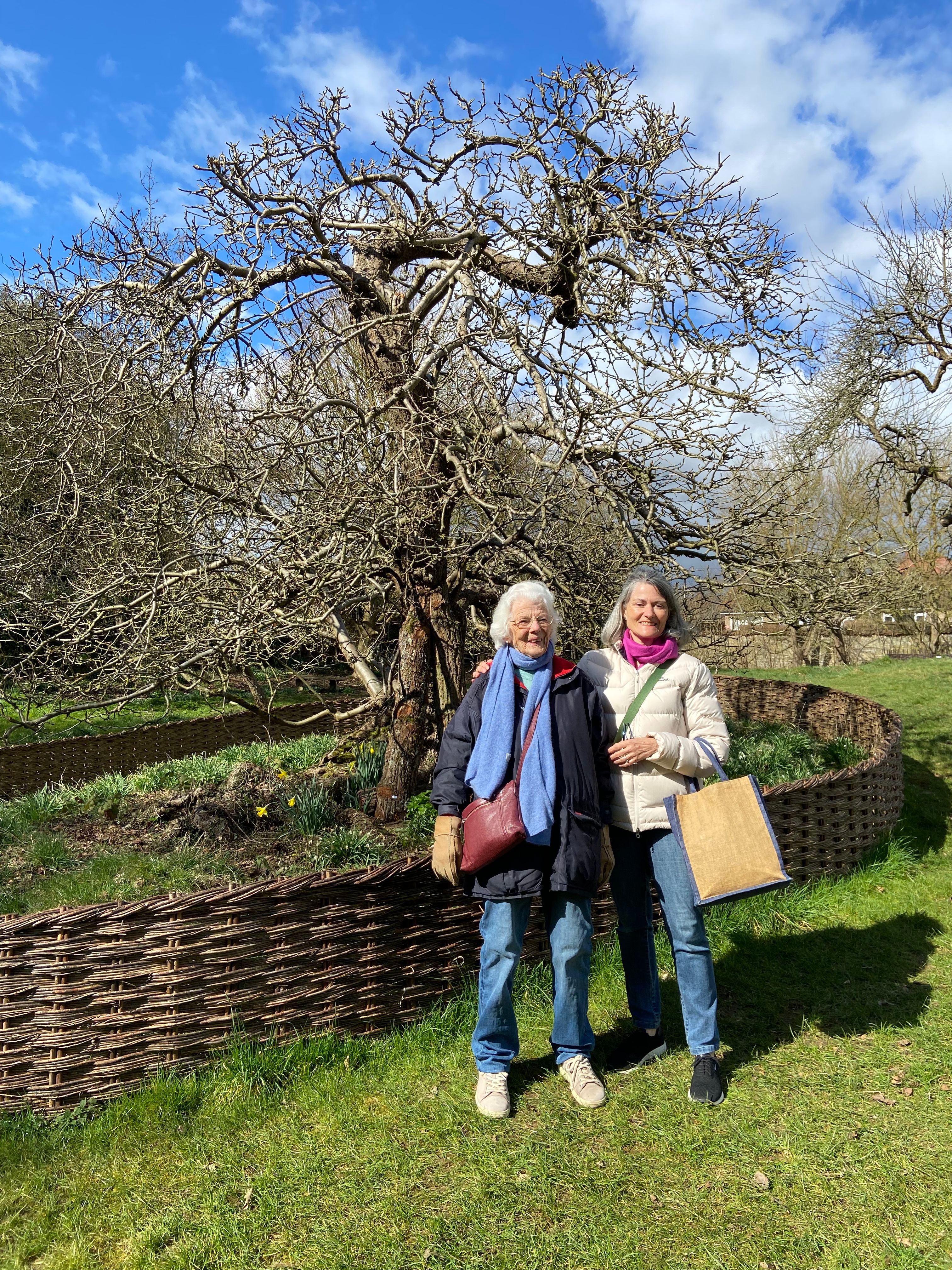
Mum had a rocky start to the year but has fought back amazingly well. So it was a triumph to manage a fun day out together and lay down new memories. At 93 it’s a case of carpe diem. We went down the A1 to Lincolnshire to see a heritage-listed tree – not just any old tree but possibly the oldest known apple tree in the world. The tree where Isaac Newton had his aha gravity moment.

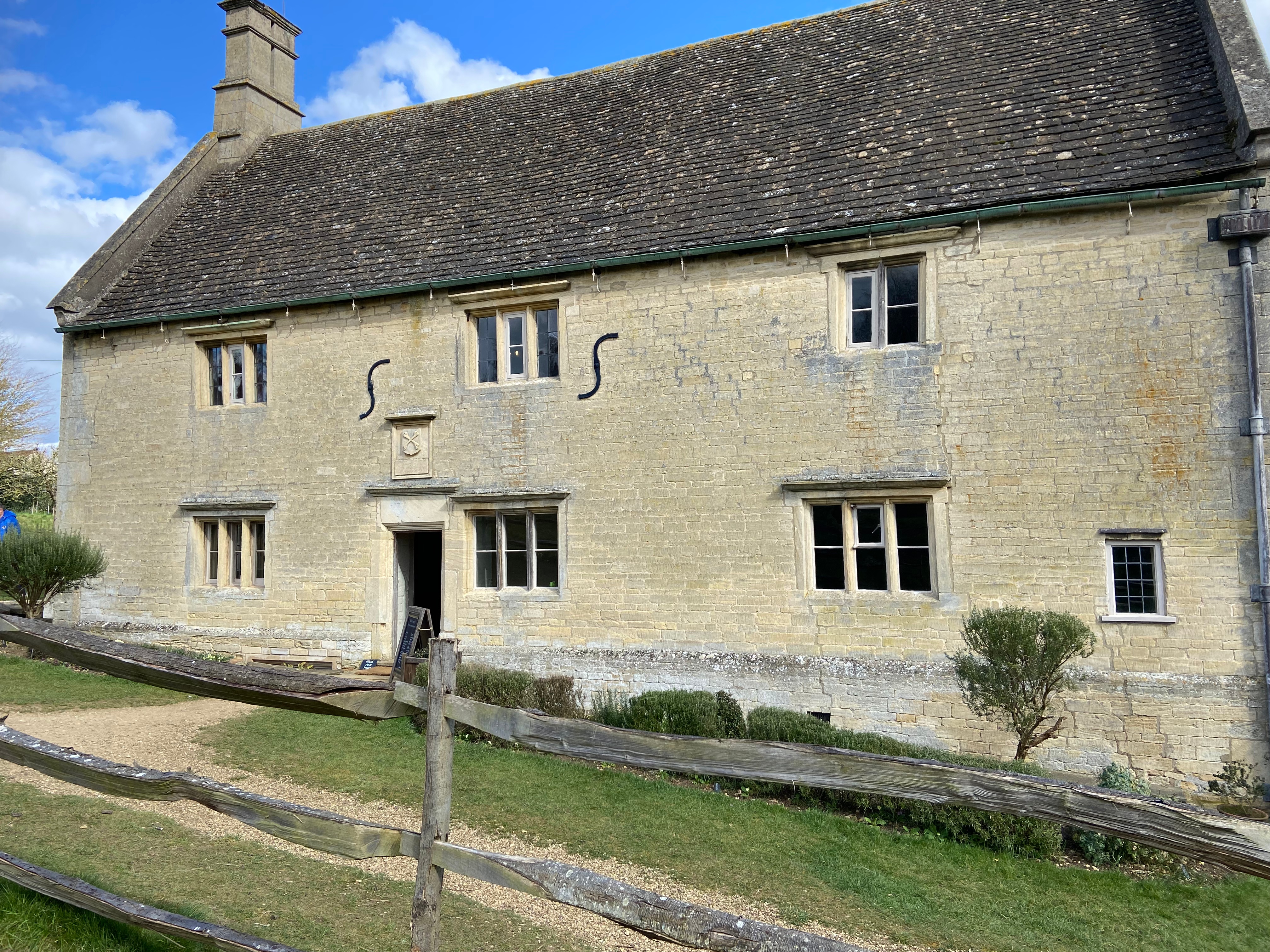
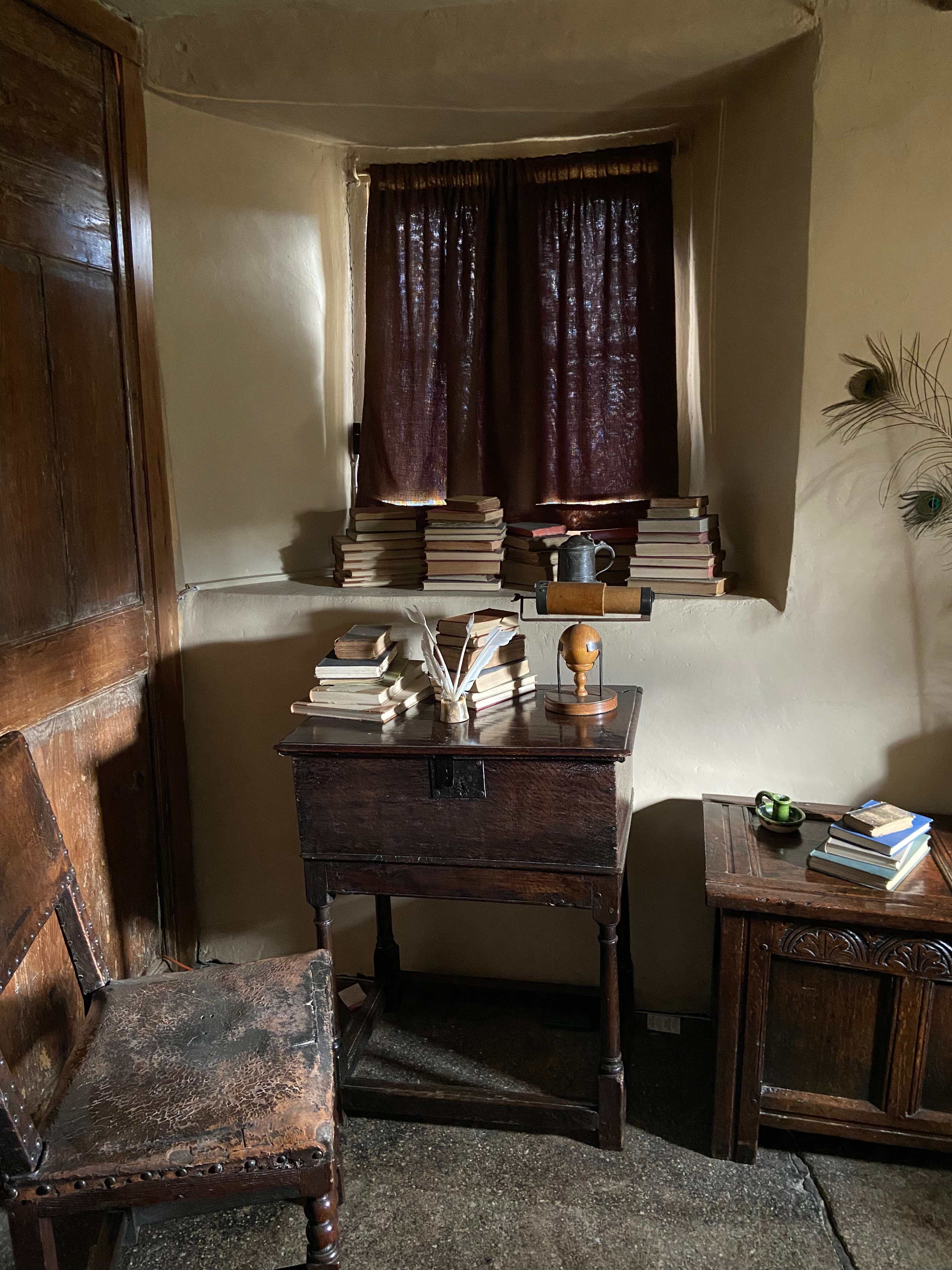
The tree is in the garden of the Woolsthorpe Manor (now a National Trust property) where Newton was born in 1643. Inside the house is the room where he conducted his experiments on light using a prism, a recreated dining room, kitchen and bedroom with lots of heavy oak furniture, and exhibition on the 17th Century uses of urine. These ranged from mouth wash, skin softening, reducing wrinkles (I’m not up for trying it on the crow’s feet!) and stain removal to making gunpowder and warding off witches. It was also prized as a valuable side-hustle commodity you could sell to soap-makers and tanners – there was no Airbnb and Uber back then.

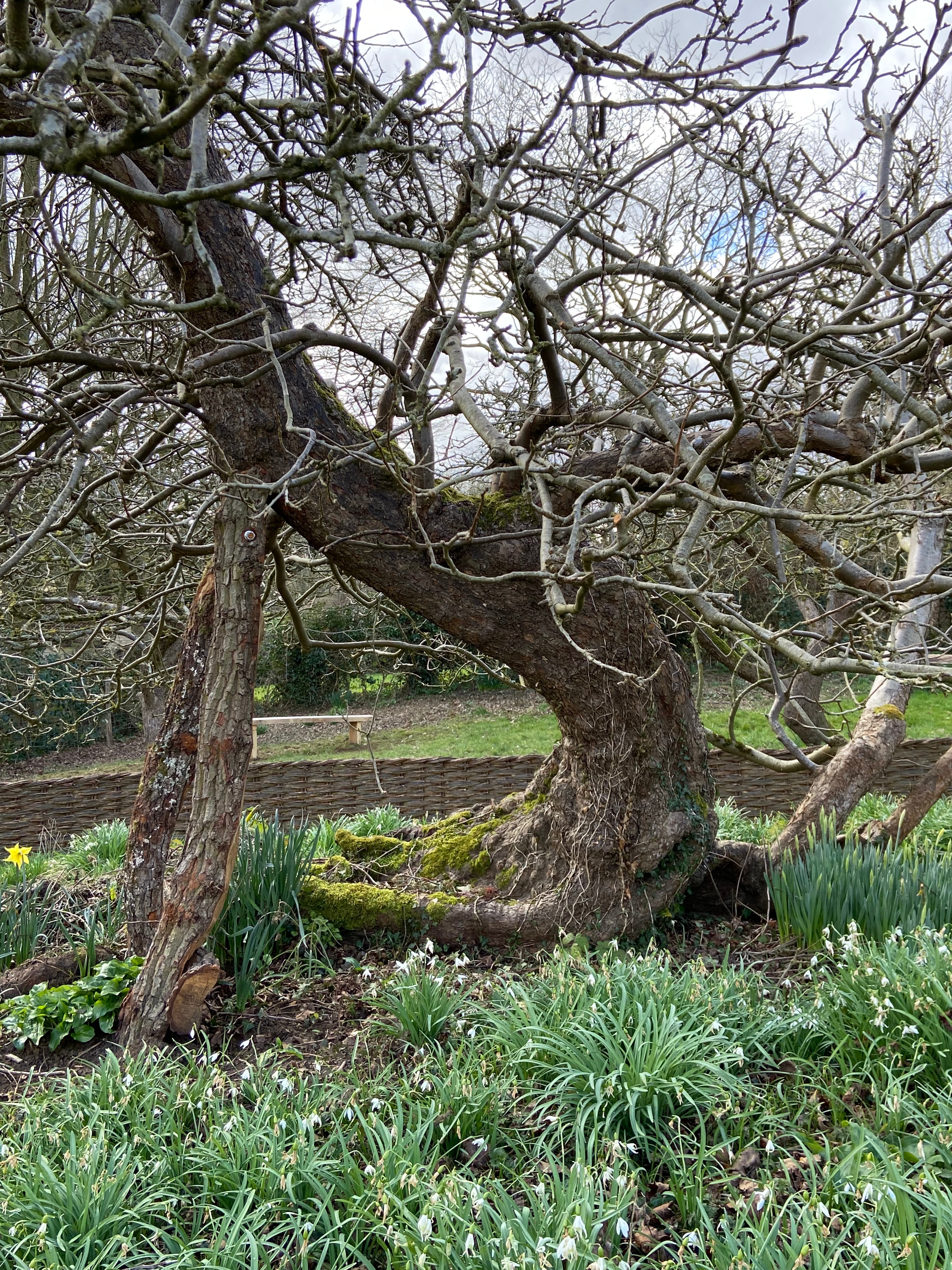
The apple tree, somewhat gnarled and bent, has proved amazingly resilient and survived being felled by a major storm in 1820. And, even better, the tree has offshoots all around the world including in Canada, the US, Argentina, Germany, South Africa, Korea, Japan and Australia. And the tree’s Australian descendants are not far from where I live.  

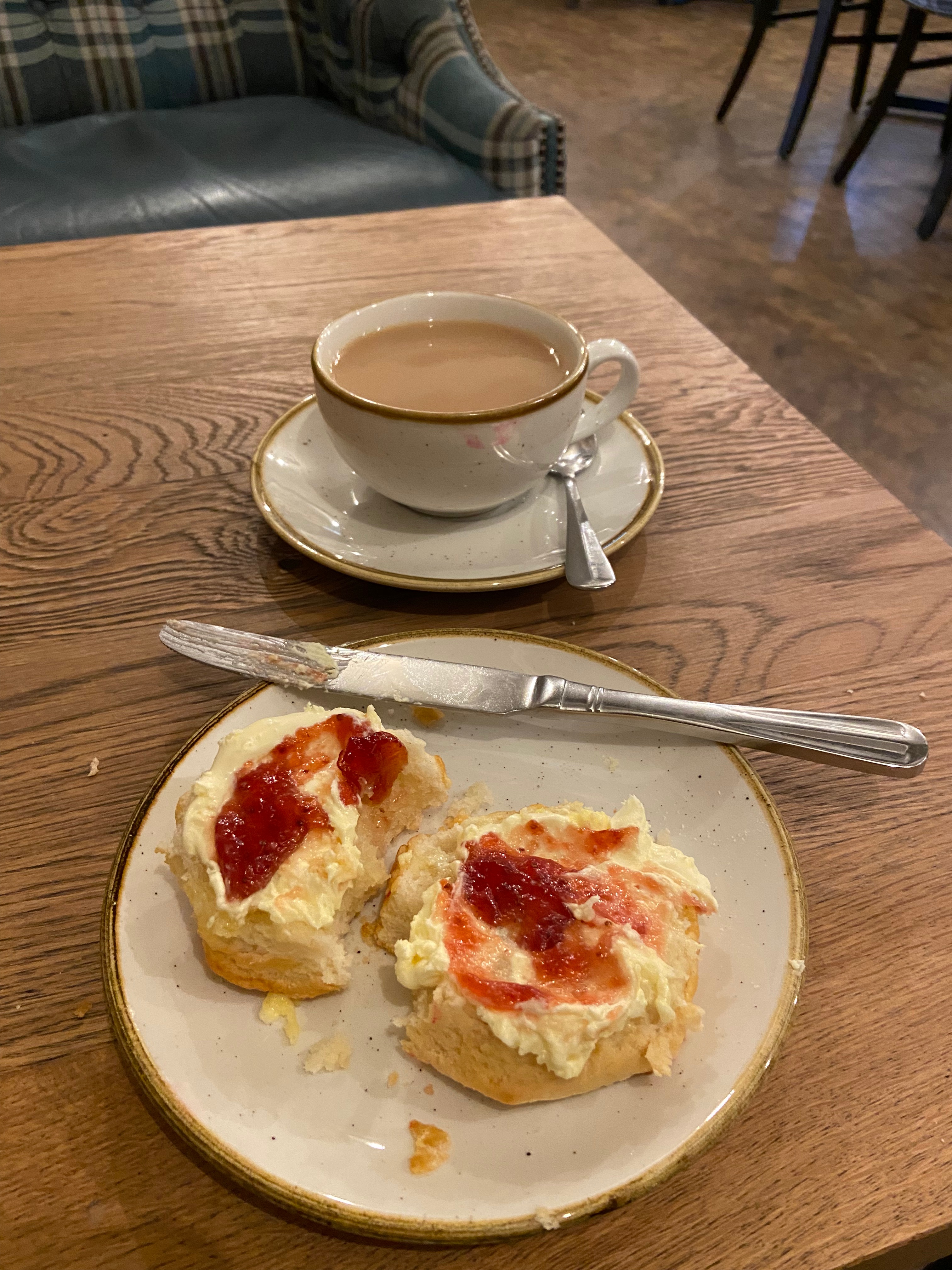
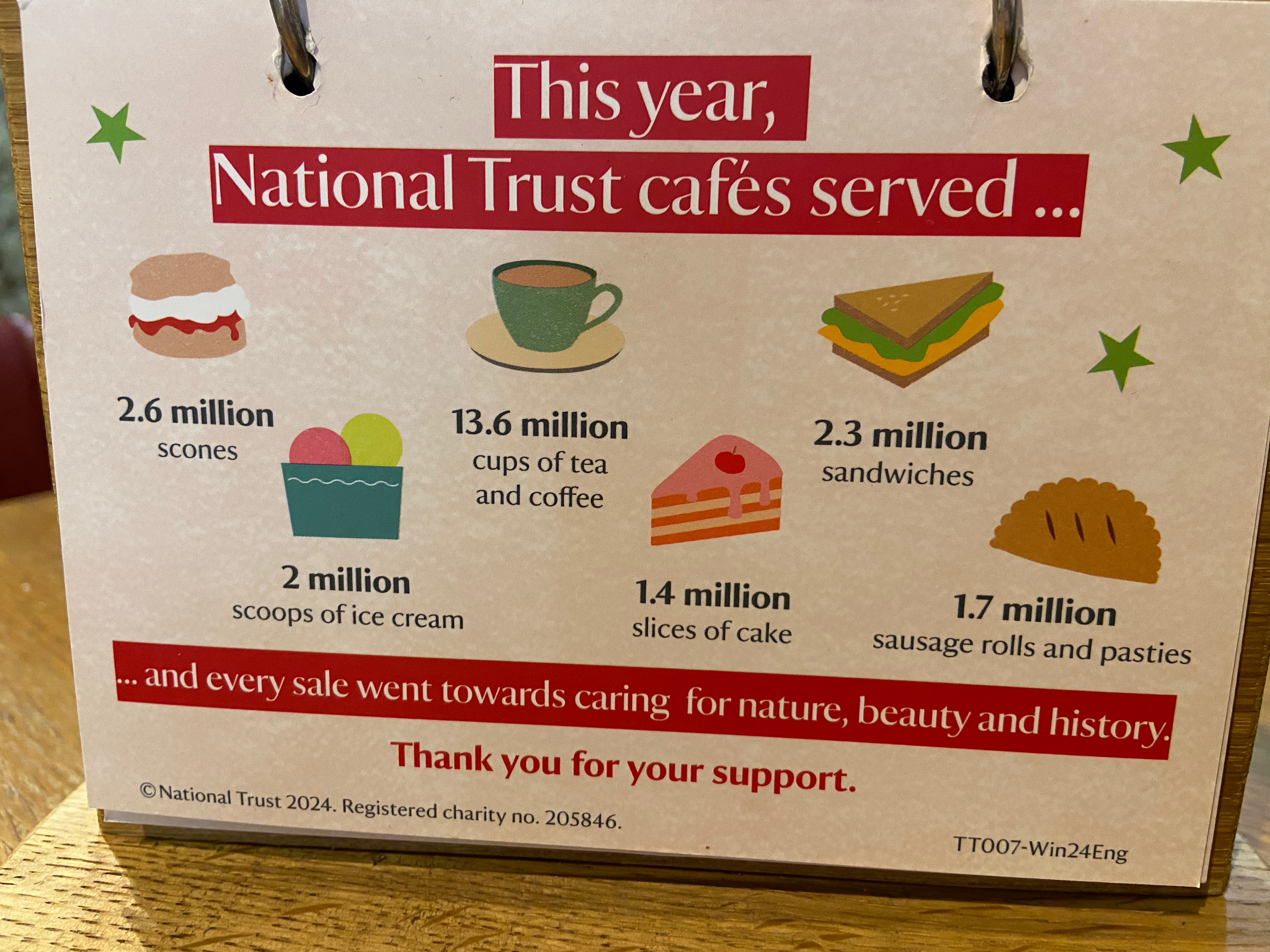
We enjoyed the spring sun but there was a biting wind, so we warmed up with a sandwich lunch in the barn and I enjoyed a nice British cuppa, one of 13.6 million served in National Trust cafés annually!

The weeks with Mum in her village near Retford in Nottinghamshire had some surprisingly busy days whether it was medical appointments, relatives coming over, neighbours popping in and out, the window cleaner appearing at the top windows early one morning when we were only half dressed, the boiler being serviced, supermarket shop-ups, a trip to the tip to get rid of rubbish from the garage – and managing all the things old age throws at you.

Mum and I had a few fraught moments due to an unholy alliance of old age irritations – hearing, digestion, eyes, poor sleep and anxiety topped off with a very nasty cold which we both succumbed to. Mum had two macular eye injections in one week, and for one of them I managed to leave all forms of payment behind on the kitchen table. Emerging from the injection feeling wobbly and seeing black dots, Mum wasn’t best pleased that I had no means of paying for the parking, which would likely result in a written penalty. You’re never too old to get a good ticking-off.  Luckily a kind-hearted woman gave us the £1.75.

However, that evening dinner was a disaster. I’d managed to make the sausage skins tough and the broccoli too crunchy (Goldilocks would have had a field day). Mum, cross and tired and unable to chew adequately, took out her dental plate and put it on the table where it sat accusingly. Mum’s teeth were out, and mine were firmly clenched. A bit of a Swords at Dawn moment!

Needless to say, we’d moved on by the next morning and, girls together, we both had 10.30am hair appointments – nothing like a haircut to make you feel better. Adjacent basins wondered my brother? Not quite but that’d be a good title for an Alan Bennett play!

I timed my trip to include Mother’s Day on my last weekend, and my sister came up from London to join us. Flowers, chocolates, coffee by the canal in Retford and roast chicken in the Aga. And time to read Mum a few more stories from Craig Brown’s A Voyage around the Queen, an entertaining biography with a difference. I bought it on the strength of this review from The Times:  “An unconventional tribute that offers a snapshot of almost a century of social history with a mix of royal insanity, and superior anecdotes, from farts and corgis to Paul McCartney and poets laureate.” And it absolutely delivered; Mum, I’ll be back to read you more extraordinary Royal tales (and tails) before you know it.

Rediscovering Spain Part 2/2: Picasso, paella, pajarete and more

It was Michael Portillo, he of the brightly coloured jackets and train journeys, who inspired me to choose Malaga as my stop-off place on the way to the UK. There’s a lot more to Malaga than being a gateway to the Costa del Sol.

Another reason I chose Malaga is that it’s very walkable, its compact city centre perfect for meandering, mooching about and soaking up the vibe. In the past I’ve tended to cram too much into my European trips – partly because living on the other side of the world engenders terrible FOMO.  

I stayed in a small Airbnb studio in a quiet residential area about ten minutes’ walk from the city centre. It was nothing fancy, but I felt completely at home and enjoyed watching the comings and goings in the street below from my narrow window balcony.

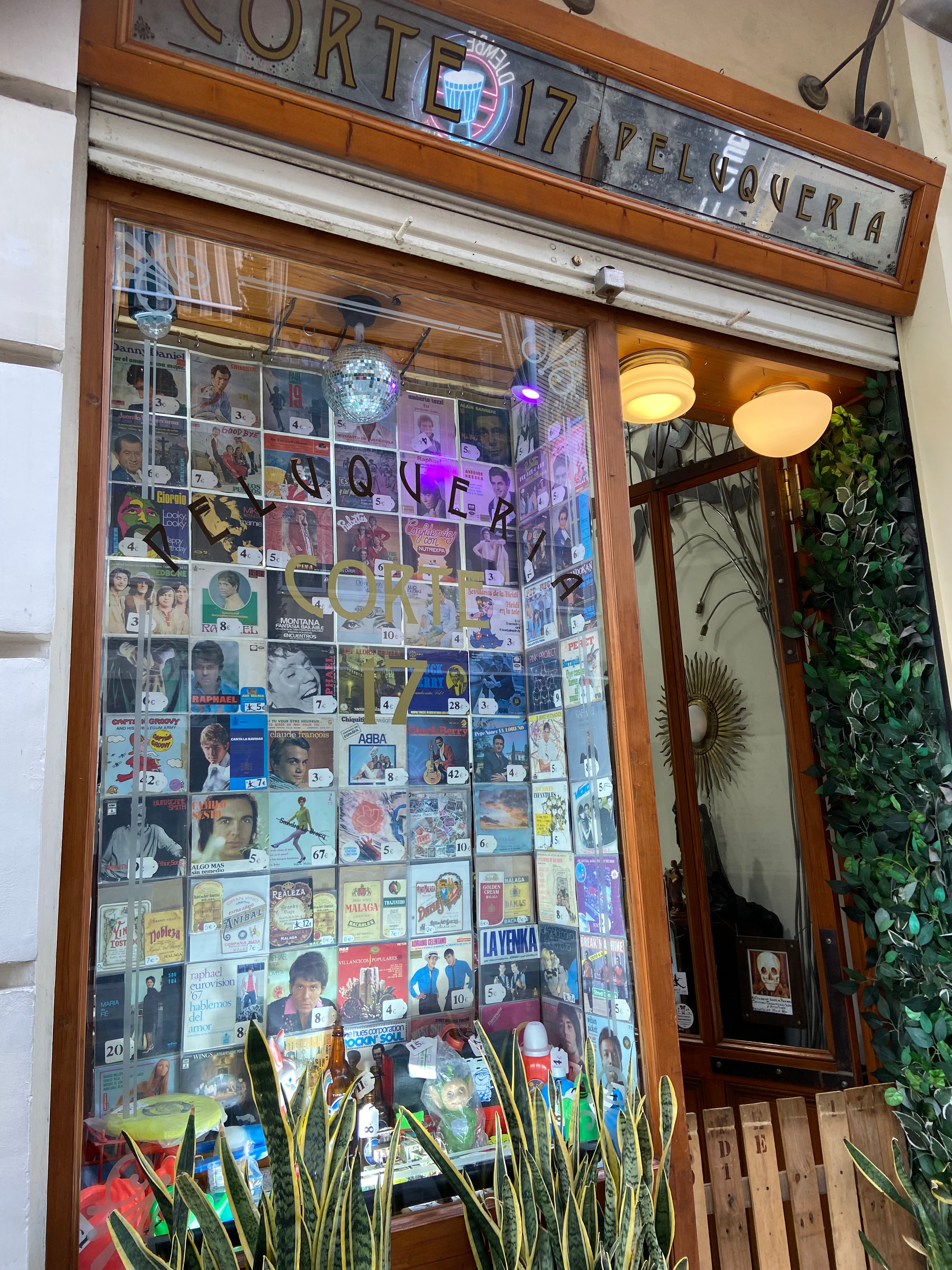
Walking to and from the centre I tapped into timelessness again (see Rediscovering Spain Part 1) noticing something new every time – a few hole-in-the-wall shops, seemingly unchanged over decades, selling salami, processed cheese, tulipán margarine (Spain’s version of Flora), bottled water, olive oil and packets of this and that. I spotted lots of traditional barber shops, one with a window artfully decorated with 45 vinyl record sleeves. Then there were the glass-fronted balconies, the lantern-style streetlamps and decorative tiles on house fronts depicting religious scenes (lots of those) or various trades or symbols related to the original homeowners. And crowded tapas bars at lunchtime, the scruffier, the more authentic.

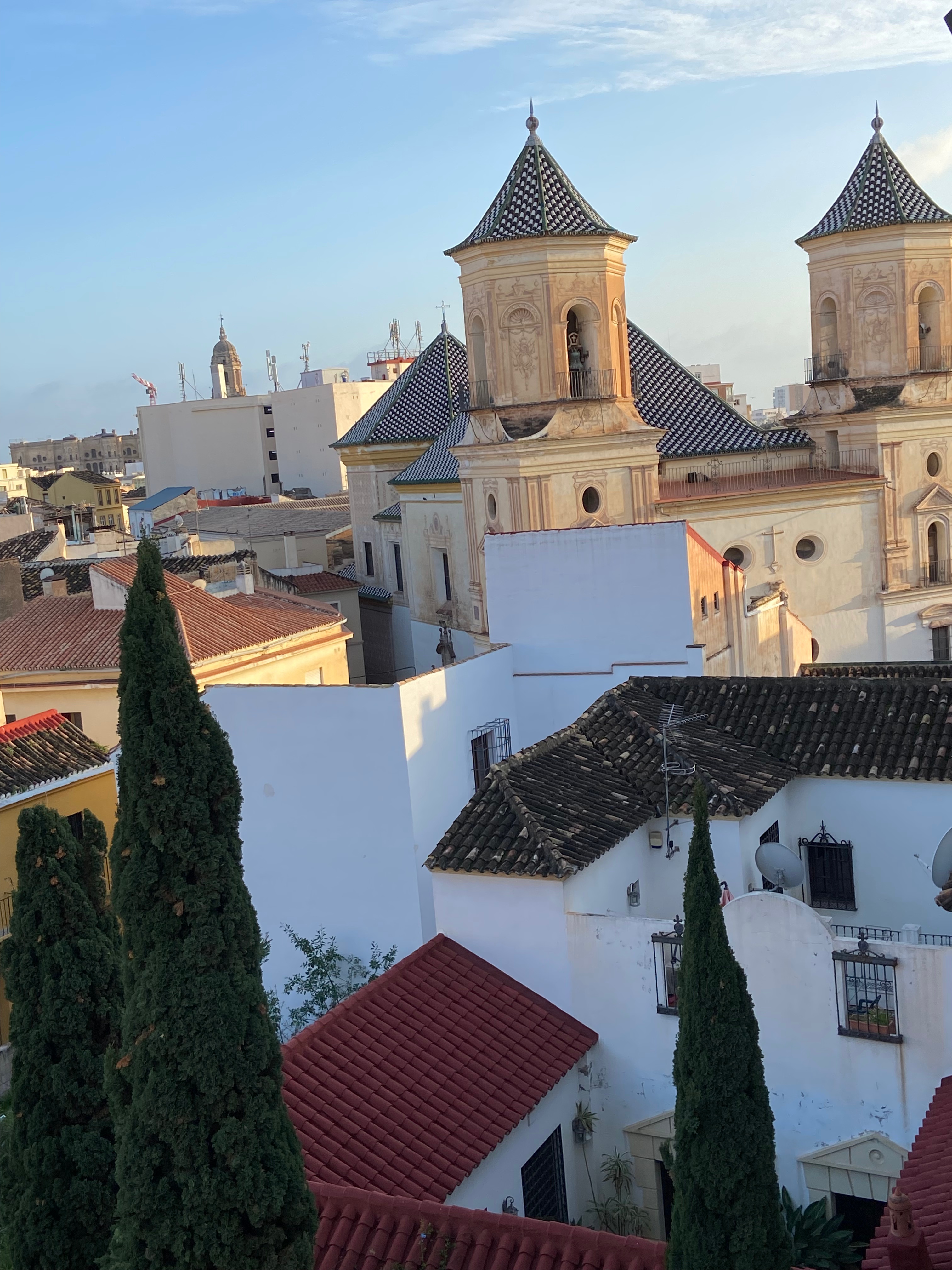
From the roof terrace of my Airbnb, I looked over to the church of San Felipe Neri, a baroque church with distinctive green and white tiles on the bell towers. Listening to the bells ring out several times a day, a pure and undiluted sound, I felt a great sense of serenity and groundedness. I’ve always loved church bells.  Although I didn’t do a tour of Malaga Cathedral, I did go into another church, Santo Cristo de La Salud, in the centre. Drawn in by its terracotta exterior and circular stained-glass window, I went and in sat for a few minutes looking up at the domed ceiling, feeling into the sanctity, time stopping still.

Thwarted in my attempt to visit the Picasso Museum (sold out even in low season!) on day one, I joined a tour of the Moorish fortress, The Alcazaba. I am somewhat spoilt having lived and studied for nearly five months in Granada in the ‘80s with the Alhambra Palace and the Generalife Gardens a half-hour climb up the hill from where I was living.  Given today’s mass and over-tourism issues, I realise how extraordinarily lucky I was to have had unfettered access to a UNESCO World Heritage site, and one of the most magnificent examples of Islamic art in Spain.

Like the Alhambra, the Alcazaba sits on a strategic hilltop and was previously a Roman settlement. The tour started at the Roman theatre and the site of sunken pits which housed fermented fish sauce called garum, the Roman equivalent of umami flavouring.

The glory days of the Alhambra and Alcazaba ended with the Catholic conquest – the Reconquista – which culminated in 1492 when Granda, the final Moorish stronghold, surrendered to King Ferdinand II and Queen Isabella I. The Alcazaba was largely abandoned by the 18th century, damaged during the Napoleonic wars and, again, during the Spanish civil war.

Restoration started in the 1930s – our guide pointed out some of the remaining Moorish parts: the double walls, one inside the other, making the fortress harder to attack along with the bent entrances, the cobbled paths that double back on themselves, another defensive feature to slow down potential attackers; the carved caliphal-style horseshoe-shaped arches at the entrance to the main hall, the Taifa Palace; the 8-point star in the paving stones; a number of carved wooden ceilings with their intricate geometric patterns from the Mudejar tradition, a style blending Islamic and Christian artistic traditions, and a decorative arched niche set into the wall that would have housed water, perfume or flowers.

To my mind nothing comes up to the Patio de Las Arrayanes (the Courtyard of the Myrtles) at the Alhambra, but the Alcazaba’s restored gardens and series of courtyards and patios with tiled pools nonetheless have charm and offer a tranquil place for reflection.  

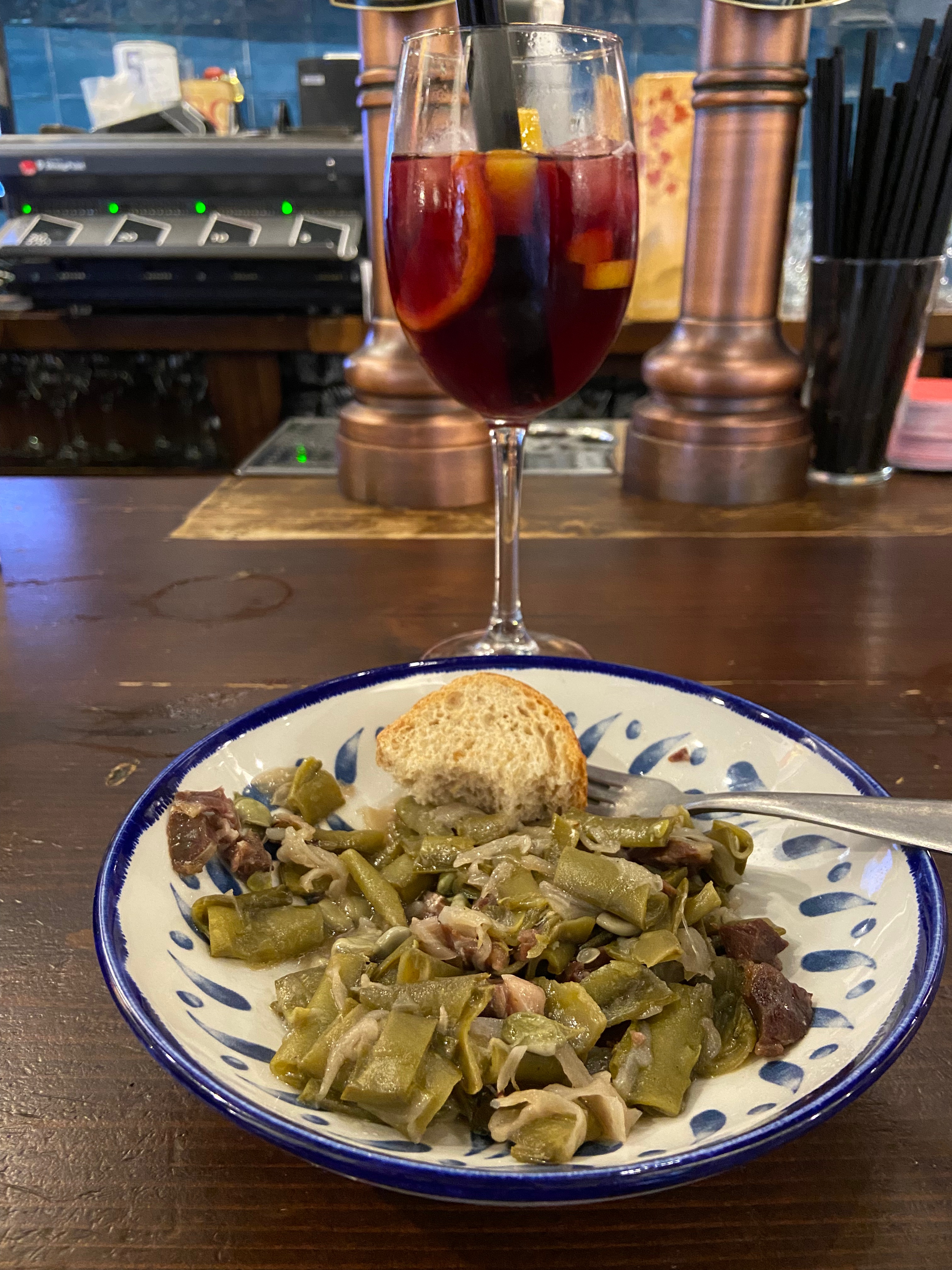
I was hungry and thirsty after all the hill climbing so I repaired to Bar El Pimpi at lunchtime, another Michael Portillo recommendation. Something of a Malaga institution since the 1970s, El Pimpi is a wine cellar with lots of different patios and rooms. I found a stool at the bar and ordered sangria, tortilla espaňola (Spanish omelette) and habas con jamón (a stew of jamón serrano and broad beans). The omelette came doorstep-size and was disappointingly dry, but the beans and sangria were excellent. I got chatting to a couple Chris and Kat, from Ireland and West Virginia respectively. They are in their 50s, have sold their businesses and are enjoying the freedom to travel. They were heading to a spa after lunch and hadn’t bothered with any of the museums or sights. No FOMO there!

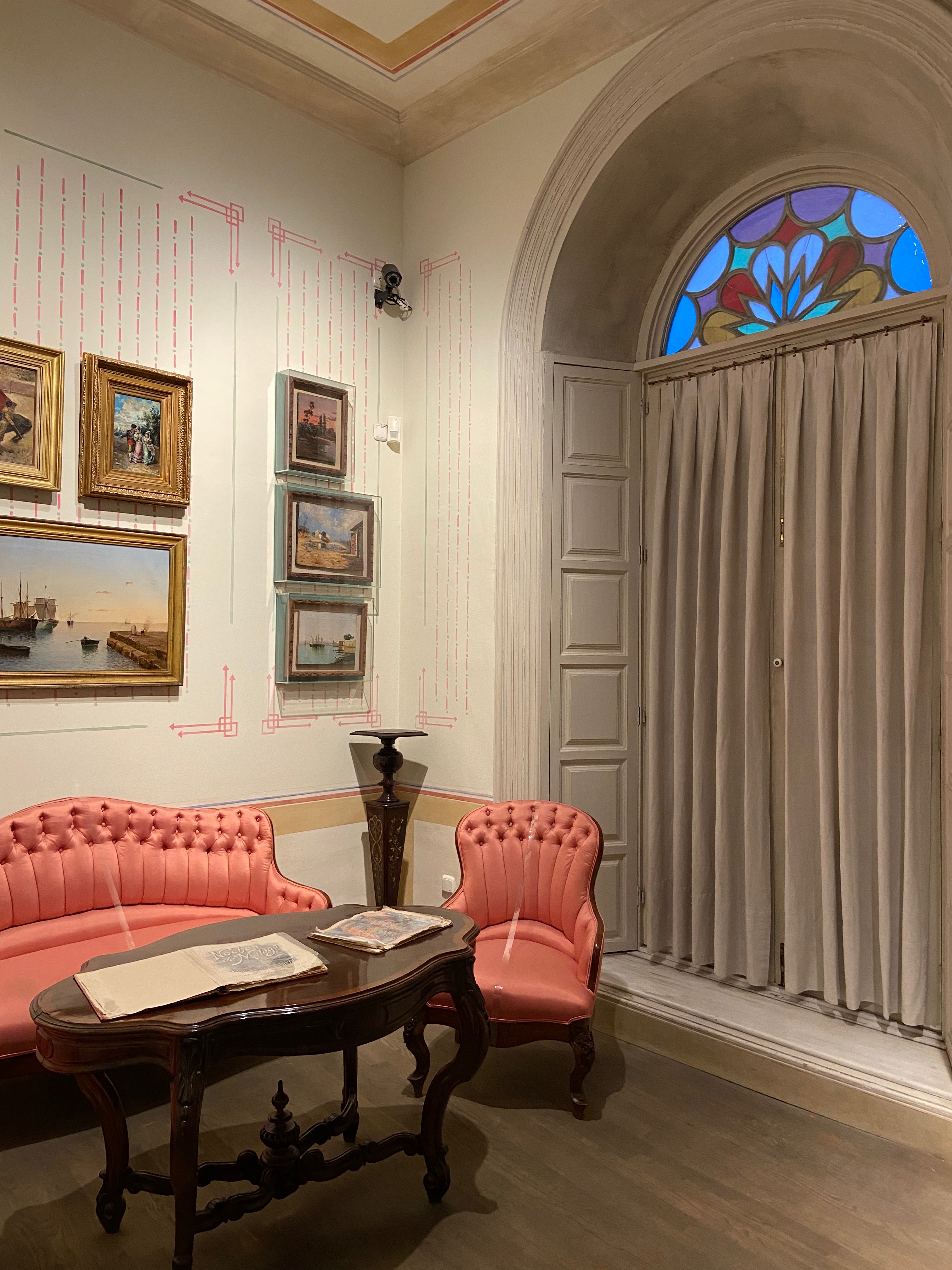
After a much-needed siesta – take a pinch of jetlag and a glass of sangria – I popped out again in the early evening. Not quite ready to do a Chris and Kat and eschew all museums, I was keen to check out Picasso’s birthplace – a house with beautiful stained-glass fan lights overlooking the Plaza de la Merced, a five-minute walk from where I was staying. Open till 8pm, it was perfect for the post-siesta, pre-dinner slot.

Picasso came from a wealthy bourgeois family and lived in Malaga until he was nine. The Museo Casa Natal de Picasso documents his early artistic influences, including his painter father, and his classical training. Despite spending most of his life in France, Malaga and Spain stayed in his blood. His father took him to the bullring as a child and bulls, bullfighting and the mythical minotaur all feature prominently in his work. Much has been written about Picasso and his representation of the bull and the bull as his alter ego. I am no fan of the bullfight, but I admired the elegant simplicity of his line drawings and painted ceramics featuring bulls and the bullring.

I went to the Picasso Museum the next morning. It’s housed in a traditional house with a courtyard and decorated with Mudejar wooden ceilings and rooftiles. A timeline on the wall describes the key events in Picasso’s life including two World Wars, the Russian Revolution, the 1949 First International Peace Congress in Paris (featuring Picasso’s “Dove of Peace” lithograph on the poster) the Vietnam War, JFK’s assassination and the advent of TV.

From the classical – a tender picture of his sister, Lola, with a doll dated 1896 –  to African masks, vases and pitchers to his cubist works and some of the more distorted surrealist pieces – the museum takes you through the stages of his artistic life, the extraordinary diversity of his work and all the different media he used – wood, plaster, bronze, linocuts, line drawings, metal, cigar boxes, clay etc.  It’s an understatement to say that Picasso was/is a complex and controversial figure, but I came away understanding a little more about his approach to art, his blurring the lines between classicism and cubism, and his exploration of what he considered the artifice of all artistic practice.

The café at the Picasso Museum is in a quiet courtyard lined with pots of bright red geraniums and orange kumquats. Scarred by ordering tea with milk at El Pimpi and receiving a pot of frothed slightly sweetened milk and a tea bag – an aberration – I chose coffee! I discovered that a weak coffee is a nube, a cloud, and the next strength up is a sombra, shade. Useful things for the traveller to know! And I enjoyed another moment of calm and quiet in a spot overlooked by a church.

On my last day, I had a slow morning – packing, stretching and doing admin. Then after a long walk along the Paseo del Parque, a park running alongside the harbour and planted with tropical and sub-tropical species, I looped back into the centre for some lunch, enjoying the views back towards the Alcazaba and adjoining Gilbralfaro Castle.

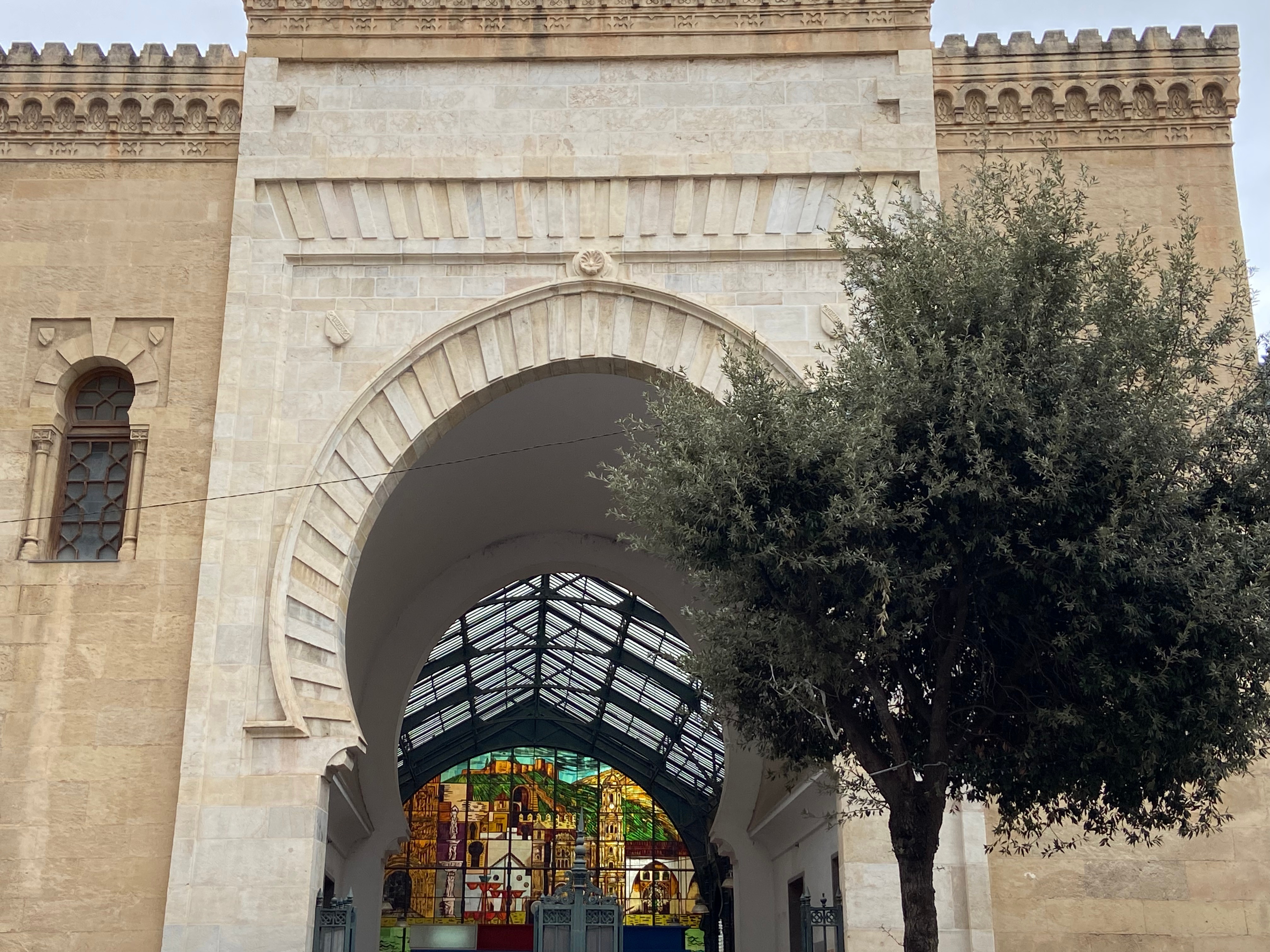
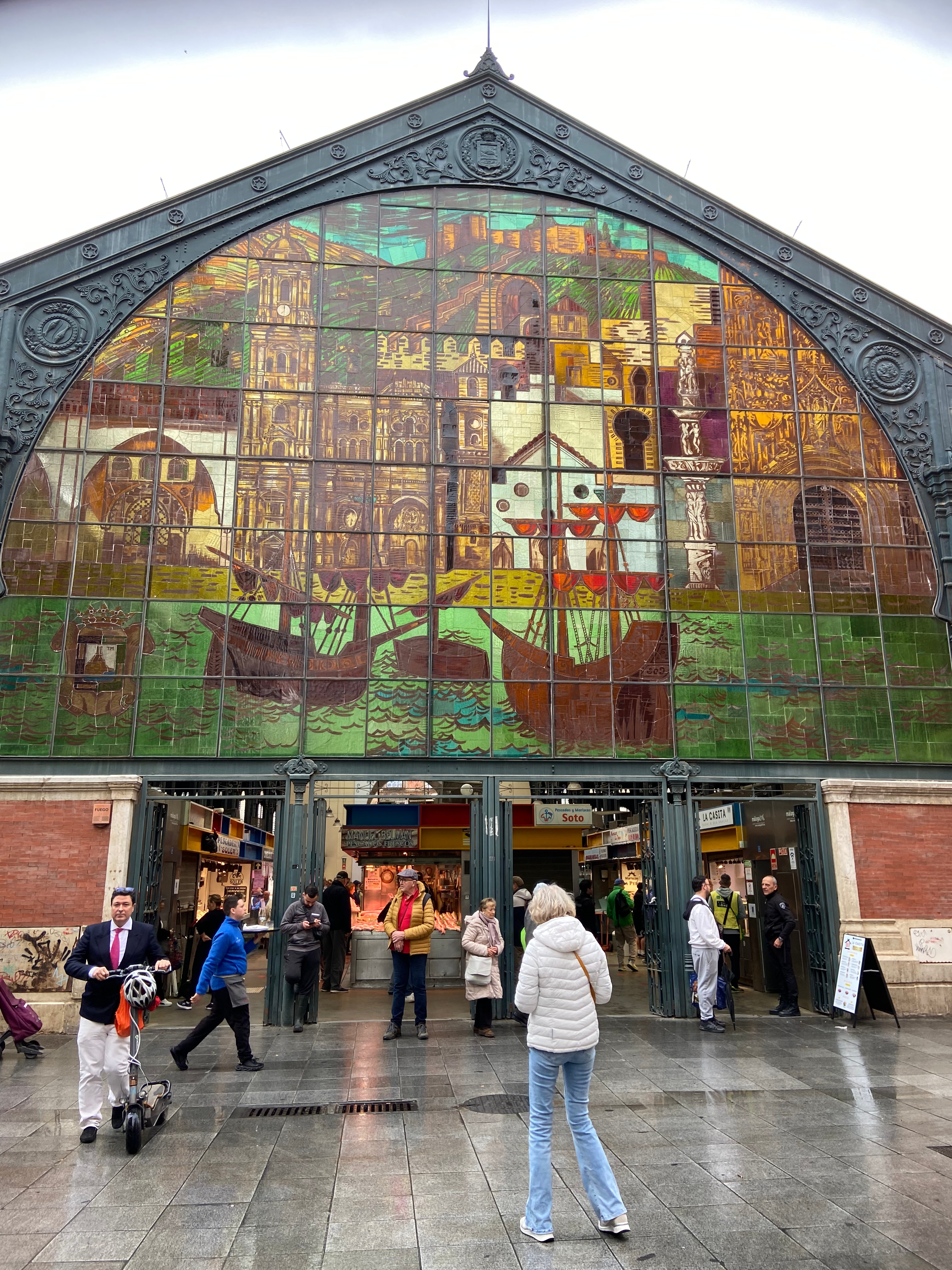
Following Chris and Kat’s recommendation, I headed for the Mercado de Atarazanas. The market was a boatyard during the Islamic period, the Moorish archway at the main entrance still part of the design today, and on the other side an impressive stained glass arched window depicts Malaga’s city scape.  It’s busy, bustling and bursting with fresh produce, tapas and aperitif stalls. I was a bit late but just made it in time to feast on paella for lunch, and to discuss with the stallholders how to get that toasted crusty layer of rice on the bottom and the layering of textures and flavours over that. What a treat!  

And to round off my afternoon, I visited another Chris and Kat recommendation, the Antigua Casa de Guardia, a bodega founded in 1840. Once again it was like going back in time. Lined with oak barrels, you choose which sherry or wine you want, and they chalk up the price on the wooden bar. I chose pajarete, a fortified wine aged for five years. A delicious and sweet note to end my stay in Malaga.

Dresden: Part 3/3 – Final reflections and scorecard: Culture 8/10, Food 5/10, Historical interest 10/10, Livability 7/10

If you’ve slogged through my last two blogs on Dresden, well done!! Apologies if I lost you in all the detail; such was my fascination with its history that I did lots of research on my return to Australia making my blog posts rather information heavy!  “You really have to concentrate,” commented my sister… This final Dresden post is more personal and less driven by facts and figures.

You’ll notice I didn’t mention food in my previous posts. To be honest, neither food nor drink were highlights of my Dresden trip. Not to stereotype German food, but I’m not so into bread, beer and sausage. I was wandering round the various stalls and wooden huts of the Spring Market one evening and felt my stomach turn at the fatty-looking potato cakes and greasy Currywurst bubbling away in a large pot.

And eating out in the Old Town – close to my hotel – was very expensive; I was paying a premium for the location. Interestingly, though, the meals with a view were somewhat marred by surly and, in some cases, outright bossy service; no frills or niceties whatsoever. After my long day visiting Loschwitz, the castles on the Elbe and the Stasi Detention Centre (see blog post 2), I stopped off for dinner in the Neustadt – the ‘new town’ on the opposite bank of the Elbe from the Old Town.

Here the vibe was quite different: trendy, younger, student-y and ethnically diverse as evidenced by the different cuisine offerings – from Turkish, Greek and Middle Eastern to French, Vietnamese and more. And the shops! I window-shopped my way past some of the most fun and original retro, vintage and niche interest shops I’ve seen in a while. Just as well I had zero room in my case, and it was anyway approaching closing time.  

However, my chief mission was to find the Kunsthofpassage (KHP)– a series of funky interlinked courtyards in Görlitzerstrasse that were jazzed up about 20 years ago with art and wall sculptures. The one I loved best was the building with the musical drainpipes set against a turquoise painted façade. I’d love to be there when it rains and the water plays through the trumpet-shaped pipes. The courtyard of the animals is fun too with monkey, giraffe and bird bas-reliefs on a lime green wall.  Elsewhere there’s a floating sculpture made of woody stems and climbing red geraniums set off a blue front door.

Among the KHP’s arty shops, chocolaterie and other offerings I found a restaurant called Lila Sosse (Lilac Sauce) that drew me in with its wooden tables, menu on the blackboard and desserts in glass jars. Away from all the Old Town Baroque bling, the wait staff were friendly and down to earth, and I had the best meal of my stay – an asparagus, beetroot and feta risotto – and at a reasonable price. Still recovering from the Stasi Museum experience earlier in the day, I also treated myself to a stiff vodka and tonic. Chin up and all that.

Keeping on the food theme, I opted for the hotel breakfast the next morning – my last full day in Dresden. The previous mornings I’d gone for the cheapskate option and made tea in my room (I had to request a kettle as there was only a coffee machine) and eaten yoghurt and fruit purchased at REWE. And I am glad I did.

Having looked forward to my 29 Euro breakfast, I was disappointed! I’ve come to the conclusion that buffet breakfasts are not all they are cracked up to be – no egg pun intended! In fact, they are the supermarket of breakfasts: it’s self-service, involves queueing and you have to wander around to find everything you want in a mass-produced environment. You find the fruit but not the yoghurt and granola – they are at a different ‘station’, then you line up at the coffee machine looking for the hot water button to pour onto a tea bag in a cup. And, if you’re like me, you stuff it up and the hot water spills over or, even better, you press the wrong button and get cappuccino on your Earl Grey. But if you do manage a cup of tea, you take it back to the table with your fruit only to realise you forgot the milk. Up you get again and around you go.  

After the fruit and yoghurt, you venture off to the hot food station where eggs and bacon sweat over bain-maries. By the time you get back to the table, the tea is stewed and cold. And then there’s the toast to organise… And that involves waiting for it to cook on one of those cake-walk-type toasters (all the while your hot food is congealing on the plate) that spits out the toast at the end. All far too much juggling and faffing.

However, there were a few silver linings. I stocked up on Sunday papers which I am still reading (the Frankfurter Allgemeiner is quite dense!), I made myself some rolls for lunch, and I got chatting to the (German) couple sitting at the table next door.  We got into conversation because I mistook the guy for a waiter (he was wearing black trousers and a black shirt) and I asked him to bring me a pot of tea. A short but sweet friendship forged over laughter.

My final destination was Pillnitz Castle. You may recall that Andreas from the Antique Shop in Loschwitz recommended that, given my interest in East/West Politics, I should visit a special exhibition about chairs made in the GDR in the 1970s and 1980s.

I got a tram and a bus out to Schloss Pillnitz, which once housed one of August the Strong’s (remember him from the first blog?) mistresses. It has three main buildings, two of them Baroque with Chinoiserie elements and the Neues Palais, in the Neoclassical style.

The furniture exhibition was in the Wasserpalais, the Riverside Palace, and there was something wonderfully mismatched about staging an exhibition about polyurethane chairs in a Baroque castle. The brightly coloured “Känguruh-Stuhl” (Kangaroo chair) and the “Garten-Ei” the Garden Egg chair are thought to be icons of East German design. But it turns out that the East Germans had a bit of help from their frenemies.

Part of a worldwide boom after the second world war, cheap to make and mass-produce, plastics were attractive to the GDR, but production in the East lagged behind the West, where production and innovation were supported by private sector investment.  A bit of a When Harry Met Sally situation, the East wanted what the West had. The exhibition documented the subterfuge and political machinations that lay behind the GDR becoming a major centre for polyurethane plastic (PUR) furniture.

Unbeknown to the citizens of East Germany, their government was involved in clandestine trade with West German companies from whom they purchased know-how, machines, foam moulds and design licenses.  In the 1970/80s more PUR furniture was made in the GDR than anywhere else in the world, and this widescale production was outwardly hailed as a sign of socialist progress. The cross-border skulduggery was well covered up. Fascinating stuff.

Pillnitz is surrounded by lush green parkland – Englisher Garten-style – has a glass house (complete with Australian natives!) an orangery, several pavilions and a camellia tree that is more than 230 years old. Reputedly brought out from London’s Kew Gardens in the 1770s, the tree is protected during the winter months by a movable glass house that sits on rails. The tree is MASSIVE and the hexagonal glass house structure is a stunning piece of modern design.  I was lucky enough to catch the azaleas and rhododendrons in flower and ate my breakfast rolls sitting in the sun on a park bench surrounded by reds, purples and pinks.

One place I hadn’t managed to visit while in Dresden was the nearby town of Meissen, famous – since the 1700s – for the manufacture of porcelain.  Anyone who has visited my house will know I am a seasoned collector of china, particularly cups and saucers. And so it was with FOMO-assuaging delight that I got to see some fine examples of Meissen figurines and tableware wandering through the state rooms of one of the other Pillnitz palace buildings.

On the way back to Dresden I got a ferry over the Elbe, cutting off a corner, and linking to a tram back into the city. The ferryman was a jovial kind of guy with a big smile and twinkle (of the right kind) in his eye. He complemented me on my German detecting only a light English accent – which was flattering, (who doesn’t love a bit of encouragement?!) – and let me cross for free. And into the bargain I got a great view of the riverfront side of Schloss Pillnitz. A good end to a richly varied and fascinating four days.

As a postscript, I play a ‘could I live here?’ game whenever I travel. On the downside, there are still post-war political tensions, and quite a significant neo-Nazi and far right faction in Dresden. The week I was there an SPD politician was attacked and badly injured by a group of men, and shortly before this incident, a member of the Green Party had been attacked putting up posters. Dresden also feels a bit off the beaten track – the kind of place where opinions can harden. However, I reckon I’d enjoy hanging out there for a few months, especially in the summer months doing artsy things and speaking German. When I am less engaged in working for a living, Dresden might be one of my house-sit destinations.

Dresden Part 2 of 3: Suspension Railways, Schlösser, sewing tables, the Stasi and the Soviets

Welcome back to Dresden where I am once again on the trusty Hop Off, Hop On bus, this time heading east from the city and across the cantilever truss bridge, colloquially known as the Blaues Wunder, up to the wealthy residential area of Loschwitz – an area of historic villas and summer residences, many of which escaped the WW2 bombings.

I start by taking the world’s oldest suspension railway (Schwebebahn) up the mountain. At this point, full declaration on suspension railways… My first visit to Germany was aged 15 when I stayed with my school friend Monica and her grandparents in Wuppertal. Quite young for our age and prone to giggling fits, we loved being with Opa and Oma, even if they did stuff us full of food – Kaffee und Kuchen every afternoon without fail! Travelling on Wuppertal’s Schwebebahn was all part of the adventure, and we loved it. Unlike the Loschwitz funicular (see below), the monorail in Wuppertal is not just a tourist attraction but part of the transport network. It literally hangs off the rails rather than sits on them, and is a great way of travelling around, lending a bird’s eye view of the city. Interestingly, the Loschwitz funicular and Wuppertal’s monorail were designed by the same engineer in 1901.  From the machine room at the top, there are stunning views over Loschwitz, the Elbe and beyond. Dresden is a city packed with panoramic viewing points.

Back on the ground in Loschwitz I had lunch at Kaffee Wippler, a café with an art deco vibe and an enticing selection of cakes – after a slightly strange Greek-style salad heaped with spelt grains (I was expecting croutons), I chose a Florentine biscuit to go with my – you guessed it – English breakfast tea! Then I wandered round enjoying the ‘olde worlde’ feel of the place: the cobbled streets and half-timbered houses; a delightful bookshop covered with ivy and vines; a knitter’s delight wool shop; an attractive yellow painted house, the final resting place of Clara Schumann’s father; an art gallery and a fabulous antique shop. Admiring a beautiful walnut sewing table in the antique shop, I got chatting to the owner and his mate, Andreas, from the Blaue Brücke Gallery round the corner. That lead on to an interesting chat about all sorts including life in the GDR.  They recommended an exhibition on polyurethane chairs at Schloss Pilnitz given my interest in East/West Politics.  See blog post 3/3!

Keen to walk in the glorious spring sunshine, I followed Andreas’ directions and branched off from the road along a steep cobbled walkway past expensive-looking villas – from Swiss Chalet-style to classical and Art Nouveau – and yet more marvellous views over the Elbe. Then I rejoined the bus for one stop and got out at the Elbschösser – the three castles overlooking the Elbe (Schloss Albrechtsberg, Lingnerschloss and Schloss Eckberg). These three castles were all built in the mid-19th century and are surrounded by rolling English-style (Englischer Garten) parkland and meadows dotted with wildflowers.

At Lingnerschloss there’s a large open-air café on the terrace overlooking the vine-clad slopes – Loschwitz has been a wine-producing area since the 11th century – and it was here I succumbed to a major attack of FOMO. Tramping around a city is tiring and part of me wanted to chill out and kick back with a cuppa or something stronger. The other part argued that I had to make the most of my time in Dresden. It was now 3.30pm, the Stasi Museum was open till 6pm, and it was on my way back into Dresden.  Having read Anna Funder’s Stasiland and seen films such as The Lives of Others, Goodbye Lenin and Balloon, my curiosity won out. I had a quick drink of water and pressed on.

The Bautzner Strasse Memorial is a former Stasi remand centre and, prior to that, a Soviet prison housed in a grey/beige-coloured apartment block. The memorial commemorates those who were victims of political persecution during the post-war Soviet occupation and then under the GDR.

The man at the desk was somewhat unhelpful when I asked how long I needed to go round and if I had time to listen to the 55-minute audio – “that all depends,” he said, shrugging, “who knows?” He handed me a map and gave muddled instructions – the museum is across a number of floors and parts of it were shut off for renovation.

It seemed entirely fitting that I should feel confused as I navigated the maze-like corridors. What a discombobulating experience it must have been for those detained by the Stasi. New arrivals to Bautzner Strasse were blindfolded until they had been processed, their families were not informed of the crimes they had supposedly committed and all detainees were identified by a number rather than a name. Not even the guards knew what the detainees had been accused of.

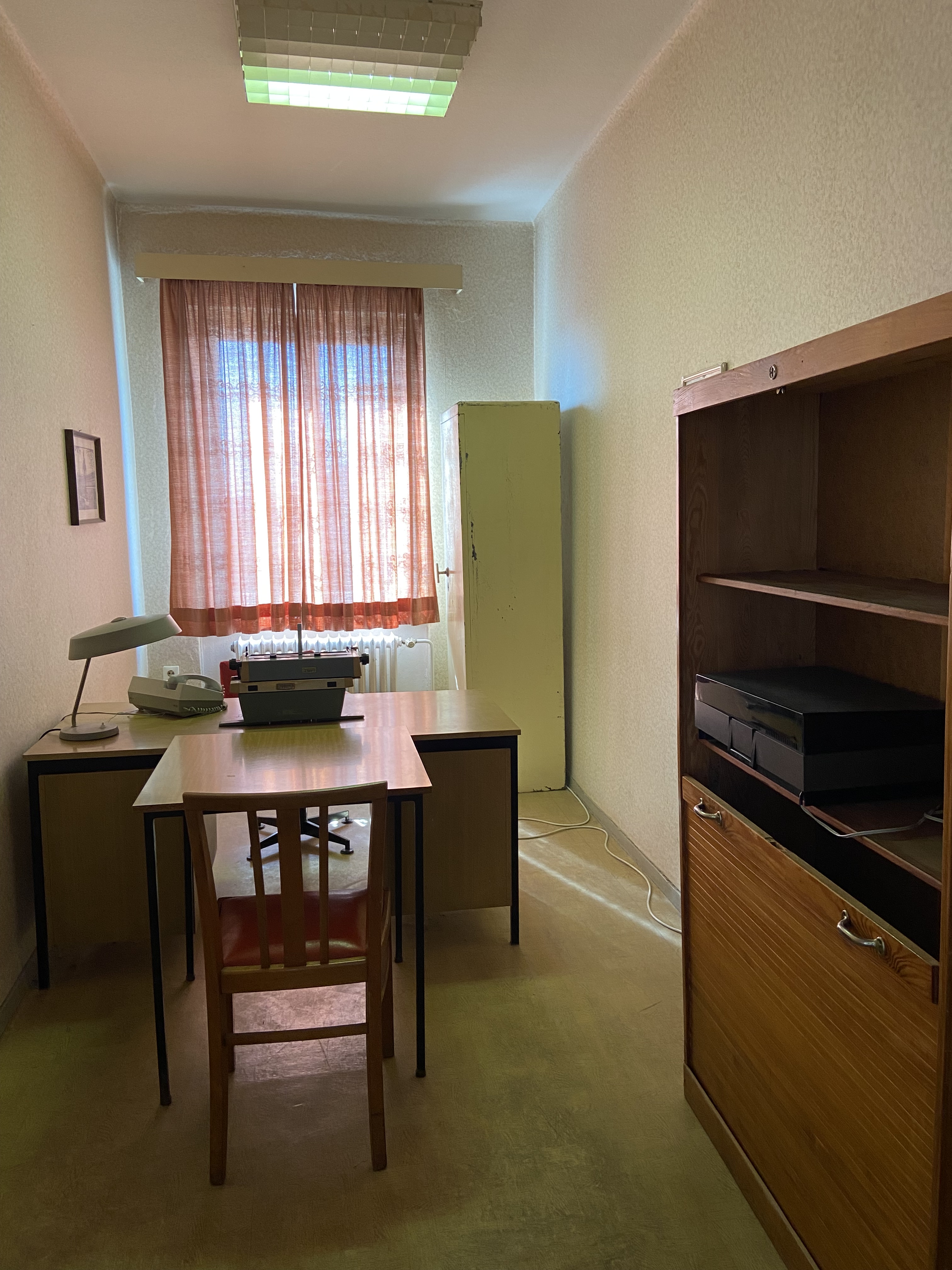
The interrogation room remains untouched and, according to the caption on a somewhat dog-eared piece of A-4 paper, was where the Stasi carried out psychological torture. For example, if a detainee didn’t cooperate, they were threatened that their partners, families and children could come to harm or that their children might be taken into care. Then there’s the small stark cells including a writing cell (any letters written under close supervision and heavy censorship), the room where mug shots were taken, a van that was used to transport prisoners with uncomfortably small compartments (mini cells), and the intact cell block on four floors – you can almost hear the clank of the keys and hear the footsteps of the guards doing their rounds. Testimonies from former inmates talk about the guards looking through the spy hole every few minutes.

And then, even more disturbing, a damp dark tunnel with peeling paint leads to the post-war Soviet prison where Nazi sympathisers, political prisoners and those arrested on the flimsiest of charges were held in appalling conditions, in cold and cramped cells, the next stop being the Gulag.

Back on the street there’s a memorial to Alexei Navalny which I found particularly poignant, not least because a couple of streets further on is the site of Dresden’s former KGB Headquarters, No. 4 Angelikastrasse, where Putin worked as the local chief between 1985 and 1990.

Exhausted on all levels and in need of a bit of light relief, I was back on the bus in time to pop into Pfunds Molkerei, celebrated by the Guinness Book of Records as the ‘world’s most beautiful milk shop’. In business since 1880, Pfunds Molkerei featured as the bakery in the film, Grand Budapest Hotel. And it’s not hard to see why: floor to ceiling Villeroy and Boch tiles decorated with winged cherubs, naked cherubs, garlands of flowers and pastoral scenes (think cows and more cows!) provide the backdrop to the selection of cheeses, buttermilks (some with liqueur), sweets and chocolates as well as Dresden’s signature cake Eierscheke.  Short of time – it was about to close – I had a refreshing swig of buttermilk and bought some chocolates and nougat for friends. Then it was onto the New Town for dinner.

In Part III – coming soon – if you’ve stayed the course… – I spend an evening exploring the Neustadt, the new town – which is more boho than baroque. I also head off to Schloss Pilnitz, stroll the grounds, gawp at a 250-year-old camellia and visit two radically different exhibitions – one royal and traditional and the other about polyurethane chairs manufactured during the time of the GDR. (recommended by my antique shop friends).

Delightful Dresden: Florence on the Elbe (Part 1 of 3)

Dresden had been on my Bucket List for a while – I’d read good things about it. But I also wanted to go somewhere I could practise my German with the added interest of heading to a city that was part of the German Democratic Republic (GDR) – and behind the ‘Iron Curtain’ for 41 years. I found it fascinating on many levels – lots to interest me – so much so that this is the first of three blog posts on Dresden.

My hotel was right in the centre of the Altstadt, the old town, which made navigation very easy. Feeling somewhat under the weather on day one, I opted for the Hop On, Hop off Bus. And what a good choice that was. Purchasing a 20 Euro ticket at the hotel gave me three days of unlimited travel. I understood most of the German commentary but the bus rattles, rocks and rolls along so it was hard to hear it all. But if there’s only one thing you take away from Dresden it’s that Augustus der Starke, Augustus the Strong, Elector of Saxony and Poland (1670-1733), made a huge contribution to the cultural, artistic and scientific landscape of the place. In fact, I was first introduced to him in the taxi on the way from the airport as we drove past a gleaming gold statue of him atop a horse in full body armour.

He might have been the Donald Trump of his day – he certainly liked surrounding himself with power, riches, wealth and women. Indeed, he was rumoured to have up to 365 illegitimate children.  But I was more interested in his cultural legacy.  It was short walk from my hotel to the Historisches Grünes Gewölbe (Historic Green Vault), which he built to store some of the many treasures he collected.

Dresden, particularly the old town, was very heavily bombed by the British in the Second World War. Amazingly however, the Grünes Gewölbe, remained mostly intact with only three rooms going up in flames.  Treasures from the vault – and many of the city’s precious objects and art collections – were removed to castles and fortresses outside the city during the war. And I learned that many valuable items were taken by the Soviets as booty after the war but were returned in the 1950s.

Entry to the Green Vault is by timed ticket, and only two people can enter and exit at a time through double-layered automated glass doors. And, needless to say, no phones or photographs are allowed. The tight security is not surprising; in 2019 thieves broke into the vault and stole precious items from the Jewel Room – some of which were recovered but not all.

The eight rooms of the Green Vault all have a different theme such as the Amber Room, The Ivory Room, the Silver Gilt Room etc. Building to a crescendo of Baroque opulence, each room has more mirrors than the previous one – there’s almost too much splendour, detail and intricate craftsmanship to take in! Variously crafted from amber, mother-of-pearl, coconuts, ostrich eggs, enamel, gemstones, gold, brass, silver, jade and more there were drinking vessels, carved figurines, clocks, sculptures, animals, birds, swords, platters and decorative boxes. And in the Jewel Room, rows of rings with knuckleduster-size gemstones – diamonds, rubies and sapphires as well as shoe buckles, swords, hat pins and a breast star of the Polish Order of the White Eagle.

Much of the Altstadt has been rebuilt and restored to its former Baroque glory since the fall of the wall in 1989. There is still building work going on at the Zwinger Palace which was never designed as a dwelling but as an orangery and a setting for court festivities and celebrations.

Just across from the Zwinger is the Semper Oper (opera), which was rebuilt earlier, in the ‘80s, and reopened in 1985. Although it was advertised as sold out, I managed to get a return ticket and attended a matinee performance of the Magic Flute, Mozart’s only opera written and sung in German. Included in my all-time operatic favourites are the arias by Papageno and the Queen of the Night so it was a magical afternoon.

A few days later I tagged onto a Night Watchman tour, and discovered there is an Opera Ball every January for the rich and famous. A glitzy ritzy event, previous guests include Vladimir Putin, who lived in Dresden for five years. I wonder if Trump ever attended or was on the guest list?

Augustus was also behind the construction of the Frauenkirche in the mid-1700s. After the war in 1945, the church remained a pile of blackened rubble and melted iron for 60 years. Archive photos from 1957 show sheep grazing around the ruins.  Then in the ‘90s, driven by the citizens of Dresden and funded by donations from all over the world, the reconstruction started. An extraordinary feat of engineering, each brick was catalogued and mapped and 40 per cent of the original materials were used. And, in a symbol of reconciliation between the UK and Germany, the orb and cross on top of the church were constructed by a team of British craftsmen including a London-based silversmith whose father was a pilot during the bombings over Dresden.  And, lest we forget, the cast-iron cross that originally crowned the dome is now displayed – molten and warped – inside the church. 

Climbing up to the dome was a good work-out, and I was rewarded with magnificent views over Dresden and the River Elbe, over spires and domes to the hills in the distance. You can see why Dresden used to be called the Florence of the Elbe.

But Dresden is not all columns, cupolas, crowns, carvings, chariots, cherubs and classical statues with fig leaves in strategic spots. It also has a history as an industrial centre – back in Augustus’ time Dresden’s wealth came from mining ore, silver and other metals from the Erzgebirge Mountains. Pre-war industries included car manufacture, medical equipment, optics and cigarettes.  Another stop on the bus tour is the eye-catching Yenidze Tobacco Factory, one of the few Altstadt buildings to survive the war. Now used as offices, the factory was built in 1909 in the style of a mosque, the minaret serving as the factory chimney, referencing the origins of the Turkish tobacco processed there. It was also a clever ruse by the architect to get round planning restrictions. I was tempted to go to the panoramic roof-top restaurant one night during my stay but didn’t get to it – next time!

Cars, optics and cigarettes (so many people smoke in Germany!) still feature today as well as IT, electronics and micro-chip manufacture.  It’s well worth taking a look at the state-of-the-art Gläserne Fabrik, the ‘transparent’ factory, home of the Volkswagen ID. ID standing for: “intelligent design, identity, and visionary technologies”. My timings didn’t work in with a tour but stepping into the glass atrium you can see the latest e-cars on display as well as cars moving along a self-driven assembly line. It’s all highly automated and futuristic, and the carbon-neutral building, which cost 86m Euros to build, is certainly impressive with its 27,500 square metres of glass.

Not everyone is a fan of the reconstructed Baroque city centre.  Some of those who grew up with a different cityscape – these ‘old new’ buildings including some with historically remodelled facades weren’t, of course, there in the 1980s – find the new Dresden homogenous and somewhat fake. And, there’s still some lingering Ostalgie (Nostalgia for the East) across the former GDR. But Dresden’s socialist past has not been completely erased. There are still some remaining Plattenbauen, prefabricated  blocks of flats,  that were common to much of the former East Germany.  And, in stark contrast to all the Baroque bling, stands the Kulturpalast (Cultural Palace) in the Altmarkt (Old Market Square ), a modernist building in the International Style which opened in 1969, and was used for concerts, dances and other events.

Kulturpalast

After heated debate, the people of Dresden voted not to demolish the Cultural Palace and deny their history but to keep a key building from the GDR period. The newly refurbished building, now protected by a preservation order, includes a concert hall, home to the Dresden Philharmonic, a library and a cabaret theatre, and was reopened in 2017.  You can’t fail to miss the large mural on the west side of the building titled Der Weg der roten Fahne (the Way of the Red Flag) with its socialist narrative. Quite a different story from that of the Electors and Kings of Saxony as shown in the pictures below.

In part 2 I will take you up to the wealthy suburb of Loschwitz, to the Elbschlösser, the castles along the Elbe, and to a stunning cheese/dairy shop dating back to the 1880s, which was voted the world’s “Most Beautiful Milk Shop,” by the Guinness Book of World Records. I also visit a former Soviet prison and Stasi remand centre.

Steeped in history: from Malta to Queen Mary’s Mansion in Yorkshire

When I studied history at school it was often delivered parrot fashion – reciting dates, battles, Kings and Queens – or from musty-smelling books wrapped in brown paper. There were occasional highlights such as making a book about the Romans and their customs (I still have my little cardboard effort somewhere) but, on the whole, it was one-dimensional and flat. But now I can’t get enough of it. Piecing together, and making sense of, the present through studying who and what went before is endlessly fascinating.

Visiting the island of Malta in November I was captivated by a timeline in the museum of archaeology in the capital, Valletta. That morning I had visited a 6000-year-old underground burial chamber at the Hal Saflieni Hypogeum. Only discovered by chance in 1902 by construction workers, scientists estimate that more than 6000 people were buried here. And, to put it in perspective, the tombs pre-date Stonehenge, the Acropolis and the Colosseum.

For three days I became a timeline obsessive, immersed in the multi-layered history of this rocky Mediterranean island, each of the many occupiers leaving their mark on the culture, language and architecture from the Romans to the Carthaginians, the Arabs, Italians, Sicilians, the Knights of St John, who arrived from Rhodes in 1530, the French (during the Napoleonic occupation) and, of course, the British. It was a British colony from 1814 to 1964, and served as a strategic military base in the Second World War.

Malta was love at first sight for me. As  the taxi from the airport negotiated Valletta’s labyrinth of narrow streets near my hotel, I was enchanted by the painted wooden box-frame balconies, like mini greenhouses, on the sides of buildings, the retro shopfronts, the many churches, statues of saints seemingly on every street corner and the plethora of plaster saints adorning doors along with brass door knockers designed variously as dolphins, lions, mythical figures or in the shape of the Maltese Cross.

One of my favourite places was the Casa Rocca Piccola, a privately owned palace that has been in the de Piro family for nine generations. Full of treasures including an 18th Century sedan chair, a Venetian glass chandelier, a cabinet of fans, a  private chapel,  a portable chapel (the kind the aristocracy took to their summer residences), silverware,  several Maltese clocks – these were only owned by the aristocracy who had staff to wind them several times a day –  and the ‘summer’ dining room laid up for a banquet with fine lacework mats, silverware, candelabras and cut glass.

From there it was an orgy of Baroque gold at St John’s Co-Cathedral with its frescoed barrel vault ceiling and marble tombs underfoot, each one commemorating a Knight of the Order.  I got a bit bogged with the audio guide meaning I took too long working out which side chapel was which. By the time I got to the Oratory with the two Caravaggio paintings it was closing time. No sympathy from the guard who suggested I took photos of the paintings with my phone, presumably so I could enjoy them over my dinner for one later! Damn!

In Mdina, once the capital of Malta, and derived from the Arabic word Medina, I skipped the Cathedral – no more audio guides – and instead sat for ten minutes in the Carmelite church admiring the stained-glass windows and relaxing into the pealing of the midday bells. Then, by chance, I discovered Palazzo Falson, a private museum housing the collection of Frederick Golcher OBE (1889-1962), a philanthropist, artist and researcher of Swedish descent, educated in Britain. I marvelled at the collection of Bohemian glass including a double-ended Victorian scent bottle (perfume one end and smelling salts the other), the snuff boxes, fob watches, model ships, Dutch still life paintings, table top cabinets inlaid with marquetry, and closer to home in the UK, Staffordshire figures.

One room at the Palazzo Falson was given over to weapons and armour, but nothing compares to the Palace Armoury in Valletta which ranks among the world’s greatest arms collections, and spans the reign of the Knights from the 15th Century till the arrival of Napoleon in 1798. Fashions changed, and as designs got more sophisticated suits of armour allowed for greater movement. Actual armour and weapons used in the Great Siege (against the Turks) in 1565 sit alongside shields, swords and muskets captured from the Ottomans. Fascinating stuff.

Every time I return to Britain, I wallow in history and often visit a castle or historic building – it’s kind of de rigueur! This time, I got to stay in a Grade II early 17th Century stately home in Yorkshire. Goldsborough Hall gets a mention in the recent Downton Abbey film; HRH Princess Mary, the Queen’s cousin, lived here in the 1920s.  I was there for the wedding of my niece Anna to Simon. The service was in the delightful adjoining church of St Mary the Virgin, where, regal, relaxed and radiant, my niece swept in to Pachelbel’s Canon in D Major.

From there – dodging the rain – it was back to the hall for drinks in the Library complete with oak panelling, stag heads, Chesterfield sofas and copies of Country Life dotted around. After much feasting, drinking, dancing and merrymaking, we ascended the oak staircase framed by stained glass windows to our various rooms. My bedroom was named The Duke of York, thankfully not after the current Duke of York, he of Pizza Express in Woking notoriety, but after Albert (aka Bertie), second son of George V, who later became George V1, the king with the stammer featured in the film The King’s Speech. Luckily my brother, Charlie, had no such problems and delivered a masterfully crafted Father of the Bride speech; clever, moving and funny.

The next morning it was wonderful to wake up to views over parklands and grounds laid out in the style of Capability Brown during the 1750s.  A right royal occasion indeed, and suitably historic on all levels.

London: Hamming it up in…Ham

My ankle now healing I am now more mobile if not entirely comfortable, and more or less beyond the RICE (Rest, Ice, Compress and Elevate) period – at least the ICE bit, not that I could follow that neat little anagram on my travels in France; I’d have needed a lackey to fetch me cold packs or to carry me around in a sedan chair!

So it made me smile when I met up with my oldest and dearest friend Monica last week and saw she was also sporting a bandage around her ankle. She has a bit of a history with ankles – I once pushed her around the Royal Academy in a wheelchair – and this time she’s broken a bone and so her foot is (as one of my nieces would say) well puffy. Puts mine in the shade in fact. Suffice it to say, however, that we were as one moving at the same non-brisk pace, every now and then having a stork-like rest on one foot.

We started our day out at Petersham Nurseries near Richmond in London, an upmarket (shorthand for pricey), artsy, vintage-y nursery surrounded by grassy meadows along the Thames. We had lots to talk about over our artisan tea in the café, the walls framed by cascades of fuchsia-coloured bougainvillea in full bloom.

From there it was a short hop to Ham House, a Jacobean mansion gifted to courtier William Murray by Charles I. Educated with the King, Murray was a ‘whipping boy’ and took the lashings for any of the king’s behavioural transgressions – it was meant to serve by example. Talk about a scapegoat. The least the King could do, later in life, was to make Murray one of the Gentlemen of the Bedchamber and reward him with a sumptuous mansion!

Before visiting the house, we had lunch in the Orangery café situated in the walled kitchen garden, a riot of colour and lushness with purple lavender borders contrasting with the orange nasturtiums and yellow sunflowers. Ham House was considered one of the grandest in Stuart England, and is now hailed as ‘the most complete survival of 17th century fashion and power’. Not only that, it’s reputed to be one of the most haunted too. I was disappointed not to see an aristocratic spectre or even an ectoplasmic footman!

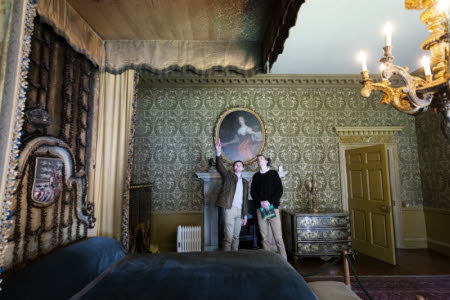
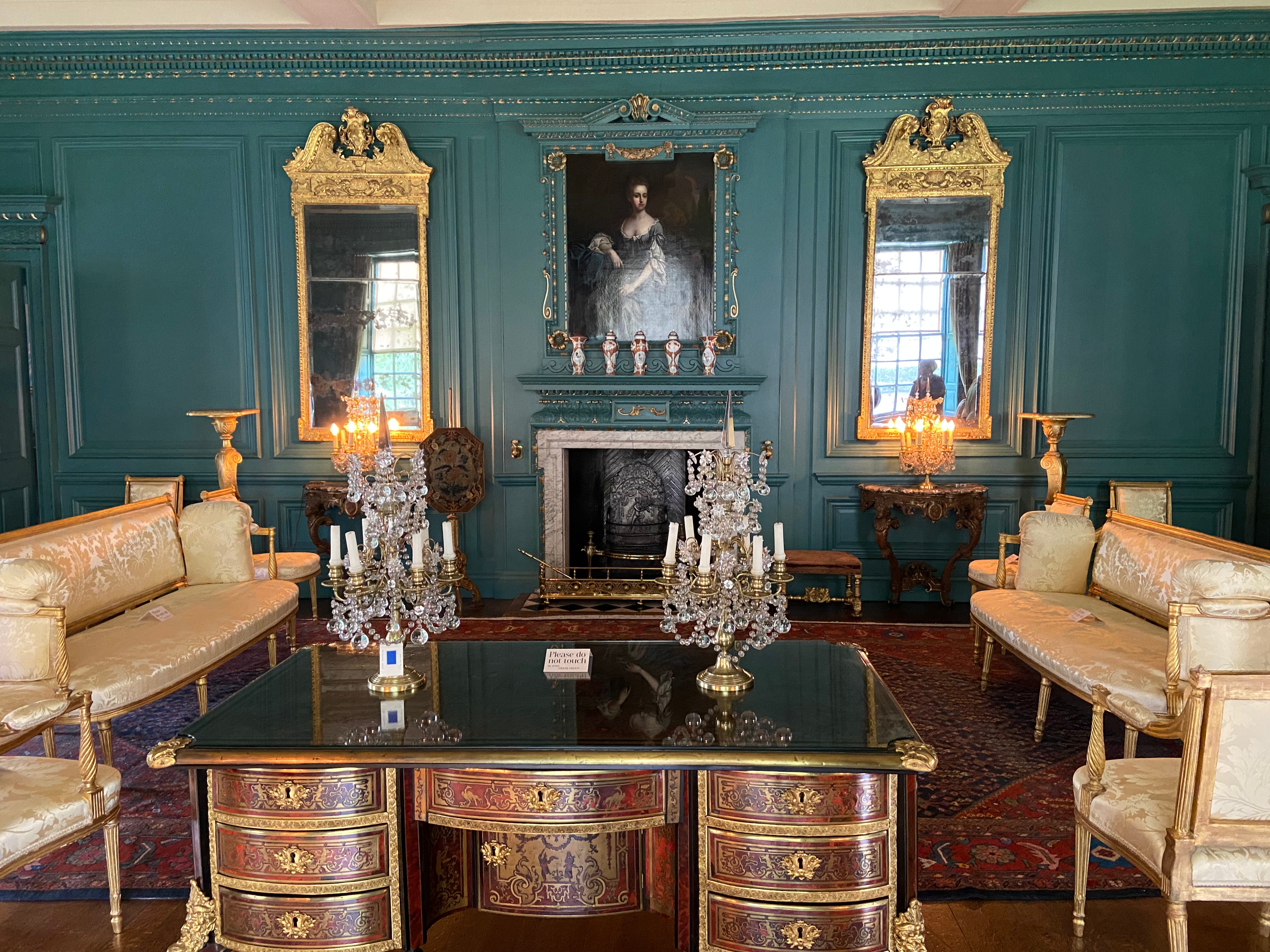
Ascending the intricately carved wooden staircase you come to a series of rooms including the Long Gallery lined with aristocratic portraits including one by Van Dyck of Charles I, a library with a screen made of a double-sided map dated 1743 in which Australia and New Zealand are drawn as one landmass, and my favourite, The Green Cabinet Room, with walls covered in green damask and hung with small paintings and miniatures, one of Elizabeth I dated 1590. Another portrait of note was of Erasmus (school of Holbein) with an intricate frame carved by Grinling Gibbons.

Monica and her husband Jonathan (we met at university) live nearby, and to my delight, Jonathan joined us unexpectedly. By 3.30 pm a volunteer guide started to close the blinds and to shut up the house to protect the paintings – interestingly, the Green Chamber was designed with a curtain rail and protective silk curtains, now restored by the National Trust. Like kids running away from the Bogey Man, we rushed to stay one step ahead.  That was all we needed to revert to our long-standing default of hamming it up – silly faces, voices and giggling – as we sped-read the information cards in each room, here a Japanese lacquer cabinet, there an exquisite monogrammed parquetry floor, here a leather stamped wall, there a bedchamber decorated in honour of Charles I’s wife, Catherine of Braganza. By the time we got below stairs to the servants’ quarters – complete with the Duchess’s bathing room with its round wooden bathtub – we were off the hook. Phew. That’s what I love about old friends; you simply pick up where you left off.

Our final stop was The Still, perfumed with dried lavender and other herbs, the shelves lined with ointments for gout containing pig fat and a bottle of dew harvested in spring this year. In bygone eras, May dew was considered a cure-all and beauty treatment for women, and for men, washing their hands in dew was said to strengthen their skills in knots, locks and net-mending.

I looked up the origin of the word hamming it up as I thought it might be Shakespearean but my research indicates that it means “overacting inferior performer,” dates from America, circa 1882,  and refers to ham fat used to remove stage make-up. Who knew!

But I did get a double Shakespeare fix, once in the British Library, repository of the Shakespeare’s First Folio dated 1623, and then at an open- air production of Midsummer Night’s Dream in Regents Park with my sister and brother-in-law. Booking an al fresco event in England is always a gamble but we hit the heatwave week, perfect for a sumptuous picnic accompanied by a fine English rosé wine, and then watching the play with the setting sun as a backdrop. What a treat to see mischievous Puck, Titania in her fairy bower and the elves on a stage fringed with reeds and surrounded by oak trees. And one of my favourite lines spoken by Helen to Demetrius (who scorns her): “And even for that do I love you the more. I am your spaniel.” Seems spaniels have a long history of being faithful and adoring!

Today my niece and I are off to see a wartime comedy by Terrence Rattigan at Richmond’s Orange Theatre, a theatre in the round. Heatwave permitting, we also plan to do a guided tour of Sandycombe Lodge, one of the houses designed and built by J. M.W. Turner in Twickenham, amid the Thames-side landscape that inspired him.  My long-cherished plan of making the most of my self-awarded time-out in the European summer is going to plan!

Adventures of a solo traveller: crossing Paris on one foot

I’m 50-something and have never been in ambulance – until last week that is.  And while I was no flashing light casualty – thank Goodness – it was a new adventure.  After five blissful days of reading, swimming and walking (oh yes, and eating very well) with my brother and his wife in Provence, I was on day two of a side trip to Avignon. And, for once, I hadn’t planned anything in advance but knew I wanted to make the most of the Festival.  The Avignon Festival is a huge two-week theatre festival originally founded in 1947. Running alongside the official ‘In’ Festival is the ‘Off’ Festival, offering hundreds of shows across theatre, dance, visual arts and music in multiple venues across the city.

Palais des Papes, Avignon

I was coming out of a performance of Molière’s L’Ecole des Femmes – in French no less – when I tripped on a step, caught my foot and wrenched my ankle back. Who knew it could be so excruciatingly painful, making me nauseous and dizzy? I tried not to f ‘n’ blind too loudly as I drew quite a crowd and the Red Cross volunteers came zipping over on their bikes.

Tearing those ligaments was more painful than breaking my wrist so I was very happy to discover that I hadn’t broken any bones when I was X-rayed in hospital. And on the plus side I’d basically got a free bone density test. Having spent all night in the Emergency Department of a French hospital with a family member last year, I knew what to expect: a long wait, some interesting characters – this time a woman delivering a three-hour monologue – and staff stretched to the limit. I felt hugely grateful to be otherwise well and able-bodied and not stuck in hospital in a war zone. And my sympathies were with the staff who were wearing T-shirts advertising they were on strike, no doubt for much-needed improved pay and conditions.

I was hungry when I got back in the taxi at 9.30 p.m. that night – lunch had been a bit of fruit and a biscuit on the run after doing a tour of the Palais des Papes.  One drawback to my Airbnb accommodation, just outside the city walls, was that it didn’t have a kitchen and was not well served by cafés and shops. I limped along until I found a shop with inviting pictures of avocados and tomatoes in the window, but when I got inside there were only dried goods, carbonated drinks, laundry powder, toiletries and ice creams. Channelling my inner Girl Scout, I bought a tin of tuna and four ice lollies in lieu of a bag of frozen peas to ice my ankle. It had to be that or the chicken nuggets. The only thing about ice lollies is that they melt quite quickly especially when stuck down one’s sock. Never mind, I put the remaining two in the mini bar fridge for the morning.

I lay awake with a throbbing foot that first night worrying how I would manage the train journey – in 31 hours’ time – from Avignon to Paris and Paris to London, what with my luggage, the long platforms and crossing Paris. I decided to start the day by icing my foot only to find the ice lollies had dissolved to a sticky orange puddle in the very un-cold fridge. Do minibar fridges ever work?!

Getting to the pharmacy was a bit laboured – while it seemed miles with a swollen and bruised foot, it wasn’t far enough to warrant a taxi or Uber. I stocked with an ankle support, arnica pills, painkillers and une canne anglaise (how interesting that crutches are called English canes!), the idea being that, when travelling, I could use one crutch to take the weight off my bad foot leaving one hand free to wheel my case. At least that’s what the travel insurance suggested when I had called at 3 a.m. to register my claim.

Then rather than sit in my room and fuss and fret, I asked my Airbnb host to give me a lift to the busy Place des Corps Saints as it would give me a choice of cafes and three theatres. And what a perfect place to hang out! Buzzing with life, people and performers plugging their shows either with flyers or bursts of song, trumpet notes, dances or outrageous costumes, it was one long spectacle. I treated myself to a hearty lunch (the highlight being the lavender-infused goats cheese panna cotta) in one café and then moved to a 1950s style bar for a cup of tea. That afternoon I went to see (foot conveniently propped up) an hour-long Offenbach ‘opera bouffe’– the Ile de Tulipan – a one-act comic operetta with some great duets that explores idea of gender, gender muddles and even the idea of same sex marriage. After a spell in another café, a pack of ice on my foot, I managed to get myself to one more show right around the corner from my accommodation. Il Nouvo Barbiere was full of farce, acrobatics and fun performed by some zany Italians – set, as the name suggests, in a barber shop. Perfect.

I didn’t manage to pre-book assisted travel for my return journey to London but, channelling my friend and erstwhile colleague Heather Ellis (see previous blog: https://wp.me/p3IScw-t0) who travelled solo by motorbike across Africa and the Silk Road, I decided to trust it would all work out, canne anglaise at the ready. And sure enough, the girl next to me on the platform in Avignon had only a small rucksack and offered to help with my case all the way through Paris and to Eurostar as she was also travelling through to the Gare du Nord.  What an angel. I was exhausted and sore on arrival in London but happy to have arrived back in one piece ready for a big family reunion weekend.  Avignon had worked out­ just a bit differently than envisaged: I’d seen some of the sites, had some interesting chats, seen five shows – each one un bon spectacle indeed – and had a free ride to hospital.