It was Michael Portillo, he of the brightly coloured jackets and train journeys, who inspired me to choose Malaga as my stop-off place on the way to the UK. There’s a lot more to Malaga than being a gateway to the Costa del Sol.
Another reason I chose Malaga is that it’s very walkable, its compact city centre perfect for meandering, mooching about and soaking up the vibe. In the past I’ve tended to cram too much into my European trips – partly because living on the other side of the world engenders terrible FOMO.
I stayed in a small Airbnb studio in a quiet residential area about ten minutes’ walk from the city centre. It was nothing fancy, but I felt completely at home and enjoyed watching the comings and goings in the street below from my narrow window balcony.

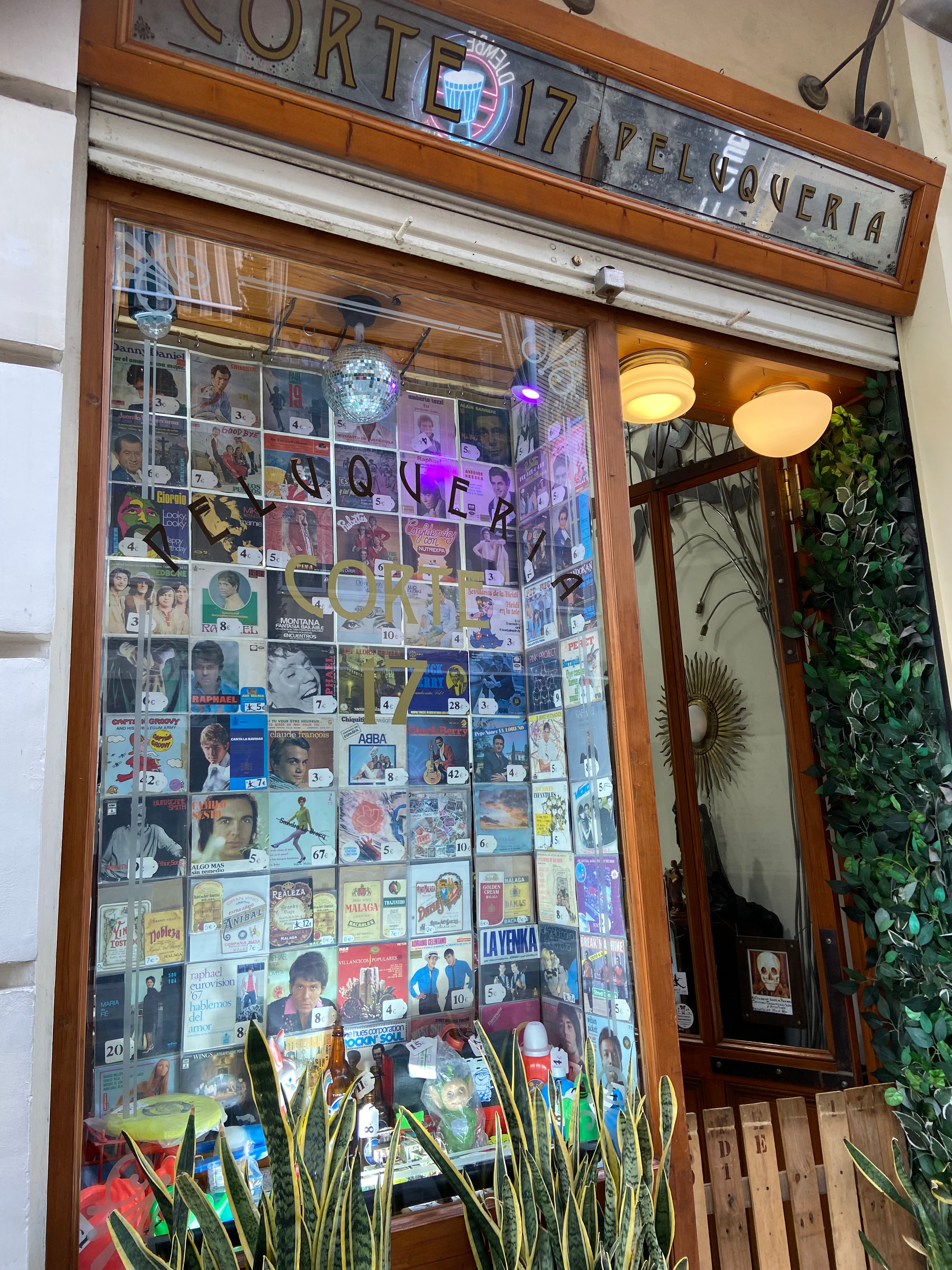
Walking to and from the centre I tapped into timelessness again (see Rediscovering Spain Part 1) noticing something new every time – a few hole-in-the-wall shops, seemingly unchanged over decades, selling salami, processed cheese, tulipán margarine (Spain’s version of Flora), bottled water, olive oil and packets of this and that. I spotted lots of traditional barber shops, one with a window artfully decorated with 45 vinyl record sleeves. Then there were the glass-fronted balconies, the lantern-style streetlamps and decorative tiles on house fronts depicting religious scenes (lots of those) or various trades or symbols related to the original homeowners. And crowded tapas bars at lunchtime, the scruffier, the more authentic.


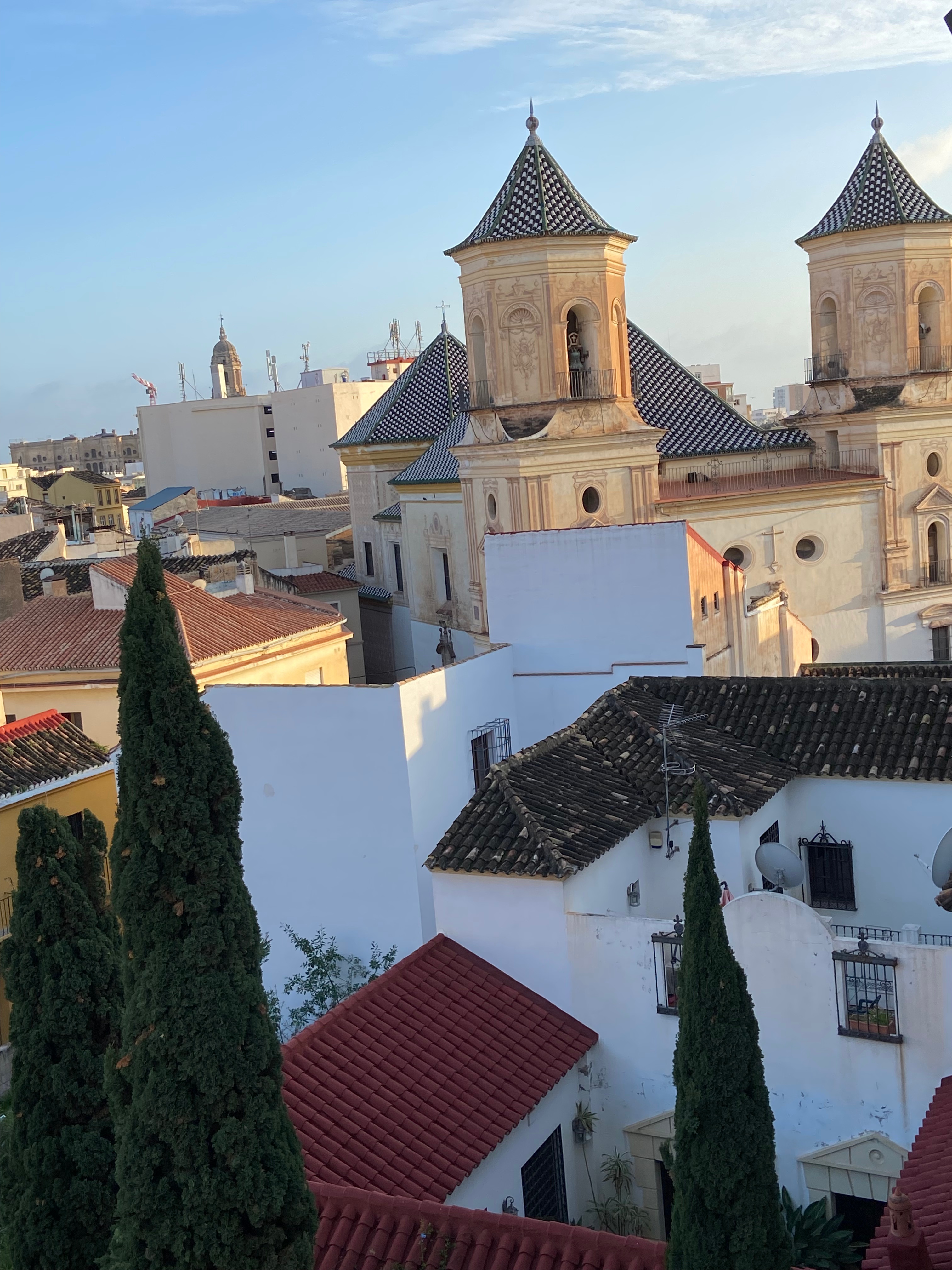
From the roof terrace of my Airbnb, I looked over to the church of San Felipe Neri, a baroque church with distinctive green and white tiles on the bell towers. Listening to the bells ring out several times a day, a pure and undiluted sound, I felt a great sense of serenity and groundedness. I’ve always loved church bells. Although I didn’t do a tour of Malaga Cathedral, I did go into another church, Santo Cristo de La Salud, in the centre. Drawn in by its terracotta exterior and circular stained-glass window, I went and in sat for a few minutes looking up at the domed ceiling, feeling into the sanctity, time stopping still.


Thwarted in my attempt to visit the Picasso Museum (sold out even in low season!) on day one, I joined a tour of the Moorish fortress, The Alcazaba. I am somewhat spoilt having lived and studied for nearly five months in Granada in the ‘80s with the Alhambra Palace and the Generalife Gardens a half-hour climb up the hill from where I was living. Given today’s mass and over-tourism issues, I realise how extraordinarily lucky I was to have had unfettered access to a UNESCO World Heritage site, and one of the most magnificent examples of Islamic art in Spain.
Like the Alhambra, the Alcazaba sits on a strategic hilltop and was previously a Roman settlement. The tour started at the Roman theatre and the site of sunken pits which housed fermented fish sauce called garum, the Roman equivalent of umami flavouring.

The glory days of the Alhambra and Alcazaba ended with the Catholic conquest – the Reconquista – which culminated in 1492 when Granda, the final Moorish stronghold, surrendered to King Ferdinand II and Queen Isabella I. The Alcazaba was largely abandoned by the 18th century, damaged during the Napoleonic wars and, again, during the Spanish civil war.
Restoration started in the 1930s – our guide pointed out some of the remaining Moorish parts: the double walls, one inside the other, making the fortress harder to attack along with the bent entrances, the cobbled paths that double back on themselves, another defensive feature to slow down potential attackers; the carved caliphal-style horseshoe-shaped arches at the entrance to the main hall, the Taifa Palace; the 8-point star in the paving stones; a number of carved wooden ceilings with their intricate geometric patterns from the Mudejar tradition, a style blending Islamic and Christian artistic traditions, and a decorative arched niche set into the wall that would have housed water, perfume or flowers.


To my mind nothing comes up to the Patio de Las Arrayanes (the Courtyard of the Myrtles) at the Alhambra, but the Alcazaba’s restored gardens and series of courtyards and patios with tiled pools nonetheless have charm and offer a tranquil place for reflection.


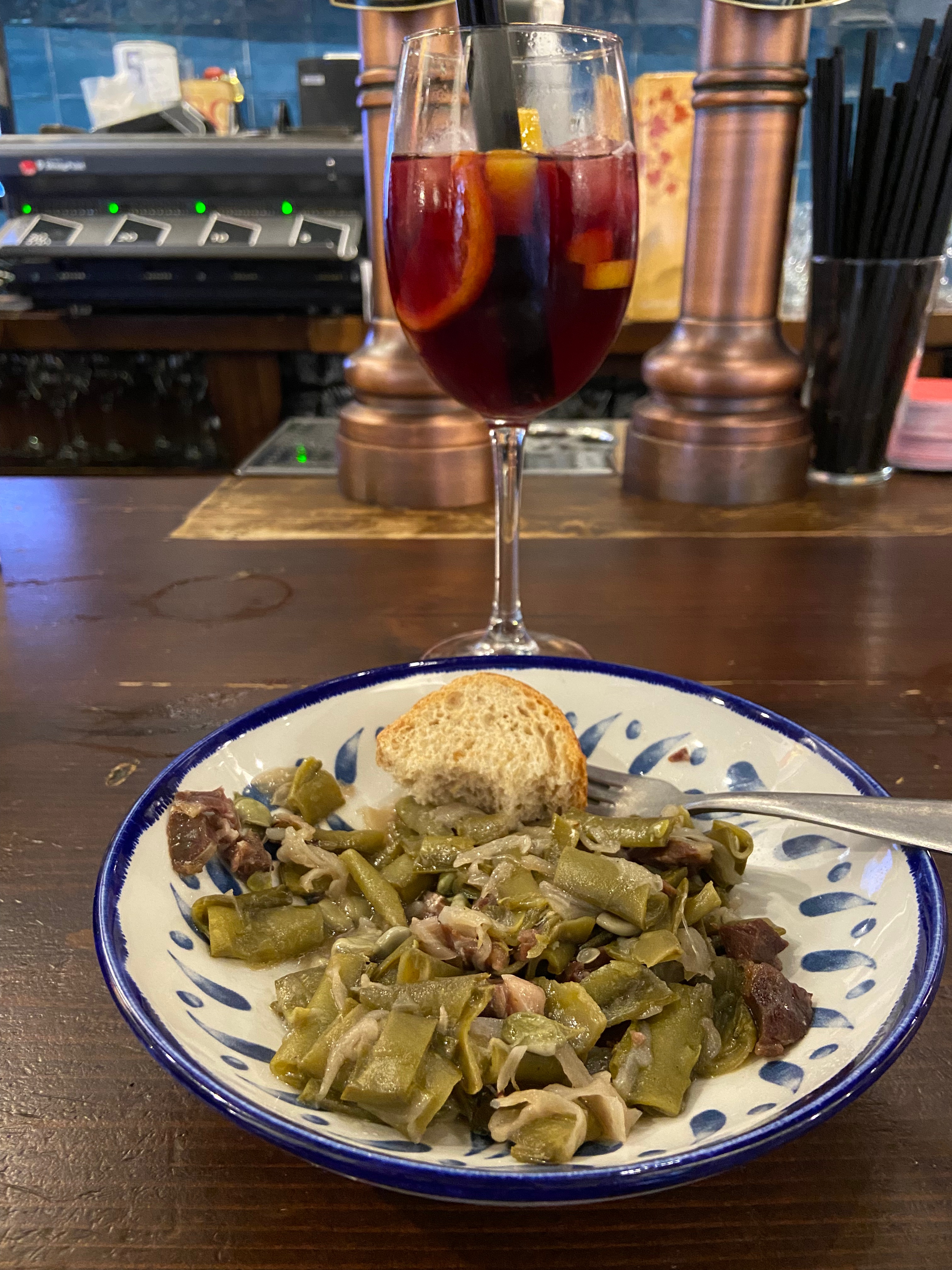
I was hungry and thirsty after all the hill climbing so I repaired to Bar El Pimpi at lunchtime, another Michael Portillo recommendation. Something of a Malaga institution since the 1970s, El Pimpi is a wine cellar with lots of different patios and rooms. I found a stool at the bar and ordered sangria, tortilla espaňola (Spanish omelette) and habas con jamón (a stew of jamón serrano and broad beans). The omelette came doorstep-size and was disappointingly dry, but the beans and sangria were excellent. I got chatting to a couple Chris and Kat, from Ireland and West Virginia respectively. They are in their 50s, have sold their businesses and are enjoying the freedom to travel. They were heading to a spa after lunch and hadn’t bothered with any of the museums or sights. No FOMO there!


After a much-needed siesta – take a pinch of jetlag and a glass of sangria – I popped out again in the early evening. Not quite ready to do a Chris and Kat and eschew all museums, I was keen to check out Picasso’s birthplace – a house with beautiful stained-glass fan lights overlooking the Plaza de la Merced, a five-minute walk from where I was staying. Open till 8pm, it was perfect for the post-siesta, pre-dinner slot.
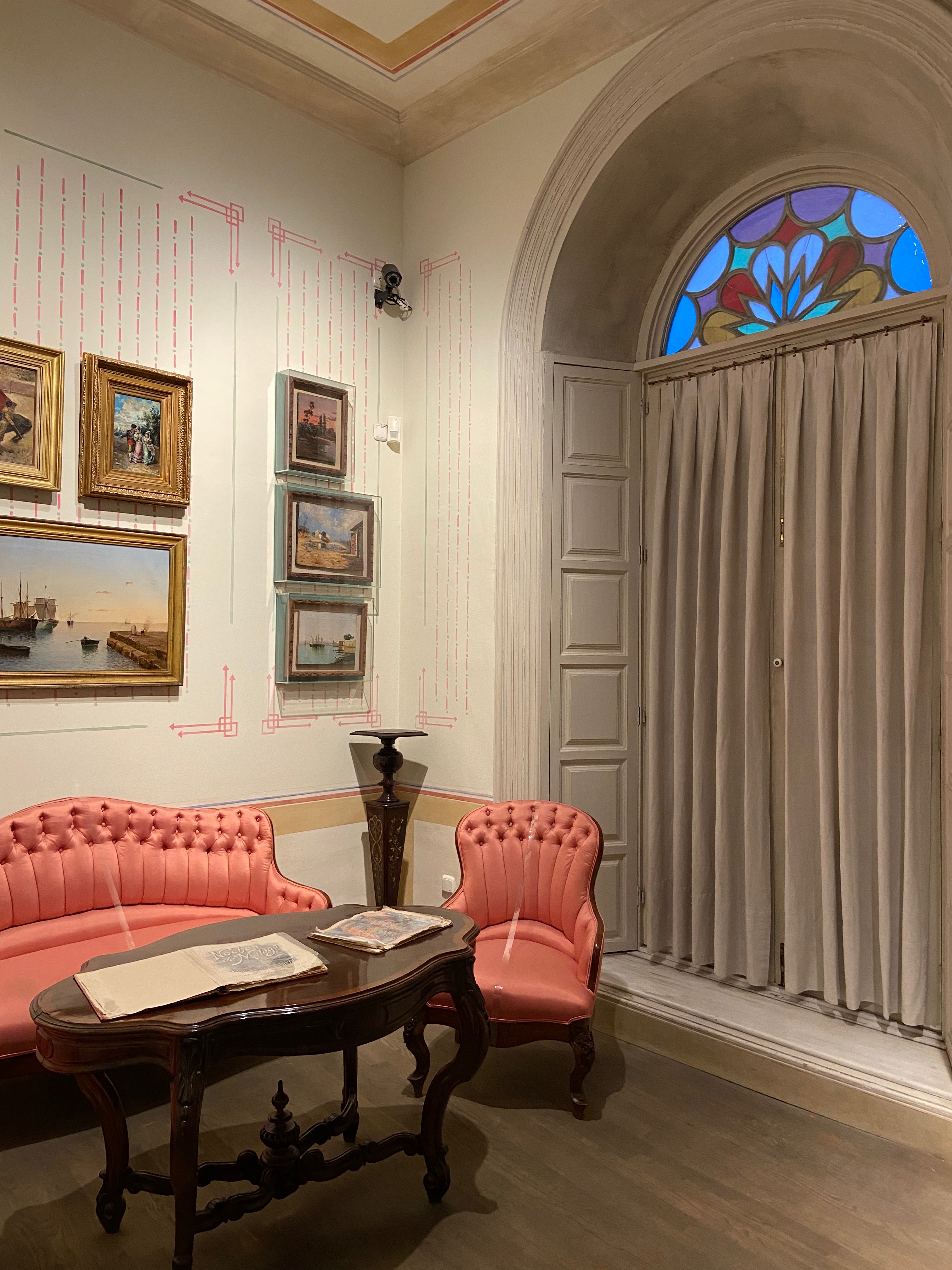
Picasso came from a wealthy bourgeois family and lived in Malaga until he was nine. The Museo Casa Natal de Picasso documents his early artistic influences, including his painter father, and his classical training. Despite spending most of his life in France, Malaga and Spain stayed in his blood. His father took him to the bullring as a child and bulls, bullfighting and the mythical minotaur all feature prominently in his work. Much has been written about Picasso and his representation of the bull and the bull as his alter ego. I am no fan of the bullfight, but I admired the elegant simplicity of his line drawings and painted ceramics featuring bulls and the bullring.


I went to the Picasso Museum the next morning. It’s housed in a traditional house with a courtyard and decorated with Mudejar wooden ceilings and rooftiles. A timeline on the wall describes the key events in Picasso’s life including two World Wars, the Russian Revolution, the 1949 First International Peace Congress in Paris (featuring Picasso’s “Dove of Peace” lithograph on the poster) the Vietnam War, JFK’s assassination and the advent of TV.
From the classical – a tender picture of his sister, Lola, with a doll dated 1896 – to African masks, vases and pitchers to his cubist works and some of the more distorted surrealist pieces – the museum takes you through the stages of his artistic life, the extraordinary diversity of his work and all the different media he used – wood, plaster, bronze, linocuts, line drawings, metal, cigar boxes, clay etc. It’s an understatement to say that Picasso was/is a complex and controversial figure, but I came away understanding a little more about his approach to art, his blurring the lines between classicism and cubism, and his exploration of what he considered the artifice of all artistic practice.
The café at the Picasso Museum is in a quiet courtyard lined with pots of bright red geraniums and orange kumquats. Scarred by ordering tea with milk at El Pimpi and receiving a pot of frothed slightly sweetened milk and a tea bag – an aberration – I chose coffee! I discovered that a weak coffee is a nube, a cloud, and the next strength up is a sombra, shade. Useful things for the traveller to know! And I enjoyed another moment of calm and quiet in a spot overlooked by a church.

On my last day, I had a slow morning – packing, stretching and doing admin. Then after a long walk along the Paseo del Parque, a park running alongside the harbour and planted with tropical and sub-tropical species, I looped back into the centre for some lunch, enjoying the views back towards the Alcazaba and adjoining Gilbralfaro Castle.

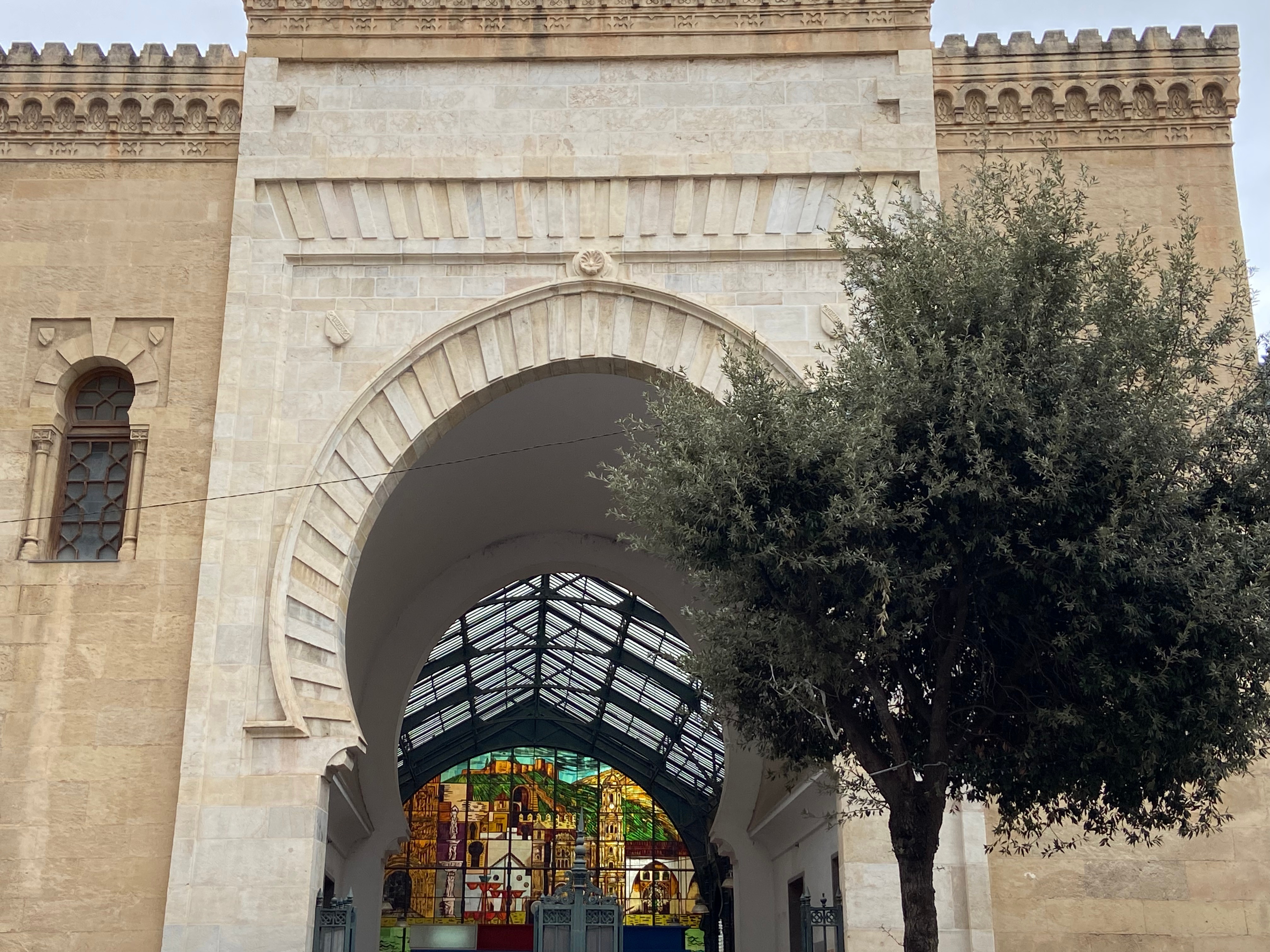
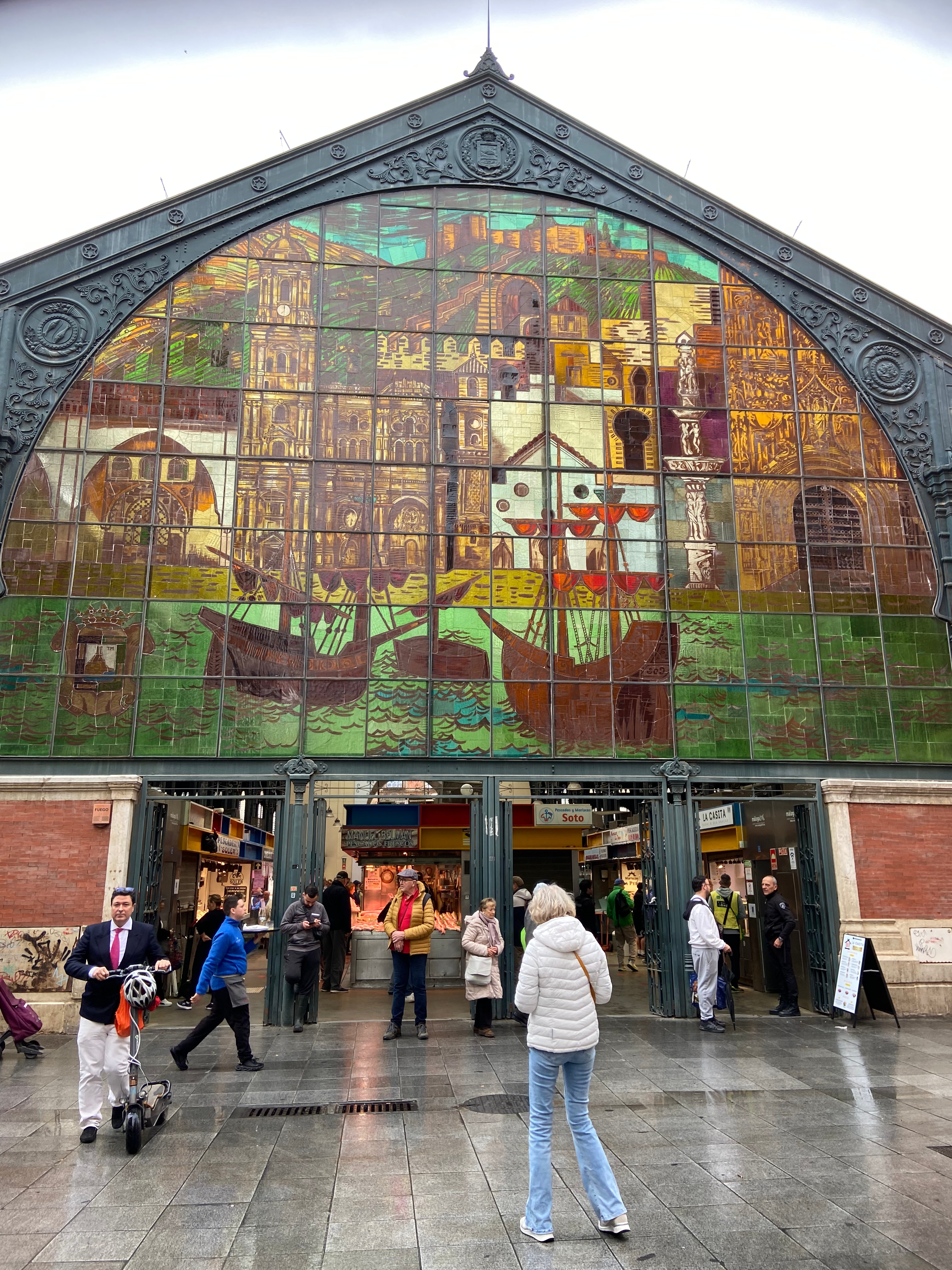
Following Chris and Kat’s recommendation, I headed for the Mercado de Atarazanas. The market was a boatyard during the Islamic period, the Moorish archway at the main entrance still part of the design today, and on the other side an impressive stained glass arched window depicts Malaga’s city scape. It’s busy, bustling and bursting with fresh produce, tapas and aperitif stalls. I was a bit late but just made it in time to feast on paella for lunch, and to discuss with the stallholders how to get that toasted crusty layer of rice on the bottom and the layering of textures and flavours over that. What a treat!

And to round off my afternoon, I visited another Chris and Kat recommendation, the Antigua Casa de Guardia, a bodega founded in 1840. Once again it was like going back in time. Lined with oak barrels, you choose which sherry or wine you want, and they chalk up the price on the wooden bar. I chose pajarete, a fortified wine aged for five years. A delicious and sweet note to end my stay in Malaga.




 This Quirky Life