In praise of the arts: hope, healing and humanity

Last (Australian) summer I got completely spooked by reading an apocalyptic novel – Leave the World Behind – by Rumaan Alam. Not my usual literary genre of choice, I had picked it up at my brother’s holiday house and couldn’t stop reading. It’s the story of a mysterious blackout along the East Coast of America and the collapse of civilisation. After finishing it I had a sleepless night worrying about the state of the world – everything from climate change, wars, plastics in the environment (and our bodies) to Trump getting back into the White House and AI into the wrong hands.

For me one of the best antidotes to Weltangst and negativity is engaging in the arts.  The arts connect us to joy, inspiration, beauty, creativity and to one another, expand our understanding of the world and humanity, enable us to dream and soar above the everyday – even if fleetingly. We may laugh, we may cry or be filled with awe and wonder.  The arts can also shock, provoke and act as a call to action.

During the endless Melbourne COVID lockdowns, tapping into all the wonderful plays, operas and musicals streamed free from the world’s stages was a silver lining. It also gave me hope and restored my faith in humanity, which was challenged by all the fear-mongering and survival of the fittest behaviours – remember the loo paper hoarding?!

An emerging body of research, strengthened since COVID, highlights the link between engaging/participating in the arts and mental health benefits. It makes it all the more regrettable that public arts funding gets slashed during periods of economic downturn. The cultural sector in the UK, for example, is suffering huge cuts. Interestingly – according to my research – Finland has the highest per capita public arts spending, and is also the country that ranks highest in the UN World Happiness Report – I rest my case.

There’s also opportunity for arts to inform and be integrated into social policy.  A good example of how this can work in action is Streetwise Opera, a UK charity that connects those living with homelessness with world-class artists to co-create bold new works, bringing together diverse voices and stories, improving the wellbeing, confidence and social connectedness of participants. It’s a great example of how an otherwise elite art form can be reinterpreted for social good.  See: https://streetwiseopera.org/

Another immersive, affordable and accessible way to experience the arts across multiple genres is to attend a Fringe Festival. In 2019 I happened to visit Avignon during the Avignon Festival in July and was drawn to Avignon Le Off (their name for the Fringe). I dashed around seeing French theatre (dusting off my A’level French), watching a naked yoga dance (which was rather beautiful and not remotely salacious), a clown-like comedy set in a barber’s shop, and a brilliant and hugely powerful two-person play written and performed by Tim Marriott (of Brittas Empire fame) about Mengele meeting the angel of death on a Brazilian beach. And everywhere I turned there was this artsy soup of drag queens, artists riding unicycles, singers, street artists and acrobats. Some of the works I saw there happened to be Adelaide Fringe shows. And in the magical way the universe works, a year later I ended up doing grant-seeking and advisory work for them.  

Fast forward a few years to August 2023, and I met a colleague from the Adelaide Fringe in Edinburgh when the Festival and Fringe were in full flow. Of course, Edinburgh is where the Fringe movement was born in 1947, when eight theatre groups turned up uninvited to perform at the Edinburgh International Festival.

While I mainly focussed on Fringe shows, I also attended a couple of Festival events. A standout was a chat between Iván Fischer, Director of the Budapest Festival Orchestra (BFO), and Edinburgh Festival Director, Nicola Benedetti, in the Usher Hall. We – the audience – lay or sat on the floor on bean bags and heard Fischer talk about – and demonstrate – how an orchestra can maintain contemporary relevance away from the formal staging of a classical concert.  Many of the musicians in the BFO play other forms of music, and we heard a selection: Monteverdi madrigals (with instrumentalists singing in the chorus), Argentinian Tango, Klezmer music and rousing wedding music from Transylvania.  An absolute treat.  

Other favourites were a one-man play, In Loyal Company, a true story of missing WWII soldier Arthur Robinson, written and performed by his great-nephew David William Bryan. A hugely energetic, visceral and totally captivating performance, you’re on board his ship in Singapore when it gets bombed, you sweat and shiver through dysentery in Malaya, and feel gutted when he finally returns to Liverpool after the war to find life has moved on in his absence.  Another very poignant play – Shanti and Naz –was about two best friends, one Hindu and one Sikh, during the time of partition in India. By complete contrast A Migrant’s Son (an Adelaide Fringe production) presents a true-life story of the Greek migrant experience to Australia. It’s a musical journey created and sung by Michaela Burger and is full of humour, heart and a few horrors along the way. Burger has a fabulous voice and was joined by a community choir as the chorus.
The New Revue was a sharp satire on (mainly British) current affairs which back then featured Rishi Sunak, BoJo, Keir Starmer, Suella Braverman and Paddington Bear.  How fortunate are those of us who live in democratic societies and enjoy freedom of speech and self-expression. A healthy and vibrant arts scene encourages the exchange of ideas, the exploration of stories and different art forms. There are all too many examples past and present of autocratic regimes suppressing the arts and subverting them for state propaganda.

I loved being in Edinburgh: the buzz and festival vibe; the many tartan and shortbread shops; the whisky; people-watching; pop-up shows and street artists; bagpipes; summer chill and cloud; ancient stone and cobbles; and, towering over it all, the great bastion of the castle. I reconnected with friends I hadn’t seen for many years and stayed in their delightfully rambling house in Morningside. I also stayed with Australian friends in the Borders, and probably drove them mad running around to so many shows.  

I did the same thing in Adelaide in February, partly as my clients at Adelaide Fringe generously gave me a bunch of comp tickets and also because it was Writers’ Week. I ran between the two – literally!

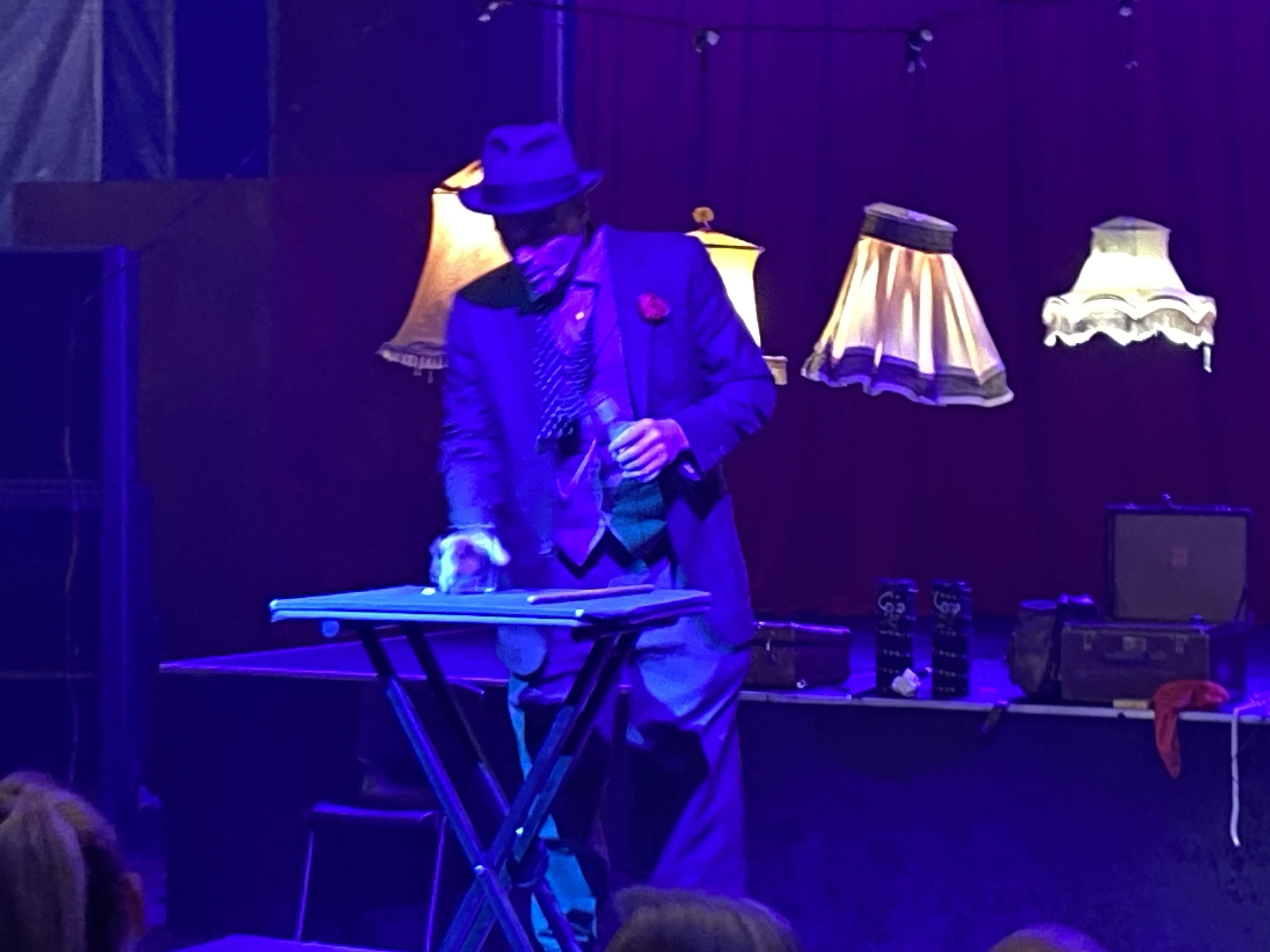
Highlights included a magic show, Charlie Caper, how DID he do it?  I strained to see the tricks and shortcuts but couldn’t. I loved the show and the old world feel conjured up (haha!) by his Fedora, three-piece suit, bow tie and the tasselled lamps. A stand-up comedy session in a converted railway carriage was raw and vulnerable while a Japanese circus, YOAH, was highly stylised and silent – all black and white and techno. Lolly Bag, a one-woman show by the talented Hannah Camilleri was a delight. Very quick, very original, and very funny, she played a whole a range of characters from a curmudgeonly car mechanic to a frazzled Year 8 class teacher, mixing improv and audience participation to great effect.  

Charlie Caper’s Magic Show

I also had the pleasure of seeing two more Tim Marriott plays – we have stayed in touch since I got chatting to him, his wife and dogs in Avignon. Appraisal was a gripping all-too-realistic and, in parts, darkly funny, two-person play about a toxic work culture, the abuse of power and position.  Watson, The Final Problem is based on Sir Arthur Conan Doyle’s Sherlock Holmes stories. With Big Ben chiming in the background and a Victorian-era room complete with hat stand, wooden chest, chair, desk and diary, we were transported to London, where Dr Watson looks back on his life and friendship with Sherlock Holmes. Tim Marriott’s masterful monologue took us on a rollercoaster ride culminating in the final demise of the detective at the hands of Moriarty at the Reichenbach Falls.

Cramming in – you know me – Writer’s Week events, it was a delight listening to Irish writer Anne Enright talking about families, Irish mothers and poets in relation to her new book The Wren, The Wren, and hearing what broadcasters Leigh Sales and Lisa Miller had to say about storytelling. I also attended an event at the Town Hall, where a group of writers each read a piece about family. My absolute favourite was by Martin Flanagan.  

On this 66th birthday he went back where he was born, the Queen Victoria hospital in Tasmania (now offices), to write a letter to his late mother. Warm, moving, fond and funny, it was clearly part of an ongoing conversation with her.  He recalled his friend Michael Long saying: “the silliest thing white fellas say is that you can’t talk to the dead.” Michael, whose mother died with he was 13, has a cup of tea with his mother every day. Martin concluded his birthplace reflection by saying to his mother: “I knew I’d find you here.” I found an extract from this tribute online if you’d like to read more. Go to: https://footyology.com.au/martin-flanagan-talking-to-mum/

That’s what I love about the arts, it all comes down to storytelling in one form or another: . “You’re never going to kill storytelling, because it’s built in the human plan. We come with it.” – Margaret Atwood,

Dresden: Part 3/3 – Final reflections and scorecard: Culture 8/10, Food 5/10, Historical interest 10/10, Livability 7/10

If you’ve slogged through my last two blogs on Dresden, well done!! Apologies if I lost you in all the detail; such was my fascination with its history that I did lots of research on my return to Australia making my blog posts rather information heavy!  “You really have to concentrate,” commented my sister… This final Dresden post is more personal and less driven by facts and figures.

You’ll notice I didn’t mention food in my previous posts. To be honest, neither food nor drink were highlights of my Dresden trip. Not to stereotype German food, but I’m not so into bread, beer and sausage. I was wandering round the various stalls and wooden huts of the Spring Market one evening and felt my stomach turn at the fatty-looking potato cakes and greasy Currywurst bubbling away in a large pot.

And eating out in the Old Town – close to my hotel – was very expensive; I was paying a premium for the location. Interestingly, though, the meals with a view were somewhat marred by surly and, in some cases, outright bossy service; no frills or niceties whatsoever. After my long day visiting Loschwitz, the castles on the Elbe and the Stasi Detention Centre (see blog post 2), I stopped off for dinner in the Neustadt – the ‘new town’ on the opposite bank of the Elbe from the Old Town.

Here the vibe was quite different: trendy, younger, student-y and ethnically diverse as evidenced by the different cuisine offerings – from Turkish, Greek and Middle Eastern to French, Vietnamese and more. And the shops! I window-shopped my way past some of the most fun and original retro, vintage and niche interest shops I’ve seen in a while. Just as well I had zero room in my case, and it was anyway approaching closing time.  

However, my chief mission was to find the Kunsthofpassage (KHP)– a series of funky interlinked courtyards in Görlitzerstrasse that were jazzed up about 20 years ago with art and wall sculptures. The one I loved best was the building with the musical drainpipes set against a turquoise painted façade. I’d love to be there when it rains and the water plays through the trumpet-shaped pipes. The courtyard of the animals is fun too with monkey, giraffe and bird bas-reliefs on a lime green wall.  Elsewhere there’s a floating sculpture made of woody stems and climbing red geraniums set off a blue front door.

Among the KHP’s arty shops, chocolaterie and other offerings I found a restaurant called Lila Sosse (Lilac Sauce) that drew me in with its wooden tables, menu on the blackboard and desserts in glass jars. Away from all the Old Town Baroque bling, the wait staff were friendly and down to earth, and I had the best meal of my stay – an asparagus, beetroot and feta risotto – and at a reasonable price. Still recovering from the Stasi Museum experience earlier in the day, I also treated myself to a stiff vodka and tonic. Chin up and all that.

Keeping on the food theme, I opted for the hotel breakfast the next morning – my last full day in Dresden. The previous mornings I’d gone for the cheapskate option and made tea in my room (I had to request a kettle as there was only a coffee machine) and eaten yoghurt and fruit purchased at REWE. And I am glad I did.

Having looked forward to my 29 Euro breakfast, I was disappointed! I’ve come to the conclusion that buffet breakfasts are not all they are cracked up to be – no egg pun intended! In fact, they are the supermarket of breakfasts: it’s self-service, involves queueing and you have to wander around to find everything you want in a mass-produced environment. You find the fruit but not the yoghurt and granola – they are at a different ‘station’, then you line up at the coffee machine looking for the hot water button to pour onto a tea bag in a cup. And, if you’re like me, you stuff it up and the hot water spills over or, even better, you press the wrong button and get cappuccino on your Earl Grey. But if you do manage a cup of tea, you take it back to the table with your fruit only to realise you forgot the milk. Up you get again and around you go.  

After the fruit and yoghurt, you venture off to the hot food station where eggs and bacon sweat over bain-maries. By the time you get back to the table, the tea is stewed and cold. And then there’s the toast to organise… And that involves waiting for it to cook on one of those cake-walk-type toasters (all the while your hot food is congealing on the plate) that spits out the toast at the end. All far too much juggling and faffing.

However, there were a few silver linings. I stocked up on Sunday papers which I am still reading (the Frankfurter Allgemeiner is quite dense!), I made myself some rolls for lunch, and I got chatting to the (German) couple sitting at the table next door.  We got into conversation because I mistook the guy for a waiter (he was wearing black trousers and a black shirt) and I asked him to bring me a pot of tea. A short but sweet friendship forged over laughter.

My final destination was Pillnitz Castle. You may recall that Andreas from the Antique Shop in Loschwitz recommended that, given my interest in East/West Politics, I should visit a special exhibition about chairs made in the GDR in the 1970s and 1980s.

I got a tram and a bus out to Schloss Pillnitz, which once housed one of August the Strong’s (remember him from the first blog?) mistresses. It has three main buildings, two of them Baroque with Chinoiserie elements and the Neues Palais, in the Neoclassical style.

The furniture exhibition was in the Wasserpalais, the Riverside Palace, and there was something wonderfully mismatched about staging an exhibition about polyurethane chairs in a Baroque castle. The brightly coloured “Känguruh-Stuhl” (Kangaroo chair) and the “Garten-Ei” the Garden Egg chair are thought to be icons of East German design. But it turns out that the East Germans had a bit of help from their frenemies.

Part of a worldwide boom after the second world war, cheap to make and mass-produce, plastics were attractive to the GDR, but production in the East lagged behind the West, where production and innovation were supported by private sector investment.  A bit of a When Harry Met Sally situation, the East wanted what the West had. The exhibition documented the subterfuge and political machinations that lay behind the GDR becoming a major centre for polyurethane plastic (PUR) furniture.

Unbeknown to the citizens of East Germany, their government was involved in clandestine trade with West German companies from whom they purchased know-how, machines, foam moulds and design licenses.  In the 1970/80s more PUR furniture was made in the GDR than anywhere else in the world, and this widescale production was outwardly hailed as a sign of socialist progress. The cross-border skulduggery was well covered up. Fascinating stuff.

Pillnitz is surrounded by lush green parkland – Englisher Garten-style – has a glass house (complete with Australian natives!) an orangery, several pavilions and a camellia tree that is more than 230 years old. Reputedly brought out from London’s Kew Gardens in the 1770s, the tree is protected during the winter months by a movable glass house that sits on rails. The tree is MASSIVE and the hexagonal glass house structure is a stunning piece of modern design.  I was lucky enough to catch the azaleas and rhododendrons in flower and ate my breakfast rolls sitting in the sun on a park bench surrounded by reds, purples and pinks.

One place I hadn’t managed to visit while in Dresden was the nearby town of Meissen, famous – since the 1700s – for the manufacture of porcelain.  Anyone who has visited my house will know I am a seasoned collector of china, particularly cups and saucers. And so it was with FOMO-assuaging delight that I got to see some fine examples of Meissen figurines and tableware wandering through the state rooms of one of the other Pillnitz palace buildings.

On the way back to Dresden I got a ferry over the Elbe, cutting off a corner, and linking to a tram back into the city. The ferryman was a jovial kind of guy with a big smile and twinkle (of the right kind) in his eye. He complemented me on my German detecting only a light English accent – which was flattering, (who doesn’t love a bit of encouragement?!) – and let me cross for free. And into the bargain I got a great view of the riverfront side of Schloss Pillnitz. A good end to a richly varied and fascinating four days.

As a postscript, I play a ‘could I live here?’ game whenever I travel. On the downside, there are still post-war political tensions, and quite a significant neo-Nazi and far right faction in Dresden. The week I was there an SPD politician was attacked and badly injured by a group of men, and shortly before this incident, a member of the Green Party had been attacked putting up posters. Dresden also feels a bit off the beaten track – the kind of place where opinions can harden. However, I reckon I’d enjoy hanging out there for a few months, especially in the summer months doing artsy things and speaking German. When I am less engaged in working for a living, Dresden might be one of my house-sit destinations.

Dresden Part 2 of 3: Suspension Railways, Schlösser, sewing tables, the Stasi and the Soviets

Welcome back to Dresden where I am once again on the trusty Hop Off, Hop On bus, this time heading east from the city and across the cantilever truss bridge, colloquially known as the Blaues Wunder, up to the wealthy residential area of Loschwitz – an area of historic villas and summer residences, many of which escaped the WW2 bombings.

I start by taking the world’s oldest suspension railway (Schwebebahn) up the mountain. At this point, full declaration on suspension railways… My first visit to Germany was aged 15 when I stayed with my school friend Monica and her grandparents in Wuppertal. Quite young for our age and prone to giggling fits, we loved being with Opa and Oma, even if they did stuff us full of food – Kaffee und Kuchen every afternoon without fail! Travelling on Wuppertal’s Schwebebahn was all part of the adventure, and we loved it. Unlike the Loschwitz funicular (see below), the monorail in Wuppertal is not just a tourist attraction but part of the transport network. It literally hangs off the rails rather than sits on them, and is a great way of travelling around, lending a bird’s eye view of the city. Interestingly, the Loschwitz funicular and Wuppertal’s monorail were designed by the same engineer in 1901.  From the machine room at the top, there are stunning views over Loschwitz, the Elbe and beyond. Dresden is a city packed with panoramic viewing points.

Back on the ground in Loschwitz I had lunch at Kaffee Wippler, a café with an art deco vibe and an enticing selection of cakes – after a slightly strange Greek-style salad heaped with spelt grains (I was expecting croutons), I chose a Florentine biscuit to go with my – you guessed it – English breakfast tea! Then I wandered round enjoying the ‘olde worlde’ feel of the place: the cobbled streets and half-timbered houses; a delightful bookshop covered with ivy and vines; a knitter’s delight wool shop; an attractive yellow painted house, the final resting place of Clara Schumann’s father; an art gallery and a fabulous antique shop. Admiring a beautiful walnut sewing table in the antique shop, I got chatting to the owner and his mate, Andreas, from the Blaue Brücke Gallery round the corner. That lead on to an interesting chat about all sorts including life in the GDR.  They recommended an exhibition on polyurethane chairs at Schloss Pilnitz given my interest in East/West Politics.  See blog post 3/3!

Keen to walk in the glorious spring sunshine, I followed Andreas’ directions and branched off from the road along a steep cobbled walkway past expensive-looking villas – from Swiss Chalet-style to classical and Art Nouveau – and yet more marvellous views over the Elbe. Then I rejoined the bus for one stop and got out at the Elbschösser – the three castles overlooking the Elbe (Schloss Albrechtsberg, Lingnerschloss and Schloss Eckberg). These three castles were all built in the mid-19th century and are surrounded by rolling English-style (Englischer Garten) parkland and meadows dotted with wildflowers.

At Lingnerschloss there’s a large open-air café on the terrace overlooking the vine-clad slopes – Loschwitz has been a wine-producing area since the 11th century – and it was here I succumbed to a major attack of FOMO. Tramping around a city is tiring and part of me wanted to chill out and kick back with a cuppa or something stronger. The other part argued that I had to make the most of my time in Dresden. It was now 3.30pm, the Stasi Museum was open till 6pm, and it was on my way back into Dresden.  Having read Anna Funder’s Stasiland and seen films such as The Lives of Others, Goodbye Lenin and Balloon, my curiosity won out. I had a quick drink of water and pressed on.

The Bautzner Strasse Memorial is a former Stasi remand centre and, prior to that, a Soviet prison housed in a grey/beige-coloured apartment block. The memorial commemorates those who were victims of political persecution during the post-war Soviet occupation and then under the GDR.

The man at the desk was somewhat unhelpful when I asked how long I needed to go round and if I had time to listen to the 55-minute audio – “that all depends,” he said, shrugging, “who knows?” He handed me a map and gave muddled instructions – the museum is across a number of floors and parts of it were shut off for renovation.

It seemed entirely fitting that I should feel confused as I navigated the maze-like corridors. What a discombobulating experience it must have been for those detained by the Stasi. New arrivals to Bautzner Strasse were blindfolded until they had been processed, their families were not informed of the crimes they had supposedly committed and all detainees were identified by a number rather than a name. Not even the guards knew what the detainees had been accused of.

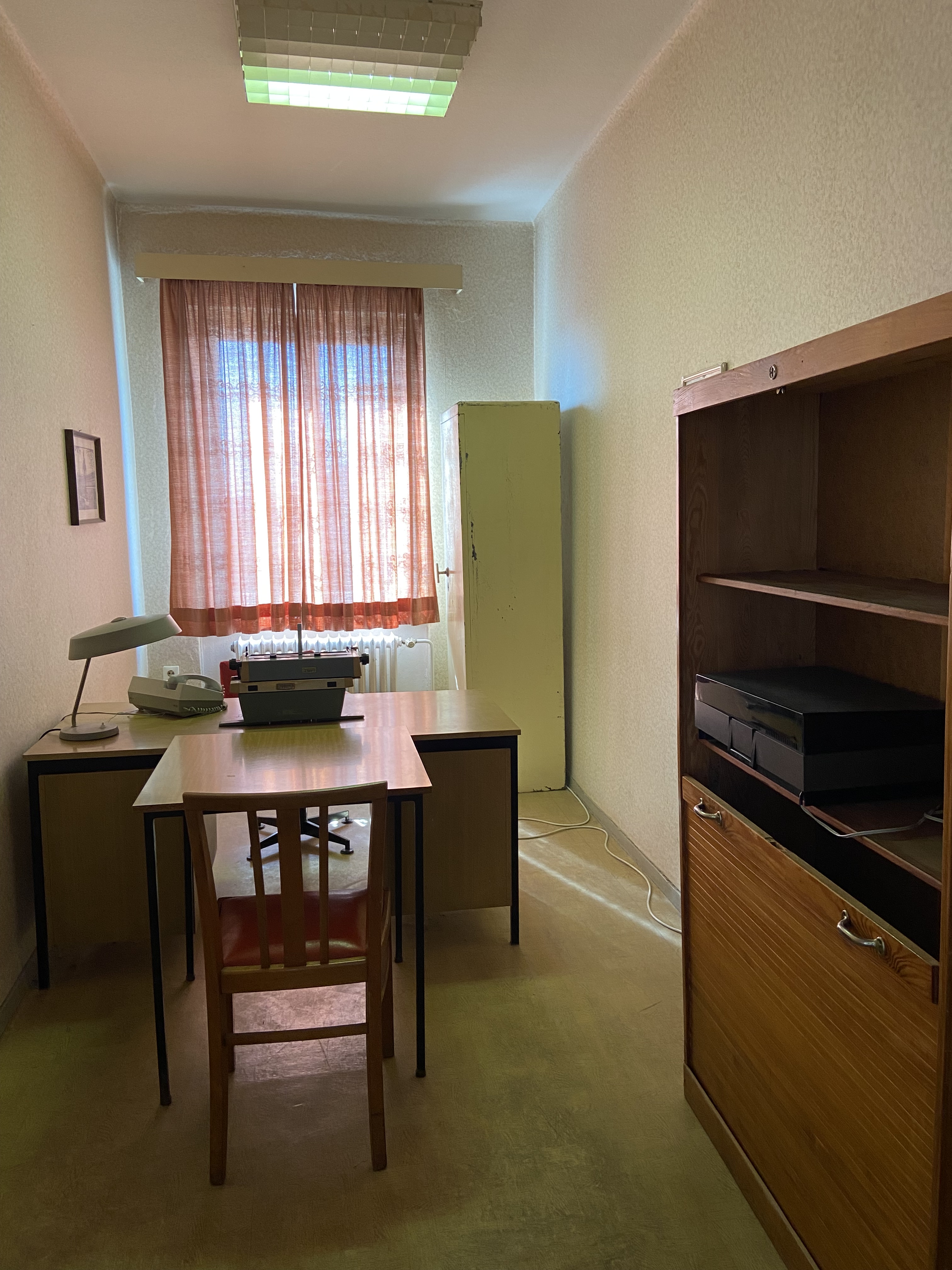
The interrogation room remains untouched and, according to the caption on a somewhat dog-eared piece of A-4 paper, was where the Stasi carried out psychological torture. For example, if a detainee didn’t cooperate, they were threatened that their partners, families and children could come to harm or that their children might be taken into care. Then there’s the small stark cells including a writing cell (any letters written under close supervision and heavy censorship), the room where mug shots were taken, a van that was used to transport prisoners with uncomfortably small compartments (mini cells), and the intact cell block on four floors – you can almost hear the clank of the keys and hear the footsteps of the guards doing their rounds. Testimonies from former inmates talk about the guards looking through the spy hole every few minutes.

And then, even more disturbing, a damp dark tunnel with peeling paint leads to the post-war Soviet prison where Nazi sympathisers, political prisoners and those arrested on the flimsiest of charges were held in appalling conditions, in cold and cramped cells, the next stop being the Gulag.

Back on the street there’s a memorial to Alexei Navalny which I found particularly poignant, not least because a couple of streets further on is the site of Dresden’s former KGB Headquarters, No. 4 Angelikastrasse, where Putin worked as the local chief between 1985 and 1990.

Exhausted on all levels and in need of a bit of light relief, I was back on the bus in time to pop into Pfunds Molkerei, celebrated by the Guinness Book of Records as the ‘world’s most beautiful milk shop’. In business since 1880, Pfunds Molkerei featured as the bakery in the film, Grand Budapest Hotel. And it’s not hard to see why: floor to ceiling Villeroy and Boch tiles decorated with winged cherubs, naked cherubs, garlands of flowers and pastoral scenes (think cows and more cows!) provide the backdrop to the selection of cheeses, buttermilks (some with liqueur), sweets and chocolates as well as Dresden’s signature cake Eierscheke.  Short of time – it was about to close – I had a refreshing swig of buttermilk and bought some chocolates and nougat for friends. Then it was onto the New Town for dinner.

In Part III – coming soon – if you’ve stayed the course… – I spend an evening exploring the Neustadt, the new town – which is more boho than baroque. I also head off to Schloss Pilnitz, stroll the grounds, gawp at a 250-year-old camellia and visit two radically different exhibitions – one royal and traditional and the other about polyurethane chairs manufactured during the time of the GDR. (recommended by my antique shop friends).

Delightful Dresden: Florence on the Elbe (Part 1 of 3)

Dresden had been on my Bucket List for a while – I’d read good things about it. But I also wanted to go somewhere I could practise my German with the added interest of heading to a city that was part of the German Democratic Republic (GDR) – and behind the ‘Iron Curtain’ for 41 years. I found it fascinating on many levels – lots to interest me – so much so that this is the first of three blog posts on Dresden.

My hotel was right in the centre of the Altstadt, the old town, which made navigation very easy. Feeling somewhat under the weather on day one, I opted for the Hop On, Hop off Bus. And what a good choice that was. Purchasing a 20 Euro ticket at the hotel gave me three days of unlimited travel. I understood most of the German commentary but the bus rattles, rocks and rolls along so it was hard to hear it all. But if there’s only one thing you take away from Dresden it’s that Augustus der Starke, Augustus the Strong, Elector of Saxony and Poland (1670-1733), made a huge contribution to the cultural, artistic and scientific landscape of the place. In fact, I was first introduced to him in the taxi on the way from the airport as we drove past a gleaming gold statue of him atop a horse in full body armour.

He might have been the Donald Trump of his day – he certainly liked surrounding himself with power, riches, wealth and women. Indeed, he was rumoured to have up to 365 illegitimate children.  But I was more interested in his cultural legacy.  It was short walk from my hotel to the Historisches Grünes Gewölbe (Historic Green Vault), which he built to store some of the many treasures he collected.

Dresden, particularly the old town, was very heavily bombed by the British in the Second World War. Amazingly however, the Grünes Gewölbe, remained mostly intact with only three rooms going up in flames.  Treasures from the vault – and many of the city’s precious objects and art collections – were removed to castles and fortresses outside the city during the war. And I learned that many valuable items were taken by the Soviets as booty after the war but were returned in the 1950s.

Entry to the Green Vault is by timed ticket, and only two people can enter and exit at a time through double-layered automated glass doors. And, needless to say, no phones or photographs are allowed. The tight security is not surprising; in 2019 thieves broke into the vault and stole precious items from the Jewel Room – some of which were recovered but not all.

The eight rooms of the Green Vault all have a different theme such as the Amber Room, The Ivory Room, the Silver Gilt Room etc. Building to a crescendo of Baroque opulence, each room has more mirrors than the previous one – there’s almost too much splendour, detail and intricate craftsmanship to take in! Variously crafted from amber, mother-of-pearl, coconuts, ostrich eggs, enamel, gemstones, gold, brass, silver, jade and more there were drinking vessels, carved figurines, clocks, sculptures, animals, birds, swords, platters and decorative boxes. And in the Jewel Room, rows of rings with knuckleduster-size gemstones – diamonds, rubies and sapphires as well as shoe buckles, swords, hat pins and a breast star of the Polish Order of the White Eagle.

Much of the Altstadt has been rebuilt and restored to its former Baroque glory since the fall of the wall in 1989. There is still building work going on at the Zwinger Palace which was never designed as a dwelling but as an orangery and a setting for court festivities and celebrations.

Just across from the Zwinger is the Semper Oper (opera), which was rebuilt earlier, in the ‘80s, and reopened in 1985. Although it was advertised as sold out, I managed to get a return ticket and attended a matinee performance of the Magic Flute, Mozart’s only opera written and sung in German. Included in my all-time operatic favourites are the arias by Papageno and the Queen of the Night so it was a magical afternoon.

A few days later I tagged onto a Night Watchman tour, and discovered there is an Opera Ball every January for the rich and famous. A glitzy ritzy event, previous guests include Vladimir Putin, who lived in Dresden for five years. I wonder if Trump ever attended or was on the guest list?

Augustus was also behind the construction of the Frauenkirche in the mid-1700s. After the war in 1945, the church remained a pile of blackened rubble and melted iron for 60 years. Archive photos from 1957 show sheep grazing around the ruins.  Then in the ‘90s, driven by the citizens of Dresden and funded by donations from all over the world, the reconstruction started. An extraordinary feat of engineering, each brick was catalogued and mapped and 40 per cent of the original materials were used. And, in a symbol of reconciliation between the UK and Germany, the orb and cross on top of the church were constructed by a team of British craftsmen including a London-based silversmith whose father was a pilot during the bombings over Dresden.  And, lest we forget, the cast-iron cross that originally crowned the dome is now displayed – molten and warped – inside the church. 

Climbing up to the dome was a good work-out, and I was rewarded with magnificent views over Dresden and the River Elbe, over spires and domes to the hills in the distance. You can see why Dresden used to be called the Florence of the Elbe.

But Dresden is not all columns, cupolas, crowns, carvings, chariots, cherubs and classical statues with fig leaves in strategic spots. It also has a history as an industrial centre – back in Augustus’ time Dresden’s wealth came from mining ore, silver and other metals from the Erzgebirge Mountains. Pre-war industries included car manufacture, medical equipment, optics and cigarettes.  Another stop on the bus tour is the eye-catching Yenidze Tobacco Factory, one of the few Altstadt buildings to survive the war. Now used as offices, the factory was built in 1909 in the style of a mosque, the minaret serving as the factory chimney, referencing the origins of the Turkish tobacco processed there. It was also a clever ruse by the architect to get round planning restrictions. I was tempted to go to the panoramic roof-top restaurant one night during my stay but didn’t get to it – next time!

Cars, optics and cigarettes (so many people smoke in Germany!) still feature today as well as IT, electronics and micro-chip manufacture.  It’s well worth taking a look at the state-of-the-art Gläserne Fabrik, the ‘transparent’ factory, home of the Volkswagen ID. ID standing for: “intelligent design, identity, and visionary technologies”. My timings didn’t work in with a tour but stepping into the glass atrium you can see the latest e-cars on display as well as cars moving along a self-driven assembly line. It’s all highly automated and futuristic, and the carbon-neutral building, which cost 86m Euros to build, is certainly impressive with its 27,500 square metres of glass.

Not everyone is a fan of the reconstructed Baroque city centre.  Some of those who grew up with a different cityscape – these ‘old new’ buildings including some with historically remodelled facades weren’t, of course, there in the 1980s – find the new Dresden homogenous and somewhat fake. And, there’s still some lingering Ostalgie (Nostalgia for the East) across the former GDR. But Dresden’s socialist past has not been completely erased. There are still some remaining Plattenbauen, prefabricated  blocks of flats,  that were common to much of the former East Germany.  And, in stark contrast to all the Baroque bling, stands the Kulturpalast (Cultural Palace) in the Altmarkt (Old Market Square ), a modernist building in the International Style which opened in 1969, and was used for concerts, dances and other events.

Kulturpalast

After heated debate, the people of Dresden voted not to demolish the Cultural Palace and deny their history but to keep a key building from the GDR period. The newly refurbished building, now protected by a preservation order, includes a concert hall, home to the Dresden Philharmonic, a library and a cabaret theatre, and was reopened in 2017.  You can’t fail to miss the large mural on the west side of the building titled Der Weg der roten Fahne (the Way of the Red Flag) with its socialist narrative. Quite a different story from that of the Electors and Kings of Saxony as shown in the pictures below.

In part 2 I will take you up to the wealthy suburb of Loschwitz, to the Elbschlösser, the castles along the Elbe, and to a stunning cheese/dairy shop dating back to the 1880s, which was voted the world’s “Most Beautiful Milk Shop,” by the Guinness Book of World Records. I also visit a former Soviet prison and Stasi remand centre.

Back in Blighty 2: Village Life

Although I grew up in various English villages, both in the North and South, I never really thought about the nature of small communities. I just took it from granted. On my recent trip to the UK, I was reminded how delightfully timeless and whimsical village life can be, and looked at it with fresh eyes.

In Devon I stayed with my friends Monica and Jonathan in Chawleigh in the heart of Devon. It’s a small village with two pubs and a shop surrounded by tiny lanes with high hedges; I am glad I wasn’t driving – all that reversing to a passing spot requires a very flexible neck! I didn’t explore the village as such – we only had one fine day in three (the UK experienced its wettest July for years!), and that was spent doing a glorious circular walk on Dartmoor.

But their house is a voyage of discovery in itself. The Grade II listed farmhouse, with its smart thatched roof,  dates from the 17th century – some of the house possibly earlier – and, atop the front door, is the crest of the Earl of Portsmouth – the house would once have been part of his estate. Walking into the house you get a visceral sense of the palimpsest of history: flagstones worn by footsteps over the ages; the sloping and uneven floors; the heft of the of the cob walls (walls made from mud, chopped straw and horse hair, a common practice before 1850); the elegant 12- and 8- pane sash windows; the 19th century glazing evident in the whorls and imperfections and the thin glass (modern sashes have thicker glass); and the early 17th Century plank-and-muntin screens.

Now I don’t know about you, but I’d never heard of these screens. The name alone is fascinating – Google informs me that muntin is a corruption of montant and, in some early spellings, mountain, a word applied to various upright dividers. That makes sense, these screens are an early form of partition wall. The screens in Monica and Jonathan’s house are made of oak and full of holes – and, to add to the intrigue, on the screen by the front door there are initials carved into the wood dated 1941 – most likely by some evacuees.

Then there’s the outdoor privy with an adult-sized seat and a child-sized one – that made me smile – a barn, a well and a former piggery. The apertures carved into the cob wall under the thatch were for pigeons to nest, and are known as pigeon boles. Back in the day, pigeon meat and eggs featured on the dining tables of the gentry.

What an experience it was staying there. It’s the kind of place where things could go bump in the night. Unfortunately, Monica was chatting to me about a podcast about ghosts and mentioned something about a ghost cat and the study door slamming shut. That was enough to fire my fertile imagination. Lying in bed, I kept bobbing up and and down like a meerkat, craning my neck around as if to challenge any spectral forms!

A country fair has taken place in the neighbouring village of Chulmleigh every year following King Henry III’s approval in 1253. What luck that this year’s fair coincided with my visit. We arrived in time to see the procession of vintage tractors and cars filing through the bunting-lined streets. Modern tractors just don’t have the same class as the old ones, their sputtering, chugging engines evoking days of yore. And the cars, among them, Austin Healeys, Triumph Heralds and Stags, Wolseleys, Hillmans and Morgans all belong to an era of fine craftmanship before the production line and robots took over.  Wonderful stuff.

As the rain advanced, we headed out of the village to the cricket field where all the tractors and vintage cars were lined up for closer inspection, and a DJ was playing Golden oldie hits – I couldn’t resist singing along to the Beatles Ob-La-Di, Ob-La-Da. I got cornered by a farmer telling me how much his badger-faced breeding sheep cost – alas, I was not in the market, but I enjoyed watching them being assessed by the judges. I felt I’d walked onto the set of All Creatures Great and Small...

Given the wet conditions we grabbed some lunch from one of the food vans and sheltered in the main tent where all sorts of home-grown, home-bottled and home-baked produce was on display to be judged – from rhubarb vodka to heritage tomatoes, Victoria sponge cakes and scones. In the crepe queue, I got talking to a local, a woman probably in her mid to late 60s, who has lived in Switzerland and Australia but now calls Chulmleigh home. She was waxing lyrical about the activities on offer in the village – the historical society, keep-fit and line-dancing, you name it!

While I’d probably love all the activities and goings-on, there’s nowhere to hide in a small village, everyone knows your business, and there are not that many people to go round. Good boundaries would be essential. Even so, you could quite quickly get Cabin Fever.

That can be the drawback. In my mother’s village in Nottinghamshire there is a village hall but no shop or pub and there’s not much going on. Mum’s house is down a lane leading to the surrounding fields, and she notes the various comings and goings and who’s who. Her running commentary, while not scripted, brings to mind Alan Bennett’s TV Monologues, Talking Heads, which all all feature single women – one a vicar’s wife (that one is quite dark), one a poison pen letter-writer, and one recently widowed woman – you get the drift. Thankfully Mum’s narratives, while full of conjecture and a bit curtain twitchy, tend to be highly amusing.

Evening view over the fields

There’s the man over the road who lovingly cleans his car daily, and takes an elderly relative out for trips, an immediate neighbour who endlessly practises his golf strokes in the garden (the ball making an irritating click noise) while his wife sunbakes on garishly coloured plastic sun loungers in between putting out the washing. The absence of washing on the line usually means they’ve taken off to somewhere in the Mediterranean in search of more reliable sun. That and the dust gathering on their car bonnets in the driveway. Similarly, Mum works out when the people behind her house are away as there’s no noise from the kids and their searchlight doesn’t beam into her bedroom at night. As it happens, she was convinced the light was some kind of special heat lamp on a timer for their chickens, but it turns out it’s just a very sensitive sensor light triggered by a gust of wind or a bird. Then if the lovely neighbours on the other side don’t draw back their hall curtains, she worries one of them must be ill. What again? I say, incredulous. You thought they were ill last week too – maybe they are just feeling private!

But curtains have their uses. Mum always draws the curtains on her top landing which faces the street. Three very kind neighbours know that if those curtains ever remain drawn during the day there’s a problem. It’s a very simple form of Neighbourhood Watch, the kind you only get in small, tight-knit communities. I find it comforting to know they are looking out for her.

This post is dedicated – with great love and affection – to Mum who turns 92 today, 12th September, 2023. Despite battling the frustrations and degenerative effects of old age, she’s going strong and living independently. She doesn’t even have a cleaner! And two weeks ago she was in London helping out with my sister’s grandsons, Mum’s great-grandsons, bathing them and reading stories etc. Go Mum! Go Granny! Go Great Granny! We love you.

Back in Blighty Part 1

It’s always an adventure of sorts returning from Australia to family and friends in the UK! Due to the long, snaking passport queue and luggage delays, it took three hours to get from the plane to my sister’s front door in London. I had hoped to fly straight into my brother-in-law’s 70th birthday party and had rested as much as possible on the plane so I’d be in sparkling form on arrival. As it turned out the only sparkle was on the glasses I helped wash up; I arrived just as the last guests were leaving! Never mind, I was still part of it and happy to muck in and help clear up. And the wonderful consolation prize was meeting – and cuddling – my newest grandchild aka great-nephew, Douglas Finlay, aged just over two weeks.  I was- and remain – totally smitten!

A couple of days later my nearly 92-year-old mother met me at her local train station in Nottinghamshire. She’s still doing short local drives – just…We had an eventful first week together what with her malfunctioning hearing aids, a pesky bladder infection popping up (every time I come over, I seem to troop to the surgery with a urine sample!), and an outbreak of mice.  Mice are canny and opportunistic little blighters; we first detected them feasting on bird food in the garage, then suddenly they seemed to be everywhere, reminding me of that song about a mouse living in a windmill in Old Amsterdam. Like their Dutch forbears these mice must have been wearing clogs – judging from the scrabbling in the roof space – and the clip-clippety-clop on the stairs.  Not only did we spot one dashing under the grandfather clock in the hall, another one had clearly been upstairs to the spare bedroom and into my suitcase where it had snacked on a (wrapped and sealed) muesli bar. All a bit too close for comfort!

Among the highlights at Mum’s were having my Yorkshire-based brother and sister-in-law overnight and preparing lunch for them and my Australian nephew and his wife. While that entailed a fair bit of shopping and catering for Mum to plan (flap and worry about!), it all went brilliantly and no rodents were in evidence. I also enjoyed watching the Wimbledon Men’s Singles Final with Mum – in real time. AND I got her to sit still for more than 20 minutes – we were both gripped by the long and hard-fought match with the 20-year-old Spaniard Alcaraz beating four-time defending champion Dubrovnik (Mum does a very good line in Spoonerisms).

Back in London the big treat was a trip to Covent Garden with my sister and brother-in-law to see one of my favourite operas, The Marriage of Figaro. I first got into opera as a 17-year-old in Vienna where I was an au pair girl to a stuffy family with minor aristocratic leanings. Back then, I would purchase a standing place at the back for a few Austrian Schillings. My ticket to Figaro was a very generous early ‘milestone’ birthday present from my sister. There’s something hallowed about the Royal Opera House with all that plush red velvet, gold and gilt edging. The music is sublime, the sets beautifully crafted and the staff attentive and gracious. And, always a rebel despite outward appearances, I love that we smuggled in our Sainsbury’s sandwiches and surreptitiously ate them at the bar with our pre-ordered dinks during the interval. While we all know and love Il Nozze di Figaro, numb bum did start to set in during Act Four. You can’t help wondering if there’s one too many layers of subterfuge, hiding in the bushes and letters falling into the wrong hands!

A few days later I went with other friends to an open-air opera at Holland Park in Kensington. Itch is a modern opera about science, adapted from a book about chemistry written by DJ Simon Mayo for his son –  and we attended was the world premiere. Against the backdrop of a brilliant set comprising 118 cubes – as in the periodic table – the plot involves the discovery of a new undiscovered element, a radioactive rock that has the power to solve the global energy crisis but also destroy humanity. Referencing climate change and the Gaia Theory and greedy corporations, it becomes a battle between the chemistry-obsessed schoolboy, Itchingham Lofte, and a bunch of corporate baddies.  I really enjoyed it and the soaring arias – accompanied by the City of London Sinfonia –wouldn’t have been out of place in a classical opera. The only drawback was the lashing rain – while the Holland Park Opera auditorium is under a canopy, the sides are open and it was none too warm! As I write this, it’s now August – but the UK has had the wettest July for years. Just my luck.

After the opera, I stayed with my friends at the Army and Navy Club in Pall Mall. It wasn’t as formal as I had imagined, and it was a treat staying in central London. My room reminded me of a cabin on a cruise ship and had everything I needed. The club has a rich history; the founder and First President was wounded in the Battle of Waterloo and – and here I’m missing the detail – there is some connection with the Entente Cordiale signed between Britain and France in 1904. The walls are lined with prints and pictures from wars, battles and country pursuits from the 1800s onwards – ranging from WWI cartoons and fox hunting scenes to portraits of members of the Royal Family across the ages including one of the young Queen Victoria. And then, as you might imagine, there are various trophies of the stuffed variety – from a greater kudu head to an emperor penguin from Scott’s Antarctic Expedition.

I book-ended this second London visit with an after party for my brother-in-law’s 70th to make up for missing the first one. It was just about warm enough to sit outside and I loved catching up with friends over drinks and nibbles. The following morning, I was off to Devon to sample rural village life. More next time.

Getting my Brit Fix and Bridging the Divide

If you had told me when I moved to Melbourne in the early 2000s that a pandemic in 2020 would see Australia close its borders, pull up the drawbridge and ban international travel, I would probably have hightailed it back to the UK (I can hear my Mum saying she wishes I had!). Never did I imagine having to face enforced separation from my family and a country I love dearly with an indulgent rose-tinted, nostalgic fondness.

But I/we’ve managed magnificently: we’ve been suitably British and stoic – and even a bit Buddhist (well, I have; ‘this too shall pass’) – and made the best of it. And, as one with strong Luddite tendencies (yes, I still have a paper diary and LOVE it!) I acknowledge that technology and video calling has given us a lifeline and a rich sense of connectedness; in fact, as a family we’re more up to date with each other’s news than we used to be. I am one of four: there’s two of us here, and two of us there and we have a sibling video call every Friday.

And, thanks to the perseverance of my eldest brother Charlie, Mum uses an iPad and is FaceTime literate. Mum and I started out chatting twice a week, then – as COVID dragged on – I suggested a new way to bridge the divide. When Melbourne is nine hours ahead of the UK, I drop in at Mum’s at noon her time on a Sunday, and we listen (via her radio and our respective iPads), to her favourite programme on Radio 3, Private Passions. Each week presenter (and composer) Michael Berkeley explores the musical passions and lives of his guests. Sometimes we’re riveted by the subject and their musical choices, other times we drift off into chit chat, easy kitchen table tittle-tattle.  Quite often, Mum gives me an update on the birds on her birdfeeder, the state of her garden, what she is having for lunch or who has just walked past the window. It’s as if I am there in the room with her, and we treasure these special interactions.

Tuning into Private Passions with Mum

I’ve also had regular Brit Fixes thanks to plugging into BBC Sounds and listening to abridged versions of classic favourites such as Middlemarch – how did Dorothea stick it out with the GHASTLY Rev. Edward Casaubon? – Desert Island Discs, a Victoria Wood retrospective and, just recently, a reading of a beautifully nostalgic and touching story, written in 1931, of a family on their annual holiday to the seaside. There’s something wondrous about my physical self strolling along banksia- and wattle-fringed coastal paths with my dog Bertie, my headspace transported to Bognor Regis on Britain’s South-East coast, following the Stevens family strolling along the Promenade. Escaping the humdrum of everyday life, excitements back then included freedom from wearing ties, tight collars and stockings, and securing a bathing box with a balcony!

Other wonderful Brit Fix moments have included TV programme Secrets of the Museum – a behind the scenes tour of London’s V & A – looking at the extraordinarily detailed and delicate work of the curators and conservators. What joy to sit on my sofa, getting up close and personal with exquisite treasures, without the slow shoe shuffle past glass display cases, peering in at the small font captions. Another highlight was an episode of Rob Bell’s Walking the Lost Railways of Britain which took in the now disused railway station in Great Longstone, the Derbyshire village where my mother was born in 1931.

So far, so good. But as the months rolled on, I realised, with great sadness and a very heavy heart, that I was going to miss my niece Annabel’s wedding in July this year (it had already been postponed from July 2020) and Mum’s 90th in mid-September.

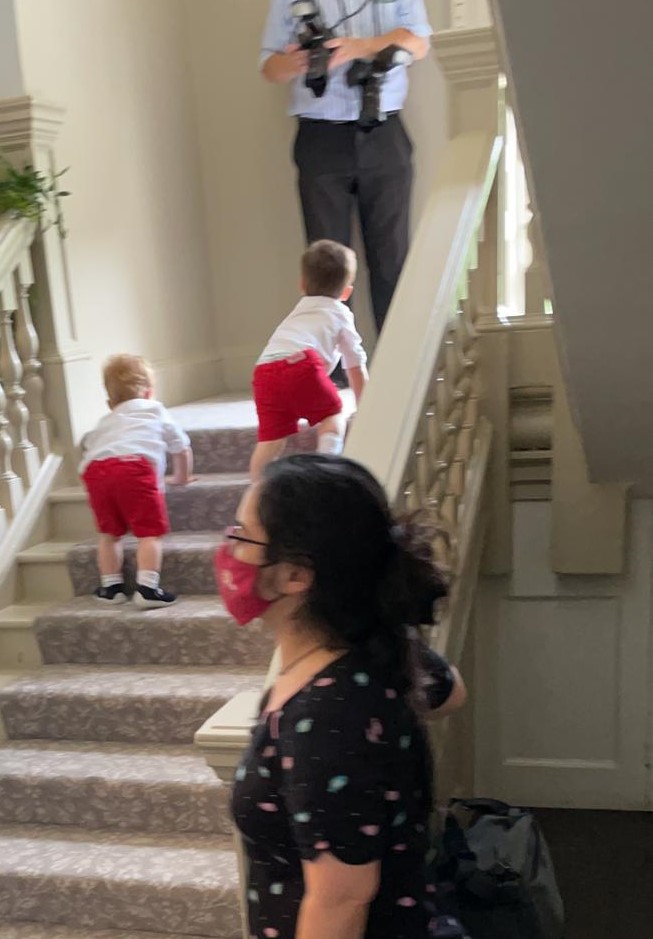
Once again, technology came to the rescue. My sister’s friend John gave me the most splendid (and I use that very British word deliberately) guided tour of Annabel and Jonny’s wedding in South London. We kicked off early and I had a bird’s eye view of the cake, the flowers, the cheeky bridesmaids and the page boys scampering about, the latter my nearly 2-year-old great-nephew twins, like little princes in their red shorts, white shirts and tartan bow ties.  I was there ‘live’ for the service, witnessed the exchange of vows, my niece radiantly happy and elegant, and Jonny resplendent in his kilt, cape and full tartan regalia, both brimming over with love. As they filed out, I had a quick chat with the just-married couple (making me the first person to address them as Mr and Mrs) and then stayed online while they were strewn with rose petal confetti, posed for photographs and then mixed and mingled. I had chats with many of the guests – from friends to family – until it got to 1am here and I had to remind them I was in my PJs and ready for bed!

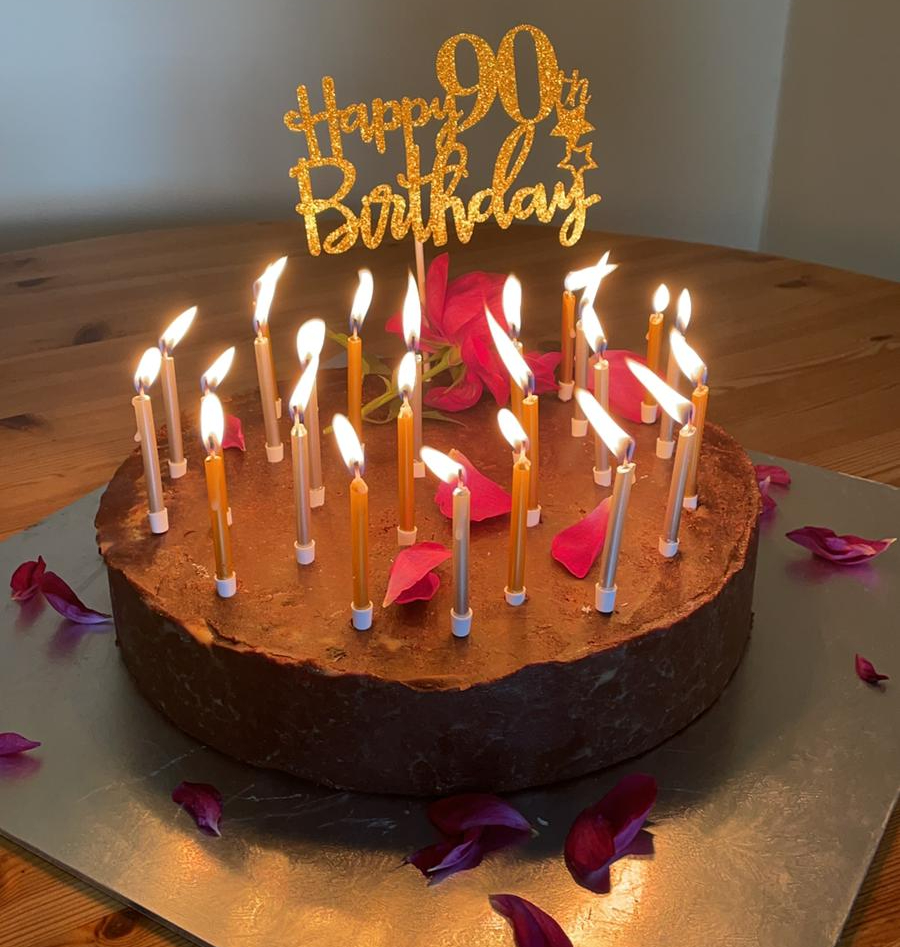
And then, the weekend before last, my brother Tim and I video-called into Mum’s 90th birthday celebrations – in fact, it was a four generation, three-country call from Mum’s breakfast table in Nottinghamshire to Tim and me tuning in from Melbourne, and my niece Georgie and the twins (the page boys) in suburban Paris! On the first call we watched Mum – in the swing and bright as a button from the get-go – open some of her cards and presents.

Four Way International Call

We tuned in again closer to her lunchtime party. This time, the newly-married Annabel, now Mrs Recaldin, was emcee. As bubbles and copious canapes were served, Annabel waltzed us around pointing out Mum’s many cards (35 and counting), the birthday banners and balloons and the assembled guests.  “Which of the grey-haired old dears do you mean?’ enquired Annabel as I asked to speak to some of Mum’s friends, “there are a few in the room!”

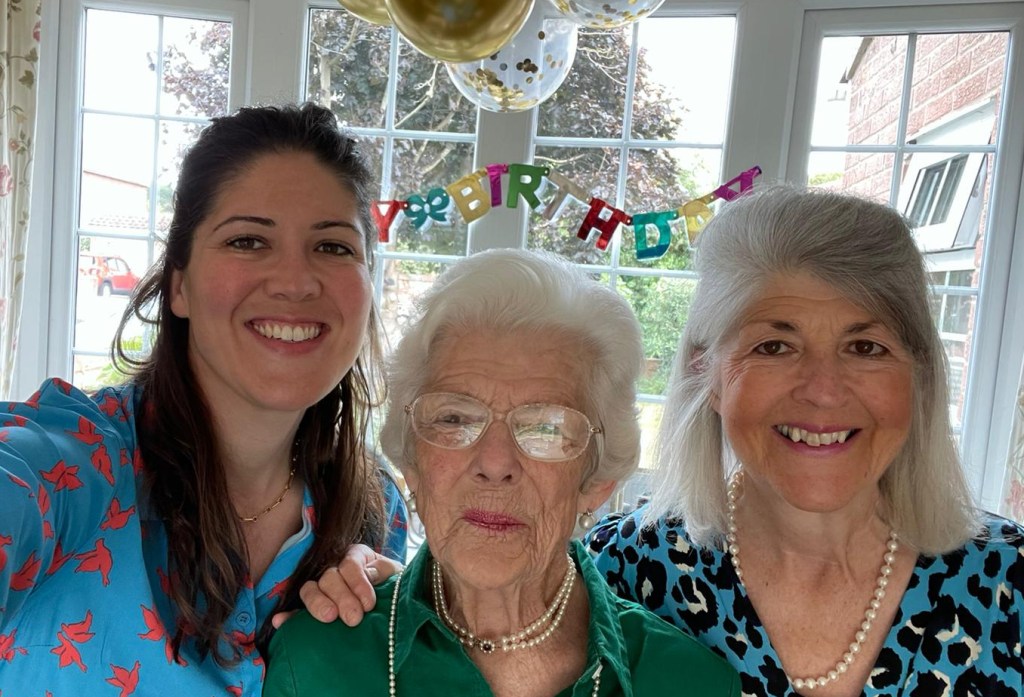
My brother, Charlie, toasted Mum with some heartfelt and touching words, acknowledging, too, the extraordinary kindness of her neighbours, George and Annette, who have been her rock and strength throughout the pandemic. “I’ve made it to 90,” replied Mum triumphantly, “and it doesn’t feel so bad!” Then, after thanking friends, family and neighbours for celebrating with her, she added: “I know I can be difficult sometimes…”  Thank Goodness for gin, piped up Charlie.

Having felt weepy on and off all weekend about missing Mum’s party, I went to bed with my heart aglow. I felt the love through the screen and across the divide, and was thrilled to see Mum, the belle of the ball, in her green linen dress and pearls. The word splendid comes to mind again. And next year I’ll be able to visit in person, catch up on hugs, lots of them, and kitchen table chat.

C is for Chevy: Cruising in the Yarra Valley

In these times of heightened uncertainty due to that other C-word, it’s important to remember that there is still joy and brightness in the world. This is not to deny or diminish the seriousness of the Covid-19 virus, the global disruption, the economic fall-out, the fear, panic, loss of livelihoods and lives and ensuing grief, the enormous stress on medical and social service professionals, and those who are vulnerable, disabled and disadvantaged.

So, to share a fun and cheerful story, last Friday my brother and I had a special day out, just ahead of all the cancellations and shut-downs. Tim turned 60 in January, and I decided to give him an experience as a present, rather than something gift-wrapped. When I read about d’Luxe Classic Car Tours in the Sunday Age travel section back in January, I knew I had found the perfect way to mark his milestone birthday.

I didn’t tell him what we were doing but he knew it involved some form of transport and a trip outside Melbourne. I’d seen pictures of the 1956 Chevrolet on the d’Luxe website but nothing prepared me for the razzle dazzle of the real thing. Purchased in Grand Rapids, Michigan, and brought back to Australia via a 2,000-mile road trip from Seattle to Los Angeles by John Frostell and his sons, Lois is a sight to behold: shining chrome fenders; spotless white wall tyres; and the body of the car – a four-door pillar-less hardtop sedan –  resplendent in two shades of glorious green, turquoise and a darker sea green, with pointy fins at the ‘trunk’ end.

Within minutes Tim and John were talking cars – Tim ran a very successful consultancy in the automotive industry and knows his stuff. As we set off from the CBD towards the Yarra Valley, we relaxed into the gentle purr of the V-8 (eight-cylinder) engine, its burbling rumble a feature, so John told us, of the special muffler (part of the exhaust system), a modification by the original owner. Winding down the windows there’s uninterrupted space – that’s where the lack of pillars comes in – and when the windows are up, the expanse of glass affords 360-degree views. It was a temperate day so we didn’t need the so-called ‘4/40 Air Conditioning’ – four windows down and forty miles per hour!

Inside, the roof, dashboard and seats are all turquoise, and the front bench seat (long enough for three) reminded us of a Ford Zephyr our father drove in the ’60s. The scallop shape of the speedometer and radio is echoed by the crescent shape made by the back windows when wound down. They really knew how to make things in those days, with every detail beautifully crafted, from the shining stainless-steel trims and the green push down door locks (remember those?) to the 18-inch green steering wheel. One simply had to pose in the driving seat!

Our route was via Wonga Park and we were soon in the leafy environs of the Yarra Valley amid farms, paddocks, fruit farms and vineyards. Our first stop was the Yarra Valley Dairy, which is housed in an old farm with a corrugated roof. We tasted four cheeses, a mix of cow’s and goat’s, and we particularly loved the Saffy, a cow’s milk cheese marinated in saffron, lemon rind, cumin seeds, garlic and olive oil, and the mature goats cheese log – the Black Savourine.

From there we headed up to Medhurst Winery, where arty sculptures dot the landscape and the cellar door and restaurant are on a hill with views over the estate.   We tasted our way through six or more wines including an excellent 2019 Rosé  (we both purchased some), the outstanding Sauvignon Blanc, much more subtle than some of the overly floral NZ numbers, and several reds, our favourite the 2016 Cabernet Sauvignon. Medhurst was also our lunch stop, and we shared a plate of glorious cured salmon, smoked chicken croquettes, crisp on the outside and gooey on the inside, followed by tempura eggplant dusted with harissa.

By then our time was pretty much up but we snuck in a trip to Alchemy Distillery in Healesville. With former incarnations as a wood-fired bakery and an antique shop, the place is full of character, a stuffed deer looking like Diana Ross with black hair, leather skirt and boots sits surrounded by barrels and artfully arranged piles of antlers, while in another room there’s a majestic stag’s head and a surviving Small & Shattell cast iron oven set into a niche in the wall. If spirits are your thing, Alchemy make chamomile gin and citrus vodka – I tried the latter, its sharp lemony notes would make it a glorious summer drink. Eagerly awaited is their single malt whisky – we saw the barrels in the tasting room – which is due in 2021 after three years’ maturation.

All our senses fully sated, we cruised back to Melbourne to a soundtrack of Latin America jazz, Nina Simone and other mellow numbers. To find out more go to: www.dluxeclassiccartours.com


Steeped in history: from Malta to Queen Mary’s Mansion in Yorkshire

When I studied history at school it was often delivered parrot fashion – reciting dates, battles, Kings and Queens – or from musty-smelling books wrapped in brown paper. There were occasional highlights such as making a book about the Romans and their customs (I still have my little cardboard effort somewhere) but, on the whole, it was one-dimensional and flat. But now I can’t get enough of it. Piecing together, and making sense of, the present through studying who and what went before is endlessly fascinating.

Visiting the island of Malta in November I was captivated by a timeline in the museum of archaeology in the capital, Valletta. That morning I had visited a 6000-year-old underground burial chamber at the Hal Saflieni Hypogeum. Only discovered by chance in 1902 by construction workers, scientists estimate that more than 6000 people were buried here. And, to put it in perspective, the tombs pre-date Stonehenge, the Acropolis and the Colosseum.

For three days I became a timeline obsessive, immersed in the multi-layered history of this rocky Mediterranean island, each of the many occupiers leaving their mark on the culture, language and architecture from the Romans to the Carthaginians, the Arabs, Italians, Sicilians, the Knights of St John, who arrived from Rhodes in 1530, the French (during the Napoleonic occupation) and, of course, the British. It was a British colony from 1814 to 1964, and served as a strategic military base in the Second World War.

Malta was love at first sight for me. As  the taxi from the airport negotiated Valletta’s labyrinth of narrow streets near my hotel, I was enchanted by the painted wooden box-frame balconies, like mini greenhouses, on the sides of buildings, the retro shopfronts, the many churches, statues of saints seemingly on every street corner and the plethora of plaster saints adorning doors along with brass door knockers designed variously as dolphins, lions, mythical figures or in the shape of the Maltese Cross.

One of my favourite places was the Casa Rocca Piccola, a privately owned palace that has been in the de Piro family for nine generations. Full of treasures including an 18th Century sedan chair, a Venetian glass chandelier, a cabinet of fans, a  private chapel,  a portable chapel (the kind the aristocracy took to their summer residences), silverware,  several Maltese clocks – these were only owned by the aristocracy who had staff to wind them several times a day –  and the ‘summer’ dining room laid up for a banquet with fine lacework mats, silverware, candelabras and cut glass.

From there it was an orgy of Baroque gold at St John’s Co-Cathedral with its frescoed barrel vault ceiling and marble tombs underfoot, each one commemorating a Knight of the Order.  I got a bit bogged with the audio guide meaning I took too long working out which side chapel was which. By the time I got to the Oratory with the two Caravaggio paintings it was closing time. No sympathy from the guard who suggested I took photos of the paintings with my phone, presumably so I could enjoy them over my dinner for one later! Damn!

In Mdina, once the capital of Malta, and derived from the Arabic word Medina, I skipped the Cathedral – no more audio guides – and instead sat for ten minutes in the Carmelite church admiring the stained-glass windows and relaxing into the pealing of the midday bells. Then, by chance, I discovered Palazzo Falson, a private museum housing the collection of Frederick Golcher OBE (1889-1962), a philanthropist, artist and researcher of Swedish descent, educated in Britain. I marvelled at the collection of Bohemian glass including a double-ended Victorian scent bottle (perfume one end and smelling salts the other), the snuff boxes, fob watches, model ships, Dutch still life paintings, table top cabinets inlaid with marquetry, and closer to home in the UK, Staffordshire figures.

One room at the Palazzo Falson was given over to weapons and armour, but nothing compares to the Palace Armoury in Valletta which ranks among the world’s greatest arms collections, and spans the reign of the Knights from the 15th Century till the arrival of Napoleon in 1798. Fashions changed, and as designs got more sophisticated suits of armour allowed for greater movement. Actual armour and weapons used in the Great Siege (against the Turks) in 1565 sit alongside shields, swords and muskets captured from the Ottomans. Fascinating stuff.

Every time I return to Britain, I wallow in history and often visit a castle or historic building – it’s kind of de rigueur! This time, I got to stay in a Grade II early 17th Century stately home in Yorkshire. Goldsborough Hall gets a mention in the recent Downton Abbey film; HRH Princess Mary, the Queen’s cousin, lived here in the 1920s.  I was there for the wedding of my niece Anna to Simon. The service was in the delightful adjoining church of St Mary the Virgin, where, regal, relaxed and radiant, my niece swept in to Pachelbel’s Canon in D Major.

From there – dodging the rain – it was back to the hall for drinks in the Library complete with oak panelling, stag heads, Chesterfield sofas and copies of Country Life dotted around. After much feasting, drinking, dancing and merrymaking, we ascended the oak staircase framed by stained glass windows to our various rooms. My bedroom was named The Duke of York, thankfully not after the current Duke of York, he of Pizza Express in Woking notoriety, but after Albert (aka Bertie), second son of George V, who later became George V1, the king with the stammer featured in the film The King’s Speech. Luckily my brother, Charlie, had no such problems and delivered a masterfully crafted Father of the Bride speech; clever, moving and funny.

The next morning it was wonderful to wake up to views over parklands and grounds laid out in the style of Capability Brown during the 1750s.  A right royal occasion indeed, and suitably historic on all levels.

What is the use of a house if you haven’t got a tolerable planet to put it on?” (Henry David Thoreau)

The other day as I was walking in my local suburb with the dog child, I noticed that yet another house had been bulldozed to the ground to make way for yet another new build. But this was no ordinary house and certainly not a tumbledown. Well-maintained, it was an elegant and gracious Victorian-style home enclosed by a bluestone wall with a polished brass number plate. In fact, it was smart enough to have statues in the garden. Like Hans Christian Andersen’s Little Match Girl – albeit in a Southern Hemisphere setting – I used to peek through the fence, admiring the porch with the tiled floor, the wrap-around veranda and the ornate cornices on the roof. This is the kind of house I would buy if I won the Lottery, I told myself.

I was aghast seeing it demolished and furious at the waste of materials – those lovely long sash windows – and the senselessness of it.  And this during the summer that Australia has been experiencing the worst bush fire season in its recorded history, with over 2000 homes destroyed. One the hand greedy developers and fickle homeowners and, on the other, individuals and families powerless to save their homes from being razed to the ground by ferocious fires.

Whatever your views about climate change and its impact on our environment, one thing is indisputable. The way we are living on planet Earth is not sustainable. We rape, pillage, plunder, pump out pesticides and plastic, spend, acquire, amass, throw away and then start over again. And we don’t learn from the past or heed the warnings. Think of Rachel Carson’s Silent Spring published in 1962, considered to be the book that kick-started the global grassroots environmental movement.

And I’ve just read – and very much enjoyed – John Steinbeck’s Travels with Charley: In Search of America. In 1960 Steinbeck set off in a truck converted to a camper van on an epic journey across America with his standard poodle, Charley, a colourful character in his own right.  It’s a wonderful tale full of rich and lyrical observations of the natural world – especially the giant redwoods in southern Oregon, amusing anecdotes about the different states he passes through, and chats over coffee and whisky with a cast of quirky characters he meets on the way. But it’s also deeply reflective and the themes he raises are still relevant today.He laments the amount of waste (including wrecked and rusting cars) in American cities, and the amount of packaging used in every day life: “I do wonder whether there will come a time when we can no longer afford our wastefulness – chemical wastes in the rivers, metal wastes everywhere, and atomic wastes buried deep in the earth or sunk in the sea.”  He talks of towns encroaching on villages and the countryside, supermarkets edging out ‘cracker-barrel’ stores. “The new American finds his challenge and his love in traffic-choked streets, skies nested in smog, choking with the acids of industry.” And he encounters political apathy – life seems to revolve more around baseball and hunting than discussions about the respective merits of Kennedy versus Nixon in an election year.  Sound familiar?

Steinbeck died in 1968, just eight years after writing this book, at the age of 66. I wonder what he would have made of the digital era. I suspect he might not have been much of a fan. “No region can hold out for long against the highway, the high-tension line and the national television.” And he rails against trailer homes, a tax efficient form of property ownership with an inbuilt form of one-upmanship as owners constantly upgrade to a better model. Overall, he comes away disenchanted.

“We have in the past been forced into reluctant change by weather, calamity, and plague. Now the pressure comes from our biologic success as a species. We have overcome all enemies but ourselves.”

How prescient, and how uncomfortable, especially given the recent outbreak of Coronavirus. Let’s face it, humans are the problem. Planet Earth can do without us, and most likely will cast us aside – as insignificant specks of dust – unless we learn to live in harmony with the ecosystems that support all life, giving us clean soils, air and water.

Rather than getting depressed and defeated, however, it’s vital that we use the current level of global discontent to campaign and advocate for change to policies and practices that reduce emissions and promote sustainability. And as we do that, let’s not lose sight of the many positive initiatives being undertaken by changemakers, entrepreneurs, inventors and scientists to tackle social and environmental challenges.  It’s not all bad: just this week I read that one of Britain’s largest builders, Bovis Homes, is incorporating “hedgehog highways’ into existing and future housing – hedgehogs walk more than a mile each night foraging for food, but numbers have dropped significantly due to habitat loss and pesticide use. A nice win for biodiversity!