Phnom Penh: history, heritage and hornbills – Cambodia Part 3/3

The BBC has named Phnom Penh one of the 20 best places to travel in 2026 and I can see why. It’s a vibrant city, full of movement and colour – so much colour – with an interesting mix of historical and contemporary attractions – not to mention exquisite cuisine. In this post I delve more into the city’s history and heritage including a harrowing but educational trip to the Choeung Ek Genocidal Centre, one of 300 Killing Fields across Cambodia. To revisit my first post on Phnom Penh go to https://thisquirkylife.com/2025/12/30/fun-festivities-and-flavours-in-cambodia-phnom-penh-and-battambang-part-1-of-3/.
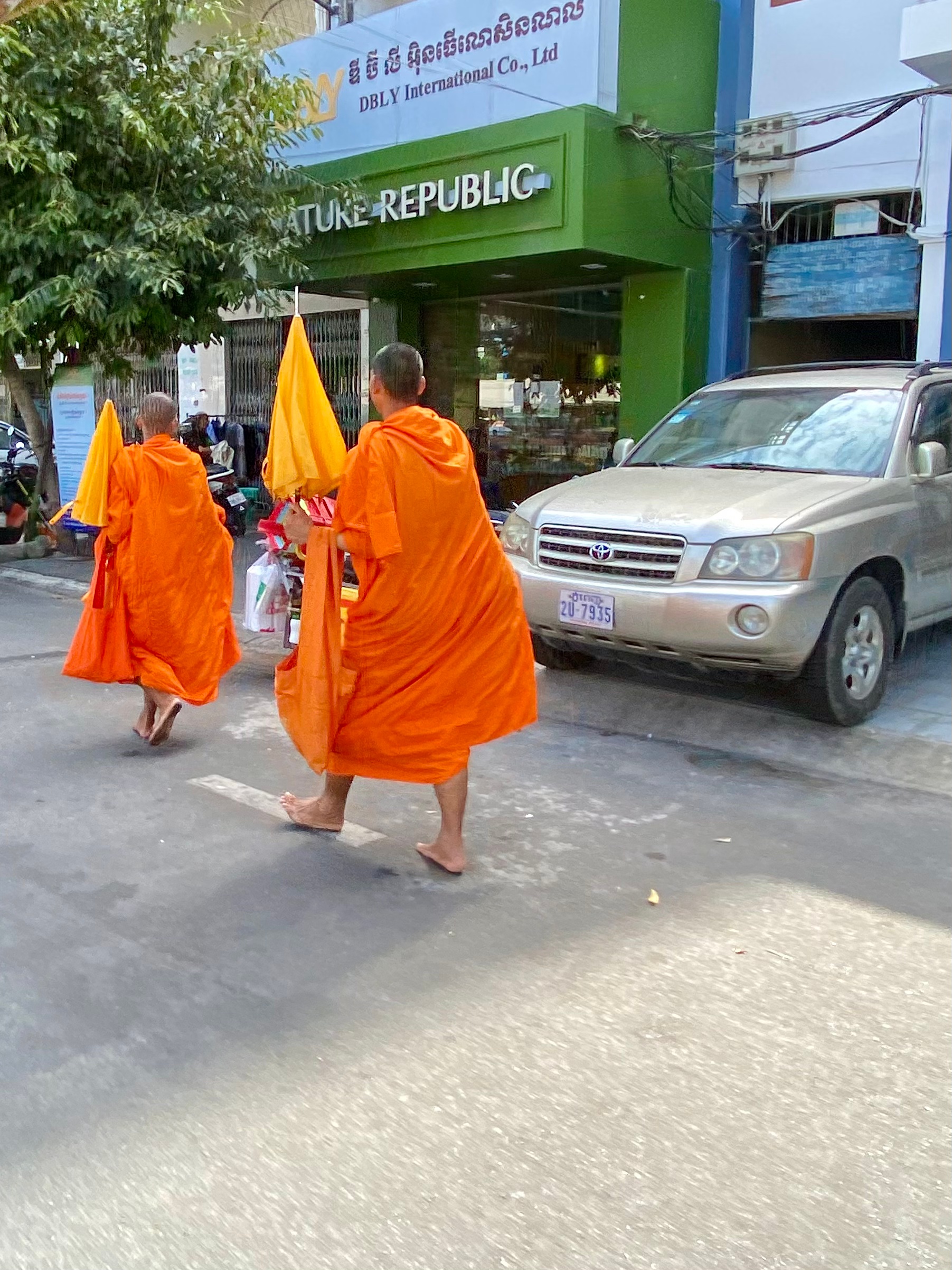
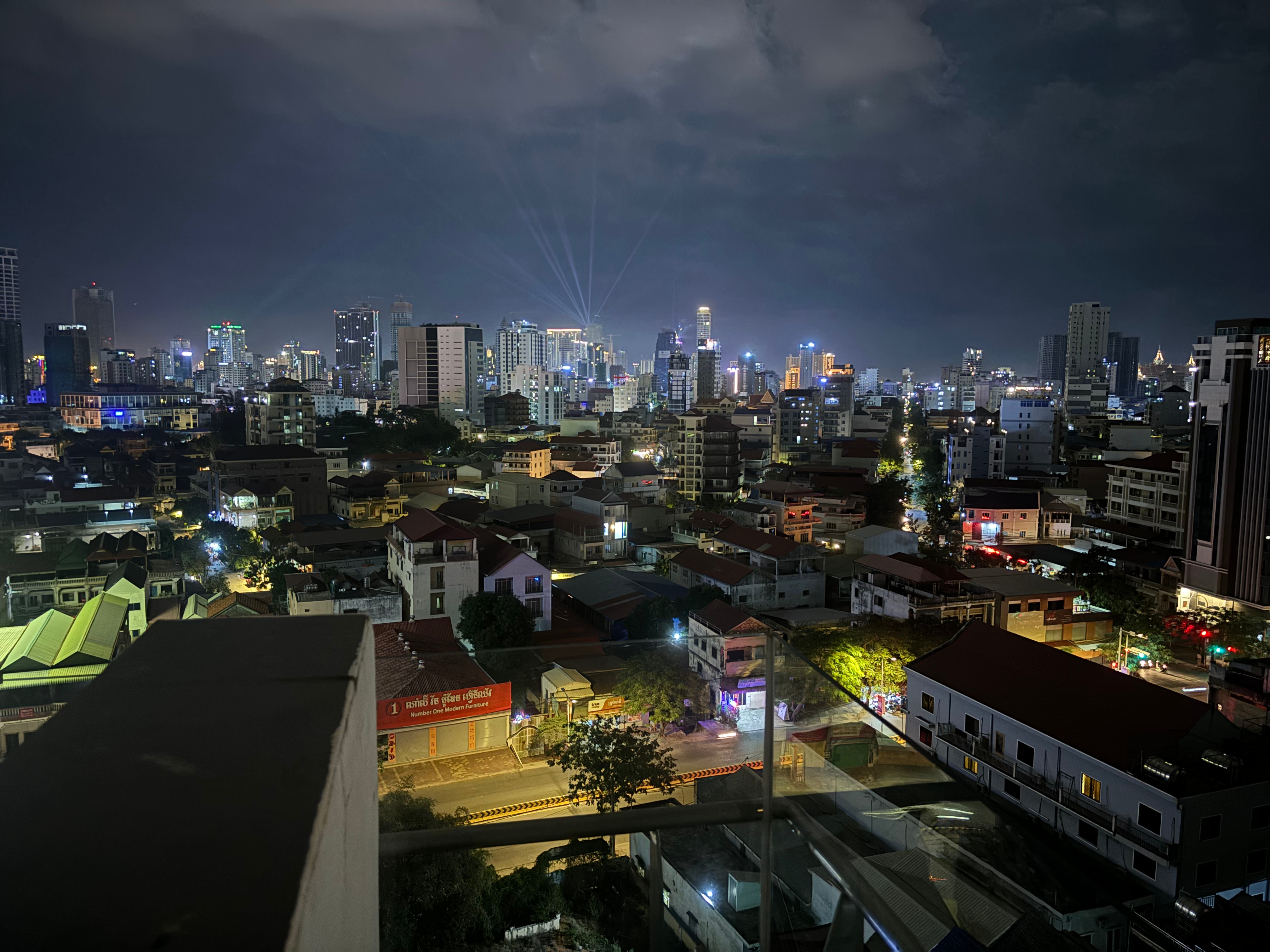
Di and I had seen in the New Year on the rooftop of her appartment block, each sipping a whisky and soda with a panorama of fireworks and crackers going off across the city. After a slow day – a swim in her rooftop pool, a Khmer massage and a meal out – on the 1st, it was back to exploring the city on the 2nd January.
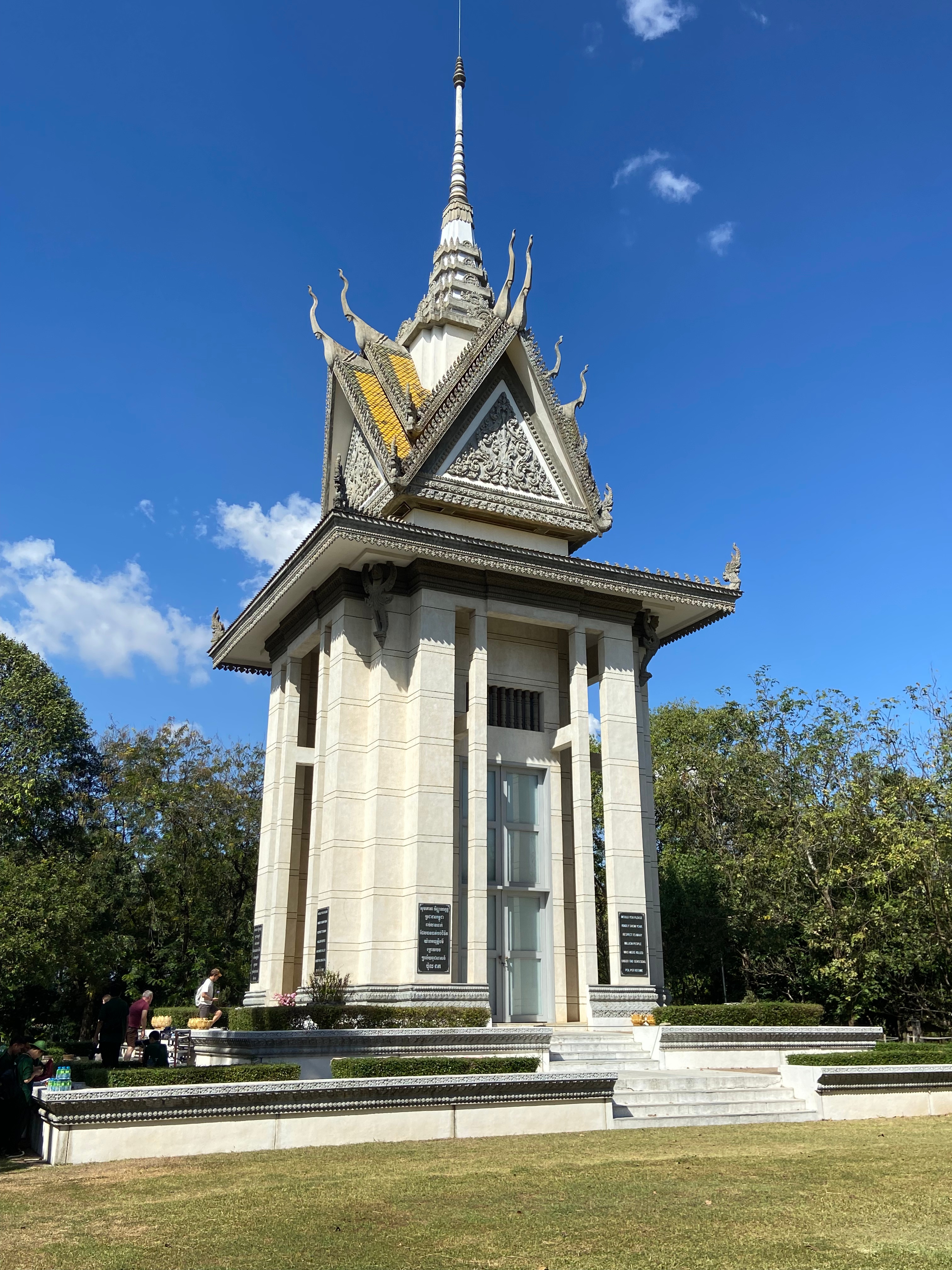
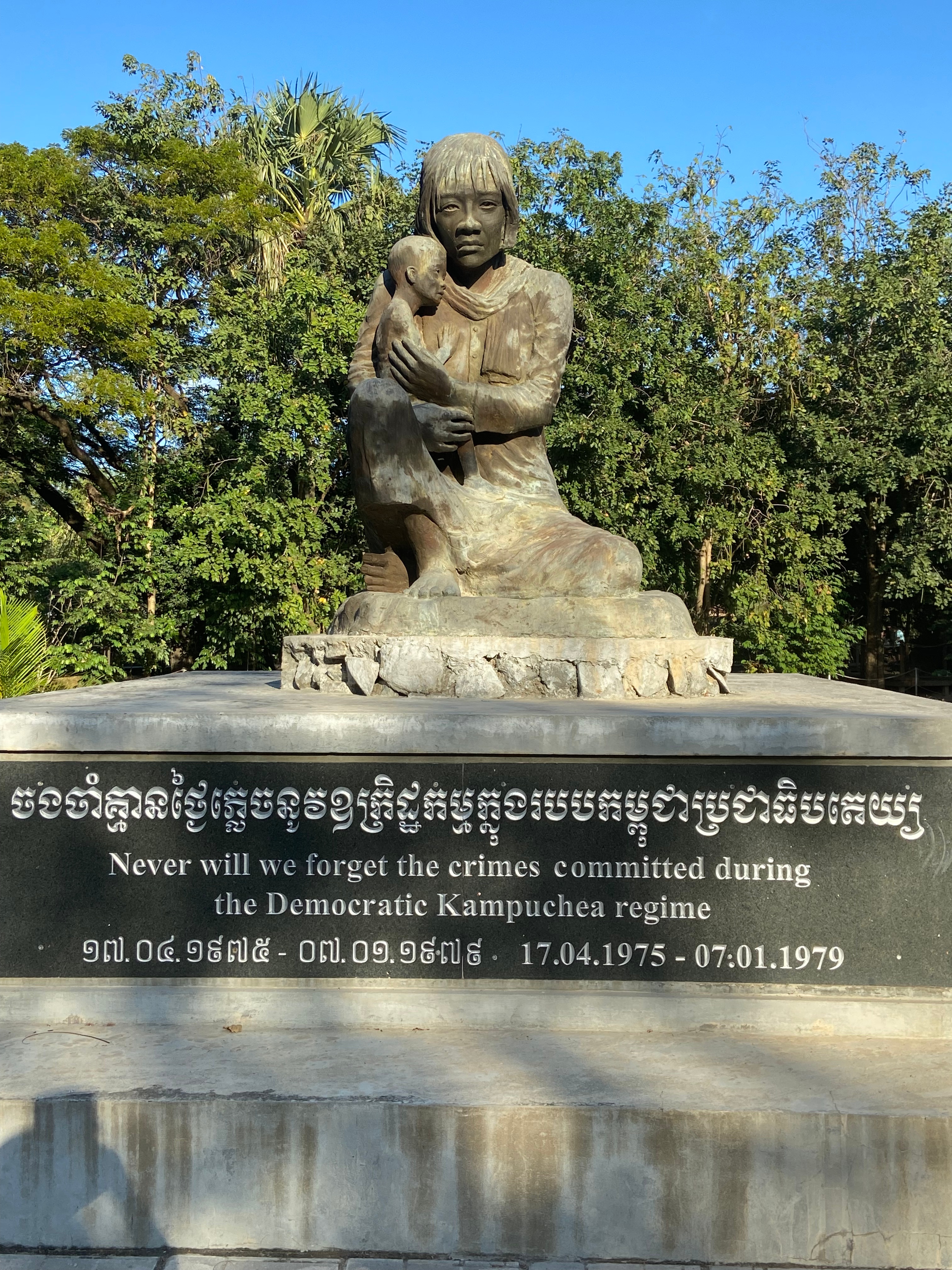
The Choeung Ek Genocidal Centre is about 15km from the city centre. We took a tuk-tuk there and, on arrival, kitted ourselves out with the audio guide which takes you around the site including a lake. I grew up familiar with hearing about the brutal Pol Pot regime, but I had no idea that it was so savage, so rough and ready, so quick and so merciless. The army stormed through the cities in three weeks in 1975, rounding people up including anyone connected with education or a profession – wearing glasses was enough to single you out – and took them off in trucks to the Killing Fields or to work on collective farms. In their fervour to create a classless, agrarian society, they shut down schools, libraries, theatres, police stations and anything related to civic life.

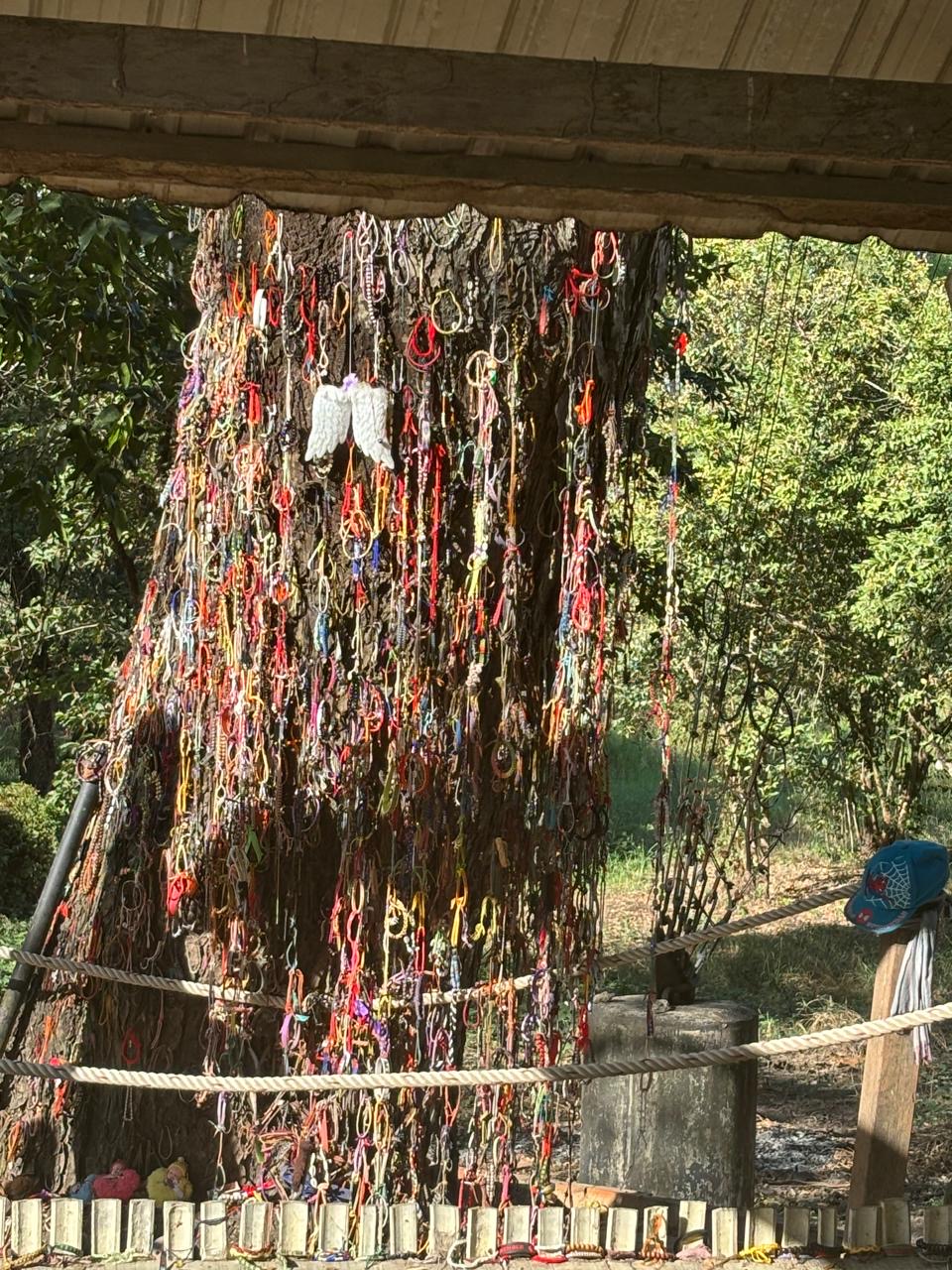
Thousands of so-called enemies of the state were massacred at the Genocidal Centre– and the henchmen put on revolutionary music to mask the groans and cries of those being tortured or hacked to death.  What struck me was the unsophisticated savagery of their methods – their weapons included lengths of plastic wire, bamboo canes, rakes and agricultural equipment.  Their level of cruelty knew no bounds – they smashed babies against trees.  I can’t find the words to describe the grief and horror – it was like being winded – I felt on seeing the memorial tree, hung with ribbons and wrist bands, that marks a site of child massacres. And all around are mass graves, fragments of bloodied cloth, clothing and bones. The audio tour ends at the memorial stupa, inside of which are the skulls or skull remains of some of the site’s victims. You can see the holes or marks in the skull where they were beaten or bludgeoned. 
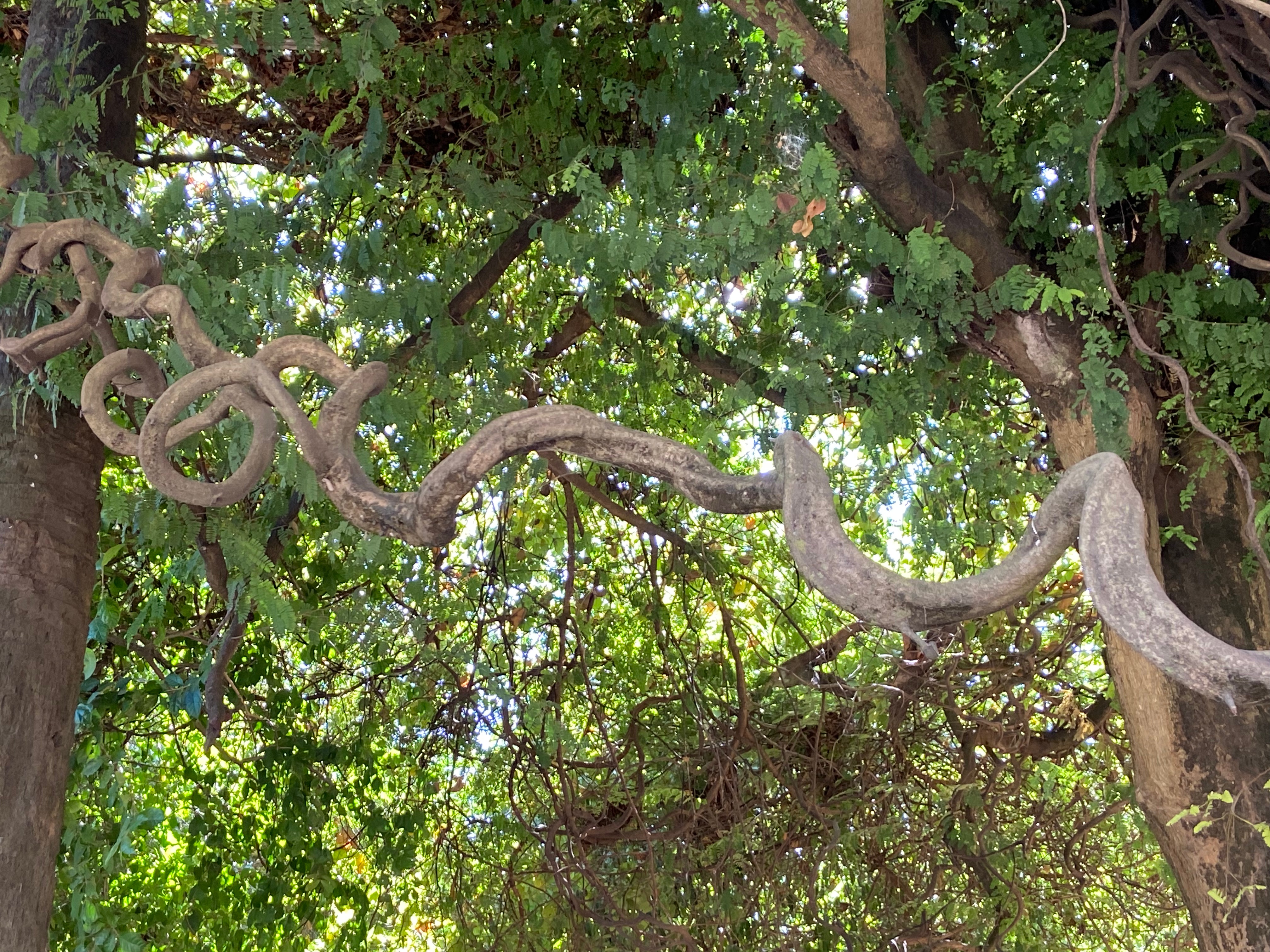
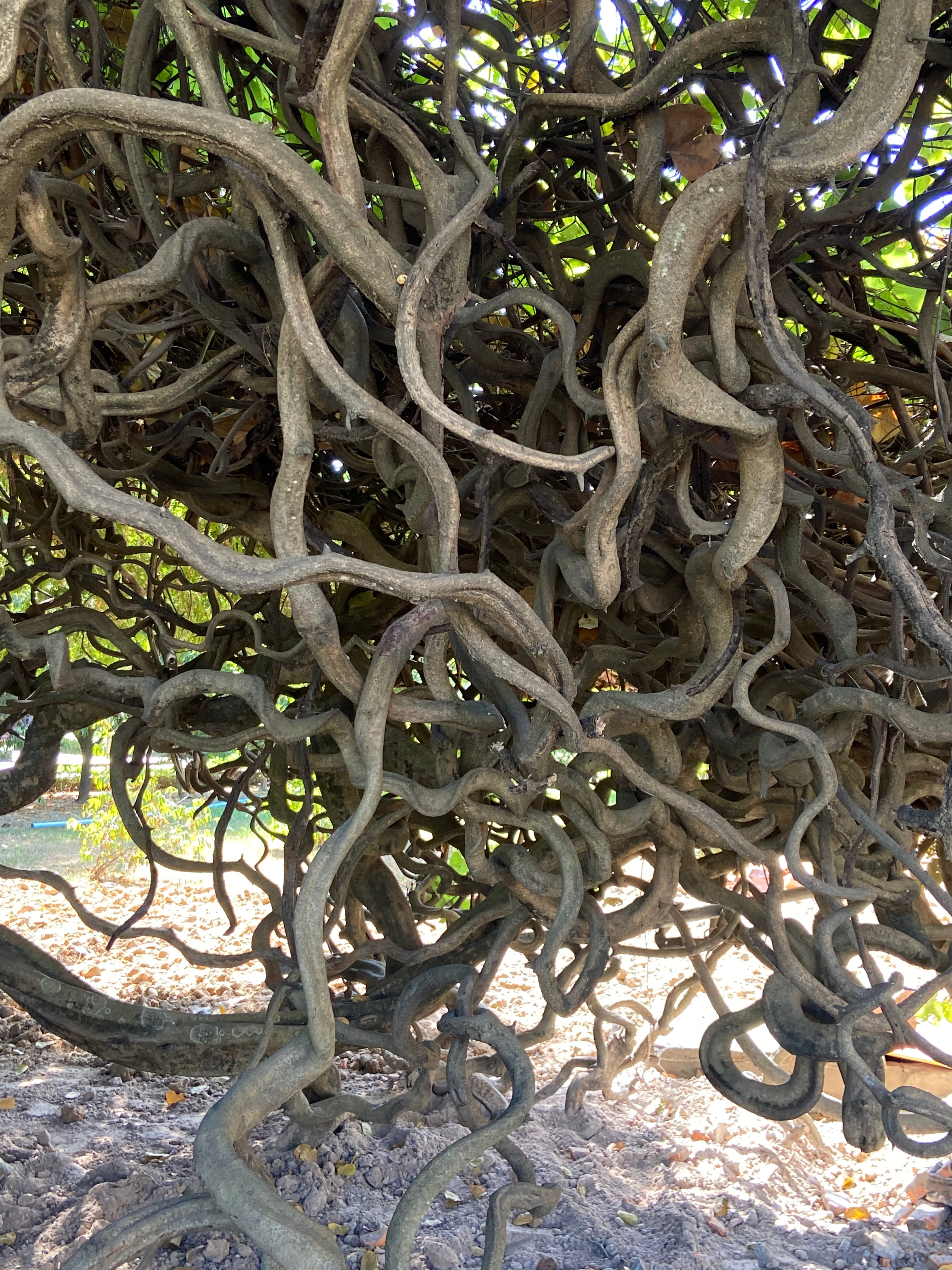
I share this information, at the risk of making readers uncomfortable, lest we forget – and to honour (and keep alive) the memory of those who senselessly lost their lives. Unfortunately, across the world, man’s inhumanity to man continues and history keeps repeating itself. If only we’d learn. You feel the heaviness of the place – it reminded me of doing a tour of Auschwitz – and we were tired and wrung out after our tour. There’s a tree at the site that has grown into a tangled knot of roots – it’s almost as if it’s mirroring the hellish conditions experienced there.
On a lighter note, our street art and street food tour took us to various neighbourhoods. Travelling by moto remorque, we started at the Boeung Keng Kang Market, a bustling market frequented by locals.
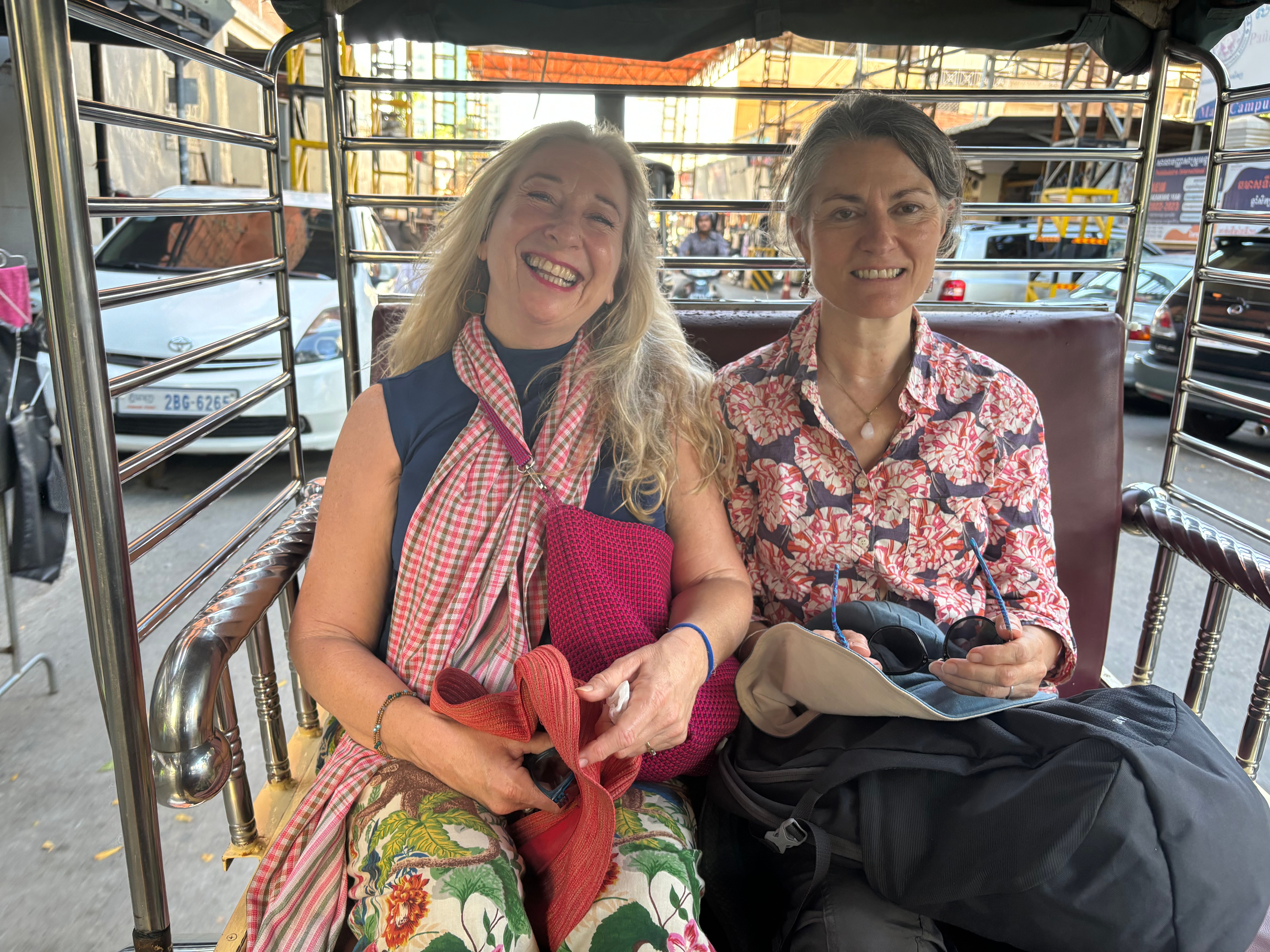
Travelling by remorque

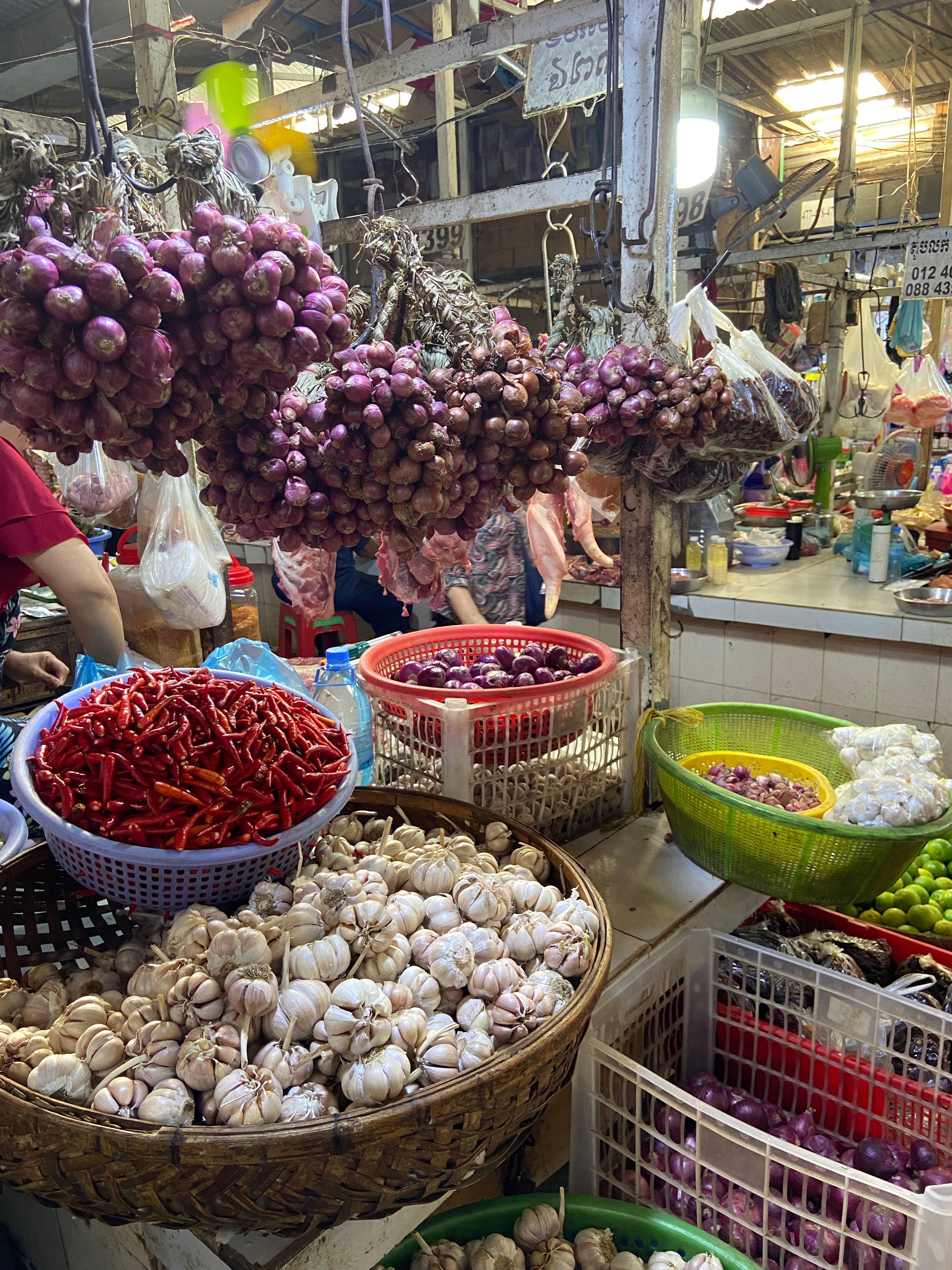
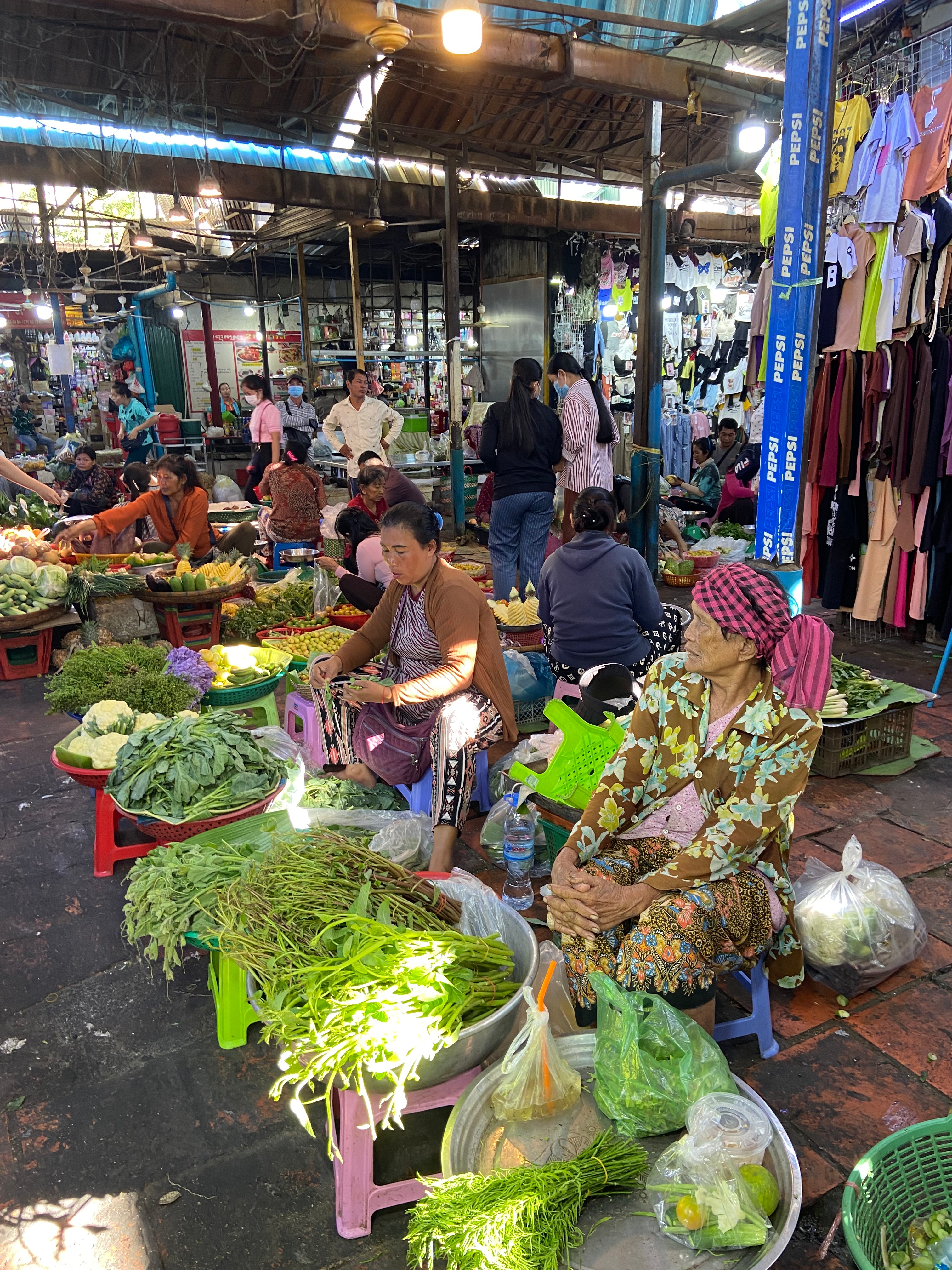
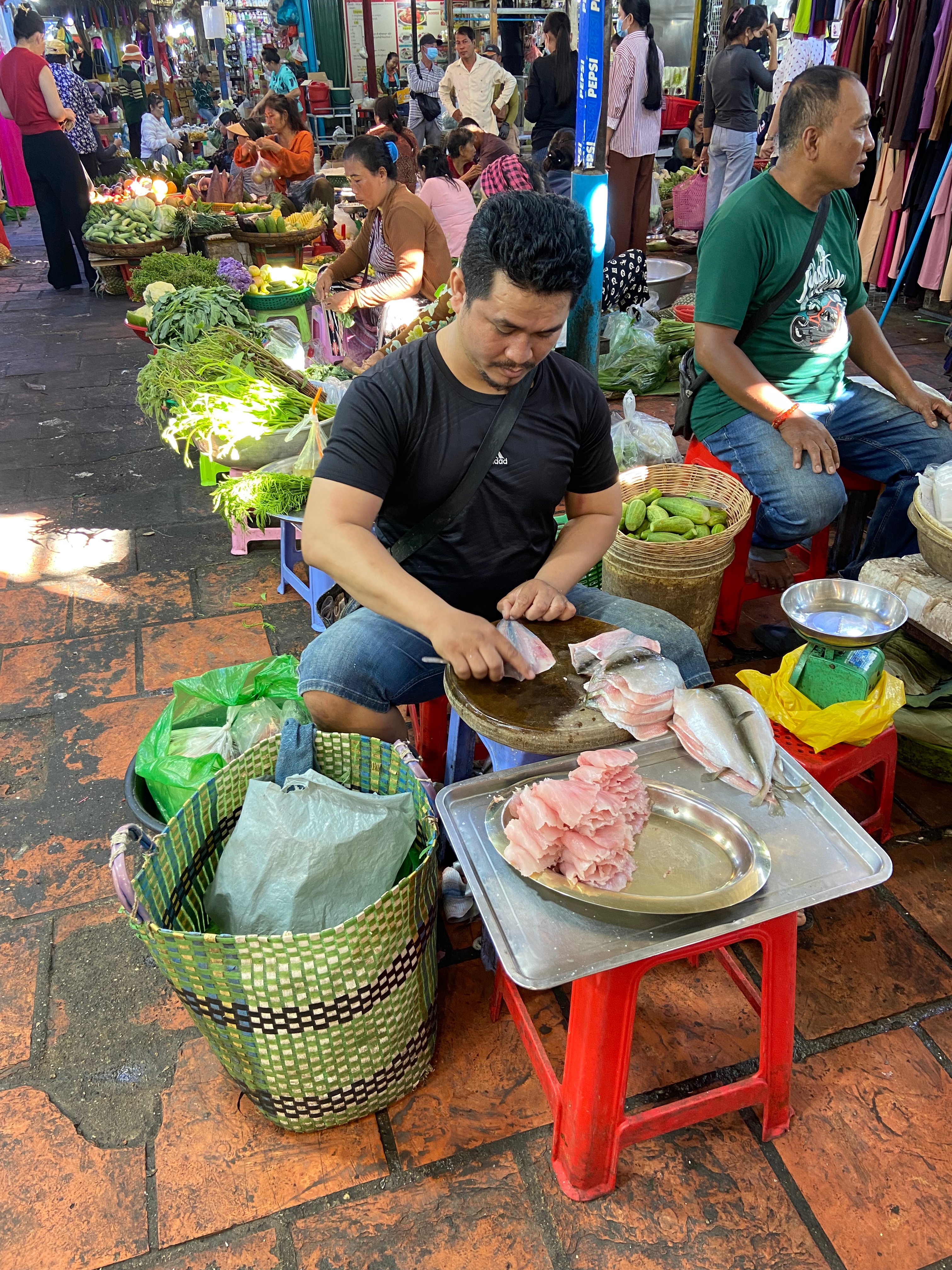
There were stalls with shoes, clothes, bedding, a hairdresser with old-fashioned pedestal dryers, a woman having her hair washed in full view and a fortune-teller – the cards spread out in front of her – supine and taking a quick nap. The fresh produce was displayed in shallow dishes on stools close to the ground in a palette of yellows, greens, purples, oranges and reds. Next door to a garlic-only stall fish was being filleted while other stalls offered fried food or fish and meat skewers as snacks on-the-go. We had the first of two breakfasts here – a delicious bowl of rice noodles in broth with crispy pork, pressed pork and fermented vegetables on the side. Our second breakfast came at the end of the tour at a roadside stall – we had a traditional breakfast of rice and pork with pickled vegetables.
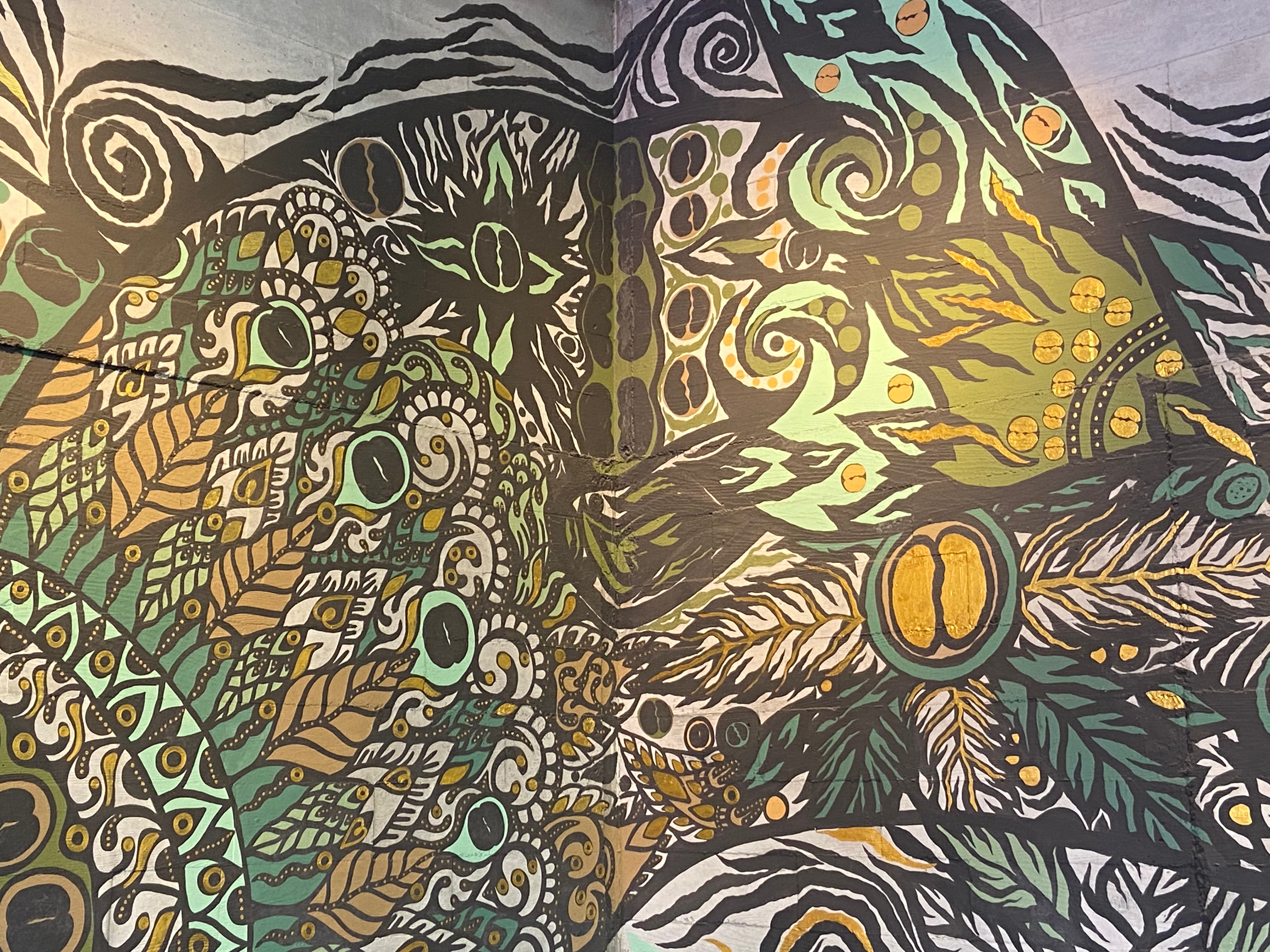
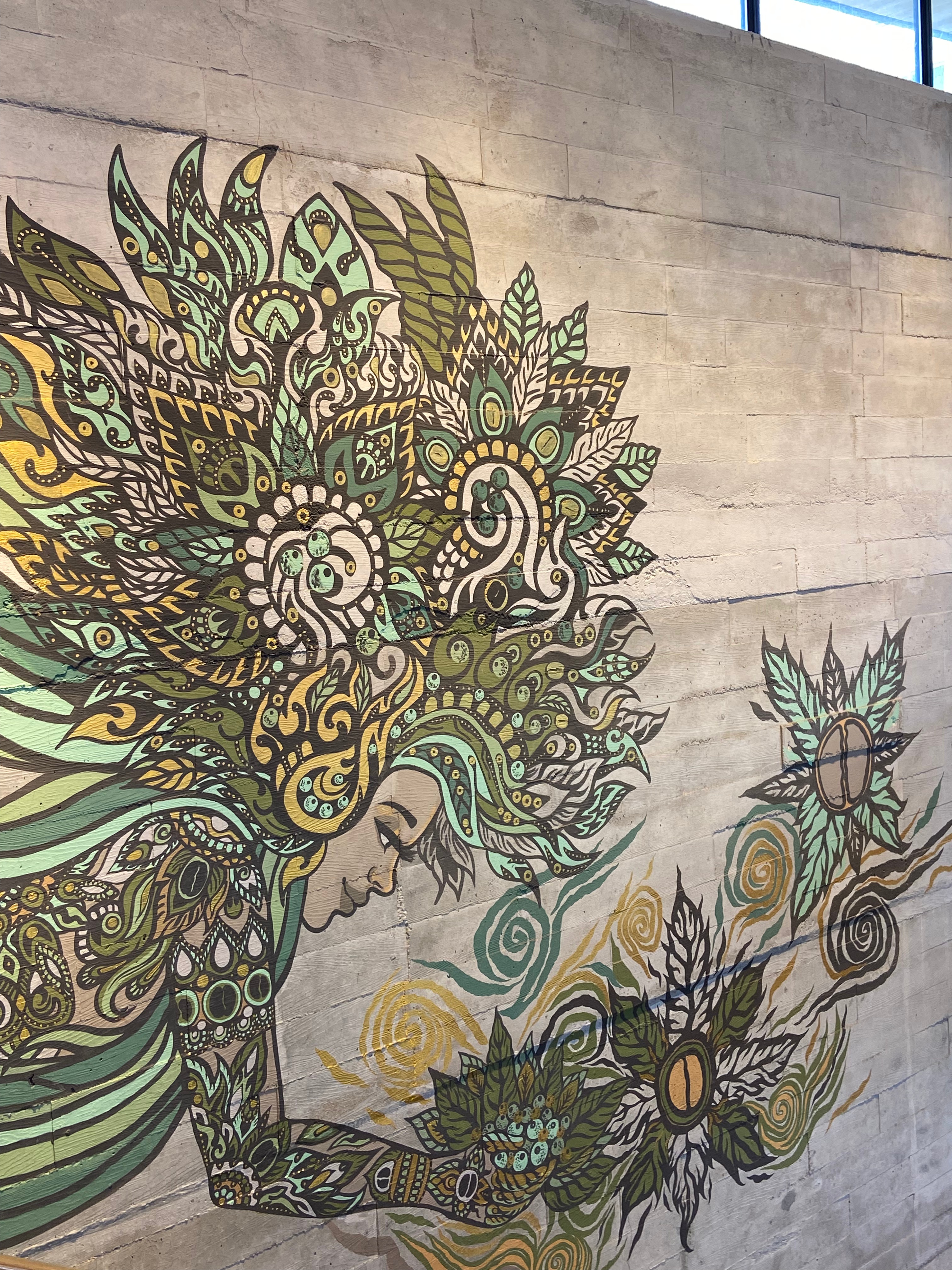
In BKK1, the ex-pat area, we dropped in at Starbucks, the first in Cambodia and a very upmarket one, but we were not there for the coffee but to see a stunning mural of a mermaid on the wall extending up the stairs. It’s by trailblazing female artists Lisa Mam and is stunning. The mermaid has big hair – a headdress of wonderful tendril-like plants in green, gold, yellow and a nearly-white pink. The mural incorporates coffee beans (in a nod to Starbucks) but also references traditional art. 
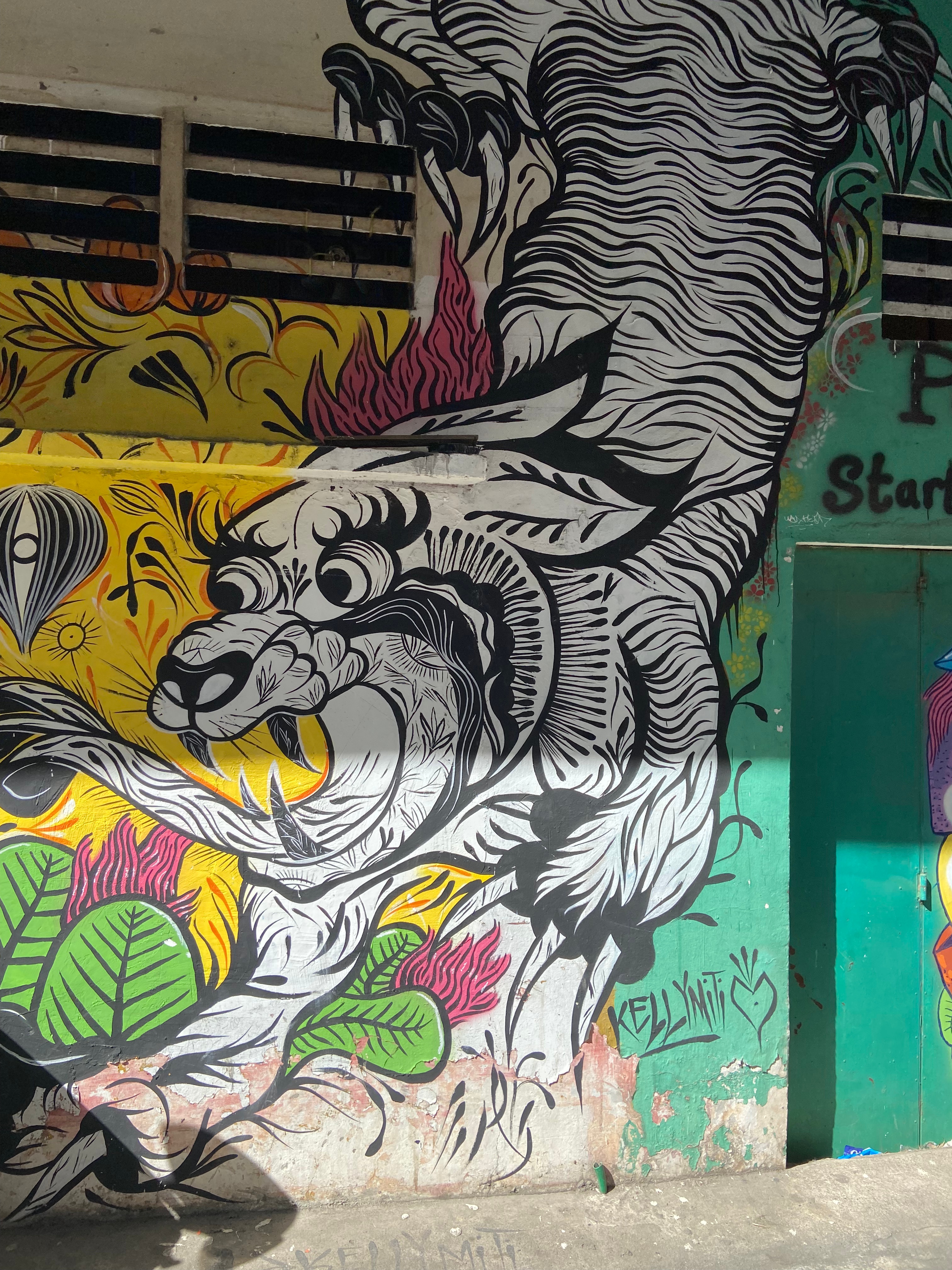
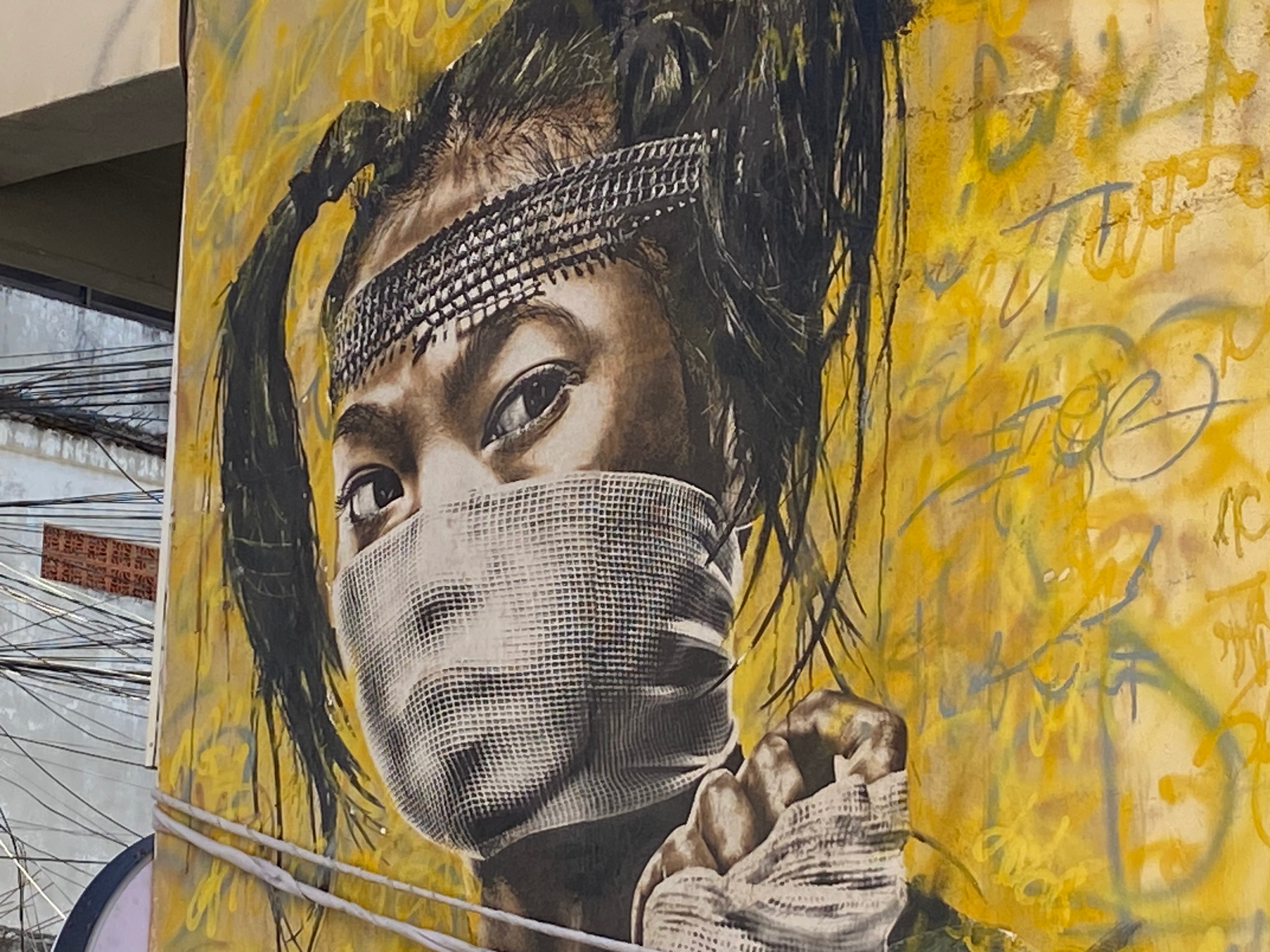
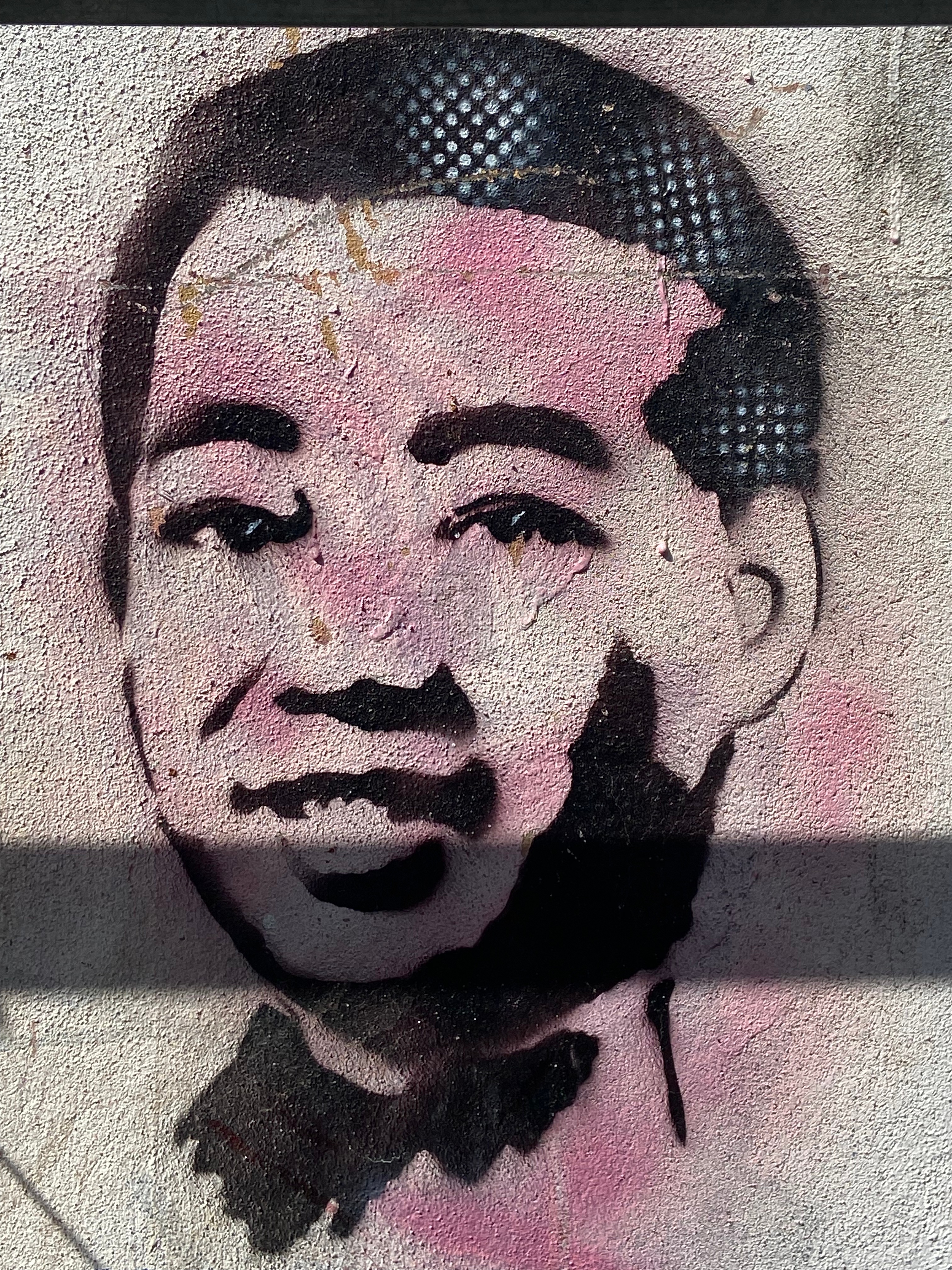
Our next stop was Boeung Kak 1 to see the street art. The Boeung Kak Lake used to be a thriving residential area for around nine villages and the lake, the largest urban wetland in Cambodia, an important source of fishing, food and water for around 4,000 families. In 2007 Chinese and Cambodian developers were granted a 99-year lease, triggering (peaceful) protests in 2011 by those facing eviction. Several BKK villagers were arrested, and others were beaten by armed anti-riot police. One of the protestors was land rights activist and human rights defender Tep Vanny – she was sentenced in 2012 and, although later pardoned and freed, she keeps a low profile to this day. I found the portrait of Tep Vanny – note the defiance in her eyes – to be one of the most powerful pieces of street art, which also includes traditional art and motifs such as dragons, demons, serpents and mythical monsters, as well as a picture of Cambodia’s Elvis, Sinn Sisamouth (apologies for the misspelling in Part 2/3) – see: https://thisquirkylife.com/2026/01/07/cambodia-part-2-3-siem-reap-embassy-restaurant-angkor-wat-temples-and-theams-gallery/.
Despite the corruption – there have been delays to the development of the filled-in lake resulting in half-finished high-rises – it’s encouraging to see there’s still a surviving community here:  vegetable, fruit and palm sugar sellers came past on their motorbikes, some women were sitting chatting in a café and there’s a vinyl record shop.  

Our tour guide – when asked – shared a bit about his personal story, which is one of disadvantage. His father died when he was young and he, his sibling and mother moved to Phnom Penh to get work, ending up being forced to scavenge a living on a landfill site. Happily, thanks to support from a French charity, he got an education enabling him (and his family) to break the cycle of poverty. Stories like this one are a reminder of why it’s such a disaster for countries such as Cambodia that Trump has cut so many of the foreign aid programs.  On my first day in Phnom Penh back in December when we were walking along the river quay, Di had pointed out a disabled man who has no legs and is blind. She told me his relatives bring him there every day to beg for money. Then driving back into Phnom Penh after our trip to Siem Reap, I was startled to see a little girl, possibly as young as six or seven, walking into five lanes of traffic to beg.  Cambodia is very much a developing country and has a legacy of intergenerational trauma, and many people and organisations are doing incredible work – but this work needs ongoing funding.

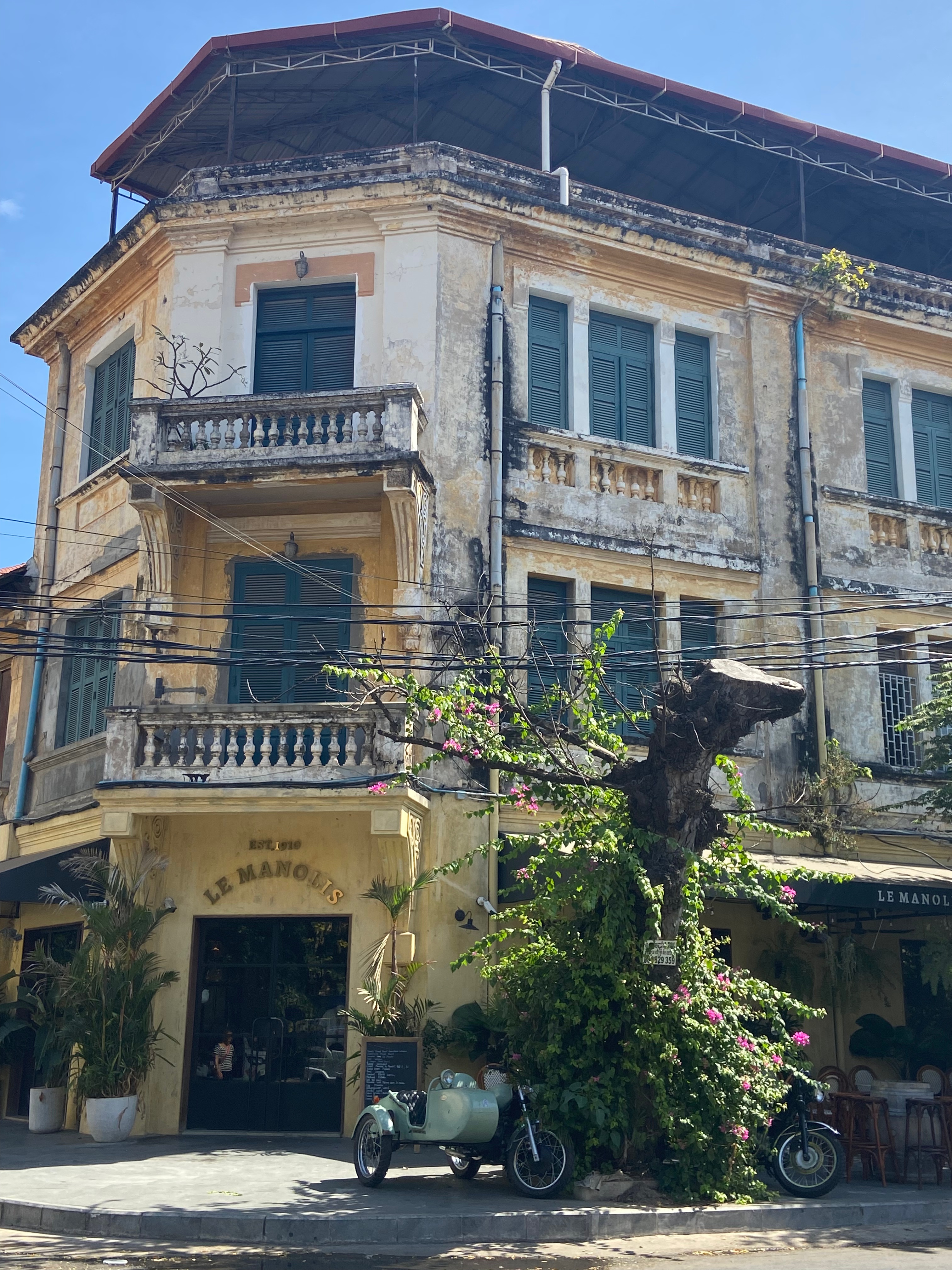
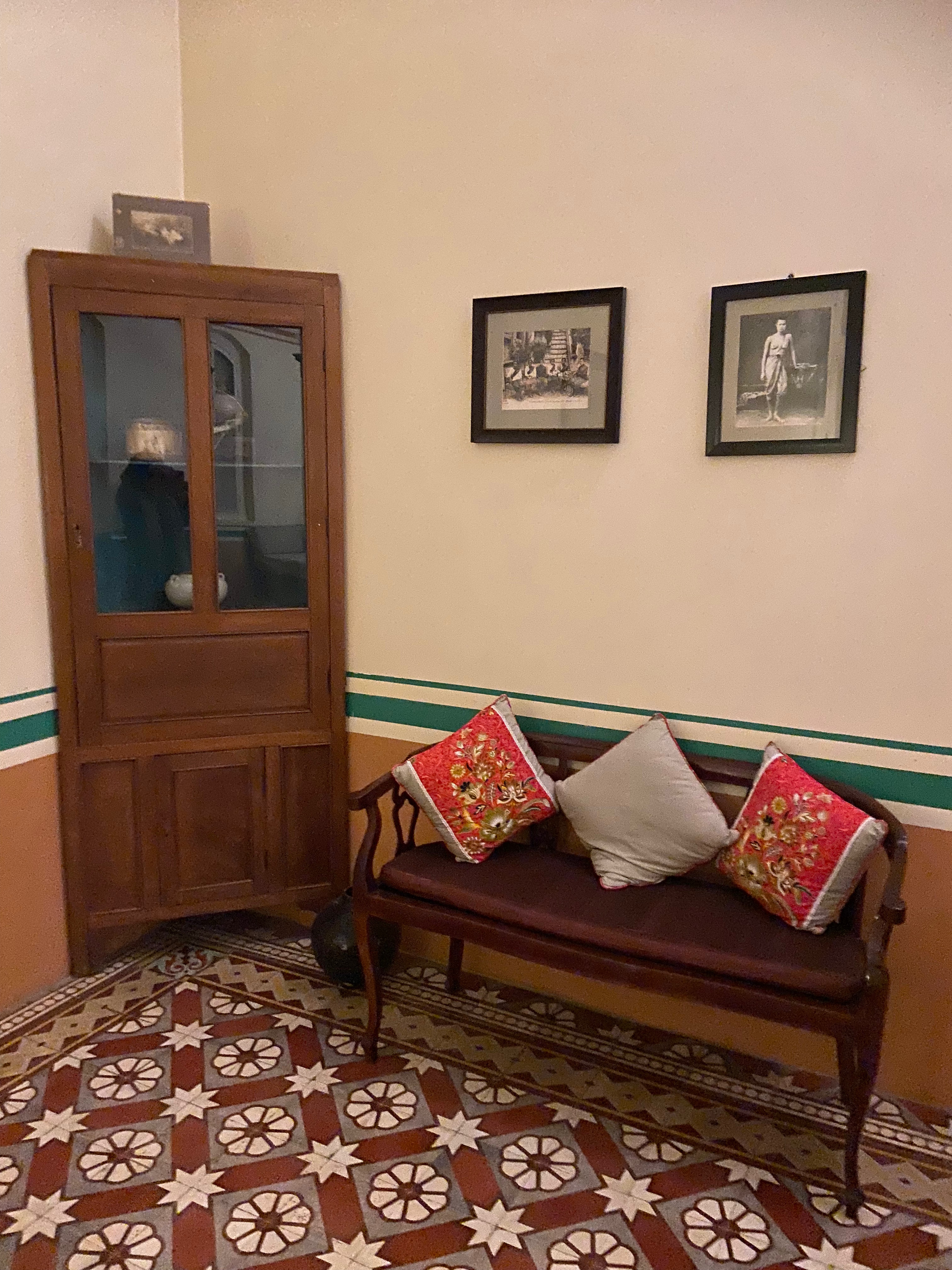
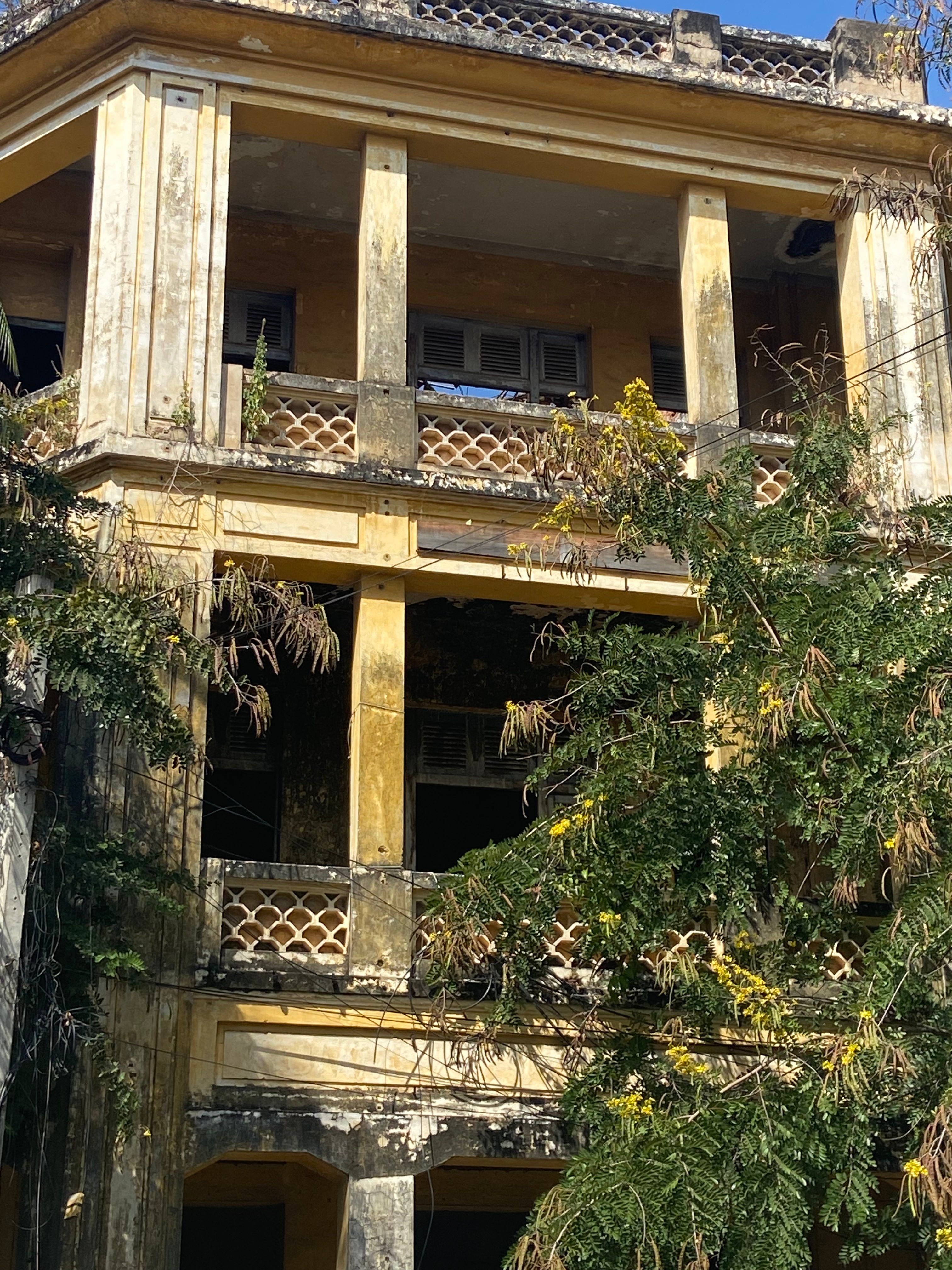
On my last afternoon we did a Heritage Tour– it’s a self-guided tour via tuk-tuk with an iPad populated with archive photos and videos explaining the history of the buildings. The tour started off with some of the buildings from the French Protectorate era (1863- 1953). Some of my favourites were the Central Post Office (1894), the French Police Station (1892), a three-storey sandstone building with lattice work on the balconies that has, sadly, fallen into disrepair, and is likely to be developed. And Hotel Manolis, once the Grand Hotel, renamed after a Greek owner. In 1979 it was filled with Khmer Rouge survivors – about 30 families. The original tiled floors inside are, apparently, still intact, and one floor of the building has been restored.
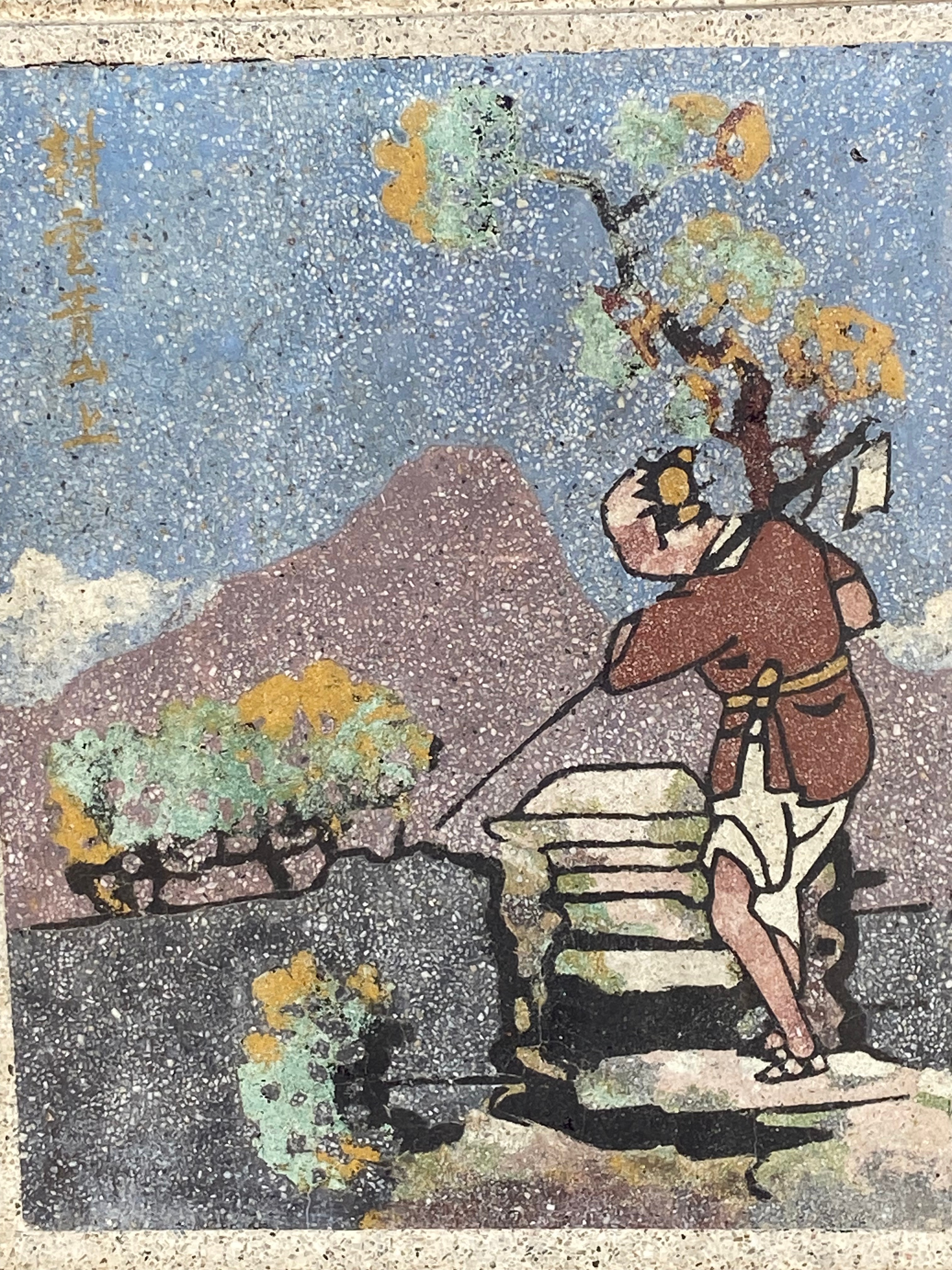
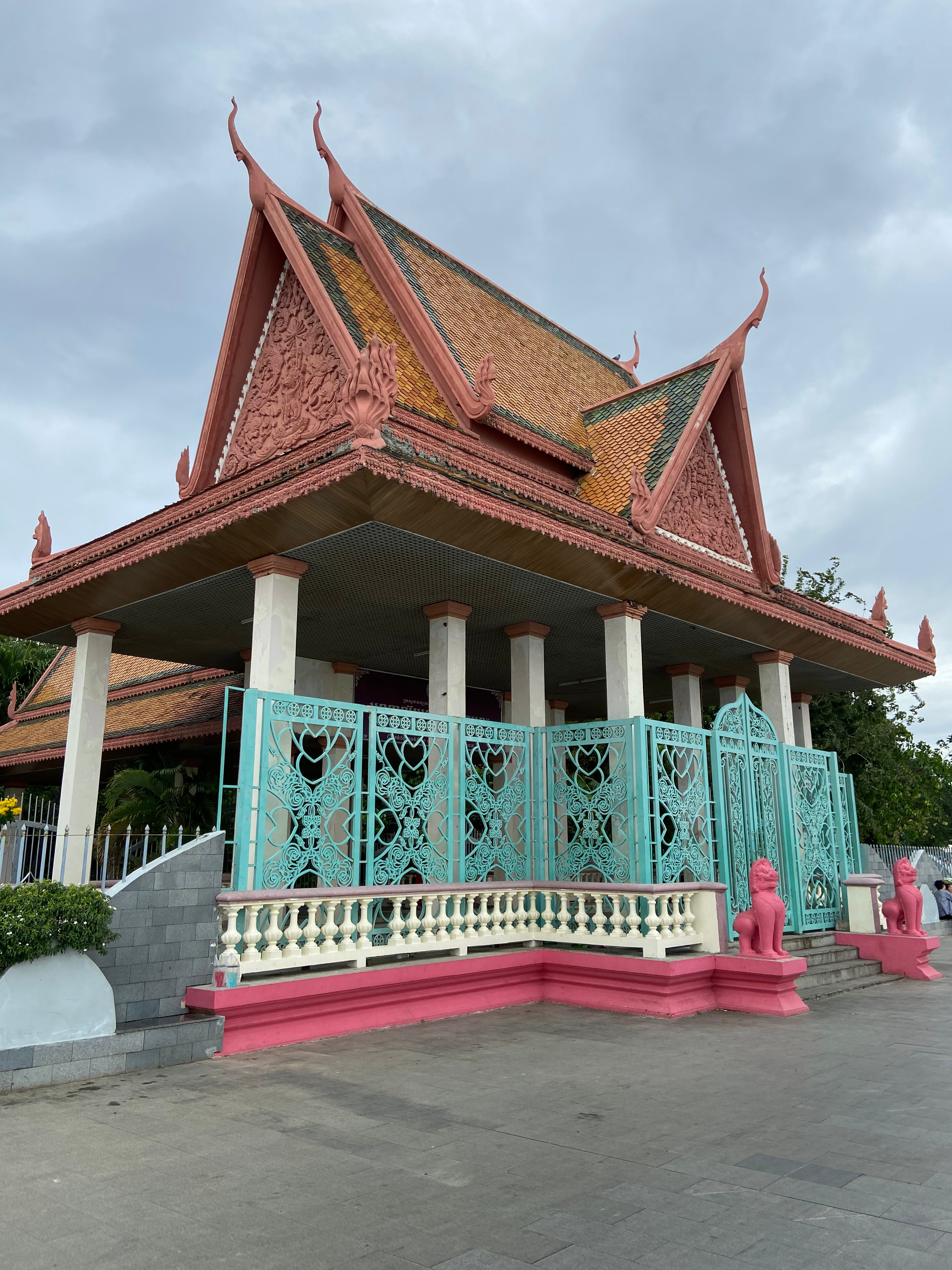
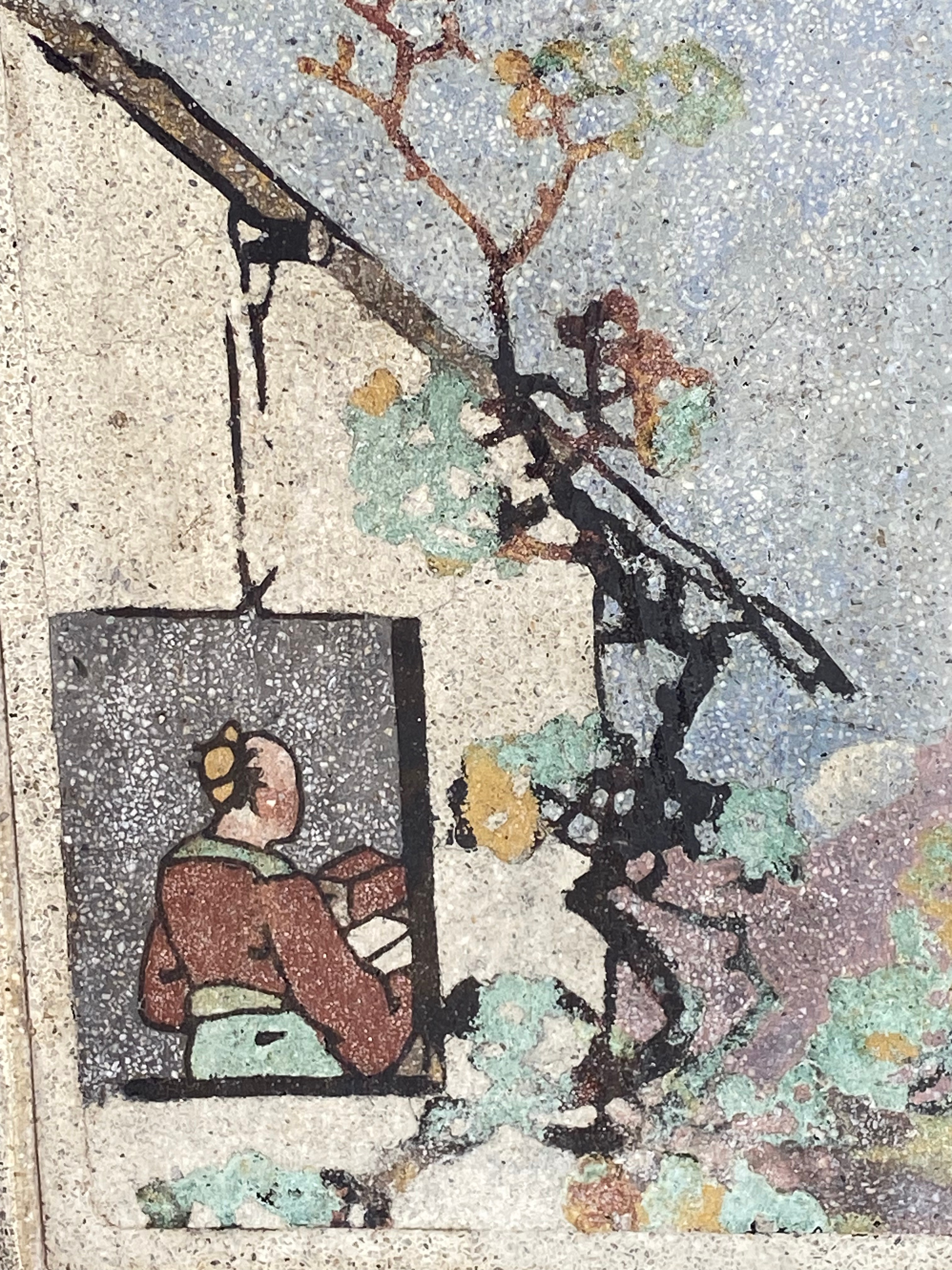
In complete contrast we also visited the Hokkien Chinese Temple – the only one to survive the Khmer Rouge. I loved the delicate, water-colour-like paintings on the door frames of figures in the landscape, blossoms and ibis perching in trees.
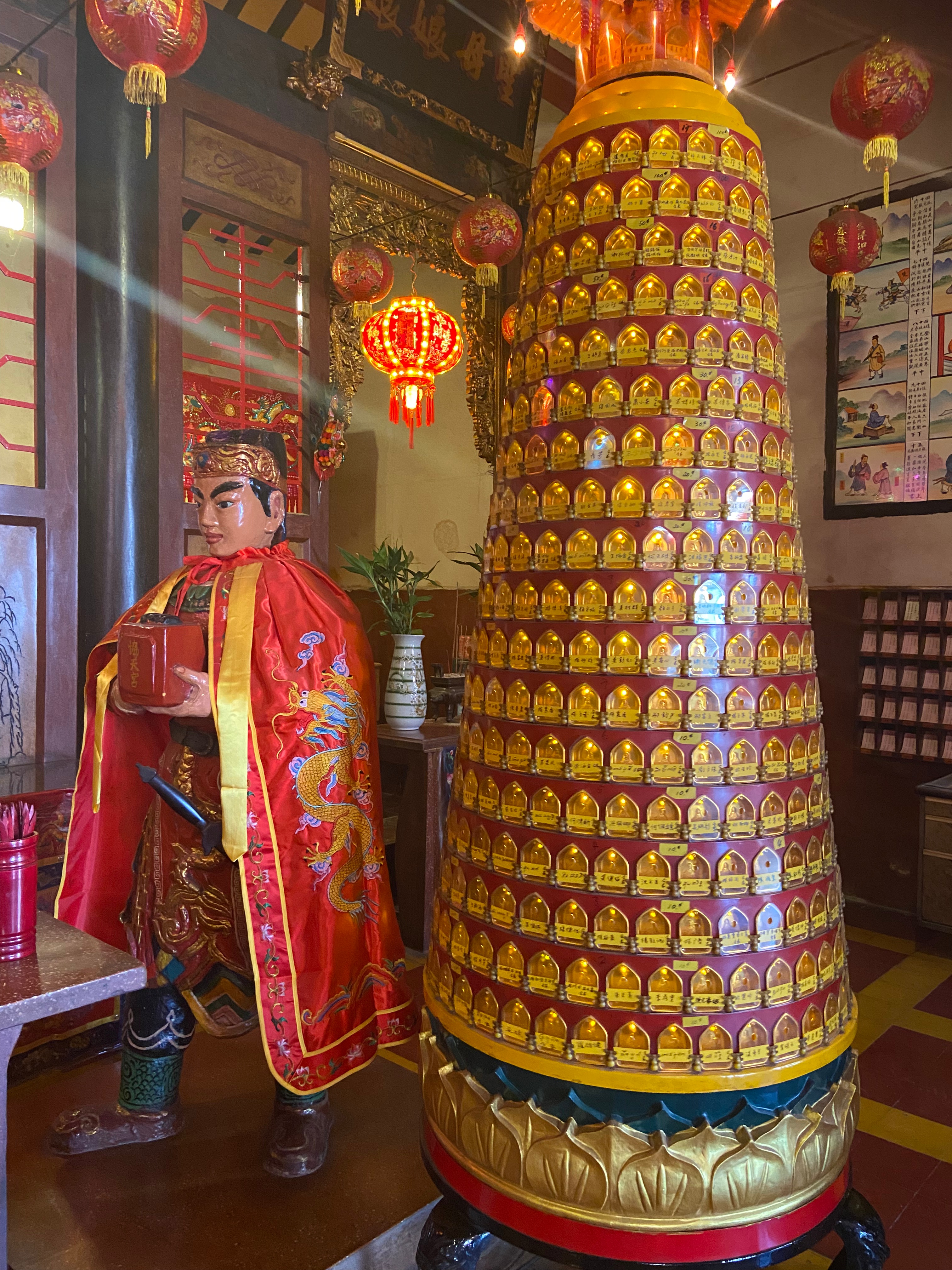
Inside it is brilliantly coloured – yellow and red – with statues, strings of Chinese lanterns suspended from the ceiling and depictions of white tigers and dragons – yin and yang. There are colourful statues of Taoist deities and a fortune-telling area by the altar comprising a cylinder of wooden sticks.

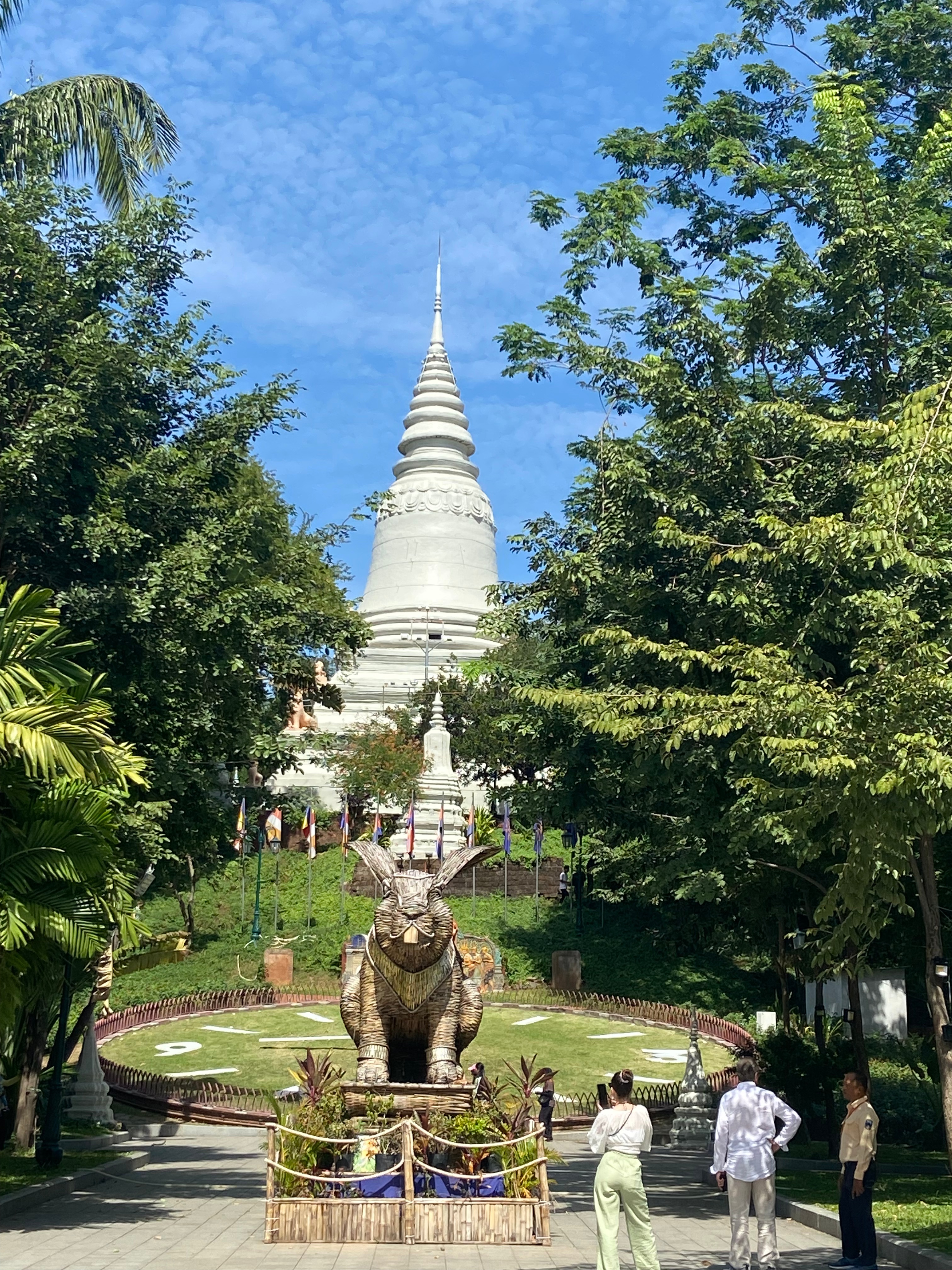
We then crossed the Naga Bridge – those now-familiar seven-headed serpents – and drove past Wat Phnom, a Buddhist temple set atop a 27m-high tree-covered knoll, the only ‘hill’ in town. We also saw – from our tuk-tuk – a pair of hornbills flying around the small circle of garden. I’d seen them featured on an ABC television programme, and was delighted to catch a glimpse of these extraordinary birds with their huge beaks!
Other stops included the impressive Art Deco railway station, the Central market and Raffles, which in its heyday hosted Charlie Chaplin, Somerset Maugham and Jackie Kennedy – she had a cocktail named after her.

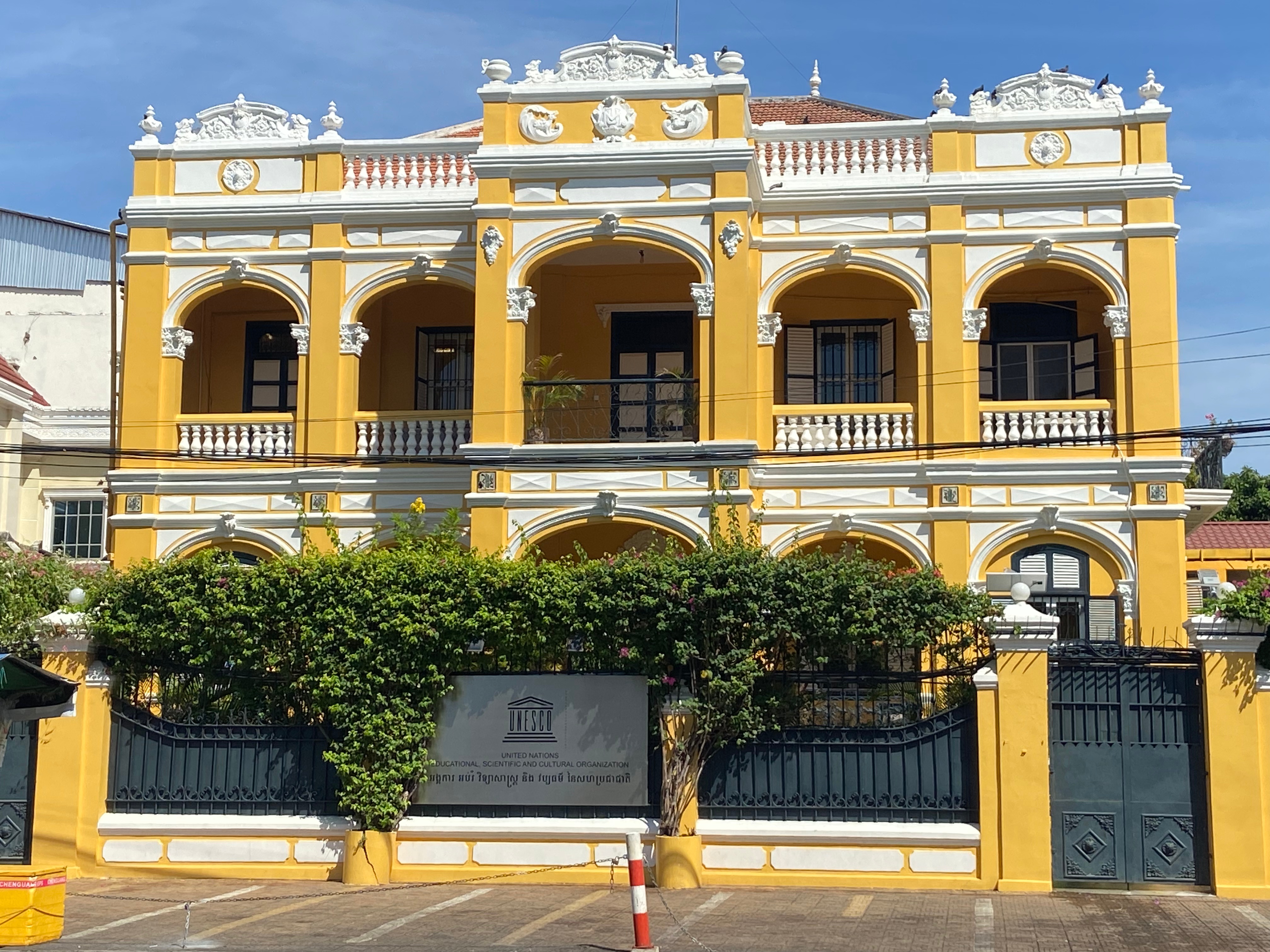
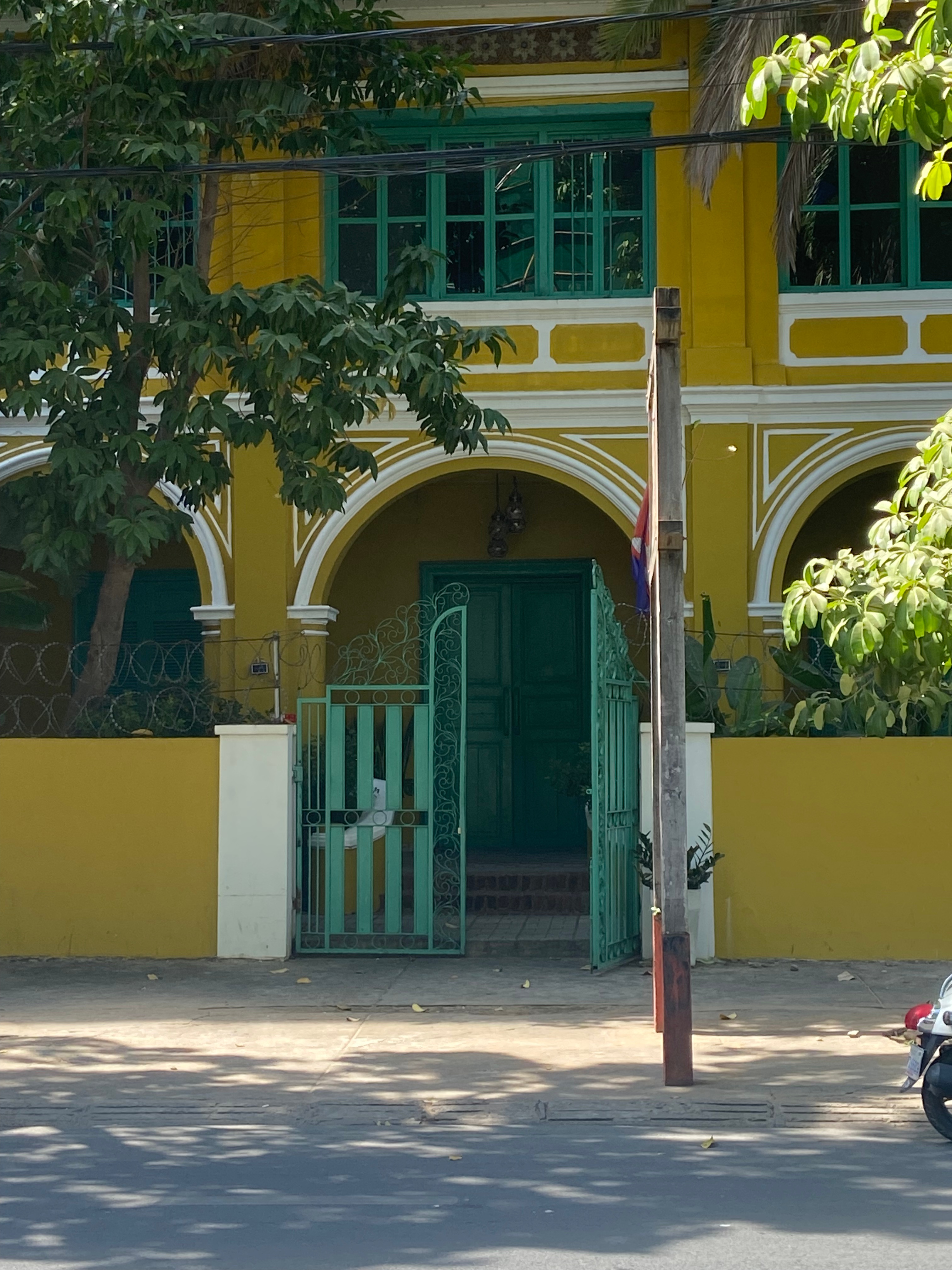
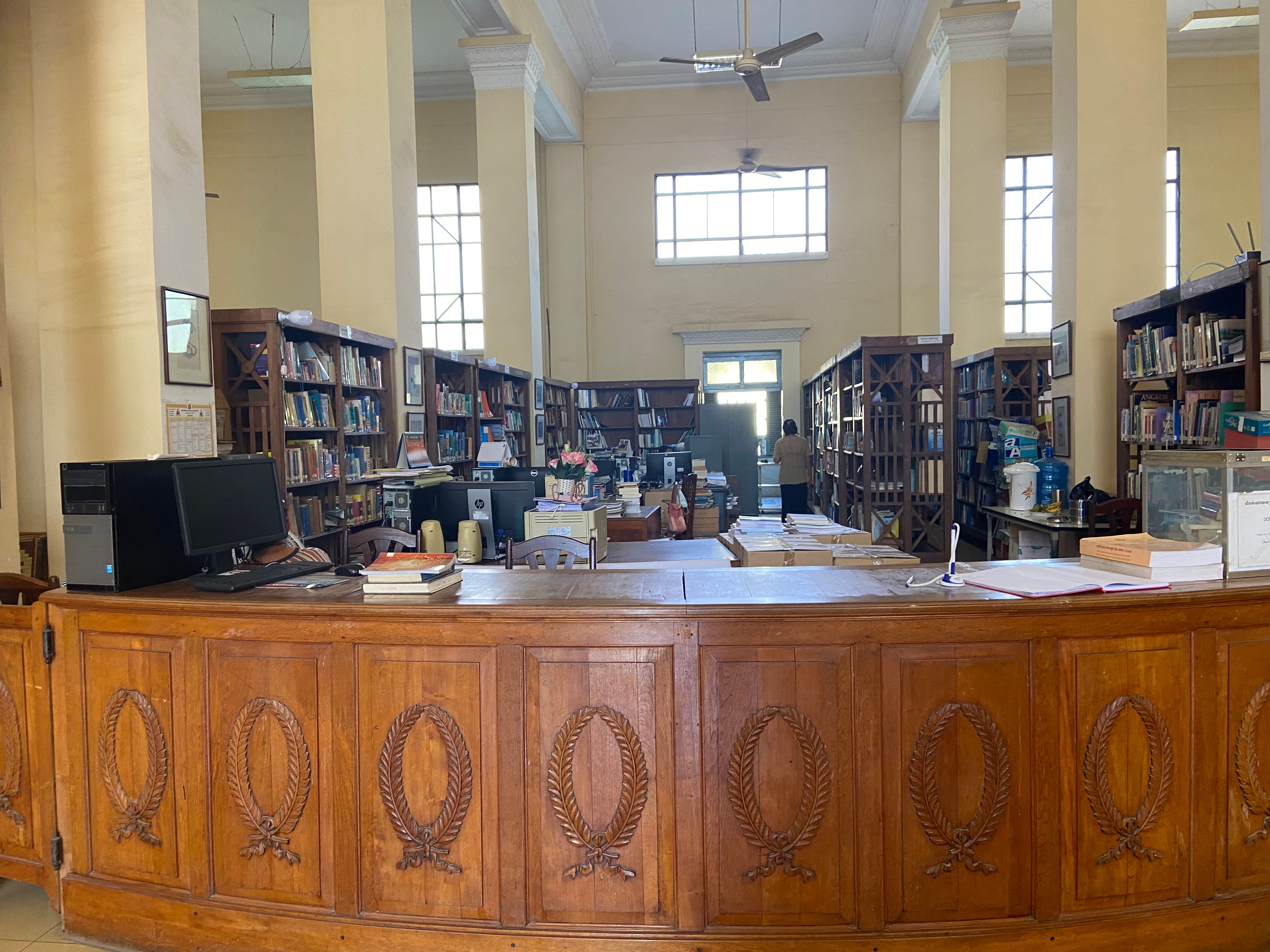
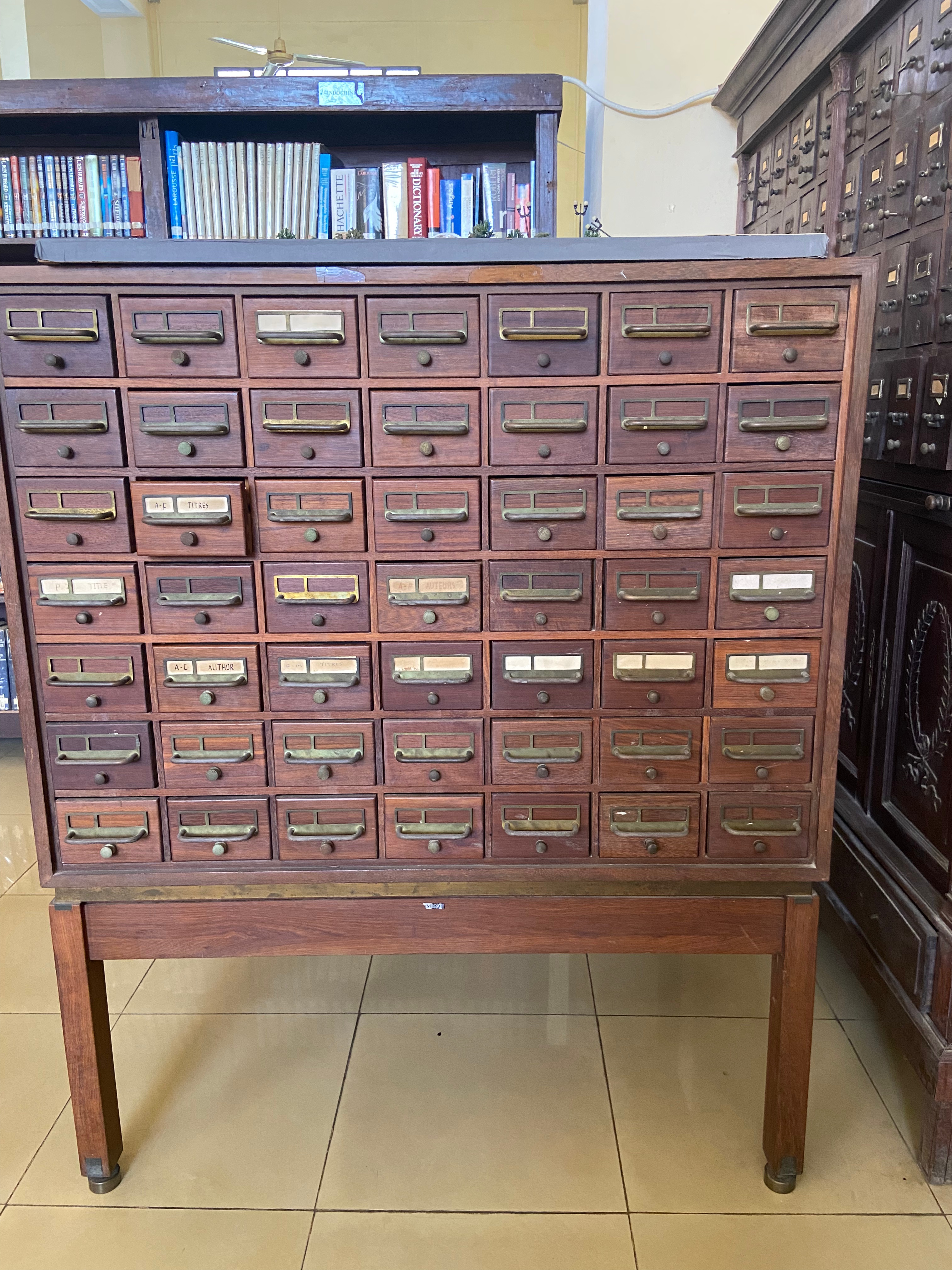
And although nearly 80% of the books at the library (built in 1924) were destroyed by the Khmer Rouge, it still has wooden shelves and a wooden cabinet with pull-out drawers for index cards – a wonderful reminder of how things were in the pre-digital age. One of the last stops was the UNESCO Building – a glorious example of colonial architecture – painted yellow with white stucco, pillars, columns and balconies.
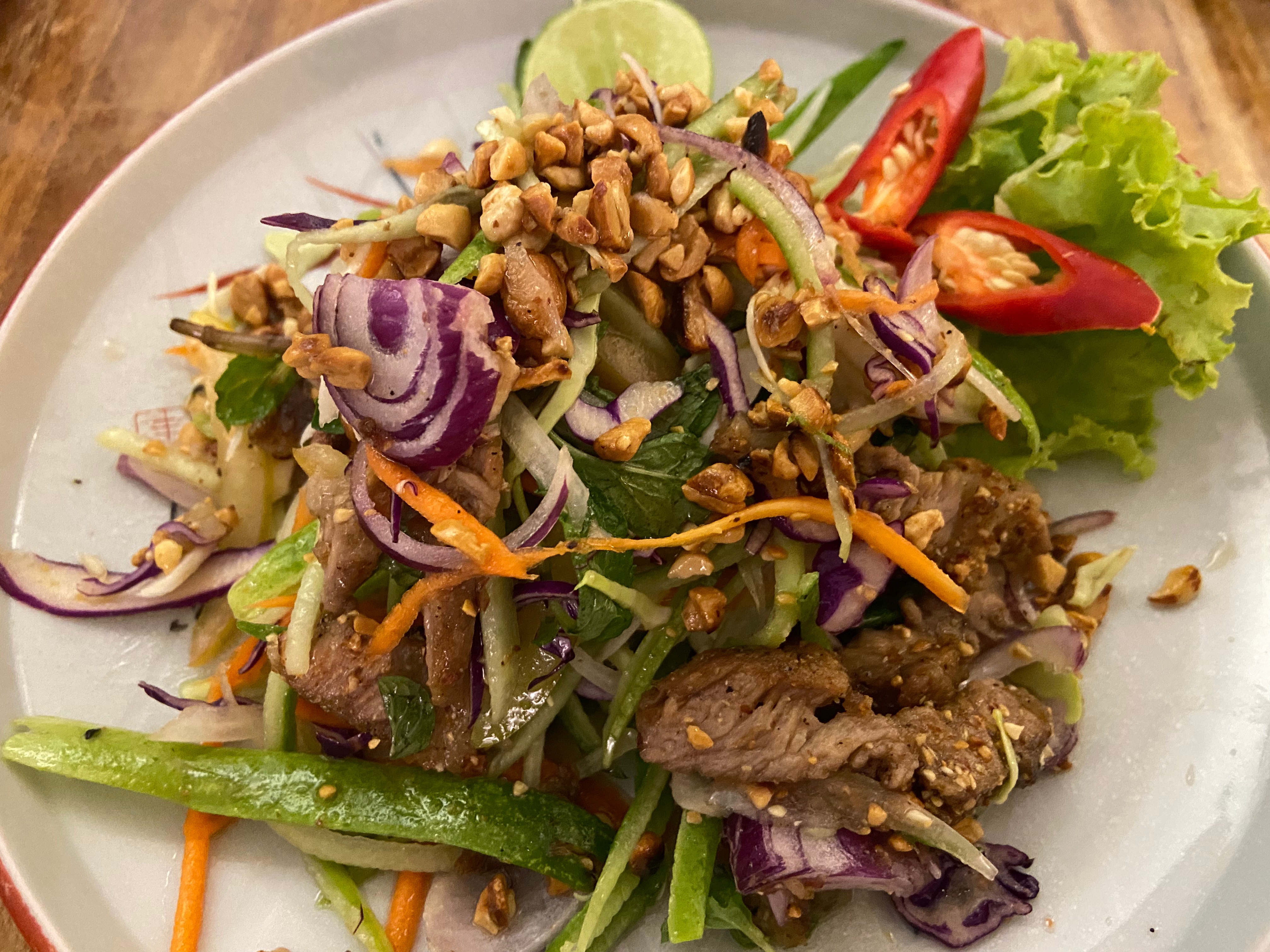
And before I end my three-part Cambodian epistle (just look at the pictures if you’re out of time!) – one more restaurant recommendation – Maloop, which is set in a lush city park, a bit like an enchanted garden with a swimming pool repurposed as a lily pond, and offers exquisite locally inspired food. https://easy-cambodia.com/maloop. Add visiting Phnom Penh to your travel bucket list!
Cambodia Part 2/3 – Siem Reap – Embassy Restaurant, Angkor-wat Temples and Theam’s Gallery

NB: Email subscribers- please click on the ‘Read on Blog’ link at the top of the email to enjoy the benefit of the formatted blog rather than the WordPress newsletter version.

Having left Battambang around lunchtime, we arrived at our Siem Reap accommodation – The Nature – mid-afternoon. It’s not the easiest place to find – it’s in a semi-rural setting (my mozzie radar was on high alert!) about 2.5km from the hubbub of touristy Pub Street and the Night Market in the town centre.

The Nature is set among the trees, and all the furniture is made from wood and natural materials with chunky chairs and tables in the restaurant hewn from tree trunks. Our rooms were adjoining – with a kitchen in between – on the top floor accessed via a steep wooden staircase with a rope bannister (you’d not want to climb these under the influence of several margaritas!). The beds were super hard – especially for this Princess and the Pea – like sleeping on a board.  It didn’t really help making a roll out of the duvet for extra padding and sleeping on one half – plus it made it way too hot.  

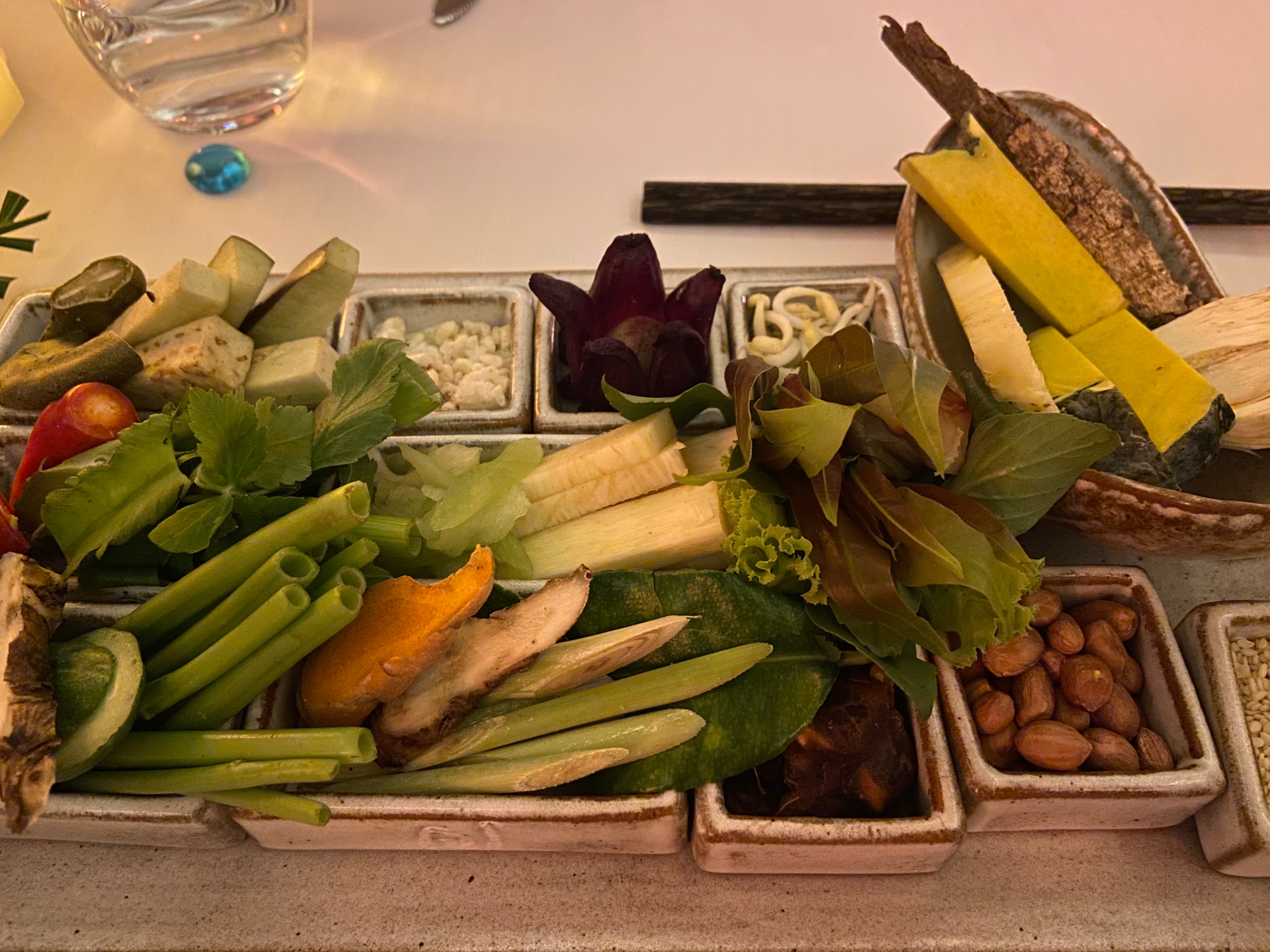
Our first night, we’d arranged to have dinner with friends of Di’s at The Embassy, an all-female restaurant in a mostly male-dominated industry.  It’s a pretty special place – head chef Kimsan Pol showcases traditional recipes which she unearthed by researching the national archives. It’s a set 7-course banquet – and the range of flavours, textures, combinations, colours and the presentation – each dish a work of art – was truly extraordinary. To start with, they bring a basket laden with seasonal and local fruits, vegetables and spices and explain what all the ingredients are.

As the only newbie to Embassy, I was keen to savour every mouthful. The food was exquisite, but I felt we didn’t focus enough on what we were eating – it became the backdrop to a lot of chat about mid-century architecture – Di’s friends were in the process of building their dream home – which I know nothing about! All the talking meant that they ate slowly and the cumulative result over seven courses – the staff couldn’t clear our plates away till everyone had finished – meant it was a LONG dinner.  I started to long to get back to my brick-like bed ahead of an early start the next day…
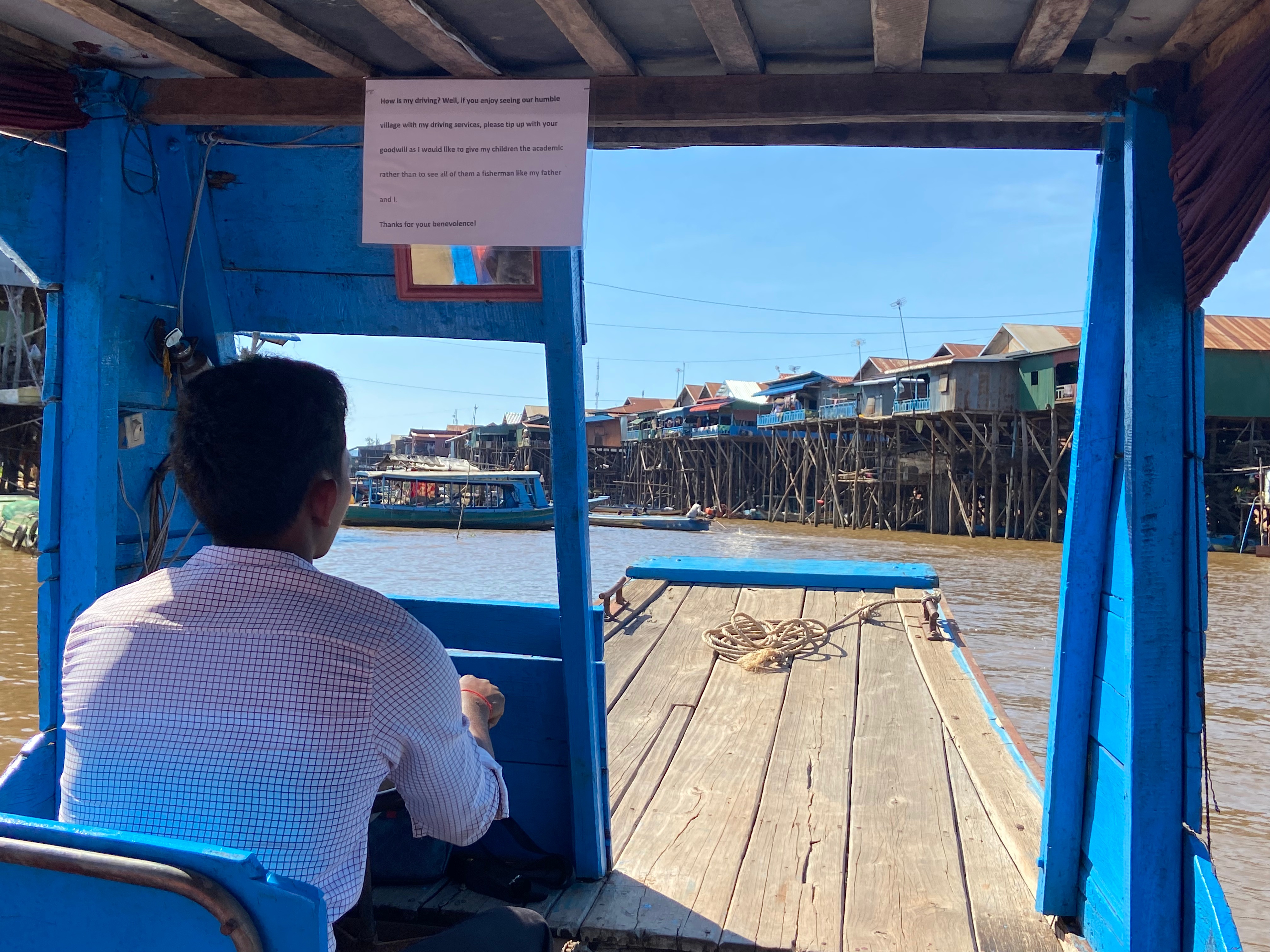
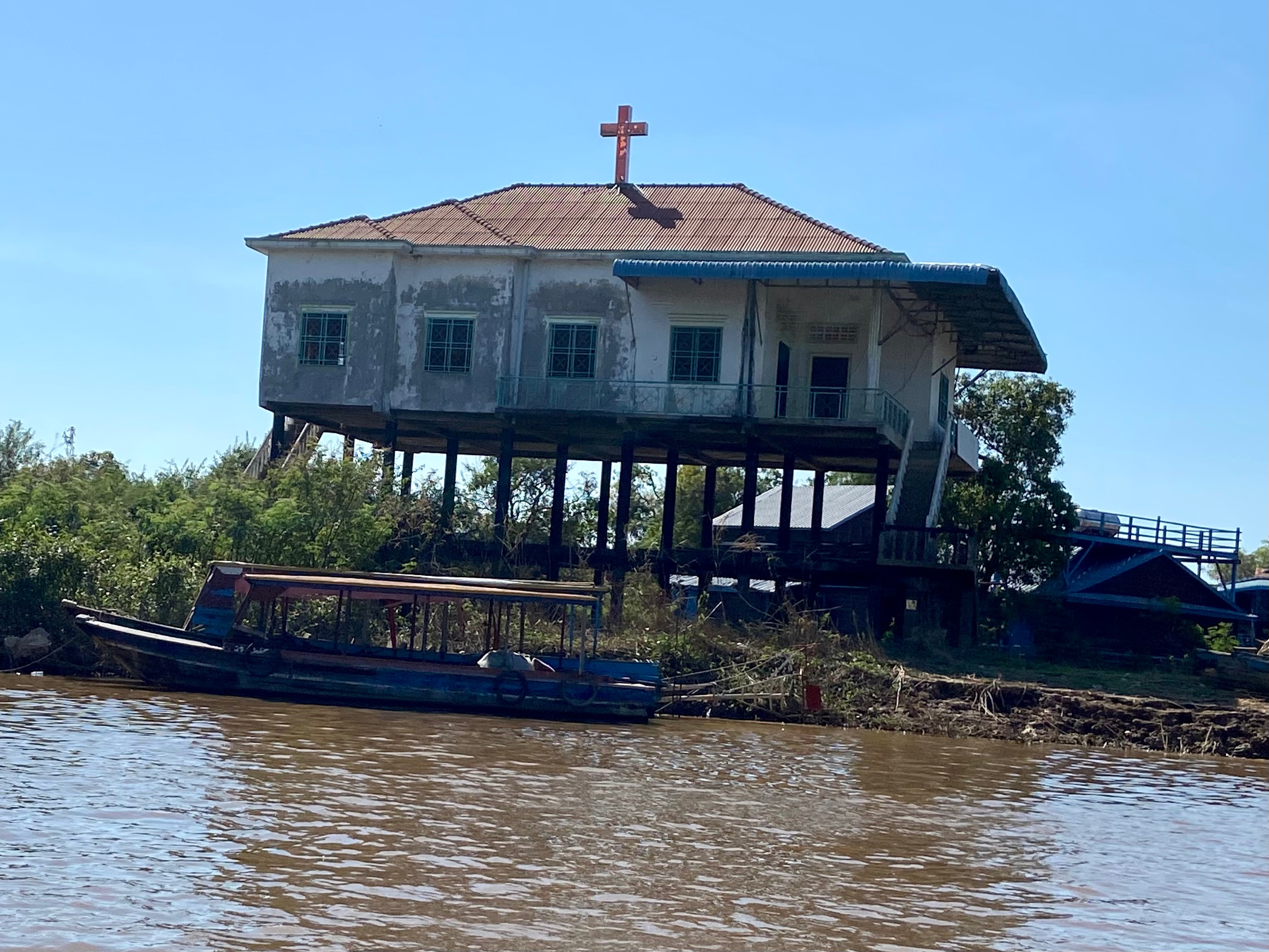
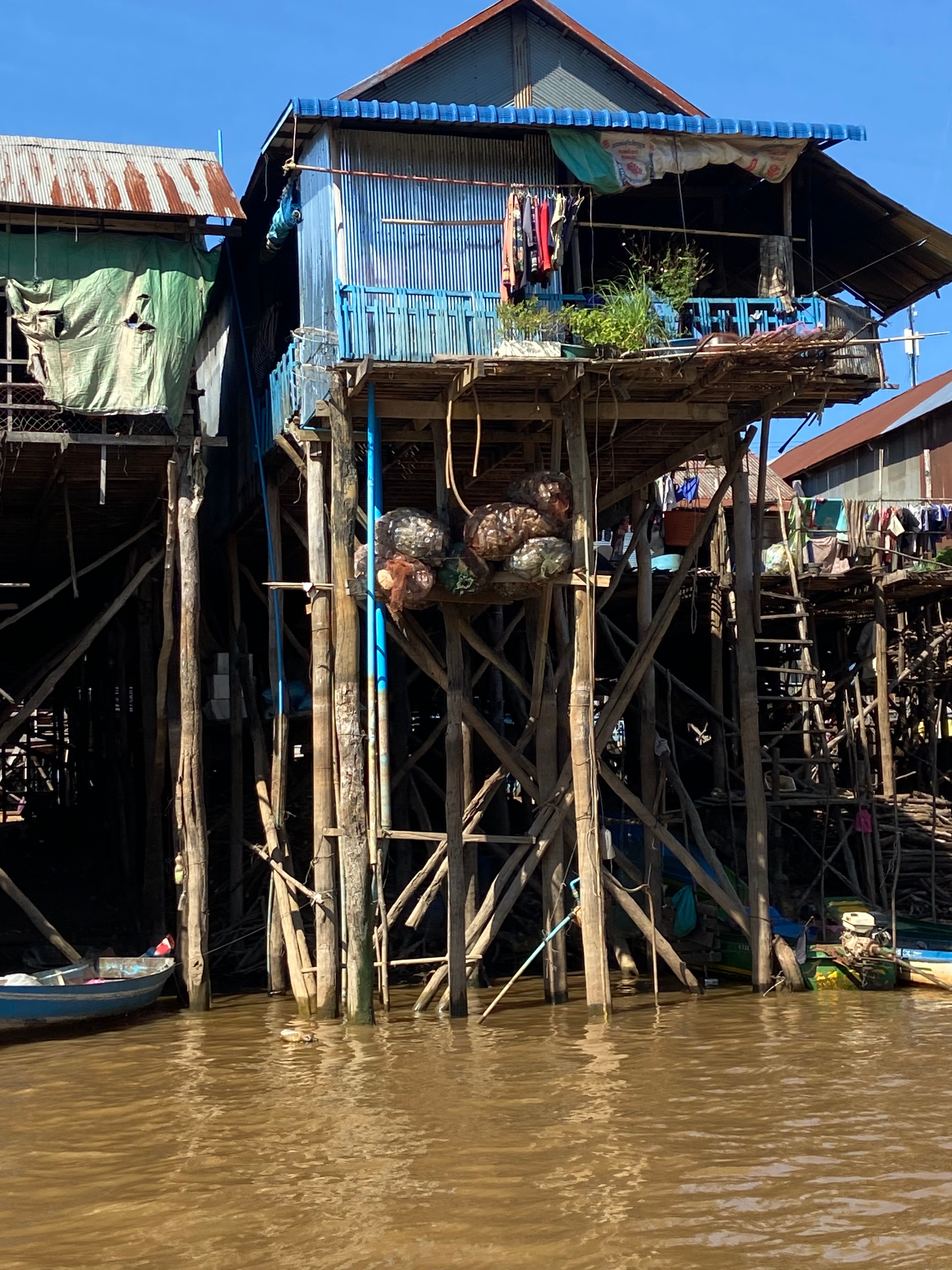
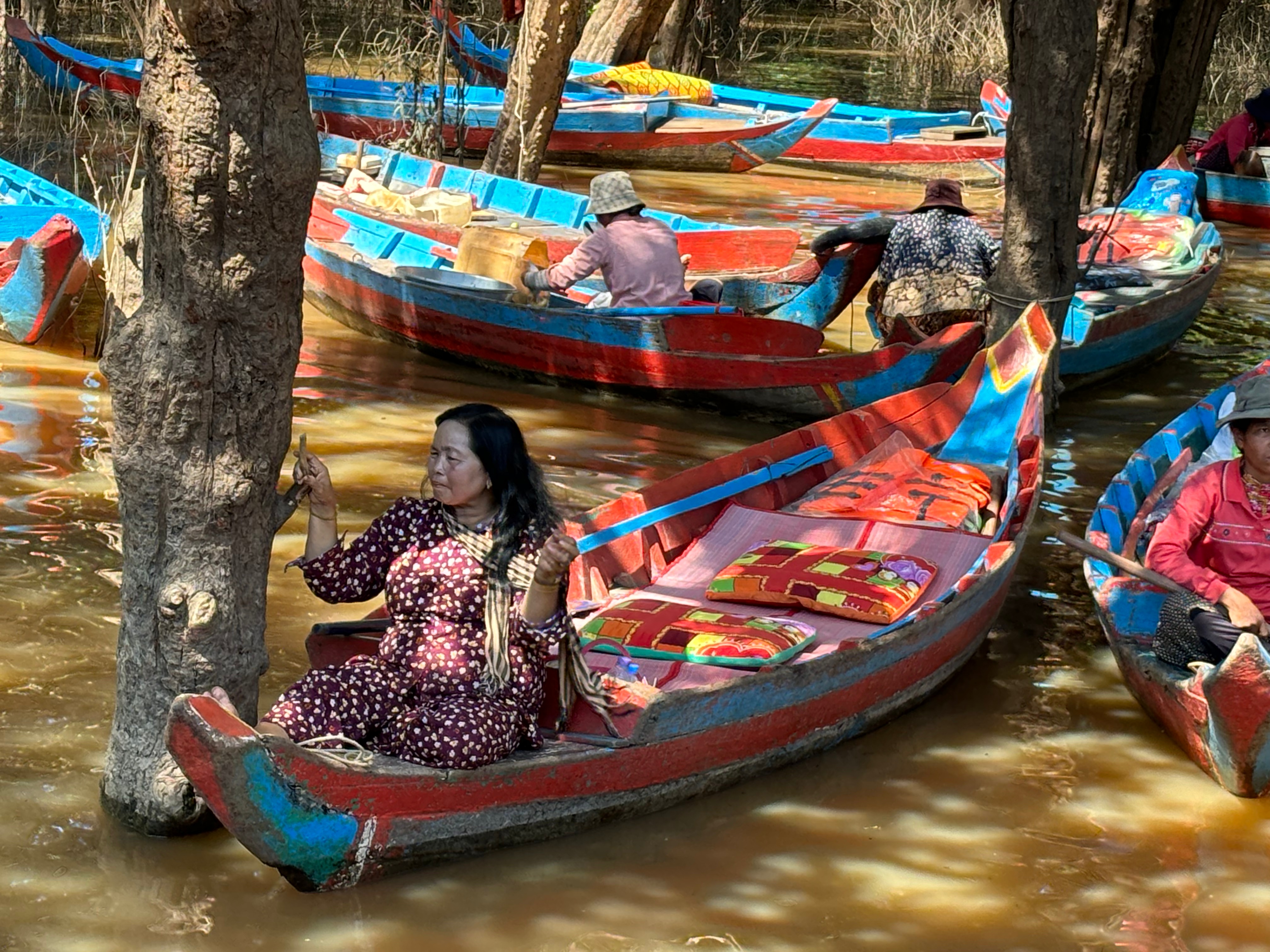
We got back to The Nature at midnight with very full bellies and were up again at 7am as Theary was meeting us at 8’ish to go to Kampong Phluk, a floating village on Tonle Sap Lake. On the approach there were rice fields either side of the river and men up to their shoulders in the river, fishing. We did a boat tour with a local guide through the houses on stilts, most of them ramshackle, part wood, part corrugated iron, washing drying and potted plants on the verandahs, and some with mezzanine layers that are only accessible in the dry season (November to April). Fishing is the main livelihood, and some houses have small fenced-off fish farms. It’s a fully functioning community – we passed a floating restaurant that operates throughout the year, a floating grocery store selling biscuits, bananas and coconuts, an ornate Buddhist temple situated on one riverbank and a church on stilts on another.

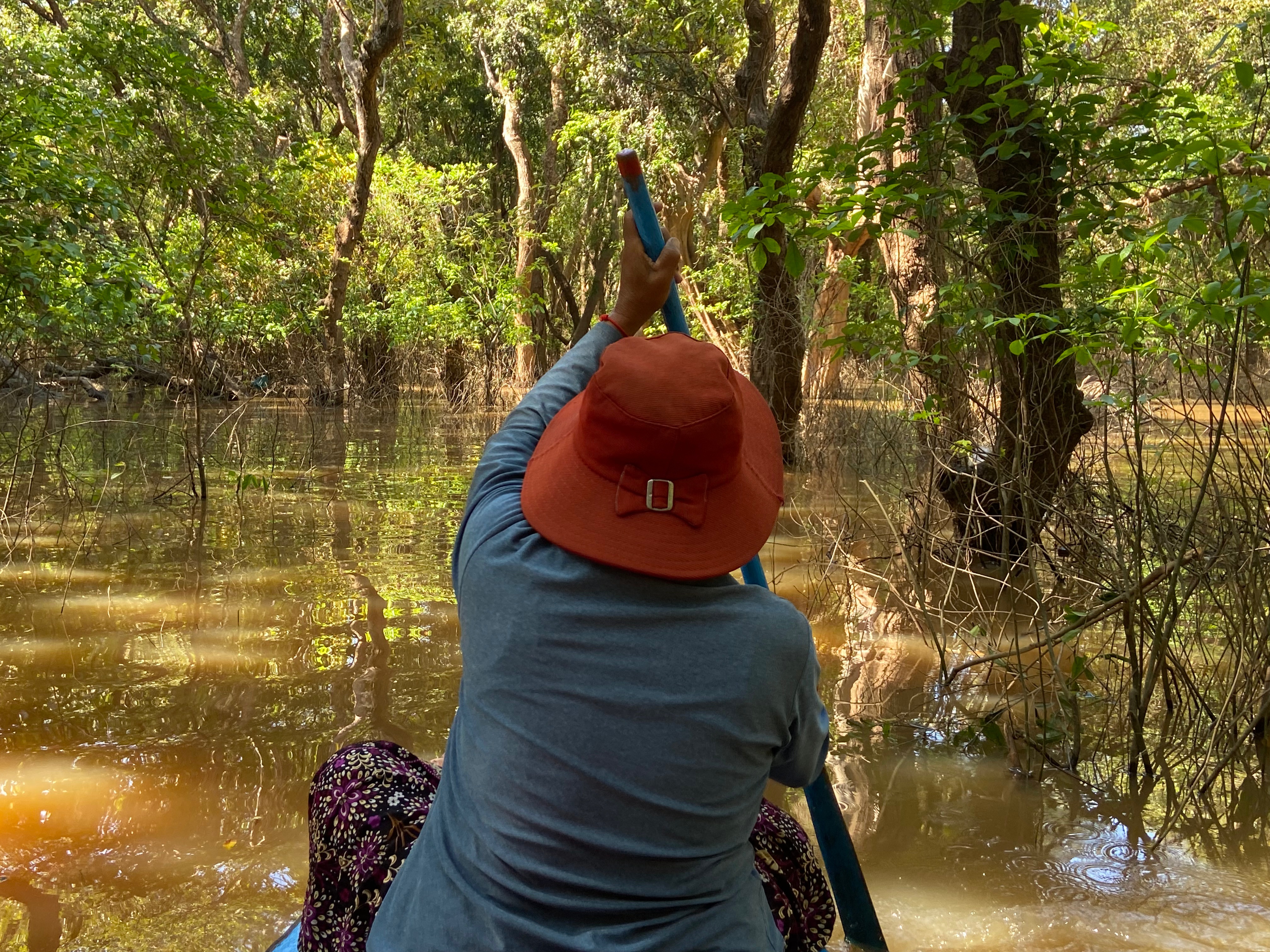
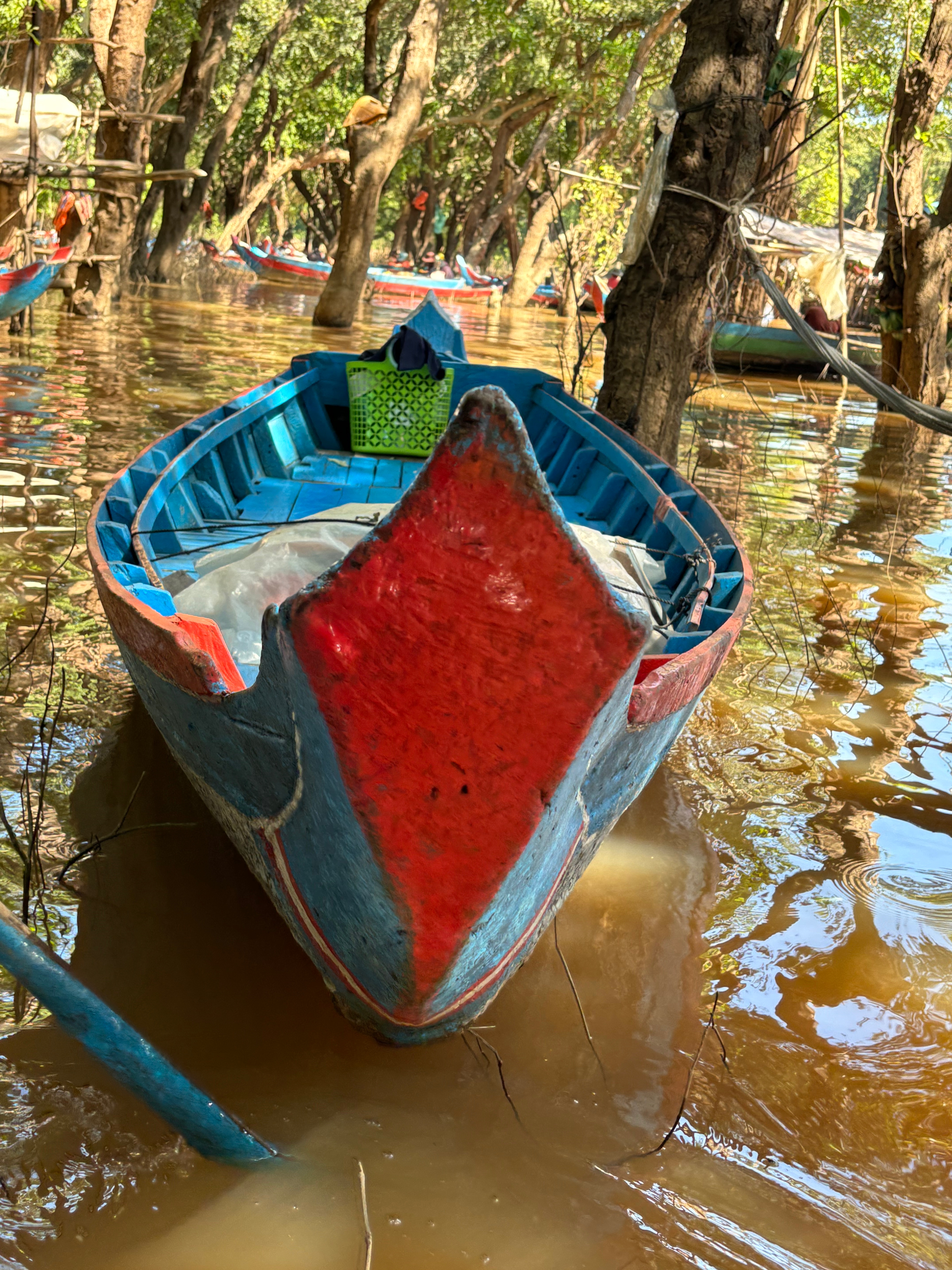
After our lake trip we decanted into a smaller brightly painted rowboat and were taken through the mangroves by a boatwoman. Immersed in birdsong and close enough to the vegetation to pluck the occasional flower, it was wonderfully peaceful, paddling through the water.

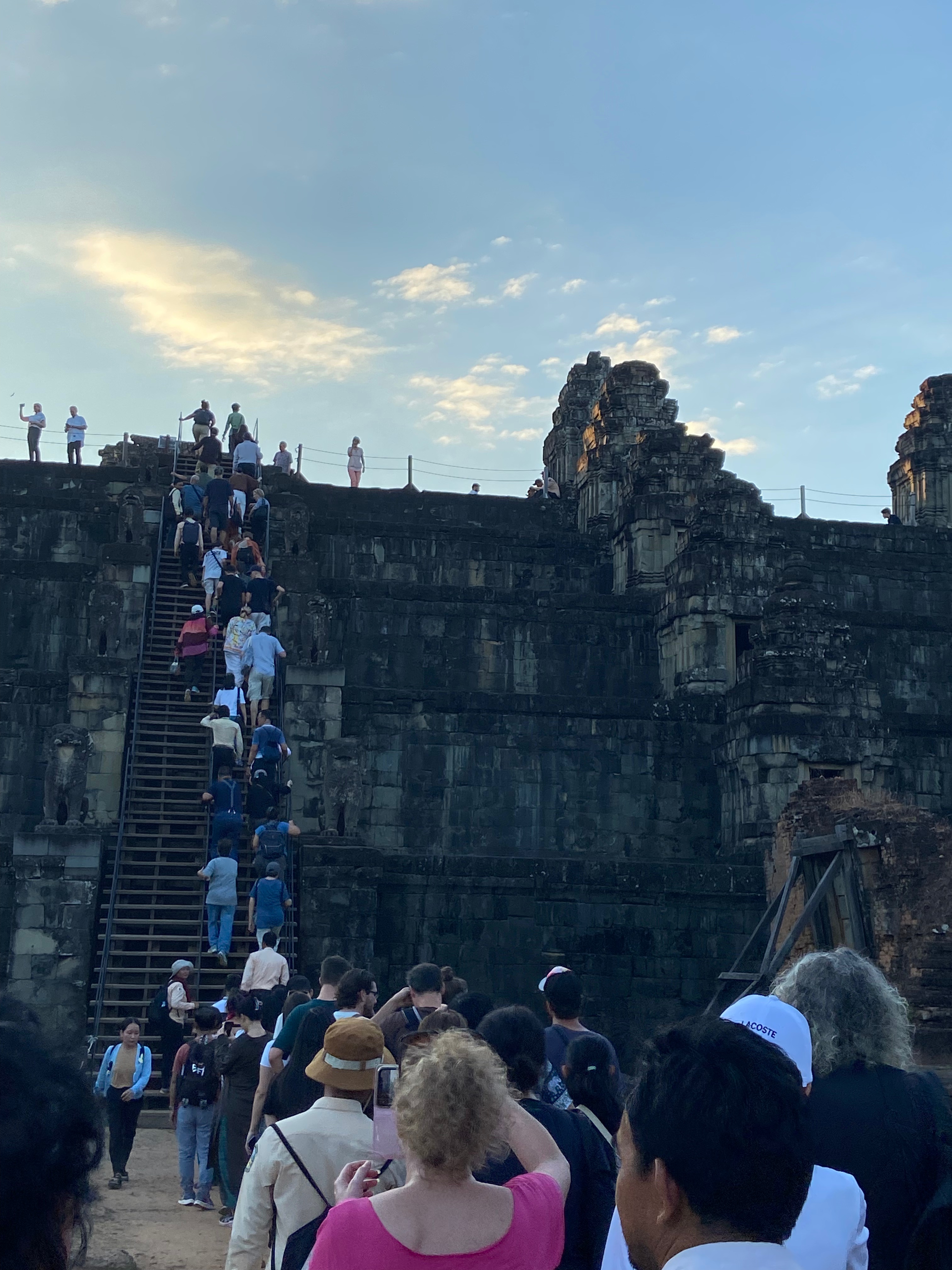
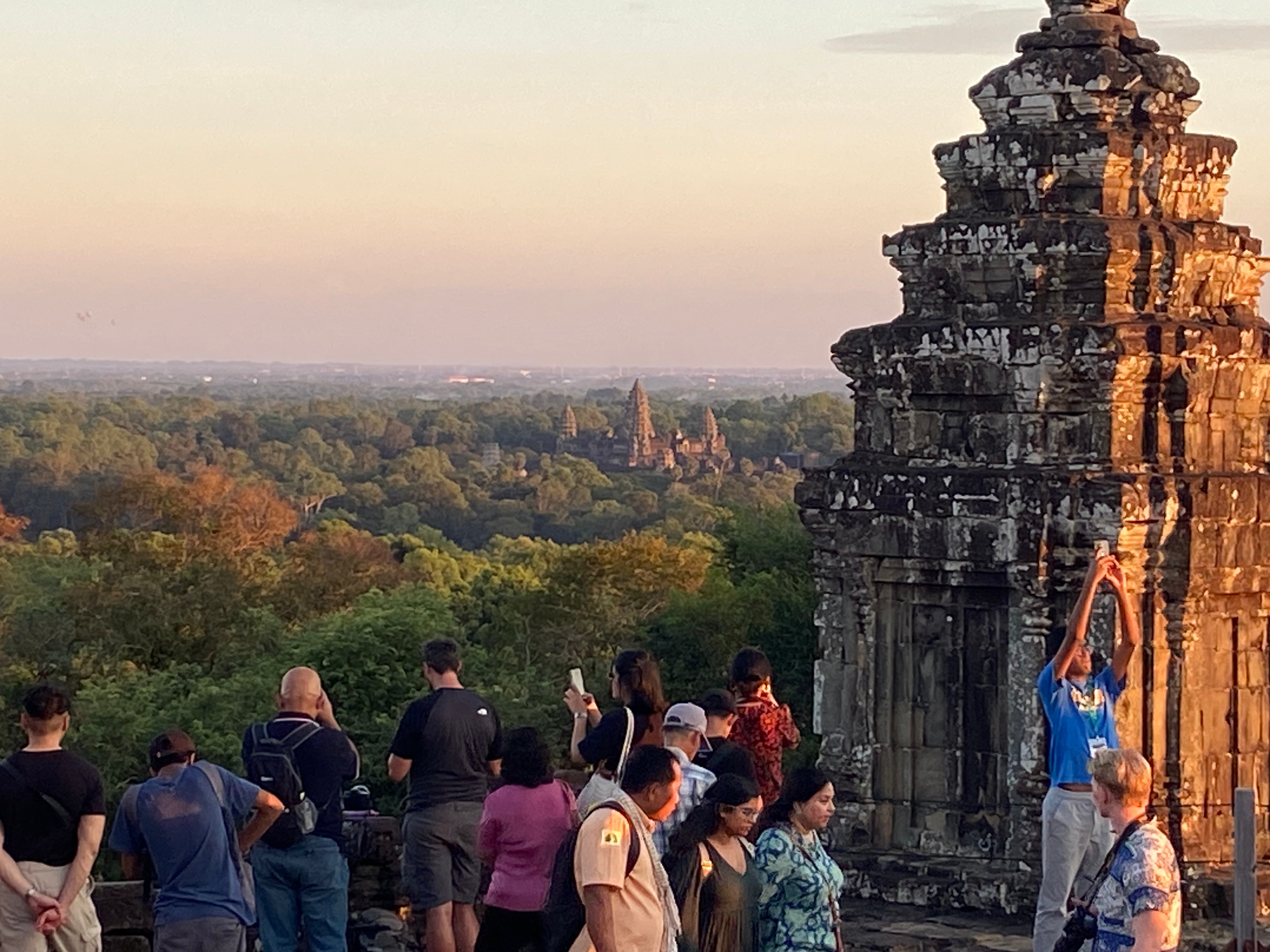
In the late afternoon we purchased our one-day tickets for the Angkor temple complex for the following day. This is how it works – you buy tickets the afternoon before so you can see that evening’s sunset and the next day’s sunrise.  Towards sunset we climbed up to Phnom Bakheng Temple (a Hindu and Buddhist temple) built at the end of the 9th century.

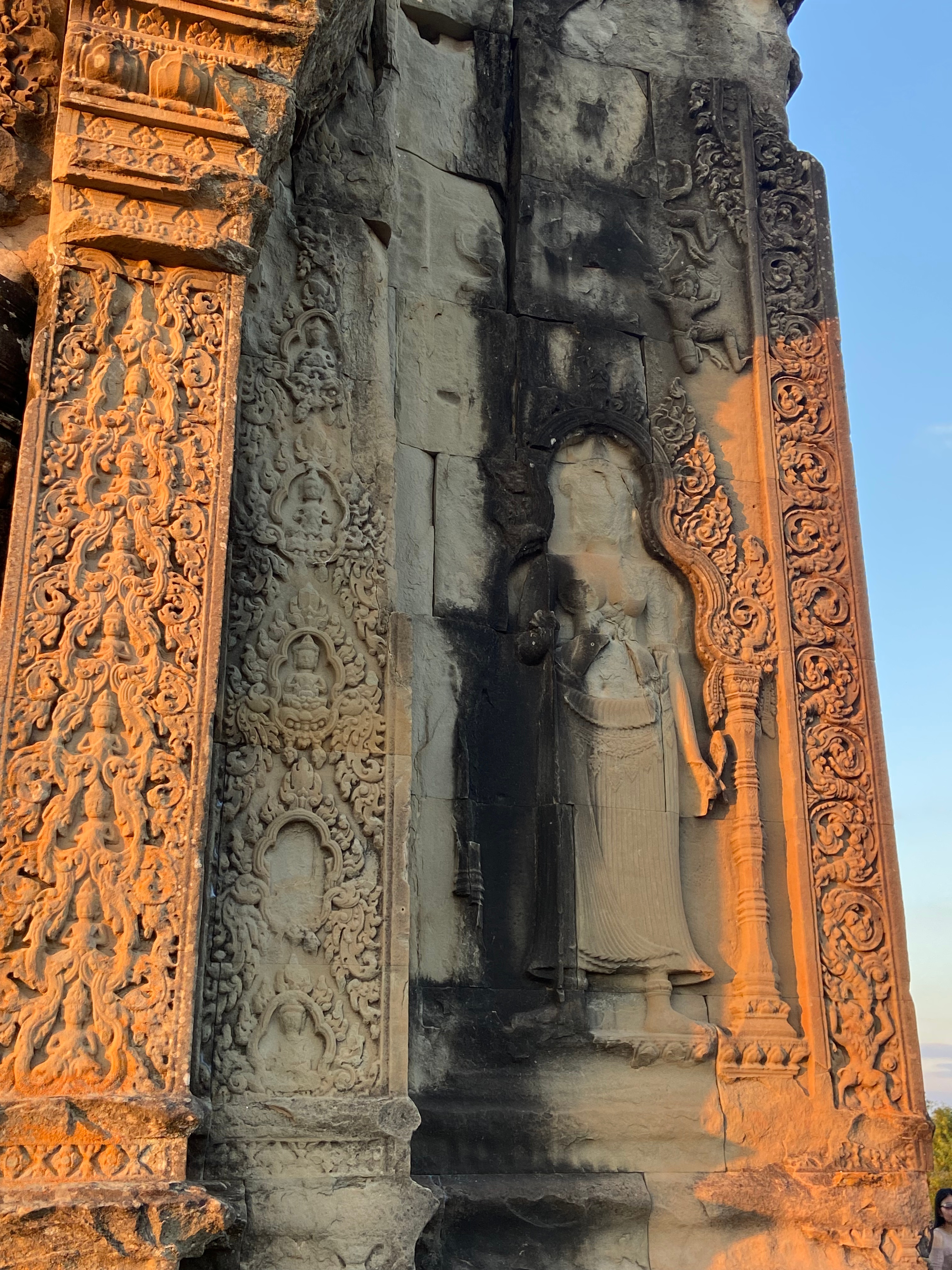
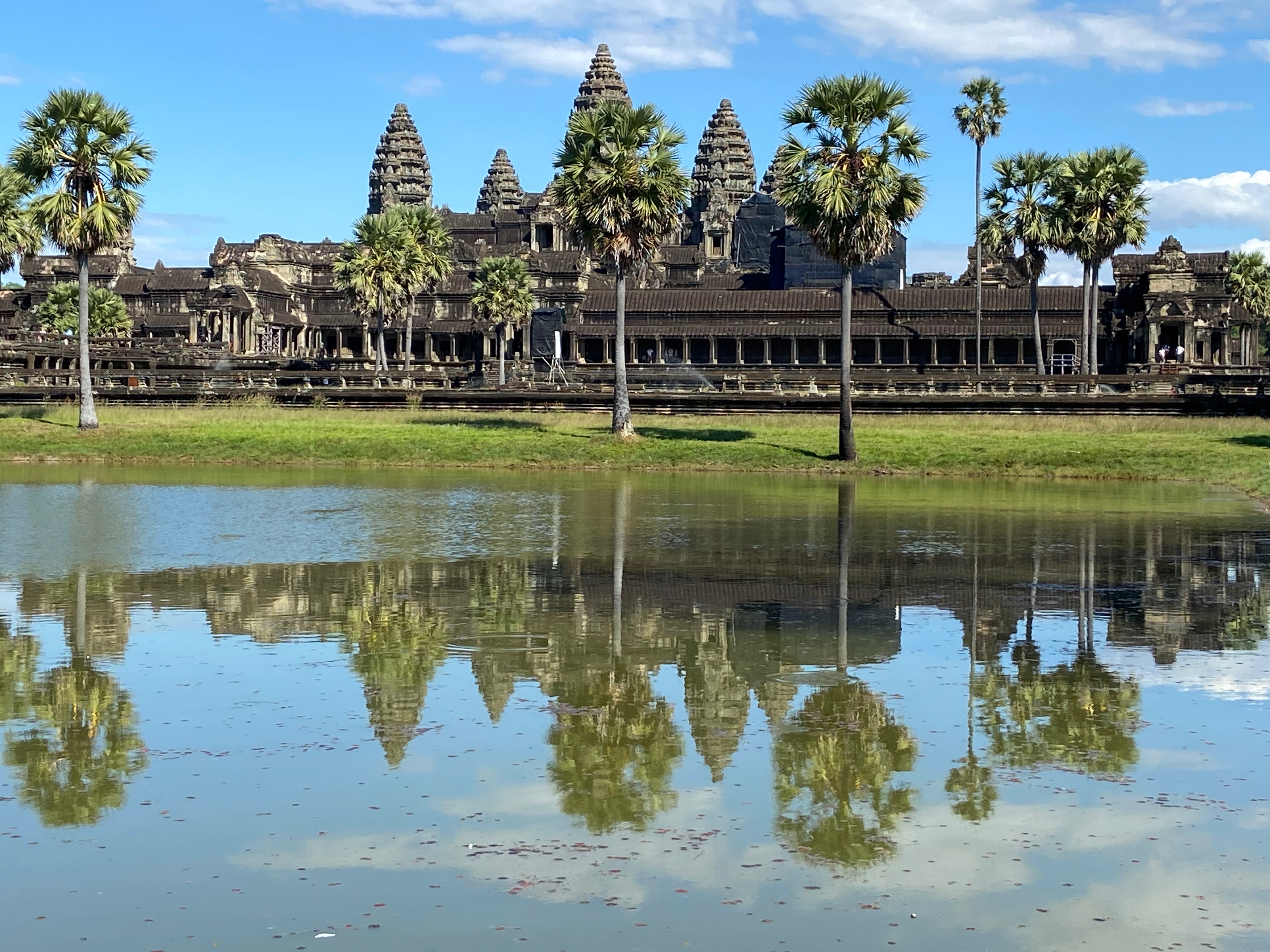
When you get to the summit, it’s crowded! Everyone is waiting for a picture-perfect sunset. We looked over at Angkor Wat (see middle picture)– a preview of what was to come the next day but   decided to go to a look-out halfway down to avoid the scrum. We almost missed the sun setting – it’s so fleeting – but the way the light fell on the stone was worth the climb and we heard geckos calling out GECKO, GECKO – I’ve never heard that before.
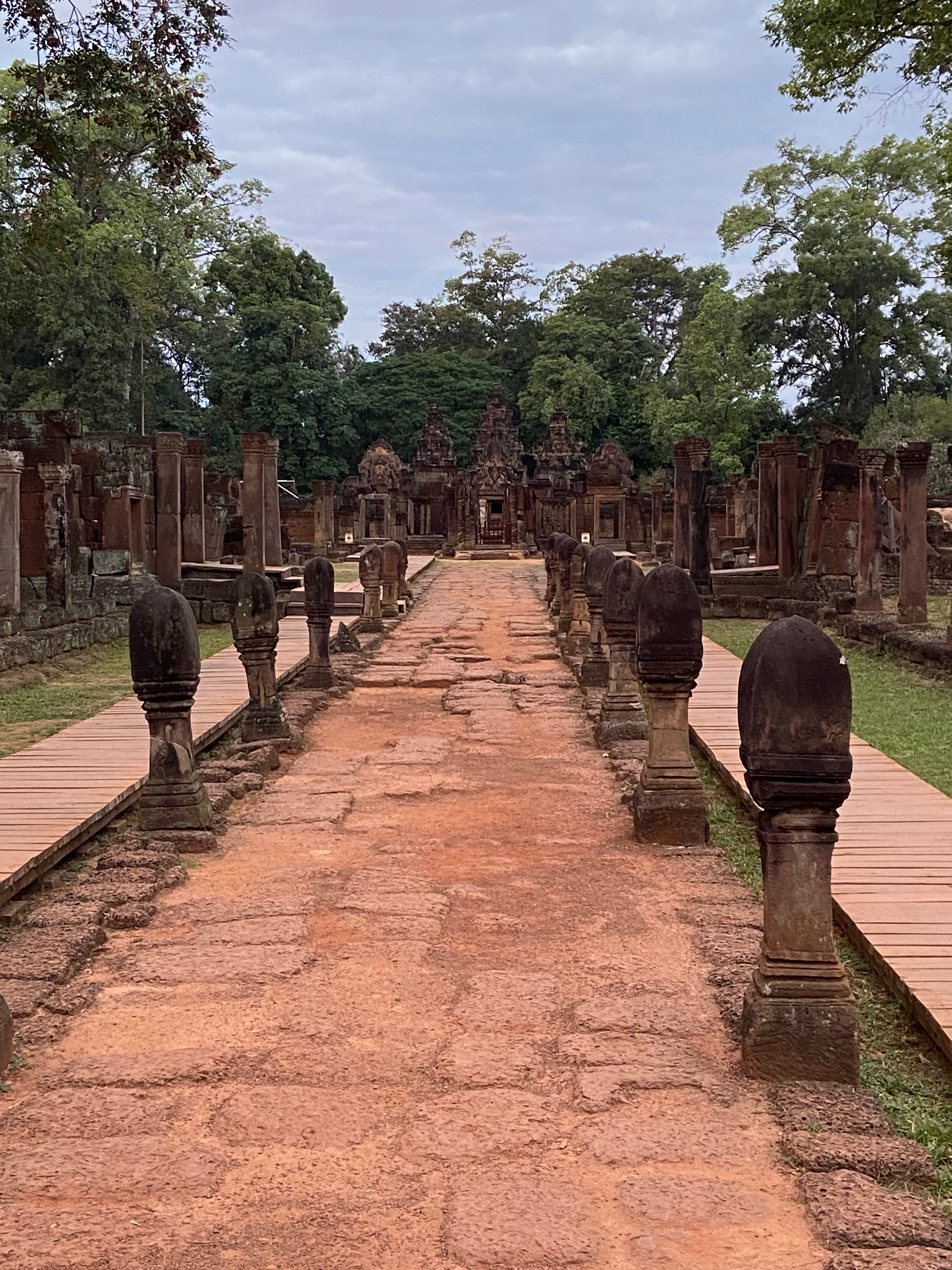
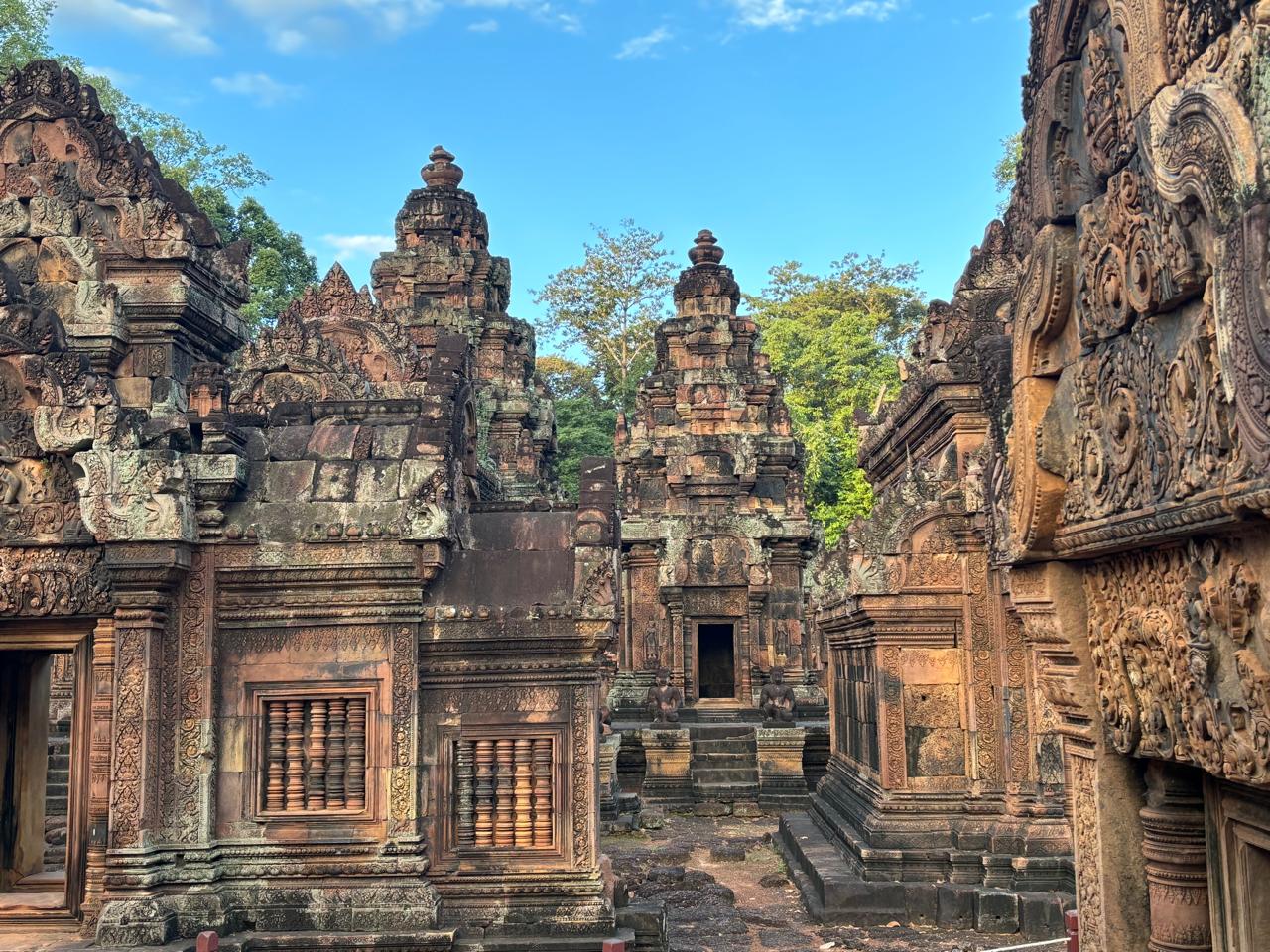
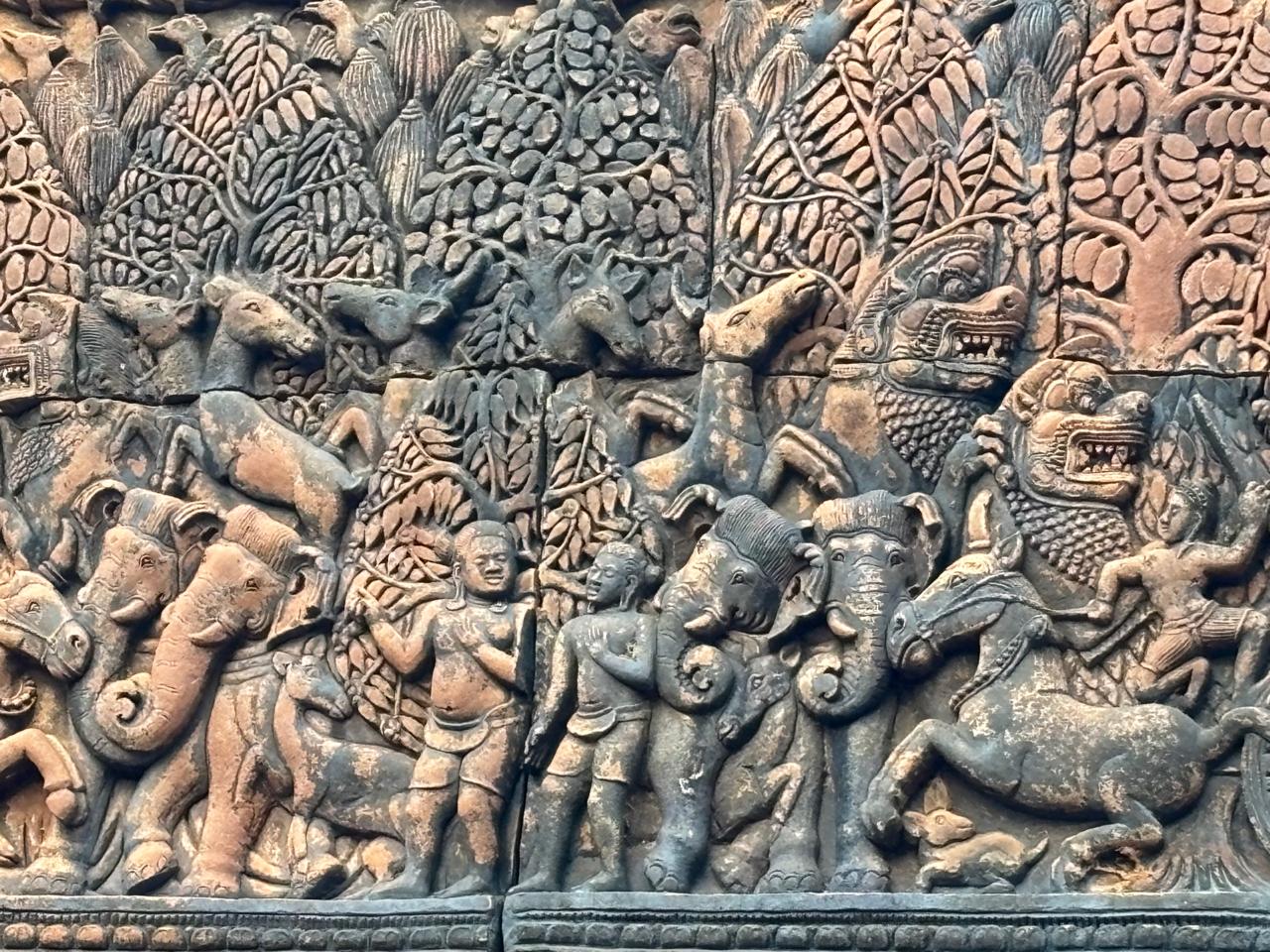
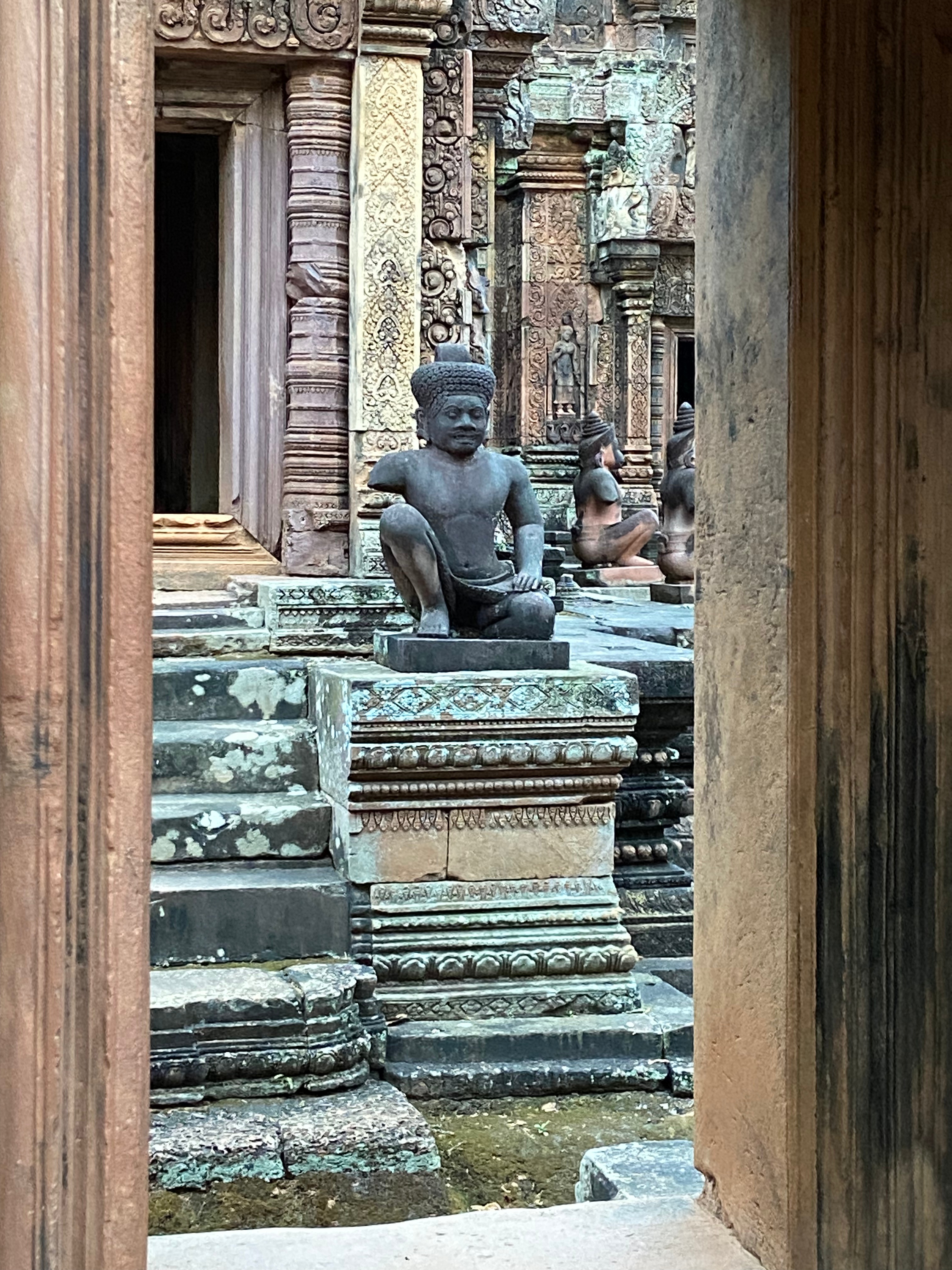
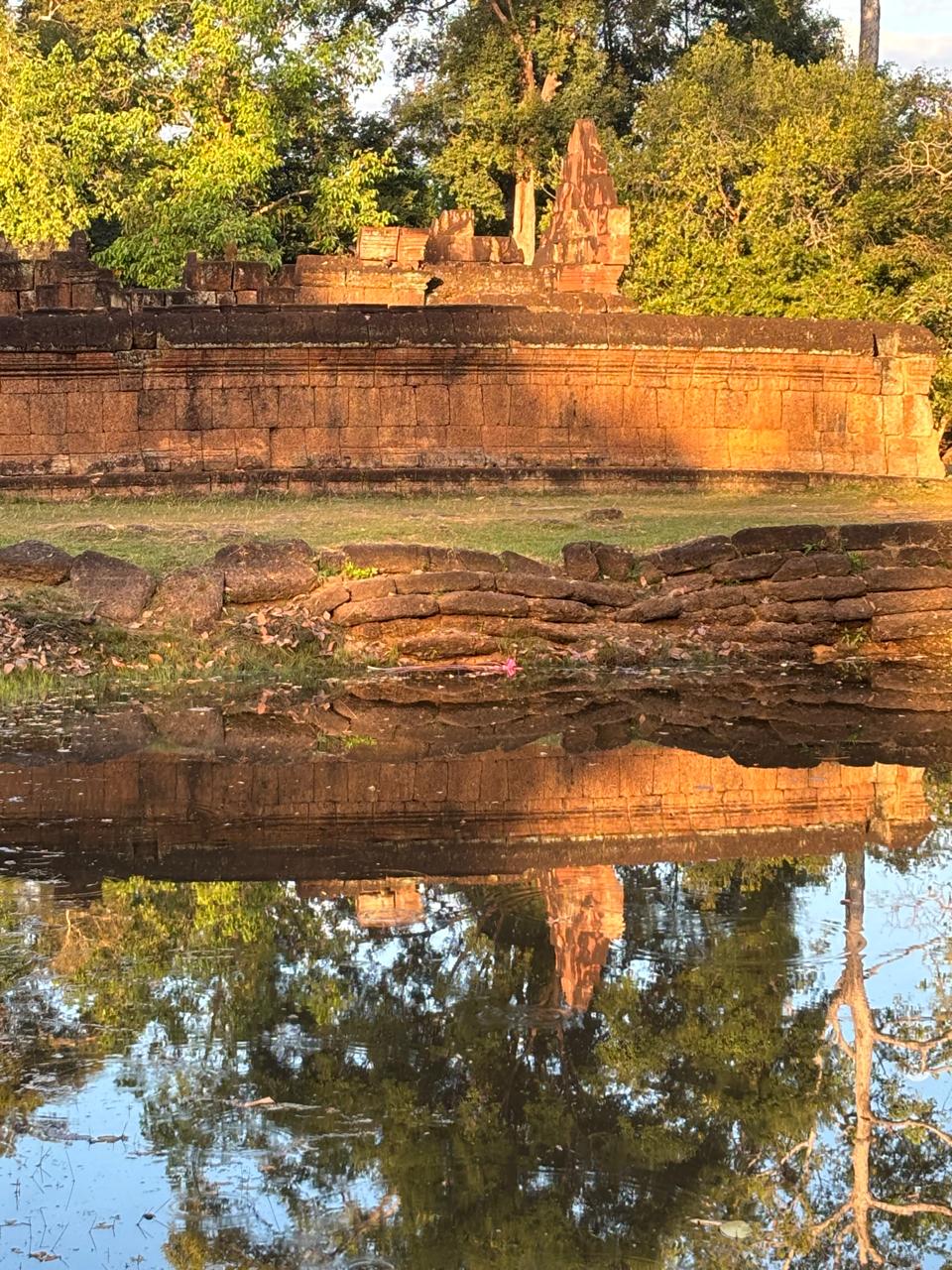
On ‘Temple Day’ Theary collected us at 5.30am, and rather than follow the crowds to Angkor Wat – how lucky was I have Di as my guide, she knows her temples – our first stop was Banteay Srey which means ‘Citadel of the Women’. Banteay Srey is said to have been built by a woman as the delicate carvings are considered too fine to have been crafted by any man. We were there at 6.30am only to find it didn’t officially open till 7.30am but there was nothing to stop us going in so we did and we had the place to ourselves, just us, birdsong and the rising sun casting a golden light on the stone. Magical. A grumpy official found us around 7am and ticked us off for entering before opening time. Like naughty schoolgirls we muttered ‘too late’ and carried on with our tour, enjoying breaking the rules!  With its reddish and pinkish stone and intricate carvings – such as scenes from the Ramayana adorning the library pediments – this was my favourite of all the temples.

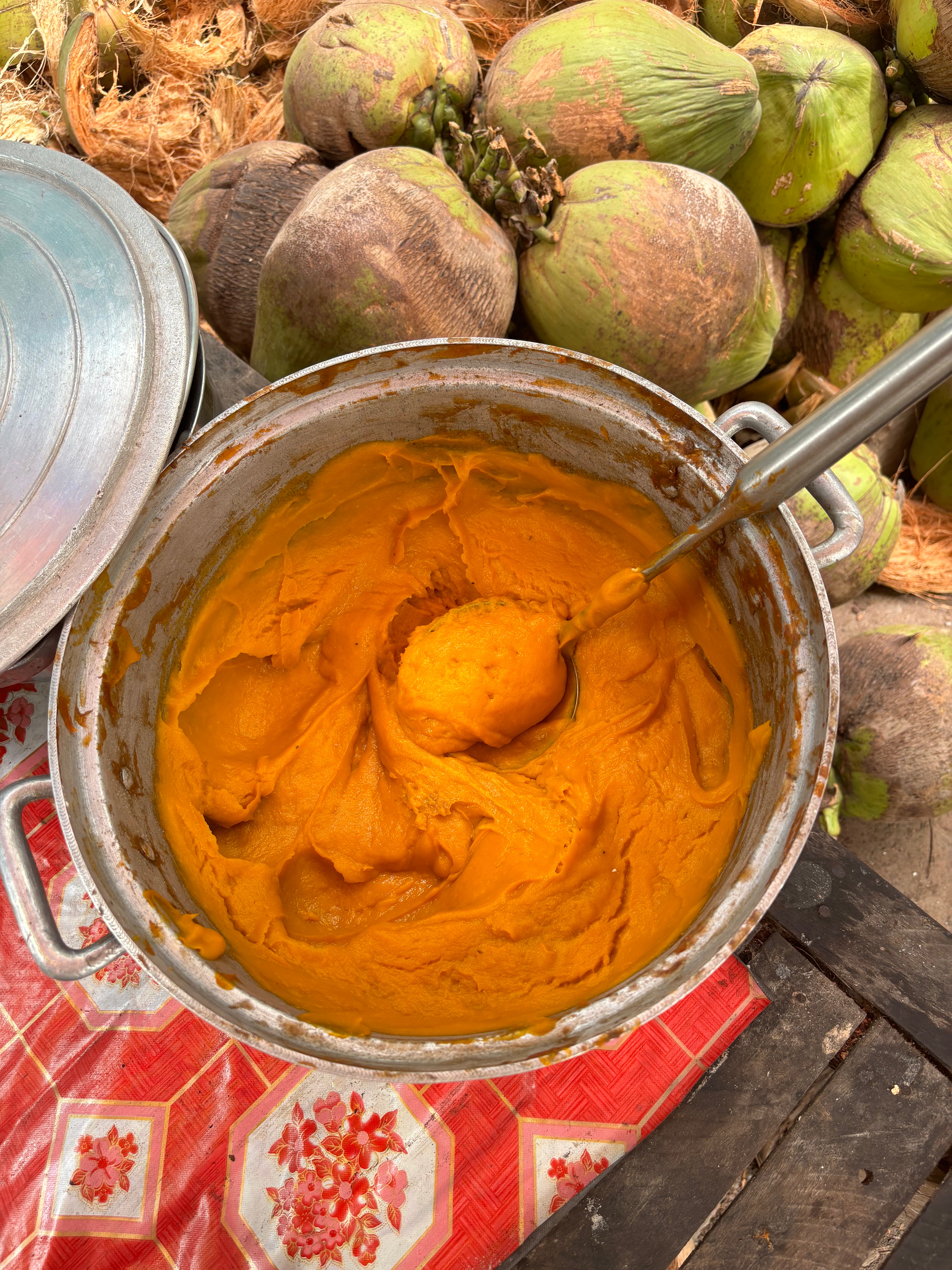
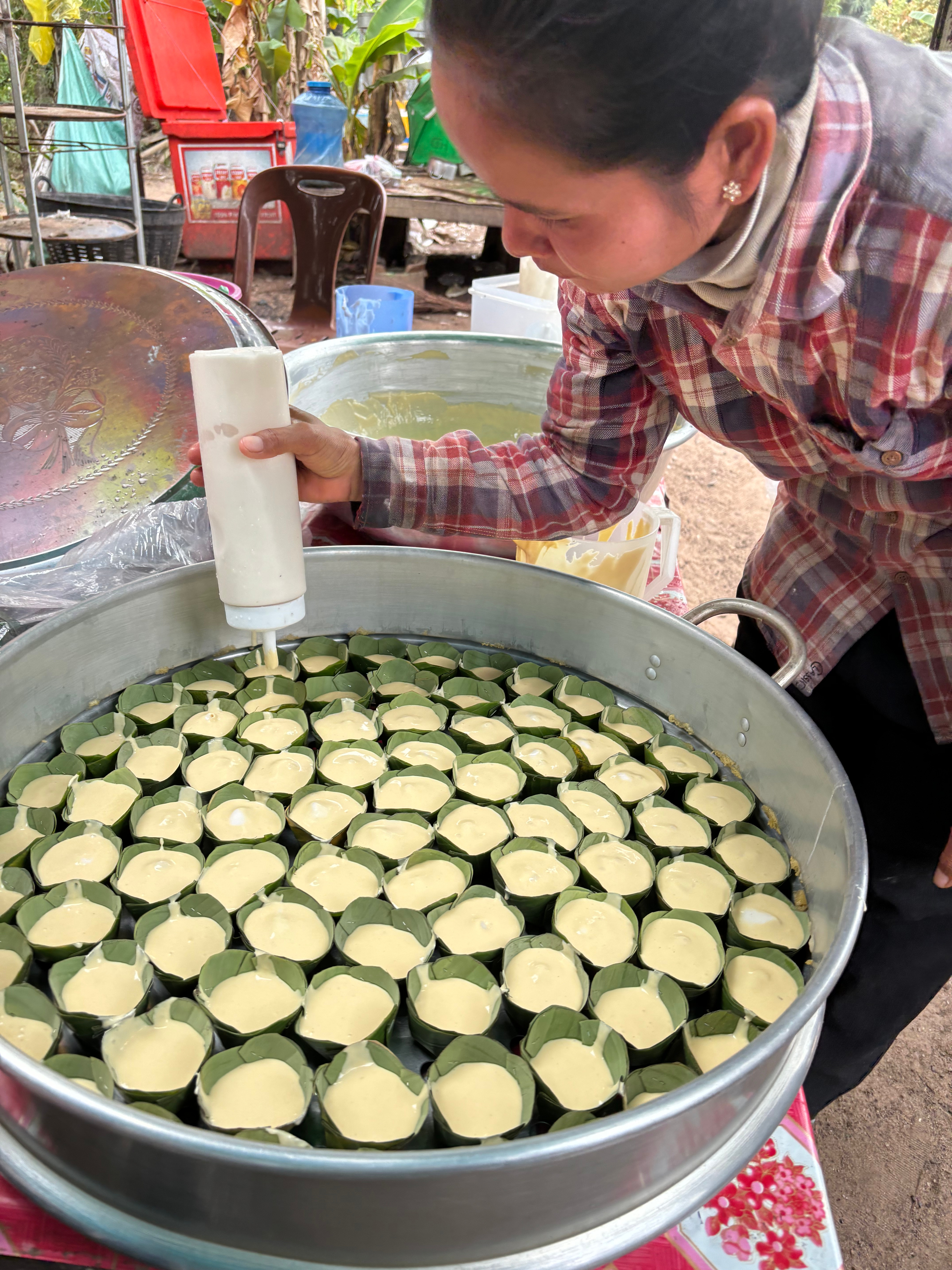
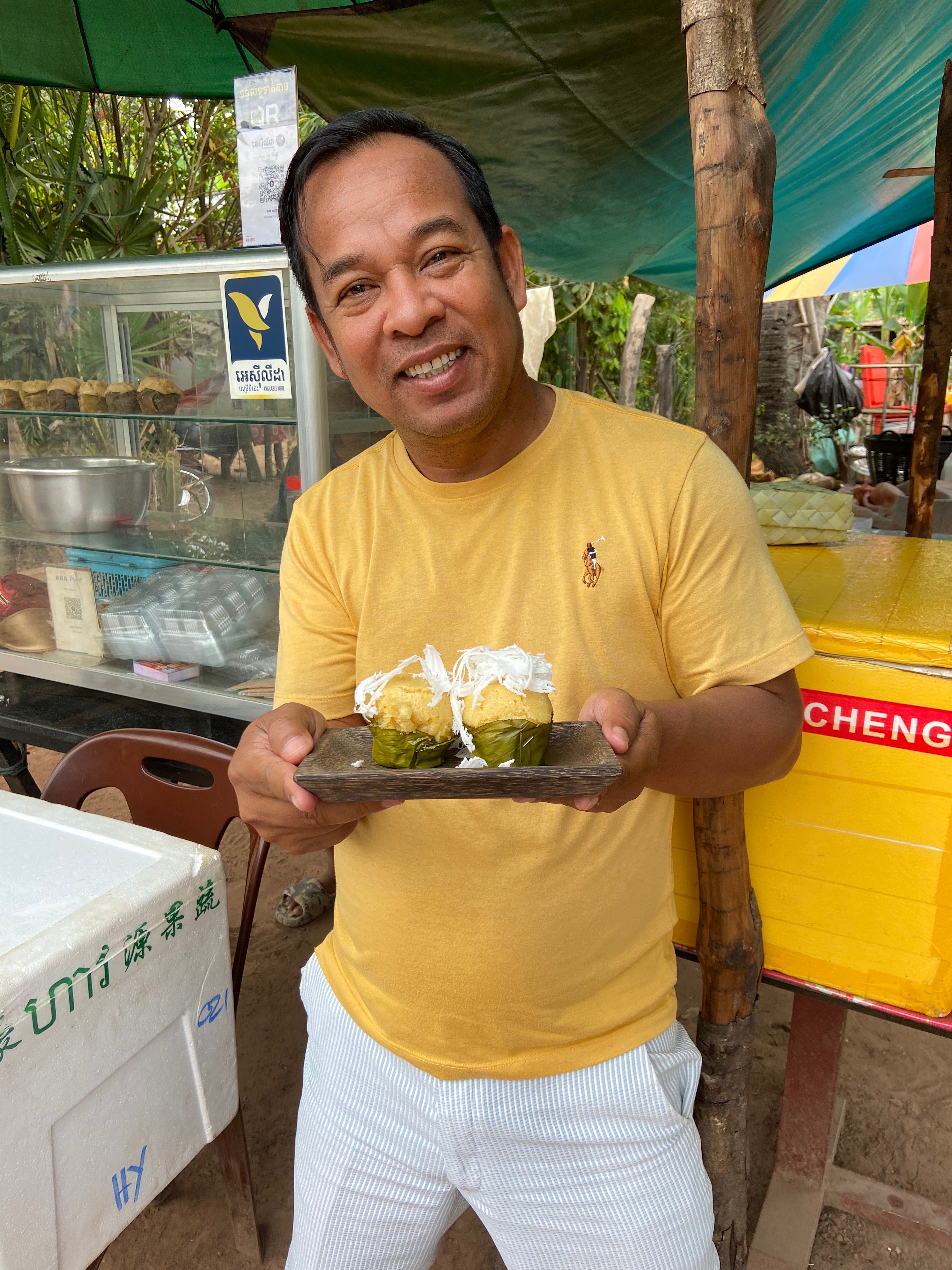
After breakfast at Banteay Srey, Theary picked us up and we continued with our temple tour. Along the way we came across a bunch of roadside stalls selling among other things palm fruit cakes, made from palm fruit puree (it looks like pumpkin puree but is sharper and has a more defined fruity flavour), eggs and palm sugar and steamed in a pandan leaf. They are served with coconut cream in the middle and fresh coconut on top. Well, this was ONE OF THE MOST DELECTABLE THINGS I HAVE EVER EATEN! I can highly recommend.

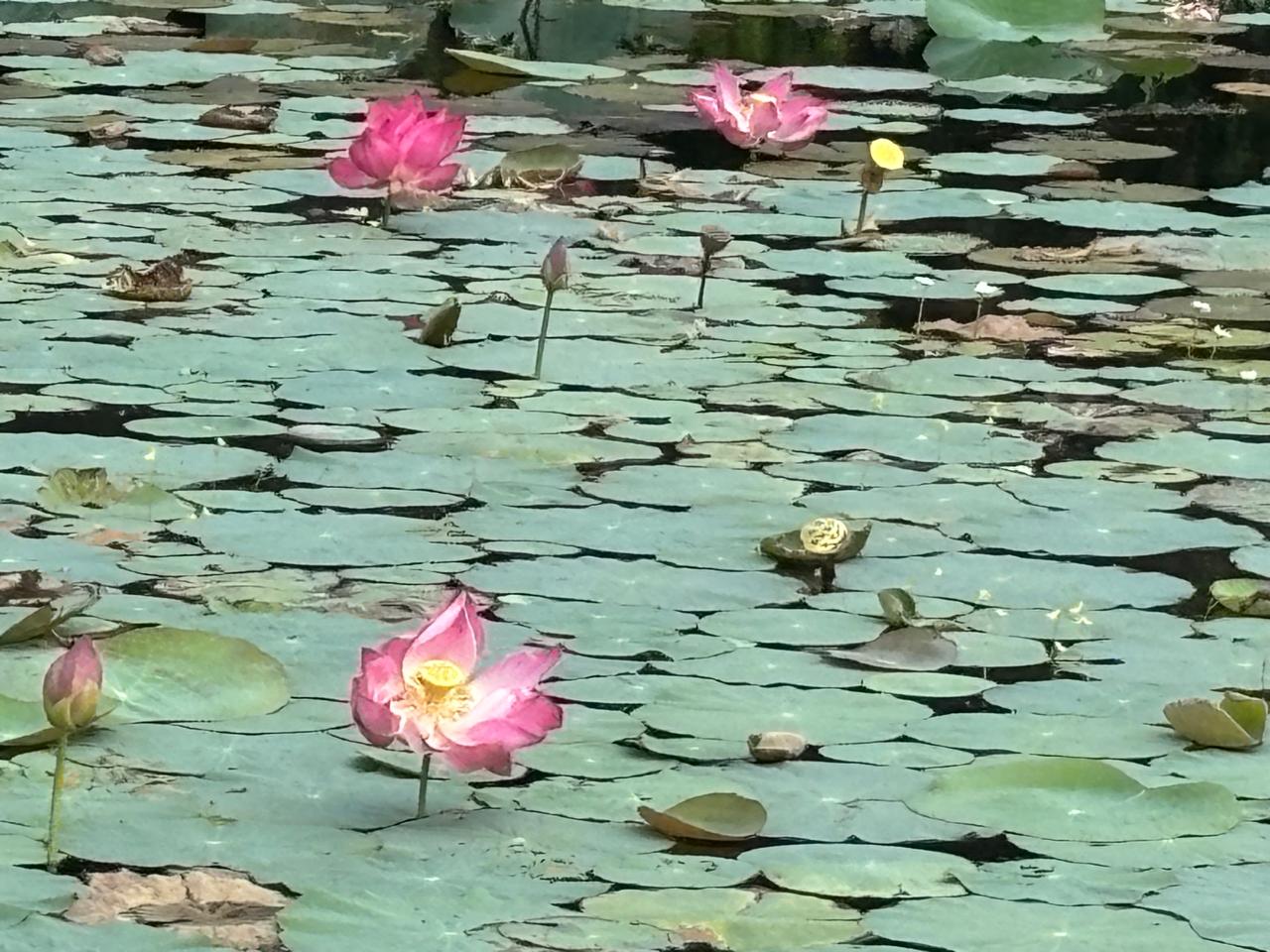
Our next stop before Angkor Wat was Neak Pean, a temple built on an artificial island with a Buddhist temple in the middle. It’s divided into four enclosures in the shape of a cross and all of them have beautiful bas-relief carvings. But what I remember most is the approach via the causeway, which is dotted with lotus flowers and lotus seed pods, the latter dotted with holes reminding me of watering can spouts.

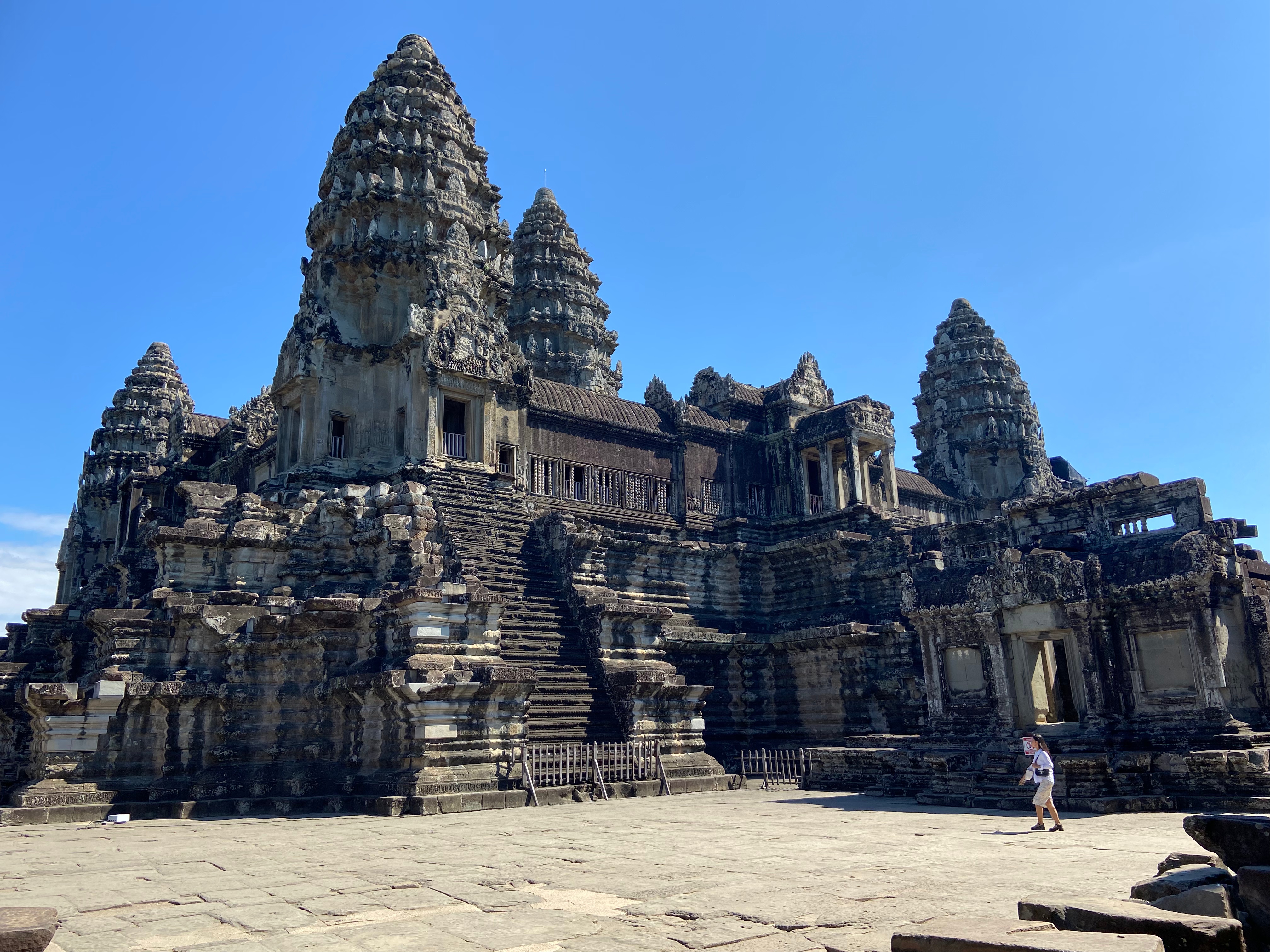
You’ll be familiar with pictures of Angkor Wat, and much has been written about it – but by way of a summary: Angkor Wat was originally a Hindu temple and later converted to a Buddhist temple. It’s on the UNESCO World Heritage List, the world’s largest religious monument, a highpoint of Khmer architecture built in the 12th century.

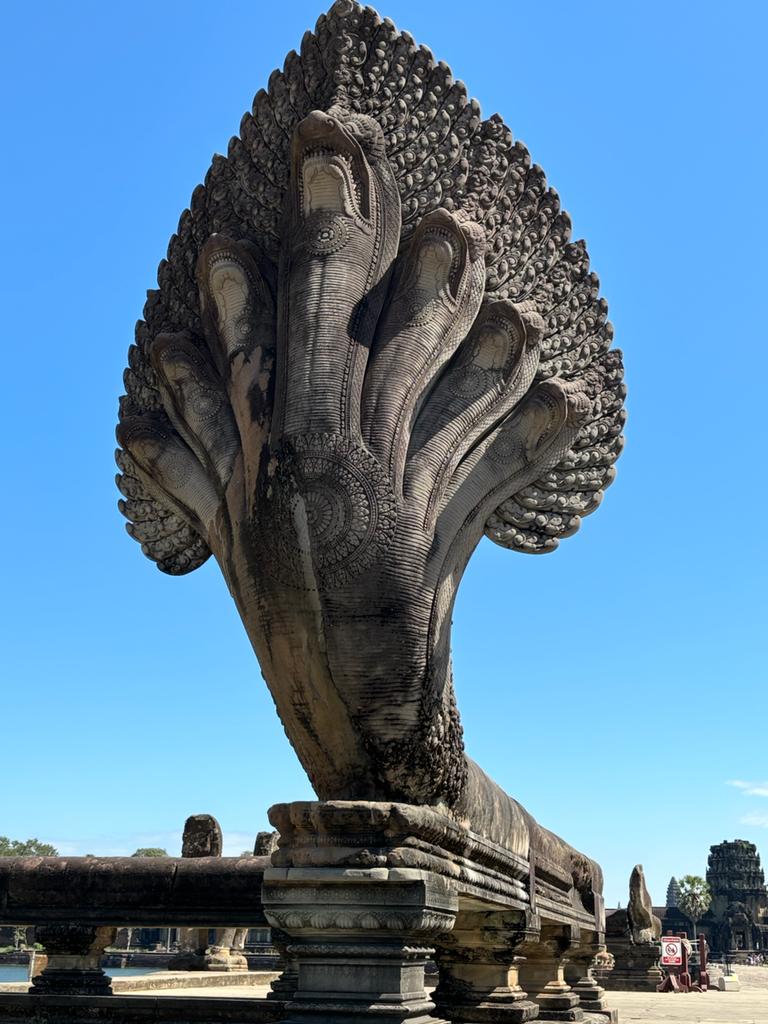
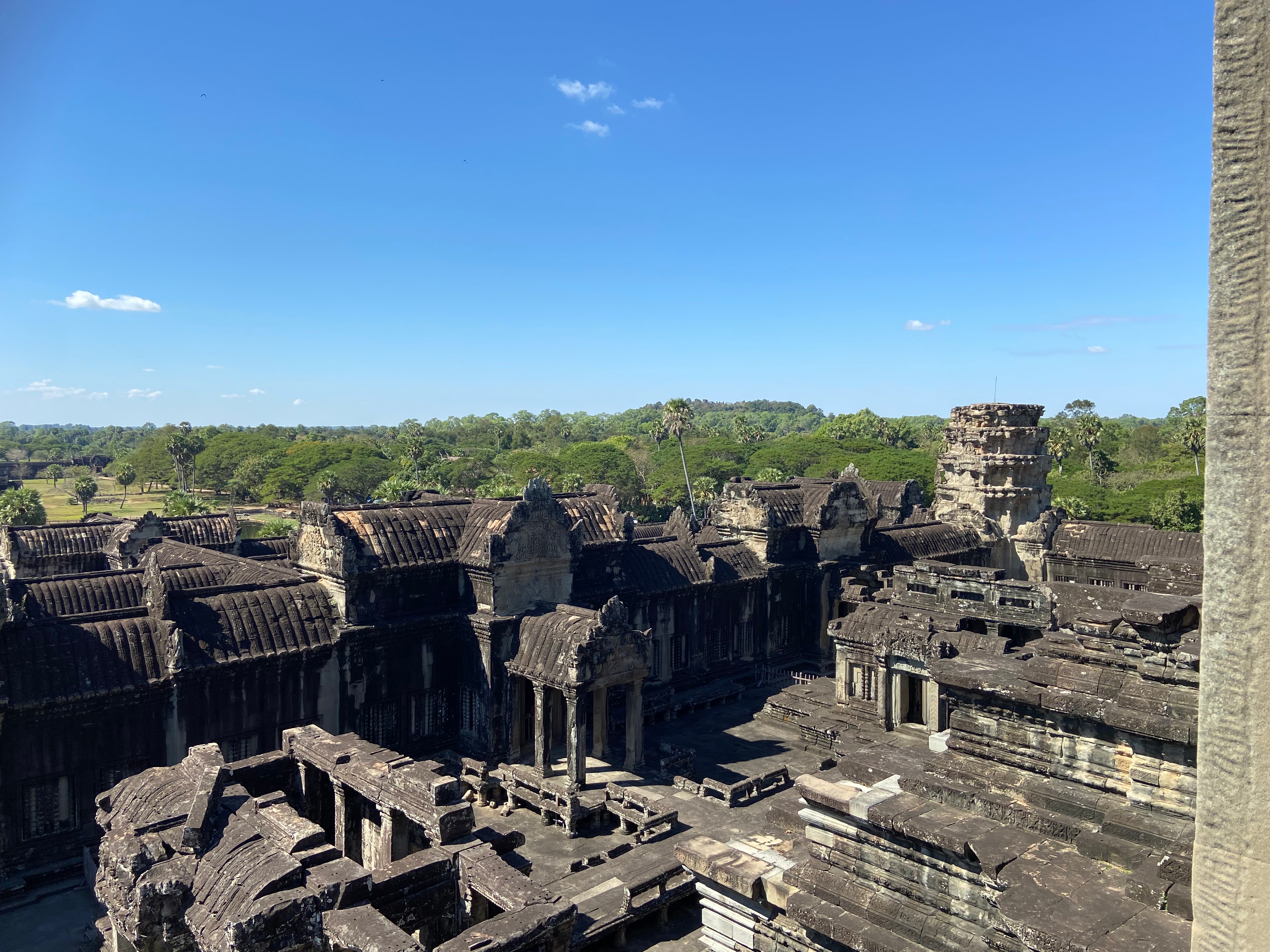
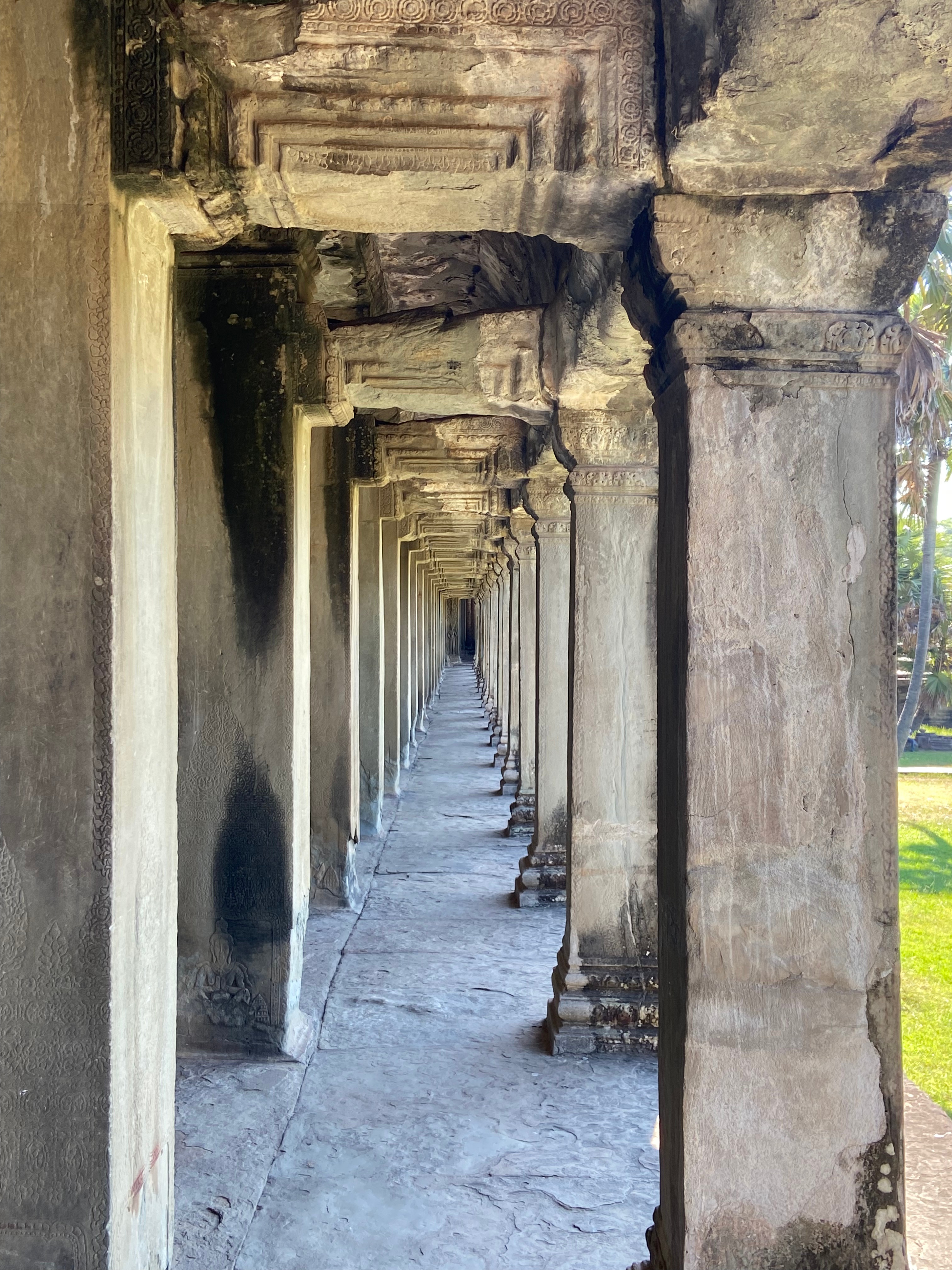
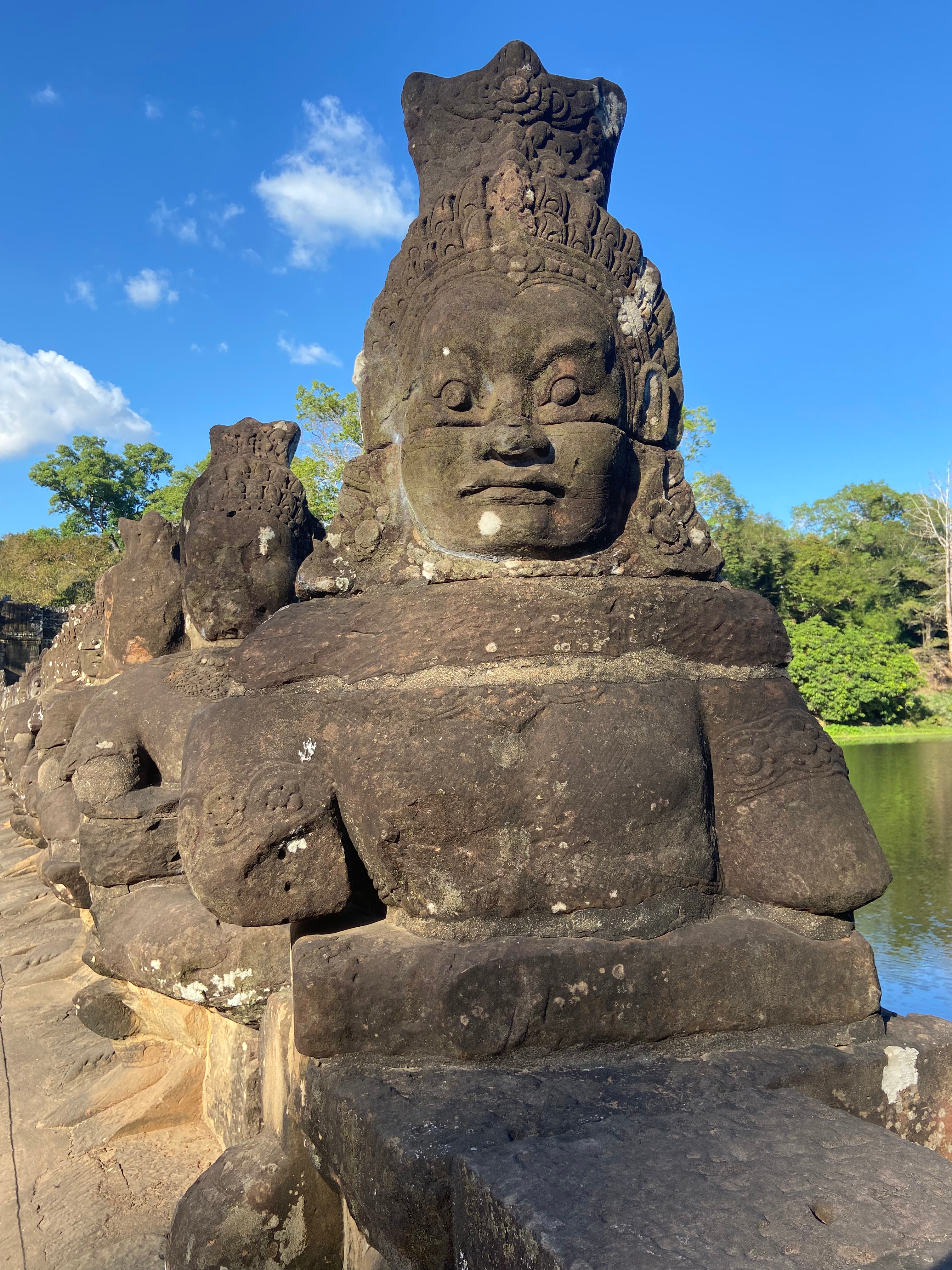
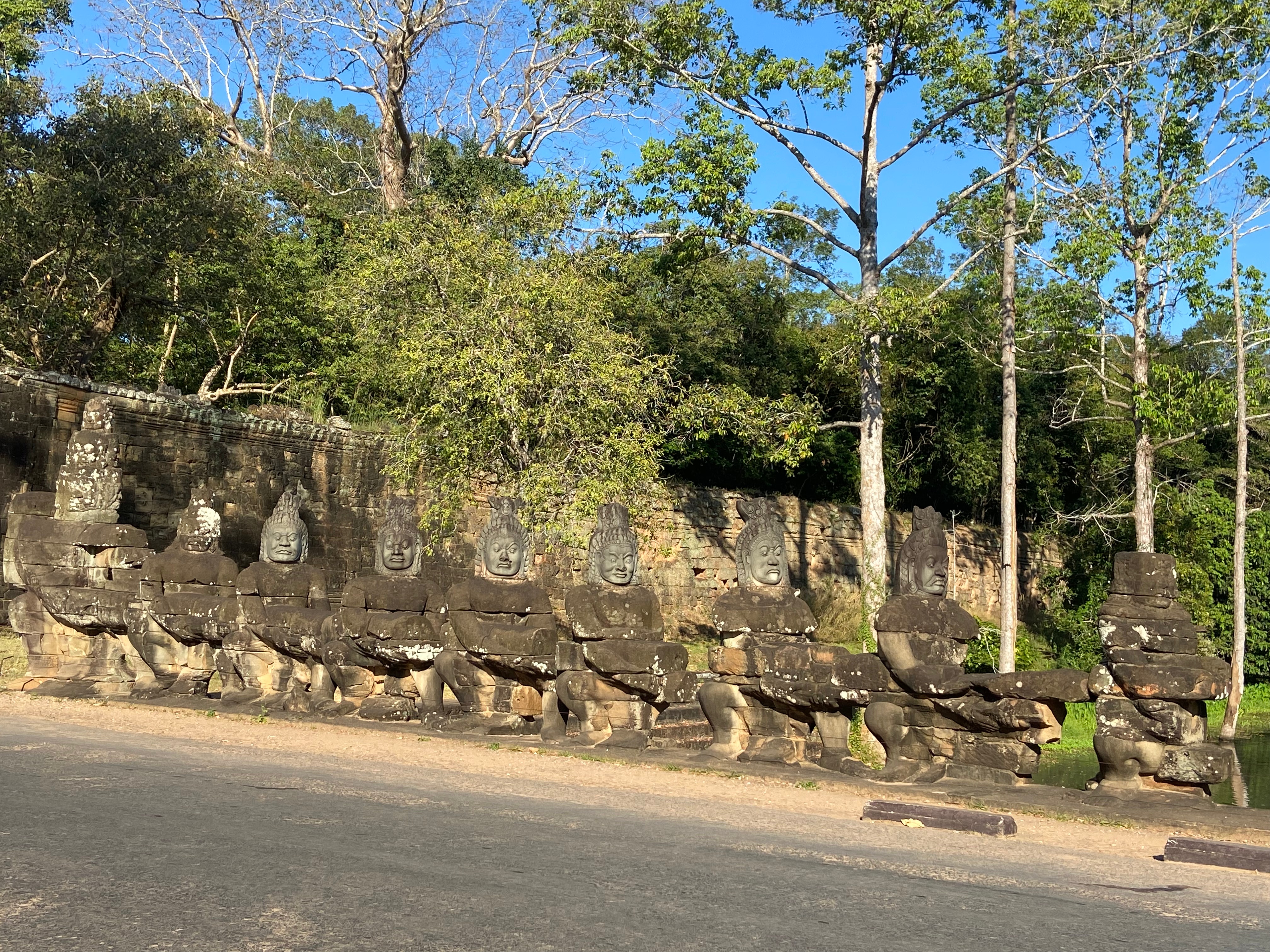
It’s surrounded by a vast moat and wall, and you approach by a long sandstone causeway guarded by the seven-headed serpents or nagas. The temple is on three levels, the tiered layout representing Mount Meru, the mythical home of the gods in Hindu cosmology. It’s a steep climb up to the top terrace but it’s well worth it for the views back over the complex.

We went round with a local guide and there was so much to learn that I failed to retain much of it! But you don’t need to understand all the layers of history, interpretation, mythology and meaning to experience a sense of awe at its sheer size and complexity – the city of Angkor served as the royal centre from which a dynasty of Khmer kings ruled one of the largest kingdoms in the history of Southeast Asia.

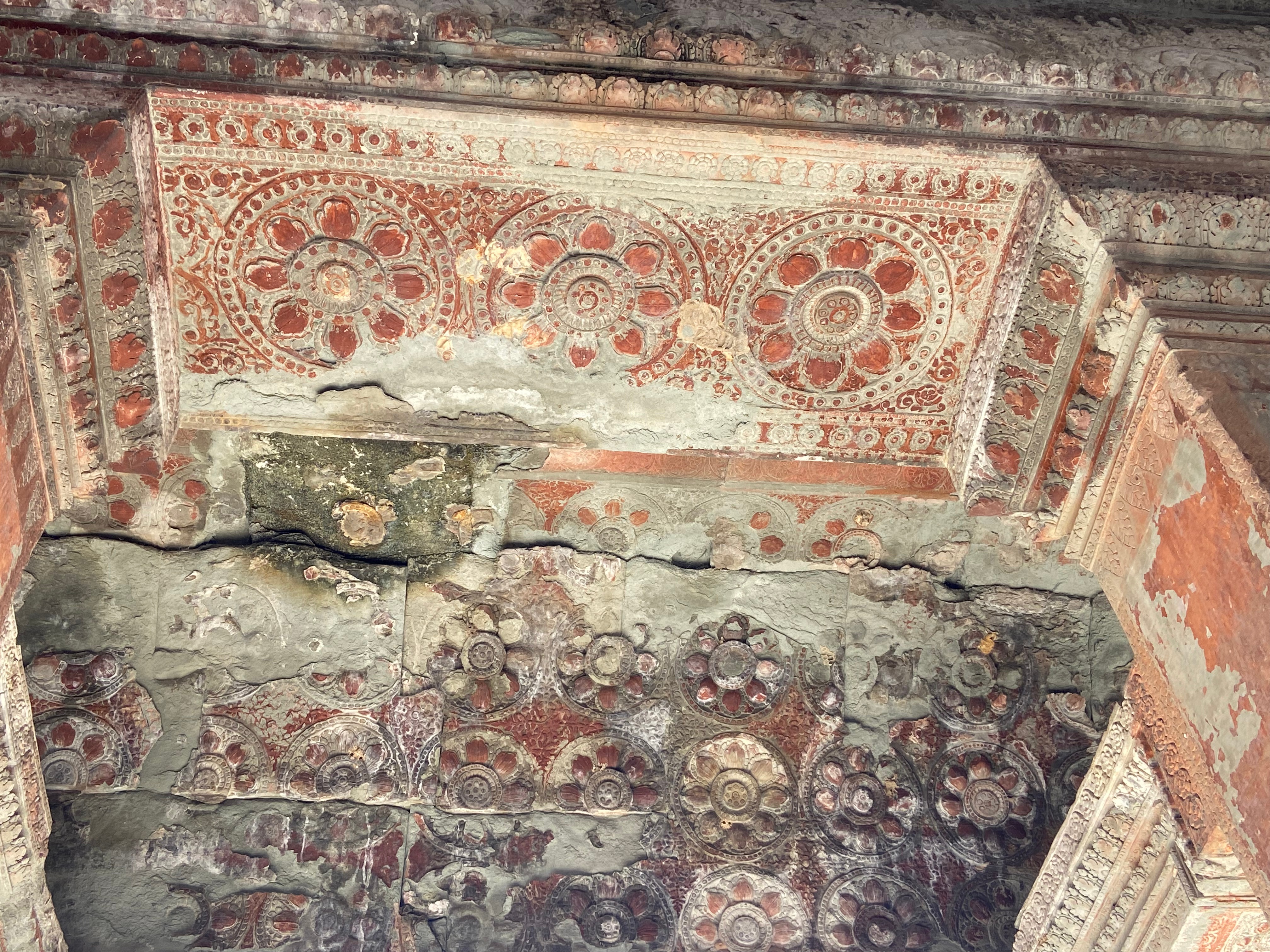
On the second level of the temple is the Gallery of a Thousand Buddhas which, while largely devoid of Buddhas – they were either removed for conservation or destroyed by the Khmer Rouge – has detailed carvings depicting scenes from Hindu mythology and sections where pigment from the original red paint is still visible on the rosettes carved into the roof beams. Close by is the Hall of Echoes – so-named because the stone picks up the vibration of sound. We tested it out by standing with our back to the wall and thumping our chest while saying OM – it’s meant to clear your karma!

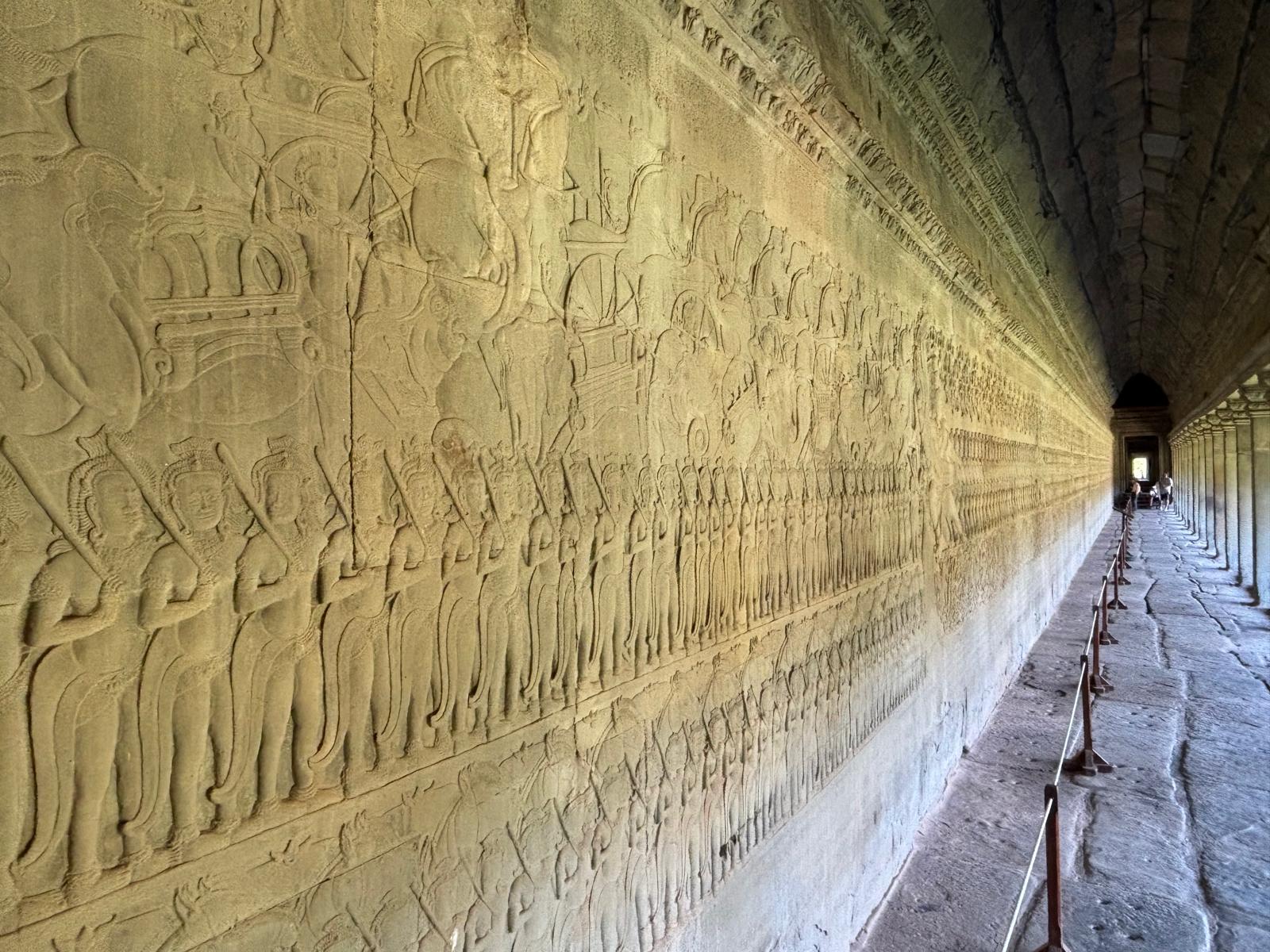
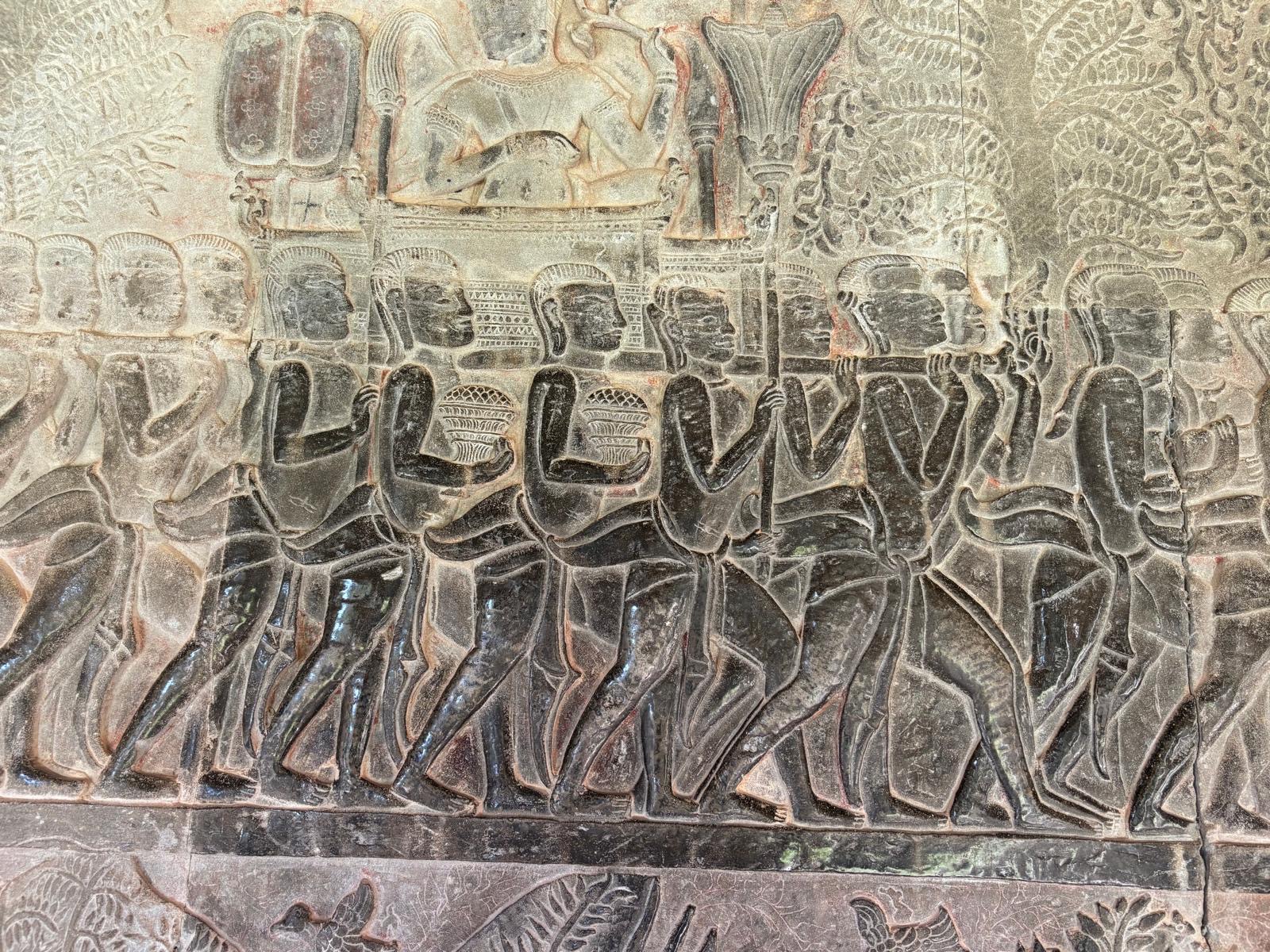
In the East Gallery is the famous 160-foot-long Churning of the Ocean of Milk bas-relief depicting a momentous event in Hindu Mythology – the very brief version of which is that the Ocean of Milk is churned by gods and demons (the struggle of good versus evil) to generate Amrita, the elixir of life. The level of detail is quite extraordinary, mesmerising.

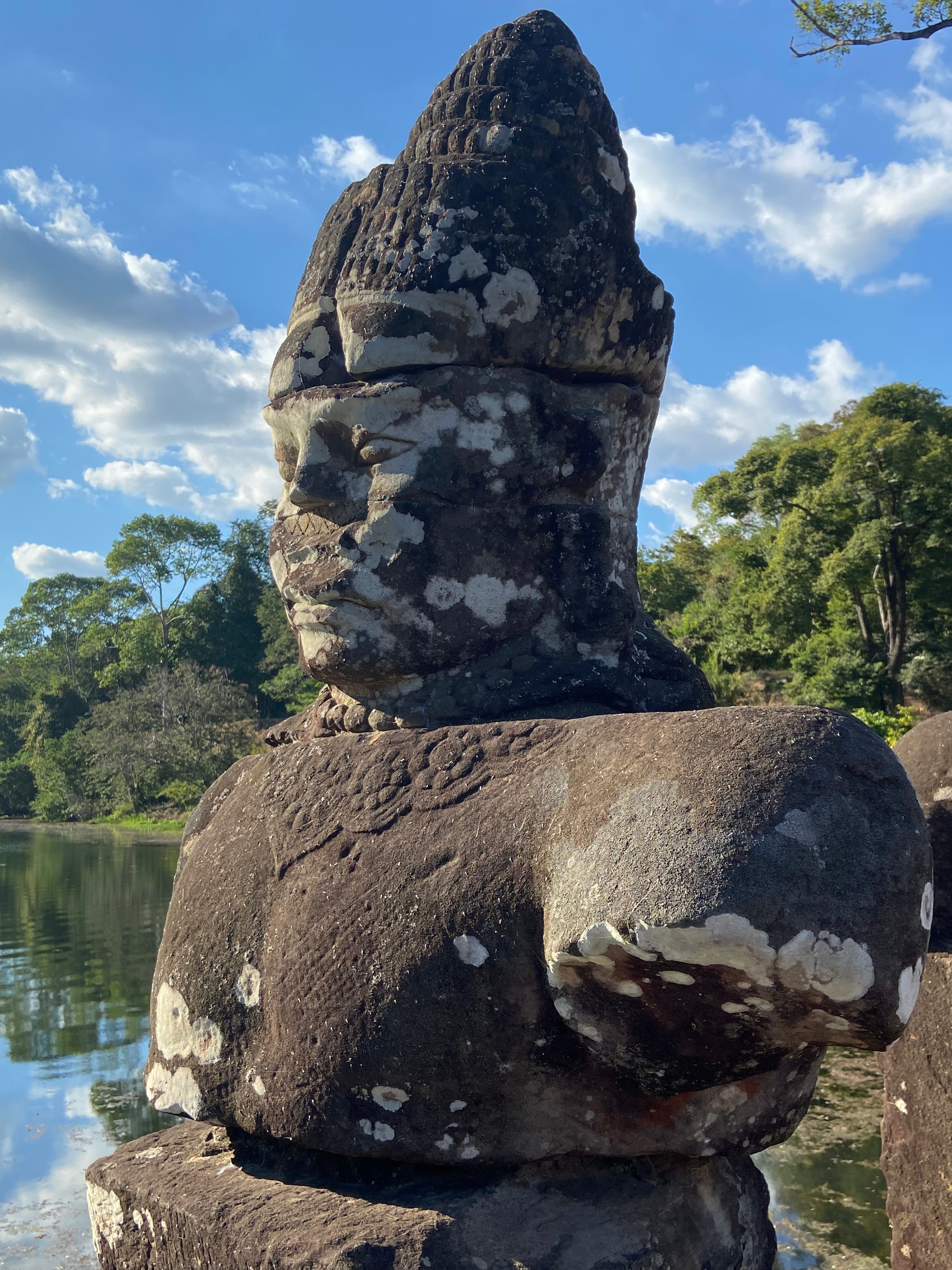
We were ready for a break at lunchtime and snacked on chicken spring rolls and banana flower salad with seafood in the café at Angkor Wat. Suitably restored we then walked across the South Gate of Angkor Thom – one of the entrances to the ancient city of Angkor – on our way to Bayon Temple.  If you think we’d have exhausted our capacity to be wowed, think again.  I loved this causeway lined with giant statues – 54 gods and 54 demons pulling on the body of a giant Naga serpent, another tug of war between good and evil.

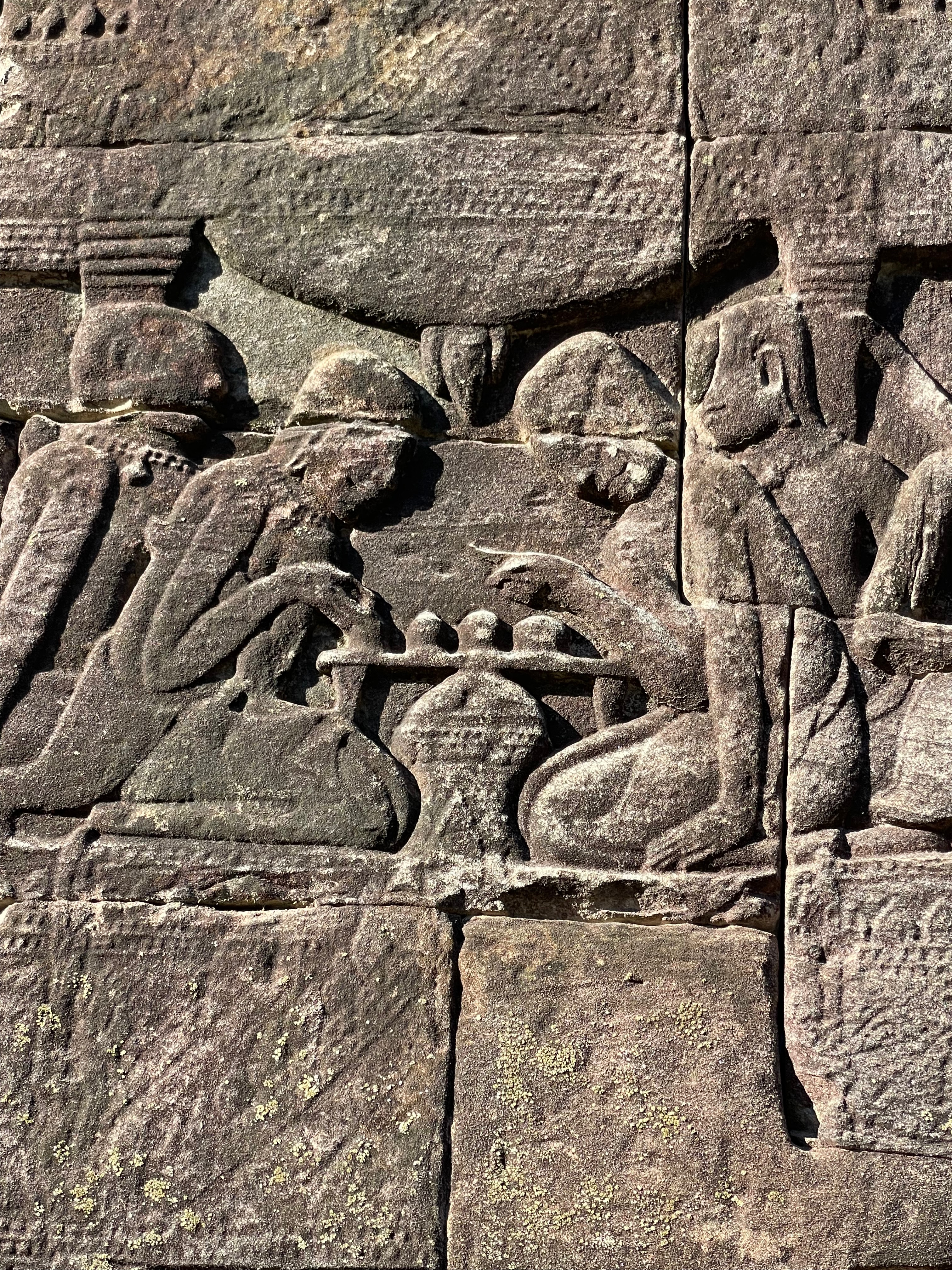
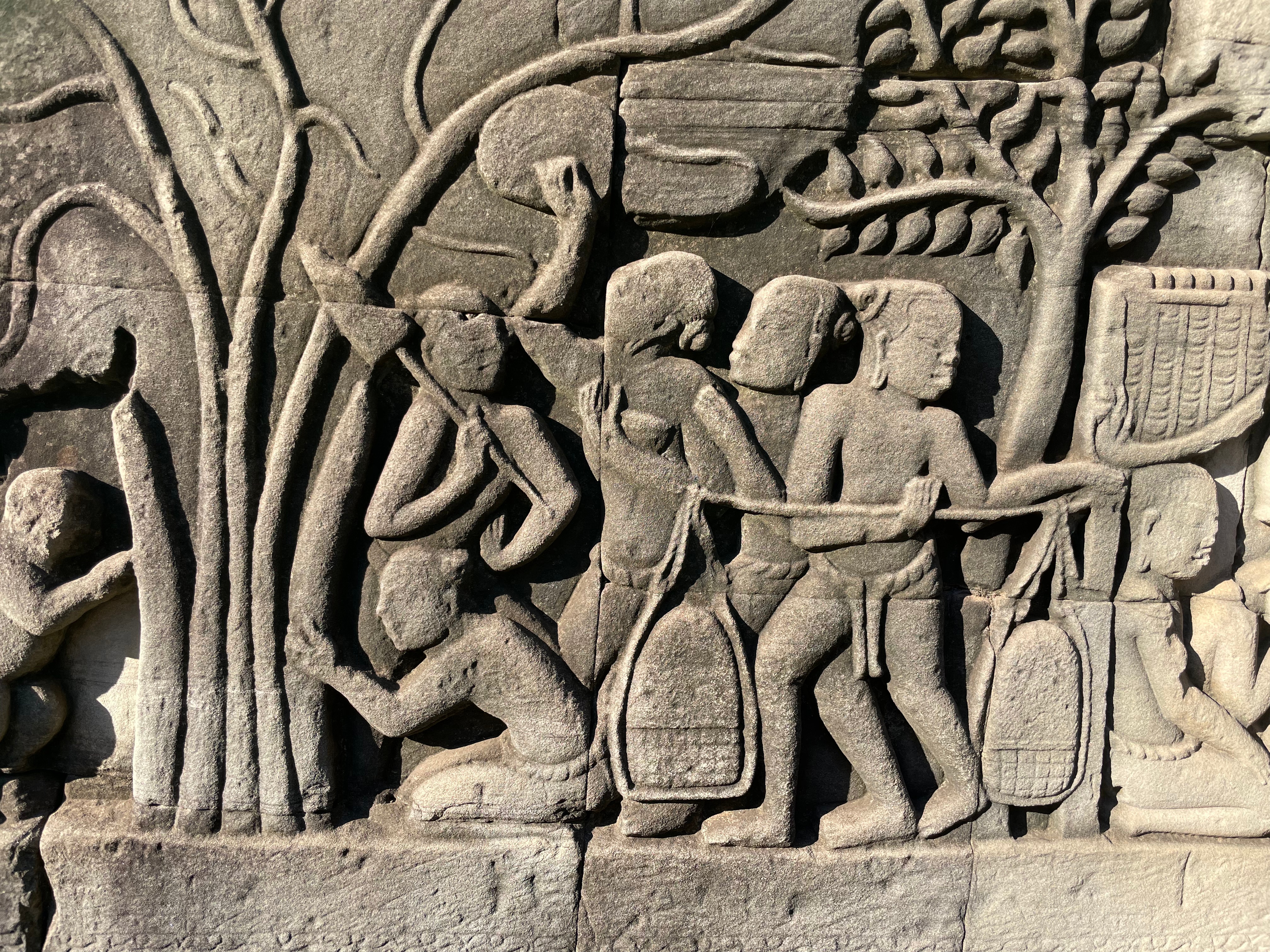
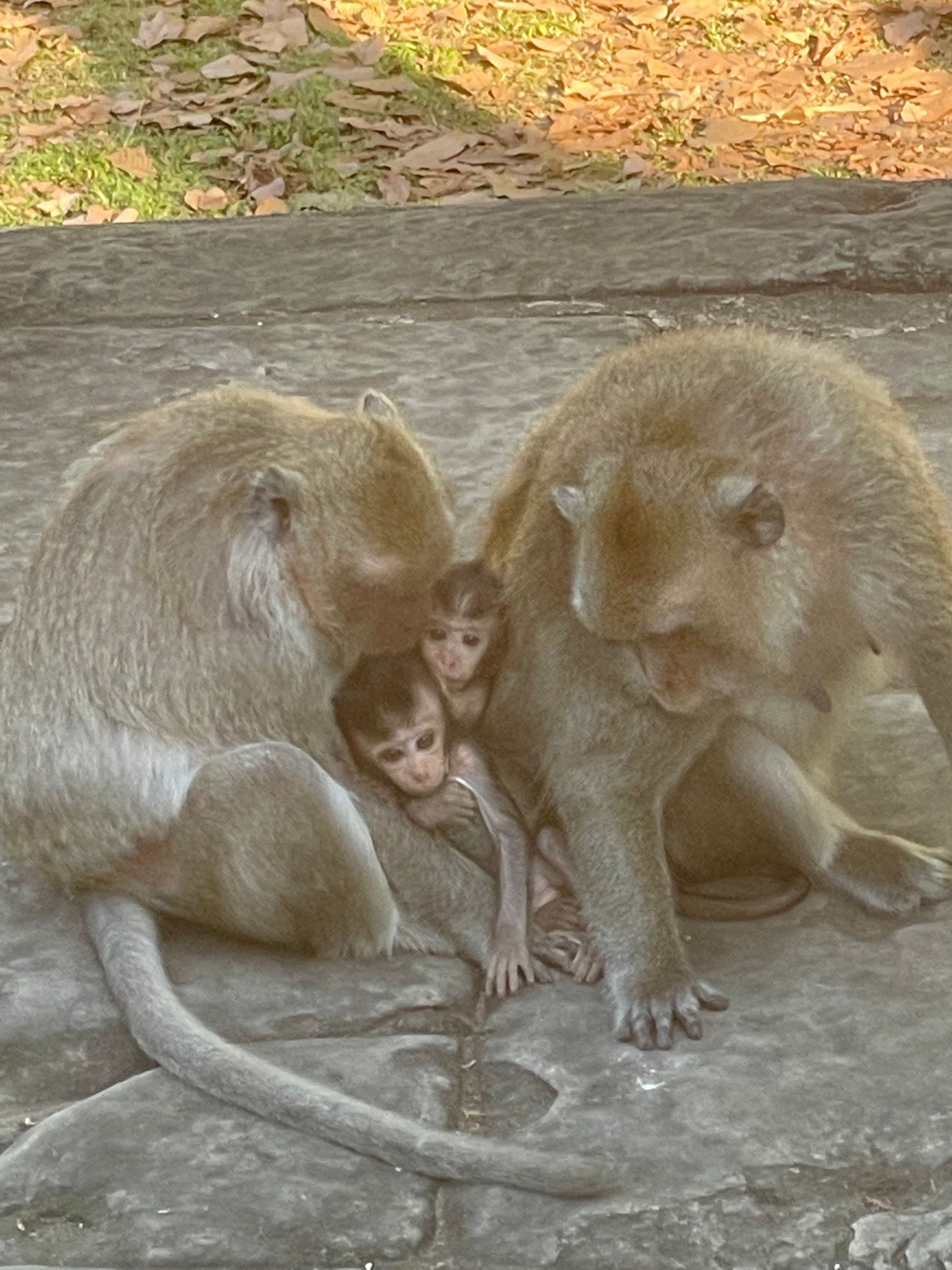
At Bayon, we focussed on the intricate and highly detailed carvings in the outer gallery portraying scenes of everyday life (working, playing, shopping at the market, food preparation etc) – quite a contrast to the focus on spiritual themes at the other temples. And we saw a monkey family with two newborn babies – gosh, they looked so human!

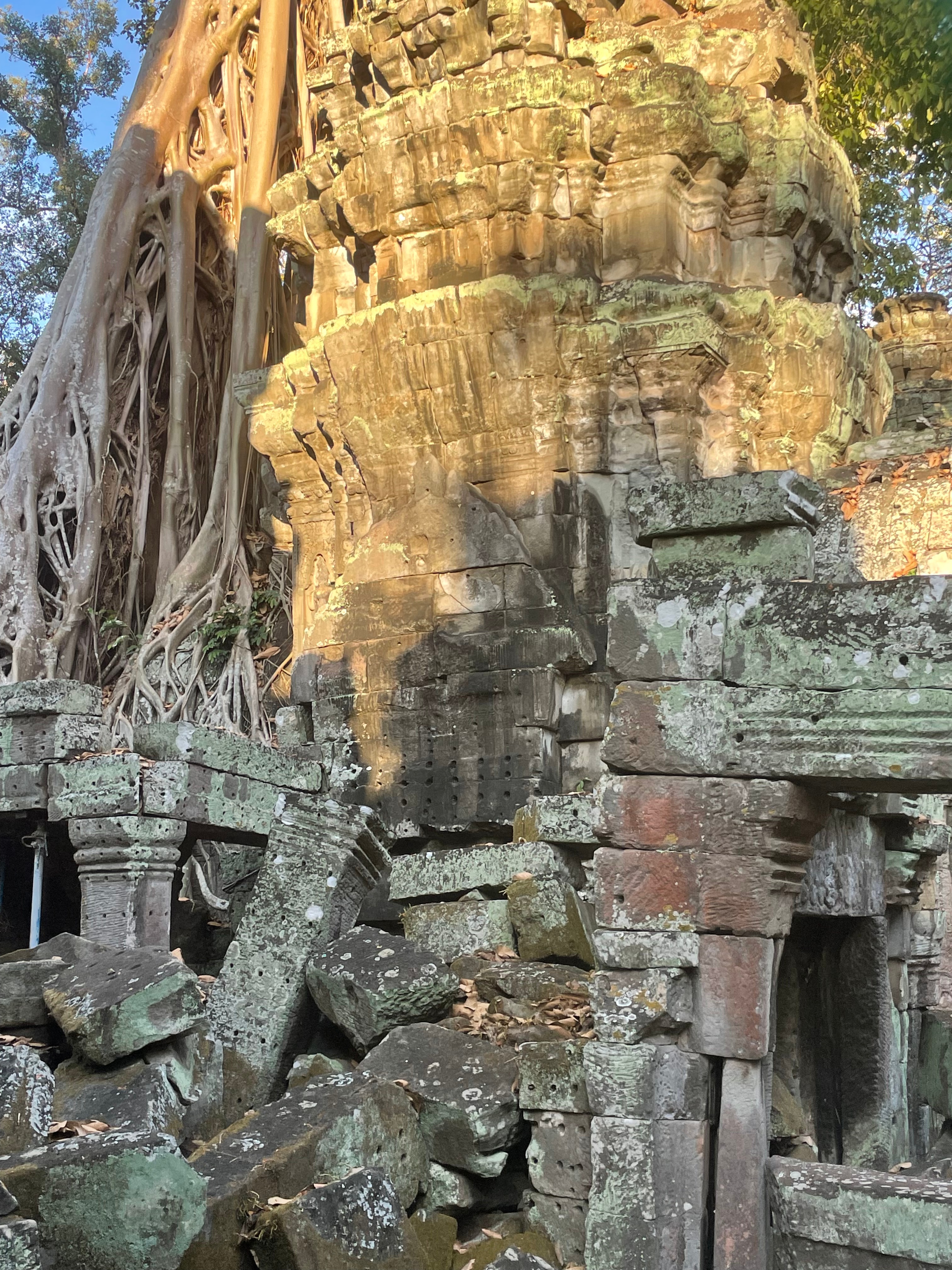
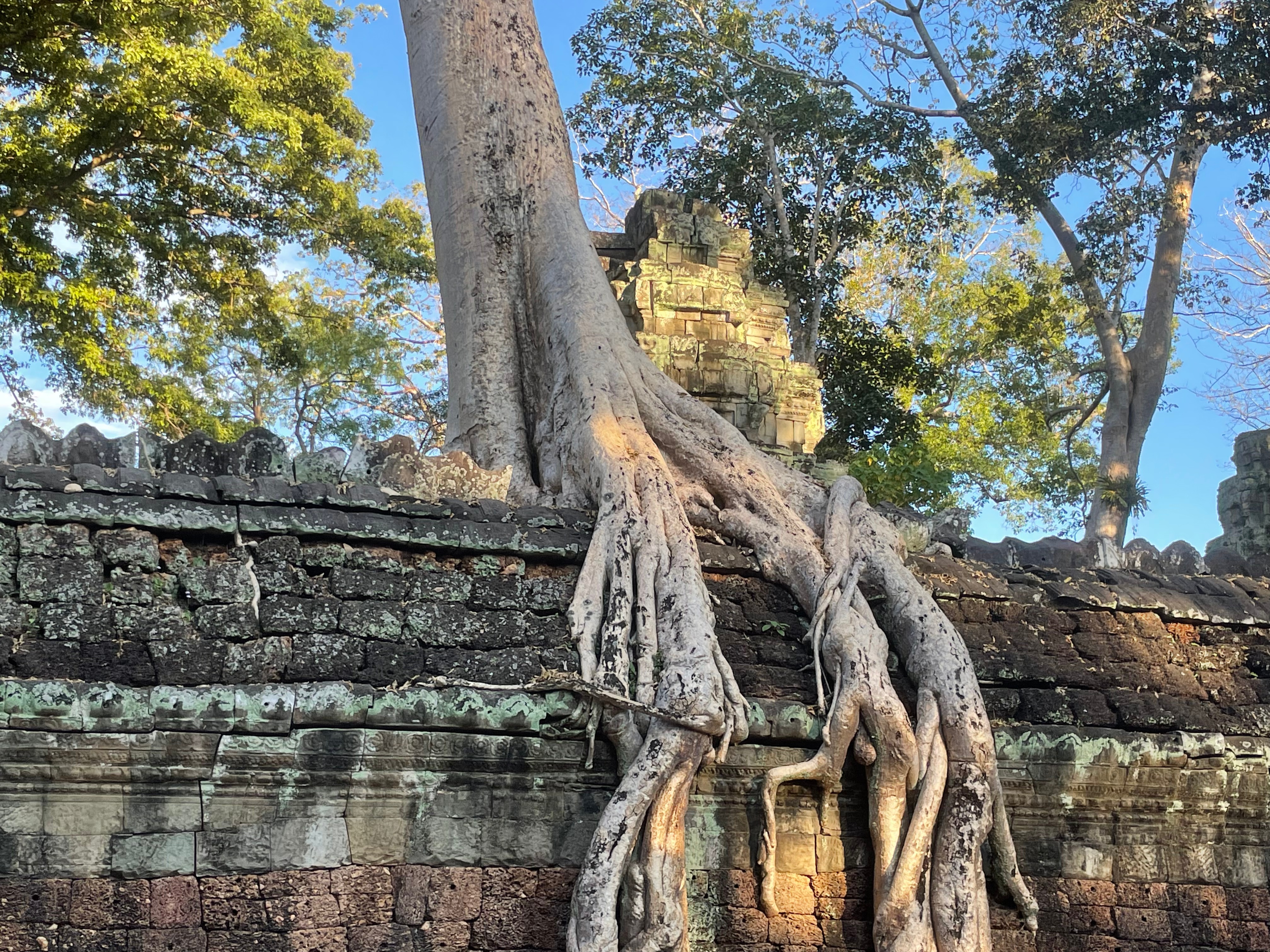
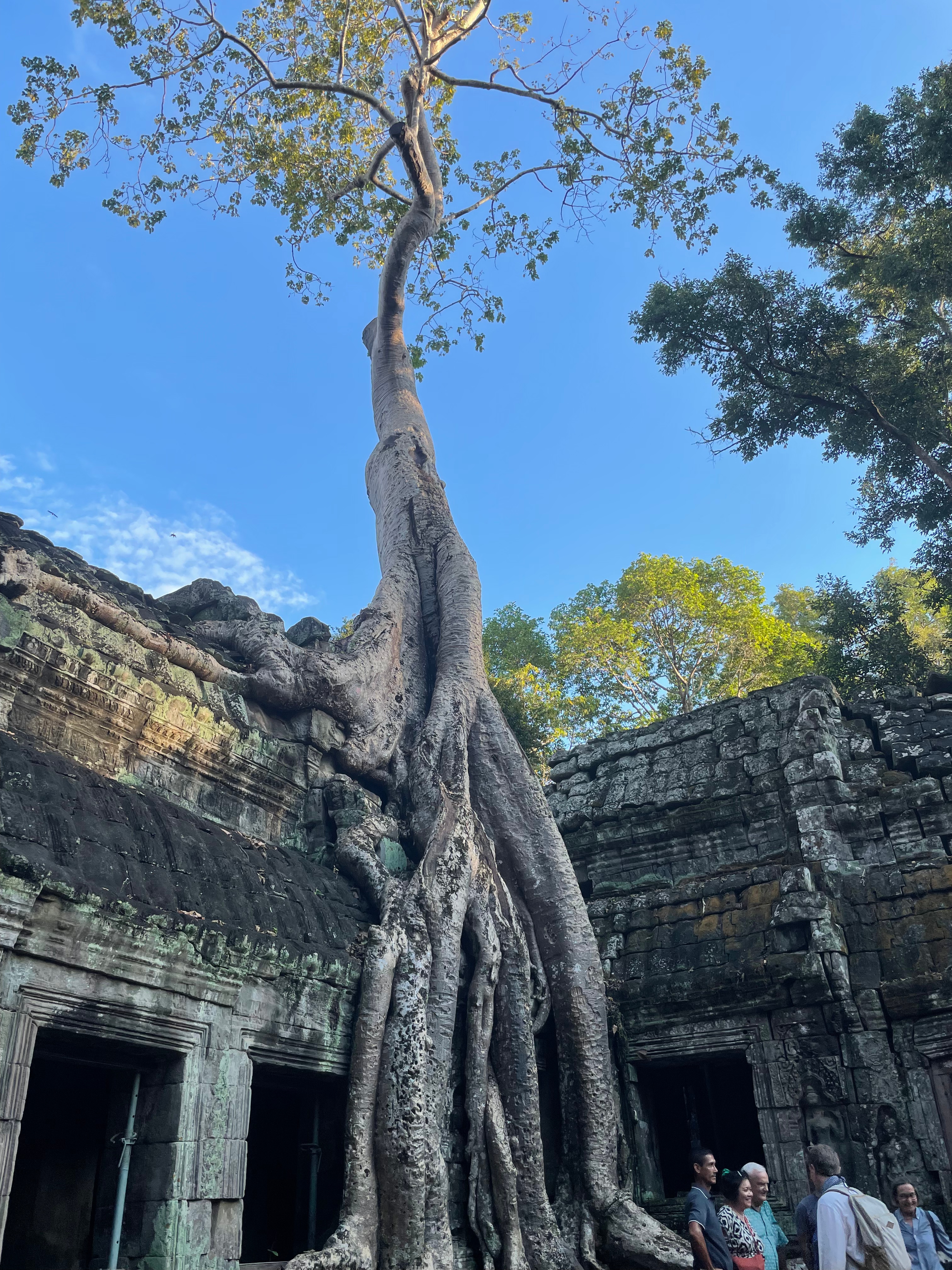
Last but not least we got to Ta Prohm, the temple that featured in Tomb Raider, as the sun was beginning to go down. Ta Prohm fell into disrepair in the 15th Century after the fall of the Khmer Empire and nature has reclaimed its supremacy here – the silk-cotton and strangler fig trees have spread their rope-like roots far and wide, uprooting stones and columns and spreadeagling across buildings as if part of the architectural design. It’s carefully curated chaos, though; ongoing conservation work aims to maintain the stability of the remaining towers, walkways and galleries at the same preventing further root damage. Watching the evening light on this post-apocalyptic-like landscape – it reminded me a bit of Chernobyl – was a fitting bookend to an extraordinary day.

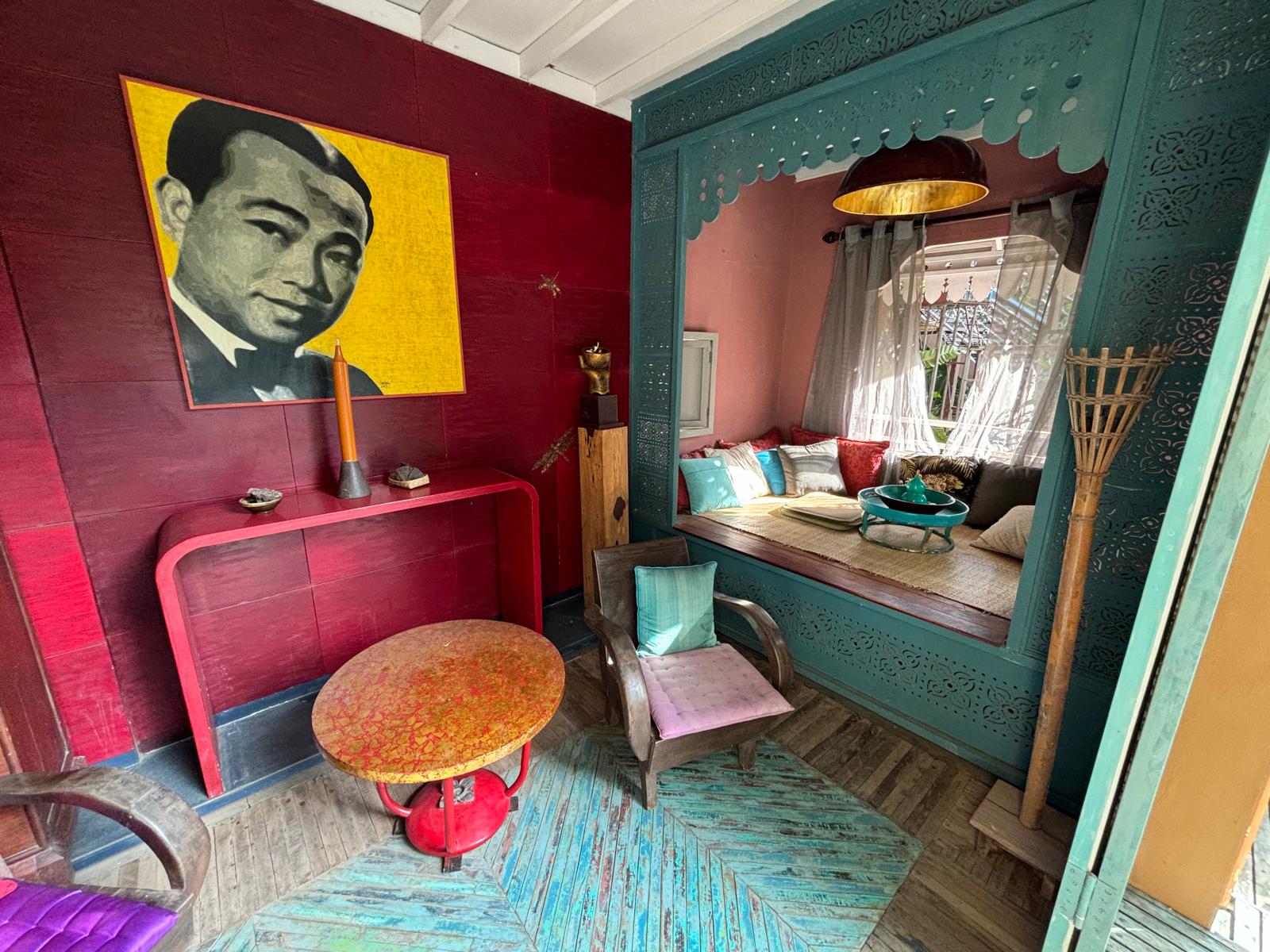
There’s of course more to Siem Reap than temples. One place well worth a visit is Theam’s Gallery, which is the home, atelier, and gallery of Master Cambodian Artist, Lim Muy Theam. It’s part workshop, part shop and part series of rooms and pavilions housing Theam’s collection of art and artefacts and in the middle there’s a garden shaped by the five elements and a Banyan Tree. The pavilions include a collection of historic instrument and bronzes of dancer’s hands with stylised dancers’ wrists and fingers. And I particularly loved the pavilion with the Buddhas, and the wooden shutters painted with gold scrolls and flowers looking out onto the garden.  Also delightful was a small room – a bit like a cocktail lounge with – a picture of Sinn Sisamouth ‘Cambodia’s Elvis’, a famous 1960s singer.

Fun, festivities and flavours in Cambodia: Phnom Penh and Battambang – Part 1 of 3

NB: Email subscribers- please click on the ‘Read on Blog’ link at the top of the email to enjoy the benefit of the formatted blog rather than the WordPress newsletter version.

On Christmas Day in 2023 my friend Di and I were sitting outside at a roadside restaurant in Cambodia, the occasional ant dropping on us from an overhead tree and supping on a tasty broth made with pieces of pork, wrinkly skinned tofu and vegetables followed by a delicious omelette filled with dried fish. If I had to sum up my trip to Cambodia in one word it would be immersive. So many sights, sounds, colours, flavours, spices, sensations and the constant hustle and bustle of tuk-tuks, survival-of-the fittest traffic, street dogs, repair shops, roadside food stalls and sidewalks sizzling with frypans.

I’d been rather anxious in the lead-up to my trip – finishing work, getting my house, garden and dog ready for the dog-sitters not to mention packing, worrying about getting food poisoning and feeling somewhat hysterical about the prospect of being zapped by a mozzie carrying Dengue fever.

But when I landed on 22nd December to a laughing and smiling Di – she’s currently living and working in Cambodia – and her lovely driver Theary, a beautiful soul and a very gentle man – all my fears started to dissipate. And Di and I were soon giggling with joy, something we often do when together.  

I jumped straight into it all on my first night and we walked out to a seafood restaurant – crossing a busy main road, one that Di must navigate daily. I have not travelled much in Asia so had no experience in wading out into the traffic – no one seems to follow any rules – and hoping the Red Sea would part. Yikes!

We ate at Nesat Seafood where I had stir-fried squid with vegetables and green Kampot pepper – young green pepper corns that have a zesty bite, a new flavour sensation for me. We also had margaritas – something that became an almost daily ritual over the 12 days of my trip.  

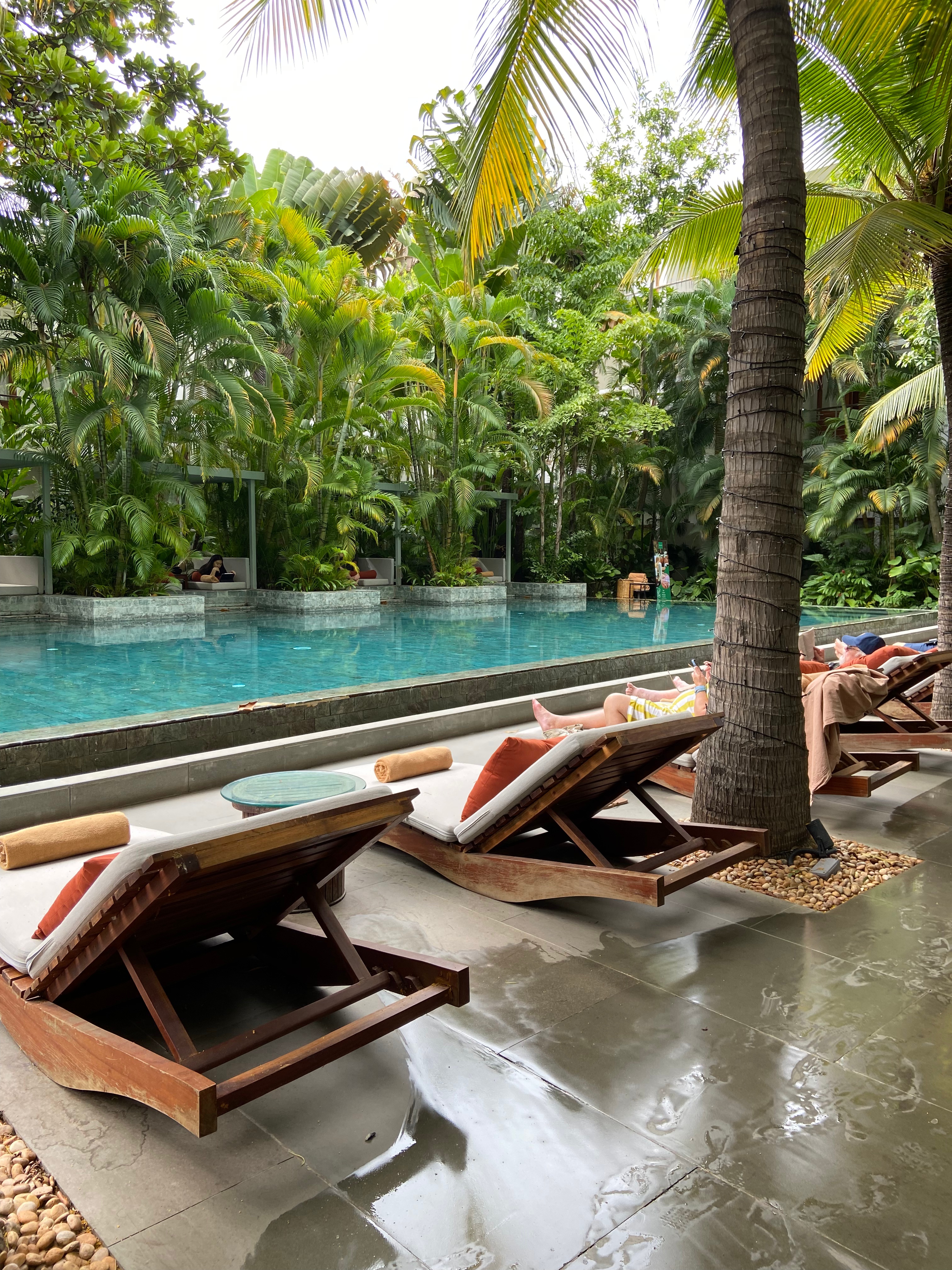
I had had a milestone birthday in October 2023, and Di’s present to me was an overnight stay and pamper session at the Plantation, an urban resort and spa in the middle of Phnom Penh. You approach via a courtyard with pillars and arches showing local art and a carp-filled pond in the middle guarded by dragon statues. The tree in the centre of the lily pond was adorned with lanterns with the addition of red baubles for Christmas. We each had a room overlooking the pool – beautifully landscaped by trees and lush greenery.

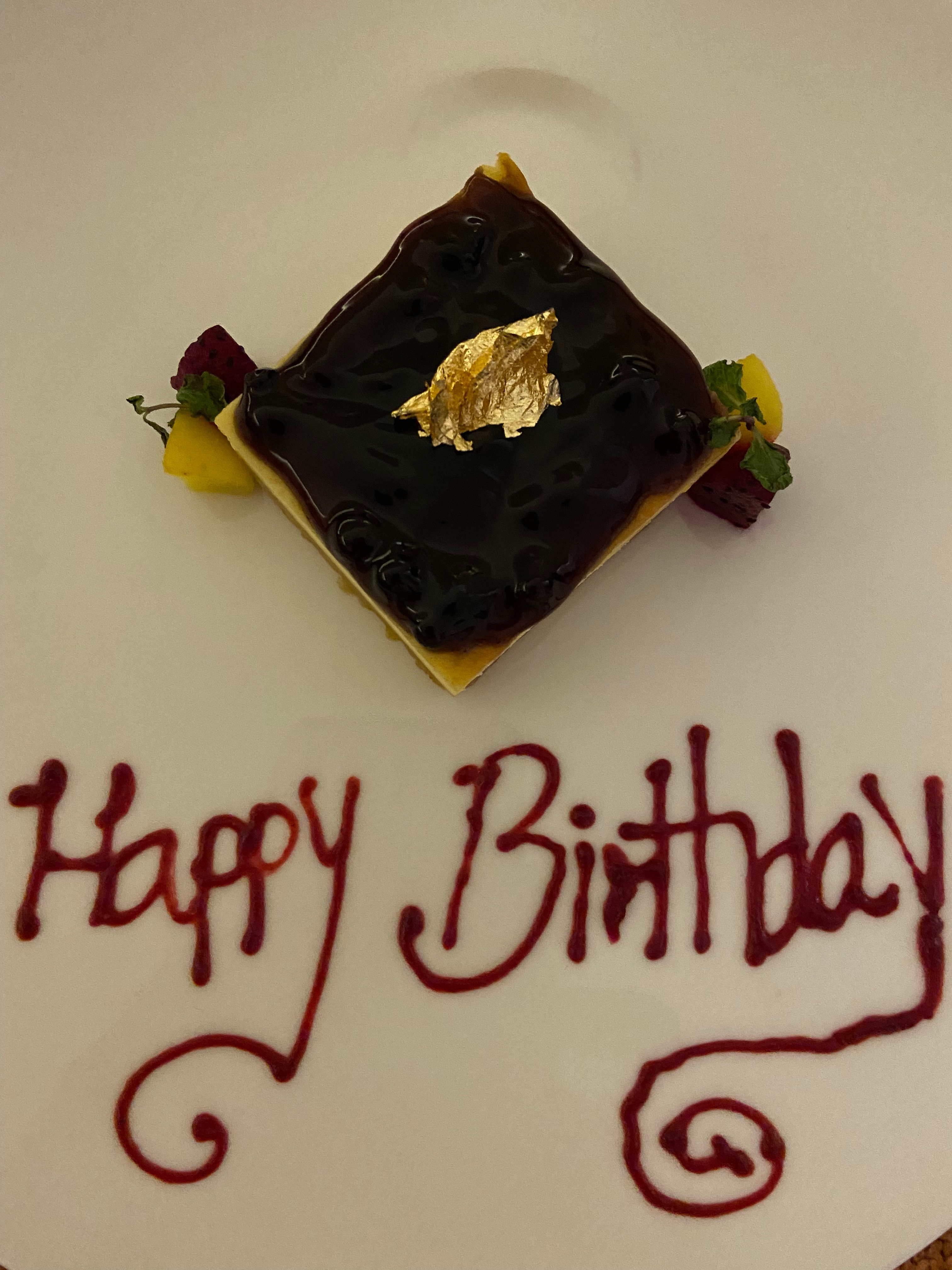
In the afternoon I enjoyed a two-hour Khmer massage with a hot compress packed with herbs including turmeric, galangal and lemongrass. Although I didn’t fall asleep as such – the compress was very hot, sometimes almost too hot – I emerged feeling wonderfully rejuvenated, my muscles warmed up and everything flowing.  Soon after my massage, one of the staff knocked on my door and presented me with a piece of cheesecake topped with a bit of gold leaf and Happy Birthday written in berry coulis.  Tempting as it looked, part of my birthday treat was dinner at a French restaurant so eating cheesecake beforehand was not an option.  The plate wouldn’t fit in the minibar fridge so I scooped it up in a plastic shower cap so it would go in – waste not, want not!

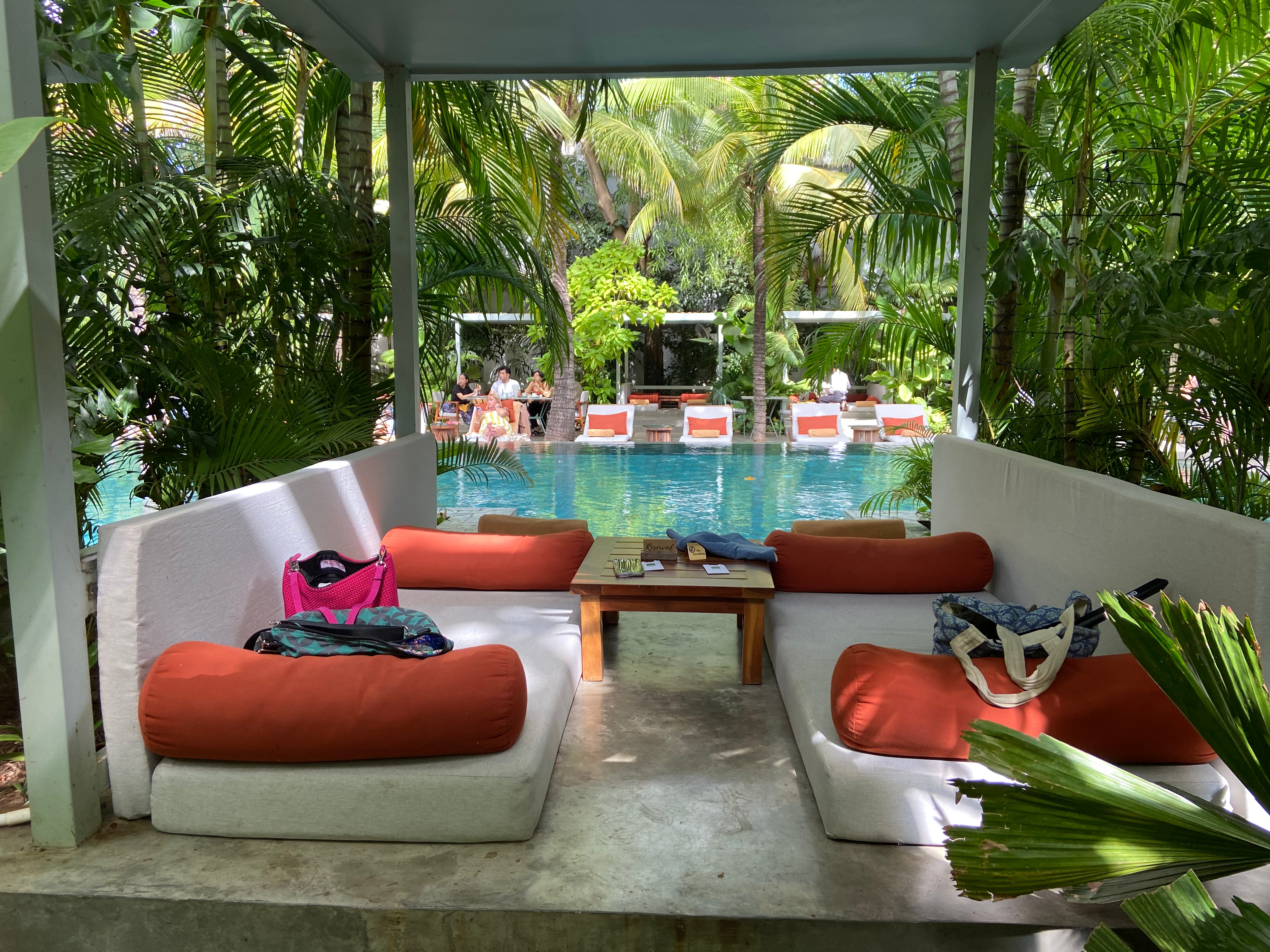
After breakfast the next day, a spot of poolside lounging in a cabana and a brisk swim in the pool – it was a coolish 23 degrees, windy and cloudy – we set off to explore Phnom Penh. We walked along ‘no traffic’ street and Street 246, before heading along the river. Di pointed out some of the architectural features – from a coffin shop to art deco and colonial buildings on the opposite side of the river. And the Chaktomuk Theatre (now a conference centre) built in the ‘60s (a golden era in Cambodia) with its fan-shaped structure referencing a palm leaf. It was designed by Vann Molyvann, the architect who pioneered the New Khmer Architecture, combining modernism and Khmer tradition.

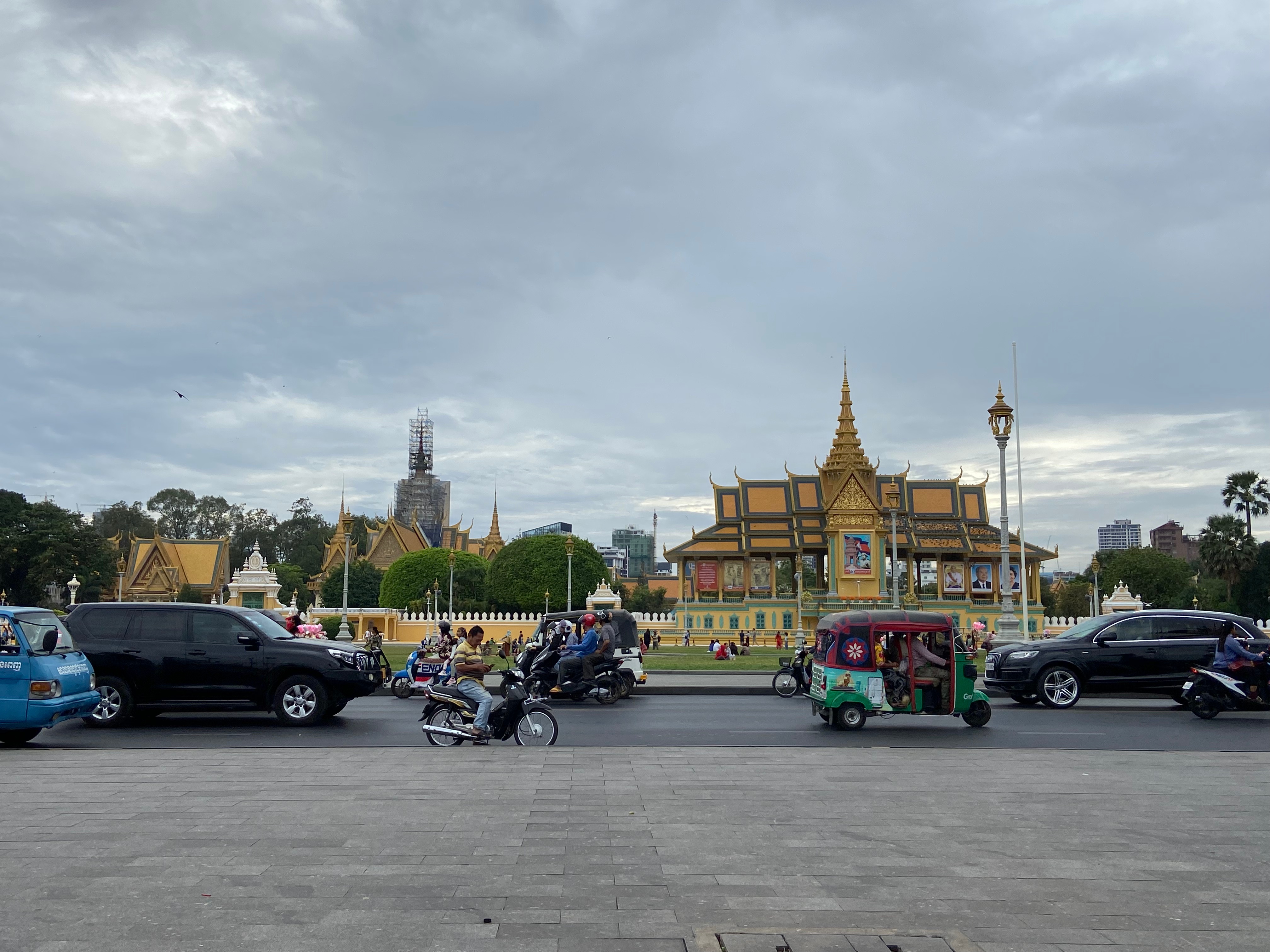
Walking on along Sisowath Quay – with great views of the Royal Palace over the road – we passed a group of people playing a Cambodian ball game – the idea is to keep the ball in the air using arms, legs, head, thighs, hands – whatever! Quite fascinating to watch. Then there were the usual food vendors, fortune tellers with their packs of cards and the Preah Ang Dorngkeu Shrine where people were buying lotus flowers, candles and incense sticks. Around 2pm we stopped and snacked on ham and cheese that we had snaffled from the breakfast buffet followed by the shower cap cheesecake, the latter rather gloopy and over-sweet. But at least we ate some of it!

In the distance we looked over at the Independence Monument built in 1958 to celebrate the day the Cambodians won back their independence from the French protectorate on 9th November 1953. The 20-meter-high monument was also designed by Vann Molyvann and is shaped in the form of a lotus.

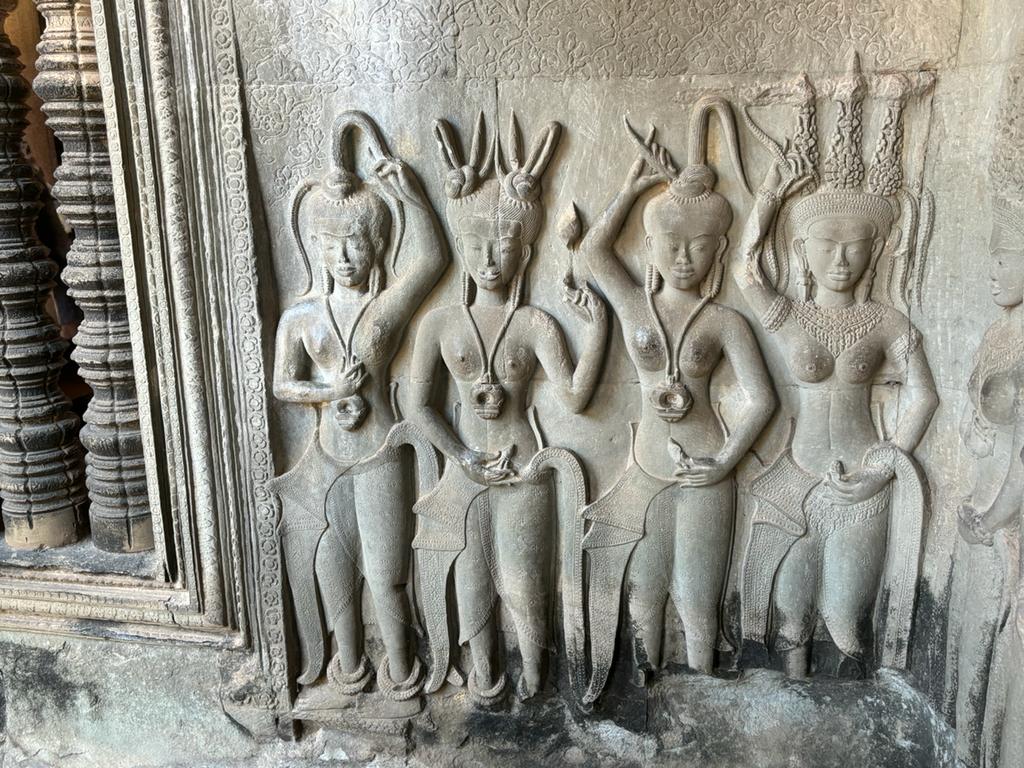
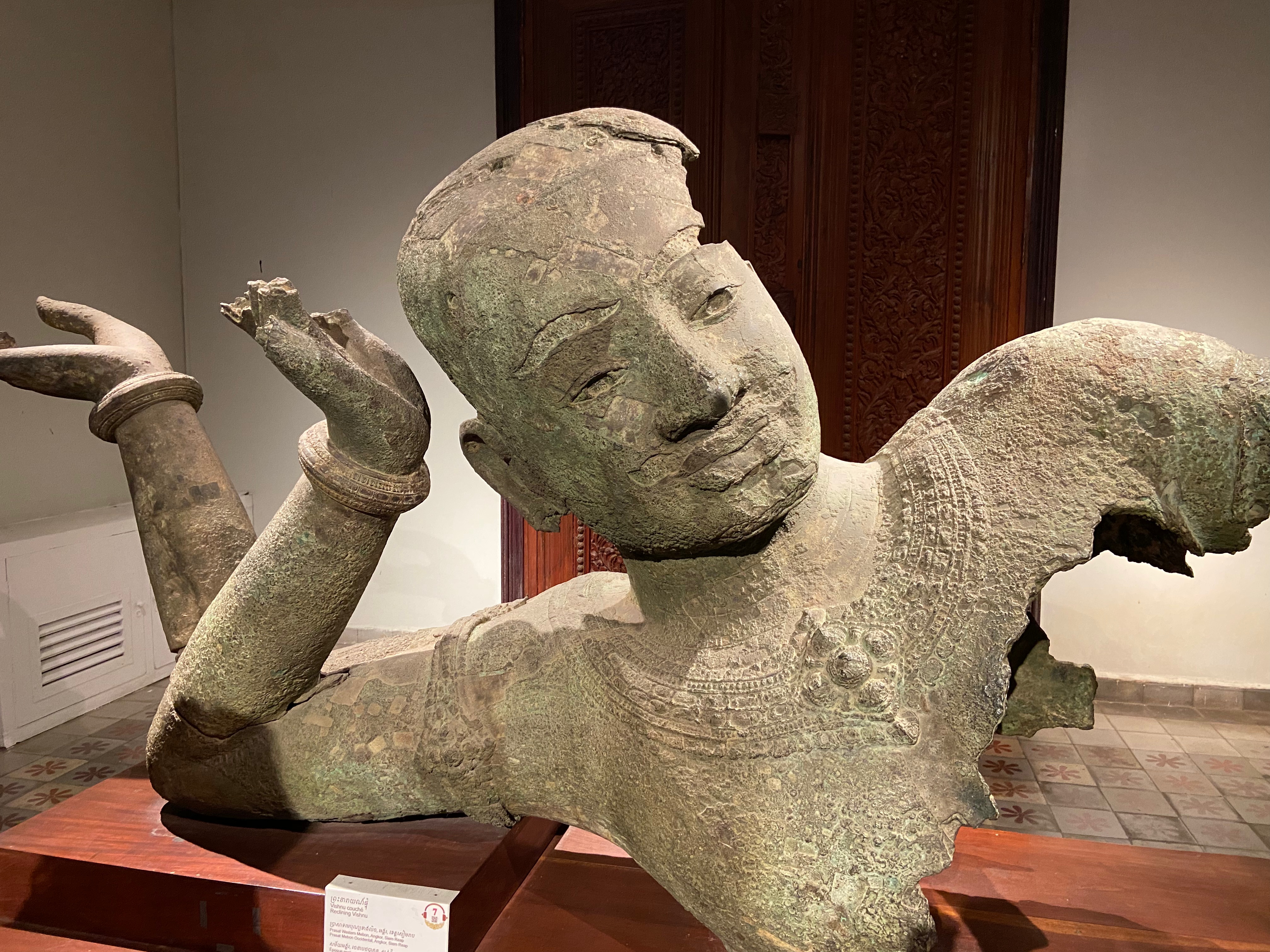
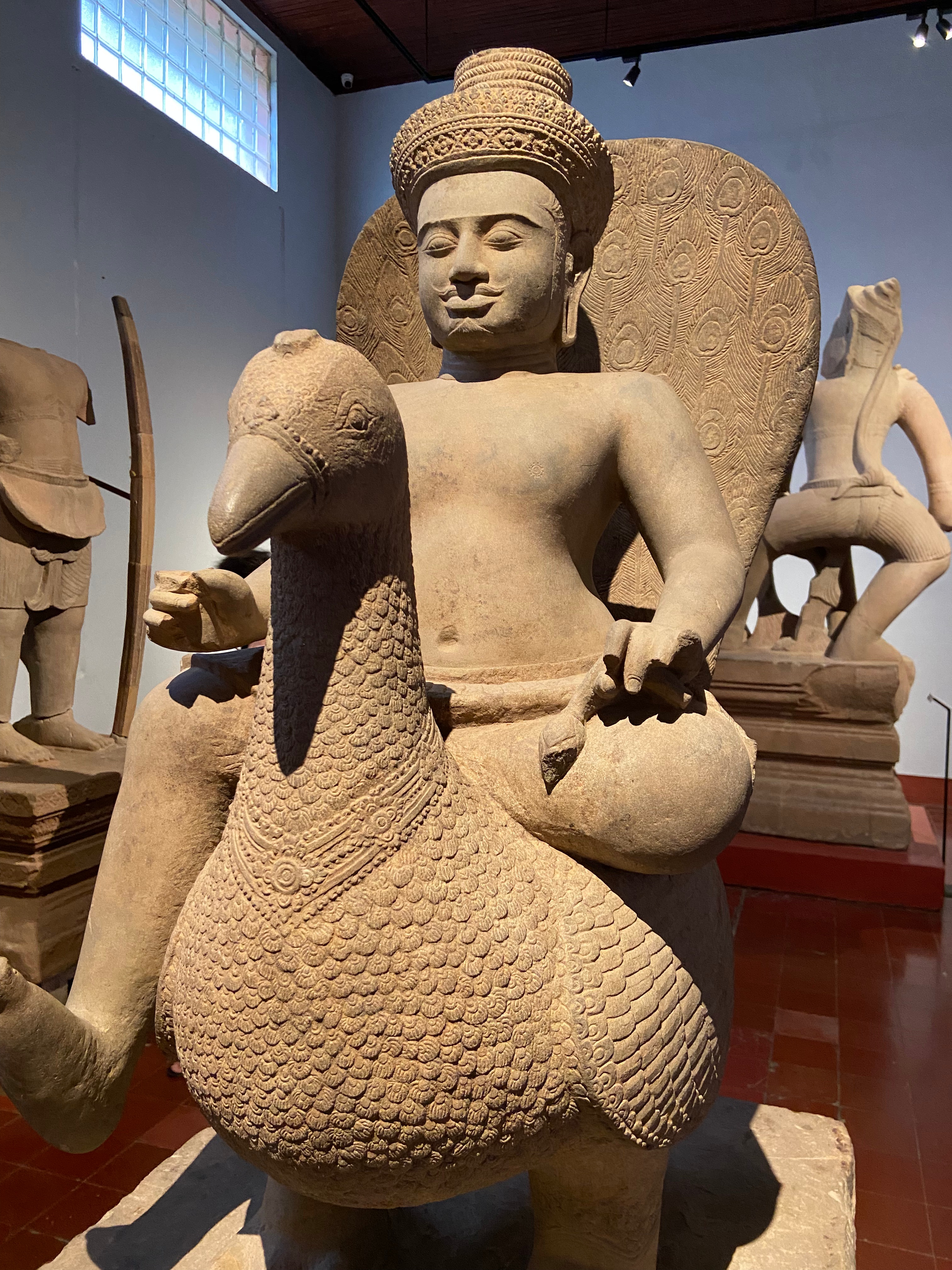
We spent the afternoon visiting the National Museum of Cambodia, built in the traditional Khmer style with tiered roofs and spires. The museum houses one of the world’s largest collections of Khmer art, over 14,000 items from prehistoric times to periods before, during and after the Khmer Empire which, in its heyday, extended from Thailand, across current day Cambodia to southern Vietnam.  Some of my favourite items were huge sets of bronze bells that were used for tracking elephants and sandstone carved Buddhas seated on peacocks, Garudas (eagle-like Divine creatures) and Apsaras – these are female celestial spirits in Hindu and Buddhist mythology who dance and entertain the gods.   I’d see many more representations of apsaras at the temples in Siem Reap (coming in Part 2).  

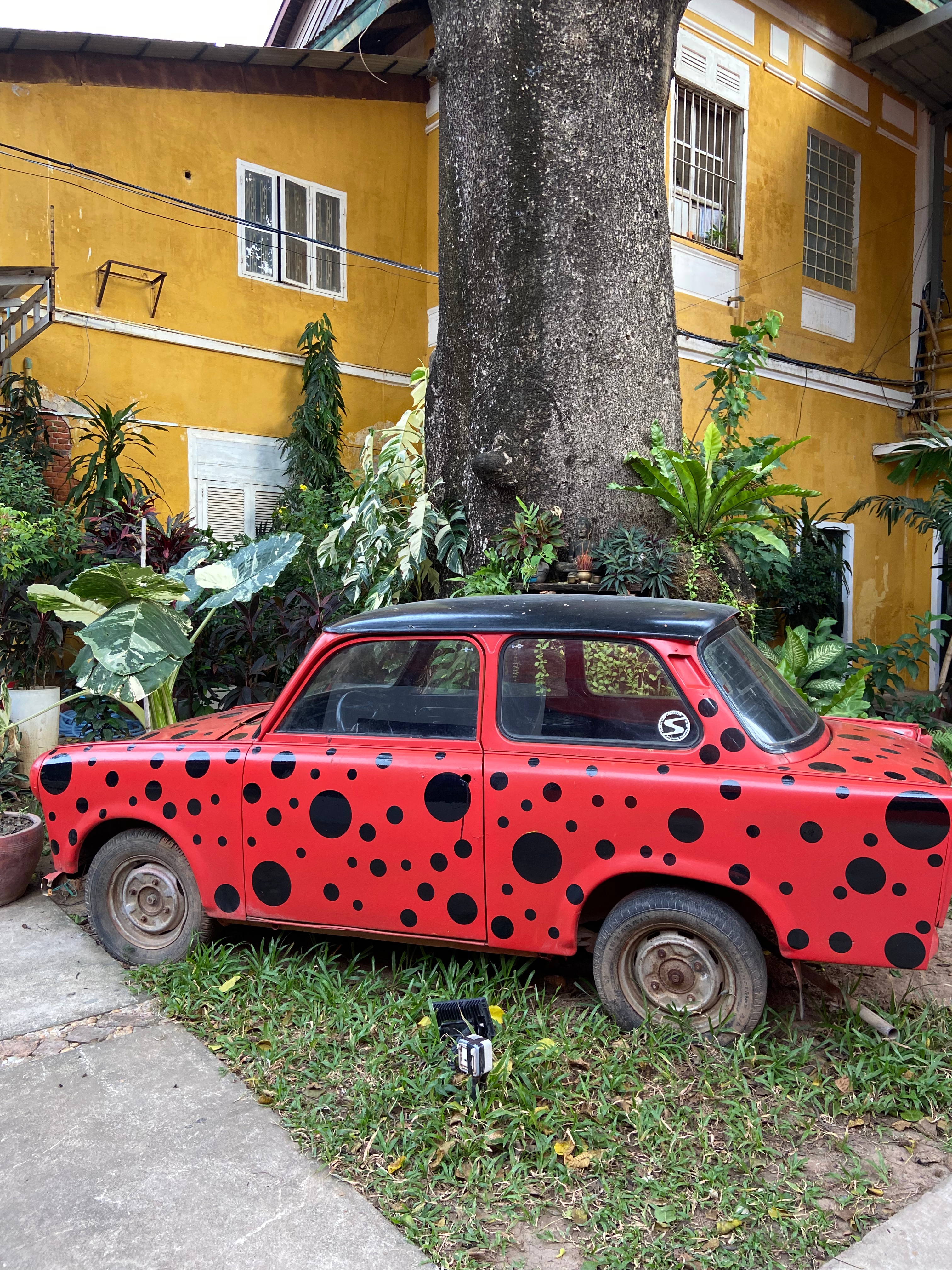
We then walked onto Friends Future Factory, which was a complete contrast, a striking barn-like building with curved orange bands forming a suspended half roof. A social enterprise, there’s a farmers’ market at weekends, designer clothing, photo and art exhibitions and a Trabant painted red with black spots – I loved that quirky touch.

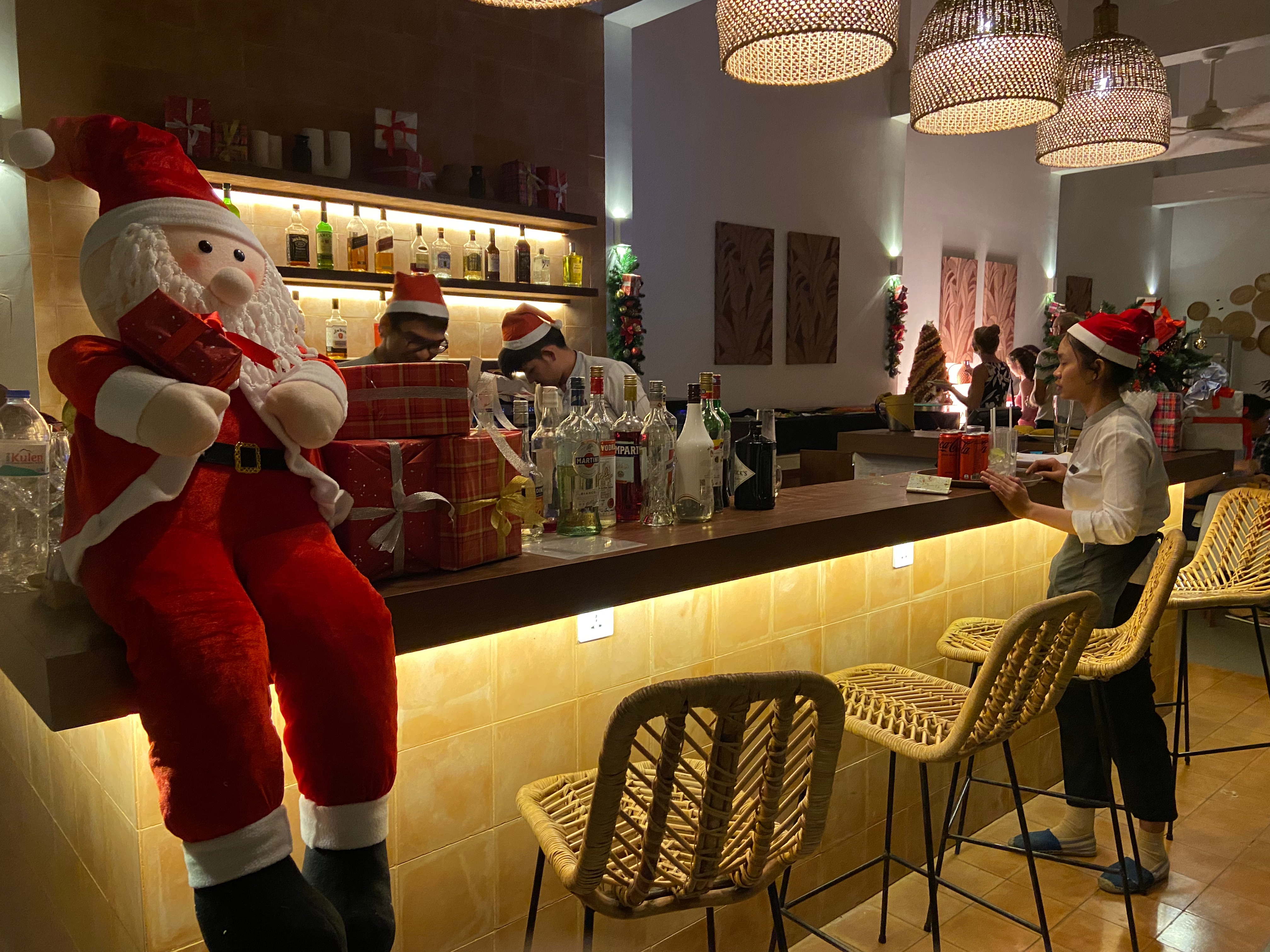
We took a tuk-tuk to the Rosewood Hotel and drank Christmas Eve cocktails –mine was an exquisite mix of rum and lychee – at the rooftop bar with views over Phnom Penh. Although we were not spending a second night at the Plantation we returned there for a western-style Christmas Eve pool-side buffet. For the modest sum of US $30, there was a lavish spread of seafood and roast meats, salads and puddings galore. What’s more there was a stuffed Santa sitting on the bar, red tea lights floating on the pool, dried orange, clove and cinnamon scrolls on the table and a choir of children singing Jingle Bells.

On the 25th itself Theary picked us up in the morning and we headed out to Battambang, the third largest city in Cambodia. In honour of Christmas Day Di and I spent a good hour singing through our joint – and pretty extensive – repertoire of carols. Although we didn’t know the words of many of them, we had a lot of fun, and Theary complemented us on our singing!

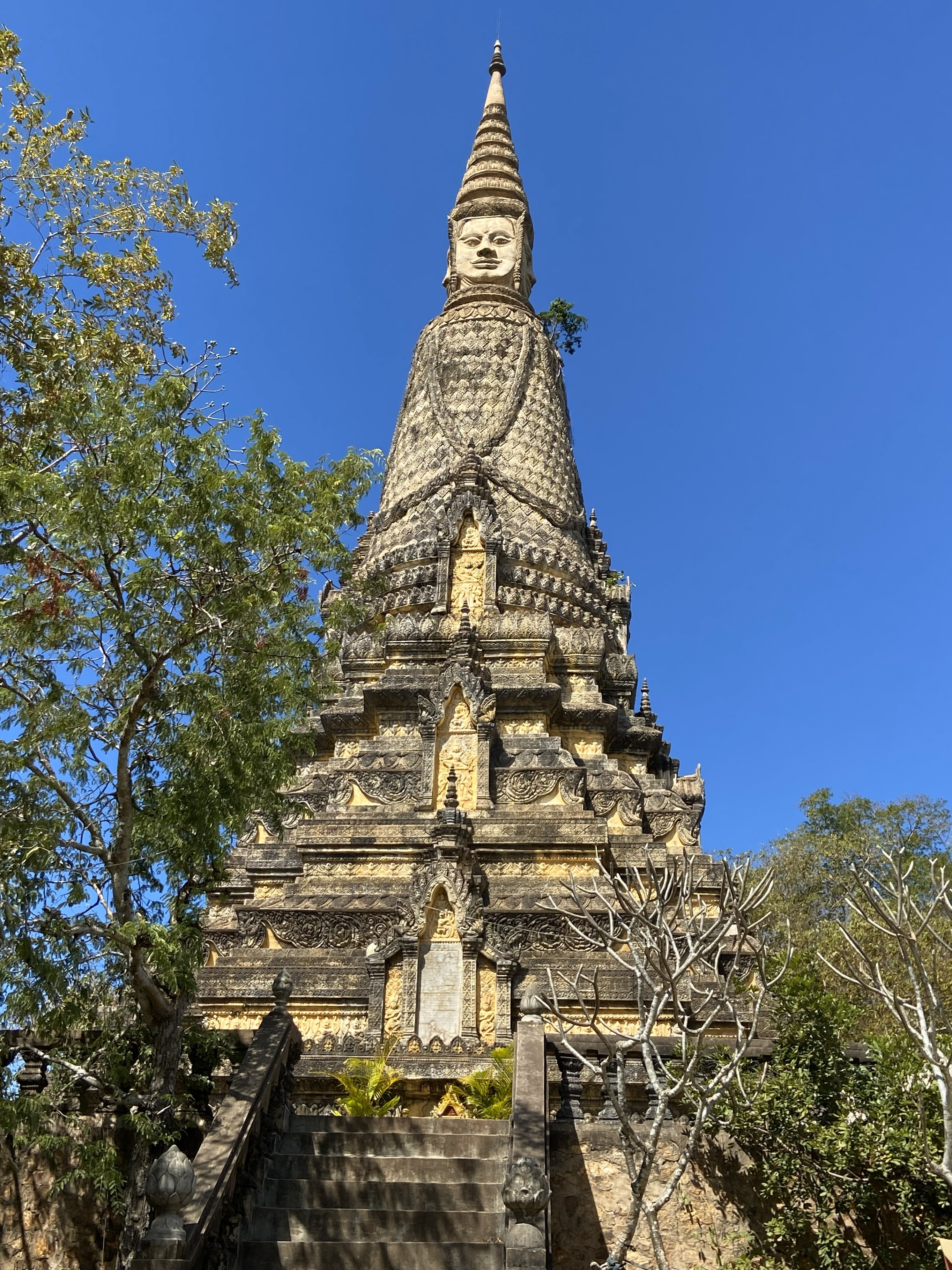
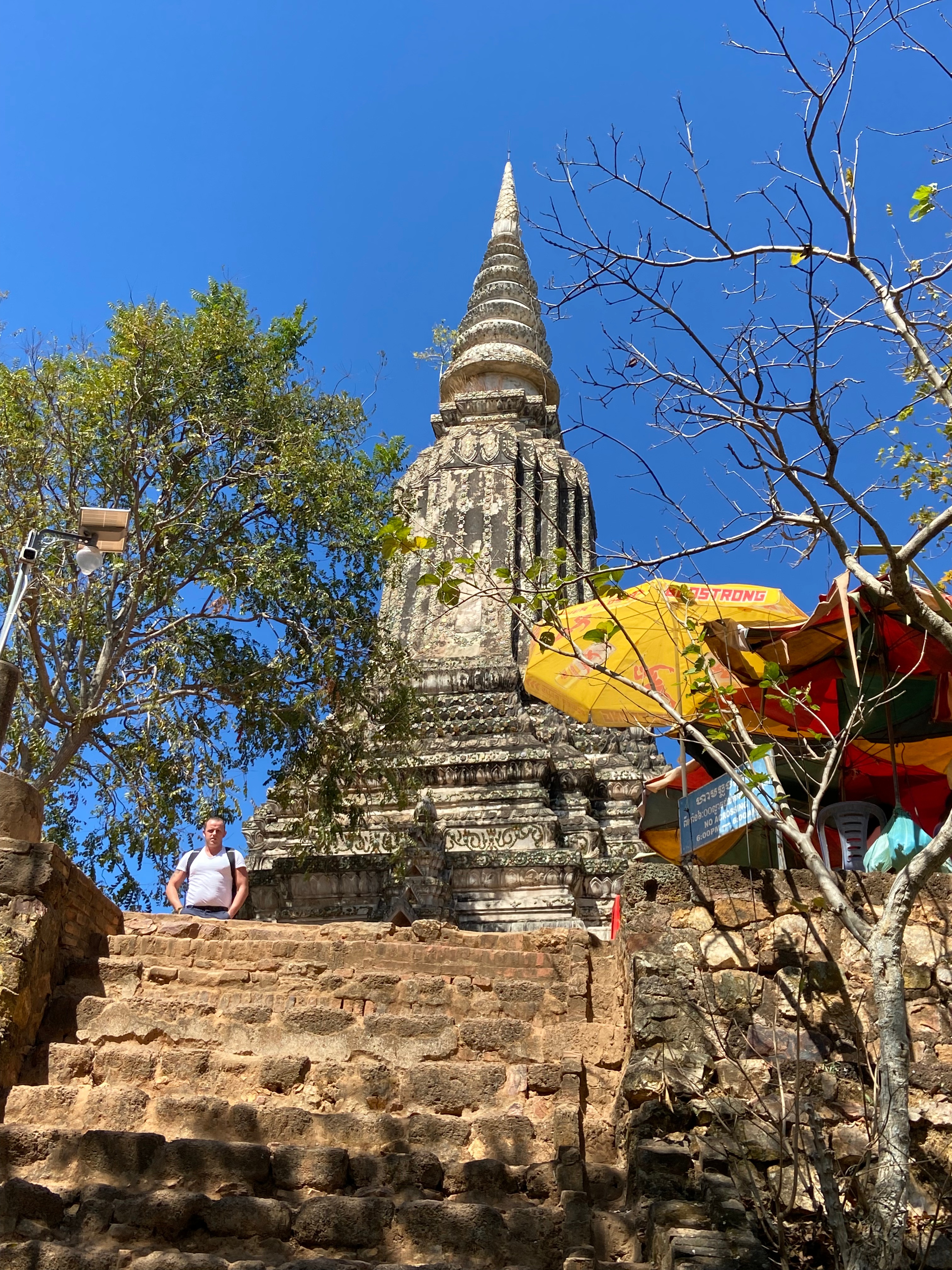
Our first stop was in Oudong, the original Cambodian capital (1618-1866) before Phnom Penh. Perched on top of a mountain, Oudong consists of a cluster of stupas (monuments housing sacred relics – in this case – of past kings of Cambodia).  There are three main stupas – the second, Ang Duong, is decorated with colourful tiles and the third stupa, Mukh Proum is very striking with four faces looking outwards towards the four cardinal directions, which made me think of a Russian doll, maybe because of the conical shape.

What we didn’t realise – I had a fair bit of muscle fatigue and twitching after descending the 509 steps – is that at the base of the mountain near the path, is a memorial buried with the bones of hundreds of bodies exhumed from one of the Khmer Rouge killing fields. You cannot go to Cambodia without coming up against the horrors of the Pol Pot regime and the legacy of trauma and grief. In Part 3, I will share my experience of visiting the Choeung Ek Genocidal Center in Phnom Penh.  

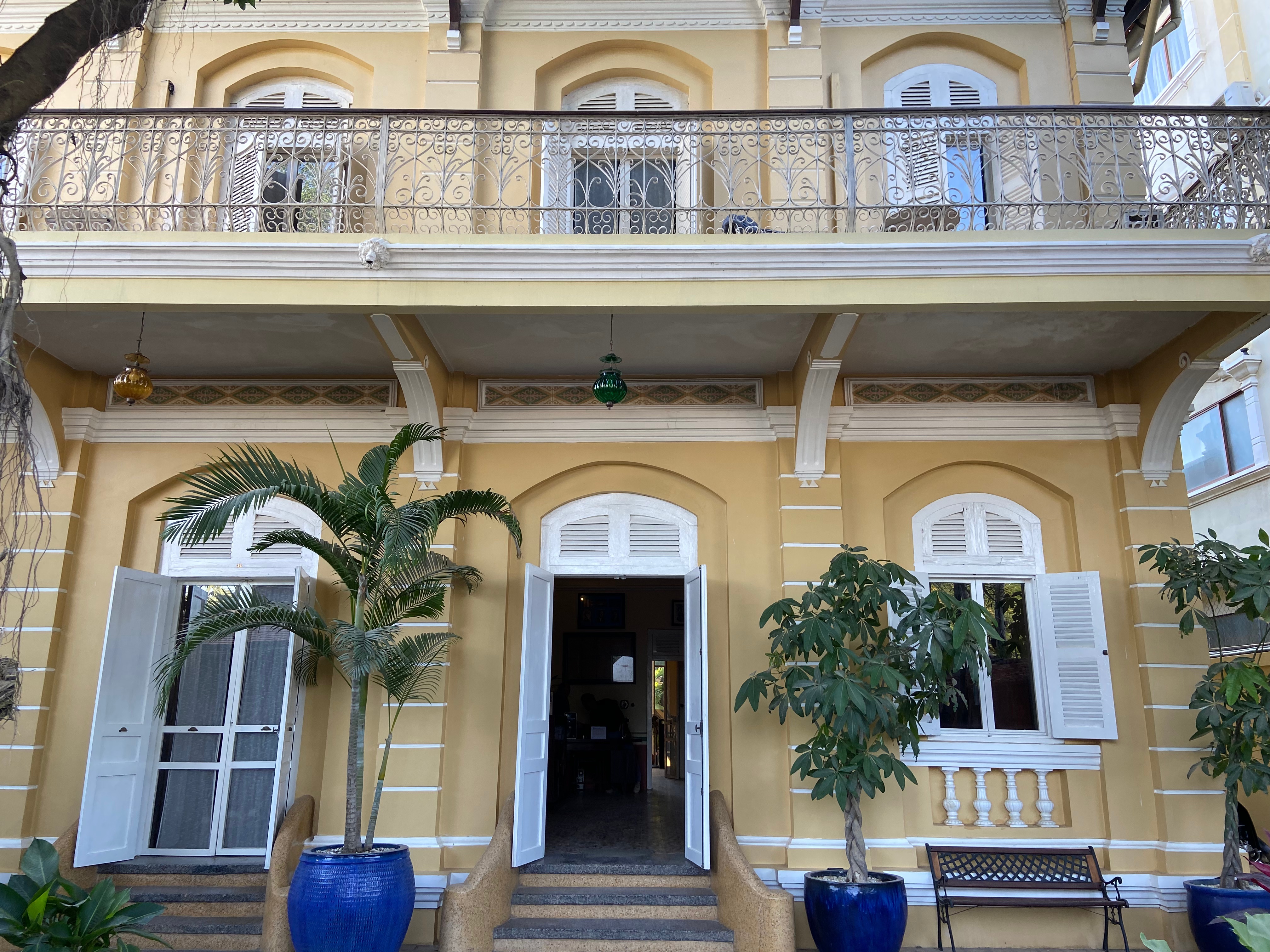
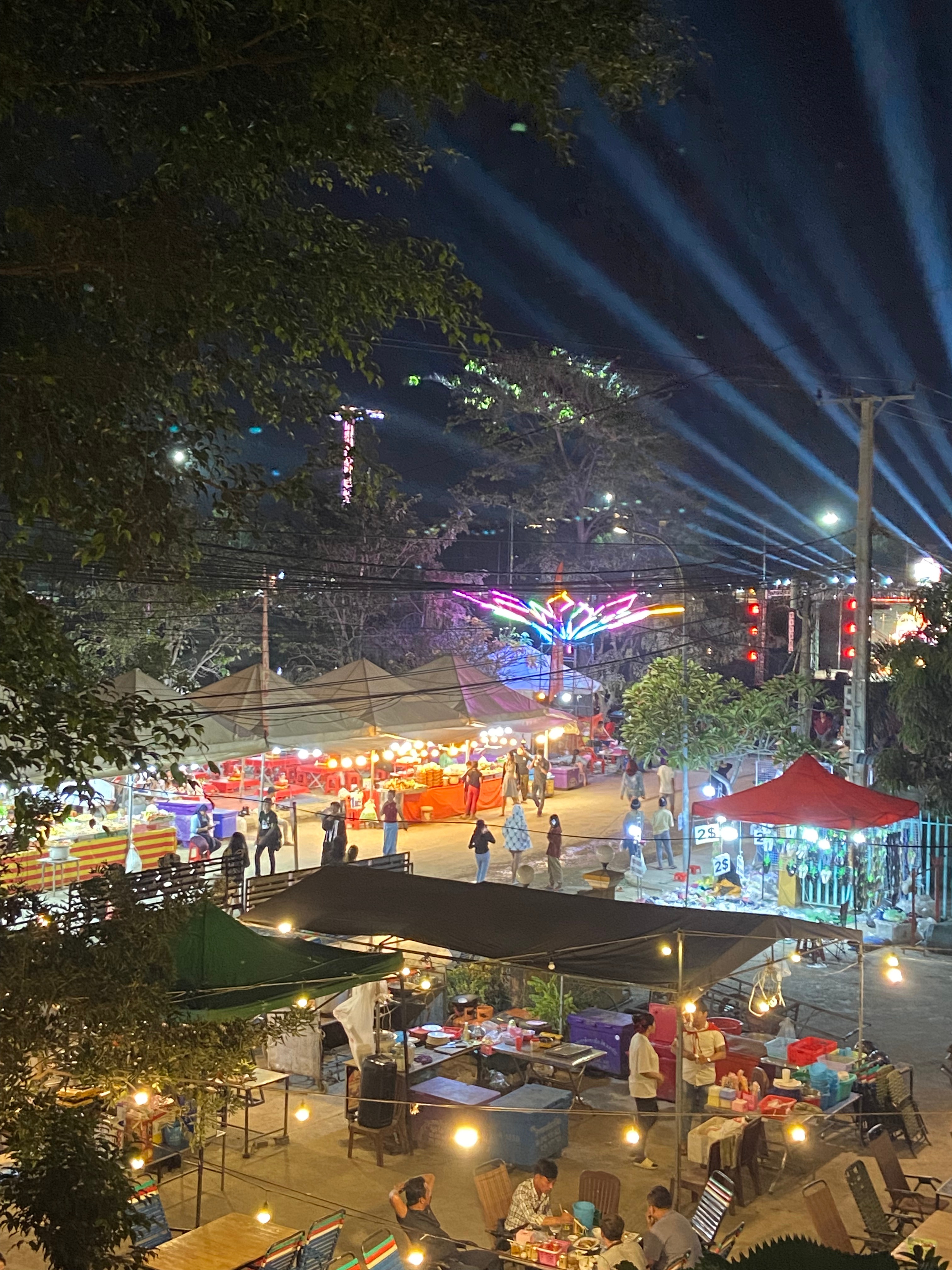
After our Christmas lunch under the ant-ridden tree, we arrived in Battambang around 5pm to be met with what I can only describe as a hellish racket.  A Christmas and New Year fair with music and stalls was going on right outside our hotel, La Villa, which overlooked the river – well it would have done if the fair hadn’t obscured the view!

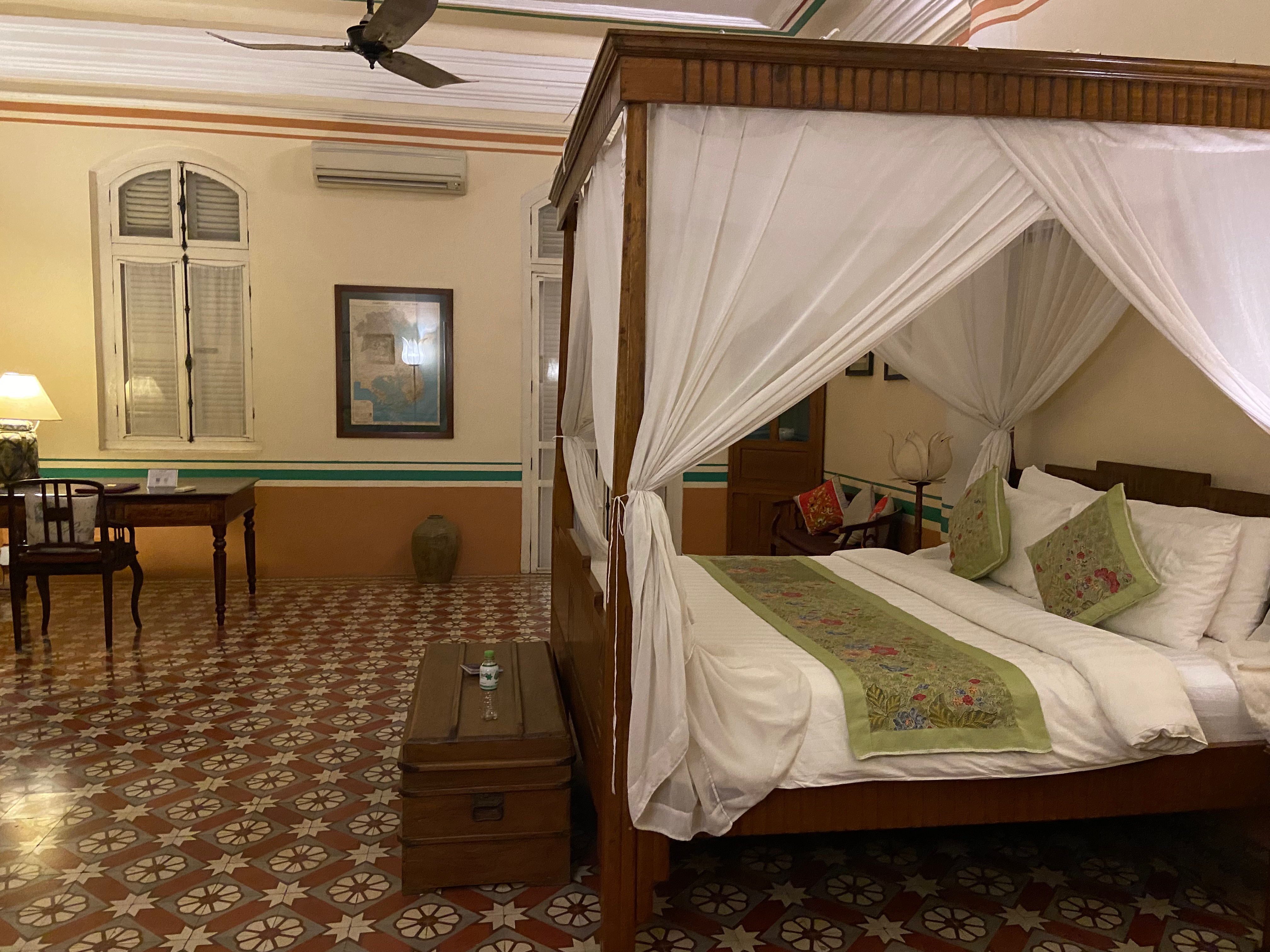
La Villa was my choice. It has an old-world vibe – our first-floor rooms were each furnished with four poster beds draped with a mosquito net, a writing desk, a mini chaise longue and shuttered windows. We had drinks and dinner in the art deco bar and eating area furnished with a gramophone and old-fashioned ear-piece phones.  And we savoured another very flavoursome dinner – Beef Lok Lak, a peppery beef stir-fry (which Google describes as a comforting Cambodian dish) and very good sticky rice and mango for pudding.  

It sounds blissful, doesn’t it? The only problem was that the noise of the fair was all pervasive with tinny, screechy pop music blaring out from a floodlit stage right by the hotel which went onto until the small hours and shouty voices – the compères sounded like game show hosts having a heated argument. Lying in my four-poster bed that night, the bed at least softer than the one at Di’s apartment, the music not only made the windows and shutters vibrate, it went right through my body. I rammed in my ear plugs and eventually tuned it out.

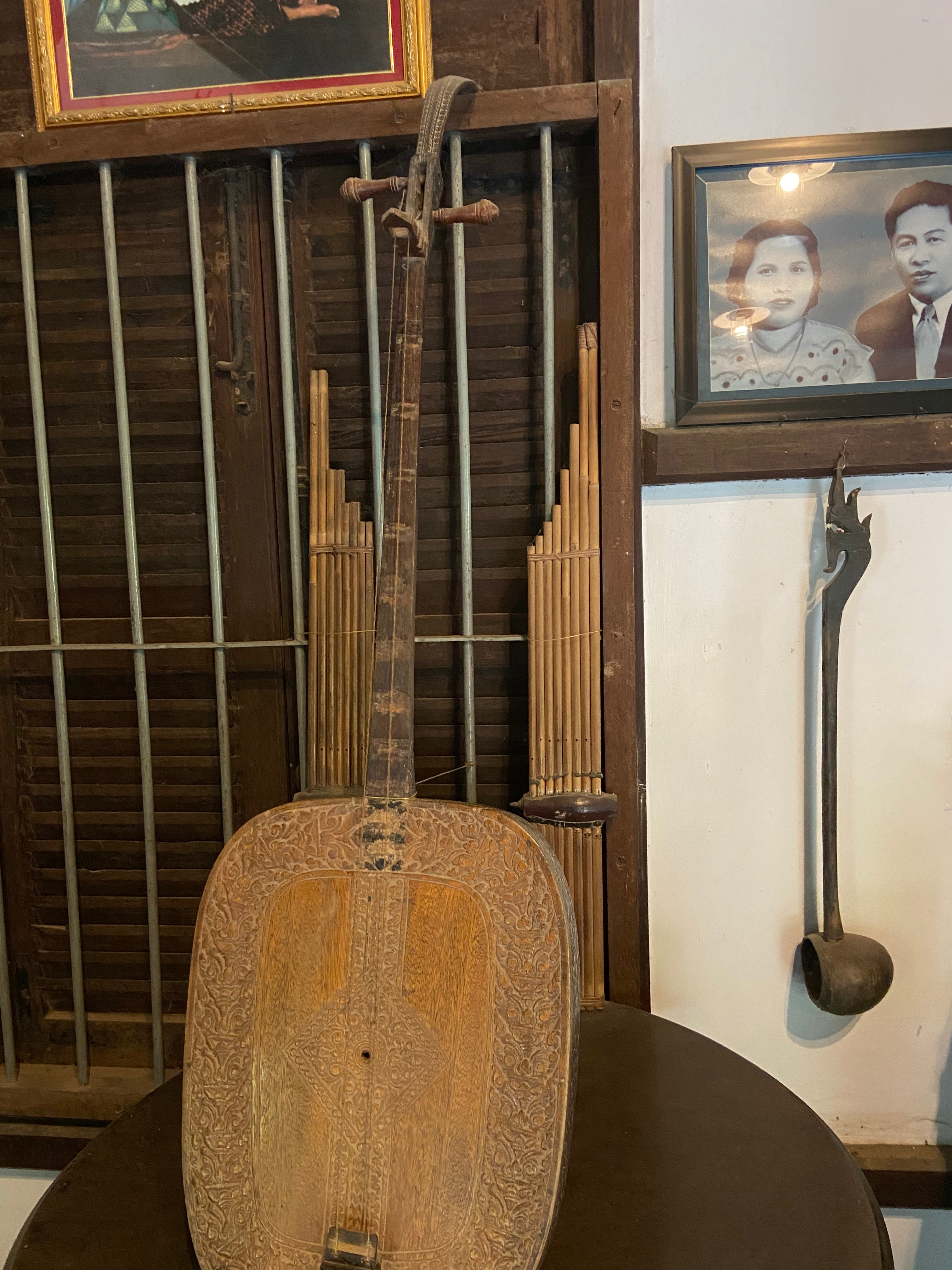
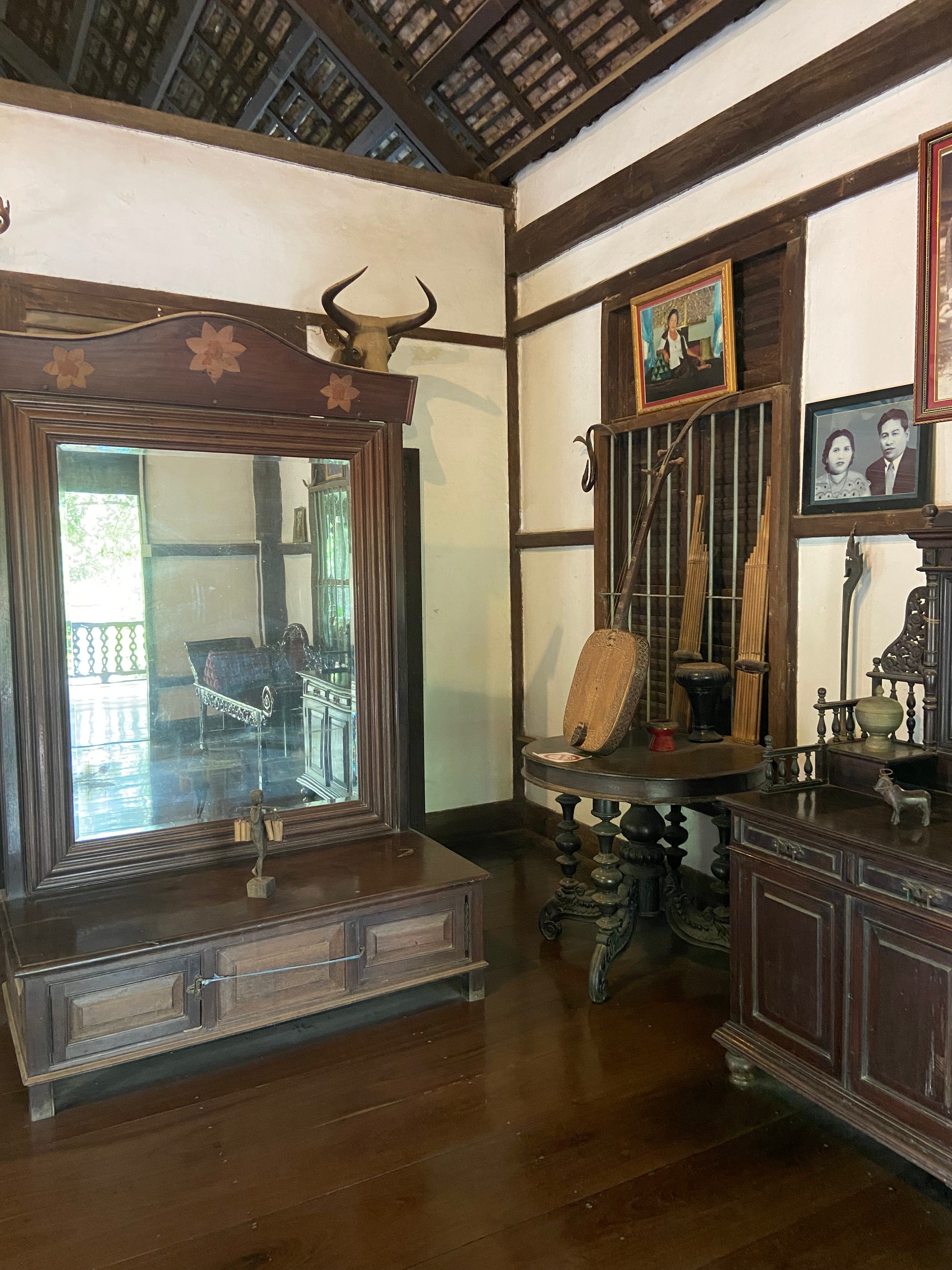
The next morning Theary took us to Wat Kor village, about 2km outside Battambang, where we visited the temple and soaked up the peace and quiet in the company of some friendly temple dogs.  Our second stop was Mrs Bun Roeung’s Ancient House – an old-style wooden house built in 1920 (that survived the Khmer Rouge) and is still in the same family four generations later. It is furnished with highly polished heavy hardwood furniture such as a chaise longue, family portraits, musical instruments and mirrors cleverly positioned so people in the room could see who was coming in and out – whether friend or foe. And, most fascinating of all, a description of what the walls are made of – dried cow dung, straw, fermented sticky rice, palm sugar, limestone and stone.

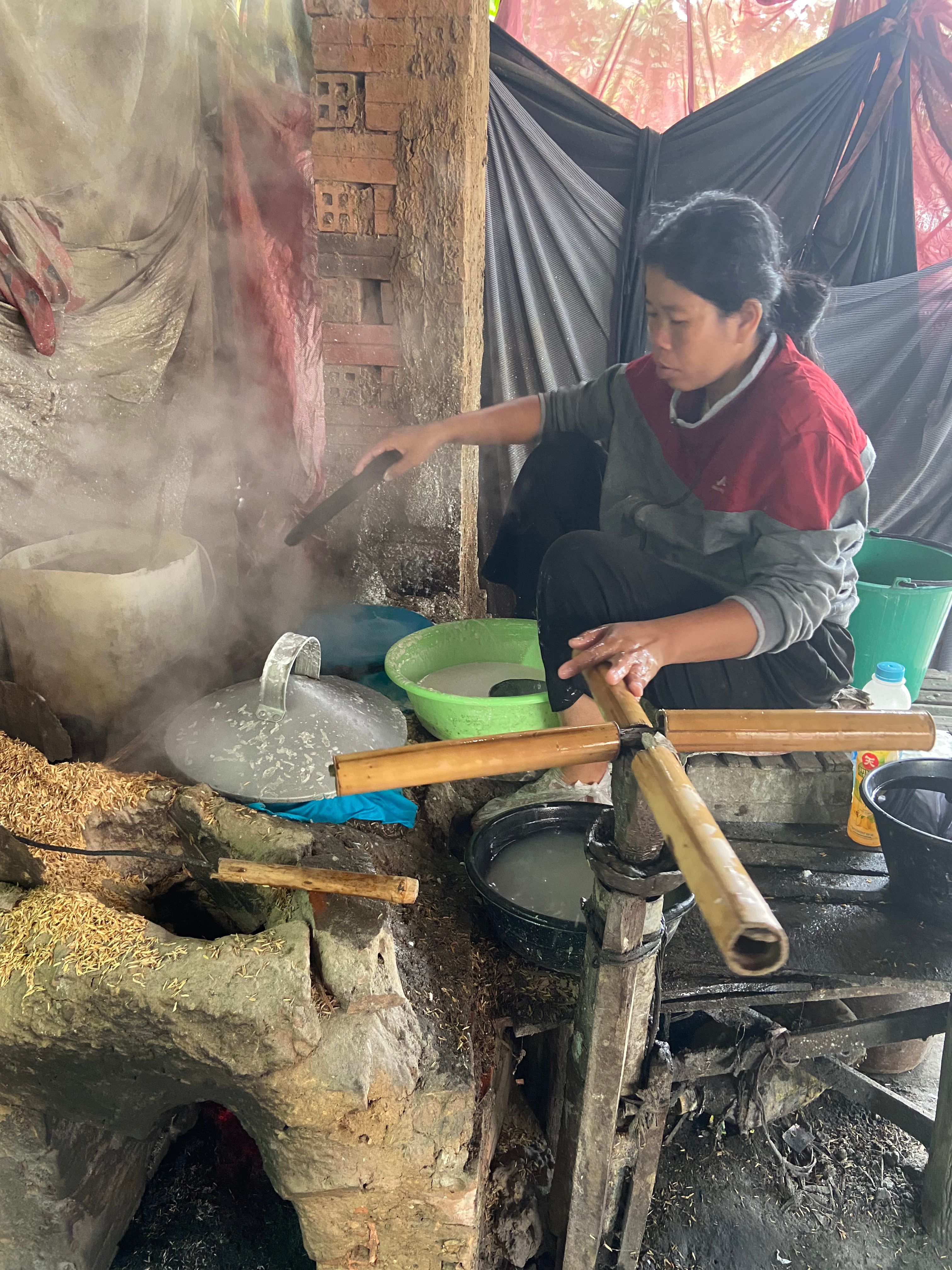
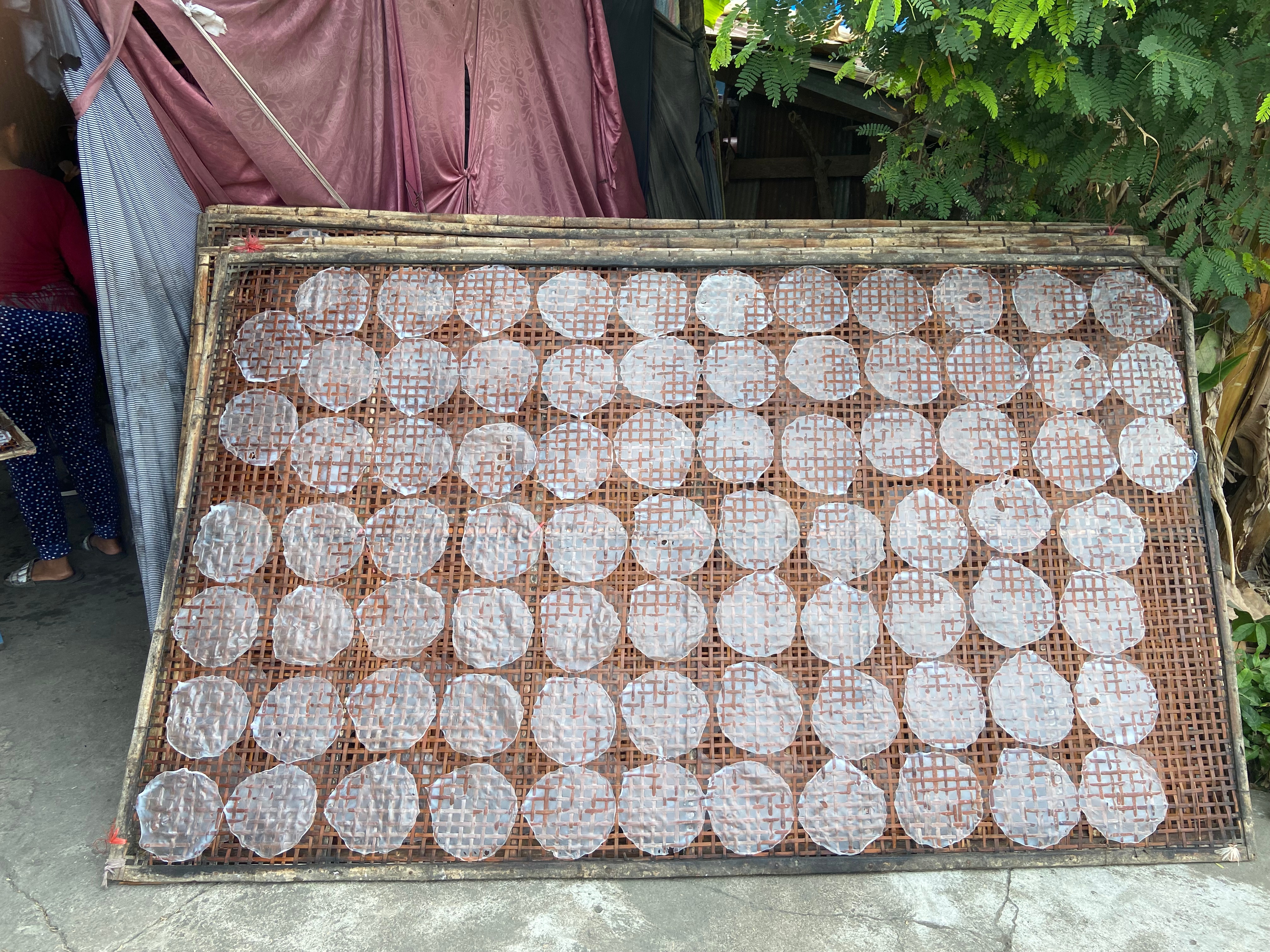
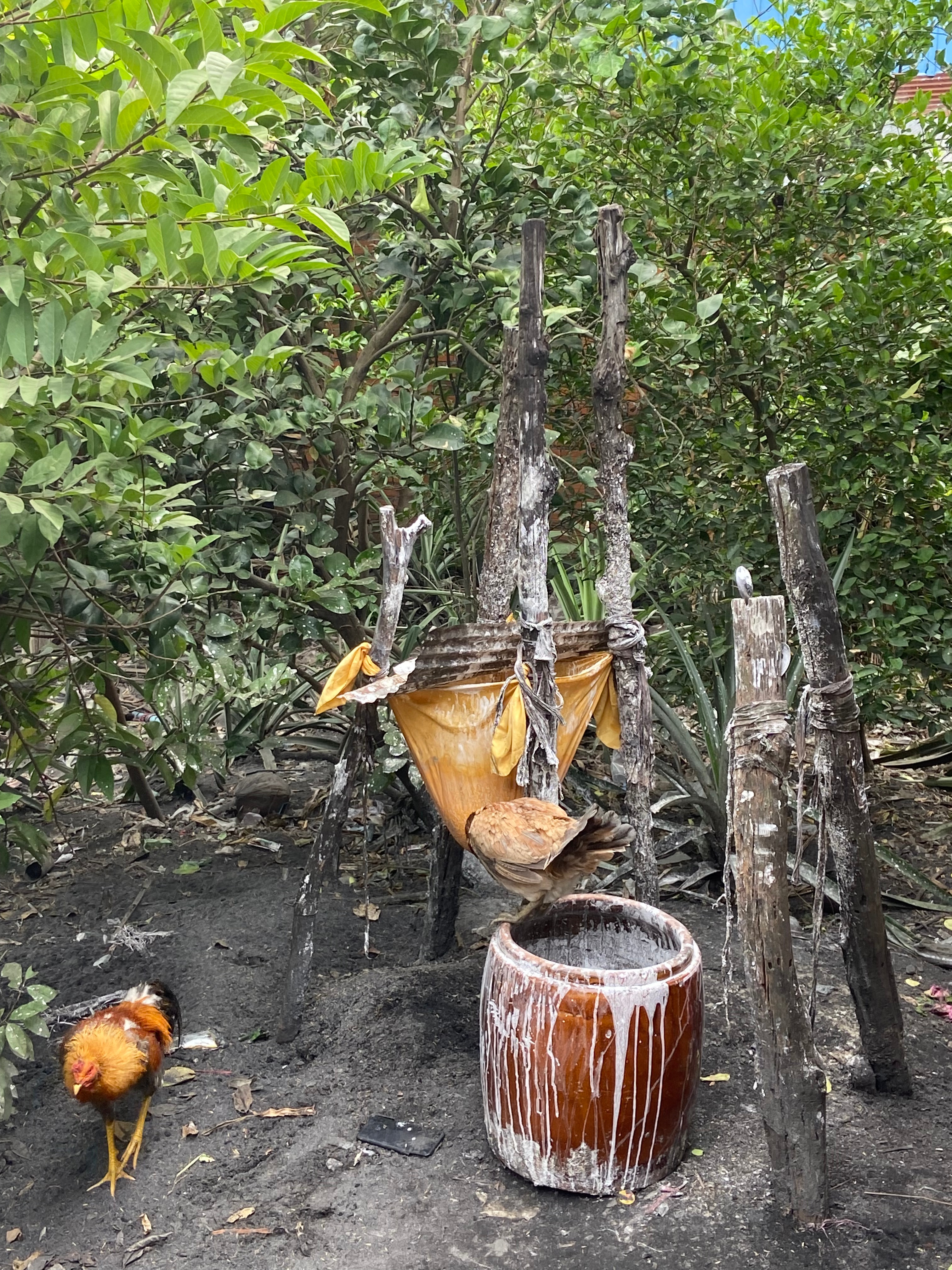
Next, we travelled on to see rice paper rolls being made by grinding up rice and water to make a pulp which is thinly spread across a layer of muslin above a pot of steaming water and then put on a rack to dry. Two women were working away sitting by the steaming pot, their feet encased in polythene bags. How uncomfortable must that be? And to think we complain about RSI from sitting at our computers. Try making rice paper rolls all day!  A couple of chickens were scratching around, a couple of kids playing, and what I presumed to be the husband was snoozing in a hammock… This is why Di’s work is needed – she works in community development and gender equality.

Our last stop of the morning was the Romcheik 5 Artspace and café, an independent gallery where four young artists, who were all trafficked across the Thai border as children, have a permanent exhibition space. Their paintings are haunting, challenging and beautiful and reference trauma, the apocalypse, impermanence, a Buddhist between-worlds landscape and some of the all-too-common social problems in Cambodia – poverty, prostitution, child trafficking and abuse.

That afternoon we swam in the pool at La Villa enjoying the quiet before the music started up again in the evening.  Dinner that evening was at the Jaan Bai restaurant, another social enterprise. Margaritas followed by turmeric pork and Tofu with Kampot pepper.

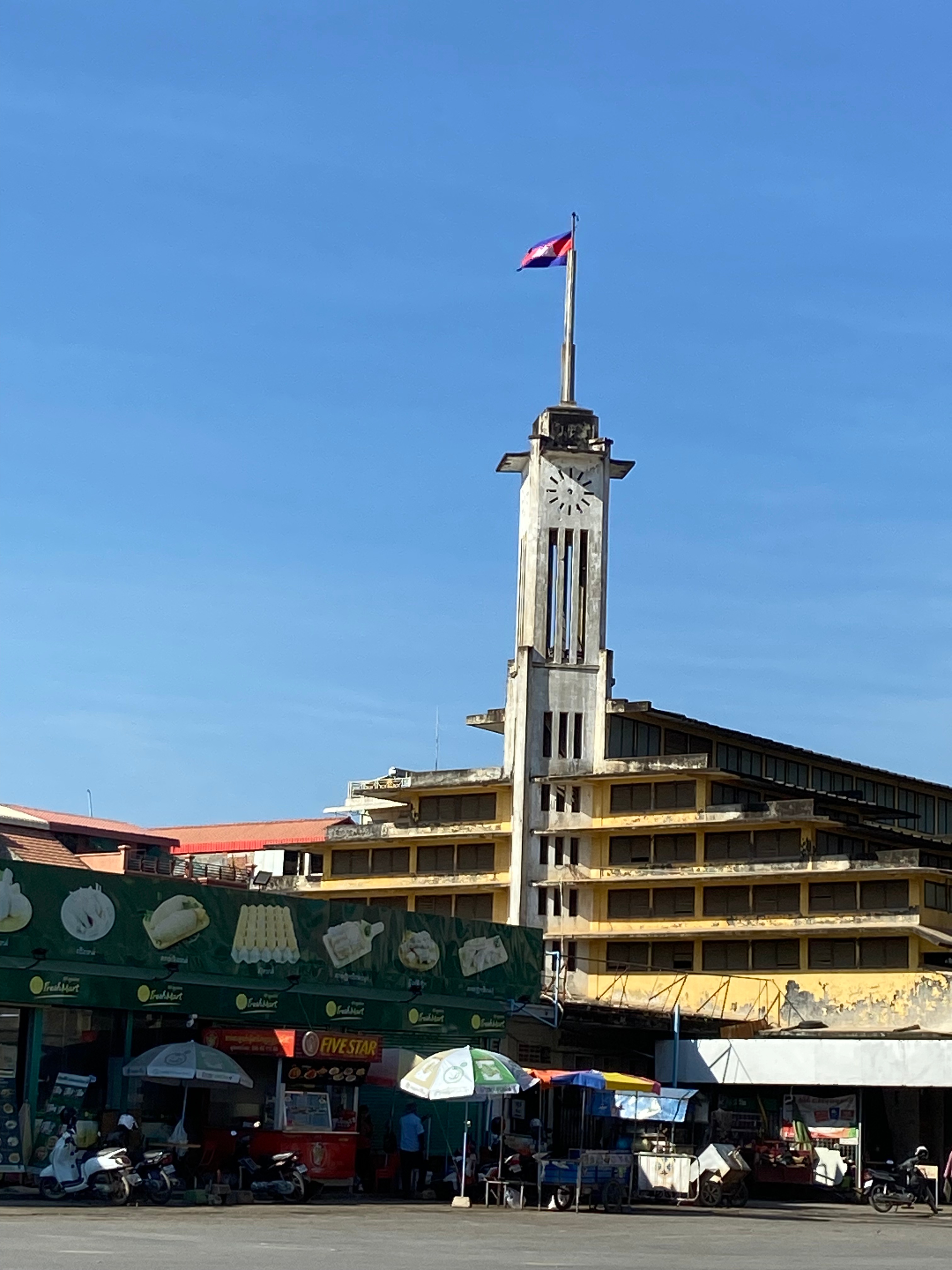
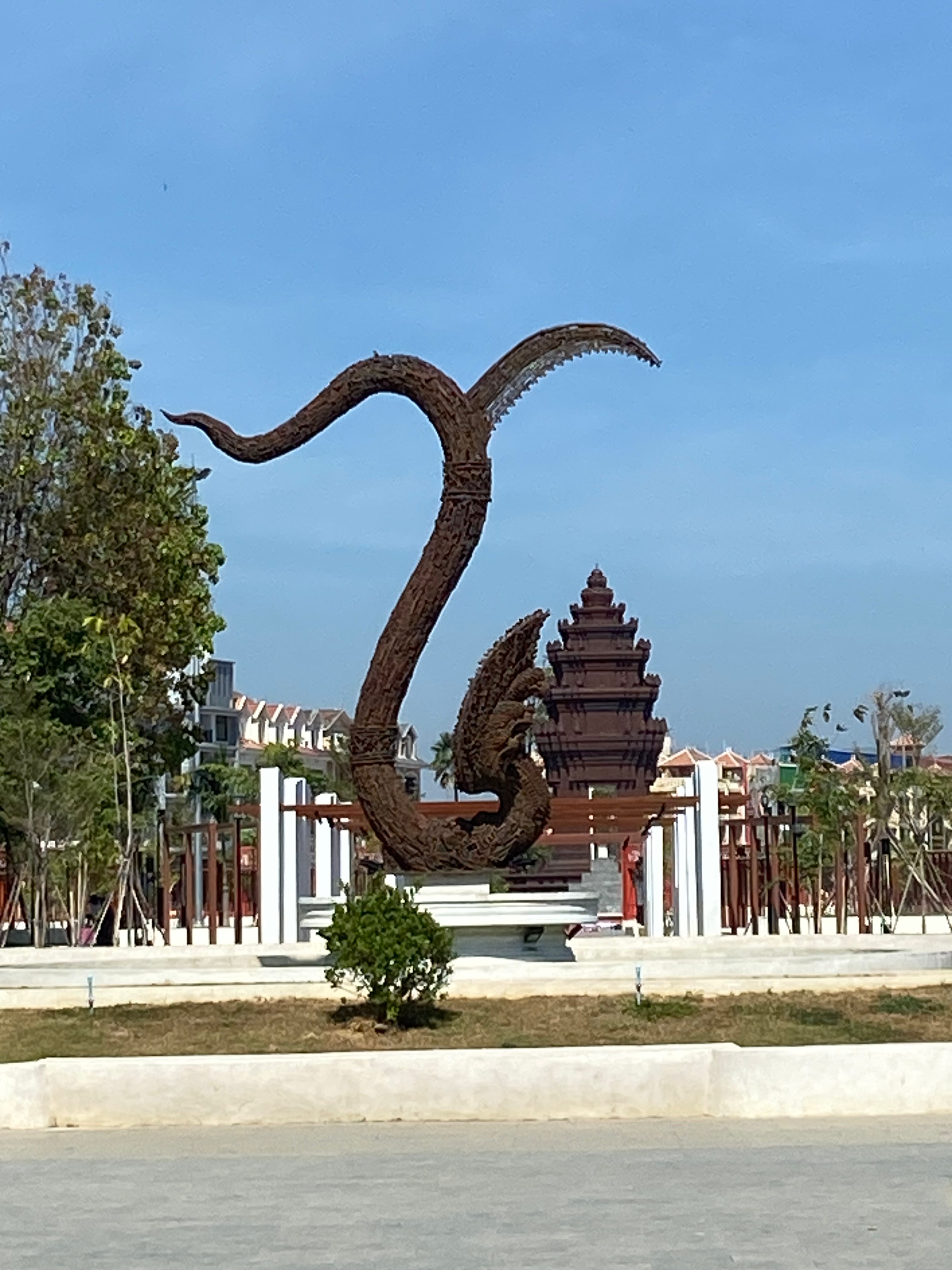
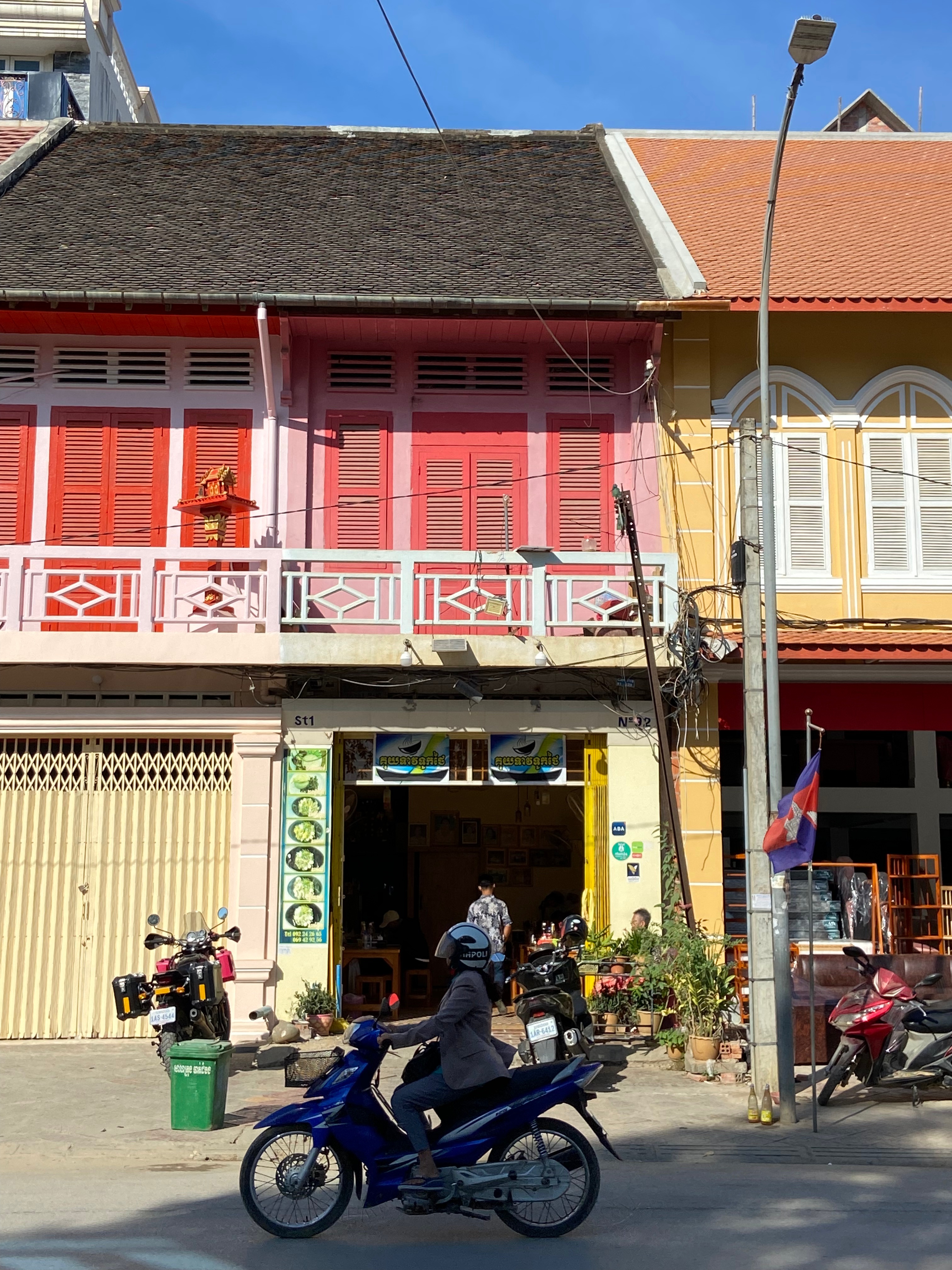
After checking out of La Villa the next morning we had a final walk around Battambang, taking in the art deco market (stocking up on snacking bananas) with its central clock tower, the Governor’s residence built by an Italian architect, a yellow building with white shutters from the early 1900s, the Independence monument, a newly built landmark  (inaugurated August 2023) reflecting Khmer heritage and serving as a focal point for historical commemoration,  and then back along by the river lined with colonial-style houses in reds and yellows, reminding me of the Peranakan houses in Singapore.

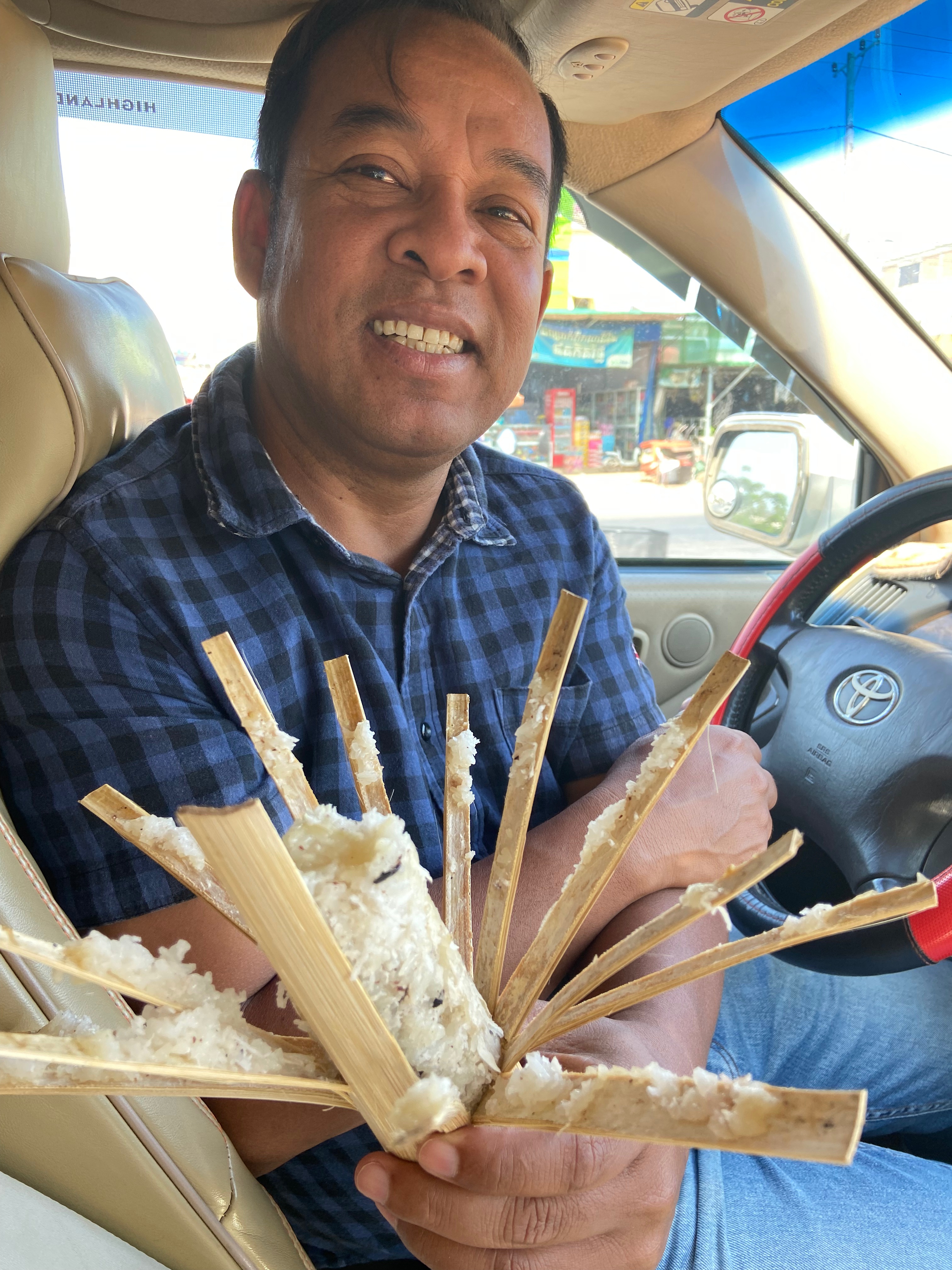
Theary picked us about 1pm and lunch was nuts and bananas on route to Siem Reap. Friends in Melbourne had insisted I try sticky rice in a bamboo tube, so I was delighted when Theary spotted a roadside stall. And, let me tell you, it’s one of the most delicious things. It’s a salty-sweet rice (but not over sweet) with little black beans and you peel back the bamboo to eat it. Forget salted caramel – this is way superior.

In part 2 of my Cambodian travel trilogy I will be taking you to Siem Reap, home of the Angkor Wat temple complex and much more. Stay tuned…