| Within three and a half hours of stepping off the plane from Australia via Hong Kong to Paris, I was shuffling along in the queue (which moved surprisingly fast) outside Notre Dame. Time-travel at its best, I had left Melbourne on a Thursday afternoon in the spring to arrive in Paris on a Friday morning, a warmish autumn day, shifting culture, language and centuries as I gazed up at the façade of one of the world’s most famous gothic cathedrals, the first stone of which was laid in 1163 during the reign of Louis VII.
What a way to ‘land’ in Europe! Stepping through one of the intricately carved portals, the first thing I noticed was the quality of light – the resplendent nave and vaulted ceiling, the whiteness of the newly cleaned stone, the sparkling stained-glass windows – the reds and blues standing out in particular. Reading up on Notre Dame, purists argue that it’s now too squeaky clean without centuries of accumulated candle smoke and grime, but I disagree. The restoration is – and continues to be – a triumph thanks to the craftmanship and expertise of the many artisans, conservationists, sculptors, stonemasons, stained-glass artists, carpenters and experts involved, not to mention the sourcing of 1,000 oak trees from approximately 200 forests across France for the roof and spire. The restoration is due to be completed in 2026.
-

-
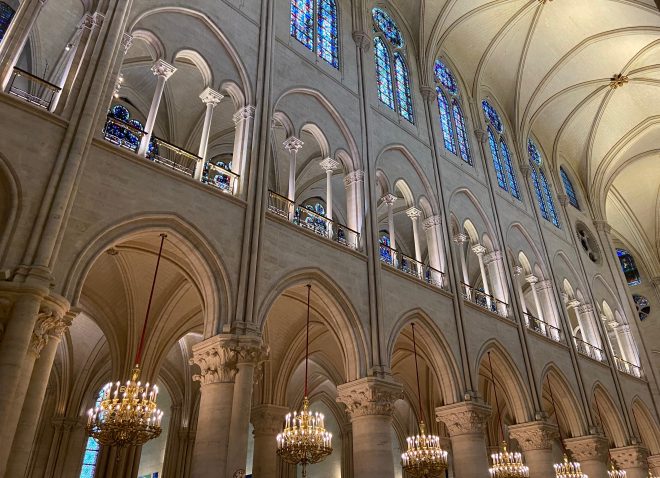
I’m straying into cliché now but arriving during a service, the organ playing – incidentally all 8000 pipes were individually cleaned – and following along to the Lord’s Prayer in English – was a beacon of light moment, of hopefulness, in our ever more troubled and conflict-ridden world. The restoration of Notre Dame following the 2019 fire is an encouraging reminder of what can be achieved when political will combined with public, private and business funding unite around a single vision. And the fire has served as a reminder for us all – witness the queues to get in – how precious these ancient monuments are. I don’t know about you, but I took Notre Dame for granted – I certainly didn’t visit it last time I went to Paris in 2019.
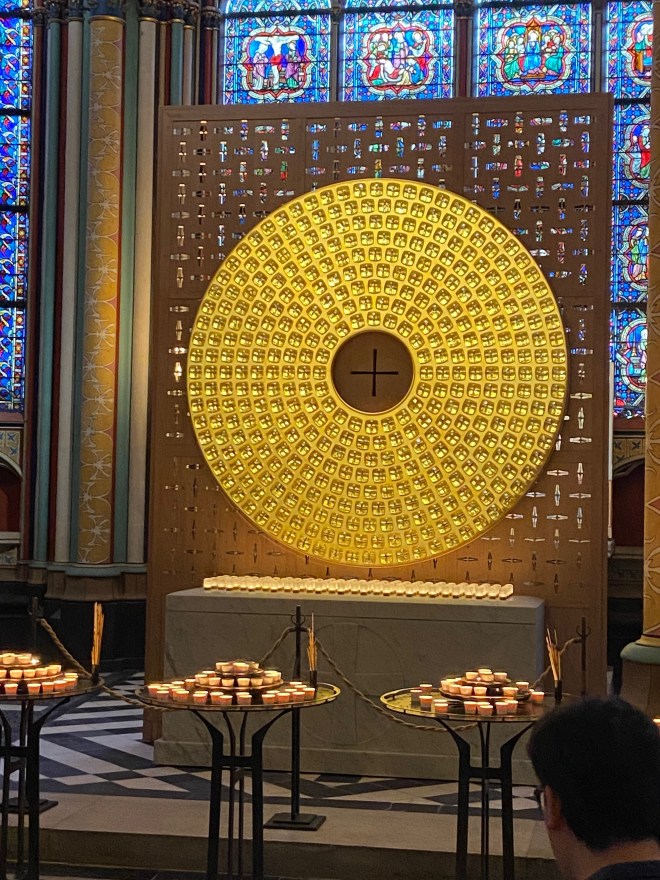
Being a bit of a swot, I rented an audio guide covering Notre Dame’s history. I discovered that the north rose window with its central image of Mary with the Christ Child still has most of the 13th century glass intact – extraordinary. The original Crown of Thorns is believed to reside at Notre Dame, brought to Paris from Jerusalem in 1263. The Crown of Thorns survived the fire, but its glass case was broken. The new reliquary designed by French artist Sylvain Dubuisson is stunning. I could have stayed for the monthly veneration service of the Holy Crown of Thorns but the jetlag was beginning to bite so I carried on with my tour admiring the contemporary tapestries hanging in the side chapels in the north aisle – my favourite Polynesia, the Sky and Polynesia, the Sea, woven in 1972 after the cut papers by Henri Matisse, before moving onto the 14th century sculpted wall scenes from the life of Christ in the choir enclosure.
-
-
Reliquary of the Crown of Thorns
-

-
Side chapel with contemporary tapestry
I was drawn to the newly created chapel for Eastern Christians (this was not included in my audio guide, but I have since learnt it was inaugurated in May 2025) displaying the eight icons that pay tribute to the founding figures of the great Eastern Churches. But I have to admit to not being sure about the new modern altar – a bronze bowl-like structure which looked more like a bath to me and had nothing of the sacred about it.

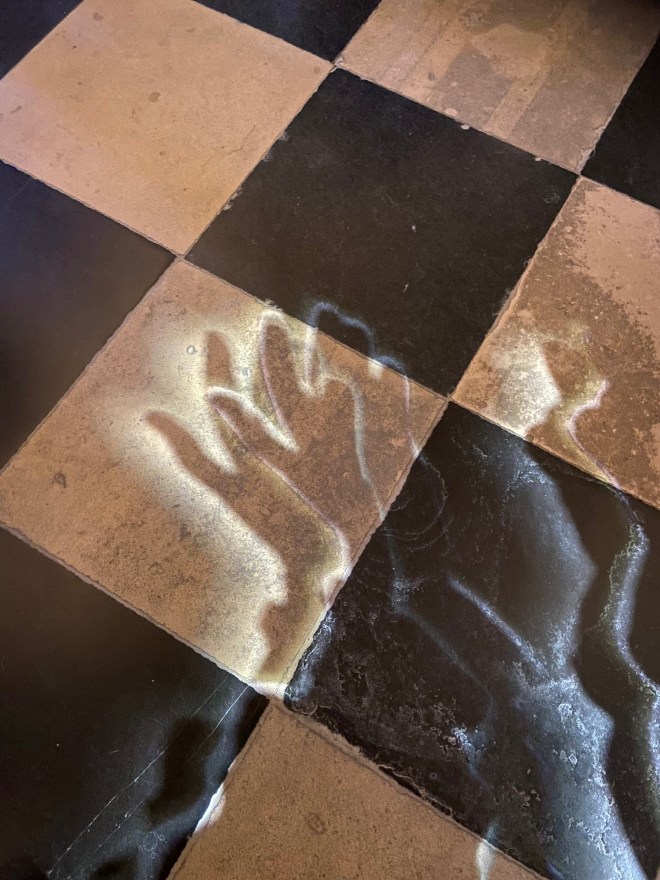
Much more mysterious was the how the play of light around the sculpture of the Virgin Mary holding the dead body of Jesus in her lap at the High Altar cast an almost spectral silhouette of Mary’s hands onto the black and white flagstones. Similarly, the statue of Joan of Arc and the statue of the Virgin Mary, both of which avoided the fire, seemed to be ringed with an auric kind of white light. Quite magical.
After a pitstop in a café near Notre Dame – where a local told me I had to shut my menu to signal I had made my choice before anyone would take my order (great intel!) – I had a bit of a rest back at the Holiday Inn Gare de Lyons, where I was staying gratis thanks to my brother generously donating his points.
My plan for the evening was to visit the Jacquemart-André Museum in the Boulevard Haussman in the 8th arrondissement. They have late night openings on Fridays with drinks and platters on offer at Le Nélie, the salon de thé. I had it all mapped out, except I didn’t…
I had read that the nearest RER station was Charles de Gaulle-Étoile, which is true, but there’s a much closer metro stop. The best laid plans and all that… A transport volunteer at Charles de Gaulle-Étoile told me the museum was a good half-hour’s walk, or I could take the 22 bus. It was pouring with rain but, determined to get there, I went on up to street level and discovered I was at the Champs-Élysées, which was gridlocked with rush hour traffic. I found the 22 bus and jumped aboard only to find I needed to be ‘de l’autre côté’ but which autre côté? The Champs-Élysées roundabout is hectic at the best of times, and amid the cacophony of coups de klaxon (cue a smug moment remembering the words for car horn from my schoolgirl French), I felt I couldn’t distract the driver by asking which side he meant.
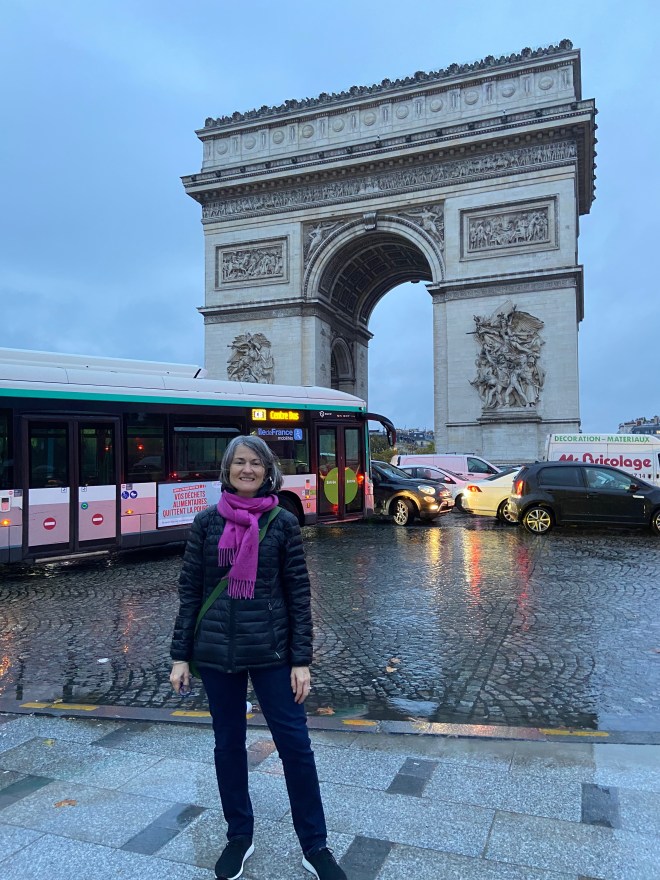
I got off the bus and back into the sheeting rain, where I took an “I woz ‘ere” photo for some fellow tourists and asked them to do the same for me. Then I took a deep breath and thought through my options. It was now getting towards 7.30pm – even if I found the right bus, the traffic was at a standstill and I’d be unlikely to get there till after 8pm. This was overly ambitious for my straight-off-the-plane day one. Too hard basket was the conclusion. I retraced my steps and went back to the Gare de Lyon area where I indulged in a spot of people-watching over a simple but delicious dinner and a glass of rosé at a local bistro. A good decision move as it turns out. You’ll find out why in Part 2. |



 This Quirky Life