I’ve already written about how I first met Connie in 1995 when I was travelling in Australia – I was in my 30s and Connie in her 60s (see https://thisquirkylife.com/2017/09/12/how-spiders-got-me-writing/). In summary, I was taking time out between jobs and had been offered the use of a cottage in Noojee in Gippsland. Picturing a quaint, rose-covered dwelling where I’d have time to do my own thing, write poetry, meditate and relax, I had eagerly accepted.
It didn’t turn out like that – the cottage was more of a shack. And as I got ready for bed on night one, I noticed a large black shape on my bed. I now know it was a huntsman but back then I thought all Australian spiders were deadly. And this one, large, rubbery and hairy, was unlikely to be an exception. After dispatching the spider to the afterlife, I lay tensely on my mattress on the floor flinching every time the loose spidery threads of the coverless duvet brushed against with my face and arms. And looking around the room, I noticed spider webs decorating the windowsills and skirting boards like a dusting of snow. Suffice it to say I had no sleep, not a wink. And stepping into the shower the next morning, there was a spider dangling from the bare light bulb. It started to feel positively Hitchcockian.
I decided flight was the only option. Rather than return to the safety and comfort of suburbia, and my brother’s house and pool in Bayside, I got out my notebook with phone numbers of friends of friends and rang Connie from a phone booth. My dear friend Helen in the UK had met Connie and Norman in a camp site in Darwin in the late ‘80s and given me their contact details.
Hearing the high-pitched hysteria in my voice and my garbled tale about killer spiders, Connie gently said: “Would you like to come and stay?” And so it was that I was soon on a train to Kyneton (Central Victoria) where Connie met me off the train with a big hug as if we’d know each other for years. And we never looked back.
I was embraced by Connie and her husband Norman as one of the family from the get-go and joined in the rhythm of their daily life, mainstays of which included porridge and poached eggs for breakfast, drinks and nibbles in the evening and roasts for dinner. I am indebted to Connie, an excellent (and published) writer herself, for encouraging me to write my first short story, and for believing in me as a writer. It was winter and she set me up with a table and typewriter with an oil-filled radiator for warmth. I still have the story – The Swim – typed up on now-yellowing paper.
And in 2009 when I was making a living, albeit a modest one, from writing travel and lifestyle articles, she helped me edit my article about fishing on the UK’s River Test entitled Duffer’s Day Out for the travel section of The Australian.


I’ve never forgotten my stay with Connie and Norman in Kyneton. It was where I first tuned into Australian birds; they had a bird bath in the drive outside the kitchen window, and Connie identified the lorikeets, crimson rosellas, Australian magpies, wattle birds and pied currawongs. I learnt that the Australian magpie is not of the crow family like its Eurasian counterpart. And I grew to love its melodic warbling song, so unlike the cackling of the magpies I had grown up with. To do this day, I always think of Connie and tap into something grounding and quintessentially Australian when I hear the magpie’s song.
After moving to Australia in 2004 I visited Connie and Norman several times in their new home in Shoalhaven Heads in NSW. And once again I slipped into their way of life, comforted by the unchanging routine of porridge and poached eggs for breakfast– often on the balcony in the early morning sun. Connie and I talked about family, books and writing, Norman tinkered with his boat, and I went for walks to the beach armed with a stick that Norman made for me to scare off any snakes that might be dozing nearby. Connie and I also went into Sydney to the Art Gallery of New South Wales. I don’t remember exactly what we saw – it may have been paintings in the permanent collection – but it was a treat as Connie knew her art and helped me view the pictures from a more informed perspective.
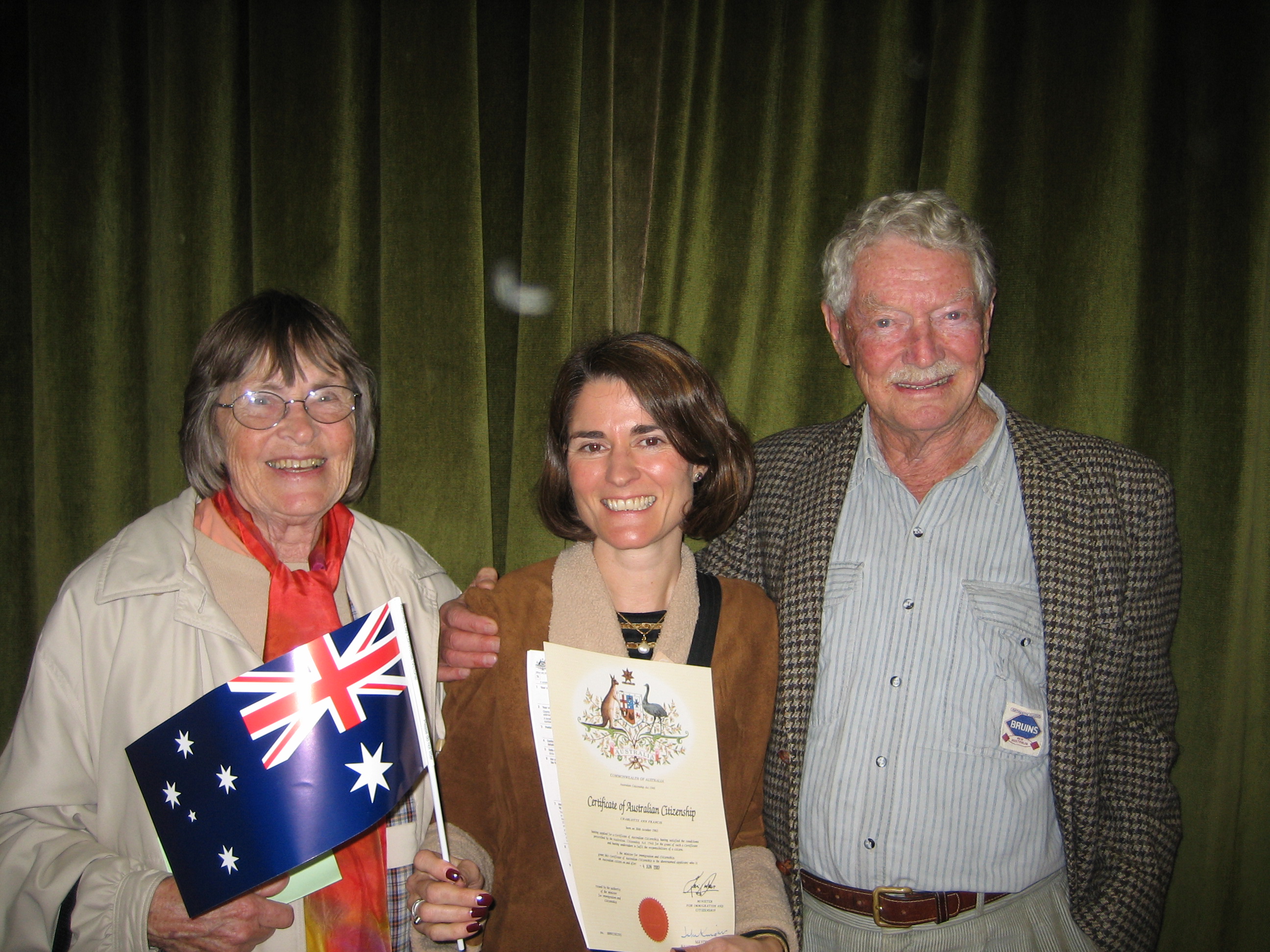
It was entirely fitting that Connie and Norman, such an integral part of my Australian ‘journey’, attended my Australian Citizenship Ceremony in June 2007. Other shared milestone celebrations included Norman’s 90th birthday party in Melbourne – a wonderful gathering of the family and extended family clan. And, over time, I can’t pinpoint exactly when, Connie began to call me Charlottie, a fitting hybrid name used exclusively by the Tout-Smith family. We also had fun and a lot of giggles playing with various English regional dialects and came up with Noite Loite, which is night light spoken with a West Country accent! Noite Loite became something of a recurring refrain in our conversations.
I last saw Connie in March 2024 in Adelaide where she had moved to live with her daughter Lynda. She was frail and suffering from cancer, and I knew it might be the last time I would see her. We played the game Bananagrams – Connie still a woman of letters and a dab hand at building words. At the same time, I felt that in Connie’s memory Helen and I may have become one and the same person – there was an element of confusion, one that presented an elegant closure of the circle. “I always did love you,” said Connie, and I, biting my lip not to cry, accepted her heartfelt words for both of us. Helen had her own formative experiences with Connie during an extended stay in Kyneton. Under Connie’s care and guidance, she encouraged Helen to join the local writer’s group and also to practise her art – one of her works was shown at an outdoor exhibition in Melbourne.
When her daughter Deb rang to tell me in late February that Connie had died peacefully in the early morning surrounded by her family, I recalled how I’d been spellbound on my dog walk that morning at the sight of several hot air balloons silhouetted against the rose-pink sky. Looking back, it feels like it was Connie’s spirit soaring home. I won’t say heavenwards as, although Connie was the daughter of a Reverend who served as a missionary in Fiji and Rotuman, she wasn’t religious.
I was deeply saddened by the news of her death, but I was thrilled to be invited to Connie’s Celebration of Life event in mid-May. The event was held in Campbelltown, NSW, in the aged care facility where Connie’s 93-year-old sister lives.
With photographs from Connie’s life rotating on the screen – wonderful shots of her as a girl and beautiful young woman that I had never seen before – family and friends came together to celebrate all that she was and all that she contributed to the world.
I already knew Connie as an accomplished writer, a regular diarist, a keen reader, a cryptic crossword solver, a connoisseur of art, a good cook, a wife, mother, grandmother, sister, aunt and friend, a generous spirit with the warmest of smiles and biggest of hearts, but I hadn’t realised the depth of her creative life. And that’s, I suspect, because Connie was extremely modest. In Deb’s beautiful tribute I discovered that Connie was a talented piano player and received a diploma from the Associate in Music, Australia (AMusA), an award for outstanding candidates. And in later life she embarked on a Master of Fine Art at Melbourne University. While illness prevented her from completing it, she was able to use her expertise as a volunteer guide at Melbourne’s National Gallery of Art.
When her nephew reminisced about visits to Connie and Norman and mentioned the pattern of their lives – morning poached eggs and all – I reflected just how lucky I was that I had known Connie and Norman and been part of the family. Vale Connie. I dedicate this blog to you as my dear friend, writing muse and inspiration. May you rest in peace.


 This Quirky Life