It had been a long time since I last visited Spain – probably back in the ‘90s when I made a couple of brief visits for work during my publishing days. Many moons ago I studied Spanish (and German) at university, and even tuning into the children’s cartoons playing above the luggage carousel at Madrid airport was exciting; just as well as my case took nearly an hour to appear!
Despite the bracing early March weather, eight degrees and wet and windy (it was mid-20s when I left Melbourne), I was off and out the minute I’d checked into my hotel, keen to make the most of my afternoon and evening in Madrid.

I was staying in the Barrio de las Letras, the literary quarter, home to many of Spain’s writers from the 17th-century Golden Age, a deliberate choice as my degree was largely literature-based. All the names came flooding back, Cervantes (Don Quixote), Lope de Vega and Tirso de Molina who, in his play El Burlador (seducer) de Sevilla), introduced the world to Don Juan, the charming hero-villain, a character with folk legend status made famous by Mozart’s opera Don Giovanni and the subject of many books, plays and films since. I was in my element walking along elegant, cobbled streets dotted with early spring blossoms in the company of these literary greats who were variously honoured in colourful tiled mosaics, street signs, cafés, Metro Station names and quotations engraved on the pavements.


I barely noticed the cold and that my feet were soaked through to my socks. Such was the excitement and cultural immersion. I had a few pit stops – an arty café where I dipped into a slim novella, Réquiem Por Un Campesino Español, one of my university books, first published in 1950, and a few tapas in a thronging and lively covered market.
Further on I stumbled on a rehearsal for Semana Santa (Holy Week) which will be in full flow as I write this over Easter. 14 men from a cofradía (a fraternity/brotherhood) were bearing a float weighed down with suitcases in preparation for the Holy Week processions. All wearing white runners, they performed a kind of slow-shoe-shuffle in time to the recorded music, their heads covered in a white cloth, a stand-in for the capirote, a hood with a conical tip, a symbol of penance, that conceals the face. I admired their dedication turning out on a cold and wet Saturday afternoon!

A few days later in Malaga, I peeked through the heavy wooden doors of a cofradía and saw the bulky shapes of sculptures (most likely Christ, the Virgin Mary and various saints) covered in cloth and mounted on a float, awaiting the Easter processions. These brotherhoods are Catholic organisations made up of lay people (men and women) who carry out charitable and religious works and events in the community. They play a key role during Semana Santa.

This was just one of many examples of timelessness and enduring tradition that I was delighted – and reassured – to find still in existence in Spain today. It’s 40 years since I spent four or so months in Granada as part of my Spanish degree – way before the distracted digital age of everything being available at the swipe of a screen.
I took the train to Malaga from Madrid’s Atocha Station the next morning. Atocha is a destination in itself with its glass and iron-clad domed roof – an old trainshed – complete with tropical garden. I was on a no-frills ticket, and it’s a three-and-a-half-hour journey from the centre of Spain down to Andalucia in the South. There wasn’t much to look at on the way but I got chatting to a young female student and soon realised how rusty my Spanish was!

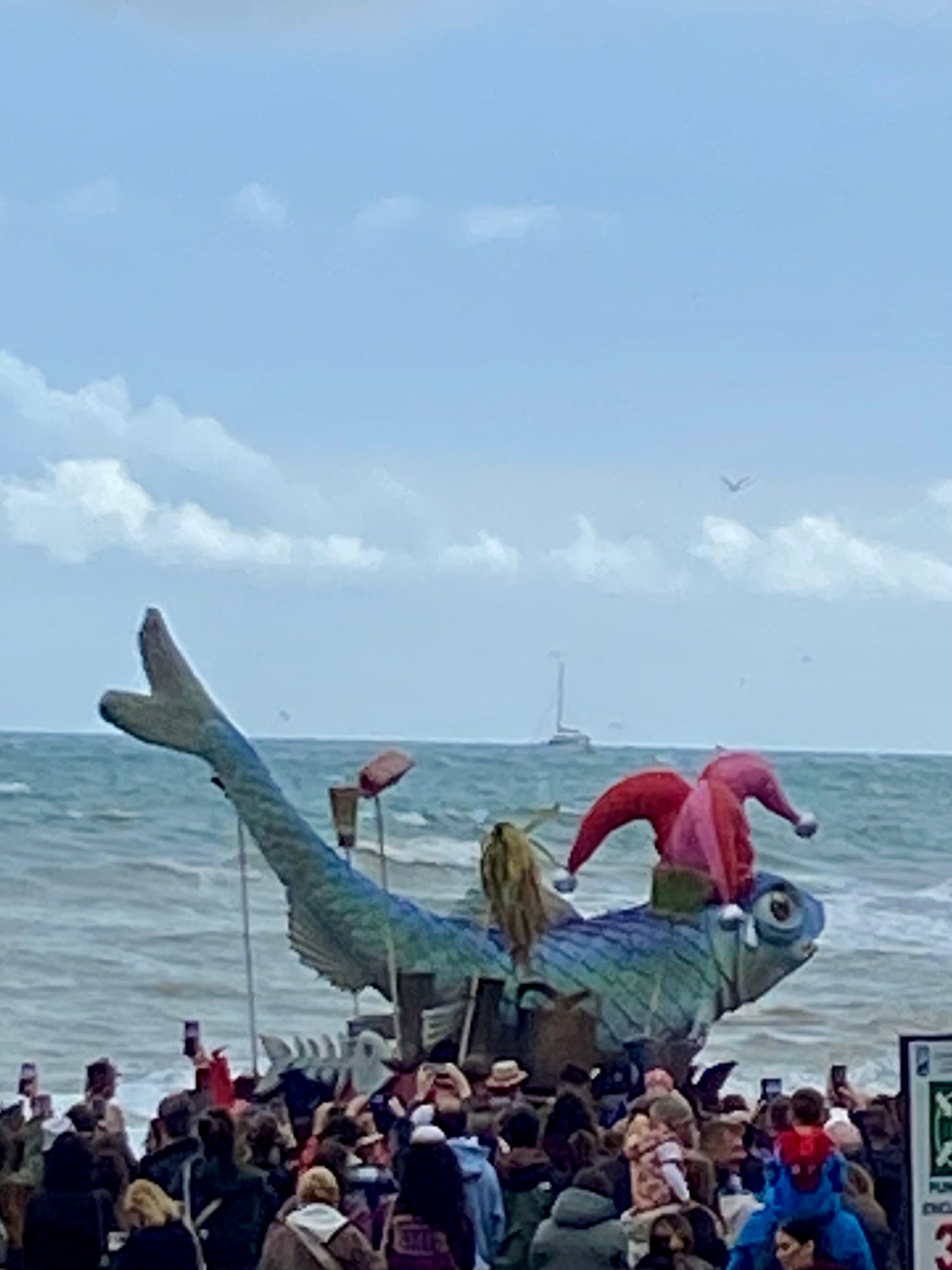
My goal was to get to Malaga in time for the Entierro del Boquerón (burial of the sardine), an annual ritual on the last Sunday of Carnaval, when festivalgoers mark the end of Carnaval. I had missed the midday jamboree of music in Calle Lario (I was still on the train) but got down to Malagueta Beach by 5pm and was surrounded by revellers in their costumes, tears painted on their faces, marking sorrow that the fun was ending and the sobriety of Lent fast approaching. Nobody quite knows how the sardine tradition came about – maybe it’s a nod to Malaga’s maritime heritage – but the message is clear, it’s about closure.


I stood on the wall overlooking the beach to get a better look. Delightfully irreverent, the sardine sat atop a float, flashed its blue and green-glinting scales and sported a jester’s hat. From what I could see the fish was made of metal and layers of fabric and paper – perfect combustible material. Although the weather was squally, the fish was set alight, and clouds of black smoke blew back towards the city. In no time at all, all that remained were the spines of the fish. Buried indeed. What joy to be part of the action. I felt as if I had time-travelled to another world.


Just back from Malagueta Beach is Malaga’s Pompidou Centre. I had no idea that the Paris Museum has a Spanish branch. But you can’t miss it with its Mondrian-style brightly coloured squares. It was open till 8pm so I drifted in and went to an excellent exhibition called Place-ness: Inhabiting Space, that explored how humans relate to (and ruin!) their environment. There were many references to exploiting the natural environment for productivity and profit, and a section with paintings and photographs exploring the impact of industrialisation including ‘non-places’ such as shopping malls, motorway interchanges, abandoned shipyards and airports. Some of my favourite pieces include an idyllic Alpine landscape with a shower and tap attached like an elephant’s trunk in the centre of the painting reminding city dwellers of the source of their water supply, and a pair of Armani suit trousers hanging on a clothesline, the pockets filled with plants and earth, an allegory by the Romanian artist about the immigrant experience in Italy and being uprooted.


For dinner, I found a delightful restaurant with earthy home-cooked food near to where I was staying and away from the city centre. Reminding me of carpet sellers in a souk, the more touristy restaurants have hawkers stationed outside brandishing menus printed in three languages. It’s all too pushy for me.
Small and cosy with the menu on the blackboard and small chalk-painted wooden tables and retro chairs, restaurant Oliva was a great find. The welcome tapa- served with a drink – was an exquisite flavoursome stew of chickpeas made with a hint of chorizo and lots of vegetables and cooked slowly for hours. Other delicacies included roasted padrón peppers, eggs with asparagus and jamón and a cheesecake made with Queso Manchego. Delicioso!


Such richness on all levels, a feast for body, mind and soul – and I was only just over 24 hours into my Spanish sojourn en route to the UK. Spain Part 2 coming next week.

 This Quirky Life