House Museum 3 of 3: Mr Straw’s House – hoarding Edwardian-style

Walking into No.7 Blyth Grove in Workshop, Nottinghamshire, you’d be forgiven for thinking the Straw family were hoarders. Not the kind of hoarding that provides voyeuristic fodder for Reality TV shows – television hadn’t even been invented when the Straw family bought their semi-detached house in 1923 – theirs was more of a post First World War ‘Make Do and Mend’ approach.

The charm of the house is that little has been touched since 1932, giving a real life – rather than a museum curated – insight into a bygone era. William Straw was a prosperous tradesman, a seed merchant and grocer with a shop at the top end of town, and father to two sons, William and Walter. William senior died suddenly while gardening aged 68 in 1932 and his wife Florence passed away seven years later.

After the death of their parents the two boys continued to live in the house, keeping everything exactly as it was for the rest of their lives, William being the last to depart when he went to hospital in 1985. It’s almost as if the house is a shrine to their parents’ memory.  They kept the curtains closed to keep out the sun in Florence’s sitting room, her bible on the table, the French Empire-style clock on the mantelpiece, her music scores on the piano stool, the bookcase fully stocked and side board crowded with ornaments and china. Fortunately, for us and future generations, William bequeathed the property to the National Trust on his death in 1990.
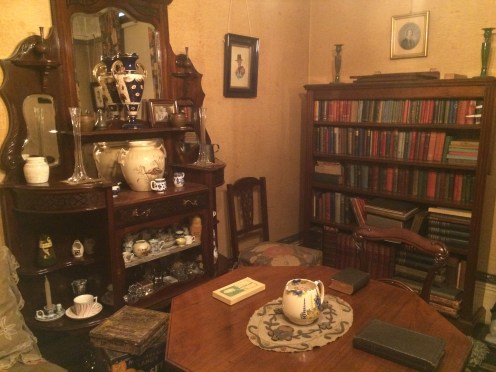
Florence’s sitting room

The dining room, which is to the right as you enter the front hall, where William senior’s coats, caps and hats still hang from pegs, is the room where time seems to have stood still. The calendar on the wall with a picture of two kittens is from 1932, William’s pipes and tobacco pouch and favourite chair to the left of the fireplace are as he left them. The walls are covered in dark wallpaper and hung with oil paintings, the furniture heavy and every surface laden with glass, china and pewter ornaments and collectables.

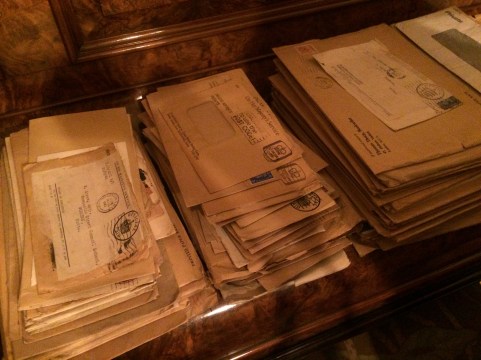
One of the most touching rooms in the house is the parents’ bedroom, where William’s detachable collars are still in a box on the dressing table with Florence’s diaries, gloves and the blue sunglasses she used on her annual seaside holiday in a drawer. The brass frame bed is heaped with Florence’s clothes perfectly preserved between layers of newspaper and carbolic soap to protect against moths. While the Straw parents hung onto everything ­– from postal correspondence to bills and old newspapers (even those that were delivered while they were on holiday) – there’s an air of thriftiness about the place. This wasn’t the age of fast fashion with flimsy throw-away items, worn just a few times, creating mountains of toxic waste in landfill sites, of electronic gadgets with built-in obsolescence or one in which plastic water bottles and takeaway food containers litter the landscape.
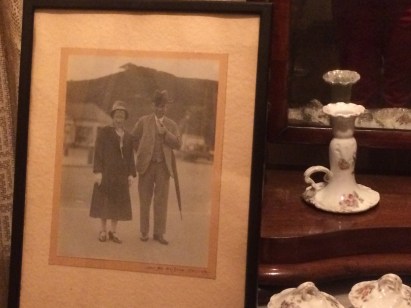
The Straws on their annual seaside holiday in Scarborough

Yet there’s a homeliness and cosiness amid all the paraphernalia, clutter and heavy furniture – possessions were an indicator of status and wealth in the 1920s. And, while the sons remained deeply resistant to change after their parents died, refusing to make way for modern conveniences as they became available such as phone, radio, central heating and television, their parents were not afraid to move with the fashions of the time.
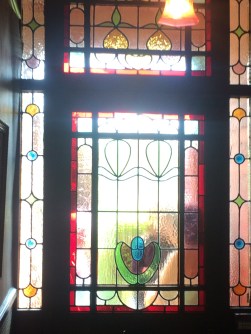
One of the first things you notice on entering the house, with its attractive stained glass door panels,  is the Axminster stair carpet bearing an Egyptian design, one that was very much in vogue following the discovery of Tutankhamun’s tomb in 1922.



Before moving in, William Senior had all the rooms decorated with fashionable Sanderson wallpapers, dado and picture rails put up, new curtains, carpets and lino laid. And, in a concession to modernity, a new lavatory was installed in the bathroom, and in 1927, a new sink and bath were put in with two taps to accommodate the introduction of hot water.  Imagine two taps being a symbol of luxury! With exposed lead piping – I always think of Cluedo and whodunnit – it looks sparse to our modern tastes but, along with improvements to the electrical system, the Straws were very much up and coming.

Two tap luxury

In 1940 William drew up an inventory of the entire ground floor of the house – down to every last packet of food in the kitchen cupboards –  and labelled some items of furniture. In common with the original owners of other house museums, the Straws documented their lives for posterity, whether consciously or unconsciously. What kind of legacy are we creating today in the absence of letters and hard copy documentation. Will our lives be digitally recorded and archived? What will happen to all our emails?

Curiously, the boys used a cupboard on the second-floor landing as a pantry. Sauces, tins, jars and bottles – some vintage such as Fowler’s Pure Cane Indian Treacle and some more modern such as a tin of Heinz baked beans – line the shelves. A lumber room on the same floor – probably originally a maid’s room (there are servants’ bells in the kitchen) served as a storeroom. It’s crammed with eclectic objects such as a foot-operated Baby Daisy vacuum cleaner, jars of home-made bottled jam, hat boxes, biscuit tins, wooden crates and a World War Two wardens’ helmet.

My family lived in Workshop, a small market and former mining town, in the 70s. I wonder if I ever passed William and Walter, both regular churchgoers (always sitting in the same pew) in their serge suits and bowler hats? What austere lives they led –baking bread once a week to their mother’s recipe and using her utensils, only ever lighting fires in two of the rooms even in the coldest months, their bachelor beds covered in checked blankets.  Little did I think I would return one day as a tourist from Australia thrilled to discover a time capsule of the Victorian and Edwardian Age.


Liberace with more money? David Roche Foundation: House Museum two of three

Canopic, canine, camp with a hint of kitsch –  perhaps not obvious bedfellows (read on…) but a recent trip to Adelaide’s first privately funded museum – the David Roche Foundation House Museum ­– convinced me otherwise. That’s why I love house museums; just as characters in novels are revealed through the pages of a book, a tour round someone’s house is similarly revealing; how they inhabit and arrange their space, their choice of books, furnishings, paintings, colours and collectables gives you an insight into their personality, their preferences and passions.

The first thing that strikes you when you enter the late David Roche’s house in Adelaide’s Melbourne Street is the riot of colour and richness of textures; everything seemingly gilded in some way. Spanning British Regency to French Empire and Neoclassicism, the place is packed with antiques, fine and decorative art: there’s silk, damask, bronze, silver, gold, parquetry, marble, malachite, china, porcelain, polished stone, glass, crystal and more.

IMG_4432

David Roche was born in 1930 and started collecting antiques and valuables when he was just 17, a practice he continued until three months before his death in 2013. He came from a property owning and developing family and clearly never had to do office work to pay the bills. A photograph of him in a double-breasted suit with a red silk tie in the breast pocket suggests he was a man of refined taste – who knows perhaps he was even a bit of snob?

By all accounts he was a generous but highly private man, which makes it interesting that he bequeathed his property and wanted it to be enjoyed by the public. His 1950s Federation home is the House Museum part, and a purpose-built adjoining gallery, once kennels for his Afghan show dogs, houses more works, many of them larger items from the Roche private collection.

The place does shout camp – you only have to look inside the master bedroom – think Empire Bed and chaise longue sofa covered in leopard skin fabric, bespoke oak-garland wallpaper ordered in Britain, French silk curtains dyed to the colour of the back of a magnolia leaf, a cabinet of snuff boxes, parasol handles and Fabergé items, a George 1V mirror and a vitrine cabinet full of priceless china – Meissen, Tournai, Sevres and Worcester.  One reviewer described Roche’s collection as ‘Liberace with more money.’

IMG_4420

IMG_4434

But that’s not all. There’s a canopic jar on the wall, one of many references to all things Egyptian, an interest sparked by Napoleon’s Egyptian expedition in 1798.

IMG_4429

The ancient Egyptians used these jars to store and preserve the organs of the deceased, one each for the stomach, intestines, lungs and liver in the belief that they would be needed in the afterlife (the heart as the seat of the soul was left inside the body).  The cultural and artistic influence of the Grand Tour, a mostly 18th century phenomena when young men of means would travel round Europe in search of the roots of western civilization, is also evident in the collection, many of the pieces in the neo-classical tradition – there’s plenty of furniture adorned with claw feet, winged creatures and sphinxes.

IMG_4440

Napoleon himself makes an entry – one of the display cases in the bedroom contains a flintlock pistol that was gifted to Napoleon Bonaparte in 1802 by an English military commander. Other aristocratic characters featuring in the collection include Catherine the Great whose portrait by Johann Baptist Lampi hangs in the Russian Room, which is rich in malachite, gilt-edged mirrors and candelabras. Then in chinoiserie bedroom there’s a French commode from around 1820, owned by the 1st Duke of Wellington.

As with many house museums, you can’t just tip up and look round. You need to book on a timed tour. Although, here, it’s an intimate experience without any cordons or ropes sectioning off the treasures.  The tour starts with tea, coffee and biscuits and a short video among the classical statues and torsos in the Roman room then continues into the hall, its deep red walls hung with the kind of framed sporting prints you’d expect to find in an English stately home, the carpet underfoot dark green and patterned with black stars, copied from a design in the White House – it’s not all inspired by classical antiquity.

IMG_4437

Far from it, in fact, the kitchen is surprisingly kitsch with its printed hessian walls, curtains patterned with cockerels, and the kind of clutter you might find in a car boot sale: lustreware mugs, chunky pottery, toys, mechanical money boxes, a butcher’s shop diorama – it’s more Country’s Women’s than Haute Cuisine.

Perhaps the closest we come to seeing the man behind the beautiful objects is in his den, which is modelled on an Englishman’s study with racing, hunting and canine portraits.  Roche, it turns out, was a dog lover and breeder – hence the kennels where the new gallery now stands – and a judge at Crufts and dog shows around the world.  Alongside a collection of The Kennel Club Stud Books are other canine-related books and trophies and rosettes that his dogs won in shows.

IMG_4417

I couldn’t help wondering if the dogs ever came into the house – the thought of wagging tails dislodging a porcelain vase from the Qing Dynasty makes me shudder.

Staffordshire dog figurines in the gallery took me back to my childhood and to my mother’s house where a pair of hearth spaniels (they were typically displayed on mantelpieces in 19th century England) still sit atop a tall boy dresser in the living room.

IMG_4446

Talking of home, the third house museum in my series will feature Mr Straw’s House in Nottinghamshire, England, where time has seemingly stood still since 1926. Stay tuned.

‘Flirt’, the sculptress’ umbrella and the Duldig Studio: House Museum Series 1 of 3

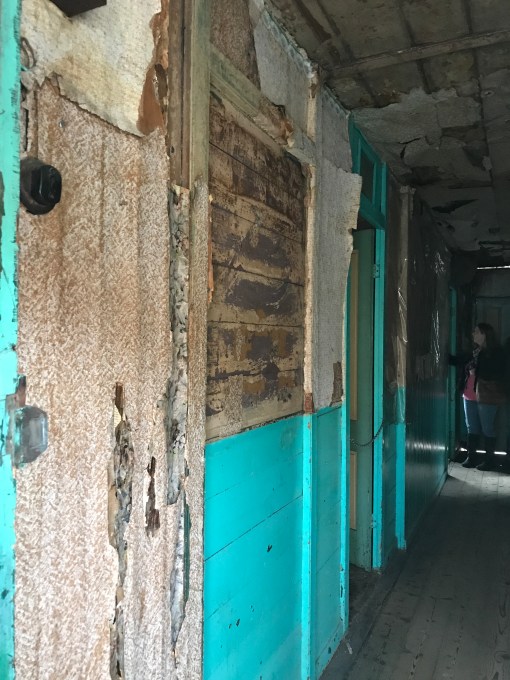
This weekend, as part of Open Melbourne 2017, I visited a few historic properties starting with a group of corrugated-iron houses in South Melbourne that were saved from demolition by the National Trust.  These portable homes were shipped out from the UK in the mid-1800s, during the Gold Rush, when tent dwellings were springing up to accommodate fortune hunters.

Forerunners of IKEA furniture, these dwellings were labelled, numbered, flat-packed in wooden crates and shipped overseas. The wood from the crates was used for wall linings, floor boards and partitions – you can still see the initials of one of the property speculators RP (Robert Patterson), on one of the walls at 399 Coventry Street. Abercrombie House (originally from North Melbourne) was moved onto the Coventry Street block by the National Trust in two halves to save the many layers of wallpaper that tell the story of how the house evolved over time.

But the stand-out property was the Duldig Studio, a house museum in Malvern East, once home to émigré artists Slawa Horowitz-Duldig and Karl Duldig who settled in Melbourne after World War II. Forced to leave Vienna at the time of the Anschluss in 1938, the Duldigs settled in Melbourne after 18 months in Singapore and two years in the Tatura internment camp. Both Viennese modernists, Karl was a sculptor and Slawa a sculptor and painter. One of Karl’s sculpted masks is owned by the  NGV in Melbourne.

Slawa was not only a successful artist– she trained at two prestigious art schools in Vienna – she also invented the first foldable umbrella and there are prototypes of her ‘Flirt’ model on display at the Burke Street property. Fleeing Nazism, Slawa was, however, forced to sell the rights to her umbrella, but the royalties she had earned paid for furniture which she designed and had custom made. With rooms in the house opened up specially for Open Melbourne 2017, we got to see her furniture.

And this is what makes the story of this couple so extraordinary. Before they fled Austria, Slawa saved everything from their apartment in Vienna, and her sister Aurelie known as Rella, hid everything away in a cellar in Paris, keeping a meticulous inventory of every item.  Even more amazingly, their cache escaped detection by the Nazis and was shipped to Australia on the aptly named Rembrandt in the 1950s.

They kept everything from dining settings to their artworks, furniture, silk curtains, lamps, ceramics, sculptures and books. Given they lost all their family bar Rella to the Holocaust, it’s consoling that their possessions survived. It’s not as if they were hanging on to clutter – I am thinking of Marie Kondo here, Queen of Life Laundry and author of The Life-changing Magic of Tidying Up, whose rule of thumb is to keep things only if they spark joy. The Duldigs were people for whom art was a way of life – Karl carved a sculpture out of a potato while they were in Tatura –  and everything around them was an expression of their artistic sensibility.

Part of the Secession Movement (formed by a group of Viennese artists including Gustav Klimt in 1897), which represented a move away from more traditional and conservative forms, the Duldigs created interiors where everything was designed to be beautiful and part of the artistic whole – even their dog had a Persian carpet bed! Materials were incorporated into the design in such a way that they were seen – from the Salzburg stone supporting a sculpture and lattice leather straps in a chair designed by Slawa to the grain of the wood on their hand-crafted bedroom wardrobe. Even their china and dinnerware survived the high seas from the chunky ceramic coffee cups and plates in the living room to the fine blue, white and gold china in the dining room. Throughout the house the mixture of art forms –  from primitive to African, Asian and classical – is characteristic of the modernist aesthetic.

(Picture taken from the Duldig Studio brochure)

At the back of the property are the sculpture garden and Karl’s studio, complete with kiln, coloured dies in jars (the couple were also both ceramicists and took commissions) and a bakelite phone, the receiver still crusted with dried clay. Just as it would have been when Karl was working, the studio remains packed with maquettes as well as finished works in wood, bronze and clay. Both Slawa and Karl taught to supplement their earnings – Slawa at St Catherine’s, where she inspired many of her students to pursue their love of art.

Shortly before her death Slawa told her daughter Eva de Jong-Duldig, who is now in her 70s and a patron of the Duldig Studio, not to throw anything away and to keep everything. Accordingly, their family home was opened to the public in 1996 and is now a museum and art gallery. Leaving us a rich legacy and insight into their creative lives in Vienna, Singapore and Australia the museum owes its existence to their practice of documenting and curating their lives with passion and purpose.

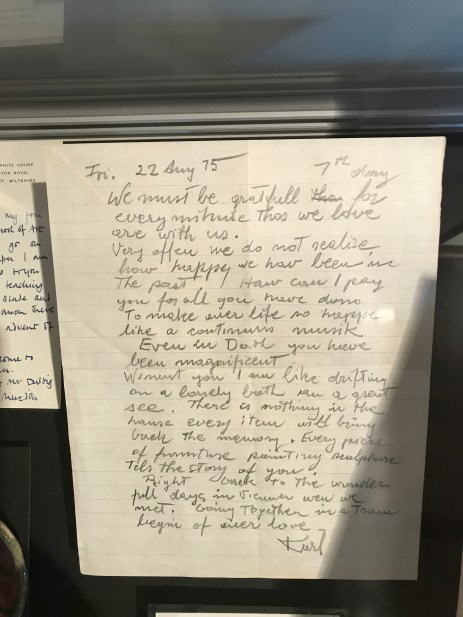
Among the sculptures and paintings on display are some of the letters Slawa exchanged with her sister, Rella, over a period of 30 years. The sisters only met up again once in the 1960s so these letters are a poignant reminder of a time when hand-written correspondence was central to people’s lives, helping to overcome separation and distance.

And, most moving of all, is Karl’s simple but heartfelt love letter to Slawa, written after her death in 1975, describing their life together “as a continuous musik.” (Karl’s German spelling of music). How heartening it is to see the essence of the Duldigs and their cultural contribution preserved for future generations.