Welcome back to Dresden where I am once again on the trusty Hop Off, Hop On bus, this time heading east from the city and across the cantilever truss bridge, colloquially known as the Blaues Wunder, up to the wealthy residential area of Loschwitz – an area of historic villas and summer residences, many of which escaped the WW2 bombings.
I start by taking the world’s oldest suspension railway (Schwebebahn) up the mountain. At this point, full declaration on suspension railways… My first visit to Germany was aged 15 when I stayed with my school friend Monica and her grandparents in Wuppertal. Quite young for our age and prone to giggling fits, we loved being with Opa and Oma, even if they did stuff us full of food – Kaffee und Kuchen every afternoon without fail! Travelling on Wuppertal’s Schwebebahn was all part of the adventure, and we loved it. Unlike the Loschwitz funicular (see below), the monorail in Wuppertal is not just a tourist attraction but part of the transport network. It literally hangs off the rails rather than sits on them, and is a great way of travelling around, lending a bird’s eye view of the city. Interestingly, the Loschwitz funicular and Wuppertal’s monorail were designed by the same engineer in 1901. From the machine room at the top, there are stunning views over Loschwitz, the Elbe and beyond. Dresden is a city packed with panoramic viewing points.


The Blaues Wunder Bridge
Back on the ground in Loschwitz I had lunch at Kaffee Wippler, a café with an art deco vibe and an enticing selection of cakes – after a slightly strange Greek-style salad heaped with spelt grains (I was expecting croutons), I chose a Florentine biscuit to go with my – you guessed it – English breakfast tea! Then I wandered round enjoying the ‘olde worlde’ feel of the place: the cobbled streets and half-timbered houses; a delightful bookshop covered with ivy and vines; a knitter’s delight wool shop; an attractive yellow painted house, the final resting place of Clara Schumann’s father; an art gallery and a fabulous antique shop. Admiring a beautiful walnut sewing table in the antique shop, I got chatting to the owner and his mate, Andreas, from the Blaue Brücke Gallery round the corner. That lead on to an interesting chat about all sorts including life in the GDR. They recommended an exhibition on polyurethane chairs at Schloss Pilnitz given my interest in East/West Politics. See blog post 3/3!


Keen to walk in the glorious spring sunshine, I followed Andreas’ directions and branched off from the road along a steep cobbled walkway past expensive-looking villas – from Swiss Chalet-style to classical and Art Nouveau – and yet more marvellous views over the Elbe. Then I rejoined the bus for one stop and got out at the Elbschösser – the three castles overlooking the Elbe (Schloss Albrechtsberg, Lingnerschloss and Schloss Eckberg). These three castles were all built in the mid-19th century and are surrounded by rolling English-style (Englischer Garten) parkland and meadows dotted with wildflowers.


At Lingnerschloss there’s a large open-air café on the terrace overlooking the vine-clad slopes – Loschwitz has been a wine-producing area since the 11th century – and it was here I succumbed to a major attack of FOMO. Tramping around a city is tiring and part of me wanted to chill out and kick back with a cuppa or something stronger. The other part argued that I had to make the most of my time in Dresden. It was now 3.30pm, the Stasi Museum was open till 6pm, and it was on my way back into Dresden. Having read Anna Funder’s Stasiland and seen films such as The Lives of Others, Goodbye Lenin and Balloon, my curiosity won out. I had a quick drink of water and pressed on.
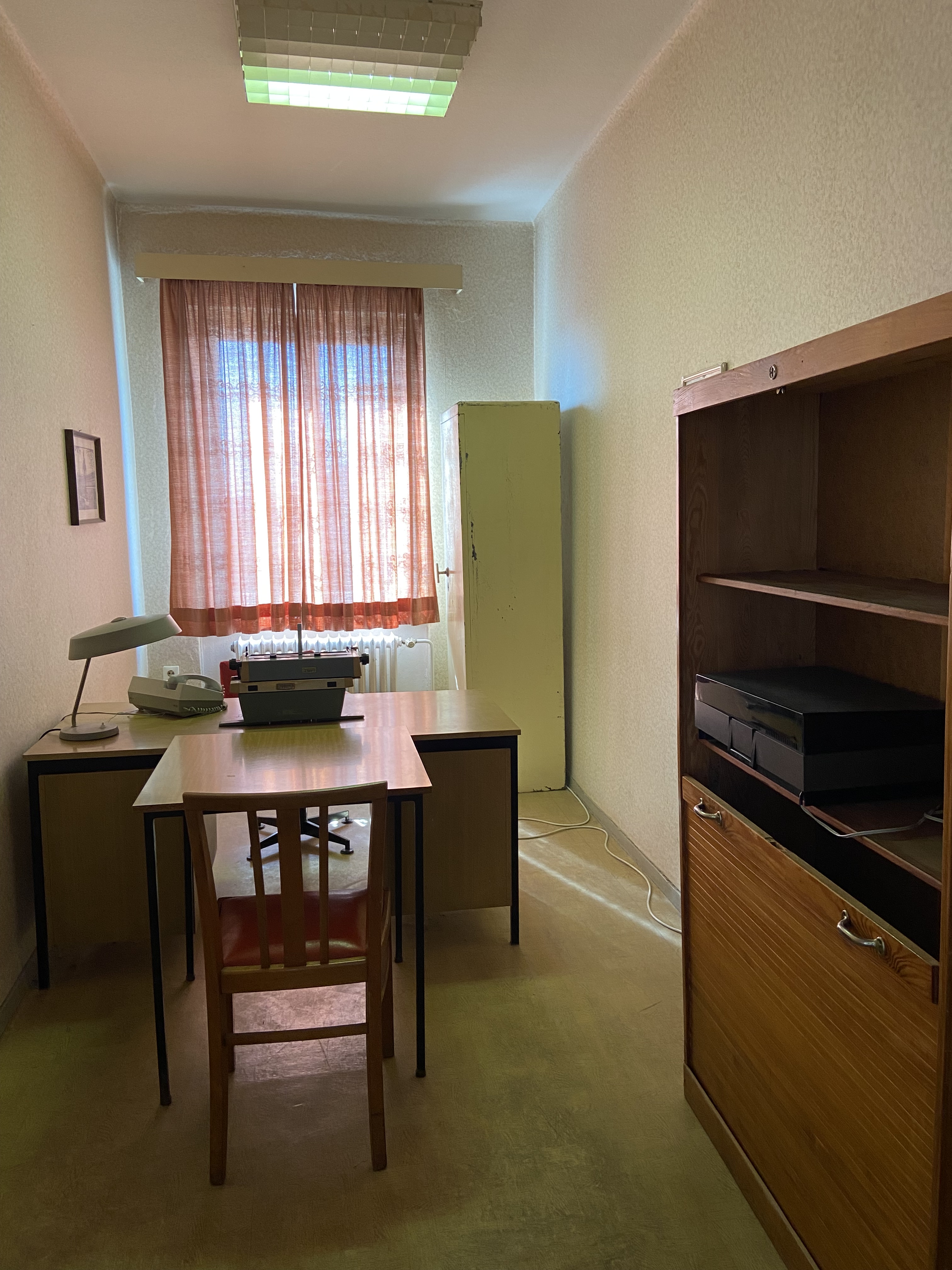
The Bautzner Strasse Memorial is a former Stasi remand centre and, prior to that, a Soviet prison housed in a grey/beige-coloured apartment block. The memorial commemorates those who were victims of political persecution during the post-war Soviet occupation and then under the GDR.
The man at the desk was somewhat unhelpful when I asked how long I needed to go round and if I had time to listen to the 55-minute audio – “that all depends,” he said, shrugging, “who knows?” He handed me a map and gave muddled instructions – the museum is across a number of floors and parts of it were shut off for renovation.

It seemed entirely fitting that I should feel confused as I navigated the maze-like corridors. What a discombobulating experience it must have been for those detained by the Stasi. New arrivals to Bautzner Strasse were blindfolded until they had been processed, their families were not informed of the crimes they had supposedly committed and all detainees were identified by a number rather than a name. Not even the guards knew what the detainees had been accused of.
The interrogation room remains untouched and, according to the caption on a somewhat dog-eared piece of A-4 paper, was where the Stasi carried out psychological torture. For example, if a detainee didn’t cooperate, they were threatened that their partners, families and children could come to harm or that their children might be taken into care. Then there’s the small stark cells including a writing cell (any letters written under close supervision and heavy censorship), the room where mug shots were taken, a van that was used to transport prisoners with uncomfortably small compartments (mini cells), and the intact cell block on four floors – you can almost hear the clank of the keys and hear the footsteps of the guards doing their rounds. Testimonies from former inmates talk about the guards looking through the spy hole every few minutes.


And then, even more disturbing, a damp dark tunnel with peeling paint leads to the post-war Soviet prison where Nazi sympathisers, political prisoners and those arrested on the flimsiest of charges were held in appalling conditions, in cold and cramped cells, the next stop being the Gulag.


Back on the street there’s a memorial to Alexei Navalny which I found particularly poignant, not least because a couple of streets further on is the site of Dresden’s former KGB Headquarters, No. 4 Angelikastrasse, where Putin worked as the local chief between 1985 and 1990.
Exhausted on all levels and in need of a bit of light relief, I was back on the bus in time to pop into Pfunds Molkerei, celebrated by the Guinness Book of Records as the ‘world’s most beautiful milk shop’. In business since 1880, Pfunds Molkerei featured as the bakery in the film, Grand Budapest Hotel. And it’s not hard to see why: floor to ceiling Villeroy and Boch tiles decorated with winged cherubs, naked cherubs, garlands of flowers and pastoral scenes (think cows and more cows!) provide the backdrop to the selection of cheeses, buttermilks (some with liqueur), sweets and chocolates as well as Dresden’s signature cake Eierscheke. Short of time – it was about to close – I had a refreshing swig of buttermilk and bought some chocolates and nougat for friends. Then it was onto the New Town for dinner.


In Part III – coming soon – if you’ve stayed the course… – I spend an evening exploring the Neustadt, the new town – which is more boho than baroque. I also head off to Schloss Pilnitz, stroll the grounds, gawp at a 250-year-old camellia and visit two radically different exhibitions – one royal and traditional and the other about polyurethane chairs manufactured during the time of the GDR. (recommended by my antique shop friends).
Discover more from This Quirky Life
Subscribe to get the latest posts sent to your email.
 This Quirky Life
So pleased to see this Quirky Life is back, and I have enjoyed reading your two Dresden pieces. Look forward to more! Xxxxxxx
LikeLike
Thanks you, Hils!! That’s so good to hear. I’m intending to blog more regularly after a bit of a hiatus! And Dresden number three coming up soon. XXXXX
LikeLike