Stories of Moving and Migrating

I’m always fascinated by other people’s stories: where they come from; their cultural heritage; and the experiences that have shaped how they think and act. Last week I attended a talk at a local library, “Migrant Stories: Arnold Zable in conversation with Rose Stone and Rita Price”. For those that don’t know Arnold, he is a published and much-loved author, storyteller, educator and human rights advocate. I love how he described story-telling as the most inclusive of all art forms. That’s so true; all you need is a voice and the confidence to let your voice be heard.

The first speaker/storyteller, Rose Stone, certainly had no issues with confidence. At 93 she has a remarkably strong voice and great sense of humour. She came to Australia aged 16 as the war in Europe loomed. She migrated from Poland, where her grandfather was a tailor. Alone and with no knowledge of the English language, she went straight into a job at a Jewish factory where she spoke Yiddish. She learnt English phonetically, going on to do her HSC later in life and then joining a U3A writing group.

She shared a wonderful tale from a collection she has written. It was about her father or grandfather (my notes are incomplete) expressing his distaste for the chicken soup served by his wife on the Sabbath. And not just as a one-off but a few Fridays in a row. It transpired that the kerosene lamp – perhaps part of the Shabbat table decoration – was dripping into his soup. The way she wove together the characters, the food, the flavours and the humour was masterful and very much in the folk tale tradition.

The other writer, Rita Price, was born in Melbourne to Sicilian parents, who came to Australia after the war seeking a better life. Her parents bought the Princes Pier Cafe (sadly no longer) in Port Melbourne. Rita’s book Cafe at the Edge of the Bay celebrates the first fifteen years of her life when her parents and grand-parents ran the cafe. Interestingly, they served Australian food – pie, steaks and chips – rather than Italian-style food. She recalls that her parents had very limited English but could read, write and add up, and her grand-parents were illiterate but great story-tellers.

Arnold compared the immigrant experience to a play in Three Acts. Act One is where the person lived before they migrated, Act Two represents the move or ‘the rupture’, a momentous decision which can be a journey in itself, and which often originates in horrific events such as the Holocaust or current day religious and political persecution. Act Three is about assimilation, the rest of your life. For some this is the hardest part and they never cease to yearn for their homeland.

I migrated to Australia from the UK ten years ago motivated by a sense of adventure and in search of a new life. I had been through a tough patch and the only thing I was escaping were the demons in my own head! How lucky was I to move here by choice, at a time of fast and reliable e-enabled global communications, knowing that my decision was reversible. Nevertheless, I did move to the other side of the world alone , and it was rather a blind date. Although my brother lived here, I didn’t have a job, man or private income to get me started!

The first few months were hell. Shortly after moving to Melbourne, I dreamt that England and Australia were geographically joined at the hip and that you could easily drive from one to the other. Clearly, I was homesick and missing family and friends.

I arrived in winter and struggled to find furnished accommodation (my furniture was on the High Seas). I ended up renting a sunless flat with an oven that wouldn’t turn off, taps that dripped endlessly and a vacuum cleaner that belched out more vomit-scented dust than it sucked up. Then there was the married man (a friend of friends in the UK) who hit on me: “Would you like to have an affair?” he asked point blank. And this hot on the heels of dinner with him and his wife where they waxed lyrical about how they first met and got together. He and his wife ran a B & B in the CBD and he had taken me out to lunch to discuss whether I was interested in providing occasional weekend relief. He gave me a lift after lunch, and so we were driving along Beach Road in St Kilda when he popped the question.

Manipulative and hugely chauvinist, he took my (equally point blank) refusal badly. I was glad to get out of the car and went into Safeway to do my groceries, pretending nothing had happened as I filled my basket with broccoli and other veggies. The next day the stress caught up with me, and when my computer froze for the umpteenth time as I was searching online for jobs, I threw it across the room in a fit of frustration. That was the end of my (luckily second-hand) computer but only just the beginning of Act Three of my story, which, I am happy to say, got a lot easier as time went on.

Deck the Halls

There was something incredibly endearing about the cow bells and yodelling echoing in stereo around the shuttle train at Zurich airport. With images seemingly lifted straight from the pages of Heidi flashing past the windows, it was a fitting farewell from Europe, and I loved it. I almost shed a tear in fact.

At Vienna airport it was all about the opera. The first thing I saw when walking towards the baggage collection area was a section of the libretto of Strauss’ Die Fledermaus stencilled (or copied – I am not sure of the medium) across the walls. Only in Vienna, I thought.

I’ve been back in Melbourne nearly three weeks now but my head is still full of Europe. I left Zurich on 18th November, just two days before the Christmas lights in the Bahnhofstrasse were officially switched on. How tantalising is that?! I could see long threads of lights hanging overhead and could only imagine how dazzling they would look on a cold winter’s night.

Garden at Café Schober, Zurich

Garden at Café Schober, Zurich

And that’s the problem you see. It’s too light and warm over here for Christmas to feel like Christmas. It’s all wrong, upside down, topsy-turvy and back to front – at least, for those of us brought up in the Northern Hemisphere. When I first moved to Australia, I suffered acute homesickness at Christmas time. I struggled to adjust to fir trees and tinsel glittering in the sun (I was amused to see Christmas trees and mounds of look-alike snow in Federation Square this year) and days spent feasting on seafood or lying on the beach. Because I love the Christmas traditions, just as I love antique bone china cups. It’s the classicist in me.
IMG_2196

My idea of listening to Christmas carols is not joining in a bun fight in the park with big screens beaming pictures of Dolly Parton-like singers blasting out American carols all about Santa and jingling bells. It’s about going to a church or cathedral and listening to an angelic-voiced choir boy leading in with the first verse of Once in Royal David’s City, preferably by candle light. Last night I drove past my local park and the carol fest was in full swing complete with B-list celebrities, lots of hype and pizzazz, hordes of people, food stalls, and very noisy fireworks at the end. Baby Jesus didn’t get a look in…

I read something in Time Out suggesting that maybe we shouldn’t lean so much towards the European-inspired traditions (as in when in Rome…) and instead of fir trees have sand sculptures and other Aussie-centric decorations. Hmm, perhaps. Anything would be better than the pitiful and cheap-looking decorations installed by my local council this year. I thought it was perhaps just me with my snobbish European thing going on but, according to my local paper, ratepayers are up in arms at the cost of this year’s embarrassing effort. “The council has attempted to spruce up shopping strips with gold ribbon wrapped around trees and secured with cable ties, and stars stuck to fences and bins.”

From being in denial one year about Christmas – I simply edited it out and focused on the summer holidays instead – this year I am going all out to get into the Christmas spirit. I’ve collected up all my decorations old and new and added bits and bobs from two dollar shops, Target, Op Shops and my local park. Rather than a tree, I’m spraying twigs silver to arrange in a vase including a few gum leaves (my nod towards the ‘When in Rome’ thing). Then I’ve sprayed some fir cones to dot around my book shelves. I’ve got two traditional advent calendars and a Julelysspil, one of those delightful rotary candle holders that I purchased in Copenhagen (see photo), a few reindeer and lots of candles.

IMG_2195

It’s easy to overlook the true meaning of Christmas – a time of peace, joy, celebration with family and friends, and an opportunity to rest and renew ourselves for the coming year. Whether it’s baking Christmas cakes and biscuits, singing carols, going to church or putting up the decorations, it’s about tapping into the wonder of the Christmas story and the aged-old Yuletide traditions. The origins of Christmas are actually something of a multi-layered mishmash of Pagan and Christian festivals. Yule was a Pagan midwinter festival celebrated by the Germanic and Scandinavian peoples, an excuse for feasting and revelry to break up the long winter months. Whatever spiritual or religious tradition you belong to – or don’t belong to – it’s definitely the season to be jolly, to be thankful and to have a good knees-up. Go forth and deck the halls. Holly anyone?

‘Christmas… is not an external event at all, but a piece of one’s home that one carries in one’s heart.’ Freya Stark

Follow my blog with Bloglovin

Stripping off and chilling in Zurich

When I arrived at my Airbnb accommodation in Zürich (my final destination before returning to Melbourne) after three busy days in London, four days of wall to wall museums and sightseeing in Krakow, 22 hours of travelling down memory lane in Vienna, a seven-hour train journey, an 11-minute tram ride (the Swiss are very precise) and a luggage schlepp up 12 stairs (the block of flats was on a slope, dammit!), I was in serious need of some R & R.

Regula, whose stylish flat I was staying in, detected a note of weariness in my voice when she reeled off all the tourist attractions in Zürich. So when she suggested a walk into the city along the lake followed by a visit to a sauna, I perked up. But, hang on, I hadn’t packed a swimming costume and could hardly go in my underwear. Needless to say the Swiss and all those Germanic and Nordic birch-slapping types are very uninhibited; no clothes needed.

The walk along the lake in the soft autumn sunshine was glorious. I strolled past copper beech trees, couples out walking, families with kids, dog walkers, roasted chestnut stalls and various sculptures including a Henry Moore.

Zurich lake 1

Everything is shut on a Sunday so I window-shopped my way through the narrow alleyways of the old town, stopping off to admire the Chagall stained-glass windows at the Fraumünster church and those by Augusto Giacometti (a relative of the famous sculptor Alberto) in the Grossmünster. Lunch was in Cafe Odeon, an art deco (Jugendstil) hangout favoured by exiled artists, writers and thinkers during the Second World War.
IMG_2163

In the afternoon it was back to the Fraumünster to listen to an a capella concert of early choral music (Tallis, Byrd, Purcell etc). The singing was sublime and the acoustics spot on. I shut my eyes and let the music envelop me. I could have sworn I heard an organ playing such was the resonance and swell of the voices.

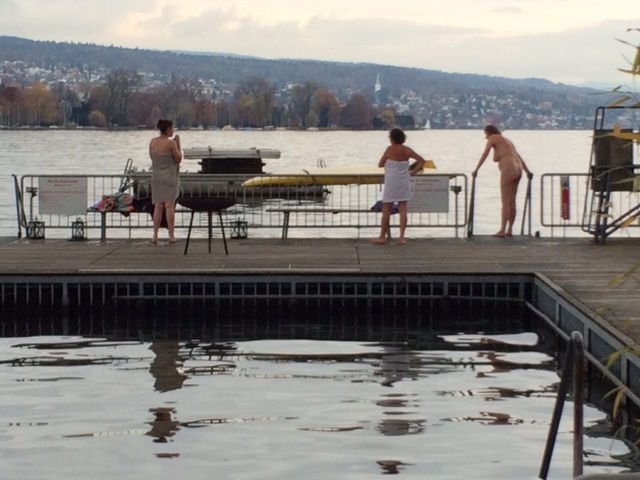
Then, saving the best for last, I headed off to the sauna in the early evening. Right on the lake with wooden decking, sun loungers and steps into the water, it was a bit like being on a boat. It even creaked.

IMG_2165

I duly stripped off, deposited my things in a locker, wrapped myself in a towel and went into one of several sauna cabins leading off a relaxation room furnished with reclining chairs and blankets. “It is gemischt (mixed) on Sundays?” I asked rather apprehensively on walking into a wall of heat and sweaty men. After a bit of good-natured teasing, I established that it was indeed a combined male and female evening, and I was not the only woman for long. It was all very relaxed and bodies were just bodies. More challenging was the recommendation that I cool down afterwards in the lake (I had had my eye on the shower on the deck). They assured me that, at 12 degrees, the water was mild for November. Mild for winter, maybe, but I wouldn’t call it mild as such! I did plunge in and it was exhilarating but a very brief immersion was all I needed to bring my body temperature down.

IMG_2166

Back on the deck – everyone clad in towels at this point – the tealights were flickering and the brazier roaring. I chatted to a lively bunch of 30- and 40-somethings about life and the universe. If we’d just had a few sausages and some prawns, we could have got a barbeque going.

Opposite the relaxation room was a quiet room with a row of futon-like single mattresses on a raised platform. The idea is to go in there, switch off, slow down and snooze in a talk-free zone. Bliss! The next day I read a fabulous quote in the German edition of Vogue – see below. Translated, it means: I don’t have time to rush. I love that even though I rushed around Europe like a mad thing!

IMG_2159

Postscript – those who read my last blog will be happy to know that Regula was happy to keep that well-travelled piece of cheese and use it in soup!!

A well travelled piece of cheese, coincidence and circular stories

(Please note all pictures at the end due to iPhone formatting challenges!).

I started writing this on the train from Budapest to Zurich (I got on in Vienna). It was good to spend all day sitting down after a hectic but happy few days! Sipping a cappuccino – I NEVER drink coffee but having burnt the candle at both ends, it seemed a good plan – I discovered a piece of blue cheese in my bag.

Rewinding to Kraków, a fellow ‘airbnber’, a lovely guy from Asturias, Spain, insisted on giving me a chunk of his favourite blue cheese – a mix of cow’s, goat’s and sheep’s milk.

He’d brought it all the way from Northern Spain and reckoned it was among the best. I’m not big on dairy usually but it was rather good if a bit rich for breakfast!

Cut to my last night in Kraków when I moved to a motel near the airport ready for my 6.25am flight to Vienna. There was no way I could get my luggage down four flights of steps (bear in mind that each flight had 24 steps with a tiled halfway landing) at 4.30am. Out of respect to the Asturian, I popped the cheese into my bag before I set off.

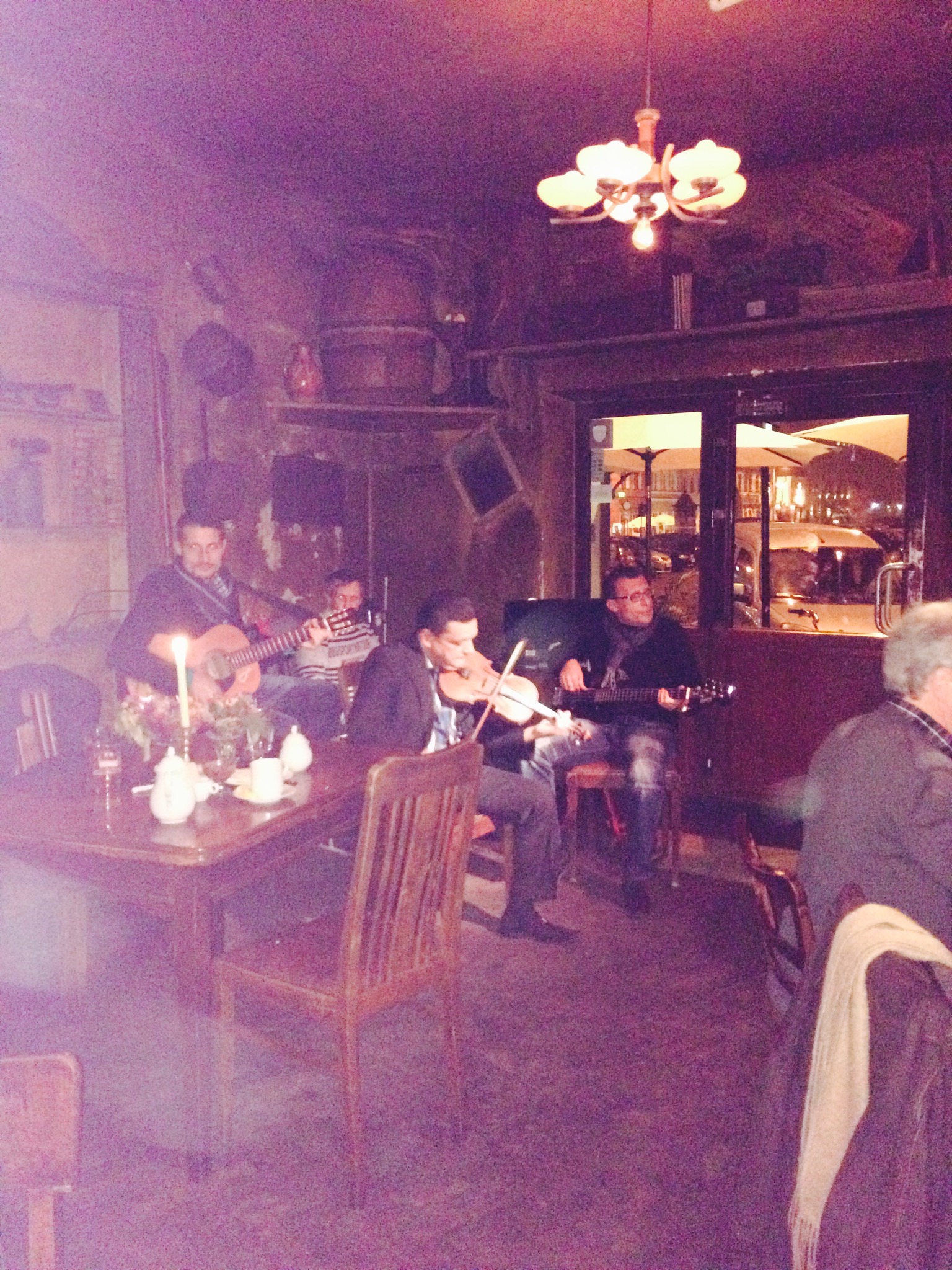
Extracting every last ounce out of my time in Kraków, my luggage, the cheese and I went to a traditional Jewish restaurant in Kazimierz to catch some Klezmer music on the way to the motel.

The restaurant called ‘Once Upon a Time in Kazimierz’ was a great find. I’d called a number earlier in the day, and not speaking Yiddish or Polish, muddled through in German and English, enough to get the name of the street.

The decor reflected the building’s history as a tailor’s shop with sewing machine tables, wedding dresses and suits hanging from the ceiling, coat hangers on the wall, boxes, shelves and leather suitcases dotted around.

One of the numbers the band played was a song I’ve sung in my choir- ‘Bei mir bist du Schoen’ by the Andrews sisters (are you reading K and R?!). So there I was foot tapping away, drinking mulled wine and feasting on duck with cranberry sauce.

A familiar looking and sounding pair walked in and sat at the table behind. An English father and daughter. Where did I know them from? Where they perhaps famous? Actors? We got into conversation and it transpired that they had taken part in a BBC historical reenactment program called Turn Back Time – The Family. It screened in Australia as well as the UK and I had seen it. Not only that, I remembered the roles they had played through the ages, pre-World War One being the toughest when they were a working class family. I was interested to hear it was pretty authentic, privations and all, apart from the emergency mobile phone (a health and safety requirement) that doubled up as a torch when visiting the outside loo!

How likely was it that they would find an Aussie fan in downtown Kraków?! Quelle coincidence! Needless to say, we found plenty to chat about and bought extra rounds of drinks which put paid to my early night.

The motel was in no man’s land surrounded by lorries, factories with pacing guard dogs and automated gates. My taxi got a bit lost but, thanks to that extra shot of raspberry vodka, (coffee, dairy and booze- what’s going on?!), I was too relaxed to worry. Of course it was all fine and, on arrival, I was greeted by an outstandingly charming woman
(customer service in Poland is not always the best) who helped me print my boarding pass for the next morning.

I was in Vienna by 10am having had 4.5 hour’s sleep. Ouch! Checking into Pension Susanne, a fabulous old-style hotel right in the centre, I realised the cheese was still in my bag! I’d somehow got rather attached to it and so put it on the windowsill to breathe. Then it was 12.30 and time for lunch at the flat of the family I au-paired for in 1982.

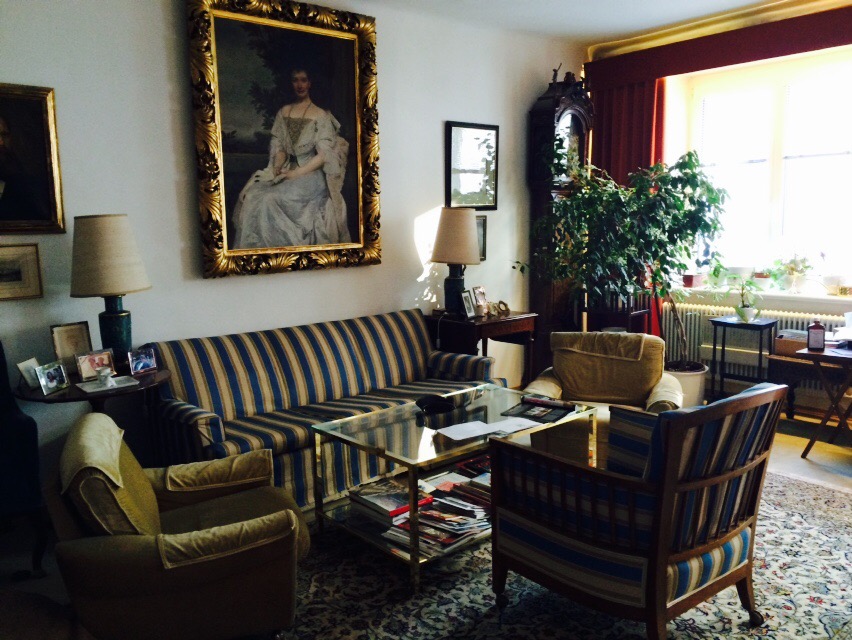
Amazingly, the father of the family still lives there and it’s hardly changed in 30 years. I could remember it all, the same ancestral oil paintings, the same dining table, the same heavy Biedermeier furniture and Louis X1V style chairs in the living room. But they couldn’t remember me!! Hardly surprising; the children were 3 and 5, they had lots of nannies and it was the mother who
took charge of everything. Sadly, she died in 2009 and Peter now lives with a carer.

I was flooded with memories of my time there, not all of them happy. I was terribly homesick back then and struggled to feel at ease with a Viennese family boasting aristocratic heritage. Suffice it to say, I walked away with mixed emotions. There’s something rather call cold and formal about Vienna in my experience.

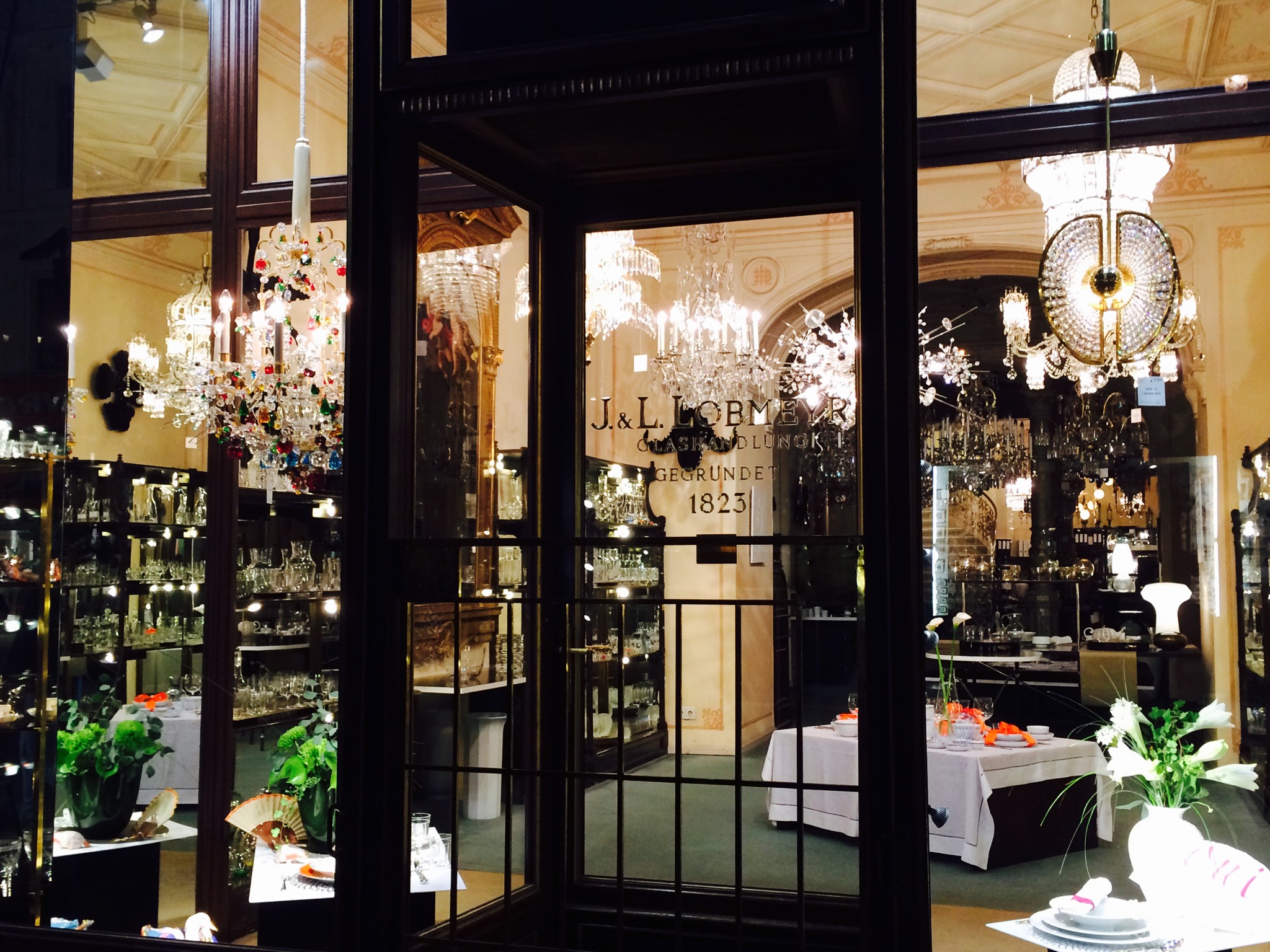
However, I broke the rather depressed spell with an afternoon stroll taking in a bit of retail therapy treating myself to a Gmundner Porzellan vase- oh God, more luggage- a mug of Gluhwein in a rather tacky Christmas market, making a short pilgrimage to the Ephrussi Palace (see my previous Ohhh Vienna post), and then marveling at some of the traditional shops, one for example devoted to chandeliers and crystal glass and one to hunting gear and dirndls. Zara and H & M, which seem to be everywhere from Kraków to Zurich, are not a patch on these old established stores.

There was just time for the briefest of naps before the opera, which was magnificent from the choreography to the singing and subtitles on little screens in front of each seat (there was nothing like that in 1982!).

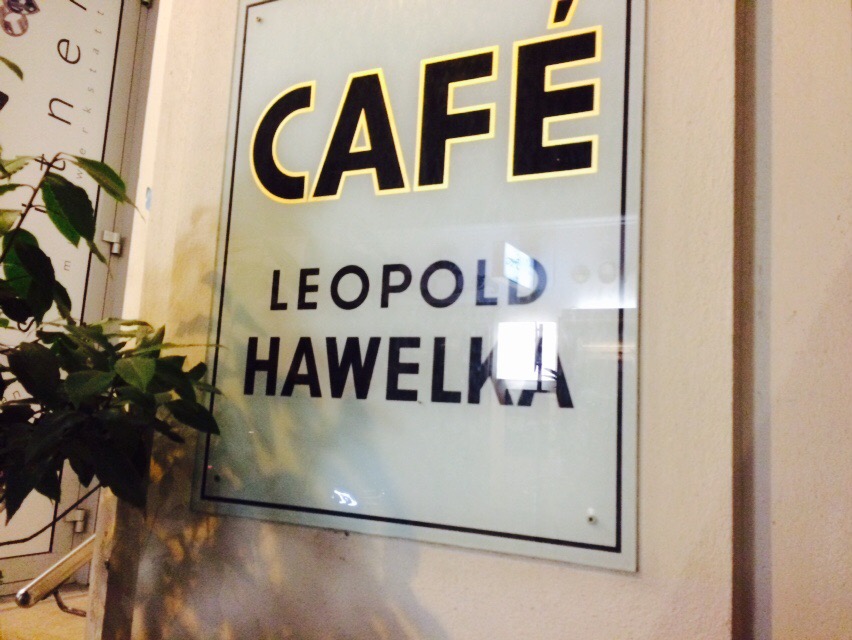
The Cunning Little Vixen is a short opera so afterwards I went to the famous Hawelka cafe near the Jewish museum. The artist Adolfo Frankl, a holocaust survivor, lived and worked there. I had come full circle – he survived Auschwitz and his story, those of other survivors and the 144 brave souls who managed to escape helps to balance the horror of the crimes committed there (I only touched on them in my blog, but they have stayed with me). What depths of emotional and physical resilience the survivors must have drawn on. I drank to them, this time in peppermint tea.

As for the cheese, it’s now in my Airbnb landlady’s fridge in Zurich! Madness, I know! It’s time for me to go offline and prepare for the long journey home. Methinks the cheese has probably gone off already! More on Zurich another time.

IMG_2065.JPG

IMG_2091.JPG

IMG_2101.JPG

IMG_2096.JPG

IMG_2051.JPG

Ohh Vienna – tra la la

I am very excited about going to Vienna. On a whim, before I left Melbourne, I wrote to the father of the family I au-paired for back in the 80s and, to my surprise, he replied by email. Sadly his wife died in 2009 but he still lives at the same address and his daughters, one of whom is married with children and one of whom is engaged, are both living in Vienna. I was in two minds whether to get in touch; looking after those girls wasn’t the easiest of gigs. But, thirty-odd years later, I’ve rather forgotten about the homesickness, the sometimes stifling routine and general stuffiness of a titled Viennese family and am left with a sense of gratitude that I had the experience – horsehair mattress, dumpling soup, tweedy relatives with leather-patched jackets and all.  I lived pretty centrally in the 10th district where all the embassies are situated and was right near the Stadt Park with its statues of Strauss, Schubert and other well-known artists. I got a bit bored endlessly playing catch or Mr. Wolf with the children, but as far as playgrounds go, this was a pretty glamorous and stylish one.

As I have written before, the family also introduced me to opera and I grew to love it. I would rush off after giving the children their tea and bath and get a standing place for just 12 Austrian Schillings. So, with just one night in this venerable city, I am treating myself to a good seat in the stalls at the Opera House.  I will be seeing Janacek’s The Cunning Little Vixen, an opera that is somewhere between a fairy tale and a folk tale. As the name suggests, Janacek was Czech and his work incorporates Moravian folk music and weaves in themes on man’s connection with nature, love, the cyclical nature of life and death and even has a bit of a socialist agenda. The Cunning Little Vixen has got all the ingredients you might expect: a forester, the forester’s buxom wife, a poacher, a cast of woodland animals including the two foxes and more.  To quote from the Welsh National Opera:

“The score contains some of Janáček’s most enchanting music. Dream sequences, the wedding march of the foxes, and the magnificent finale of ‘When evening arrives’ paint a glorious picture of the countryside Janáček loved so much.” 

There’s something magical and majestic about the Vienna Opera House. From what I recall, it’s all gold, gilt, splendour and sumptuousness with glittering lights and sweeping staircases. It belongs to a bygone era of men in top hats and ladies in fine dresses, hats and gloves, their horse and carriage waiting outside.

Talking of a bygone era, another thing on my list for my 23-hour stop in Vienna is to visit the Palais Ephrussi, one of the properties originally owned by the Ephrussi family, a wealthy Jewish banking dynasty who made their money as grain merchants in Odessa. The story of their demise at the hands of the Nazis and the fate of a family collection of 264 netsuke ( intricately carved  miniature Japanese figures made of ivory), is captured in Edmund de Waal’s brilliant family memoir The Hare with the Amber Eyes (winner of the 2010 Costa Biography Award). After the war in 1945 one of the Ephrussi family returned to find the Palais Ephrussi severely damaged but their maid, Anna, had managed to save the netsuke from the Gestapo. It’s a wonderful story and told with such grace, humility and sensitivity. The building is situated opposite the Votivkirche (church) on the Ringstrasse with its imposing, imperial-style showy buildings. The Ephrussi Palace building is now owned by Austrian Casinos so is still clearly in the business of making money!

Culture-Vulturing in Krakow

I’m getting ready to move onto Europe next week – and it’s been fun and games getting it all organised. When I ran through my travel schedule with Mum, she remarked that it seemed a bit punishing. It probably is a bit. However, living so far away in Australia, I’m hell bent on immersing myself in all things European and making the most of every minute.

The organisational challenge started with the luggage. I always vow to pack lightly and never do. To get my luggage down to Ryan Air’s strict 20kg, I’ve already crammed a jiffy bag with shoes and clothes and sent it home via sea mail, left a bag, two more pairs of shoes and other ‘stuff’ in a cupboard at Mum’s house (too bad, I will simply have to come back and get them), and promised my father that I won’t bring so much next time. Star that he is, he helped me pack, carefully protecting my bone china cups in bubble wrap and scarves. Thankfully, I am allowed 10kg of hand luggage as well but both cases are straining at the seams. No room for anything more – it’s a bit like that scene with the fat man in Monty Python’s Life of Brian – one more wafer thin mint and it would explode!

Up until now I’ve always been ultra frugal when travelling and battled around – luggage in tow – on public transport rather than take taxis. One time I stopped off in Japan on my way back to Melbourne. I flew in, jet-lagged and a bit hazy, from Manchester and got lost in Kyoto Station ending up in a beeping and flashing electronics store. I finally found the right bus, hauled on my cases and mustered the right change, but was universally unpopular with my fellow travellers who sighed, shot me angry looks and tut-tutted at the amount of space I was taking up. Even the unfailingly polite Japanese struggle to maintain their dignity in the rush hour!

My airbnb host in Krakow recommended MEGA taxis as they are apparently much cheaper than the taxis at the airport. I tried calling them but they put the phone down on me, either because they didn’t speak English or were put off by an overseas number. So we went down the road (I’m in London) to my sister’s Polish builder’s DIY shop, and his sister Annette called them for me. To cut a long story that won’t work but at least I tried!

I’ve got a magazine commission and am writing about some of Krakow’s most interesting museums. Poland’s cultural capital boasts more than 40 museums and galleries – after extensive research I whittled my hit list down to seven. Working out when to go to what museum was as complicated as organising a business trip.  Not surprisingly they are all shut on 11th November as it is Independence Day, which, I have now learnt, commemorates the anniversary of the restoration of the a Polish state ­– the Second Polish Republic in 1918.

Luckily several companies run tours to Auschwitz that day so all is not lost. The company recommended by Trip Advisor was crazily expensive making me wonder if the tour was running just for me in a stretch limo! So I rang the Tourist Information Office and found a much better deal including a free lunch.  This was more like it!

Some of the other museums on my list – I’ve chosen an eclectic mix from a stained glass workshop to a pharmacy museum, a town house, an underground archaeological museum, Schindler’s factory and more – have strange opening hours. One is only open from 12-7, one has guided tours in English on Thursdays and Saturdays at 12, others have erratic winter opening hours such as 14.00 to 15.20 and so it goes on. With a bit of luck and organisation, I should manage to see at least five out of the seven!

I’m sure I’ll get time in between all this culture-vulturing to sit in cafes and watch the world go by or catch a few notes of a Chopin drifting out of some ancient church or concert hall, peruse the markets, chat to the locals, perhaps dine in a Jewish restaurant in the old town or take advantage of whatever other opportunities come my way. I doubt I’ll be up to much nightlife; after three days of running around, my flight to Vienna leaves at 6.25 in the morning. But I’m not complaining as I’ll be in Vienna by 10am and ready for the next adventure.

Fabulous street market: Maltby Street SE1

Today my niece Georgie introduced me to one of London’s funkiest food markets. Tucked under the railway arches in Bermondsey south east London, Maltby is abuzz with artisan food producers from around the world and the crowd is hip, young and happening.

IMG_1763-3.JPG

There’s even a gin distillery- Little Bird- and an emporium selling everything from retro school desks, claw foot baths and vintage luggage to light fittings, door handles, rugs and framed Union Jacks.

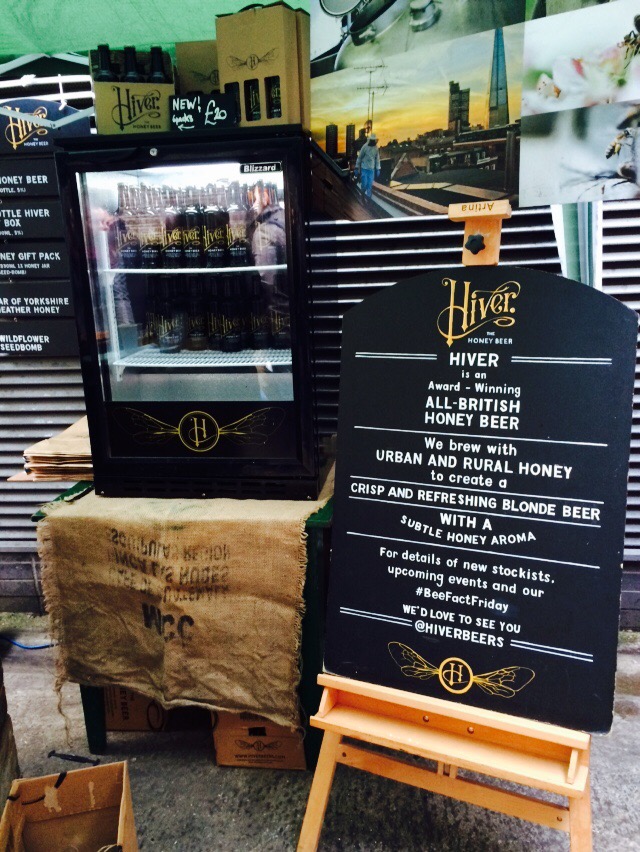
We tasted beer made with honey from local rooftop bees, succulent jamon iberico, Greek savoury pastries, cheeses, hand-cured Norwegian salmon, homemade Scotch eggs and then rounded off with chocolate truffles filled with liquid caramel. Does it get much better?!

IMG_1748-0.JPG

IMG_1766.JPG

IMG_1752-0.JPG

IMG_1759-0.JPG

IMG_1761-2.JPG<

My Cup Overfloweth

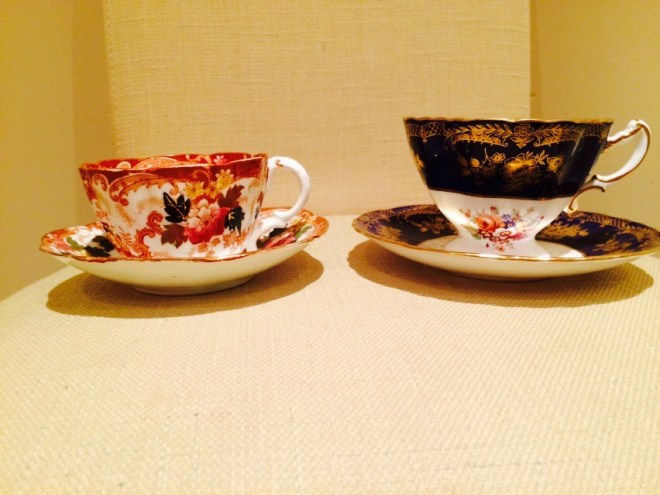
As regular readers may have picked up, I am a big fan of English china, the more antique the better, and am collecting bone china cups and saucers. Perhaps I should have gone into the antiques business or worked in a museum – or maybe I still can?! Anyway, back to the cups.

When I flew over to England a couple of weeks ago, I had hardly set foot in my mother’s house before I asked if I could take one of her Spode Mayflower tea cups back to Australia to add to my somewhat eclectic collection. Spode Mayflower is a particularly pretty with a purple floral design on the outside, red poppy-like flowers on the inside and scalloped edges – see picture – and one that takes me back to my childhood. My parents received a set of Mayflower tea and coffee cups as a wedding present in 1951.

IMG_1700.JPG

But there is a bit of a hiccough in this nostalgic reminiscing; one day in 1970-something we were expecting people to afternoon tea and the tea trolley was laid up with the silver tea pot, the Mayflower tea cups, saucers and side plates and a freshly baked Swiss roll oozing raspberry jam. My brother Tim and I were larking around playing with a bouncy ball. I don’t recall who threw it in the direction of the tea things or who dived to catch it, but one of us collided with the trolley, one of the wheels came loose and the whole thing toppled over scattering broken china, milk, sugar cubes and Swiss roll across the linoleum floor.

But I do remember that my mother was furious, and rightly so. Although we managed to salvage some of the tea cups and still have all the coffee cups, we are now down to one tea cup. Mayflower is a discontinued line but I’ve been on Google and discovered that we could order some replacement tea cups from eBay in America. Meanwhile we had my uncle and aunt for lunch on Sunday and I made chocolate pots which I served in the Mayflower coffee cups and saucers. It was so lovely to use them, cherish them and give them a bit of tlc; cups needs to be used as much as a house needs to be lived in!

IMG_1699.JPG

Mayflower aside, I’ve also found two new bone china cups to add to my collection – yes I will need lots of bubble wrap for the journey back to Melbourne – one purchased at a bric-a-brac shop in Knaresborough in Yorkshire and one in an antique shop near Darlington in Teeside. I’m hoping to find something in Poland and Zurich too, more about my travel plans in my next blog.

IMG_1708.JPG

Tearooms and Treasures

It was a fairly emotional reunion with my father after nearly two years (Mum came out to Melbourne to see me in January). He hugged me and made some jokey reference to my living in Australia, a comment that was laden with regret at being a long-distance parent. He kept on saying how lovely it was to be able to experience the real flesh and blood version of me, rather than a voice on the end of the phone.

There’s a lot less of Dad to hug nowadays; he’s had a few falls since I last saw him and is pretty frail and a bit wobbly on his feet. But he’s the proud owner of what we call a ‘pusher’, one of those Zimmer-type frames on wheels which allows him to totter off to the village shop to get the papers, and he’s still got a wonderful sense of humour, is very dapper and up to speed with what’s going on in the world.

One way we’ve bonded is over meals, so I’ve done a bit of creating in the kitchen, and one lunch time made Heston’s prawn cocktail, which went down a treat and took us down yet another memory lane; we used to go out for dinner at a local inn called the Normanton in the 70s where prawn cocktail was a firm favourite.

Midweek saw us drive over to Derbyshire to meet up with a former work colleague of Dad’s for a pub lunch in the village where I was born! It was a glorious drive along steep country lanes darkened one minute by heavy rain clouds and the next lit up by flashes of bright sun. Derek, who has recently been bereaved, worked with Dad at Whitbread East Pennines. Back then Whitbread was a brewing company but they are now a hotel and leisure chain. Dad and Derek are both in their 80s and loved reminiscing about the good old days. Derek remembers that I sometimes went to the brewery after school and did my homework in his office. Another emotional reunion!

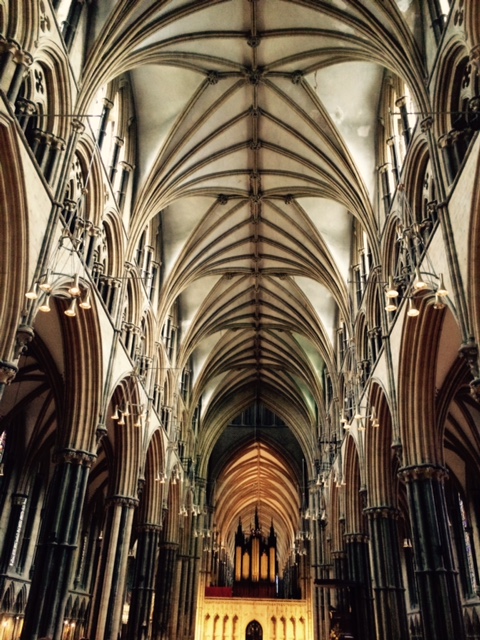
On Thursday Mum and I did a day trip by train to Lincoln. Once again it was a mild day – is this global warming or what? – and, on arrival, we walked straight along the High Street through the arches of the ancient Guildhall building and up the steep and narrow cobbled streets to the cathedral. What a climb it was.  I am so proud of Mum at 83 for managing both the distance and the gradient. Go Mum! We rewarded ourselves with a cuppa in a charming little tea room – all chiming clocks, copper kettles and timber beams – when we got to the top. As we sat down to a pot of earl grey served in Royal Albert china (the one with the roses and gold rim), I reflected that it really is the simple things in life that make me happy.

mum

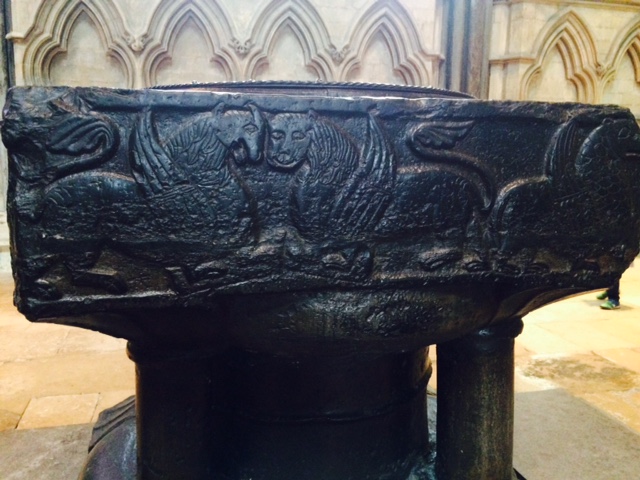
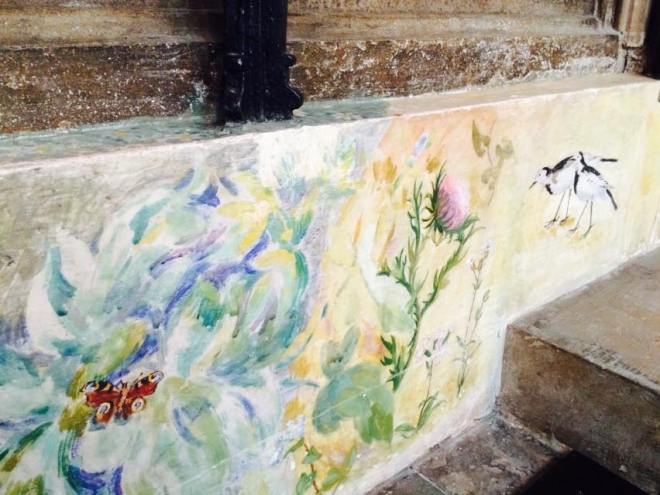
The cathedral is, in a word, magnificent. Built in the shape of a cross to mirror Christ’s journey, it’s huge, vast and magisterial with lofty vaulted ceilings directing all the attention heavenward. Commissioned by William the Conqueror (there’s also an 11th century castle nearby) in 1072 and finished around 1245, it’s a fine example of gothic architecture, and is full of treasures: a 12th century marble font adorned with mythical beasts enacting the battle between good and evil; a series of striking modern wooden carvings depicting the Stations of the Cross; St Hugh’s Choir, a church within a church where every pew and choir stall is intricately carved with figures and symbols; Eleanor of Castile’s Tomb; and in a small side chapel, a series of murals by Duncan Grant (one of the Bloomsbury set) from the 50s depicting my favourite thing, the English countryside.

FullSizeRender

Lincoln 3Lincoln 2


By lunchtime we’d worked up a good appetite and had a delicious lunch in the Wig and Mitre pub. Then we ambled back down to the train station via little boutiques and arty shops, a shambolic antique shop that smelled of cat pee and was full of curiosities but no bone china mugs! No single ones anyway, to add to my collection of non-matching English bone china mugs. The irony is that since I moved to Australia, I can’t get enough of English antiques, history or heritage! So I was delighted to find a little Toby Jug in a charity shop for the princely sum of £2.50. Then it was straight to Marks and Spencers where I got so engrossed in buying new bras that we ended up running to the station. Poor, long-suffering Mum doing  her best to keep up. But it gets worse. Platform 4A looked identical to 5A (I won’t explain why, but it did) and even had the same two carriage little chugger (my word for those small trains) ready and waiting.  So we jumped on, fairly breathless at this point. It seemed strange that it didn’t leave on time. Then a man got on and asked if the train was going to Newark and when his fellow passengers nodded, I suddenly realised our (my) error. We were up and off the train in seconds, only to find our train had left three minutes ago. Mum was very good about it. Luckily we only had an hour to wait till the next train. Better than ending up in Newark though. I got Mum a cup of tea at the station cafe and dashed back to Marks and Spencer’s. Any opportunity…

The hour passed very quickly but I was back in time to get the right train equipped with several new bras, one Toby Jug and sweet, sweet memories of a fabulous day of all that Blighty does best.

I will leave you with a picture of a section of Duncan Grant’s fabulous mural:

Duncan Grant Mural

Back in Blighty

Well, I made it over here in one piece. The flight was LONG as it always is but I stuck to my plan of seeing it as a mini holiday. The food was pretty mediocre but I watched three films, a light Spanish comedy, Ocho Apellidos Vascos, Words and Pictures, a rather hard work film with Clive Owen and Juliette Binoche, and The Grand Budapest Hotel, which I loved. I also continued to read Slipstream, Elizabeth Jane Howards’s autobiography. Howard, who died recently, was an author married to the naturalist Peter Scott and then, latterly, after multiple affairs with married men, to Kingsley Amis. The book is full of encounters with literary figures, artists, playwrights and the like – from Charlie Chaplin, Laurie Lee, John Betjeman, Laurens Van der Post, members of the royal family and other glitterati. The rest of the time I slept and dozed and longed to lie down. I’m normally very organised but had run around all day like a mad thing only taking Bertie to the dog sitter a few hours before I was due to leave so I was still watering my lemon tree and washing up when the taxi came. No wonder I felt a bit tense and stiff by the time I got on the plane!

I’m now back in Nottinghamshire, the county we’ve all heard of thanks to the forest-dwelling tax evader, Robin, he of the Hoodie, with my parents. I did spend some of my childhood years in Nottinghamshire, but I don’t feel any particular allegiance to it or that it’s what the Spanish call ‘mi tierra’, which, literally translated, means my homeland or my country, but on a deeper level conveys a sense of soul connection with a place.

I flew into Manchester airport, where Eddie from Mum’s village met me, along with his dear little dog Scruffy who was rescued from a Spanish village. We travelled over the Pennines (following at one point the Tour de France route) passing through wild expanses of moorland cloaked in bracken and heather, now turning brown and gold as autumn moves into winter. It was unseasonably mild and sunny and the trees look magnificent in shades of russet, copper and gold. We passed through tiny villages with names such as Tintwhistle and Stone and past fields bordered by hedgerows and dry stone walls. I’d forgotten about hedges but now I’ve seen and remembered them, I realise how much I’ve missed them! Hedges are havens for wildlife – according to the Royal Society of the Protection of Birds, Hedges may support up to 80% of British woodland birds, 50% of British mammals and 30% of butterflies.

A good native hedgerow is made up of a mix of plants such as Hawthorn, Blackthorn, Crab apple, Guelder rose, Dog rose, Wild privet, Honey suckle, Hazel, Field maple and Holly. As a child I used to look for birds’ nests in the hedges and watch the parents flying in and out until the babies flew. Even in my mother’s garden we get a great selection of birds; this morning we saw goldfinches, blue tits, robins and green finches all darting around on her bird feeders. Although Australia has a rich diversity of birds, I only seem to get mynas, an introduced species, wattle birds (they can be very noisy too) and pigeons in my Melbourne suburban garden.

Much as I love Australia, the life I have created there and all my wonderful friends, I really miss the British countryside. It’s definitely mi tierra, my spiritual home. There’s something about the soft, green, gently rolling landscape that gets under my skin; it reminds me of family walks on Sunday afternoons, picnics by rivers, bike rides along country lanes, village fetes with tombolas and teas and long summer evenings when it’s light till ten o’clock.

I read an article a few years back about Sidney Nolan who moved to England in 1955 and then to the borders of Wales where he settled in 1983. He painted Australian landscapes from afar, but also travelled widely outside Europe to Africa, China and Antarctica, returning regularly to Australia to connect with the quality of light and the shape of the trees. When people talk of homesickness, perhaps what they are really getting at is a yearning for the topography of their native country. Every time I return to English I feel like doing a Pope John Paul II and kissing the ground.

I have very intermittent internet access and so am writing this from the library in Retford near where my mother lives. It’s a small market town, worlds apart from Melbourne in every way, but I’m rather fond of it. There are no shops to speak of – not even a Marks and Spencers – but there is a great little market on Thursdays and Saturdays. On Saturday I bought a wonderful 1950s style cloche hat with a flower on the front ready for Krakow and Zurich, and a red leather collar for Bertie. The hat cost just £10 and the collar £3.50; everything seems much cheaper here. My brother tells me that the cost of living is indeed higher in Australia but so are wages. Not mine, I fear! Next time I come over I’m going to bring an empty suitcase and load up with goodies.