Feeding my inner European

When I got back from Europe in September last year, I went through my usual grieving process: one minute I was walking round Goethe’s house and sipping tea in a chandelier-bedecked café in Frankfurt and, seemingly the next, I was in a yellow cab in Melbourne on my way home, Dave Hughes’ unmistakeably strident tones issuing forth from the radio, the front page of the Herald Sun screaming all things footy and, outside, Beach Road fringed with palm trees.

It’s always a bit of a wrench going from one world to the other, from my former, still parallel life in England were I ever to reclaim it, to my ‘new’ life here. A bit like those early settlers I read about in the Tasmanian Museum and Art Gallery, I have held onto bits and pieces from my original home and country as part of the re-settling process here. But at what stage does the new life cease to be new?

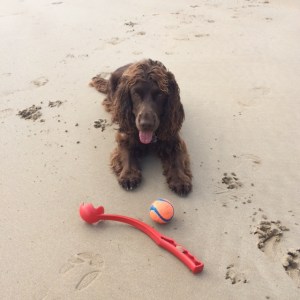
I think, in my case, it’s probably already happened. And any newness is simply a figure of speech and a way of distinguishing my life before and after my move to Australia. I’ve now lived in my Bayside suburb for twelve years – the longest I have ever lived in one place – and it does feel like home. Apart from putting my own stamp on my house and garden, getting a dog really helped me to put down roots. I’ve got to know many people and their pooches on our daily walks on the beach or in the park, and that has created a sense of community and belonging. Bertie and I are part of the local landscape and we blend in. And we’re getting used to summer being in winter and winter being in summer.

Last time I got back to Australia and was still battling the pull-push of Europe versus the Antipodes, a friend suggested I found ways to honour my inner Brit and European. Because it doesn’t have to be an either-or situation. I have, after all, chosen to live in the most European of Australia’s cities. Since then, whether consciously or subconsciously, I’ve been finding ways to stay tuned – literally – to Europe and, as a modern language graduate, to rediscover my languages. I started by joining a German Meetup Group. So far I’ve been to a fascinating film about Techno Music in Berlin in the 80s and to a Stammtisch (an informal gathering at a bar) at the Bavarian-styled Hophaus on the Southbank. And I’ve found German cuisine in the most unlikely places. Das Kaffeehaus in Castlemaine is a Viennese café complete with red leather banquettes, gilt-framed mirrors and chandeliers housed in a former carpet factory. I spent five months in Vienna as an au-pair girl when I was 18, and I can vouch for the authenticity of the food – think Wiener sausages, schnitzel, goulash and sweet favourites such as Linzer Torte and apple strudel.

IMG_3376

Then there’s SBS Radio and Television, a hotline to all things multicultural and multilingual. I have downloaded the Radio App and sometimes listen to Spanish news or I download the German Radio podcasts which deliver newsy and interesting items in easily digested 10-minute bites. Listening to the spoken language, its rhythms and cadences awakens dormant neural pathways and I start to remember words, phrases and expressions. Like old friends they flood back with a welcome familiarity. Tunein Radio has been another wonderful discovery; the app allows you to listen live to different talk shows and music stations from all over the world.

I love foreign language films and letting myself be transported to wherever it is. This past weekend I saw two excellent Spanish films (a rom-com set in Madrid and a quirky Mexican road movie) as part of the Spanish Film Festival. We have an embarrassment of riches when it comes to foreign language film festivals in Melbourne – French, Spanish, German, Greek, Turkish, Israeli, Russian and Latin American to name but a few, and even, last year, a BBC First British film festival showing golden oldies as well as new releases.

And that’s not all. Palace Cinemas screen productions filmed live in HD from London’s Royal Opera House, La Scala, Opera Roma and the Opéra National de Paris as well as some of the best performances from the British Stage as part of the National Theatre Live program. Whoever first thought of sharing these live-filmed productions globally is a genius.

So far I’ve seen heartthrob Benedict Cumberbatch in Hamlet and Royal Opera House productions of the Marriage of Figaro and La Bohème. The joy of these performances is that you get the equivalent of front row seats for a mere $20 or so and, in the case of the operas, you can read the subtitles and follow the plot with ease. Not only that, each performance is introduced by a well-known actor and he or she goes backstage and interviews the director and actors or singers. My favourite so far has been John Copley’s production of La Bohème. Originally intended to run for a few seasons in 1947, it stayed in the repertoire for forty years, the 2015 filmed performance being the last ever.

The weekend before last a friend treated me to a surprise night out. It turned out to be the BBC Proms – the Last Night no less. Echoing the UK’s Albert Hall tradition, the program on the last night includes sea shanties and jingoistic numbers such as Rule Britannia and Elgar’s Jerusalem. It felt a bit strange sitting in an auditorium in Melbourne waving a dual English/Australian flag and belting out songs about Britain ruling the waves. I reflected that there are certain things you can’t export – it all becomes a bit ersatz. There’s a time and a place to celebrate your heritage and a time and a place to adhere to the old saying: When in Rome, do as the Romans.

IMG_3888

At Home in Hobart

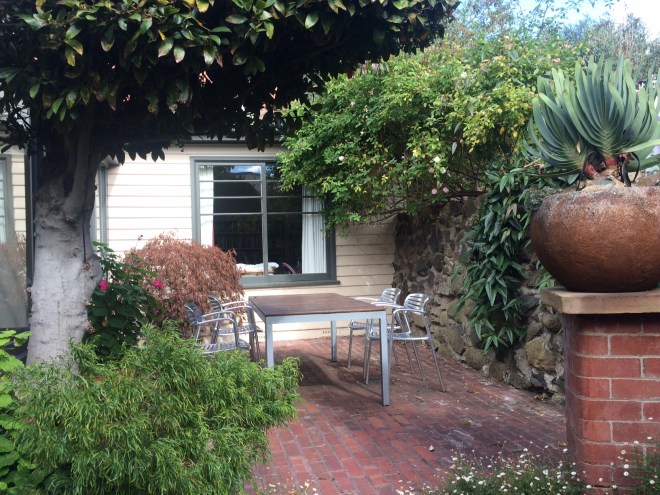
Last week I was in Hobart for work, to run a grant-seeking workshop and meet with a few clients, and I stayed on for a couple of days afterwards. For three out of the four nights I stayed in a delightful studio which I found on Airbnb. Situated at the back of a beautiful period home just 10-15 minutes’ walk from the city centre, it was attached to the main house but had its own entrance reached via a red brick path. But for the bay window (which reminded me of my Oxford terraced house) overhanging the sandstone wall on the street side, you might not notice that there’s a house tucked away up there. Even the wooden lattice gate and steps up to the house are enveloped in a tunnel of foliage.

incognito house

tunnel of green

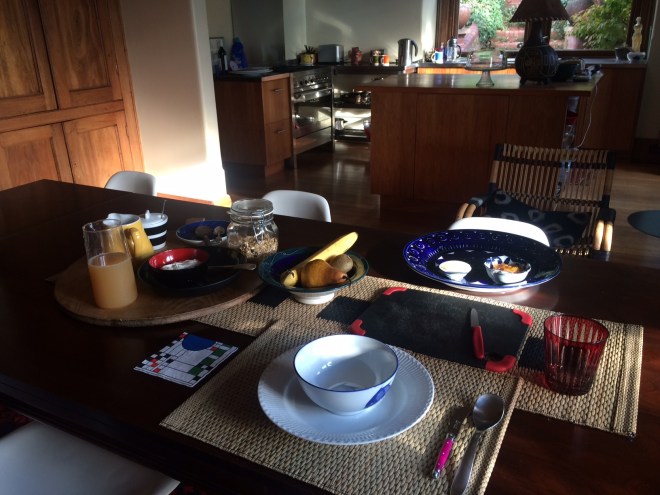
It was fun working in a different space and looking out on a sun-filled courtyard planted with a bay tree, clematis armandii, weeping Japanese maple trees, succulents and geraniums. My charming host, Bruce, is an architect who relocated from Sydney. What made the stay particularly special was the delicious breakfast he prepared every morning. There was something flavour-enhancing about the blue and white china, the yellow milk jug, the red bowl full of creamy white yoghurt, the black and white striped sugar bowl and the Mondrian napkins. What a joy it was to enjoy a slow and convivial breakfast; Bruce and I talked about everything from politics to arts, books, music and travel. The simple elegance of the breakfast table was echoed throughout the house with its dark green shutters, stained glass panels flanking the front door, polished boards and floor rugs.

Garden view two

breakfast

Having visited MONA – the Museum of Old and New Art – on a previous visit, this time I went to the Tasmanian Museum and Art Gallery, where I explored the section covering the arrival of the early settlers who brought with them their ideas of order and post industrial revolution ‘enlightenment’, not to mention animals, plants, trees, insects, salmon and trout eggs, furniture, china, silver and glassware. How strange it must have been moving to the other side of the world in the days before air travel and fast communications. One of the exhibit captions really sums up the experience: “The swans were black, not white. The trees shed their bark but kept their leaves. The seasons were reversed. European settlers in Van Diemen’s Land viewed the new world they encountered with amazement and wonder. They called It ‘The Antipodes” – the name means ‘direct opposite’.

The top floor documents the Aboriginal genocide (with ‘Bugger Off’ you white fellas translated into the native language) and the fear, ignorance and savagery of the colonialists. What I found most confronting is that one of the tribes was completely wiped out and so will never be able to tell their story. On a brighter note, the exhibition does at least acknowledge the atrocities, and Aboriginal people from the community had a hand in developing the space.

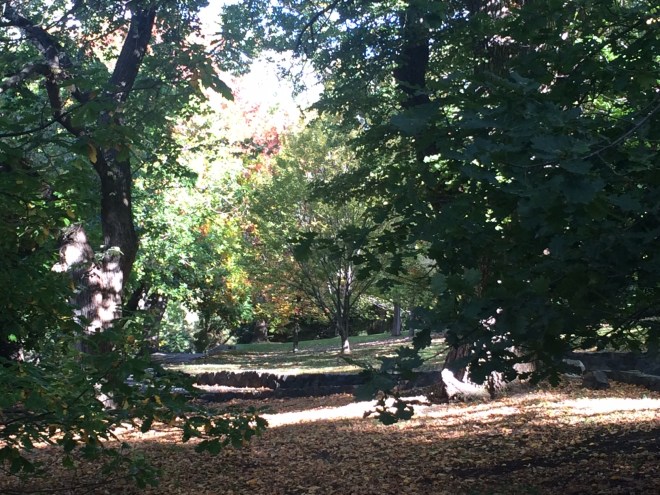
I got chatting to a couple in the gallery café and told them I was heading to the Botanic Gardens. Before I knew it they were giving me a lift – thank you Ray and Anne! It was lunchtime when I got to the gardens and I headed straight to the restaurant where I secured a table on the balcony with glorious views over the Derwent Estuary and hills beyond. After lunch I strolled through the gardens in the soft autumn sunshine through the fernery to the lily pond and onto the oak woodland, no doubt planted to remind the colonialists of the Mother Land. Here, briefly, I was back in the land of deciduous trees and the snap of fallen leaves underfoot, the dappled light through branches and the musty smell of leaf mould was so evocative of England that I felt tears pricking my eyes. A few steps on and I was back to the Antipodes in eucalypt woodland watching fairy wrens foraging on the ground for food.

Botanic gdn view

oak trees

That afternoon I headed up to North Hobart to the State Cinema where I got chatting to a woman who was seeing the same film, Rams, a wonderful tale of sheep rearing and sibling rivalry set in Iceland. We shared one of the comfy leather sofas and laughed and cried our way through the film. She insisted on giving me a lift back to my lodgings afterwards. What is it about Tasmanians and friendliness? Perhaps it comes from living on a small island where the pace is slower and people have more time to chat?

Dinner that night was a $12 steak at the Irish pub down the road. It was delicious and easy, and, as with everywhere I chose to eat, dining solo felt very relaxed and I escaped away to Southern Ireland care of my Kindle and Colm Tobin’s (of Brooklyn fame) novel Nora Webster.

After a quick peek at the Salamanca Markets on Saturday, my last day, I headed back to the Art Gallery to see a wonderful exhibition documenting the experience of migrant women, mostly from Britain and Europe, who moved to Tasmania between 1945 and 1975. What I loved most were the re-created interiors showing how the women maintained a connection with their homeland and customs through food, fabrics and costumes, books, religious icons, photographs and paintings. Before the days of email photographs documenting important events and milestones were sent to relatives back in the homeland, even – particularly for Catholic families – mourning photos showing the deceased person. Whether consciously or sub-consciously, many of us more recent migrants still hold onto keepsakes, furniture, china, treasured objects and items of pure sentimental value that connect us to our heritage. My house certainly has an English cottage feel about it.

museum interior

One of our clients at work is the Tasmanian Symphony Orchestra and I was able to attend one of their matinees on Saturday. Cleverly titled Bach to the Future, the concert featured works by Haydn, Bach, Mozart and Barber. But, for me, the most heart-soaringly beautiful piece was variations on Bach and Mendelssohn by Elena Kats-Chernin and other artists with Genevieve Lacey on recorder and clarinet. My only experience of the recorder being at school when it was invariably squeaky, never have I heard it played with such dexterity and clarity. The ‘Re-Inventions’ were interspersed with choral movements from Bach’s St Matthew Passion and Mendelssohn’s Elijah. Creating an evensong feel, the choir sang by torchlight up in the roof space and the whole thing was sublime. When I turned on the car radio back in Melbourne on Sunday, they were playing a recording of the very same concert. Spooky or what?

Before heading to the airport, I had a final cuppa in the café at the Grand Chancellor Hotel (where I had left my luggage) looking out over the water. Ah, Hobart, you’ve treated me well. Can I come back again soon?

Princely gardens, barmen and baggage

My mother loves the Royal Family and is fascinated by them. From all she’s read, observed and seen I think she thinks she knows them. I’m quite happy to join in. When I got to England in August she’d recorded a documentary and saved it for us to watch together. Prince Philip: The Plot to Make a King made fascinating viewing and started with his family’s flight from Greece in revolution when he was just a baby. Funnily enough, the same program screened recently here in Australia on SBS. Anyway, the reason I say all this is that it referred to a country residence owned by his German relatives, Wolfsgarten near Frankfurt, where he would sometimes spend the summer holidays.

My ears pricked up as I was due to stop in Frankfurt on the way back to Australia. A Google search revealed that the gardens at Wolfsgarten open twice a year, and, as luck would have it, my trip coincided with the autumn weekend, the Fuerstliche Gartenfest (Princely Garden Festival).

So it was that on a glorious autumn day in September – blue skies and temperatures in the low 20s – I found myself in the gardens of a former hunting lodge tucked away in the woods in Langen, just outside Frankfurt. I had envisaged an open garden but it turned out to be a garden design and outdoor living expo with stalls selling everything from garden furniture, plants and ornaments to hats, scarves, food and wine.

hats

In the old orchard, amid ancient pear and apple trees, I stopped to admire a jumble of retro galvanised metal watering cans and enamelware. Then I came across a table laid out with heritage apple varieties in all their mismatched, variously coloured, un-waxed,un-polished, irregular glory.

2015-09-18 11.10.37

heritage apples

Strolling on through a courtyard and past a large imperial-style fountain, I came to the Japanese garden, an oasis of calm with Monet-like water lilies floating on the surface of the lake amid shimmering reflections of acers and willow trees. Another favourite place was the old half-covered swimming pool where a flower arranging competition was in full flow. And we’re not talking church rota type arrangements but lavish and exotic sculptures.

Jap Garden

A bed of dahlias in reds, yellows and oranges (the theme of the show was ‘flammende Gaerten’ meaning flaming gardens, as in warm and hot colours) reminded me that, yes, it was autumn here even if I was days away from returning to spring in Australia.

Lots of stalls were selling edible treats: I sampled truffle-infused honey; salt infused with cornflower petals; variously aged Gruyere cheeses; and baked apple chips on offer at a wholefood store where a lean, lanky guy with sandals and a beard (a cliché but true) was promoting the nutritional benefits with evangelical enthusiasm. With the rigorous Australian customs regulations in mind, I decided against buying the honey and the apples but did get some of the salt. It’s blue and turns my scrambled eggs green! Other treasures I would have loved to bring back include a pink-painted ladder and an Ark-like collection of brightly painted animals.

2015-09-18 13.23.52

2015-09-18 13.30.26

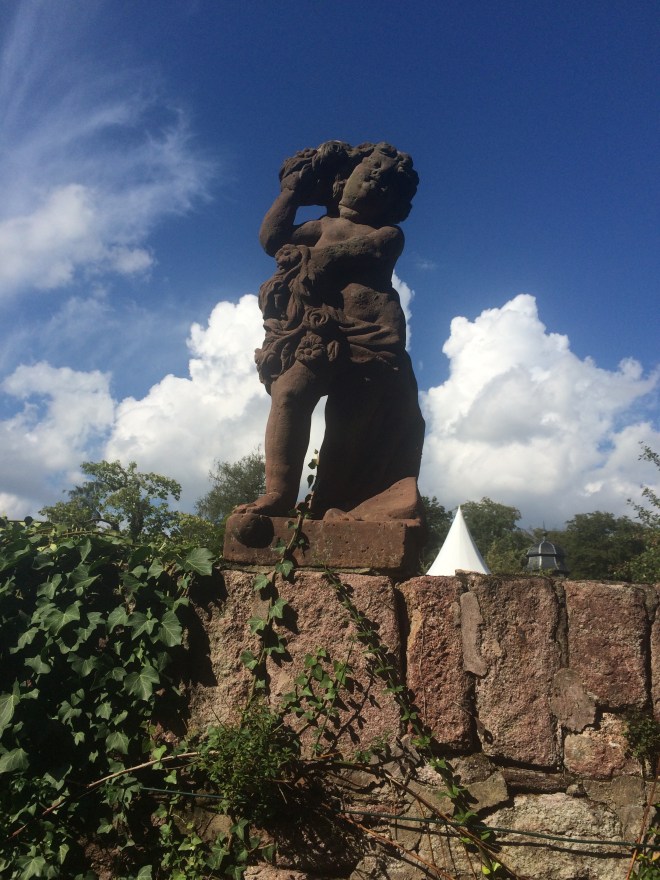
Wandering around, I listened to a string quartet, ate my home-made picnic (smuggled out of the hotel breakfast bar), supped on mint tea at one of the many stalls selling Moroccan sweetmeats and got chatting to a like-minded local woman in a courtyard where cheeky putti angels sat atop the garden walls.

2015-09-18 14.40.31
Wolfsgarten is surrounded by woodland – there’s something special about German forests that goes beyond Black Forest Gateau fame; in fact I spotted a red squirrel (a rare thing since the introduced greys have taken over) on my way to the station – and was a very special find. I felt a deep wave of happiness walking round the gardens and a renewed love for Europe, its history, languages and culture.

Another bonus was that the hotel where I was staying was just three stops away from Wolfsgarten. Searching for something affordable yet elegant, I remembered Hotel Wessinger from the 90s when I went to Frankfurt for the International Book Fair as part of my job The Wessinger was good then – small and family run with its own chocolate shop and patisserie – but it’s recently been renovated and now has a fabulous pool and spa, which I made good use of.

2015-09-18 09.48.52

After cheap guesthouses and/or Airbnb places the last few trips, it was a treat, and I ate in the excellent restaurant every night. I also had a drink in the bar, a cosy place suited to tea with your aunt or a drink with a business colleague, two of the nights. I wheeled out my best German for the barman only to discover he was Irish, and flirty at that. Calling me young lady, he assured me I was only as young as the man I was currently feeling. Had that been the case, it would have taken about twenty years off me; I discovered he was a mere whippersnapper born in the 80s. On my last night he asked what my plans were for the evening and was most insistent that I join him for a nightcap, adding that he would be around till 1 a.m. Flattered as I was (golly, can I still pull?!), he was a bit of a lush and I preferred to save my energy for shopping at the flea market the next day.

As well as the flea market, I explored the arty/studenty area of Sachsenhausen and had fun browsing in a olde worlde crime fiction bookshop with a spiral staircase. I bought a few books but restricted myself to avoid excess luggage. I asked the ladies in the shop if baggage in the German language can mean emotional as well as physical baggage. I told them I was writing a humorous, warts ‘n’ all memoir, formerly an A-Z. We came up with a good opening line: Charlotte always had so much baggage…

Wendeltreppe

The baggage problem became a self-fulfilling prophecy after the flea market and I had to cram my cases to the gills! I’m always a bit sad to leave Europe so like to buy up a few souvenirs – that’s my excuse anyway!

Bird, Beaches and Balmain

I started writing this post at the weekend sitting outside on the deck surrounded by subtropical rainforest with a soundtrack of bellbirds, whip birds, scrub wrens, finches, kookaburras, catbirds and yellow-tailed black cockatoos echoing around me. I was staying with my friend Nicki, who moved from Melbourne to the New South Wales (NSW) Central Coast earlier this year, for the Australia Day weekend.

Having been in Melbourne all over Christmas and New Year I was more than ready to get away, and NSW very much delivered. Nicki had an unexpected family commitment in Sydney on my first day and offered me the choice of staying home with her delightfully playful and engaging young cat, Maya, or catching a ride into the city. I decided to go into Sydney but wasn’t up for touristy stuff, crowds, shopping centres or sightseeing.

Maya

Maya

I just wanted wander without any fixed agenda. Nicki used to live in Balmain and suggested that it could be a good place to nose around. It sounded suitably village-y so I took the ferry (‘ticking off’ – from the relaxed distance of the boat – a few of Sydney’s iconic landmarks on the way) and got off at East Balmain.
I’d only walked a short distance up Darling Street when I found a small shop called Home Industry selling vintage items, linens, glassware, china, soft furnishings and cotton reels in jars. I bought a non-vintage, but charming, small white bowl with an embossed dragonfly on the rim – it’s already in use as a butter dish – and got chatting to the two sisters who run the business about cushion cover sizes. As you do…

Further up the hill I came to St. Andrew’s Church where there’s a weekly market. I browsed bric-a-brac and jewellery and then spotted a Chinese massage stall. Something to do with the early start the day before and Jetstar failing to get my luggage on the right plane had left me with a cracking headache. I negotiated $15 for a head and shoulders massage and the guy worked wonders, pinpointing the areas of tension and hammering away at the knots.

Feeling clearer and lighter I walked on to a café where I enjoyed an extended cup of tea and the papers. I got chatting to a few people, even a good-looking man, but it started to spit with rain (it’s hair-curlingly damp in NSW this summer) so it was time to move on. Part of the fun of hanging out in an unknown area is observing people, their houses, gardens, kids and everyday comings and goings.

Balmain was once a working class suburb and home to coal mines, shipbuilding, metal foundries, boiler making and soap factories. The tiny cottages lining many of the streets were originally built for the workers. Now, of course, it’s undergone a process of gentrification – hence the smartly groomed samoyeds and standard poodles walking head-in-the-air with their owners and the boutique-style shops, but I’m happy to say that it’s retained its soul and character.

I browsed a few shops and ended up buying a hand-made damask duvet cover with matching pillow cases in a knock-down sale in a pop-up shop. At only $70 including postage to Melbourne, it was an irresistible bargain. In a men’s clothing store, I got some ‘designer’ shaving balm as a birthday present for my brother, and then met Nicki for lunch at a wholefood emporium called About Life, a wonderfully earthy place with a sustainable/paleo focus. We had planned to visit the Brett Whiteley studios in Surry Hills but it got too late. Next time. Less is more.

We picked Sunday, the only totally rain-free day of the four days, to go to Pearl Beach. We walked from one end of the beach to the other looking out over northern Sydney and Pittwater Basin. We tapped back into that slow, leisurely holiday vibe and swam, sunbathed and read the papers watching pelicans flying overhead.

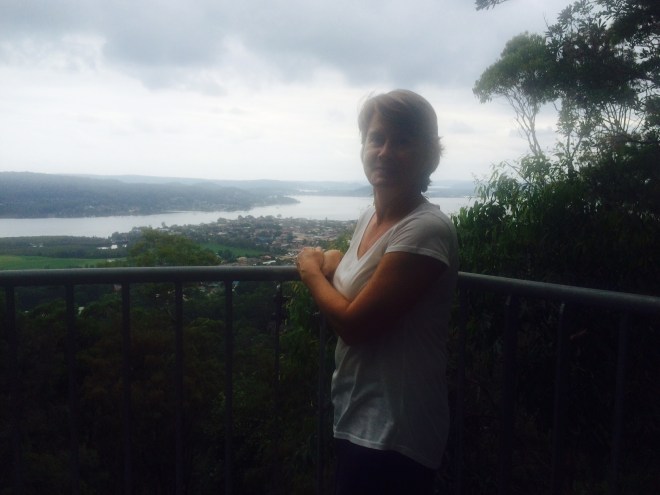
Dodging the rain, we managed a couple of bushwalks over the weekend too. We got a bit lost on one of them and negotiated a steep slope by slithering down on our bottoms, collecting a few leeches in the process. Like sticky, super-glue sticky slugs, leeches cling to your skin or shoes and take some prizing off. Yuk! On another walk we laughed at a laryngitic-sounding kookaburra surveying his territory, as we enjoyed views out over Brisbane Water.

Nicki looking out over Brisbane Water

Nicki looking out over Brisbane Water

In between bushwalks and outings I enjoyed reading on the deck with Maya cuddled up close by. I started Ruby Wax’s A Mindfulness Guide for the Frazzled while, for once, feeling anything but. In her inimitable humour and with soul-baring honesty she explains really clearly what mindless rushing around and constant multi-tasking does to our bodies, brains and neural pathways. I decided to follow her 6-week program and started then and there by attuning all my senses to the birdsong on Nicki’s deck. Let’s see what happens when life speeds up again back in the Metropolis and world of work!
FullSizeRender.jpg

Hoovering, holidays and tents

Even though I returned to work on 4th January, I’m still tapping into the holiday vibe as much as I can. There’s such a frenzied build up to Christmas Day and a pressure to get everything done that I’ve begun to really cherish the peace that comes afterwards when everything and everyone calms down.

Two months into a new job, this year’s yuletide season proved quite a marathon. My workload started to intensify at the end of November and, from the beginning of December, life became a seamless blur of grant-writing and deadlines, social stuff, choir rehearsals and practising new songs (I’ve joined a smaller choir and we did a couple of pre-Christmas performances), putting on a garage sale, co-hosting my first dinner party for about two years – typically, it turned out to be the night (a late night) before two morning choir gigs, one of them in an aged care facility. What joy it was to sing (even if I was a bit post party croaky) new versions of old favourites such as Away in A Manger and Silent Night to the oldies.

Deck the Halls...

Deck the Halls…

The week before Christmas I went up to Brisbane for a couple of days of work and play. After a day and half of strategizing followed by a long and lavish staff Christmas lunch, I raced off to the Powerhouse to see a show by Cocoloco, a madcap duo consisting of a university friend from Bristol and her Australian husband.

IMG_3237

I spent my last day wandering round GOMA – the Gallery of Modern Art – before squeezing in another show at the Powerhouse, having a quick chat with Helen and Trevor, and then travelling straight to the airport from there. It’d all been fun but exhausting and I had a sense of humour failure when I got stopped in security because the funky fish-shaped corkscrew I had bought for my nephew had a foil-cutting knife on it. What?! I’d been in too much of a whirl to notice. Amazingly, I was allowed to go back out to the Qantas desk and post it back to myself. Even more amazingly, it arrived in time to go under the tree!

I got home late the Saturday before Christmas and on route to a lovely Christmas lunch the next day, I managed to hit my head on a shelf, drop a bowl I was given for my 21st and then scrape my car along my carport wall. Not a good look, any of it! Things continued apace until Christmas Eve when I spent all day cooking two complicated desserts (and this from the woman who is 90% sugar free) to take to my brother’s. Dinner was at 7 p.m. and at 6.30 p.m. I was still hoovering and mopping the kitchen floor. I just couldn’t bear to leave it dirty; Christmas, for me, is also a time for renewal and reflection and I didn’t want to kick off with a crumb- and dog-hair-strewn floor.

Talking of hoovering – it’s not just the Brits, some Kiwis also talk of hoovering – reminds me of my trip back to the UK in August. My hoover is a Sebo (yes, I know that’s like saying my Mazda is a Toyota), a German make, which travelled the seas with me from England in 2004. It could probably do with a complete overhaul but my mission in England was to track down a spare part. Now the small market town in Nottinghamshire where my mother lives is no retail Mecca – at best, you’ll find Dorothy Perkins, Primark and Poundland, but it is exactly the place to find a store specialising in vacuum cleaners. Near the train station, in a residential street, is a shop that looks just like the one in the BBC show Open All Hours with Arkwright and Granville. https://www.youtube.com/watch?v=4mTxaK1AHMc

The shop is delightfully cluttered, dusty (don’t think they ever hoover it) and a bit dark. Somehow it’s escaped the digital age completely and there’s not even a computer anywhere in sight. An older man in brown overalls (Arkwright without the stutter) explained that the shop started life in 1946 when his father was one of the first approved Hoover dealers in the area. He, in turn, now works alongside his son who will inherit the business. Helpful as they were, they didn’t have the spare part I needed – my Sebo is now so old as to be obsolete. However, visiting the shop was quite an experience. As we were leaving, a curious-looking man with a pot belly, lank, dyed blond hair and a generally dishevelled appearance strolled in and greeted us with a rather affected and effeminate “Helloooo!” The son explained it was his brother and quickly ushered him next door to a rather run-down house. All I can say is that if this bloke wasn’t the inspiration for Little Britain’s “Only Gay in the Village” sketch I don’t know who is.

Anyway, back to the Christmas holidays – once I had farewelled English and interstate visitors on the 28th, I sat in the garden with my feet up and got stuck into a fabulous novel about a Special Operations Executive parachuted into France as a spy in World War II. But the real hero of the holiday was a sun shelter tent lent to me by friends. I feel so blessed to live near the beach and really made the most of it. There’s something magical and healing about swimming in salt water and then lying on warm sand and sculpting it to your body shape. It’s as good as a massage. Without phone calls, emails, chatter and the normal day to day stuff, it was pure bliss and the tent meant I could stay for longer and not get burnt. Just me, the birds, the waves, the wind, the sun and the sea.

All the World is a Tent

All the World is a Tent

I even let myself off the hoovering – well almost. All that time on the beach – whether alone in my tent or walking Bertie adds up to quite a few grains of sand on the floor…

Bertie sporting sand and salt sculpted hair...

Bertie sporting sand and salt sculpted hair…

Chocolate, choc-a-bloc living and computerised cleaning

On Saturday afternoon I found myself grating chocolate – a jaw-clenchingly fiddly activity – for a chocolate pâté I was making. Yes, you read that correctly; chocolate pâté. It was an everything-free recipe (as in no gluten, refined sugar or dairy) I had cut out of a magazine over a year ago. Made in a loaf tin from a mixture of organic cacao powder, walnuts (soaked overnight to remove enzyme inhibitors – so the recipe said), maple syrup, tahini, grated chocolate and pure vanilla extract, it was actually very good – especially when garnished with berries – if very rich.

But I don’t recommend grating chocolate as a relaxing activity; it flies everywhere a bit like polystyrene beans and I ended up breaking a much-loved Pyrex dish in my attempts to sweep up the chocolate confetti littering the kitchen bench. I was rushing – hence the jaw clenching bit – as I’d done my beach cardio routine (see my last blog post) in the morning, washed the floors, cleaned Bertie’s ears, done a few loads of laundry and washed up all the pots and pans left over from making coq-au-vin the night before for a meals-on-wheels catch-up with a girlfriend, and now I had a 3.30pm appointment to get to. After that I just had time to bolt round the block with the dog child before heading across town – complete with grid-locked Saturday night traffic (argh!!!) – to meet friends at the cinema.

I studied Far From the Madding Crowd for my O’ levels at school (that dates me…) and know and love the book and the 1967 film with Julie Christie and Alan Bates. The 2015 adaptation is good; Carey Mulligan is excellent as Bathsheba Everdene and who can fail to be swept away by the rolling Dorset countryside? I’m not sure Matthias Schoenaerts’ Gabriel Oak has quite the same humble earthiness as Alan Bates’ character, but it was a fine film nevertheless and I got to SIT DOWN! Over drinks with my friends after the film, they talked variously of a holiday in Bali, sleeping in and siestas. Green with envy, by 10pm I was beginning to flag, my batteries seriously flat.

The next day I was up and out with Bertie and then across town again for a sumptuous birthday feast prepared in honour of a friend’s birthday. We all took a dish – from Greek rabbit casserole to chicken and fennel meatballs to the most divine lemon cheesecake and my chocolate pâté. A marvellous time was had by all but it was 6pm by the time I got home. Sated but happy, I was also exhausted and in bed by 9.30pm, which was bliss after three nights out and about.

So, come Monday morning, by which time I was once again bright-eyed and bushy-tailed, I was particularly interested to read a blog post by motivational coach and author Andrew Jobling and to watch a video by Brendon Burchard of the High Peformance Academy. Both had content that really interested me, and after a choc-a-bloc weekend, the timing seemed perfect. Jobling’s blog was all about ‘do or die’ non-negotiable goals – I’m thinking writing a book – and how to stick to them, whatever life throws at you. Birthday feasts apart, committing to writing means keeping a day or afternoon free a week even if it means saying ‘No’ to a lunch or seeing a friend. It’s called commitment – and a healthy measure of self-belief comes in handy too.

But how do we stick to our goals when so many other things compete for our time and attention? Because everyone is busy. Burchard talks about getting into the right mindset and having focus and clarity. He asks if we can envision – really see, feel and sense – ourselves achieving the goal, as in becoming our future selves. Have any other wannabe authors pictured themselves holding a finished book at the launch party? I like his tip about programming in some quick wins to keep the motivation going and about gathering supportive people and mentors around you. And my favourite – given my choc-a-bloc tendency – is Bandwith Belief. This is where you ask yourself if the goal or activity is something that you have enough time or focus to do well.

Burchard – and he has a very compelling style – claims that we can all get 30 minutes to an hour back each day. Really?! But he’s not one of those lifestyle gurus who tell you to get up half an hour earlier each day. On the contrary, he advocates getting up to 50 minutes more sleep. But he does recommend avoiding distractions such as trashy TV or clicking through to banal or non-essential links on social media. The trouble is that I am not doing any of those things anyway – some weeks I don’t even turn the TV on and I go for days without looking at Facebook. But there is something I could do less of – and that’s housework.

And I’m not the only one harassed by housework. My recent Airbnb guest, GP, asked if I did all the cleaning myself, remarking that there was quite a lot of floor to clean (ah, sympathy, how nice!). She lives in a small apartment in Singapore but has one of those robot cleaners. As long as you take up any floor rugs (the robot might try and eat them), she says they are pretty effective. The conversation at the birthday feast also turned to computerised cleaners. In fact my friend Di is thinking of putting her birthday money towards one of these automated floor mops. And why not if it gives you more time to focus on more important things?

robot-148989_1280 (2)

Right now, either human cleaners or robots seem an attractive solution to broadening my Bandwidth! But I’m still intrigued to watch Burchard’s video on how to increase productivity by 30%. He says you can do that by working less and reducing stress. Sounds good, doesn’t it? Stay tuned for my next post. Meanwhile I could do with a robot at work to write grant and funding applications…

Fascinated by the Lives of Others

A few weeks ago I went to hear award-winning, London-based biographer Claire Tomalin talk at The Wheeler Centre in Melbourne. It was such a treat to share her world for an hour and discover how she goes about her craft.

Her first biography was of Mary Wollstonecraft, an 18th century English writer, philosopher and advocate of women’s rights. There’s a strong feminist streak to Tomalin’s writing and, with Mary Woolstonecraft, she set out to find the historical truth behind women’s lives.

Her most recent biographies have been of Charles Dickens and Thomas Hardy but she has also written a book about Dickens’ mistress Nelly Ternan, The Invisible Woman, which was made into a film starring Ralph Fiennes. She described a process of falling in love with her subjects and inhabiting their worlds as she researched them. As she spoke of threading lives together, I had the image of a patchwork quilt – what a skill to be able to order all those squares into a fluent narrative.

Other people’s lives are endlessly fascinating – truth is indeed often stranger than fiction. Last week I read an obituary of Ann Barr (born 1929) who was features editor of Harpers & Queen from 1970 to 1984. She coined the term ‘Sloane Ranger’ and launched The Official Sloane Ranger Handbook and, later, The Official Sloane Ranger Diary. For those who don’t know what a Sloane Ranger is (or was) let me share the definition from the article in The Telegraph: “the country loving, upper-middle-class, well-connected tribe of posh, but not particularly rich or grand Henrys and Carolines (the men were noted for their mustard cords) who seemed to be everywhere 40 years ago.” Princess Diana was a Sloane Ranger – think Green Wellies, floral Laura Ashley skirts and blouses with frilly collars turned up.

I was captivated by this account of a self-effacing woman who was never afraid of off-beat ideas, had a pale face and red hair as a child, spent some of her childhood in Canada and then at a girls’ boarding school in Shropshire. Barr was clearly eccentric and unafraid of bucking convention. At the peak of her career she apparently dyed her hair a “startling version of its original colour and wore quirkily patterned tights and knickerbockers.” She lived in a top-floor flat near Notting Hill Gate and never married but had several romances. For the past 30 years she took up with a parrot called Turkey who accompanied her to parties. He survives her as do a host of devoted god-children.

What a life! How wonderful to have lived such a rich and creative life without needing to conform. As Oscar Wilde was quoted as saying: Be Yourself as Everyone Else is Taken. Hear, hear, I say!

This last weekend I heard broadcaster and writer Ramona Koval speaking about her memoir, Bloodhound, the story of searching for her father. Her parents were Holocaust survivors who ended up settling in Melbourne. Her mother escaped the death camps by changing identity and passing her 14-year-old self off as a 21-year-old Catholic girl, speaking Polish rather than the more familiar Yiddish – an extraordinary story in itself.

Koval always suspected that the man who raised her was not her biological father. She took 15 years to write the story of her quest which took her to rural Poland, to a nursing home in Melbourne and to a horse whisperer in Queensland. A turning point in her search came when she and her sister did a DNA test, both scraping away at the inside of their cheek for an answer! They discovered that they were half sisters and so clearly Ramona was on to something. By all accounts the book is as gripping as a thriller as the clues come together. Luckily, there were no ‘spoilers’ in the audience – I can’t wait to read it and find out what happened and if she got a definitive answer. I’ll let you know.

Culinary Catastrophes and very slooooow soup

This weekend I decided to let go of the to-do lists and writing compulsion and, instead, potter around the house, watch films and have a cook-up. A sort of brain de-cluttering weekend after a few intense weeks at work.

I started with a long bath on Friday night accompanied by a whisky and soda followed by leftovers for dinner. Bertie and I then snuggled up (he definitely thinks the sofa is HIS bed) and watched the first episode of Homeland (a friend from work lent me the first series on DVD).

On Saturday I tested out a slow cooker that a dog-walking friend passed on to me. I started with a curried carrot and lentil soup. The recipe stated that it should be cooked on low for 4-5 hours. I have never used a slow cooker before so didn’t want to leave it on while I was out. Slow cookers really do require a lot of trust. What if the soup boiled dry and caught fire? What about Bertie? So it was only on for half an hour before I took myself off to see Testament of Youth, the fabulous film adapted from the First World War memoir by Vera Brittain. Do go and see it if you haven’t already.

When I got home I put the soup on for another couple of hours and watched with fascination as nothing seem to happen – not a single bubble, pop or squeak, but then the whole point of slow cookers is the, um, slowness. Assuming that the soup would eventually cook, I turned my attention to Sunday night’s dinner. With my brother and his wife overseas, I volunteered to cook for my niece and my two nephews. Now before I start on my tale, I should explain that my sister-in-law is a Cordon Bleu cook and produces the most amazing meals. My 21-year-old nephew is also a highly accomplished chef. No pressure there then…

I used to love cooking when I was a child and young adult. Starting with domestic science classes at school when I was eleven to dinner parties at university and then in my share houses and first flat, I was a reasonably good and keen cook. Although I still enjoy cooking, something seems to have been lost in translation.

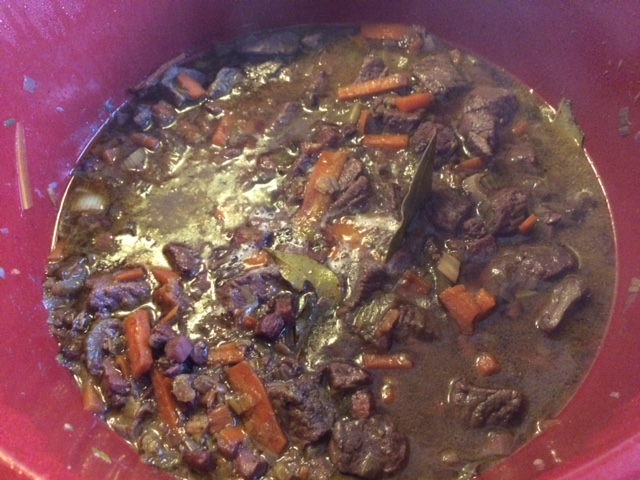
Anyway, a friend shared a Boeuf Bourguignon recipe with me, one she had downloaded from the SBS website and found to be easy and delicious. As a dish I could prepare in advance, it seemed perfect. Once I’d bought in a kilo of topside, a few leeks, shallots, a bottle of red wine, herbs, some carrots, celery and about 300g of speck and mushrooms, I was ready to go. So on Saturday night, in case the urge to write came upon me on Sunday (it didn’t), I sautéed the base of speck, thinly chopped carrots, celery, leek and onion.

Come Sunday afternoon all I had to do was brown the beef and add it to the vegetables with the wine, bring it to the boil and cook very slowly for 40 minutes. As the meat simmered, I started on the carrot puree, a special touch in this particular recipe which you stir in at the end, and on the fruit crumble. I had the meat on one ring, apples and frozen blackberries on another and the carrots on the back ring. My casserole pot is quite large and about ten minutes into the cooking, I noticed that it had knocked the gas knob up to high. I quickly lifted off the lid and brought the meat back to a simmer. But I fear the damage was already done as the meat was pretty damn tough and chewy when I tested it twenty minutes later. How could I feed the kids shoe leather?

Delicious apart from the leathery meat!

Delicious apart from the leathery meat!

In desperation I rang Ollie, the 21-year-old, and asked for his advice. He thought that I must have either over-cooked the meat when I browned it or during the actual cooking. I offered to run out and buy steaks – we could perhaps drain off some of the delicious bourguignon sauce to have with them – but they had had steak the night before. Ollie said there was some lamb in the fridge that needed cooking so he threw that into the top oven. I agreed to go down about and hour before we were due to eat and pop some baking potatoes in the oven.

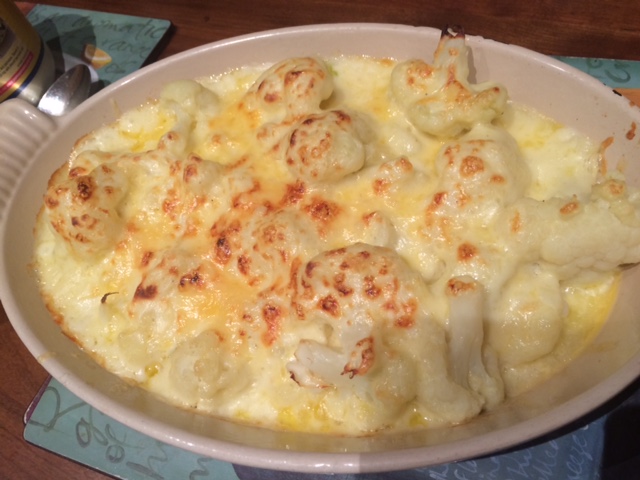
I got the potatoes in just after 6pm – we planned to eat at 7pm – and then, keen to salvage my culinary credibility, dashed out to Woolworths and got some milk, a cauliflower and some cheese. I am proud to say – something had to work – that I produced a beautifully browned cauliflower cheese on the dot of seven. We also heated up the carrot puree and fried up the mushrooms. While the cauliflower cheese was in the oven, I got on with the rest of the crumble, rubbing the chilled unsalted butter into the mix of flour, almond meal and sugar (special low GI coconut sugar, if you please). Not only did it start to resemble dough rather quickly, I began to get pains in my wrists – too much typing, I say – so re-named the dish RSI crumble.

Phew - it worked!

Phew – it worked!

With a bit more flour and almond meal, the crumble turned out OK. Well more or less. We were laughing so much about how I’d never make Masterchef – the baked potatoes were a little undercooked and the carrot puree was on the bland side – that I forgot to time the crumble. The topping was a wee bit burnt, but salvageable, when I got it out of the oven but the apples were still a bit crunchy. How did that happen?! I did better than this in year 8! At this point we were all laughing hysterically. What we lacked in culinary precision, we gained in the most wonderful evening of belly laughing bonding. And I proved worthy of my nickname: Mad Aunt Lot-Lot.

Oh, and when I got the home the carrot soup was just about cooked!

Write for Your Life but avoid the red flags

I’ve recently had a quite a bookish time: I had my first memoir mentoring session last Friday (in lieu of the workshop I missed), attended a session at the Victorian Writers’ Centre on how to craft a pitch to publishers – “Every writer should be prepared to explain their story in one sentence,” (a quote from a literary agent), and then on Monday I was back at the Writers’ Centre for a panel discussion entitled ‘All About Agents.’

Memoir-writing is very much in vogue at the moment which is good in some ways but also means more competition! One of the main things I took away from my mentoring session is to ignore the pesky critic that sits atop many a writer’s shoulder chattering away along the lines of: why would anyone want to read my story, I’m not good enough, I haven’t lead an interesting enough life (climbed Everest, sailed solo round the world, invented something new or changed the world) plus my family and friends might not approve etc.

Because we all have a story to tell – if we’re brave enough– and we all have our unique voice, style and perspective on life. The challenge, and I say this as someone who is good at glossing the tricky stuff and making it funny, is to connect with the raw emotion and to write from an authentic space. So, for example, if you’re writing about your childhood, you need to take yourself back to that time and channel the younger you, not the wise adult writing with the benefit of hindsight. It’s a fine line balancing the light and the dark. Spiri, my mentor, suggested I read “A Funny Thing Happened on the Way to Chemo” by writer and comedian Luke Ryan. Have any of you come across it? Or does anyone have any good memoirs to recommend?

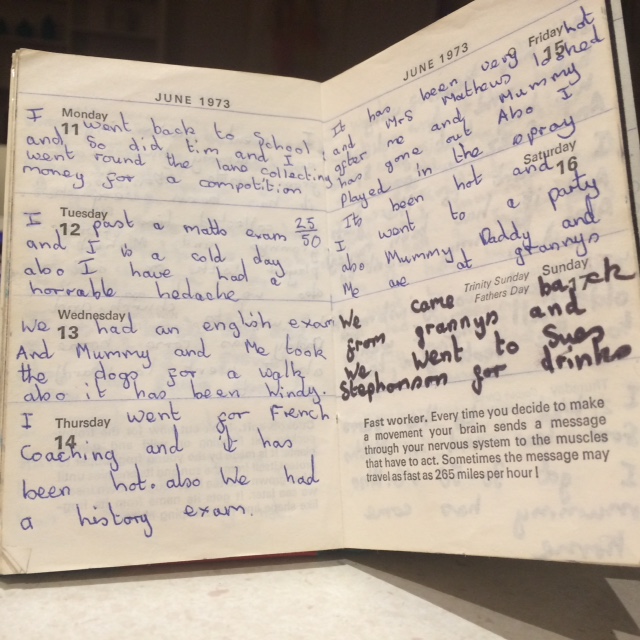
One way to stimulate and inspire life story writing is to draw on diaries, photographs and other memorabilia. When I shipped my remaining belongings from the UK to Australia a few years ago, I included a box of diaries, letters and other keepsakes. In the back of my mind I thought they might come in handy one day. I’ve had a lot of fun reading my diary from 1973. Interestingly it was quite a turbulent time in my family – marital mayhem and moving schools to name but a few challenges – and yet my entries are totally matter of fact: meals; visits to grandmothers; aunts; shopping trips; fun fairs; school; friends; and endless accounts of the weather ( I reckon I picked the weather obsession up from my mother!). Apart from describing a few horrable hedaches (my spelling had a way to go as you might expect from a nine year-old going on ten), a nasty tonsillectomy that made me throw up eight times and a not-so-good day or two at school, my daily accounts are almost devoid of emotion. I think that will change as I get older and my dairies become more private – as in lockable!

IMG_2453

The pitching essentials workshop run by journalist and author Maria Katsonis was fun too. We did some practical exercises and had to come up with a 30-second elevator pitch for our book, identify comparison titles and develop a mini synopsis describing our story or concept in one paragraph. The pitch Maria used was: ‘A true story about me and my experience of mental illness set against the backdrop of growing up gay in a traditional Greek family’. She admitted that it took quite some time to come up with something as concise and pithy: brevity is definitely the name of the game. I cheated a bit as I had already come up with some of these pitches for my A-Z but I may have to change them as my new project emerges. As for comparison titles I have been saying – but again this may change – that my book is Eat, Pray, Love crossed with Bridget Jones meets Embarrassing Bodies (the TV show). Go figure…

Red flags to avoid include explaining how or why you came to write the story, how much you’ve wanted to write since you were a child and how much your family and friends love your work. Hmm… I’ve fallen into a few of those clichéd traps before now. And never comment on the quality of your work. Your writing should speak for itself – it’s the show don’t tell rule.

It was somewhat sobering to hear the agents talking. One of them confessed she gets up to 38 submissions a week, more than she can possibly read. The focus for agents needs to be on the commercial potential of your work – if they can’t sell it they don’t make any money (typically they take 15% of all sales) and on career longevity versus one shot wonders! I was amazed to hear that so many writers fail to read the guidelines on an agent’s website and send in strangely formatted works in all different fonts or submit more words than requested. All no-nos that will consign you to the bin.

But I’m a long way off red flags and the editorial bin. My homework for the week is to identify the key themes of my story and how they might group together and, from there, build some kind of overarching framework.

A bit of fun – the Liebster Award

My grateful thanks to Chloe who writes a fascinating blog about life in Georgia (https://itstartedinoxford.wordpress.com/one), for nominating me for the Liebster Award, an initiative started by the blogging community to promote and share favourite blogs, giving them increased exposure. Chloe’s blog is a great read and gives a very visceral feel for living in a country that was once part of Soviet Russia. I highly recommend it.

liebster-award

Please see the last section of this post for how the Liebster Award works if you are a fellow blogger. In nutshell, the person who nominates you asks you 11 questions and also asks you to provide 11 random facts about yourself. I thought 11 ‘About Me’ questions was quite enough so cheated and didn’t provide the random facts! As the nominee I, in turn, nominate 5-10 of my favourite blogs and ask them 11 questions. And so it goes on.

So here, dear readers, are my answers.

1: Where is your dream travel destination?

Europe, Europe, Europe – plonk me in just about any city in Europe and I’ll be happy. OK, so maybe not somewhere like Preston in Lancashire (sorry Lancastrians, no offence meant)… Although I live in Australia, I love to visit Europe whenever I get the chance. I aim to explore a new city every time I return to see relatives in the UK. In recent years I’ve visited Krakow, Copenhagen and Zurich. Give me cobbled streets, cafes with newspapers on racks, church spires, Royal palaces, Baroque, Rococo, Art Nouveau and more. I love the history, culture and elegance of everything European.

2: Dogs or cats?
Dogs every time! Just ask Bertie. In fact, we’ve just got in from a walk and he barked like mad at a couple of cats who had the ‘temerity’ to remain on the pavement as we approached.
IMG_2352

3: Do you have any hidden talent?
I think I’m a frustrated actor. I recently went to an interactive Murder Mystery dinner – see the picture below – and had a lot of fun playing a character called Ursula Eades-Jones who was big in the suffragette movement – the play is set in the 1920s!

That's me in the middle

That’s me in the middle

4: Can you speak any foreign languages?
I speak passable French and I did a degree in German and Spanish, both of which are a bit rusty nowadays! However, I try to keep them going by watching foreign language news on SBS and going to the French, German and Spanish film festivals.

5: What is your favourite type of flower?
I adore roses!

6: Where do you see yourself in 10 years?
Ooh, well. Perhaps retired from the formal side of work with a published book or two under my belt…

7: How would you describe yourself in 3 words?

A one hundred and ten percenter, funny (as in ha-ha, not peculiar) and all heart (when my busy head is not running the show, that is).

8: Tea or coffee?
Tea – there are so many wonderful teas to enjoy from caffeinated ones to herbal infusions. But you can’t beat a good English Breakfast!

9: What are you currently reading?
Autumn Laing by Alex Miller which is (and I quote from the ABC website) “loosely based on painter Sidney Nolan’s formative years with his patron, muse and lover, Sunday Reed, and explores the doomed affair between an artist and the woman who aspires to change his life”. It’s beautifully written and an engrossing read.

10: What’s the first thing you see if you turn your head right?
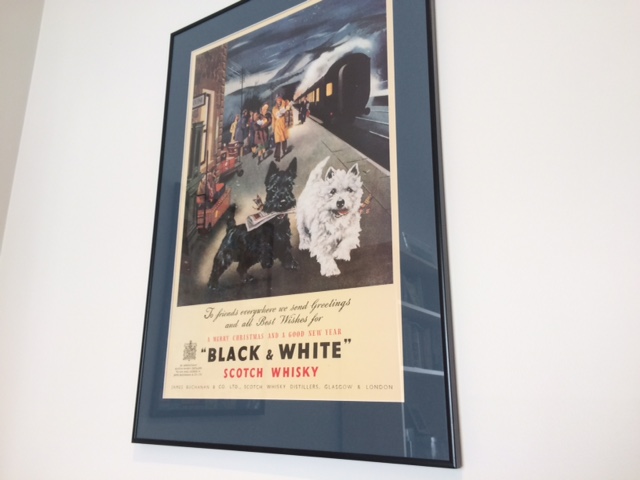
A framed poster featuring two Scottie dogs and advertising ‘Black and White’ Scotch Whisky.
IMG_2428

11: If you have any pets, what are their names?
Bertie is my two-year old spaniel. Love him to bits!!

Now, that’s quite enough of me!

I am nominating the following blogs for the Liebster Award. No offence taken if any of my nominees don’t wish to take part. I hope that you are anyway happy to be nominated!

http://annemadelinedesigns.com – Anne marie
http://ryanlanz.com/ – A writers’ path
https://serinssphere.wordpress.com/
Kiwi Bee at https://kiwibeeblogger.wordpress.com
http://dailyinspirationblog.com
https://kelzbelzphotography.wordpress.com
http://freshfieldgrove.com.au/category/blog – Farmer Fi
http://whattohavefordinnertonight.com/ – Harriet
https://paintintoacorner.wordpress.com/ – Sara
http://markbialczak.com/ – Mark

The Official Rules Of The Liebster Award (non-bloggers do not need to read on..)

If you have been nominated for The Liebster Award AND YOU CHOOSE TO ACCEPT IT, write a blog post about the Liebster award in which you:

1. thank the person who nominated you, and post a link to their blog on your blog.

2. display the award on your blog — by including it in your post and/or displaying it using a “widget” or a “gadget”. (Note that the best way to do this is to save the image to your own computer and then upload it to your blog post.)

3. answer 11 questions about yourself, which will be provided to you by the person who nominated you.

These are:

1. What is your all-time favourite film
2. What does your ideal Sunday morning look like?
3. Town or country or both?
4. What is your favourite meal – feel free to share your recipe!
5. What would you do if you won the lottery?
6. Arts or Science?
7. How would you feel if you had no TV, phone or internet access for a week?
8. Most memorable travel adventure to date
9. Favourite drink – alcoholic or otherwise
10. What world issue most concerns you today?
11. If your fairy godmother could grant you one wish, what would it be?

4. provide 11 random facts about yourself.

5. nominate 5 – 11 blogs that you feel deserve the award, who have a less than 1000 followers. (Note that you can always ask the blog owner this since not all blogs display a widget that lets the readers know this information!)

6. create a new list of questions for the blogger to answer.

7. list these rules in your post (You can copy and paste from here.) Once you have written and published it, you then have to:

8. Inform the people/blogs that you nominated that they have been nominated for the Liebster award and provide a link for them to your post so that they can learn about it (they might not have ever heard of it!)