Remembering adventures in Western Australia – Eye Candy Colin, coral reefs, Carnarvon, cancelled in Karratha and the Karijini National Park

A colleague recently travelled with his family to the Kimberley in Western Australia (WA), hiking in the remote bush. Hearing of his tales and seeing the photos reminded me of my travels and adventures in WA in 2003, and prompted me to dig out my photo album*. The characters I met were as colourful as the sea- and landscapes I explored. *please excuse the grainy photos photographed from said album.

On a mature gap year in Australia – my house in Oxford rented out – I had been staying with friends of friends in Freemantle, a suburb of Perth, camping in their garden.  A bit less Princess and the Pea than I am now, I shared the tent with a littler of Jack Russell puppies for company. I’d wake up with the puppies snuggled in my armpit, across my belly and around my head. How I adored them, particularly one of them whom I named Oscar.

From Perth I travelled north up to Exmouth with Australian Adventure Tours. The tour included sandboarding in Geraldton, marvelling at the Pinnacles, ancient limestones formations – some rather phallic-looking – as our guide Colin was (very) quick to point out, hanging out with bottlenose dolphins at Monkey Mia in the Shark Bay World Heritage Area and learning about the nearby Hamelin Pool stromatolites, layered sedimentary rock formations, single-celled organisms, that produce oxygen in a saltwater environment and were once the dominant lifeforce on earth! We passed through Carnarvon (my diary reading simply: Boiling! Banana plantations, NASA dish, supermarket and, according to Colin, the cheapest grog till Broome), swam with the whale sharks at Coral Bay, a wonderfully life-affirming – and energetic – experience, drank in orangey-red dawn and dusk skies and travelled on red dust dirt roads.


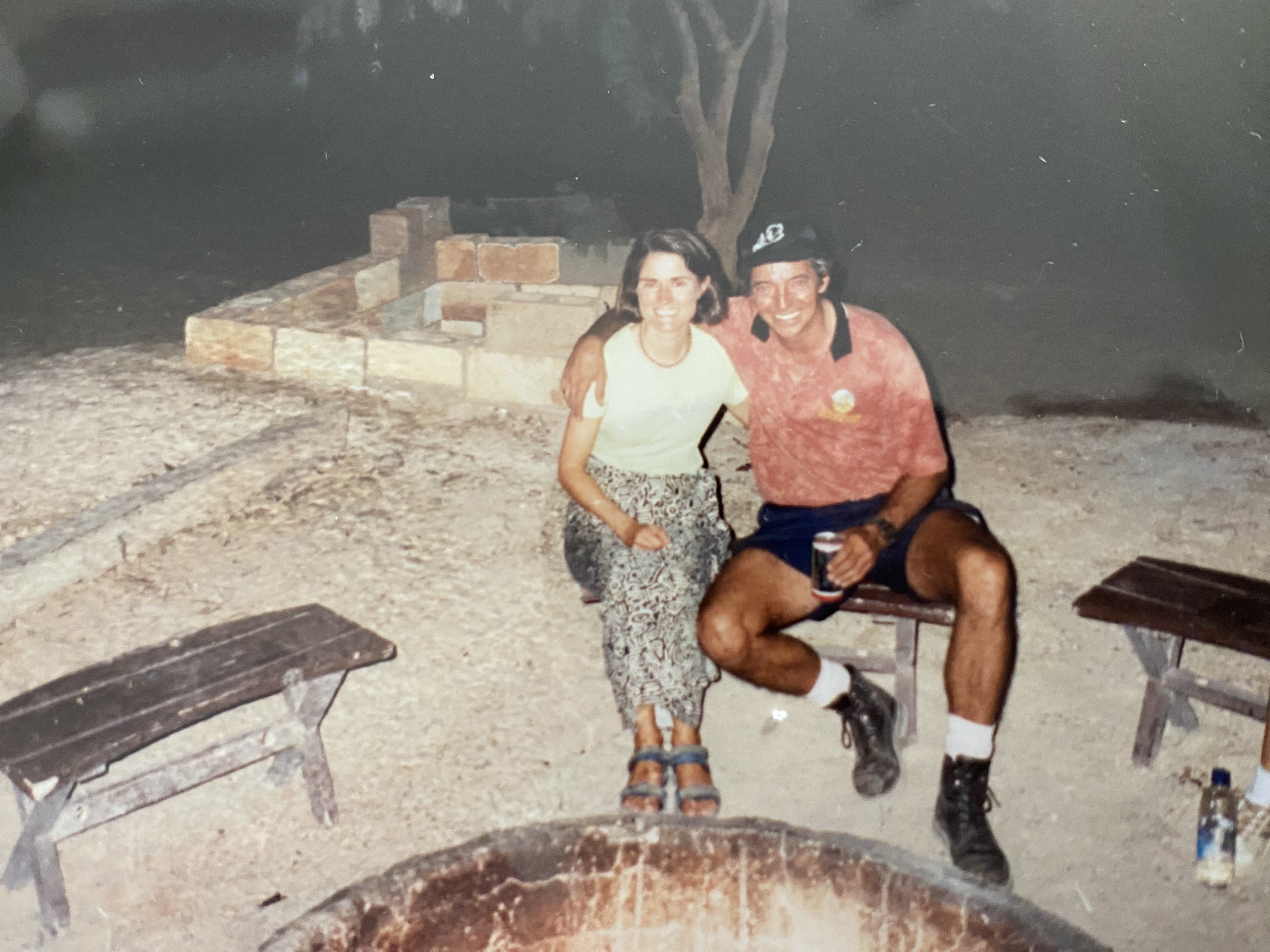
We stayed at various old homesteads and stations including Warroora Station (meaning Woman’s Place in the local Aboriginal language), where we made raisin damper, sat round the campfire, and where I did my best to keep Colin at bay.  I was the odd number on the tour; our party consisted of two gay girls from Tasmania, two rather inflexible German girls (they eschewed the damper at breakfast saying: “nein danke, only ever muesli in the morning”) and two sweet and giggly Japanese girls.

Colin was unapologetically Colin endlessly searching beaches for ‘Eye Candy’ and regaling us with apocryphal stories of past conquests such as Debbie from Essex.  He was sweet on me, insisting I sit next to him in the front of the van and dropping inuendo-laden hints, but I came away unscathed bar some campfire hugs. While he was a bit of a tour guide cliché, he created camaraderie, kept us all entertained and energised and loved his job.  

My next stop was the Ningaloo Reef Retreat (before it got upmarket and swanky). Ranger Dave with his bright eyes and rasta blond hair took out us to the turtle beds and kayaking on the Blue Lagoon. Sadly, even then, more than 20 years ago, there were sections of dead coral but what I remember more is the extraordinary diversity of marine life, the dazzling colours and quirky names of the fish. To name a few, we saw sailfin catfish, the harlequin snake eel, Tawny nurse sharks, Christmas Tree worms, fusiliers, humbugs, sweetlips and convict surgeon fish being chased by black damsels. A very different vibe from Colin’s tour, Dave was more Hippie Hippie Shake and exuded the kind of positive energy that comes from living close to nature. I also enjoyed the company of Mike, a curator of Indigenous art, a chain smoker of roll-ups with gappy teeth and wild and woolly grey-blond hair, and his wife Ilse, a linguist.

From Ningaloo Reef I took the overnight bus to Karratha, a mining town, to join a tour to the Karijini National Park. Due to arrive at 6.30 am, I had booked into a backpacker’s, and, as arranged, the manager came to meet me at the service station. I had stayed in some wonderful youth hostels in the south of WA – at Denmark, at Bunbury and Albany. Here, my room overlooked a courtyard full of cigarette stubs and empty beer cans, there were ants, chicken bones and food on the floor in the kitchen, and I’ll spare you the detail of the bathrooms.  Tired from a night on the bus, I couldn’t handle the nicotine-imbued squalor. Looking back, I realise this place was a budget option for mine workers and transient labourers rather than travellers.

The manager was furious when I complained it was dirty. She screamed at me, blaming me for getting her out of bed at 6 am and flung $30 of the $50 I had paid into my hand and booted me out the door. In today’s parlance, we’d say I’d been cancelled!  Smarting from the experience, I cut a tragic figure wheeling my case along the streets looking for alternative accommodation. But all was well as I pitched up at the Mercure and for $98 (bargain!) got a sparklingly clean room, TV, air-con, private bathroom and access to the pool. Bliss.

At 7.30 am the next morning, Andrew from Snappy Gum Safaris picked me up for the tour I’d booked to the Karijini National Park. We had to wait around a bit as his brother Brendan was still in the shower and nursing a hangover and sore leg from coming off his motorbike the night before. Something about the camber of the road. Yeah, right… And guess what? I was the only one on the tour, a fact which came back to haunt me.

Karijini is iron ore country. It is vast, remote and characterised by rust red dirt roads, cliffs, gorges and large termite mounds interspersed with splashes of green ranging from the grey green of the gum trees and the spinifex grass to the brilliant jade of the water in the rock pools. It’s like being inside a Fred Williams painting.

It’s a four-to-five-hour drive and, with a few stops along the way – a deserted homestead and a spidery drop dunny – we got to our first stop at lunchtime, the Hamersley Gorge, where Brendan and I had a dip in a water hole, the waterfall giving our shoulders a gentle massage. Sounds good doesn’t it but the brothers were distant and disengaged, cross that they were not making any money by taking one person on the tour.   While there was no male/female tension, they were keen to get their pound of flesh.

By early evening we crossed the dry riverbed of the Fortescue River towards the Rio Tinto Gorge (note how the big mining companies have claimed and named the land as theirs) and the Dales Gorge camp site, which was just a patch of red earth. Here they set up our swags and, for mine, hitched up a mosquito net to a tree branch.

Dinner was cheap sausages cooked over a fire served with salad and, to drink, bog standard cask wine or Victoria Bitter (VB).  My diary reports the boys ‘romped through the VB’ and complained about penny-pinching backpackers.  I was almost starting to miss cuddly Colin.

By chance a group of four tourists – an English girl, a Dutch girl and two Canadian blokes – came over after dinner and asked Andrew and Brendan if they knew the park and the various hikes. They boys went into a huddle with them while I sipped at my wine. Dollar signs in their eyes, they turned back to me after about ten minutes and asked how I’d feel about changing the itinerary to walk the much-more-exciting Miracle Mile the next day? It’d be the walk of a lifetime, the said. The tourists were keen to engage them as guides. Ching Ching.

Miracle Mile, why not?  It sounded good and I didn’t want to be the party pooper.  I slept reasonably well in my swag –  apart from being startled awake by one of the boys shouting in his beer-soaked sleep, after which I got a bit lost going for a pee in the spinifex. No mobile phone torches in those days!  
After a light breakfast, the day started gently with a trip to the Joffrey Falls, Knox Gorge lookout and Oxers lookout which is the meeting point of four gorges.

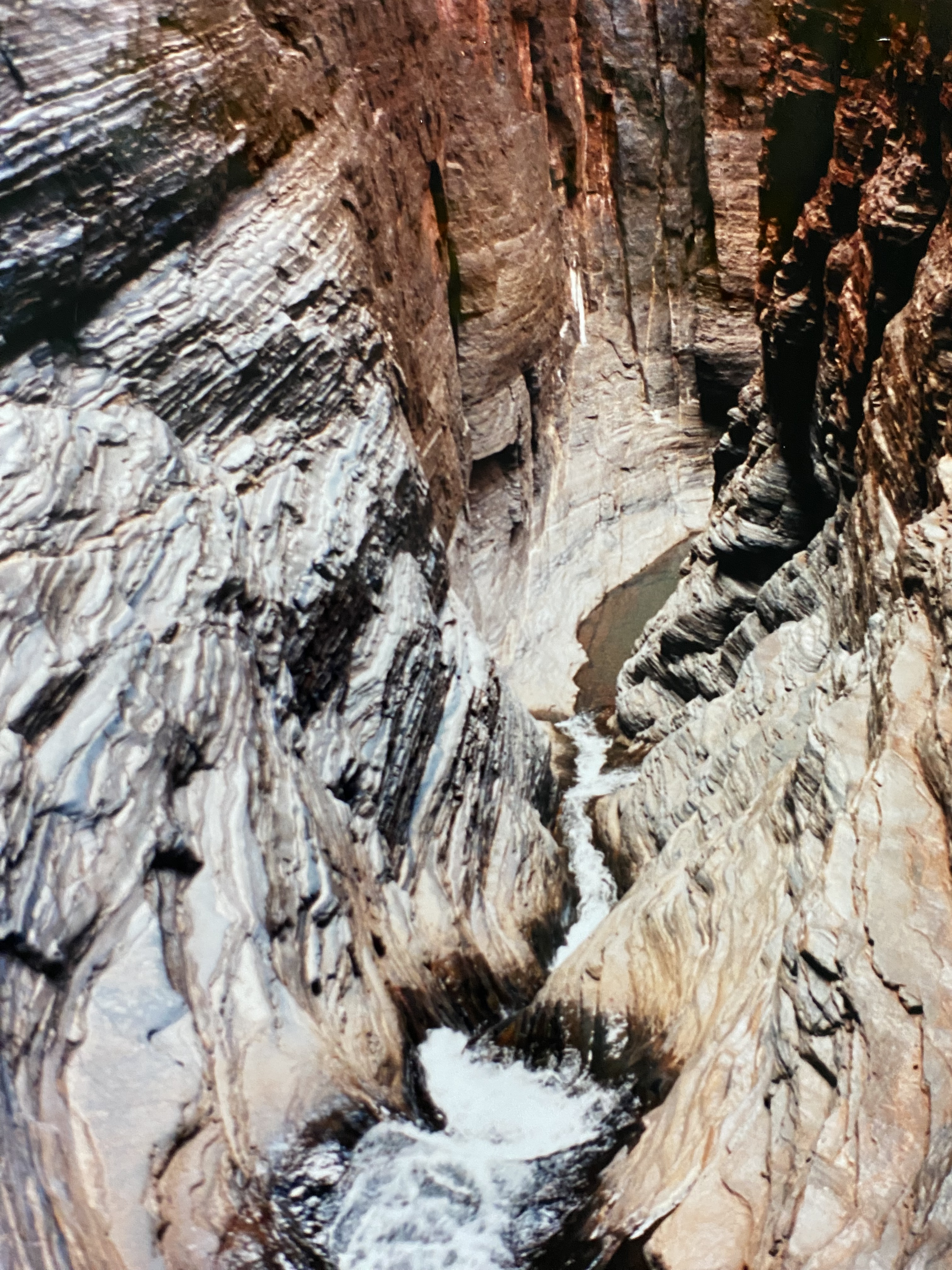
And then the adventure started. No wonder they had stuck to the catchy Miracle Mile moniker rather than detailing what it involves. The Miracle Mile is within the Hancock Gorge and the Joffre Gorge and involves walking along extremely narrow 20-metre gorge walls. While we did have helmets, there was no rope, and one wrong foot could have spelled disaster.  

It was physically and mentally demanding, but what made it most challenging for me was being the odd one out while the other four were a bonded team, walking together and encouraging each other on. I’ve always loved a bit of solitude and peace and quiet, but this was uninvited exile. I changed schools a lot as a child, and this reminded me of being the new girl and not having a gang to belong to.

At one point I slipped and grazed my knee, irritating Andrew, who was walking behind me. Shaking, I picked myself up and pushed on, desperate not to let the others see my fear – and suppressed fury! We crawled, climbed, clambered and inched our way along, in parts spreadeagled between gorge walls, jumping into rock pools below and swimming between gorges, floating our day packs on air beds. Andrew and Brendan set challenges and dares for the others, while I waited around – like a spare part at a wedding – getting cold (think damp bathers in shaded gorges), tired and hungry. When I got back to the car at the end, I bit into an apple only to crack a tooth!

The scenery was out of this world SPECTACULAR but I’m appreciating it more all these years later looking back at the photos in my album. My diary description from 11 May 2003 is underwhelming: Fab gorges, layering and rocks but wasn’t happy in my head as Phil (an ex) would say.  It was a tough character-forming experience, but one I will never forget. And as my German teachers would say: it’s all grist to the mill. Indeed, and 22 years on it makes a good story for my blog!

Back in England: family, fine art, an old flame, a (very) old tree and teeth on the table

A highlight of this trip was meeting up with an old flame for the first time in over 25 years. We met in the ‘80s in London when I was his lodger and the world was a very different place. After years of communicating via Christmas cards between America and Australia, we were, at last, going to be in London at the same time. The anticipation and getting ready were half the fun. Limited to a travel wardrobe and my hair out of shape, my beloved sister came to the rescue. Despite our combined age of just over 130, we were like teenagers again. She helped me get ready, backcombed my hair, lent me a coat and scarf and some jazzy earrings. It was wonderfully bonding.

Lance and I met at the Cavalry and Guards Club in Piccadilly. Honouring the Club’s formal dress code, he was wearing an elegant blue suit and orange silk tie – the word dashing comes to mind. He’d hardly changed at all, and we effortlessly took up where we left off in what proved to be a fun and fond evening. Dining on the best of British at the wonderfully-named Noble Rot in Mayfair, we reminisced, caught up on all the years in between and shared unrealistic ex-pat dreams – he and his family now live in San Francisco – about how nice it’d be to own a pad in London and to stay for three months every year.

He remains a stalwart drinker, a bon viveur, a keen golfer and, while politically poles apart from me, he’s stylish, has artistic sensitivity and impeccable taste. He always did have a dry sense of humour. Quote of the evening had to be “Well, Cha (he’s the only person in the world who calls me Cha) it’s good to know, as a former lover, that you have found happiness with a dog.”

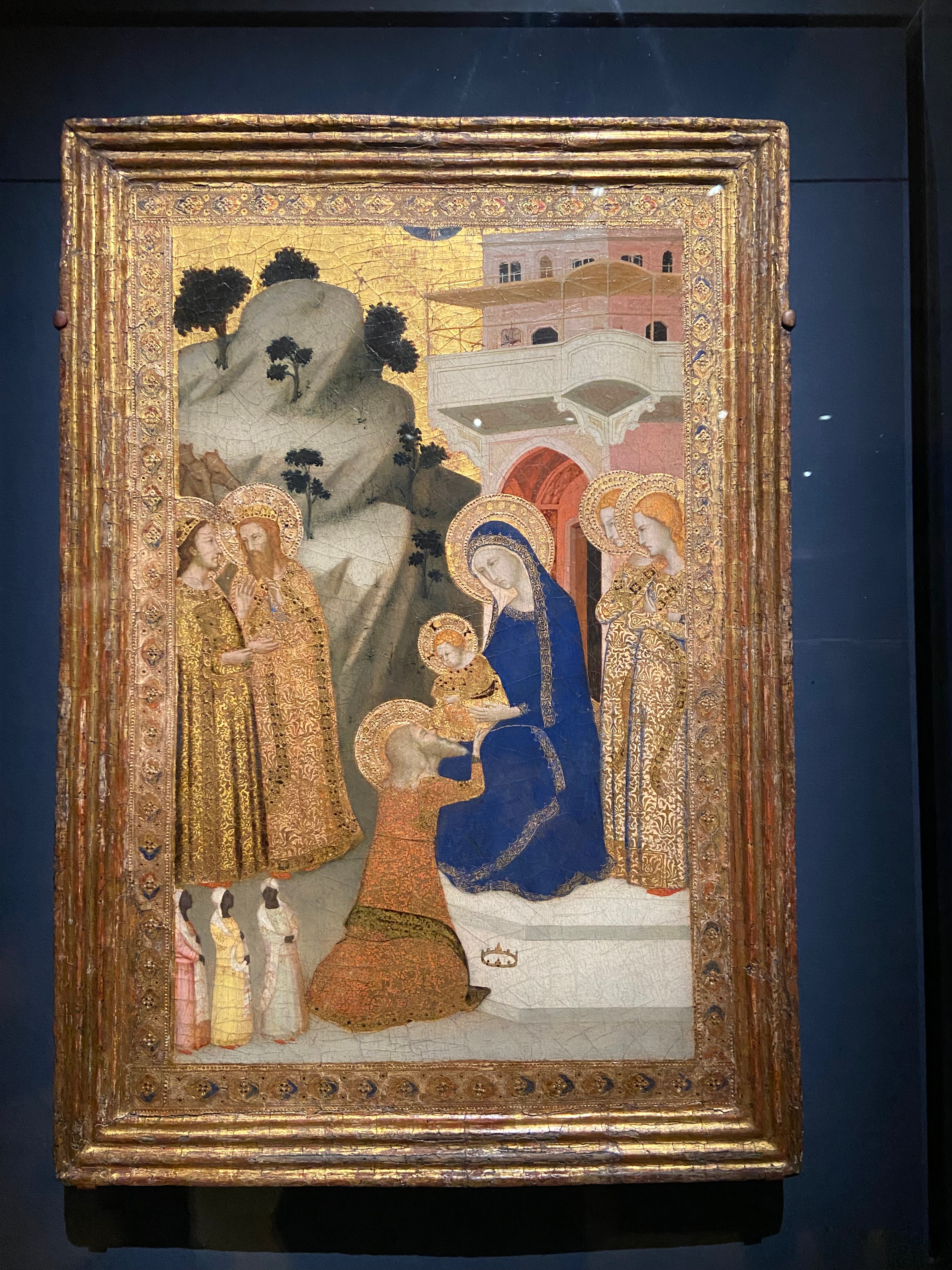
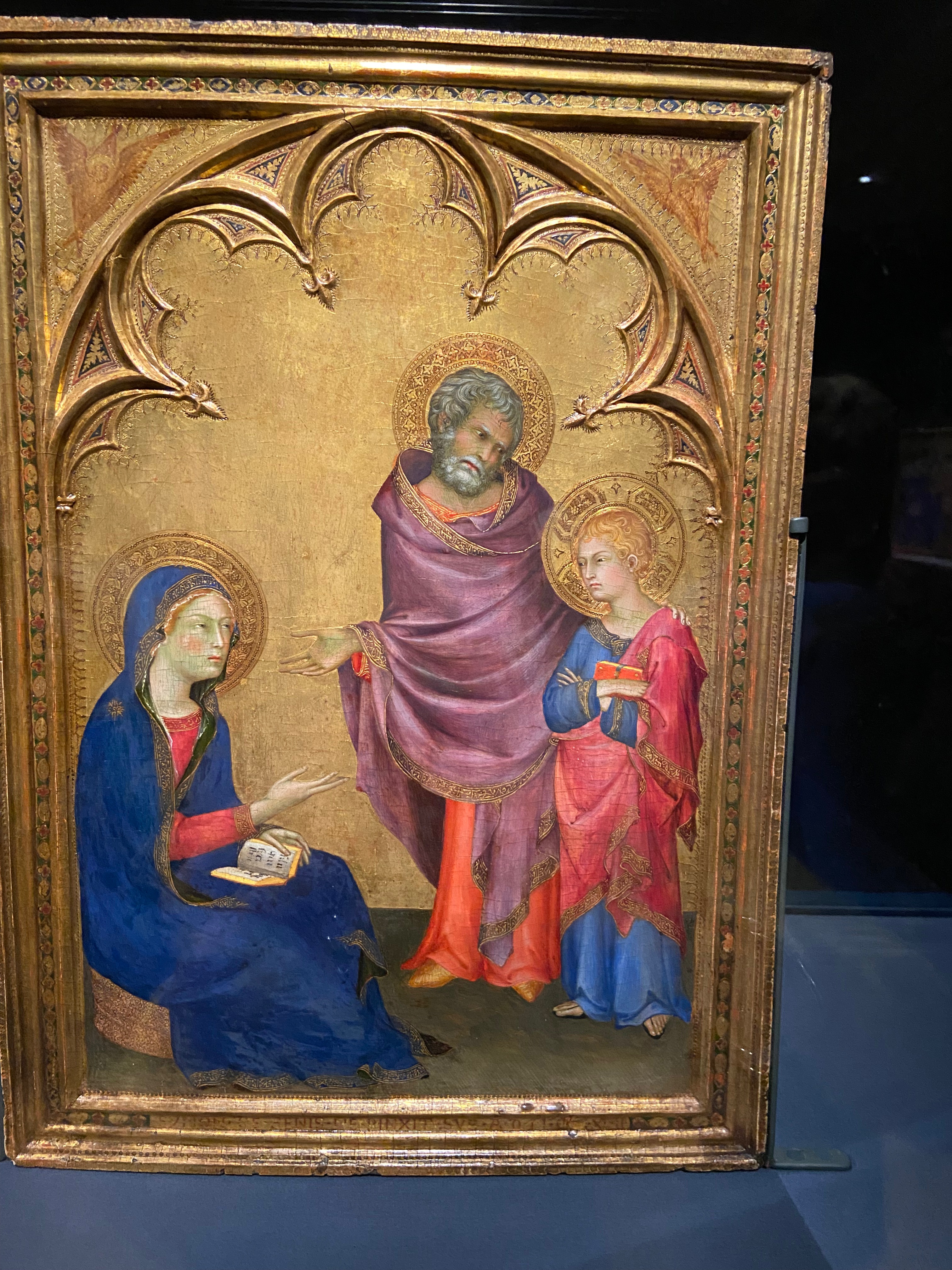
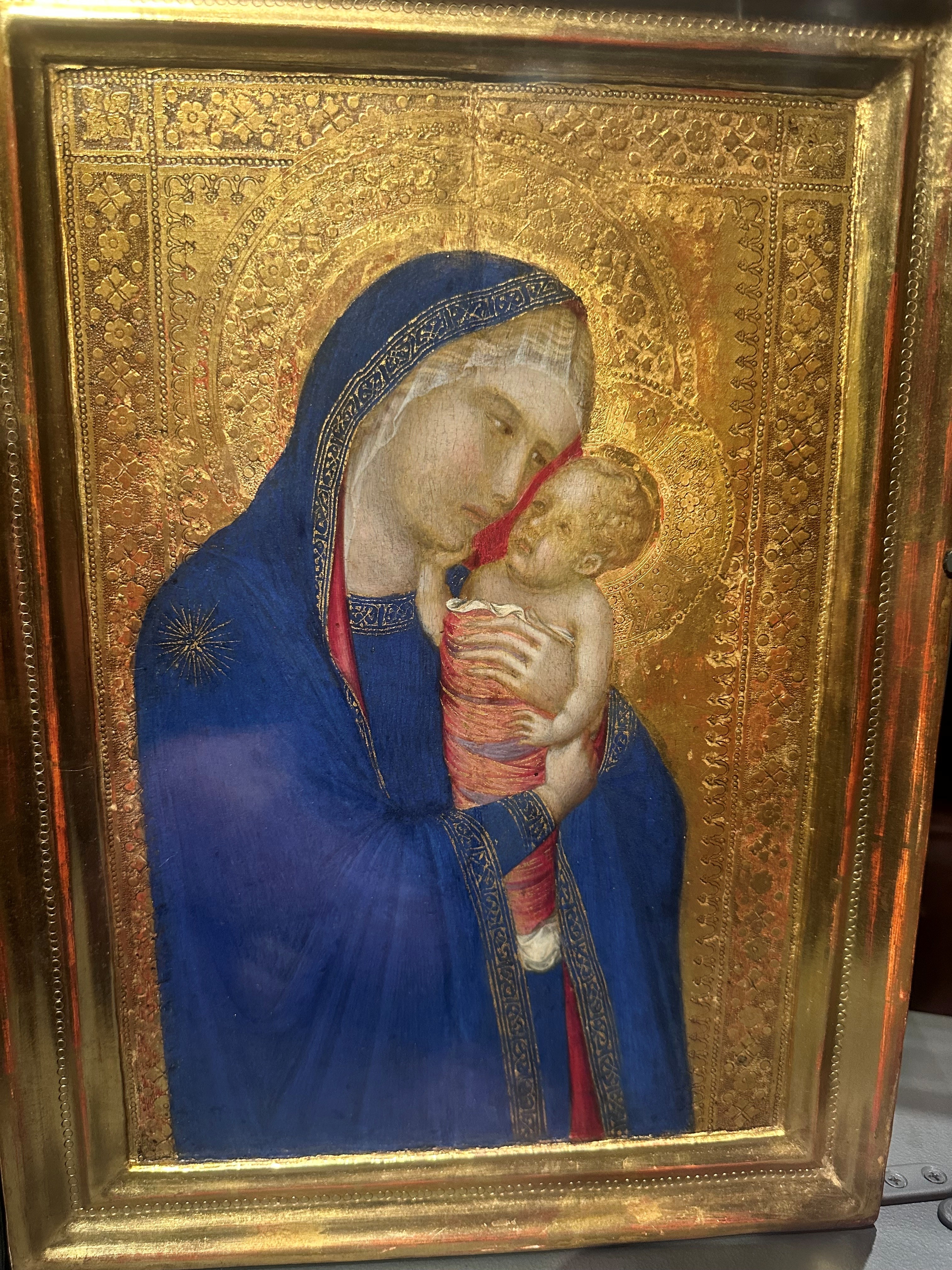
In a small world moment, Lance had seen the exhibition Siena: The Rise of Painting 1300-1350 at the Met that I was about to see at the National Gallery. In fact, some of the photos I am sharing are his.  It was an exquisite exhibition, and an extraordinary one with many of the works reassembled for the first time in centuries.

To quote from the National Gallery:

Simone Martini’s Orsini polyptych, split between Antwerp, Paris and Berlin is together again. His panels for the Siena’s Palazzo Pubblico altarpiece are reunited. 

Panels from Duccio’s Maestà, one of the largest and most complex altarpieces ever produced, on loan from Madrid, Fort Worth, New York and Washington and his ‘Virgin and Child’ and ‘Crucifixion’ triptychs come together.

Siena, I learnt, was one of the world’s richest cities and a major centre for artistic innovation and experimentation before the Italian Renaissance and up till the outbreak of the Black Death in 1348.  

What I loved was the sweep of the exhibition from the large, commissioned altarpieces, shimmering gold, to smaller paintings as well as ivory carvings, intricate enamelled boxes, reliquaries with fragments of bones, silks and textiles from Iran and Turkey, marble and wooden sculptures and illustrated manuscripts. The level of detail and the vividness of the colours – particularly the  blues, oranges, reds, purples and pinks – pulled me in as did the emotion and humanity in many of the pictures; the tender face of Mary, baby Jesus reaching up to pull aside the veil from his mother’s face and, my favourite, a picture of Jesus as a boy being told off by his parents and sporting a sulky teenage face and crossed arms.

Seeing great nephews and nieces is always a joy on my UK trips, the catch being that it’s all or nothing, and I miss out on many of their milestones from trip to trip. I enjoyed reading Hairy Maclary to Dougie, who is now coming up for two, walking, talking and being schooled in the art of calling me Lot-Lot.

Up in Nottinghamshire with Mum, I caught up with my great nieces – Millie and Imogen from Yorkshire. Millie at 14 months was too young to recognise me but I got a great welcome Imogen, who is nearly five. I’d decorated the dining room with bunting and balloons, but much more exciting was doing the washing up standing on the step and playing peek-a-boo through the (rather old-fashioned) serving hatch between kitchen and dining room. That and ragging around with my eldest brother, the most devoted grand-father ever.

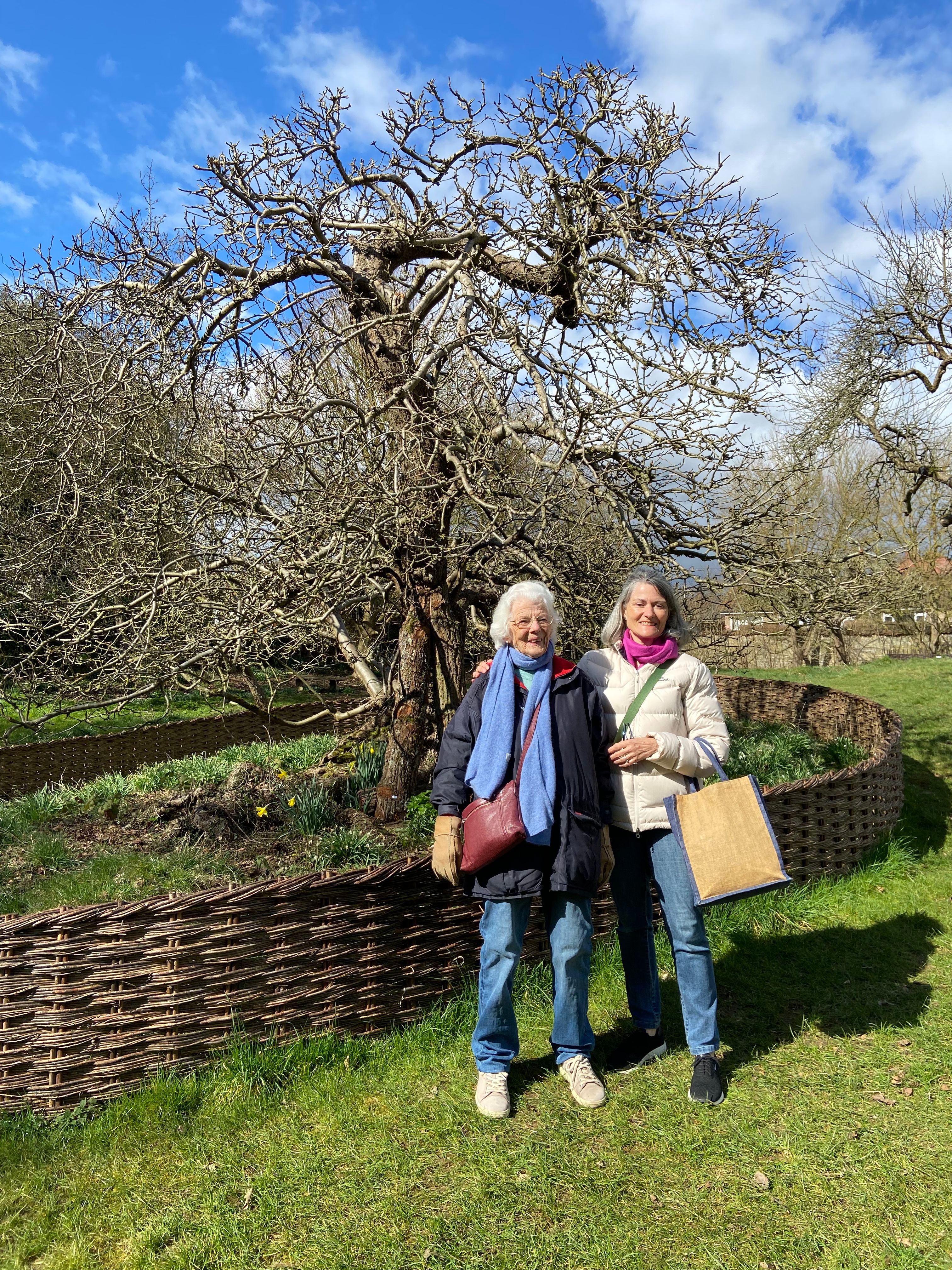
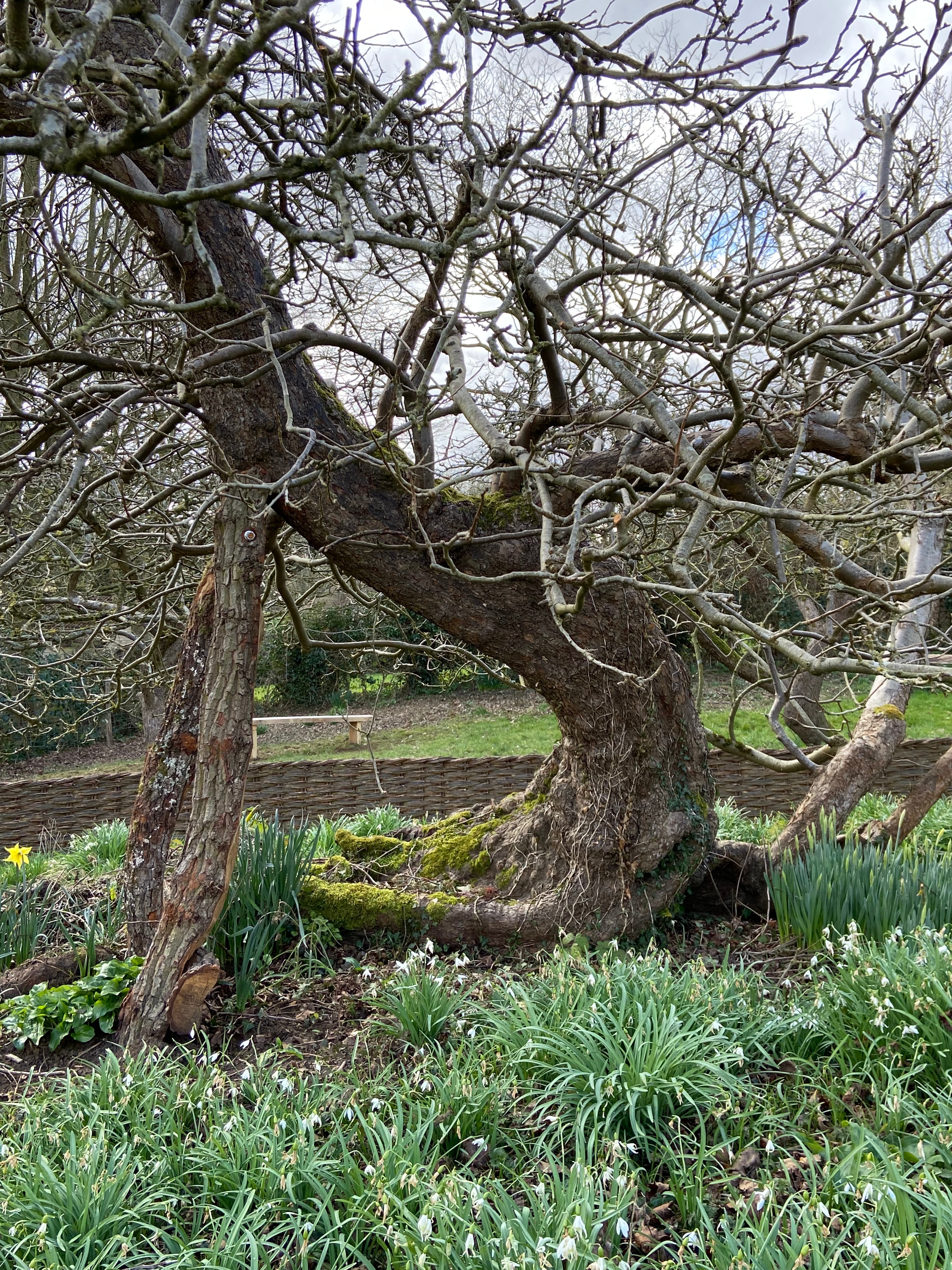
Mum had a rocky start to the year but has fought back amazingly well. So it was a triumph to manage a fun day out together and lay down new memories. At 93 it’s a case of carpe diem. We went down the A1 to Lincolnshire to see a heritage-listed tree – not just any old tree but possibly the oldest known apple tree in the world. The tree where Isaac Newton had his aha gravity moment.

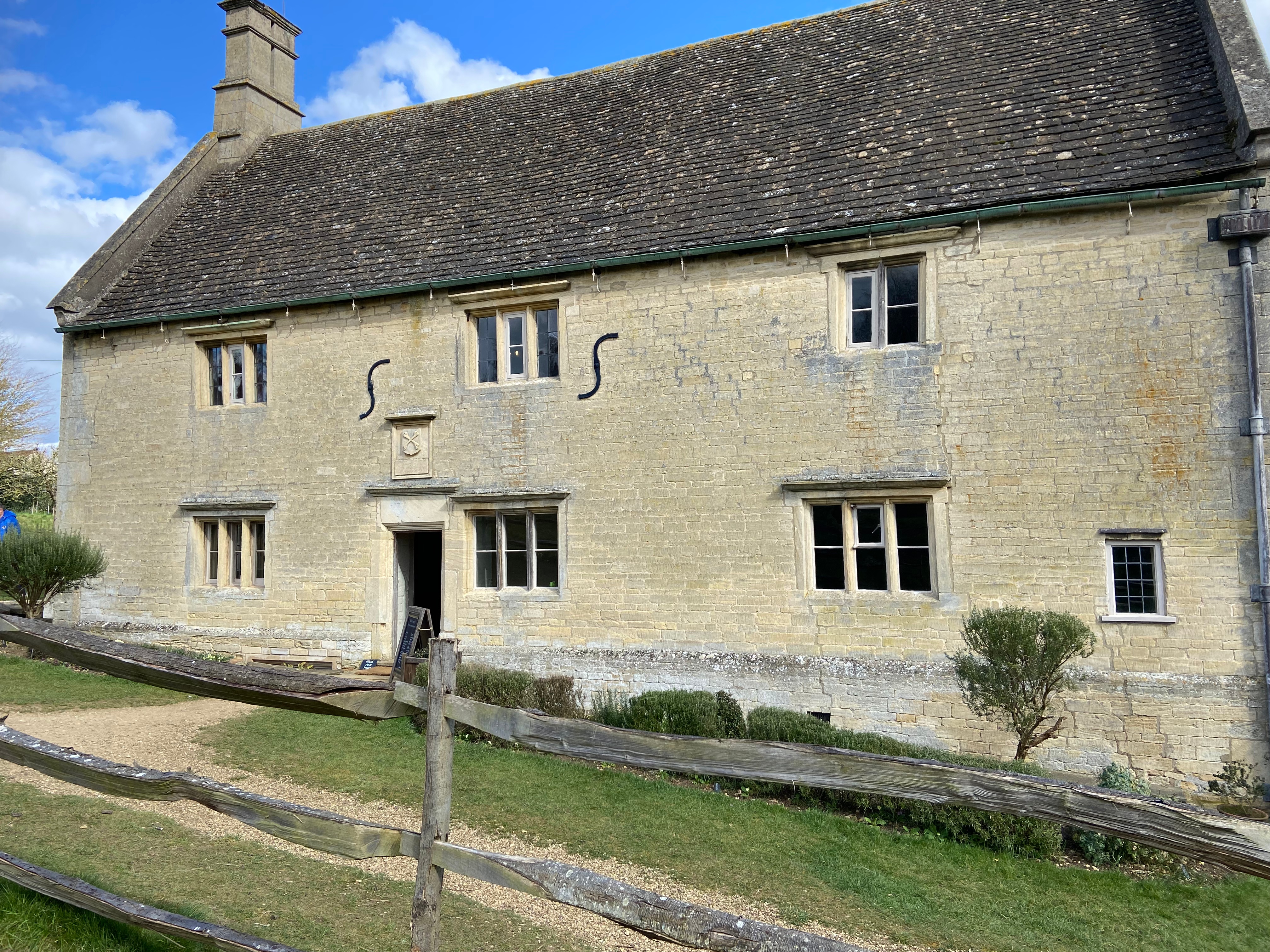
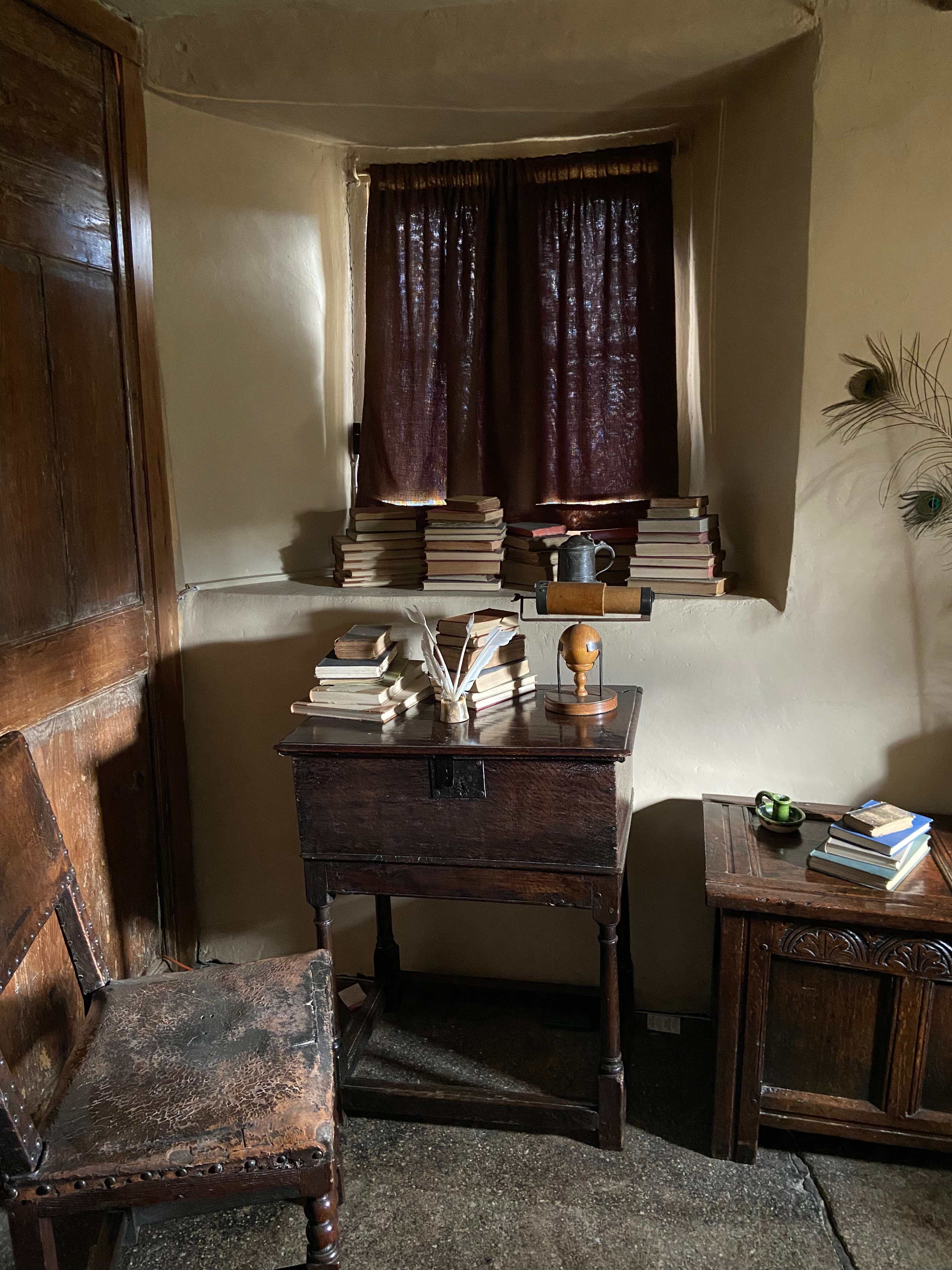
The tree is in the garden of the Woolsthorpe Manor (now a National Trust property) where Newton was born in 1643. Inside the house is the room where he conducted his experiments on light using a prism, a recreated dining room, kitchen and bedroom with lots of heavy oak furniture, and exhibition on the 17th Century uses of urine. These ranged from mouth wash, skin softening, reducing wrinkles (I’m not up for trying it on the crow’s feet!) and stain removal to making gunpowder and warding off witches. It was also prized as a valuable side-hustle commodity you could sell to soap-makers and tanners – there was no Airbnb and Uber back then.

The apple tree, somewhat gnarled and bent, has proved amazingly resilient and survived being felled by a major storm in 1820. And, even better, the tree has offshoots all around the world including in Canada, the US, Argentina, Germany, South Africa, Korea, Japan and Australia. And the tree’s Australian descendants are not far from where I live.  

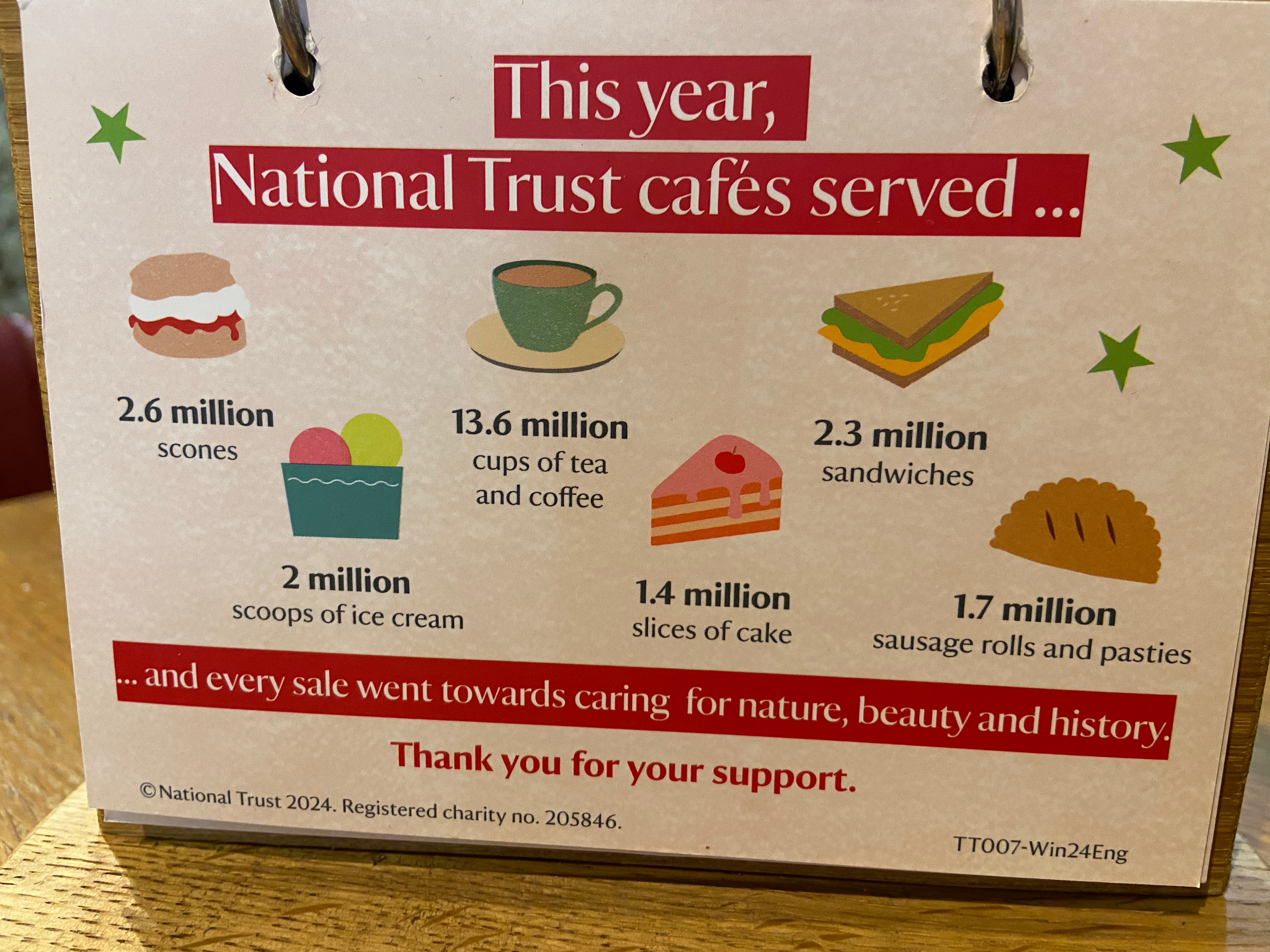
We enjoyed the spring sun but there was a biting wind, so we warmed up with a sandwich lunch in the barn and I enjoyed a nice British cuppa, one of 13.6 million served in National Trust cafés annually!

The weeks with Mum in her village near Retford in Nottinghamshire had some surprisingly busy days whether it was medical appointments, relatives coming over, neighbours popping in and out, the window cleaner appearing at the top windows early one morning when we were only half dressed, the boiler being serviced, supermarket shop-ups, a trip to the tip to get rid of rubbish from the garage – and managing all the things old age throws at you.

Mum and I had a few fraught moments due to an unholy alliance of old age irritations – hearing, digestion, eyes, poor sleep and anxiety topped off with a very nasty cold which we both succumbed to. Mum had two macular eye injections in one week, and for one of them I managed to leave all forms of payment behind on the kitchen table. Emerging from the injection feeling wobbly and seeing black dots, Mum wasn’t best pleased that I had no means of paying for the parking, which would likely result in a written penalty. You’re never too old to get a good ticking-off.  Luckily a kind-hearted woman gave us the £1.75.

However, that evening dinner was a disaster. I’d managed to make the sausage skins tough and the broccoli too crunchy (Goldilocks would have had a field day). Mum, cross and tired and unable to chew adequately, took out her dental plate and put it on the table where it sat accusingly. Mum’s teeth were out, and mine were firmly clenched. A bit of a Swords at Dawn moment!

Needless to say, we’d moved on by the next morning and, girls together, we both had 10.30am hair appointments – nothing like a haircut to make you feel better. Adjacent basins wondered my brother? Not quite but that’d be a good title for an Alan Bennett play!

I timed my trip to include Mother’s Day on my last weekend, and my sister came up from London to join us. Flowers, chocolates, coffee by the canal in Retford and roast chicken in the Aga. And time to read Mum a few more stories from Craig Brown’s A Voyage around the Queen, an entertaining biography with a difference. I bought it on the strength of this review from The Times:  “An unconventional tribute that offers a snapshot of almost a century of social history with a mix of royal insanity, and superior anecdotes, from farts and corgis to Paul McCartney and poets laureate.” And it absolutely delivered; Mum, I’ll be back to read you more extraordinary Royal tales (and tails) before you know it.

Rediscovering Spain Part 2/2: Picasso, paella, pajarete and more

It was Michael Portillo, he of the brightly coloured jackets and train journeys, who inspired me to choose Malaga as my stop-off place on the way to the UK. There’s a lot more to Malaga than being a gateway to the Costa del Sol.

Another reason I chose Malaga is that it’s very walkable, its compact city centre perfect for meandering, mooching about and soaking up the vibe. In the past I’ve tended to cram too much into my European trips – partly because living on the other side of the world engenders terrible FOMO.  

I stayed in a small Airbnb studio in a quiet residential area about ten minutes’ walk from the city centre. It was nothing fancy, but I felt completely at home and enjoyed watching the comings and goings in the street below from my narrow window balcony.

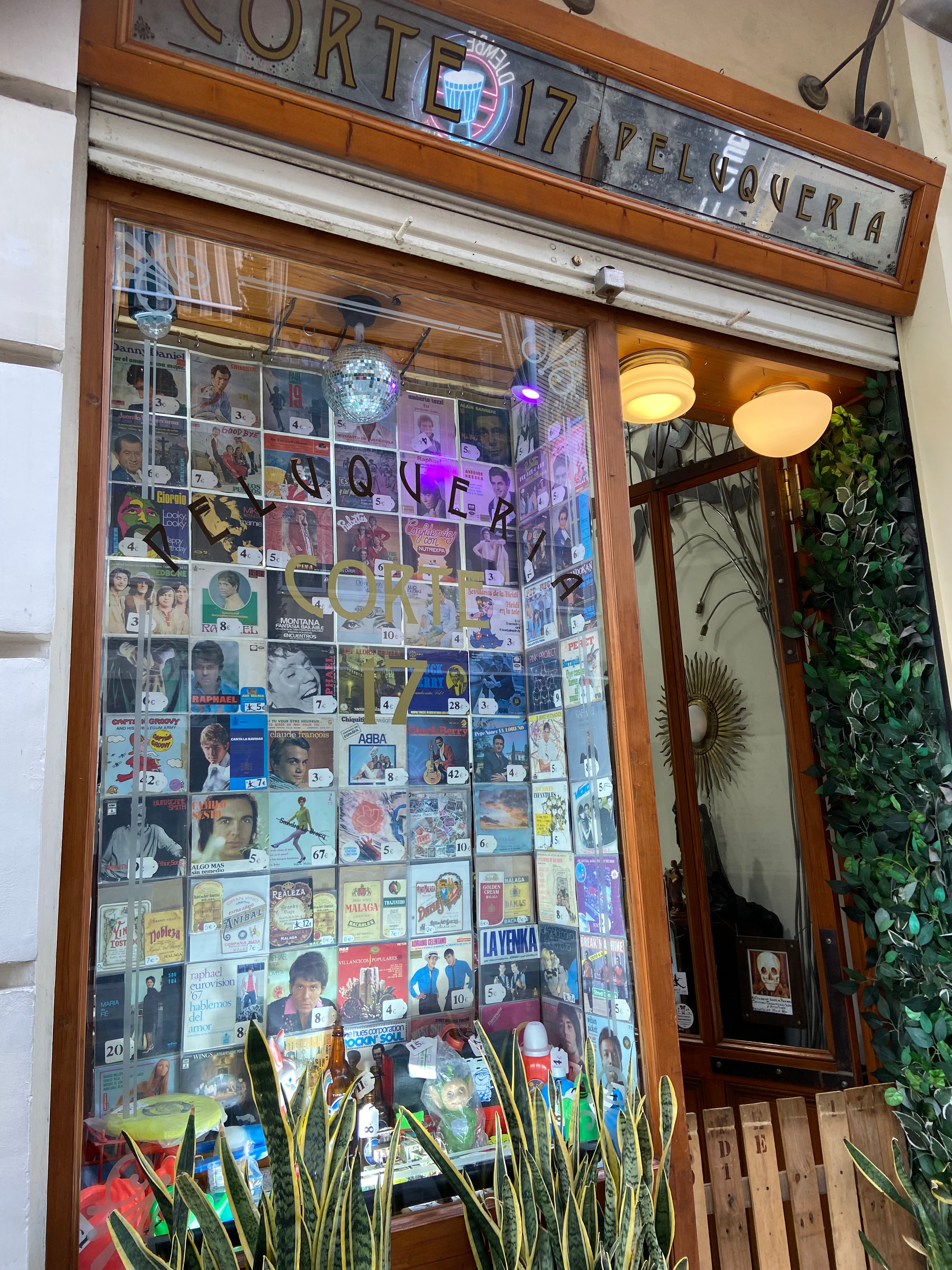
Walking to and from the centre I tapped into timelessness again (see Rediscovering Spain Part 1) noticing something new every time – a few hole-in-the-wall shops, seemingly unchanged over decades, selling salami, processed cheese, tulipán margarine (Spain’s version of Flora), bottled water, olive oil and packets of this and that. I spotted lots of traditional barber shops, one with a window artfully decorated with 45 vinyl record sleeves. Then there were the glass-fronted balconies, the lantern-style streetlamps and decorative tiles on house fronts depicting religious scenes (lots of those) or various trades or symbols related to the original homeowners. And crowded tapas bars at lunchtime, the scruffier, the more authentic.

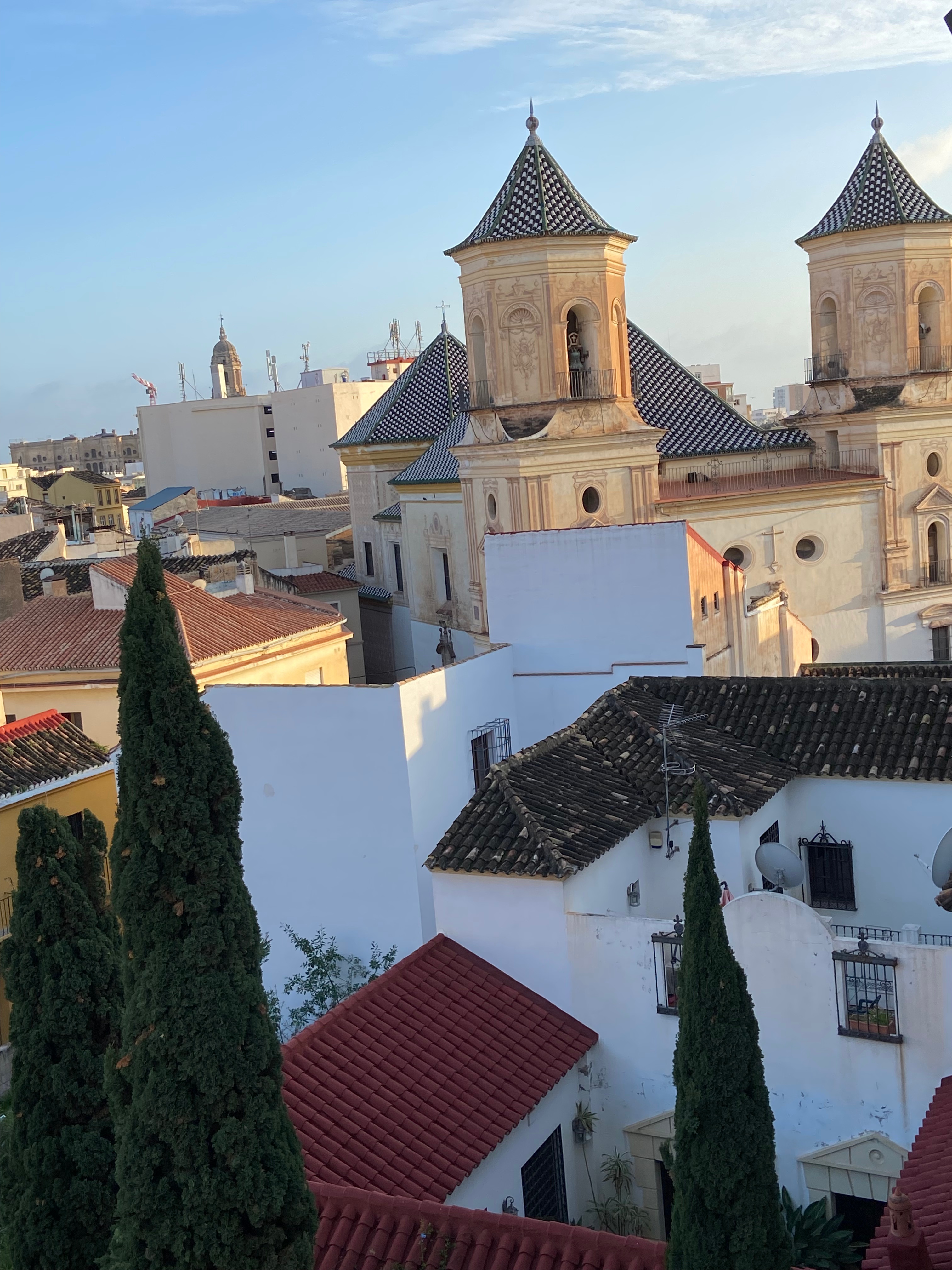
From the roof terrace of my Airbnb, I looked over to the church of San Felipe Neri, a baroque church with distinctive green and white tiles on the bell towers. Listening to the bells ring out several times a day, a pure and undiluted sound, I felt a great sense of serenity and groundedness. I’ve always loved church bells.  Although I didn’t do a tour of Malaga Cathedral, I did go into another church, Santo Cristo de La Salud, in the centre. Drawn in by its terracotta exterior and circular stained-glass window, I went and in sat for a few minutes looking up at the domed ceiling, feeling into the sanctity, time stopping still.

Thwarted in my attempt to visit the Picasso Museum (sold out even in low season!) on day one, I joined a tour of the Moorish fortress, The Alcazaba. I am somewhat spoilt having lived and studied for nearly five months in Granada in the ‘80s with the Alhambra Palace and the Generalife Gardens a half-hour climb up the hill from where I was living.  Given today’s mass and over-tourism issues, I realise how extraordinarily lucky I was to have had unfettered access to a UNESCO World Heritage site, and one of the most magnificent examples of Islamic art in Spain.

Like the Alhambra, the Alcazaba sits on a strategic hilltop and was previously a Roman settlement. The tour started at the Roman theatre and the site of sunken pits which housed fermented fish sauce called garum, the Roman equivalent of umami flavouring.

The glory days of the Alhambra and Alcazaba ended with the Catholic conquest – the Reconquista – which culminated in 1492 when Granda, the final Moorish stronghold, surrendered to King Ferdinand II and Queen Isabella I. The Alcazaba was largely abandoned by the 18th century, damaged during the Napoleonic wars and, again, during the Spanish civil war.

Restoration started in the 1930s – our guide pointed out some of the remaining Moorish parts: the double walls, one inside the other, making the fortress harder to attack along with the bent entrances, the cobbled paths that double back on themselves, another defensive feature to slow down potential attackers; the carved caliphal-style horseshoe-shaped arches at the entrance to the main hall, the Taifa Palace; the 8-point star in the paving stones; a number of carved wooden ceilings with their intricate geometric patterns from the Mudejar tradition, a style blending Islamic and Christian artistic traditions, and a decorative arched niche set into the wall that would have housed water, perfume or flowers.

To my mind nothing comes up to the Patio de Las Arrayanes (the Courtyard of the Myrtles) at the Alhambra, but the Alcazaba’s restored gardens and series of courtyards and patios with tiled pools nonetheless have charm and offer a tranquil place for reflection.  

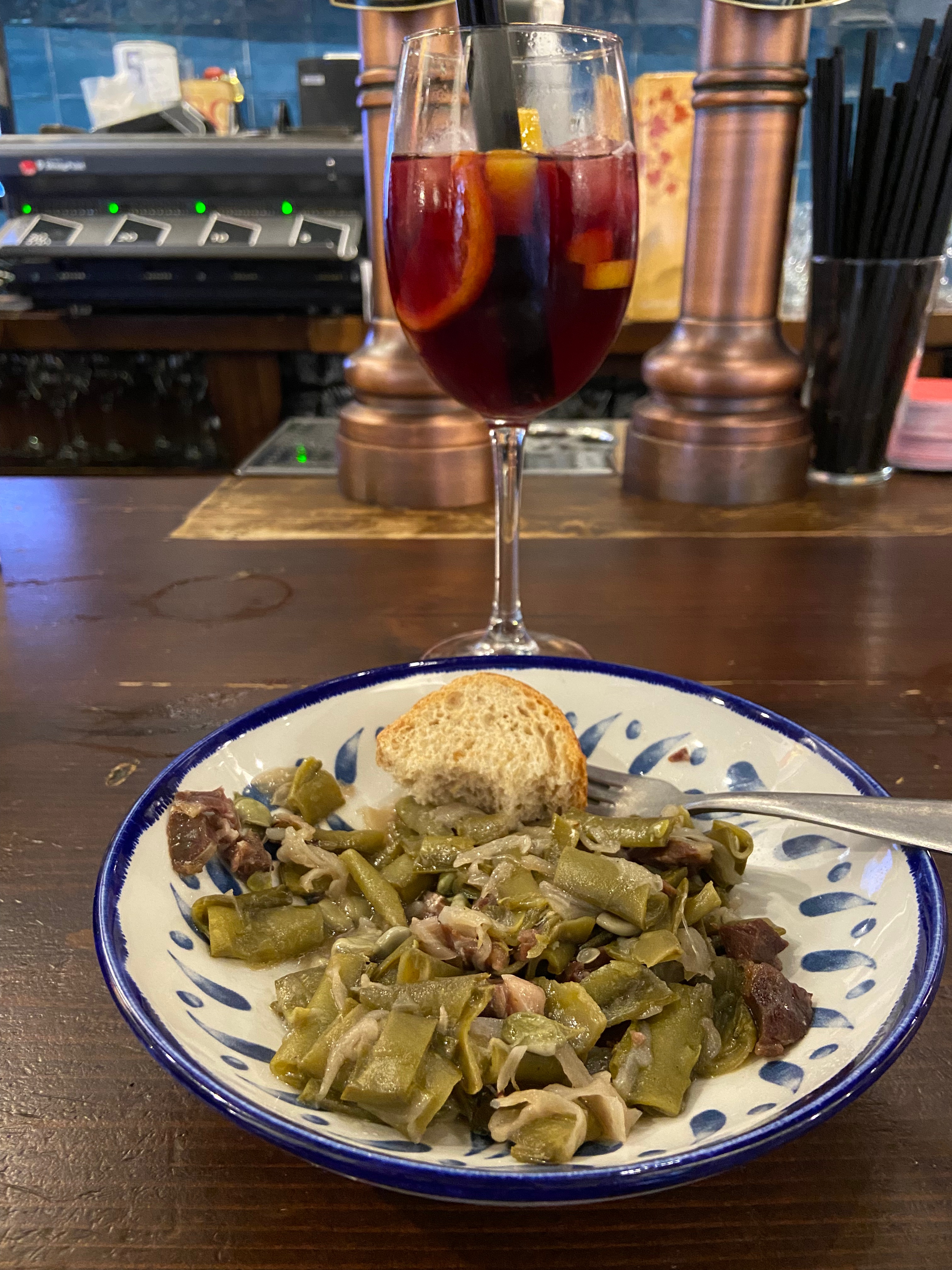
I was hungry and thirsty after all the hill climbing so I repaired to Bar El Pimpi at lunchtime, another Michael Portillo recommendation. Something of a Malaga institution since the 1970s, El Pimpi is a wine cellar with lots of different patios and rooms. I found a stool at the bar and ordered sangria, tortilla espaňola (Spanish omelette) and habas con jamón (a stew of jamón serrano and broad beans). The omelette came doorstep-size and was disappointingly dry, but the beans and sangria were excellent. I got chatting to a couple Chris and Kat, from Ireland and West Virginia respectively. They are in their 50s, have sold their businesses and are enjoying the freedom to travel. They were heading to a spa after lunch and hadn’t bothered with any of the museums or sights. No FOMO there!

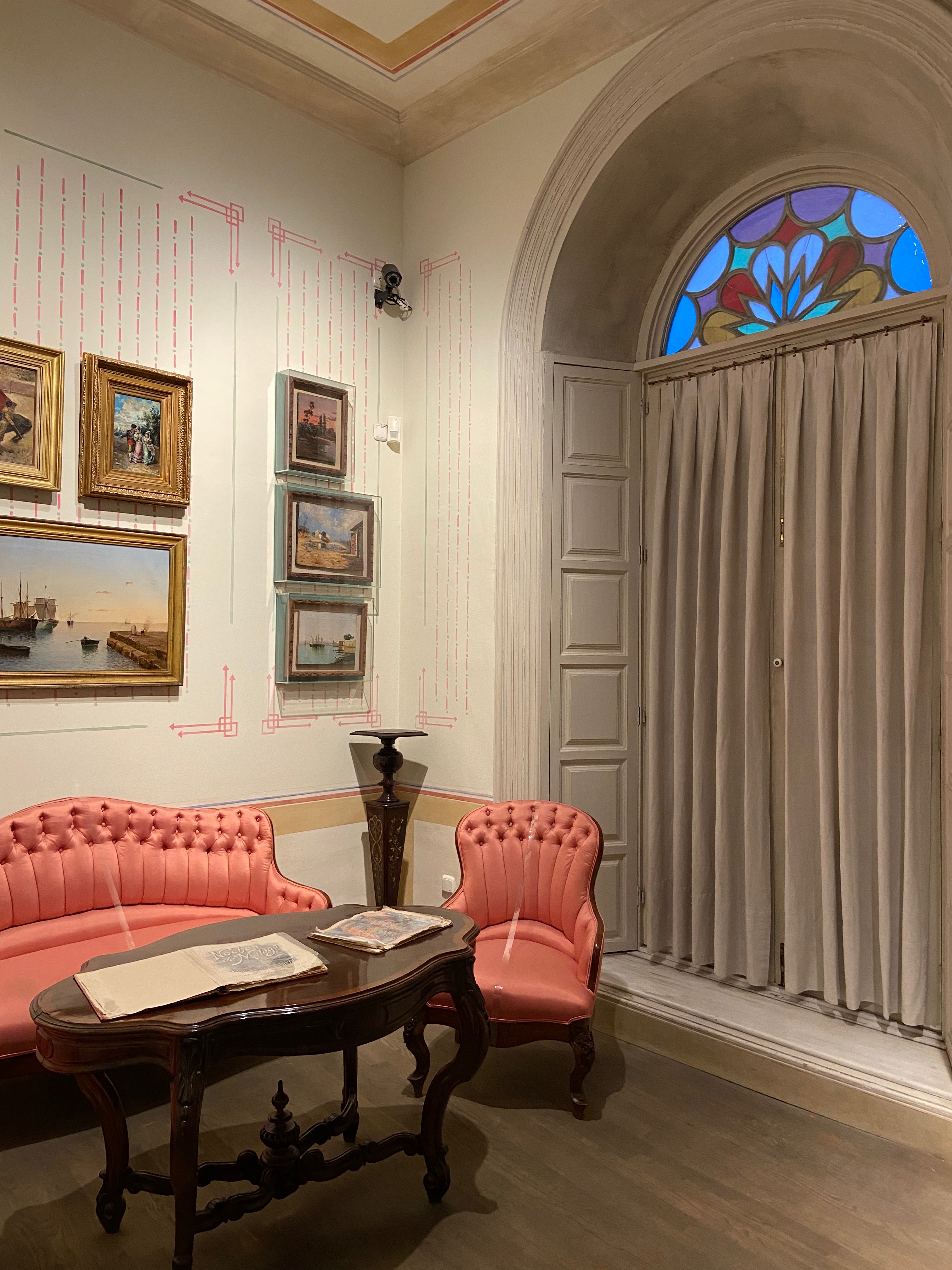
After a much-needed siesta – take a pinch of jetlag and a glass of sangria – I popped out again in the early evening. Not quite ready to do a Chris and Kat and eschew all museums, I was keen to check out Picasso’s birthplace – a house with beautiful stained-glass fan lights overlooking the Plaza de la Merced, a five-minute walk from where I was staying. Open till 8pm, it was perfect for the post-siesta, pre-dinner slot.

Picasso came from a wealthy bourgeois family and lived in Malaga until he was nine. The Museo Casa Natal de Picasso documents his early artistic influences, including his painter father, and his classical training. Despite spending most of his life in France, Malaga and Spain stayed in his blood. His father took him to the bullring as a child and bulls, bullfighting and the mythical minotaur all feature prominently in his work. Much has been written about Picasso and his representation of the bull and the bull as his alter ego. I am no fan of the bullfight, but I admired the elegant simplicity of his line drawings and painted ceramics featuring bulls and the bullring.

I went to the Picasso Museum the next morning. It’s housed in a traditional house with a courtyard and decorated with Mudejar wooden ceilings and rooftiles. A timeline on the wall describes the key events in Picasso’s life including two World Wars, the Russian Revolution, the 1949 First International Peace Congress in Paris (featuring Picasso’s “Dove of Peace” lithograph on the poster) the Vietnam War, JFK’s assassination and the advent of TV.

From the classical – a tender picture of his sister, Lola, with a doll dated 1896 –  to African masks, vases and pitchers to his cubist works and some of the more distorted surrealist pieces – the museum takes you through the stages of his artistic life, the extraordinary diversity of his work and all the different media he used – wood, plaster, bronze, linocuts, line drawings, metal, cigar boxes, clay etc.  It’s an understatement to say that Picasso was/is a complex and controversial figure, but I came away understanding a little more about his approach to art, his blurring the lines between classicism and cubism, and his exploration of what he considered the artifice of all artistic practice.

The café at the Picasso Museum is in a quiet courtyard lined with pots of bright red geraniums and orange kumquats. Scarred by ordering tea with milk at El Pimpi and receiving a pot of frothed slightly sweetened milk and a tea bag – an aberration – I chose coffee! I discovered that a weak coffee is a nube, a cloud, and the next strength up is a sombra, shade. Useful things for the traveller to know! And I enjoyed another moment of calm and quiet in a spot overlooked by a church.

On my last day, I had a slow morning – packing, stretching and doing admin. Then after a long walk along the Paseo del Parque, a park running alongside the harbour and planted with tropical and sub-tropical species, I looped back into the centre for some lunch, enjoying the views back towards the Alcazaba and adjoining Gilbralfaro Castle.

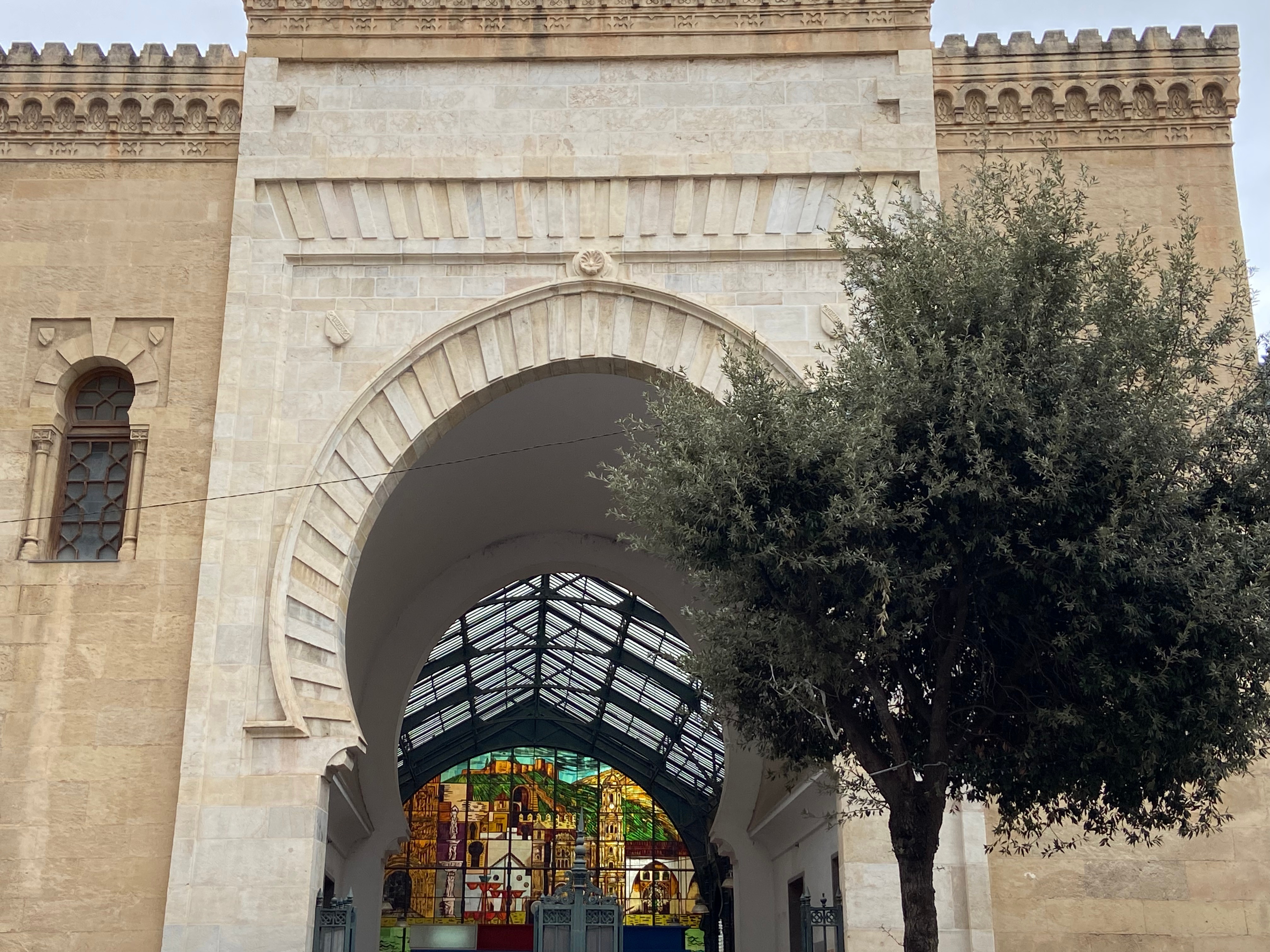
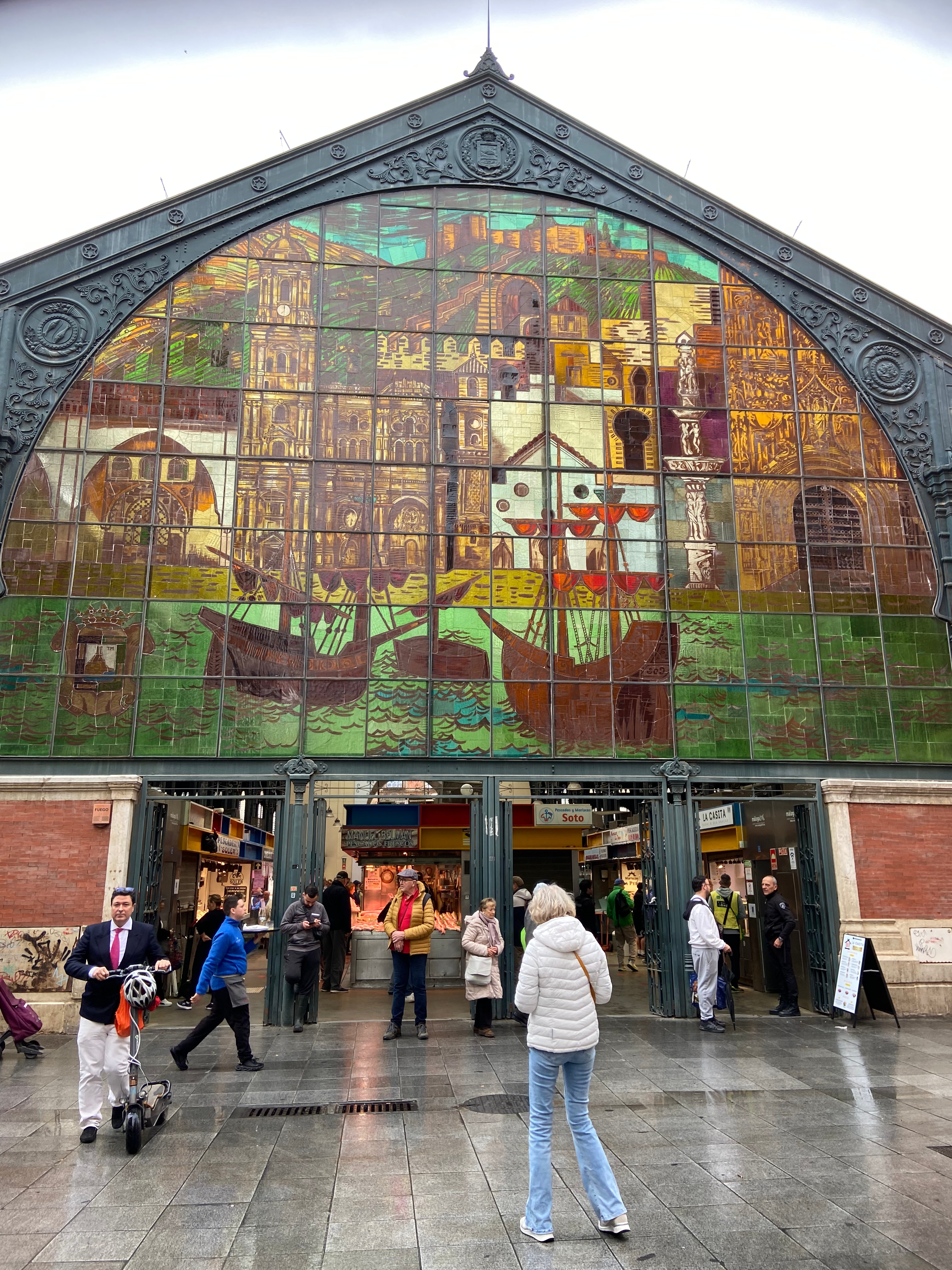
Following Chris and Kat’s recommendation, I headed for the Mercado de Atarazanas. The market was a boatyard during the Islamic period, the Moorish archway at the main entrance still part of the design today, and on the other side an impressive stained glass arched window depicts Malaga’s city scape.  It’s busy, bustling and bursting with fresh produce, tapas and aperitif stalls. I was a bit late but just made it in time to feast on paella for lunch, and to discuss with the stallholders how to get that toasted crusty layer of rice on the bottom and the layering of textures and flavours over that. What a treat!  

And to round off my afternoon, I visited another Chris and Kat recommendation, the Antigua Casa de Guardia, a bodega founded in 1840. Once again it was like going back in time. Lined with oak barrels, you choose which sherry or wine you want, and they chalk up the price on the wooden bar. I chose pajarete, a fortified wine aged for five years. A delicious and sweet note to end my stay in Malaga.

Rediscovering Spain (Part 1 of 2) – Madrid to Malaga

It had been a long time since I last visited Spain – probably back in the ‘90s when I made a couple of brief visits for work during my publishing days. Many moons ago I studied Spanish (and German) at university, and even tuning into the children’s cartoons playing above the luggage carousel at Madrid airport was exciting; just as well as my case took nearly an hour to appear!

Despite the bracing early March weather, eight degrees and wet and windy (it was mid-20s when I left Melbourne), I was off and out the minute I’d checked into my hotel, keen to make the most of my afternoon and evening in Madrid.

I was staying in the Barrio de las Letras, the literary quarter, home to many of Spain’s writers from the 17th-century Golden Age, a deliberate choice as my degree was largely literature-based. All the names came flooding back, Cervantes (Don Quixote), Lope de Vega and Tirso de Molina who, in his play El Burlador (seducer) de Sevilla), introduced the world to Don Juan, the charming hero-villain, a character with folk legend status made famous by Mozart’s opera Don Giovanni and the subject of many books, plays and films since.  I was in my element walking along elegant, cobbled streets dotted with early spring blossoms in the company of these literary greats who were variously honoured in colourful tiled mosaics, street signs, cafés, Metro Station names and quotations engraved on the pavements.  

I barely noticed the cold and that my feet were soaked through to my socks. Such was the excitement and cultural immersion. I had a few pit stops – an arty café where I dipped into a slim novella, Réquiem Por Un Campesino Español, one of my university books, first published in 1950, and a few tapas in a thronging and lively covered market.

Further on I stumbled on a rehearsal for Semana Santa (Holy Week) which will be in full flow as I write this over Easter.  14 men from a cofradía (a fraternity/brotherhood) were bearing a float weighed down with suitcases in preparation for the Holy Week processions. All wearing white runners, they performed a kind of slow-shoe-shuffle in time to the recorded music, their heads covered in a white cloth, a stand-in for the capirote, a hood with a conical tip, a symbol of penance, that conceals the face. I admired their dedication turning out on a cold and wet Saturday afternoon!

A few days later in Malaga, I peeked through the heavy wooden doors of a cofradía and saw the bulky shapes of sculptures (most likely Christ, the Virgin Mary and various saints) covered in cloth and mounted on a float, awaiting the Easter processions. These brotherhoods are Catholic organisations made up of lay people (men and women) who carry out charitable and religious works and events in the community. They play a key role during Semana Santa.

This was just one of many examples of timelessness and enduring tradition that I was delighted – and reassured – to find still in existence in Spain today. It’s 40 years since I spent four or so months in Granada as part of my Spanish degree – way before the distracted digital age of everything being available at the swipe of a screen.

I took the train to Malaga from Madrid’s Atocha Station the next morning. Atocha is a destination in itself with its glass and iron-clad domed roof – an old trainshed – complete with tropical garden. I was on a no-frills ticket, and it’s a three-and-a-half-hour journey from the centre of Spain down to Andalucia in the South. There wasn’t much to look at on the way but I got chatting to a young female student and soon realised how rusty my Spanish was!

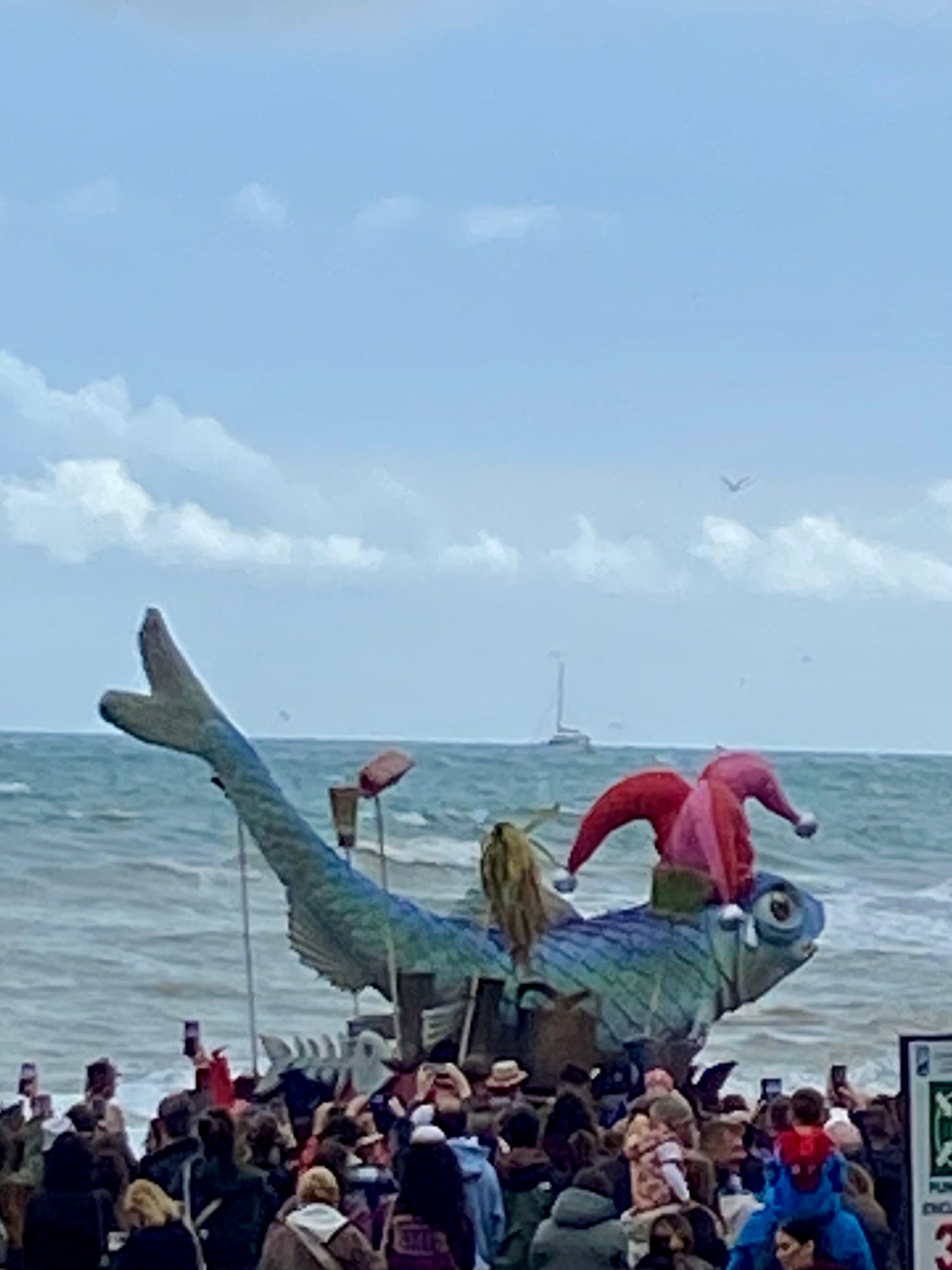
My goal was to get to Malaga in time for the Entierro del Boquerón (burial of the sardine), an annual ritual on the last Sunday of Carnaval, when festivalgoers mark the end of Carnaval. I had missed the midday jamboree of music in Calle Lario (I was still on the train) but got down to Malagueta Beach by 5pm and was surrounded by revellers in their costumes, tears painted on their faces, marking sorrow that the fun was ending and the sobriety of Lent fast approaching. Nobody quite knows how the sardine tradition came about – maybe it’s a nod to Malaga’s maritime heritage – but the message is clear, it’s about closure.  

I stood on the wall overlooking the beach to get a better look. Delightfully irreverent, the sardine sat atop a float, flashed its blue and green-glinting scales and sported a jester’s hat. From what I could see the fish was made of metal and layers of fabric and paper – perfect combustible material. Although the weather was squally, the fish was set alight, and clouds of black smoke blew back towards the city. In no time at all, all that remained were the spines of the fish.  Buried indeed. What joy to be part of the action. I felt as if I had time-travelled to another world.

Just back from Malagueta Beach is Malaga’s Pompidou Centre. I had no idea that the Paris Museum has a Spanish branch. But you can’t miss it with its Mondrian-style brightly coloured squares. It was open till 8pm so I drifted in and went to an excellent exhibition called Place-ness: Inhabiting Space, that explored how humans relate to (and ruin!) their environment. There were many references to exploiting the natural environment for productivity and profit, and a section with paintings and photographs exploring the impact of industrialisation including ‘non-places’ such as shopping malls, motorway interchanges, abandoned shipyards and airports. Some of my favourite pieces include an idyllic Alpine landscape with a shower and tap attached like an elephant’s trunk in the centre of the painting reminding city dwellers of the source of their water supply, and a pair of Armani suit trousers hanging on a clothesline, the pockets filled with plants and earth, an allegory by the Romanian artist about the immigrant experience in Italy and being uprooted.

For dinner, I found a delightful restaurant with earthy home-cooked food near to where I was staying and away from the city centre. Reminding me of carpet sellers in a souk, the more touristy restaurants have hawkers stationed outside brandishing menus printed in three languages. It’s all too pushy for me.

Small and cosy with the menu on the blackboard and small chalk-painted wooden tables and retro chairs, restaurant Oliva was a great find. The welcome tapa- served with a drink – was an exquisite flavoursome stew of chickpeas made with a hint of chorizo and lots of vegetables and cooked slowly for hours. Other delicacies included roasted padrón peppers, eggs with asparagus and jamón and a cheesecake made with Queso Manchego. Delicioso!

Such richness on all levels, a feast for body, mind and soul – and I was only just over 24 hours into my Spanish sojourn en route to the UK. Spain Part 2 coming next week.  

A sofa saga – a 2-seater with a backstory but no backbone

I’m a big fan of recycling, upcycling and reusing so when it came to choosing a new sofa, something that’s been on my agenda for a while, I searched on Facebook Marketplace.

Although I do love a bargain, it’s as much about the thrill of the chase and finding something different that may not be available elsewhere as about saving money. Similarly, I enjoy finding new ways of using what I have – whether it’s moving furniture around or giving a new lease of life to an item of clothing that’s been languishing in my wardrobe. A snippet in last weekend’s paper said that skinny scarves are back in; I knew it was worth hanging onto that quirky scarf my niece gave me years ago. So good to be on trend! But back to the sofa.

I’d been scouring Marketplace for sofas for some months trawling through Chesterfields, velvet pleated sofas, bog-standard IKEA offerings and even some sofa beds. Then a month ago I spotted a funky sage-green corduroy number, a 2-seater with no arms and deep storage underneath. I’ve been doing a lot of Life Laundry recently, sorting through old files, papers, newspaper cuttings, tax returns, diaries and journals. If I were famous biographers would have a field day. Who knows, I might mine my diaries for a book one day. Meanwhile, the under-sofa storage looked like a perfect repository for them.

The only drawback was that the sofa was in the Western suburbs of Melbourne, about a 24-km drive from where I live. I couldn’t face driving over there so I asked lots of questions instead. Having established that it was roughly the same height as my other sofa and that there were no dips, stains or squeaks (you’ll see later why I asked this), I bought it for the modest sum of $250 (it had been reduced from $400), and paid upfront to secure it.

Finding someone to collect and deliver the sofa took more scrolling and back and forth-ing on various apps. Hmm, I thought that buying something this way would be less of an effort than going to a physical store but now I’m not so sure. A friend recommended Airtasker, where I got offers ranging from $385 (ridiculous, at more than the cost of the sofa!) to $90. I chose a driver around the $100 mark. In readiness for the arrival of the new sofa, I shifted my old, more traditional sofa (rolled arms and pleated skirt) up against my study door.  I measured it and photographed it to advertise free on Marketplace and a few other sites. I’d had the sofa for 26 years, from when I lived in Oxford. It had been a good friend, and I loved its green, yellow and terracotta checks but it was very faded and it was time to pass it on. But despite over 1200 views and 19 saves on Facebook, I didn’t get any takers.  

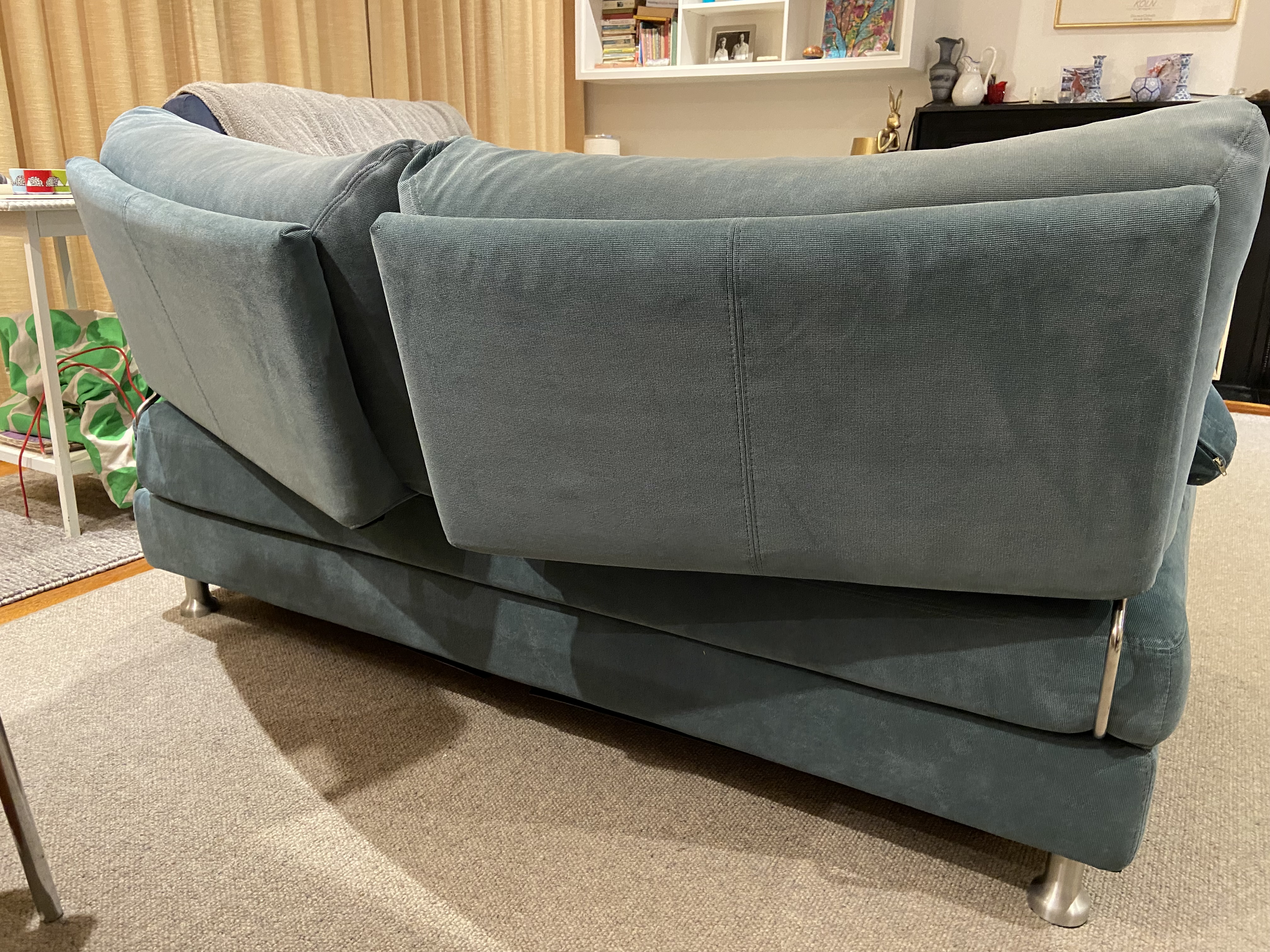
The new sofa duly arrived – the base with the storage underneath came as one unit, the back cushions separately in a black bin liner. I reckon it had been in a shed or garage for a while. There were two steel rods to fix the back cushions into the base. I quickly realised – heart sinking – that there should be four rods, and so I asked the driver to search his van but no luck. There was a rod at each end but nothing anchoring the inner side of each back cushion. A sofa without arms was one thing but no proper back?!  I hadn’t signed up for an Ottoman.

I rang the vendors immediately – a mother and her daughter who were selling on behalf of the other daughter/sister. Later that night they texted that neither they nor the sister could find the rods, and didn’t even realise they were missing as: ‘the couch is functional without them’. I begged to differ. And, while I was at it, I mentioned there was a bit of a splotchy stain on one of the back cushions. To my amazement, they said they knew a steel engineer and they’d swing by at the weekend, pick up one of the rods and get two new ones made. Plus, they refunded me $50 for the stain. It seemed too good to be true – how many sellers on Facebook know a steel engineer and would go to those lengths to find a solution?

Meanwhile, I was stuck with old sofa as I had used up the second of my two annual Council-run ‘hard rubbish’ collections earlier in the year disposing of one of my other sight unseen Facebook purchases – a single bed base with drawers (I’ve got a thing about storage) for my twin-bedded spare room. Turns out it had an incurable, inconsolably whiny squeak. Thank Goodness, I tested it when I got new mattresses – I could barely breathe without the base creaking. It ended up as hard rubbish, and was devoured by the metal jaws of the Council truck. On sending photographic evidence to the seller, I did get a refund minus the delivery fee. But here I was going in again for a blind date with a second-hand sofa!

My lovely neighbour Jill about ten doors down offered me one of her hard rubbish collections. We wheeled  and wobbled my old sofa down the street on a trolley to the nature strip outside her house. And it was RIP to my dear old sofa purchased from the MFI Furniture Group in 1996. So far, so far good, pun intended.

The following Friday I got a text from the sofa sellers to say the mother had sent the newly made steel rods by Express Post. My excitement mounting, I asked for a copy or screenshot of the tracking slip only to learn that the mother had split tea all over it. What? Seriously?! This did not inspire confidence but I resolved not to cry over spilt tea… They reassured me, however, that the rods had been sent, that they would arrive, and I would need to sign for them. I never truly doubted the honesty of the vendors but the rods looked like they’d be tricky to copy and what if they didn’t fit or didn’t match? It all felt so unlikely. I was worried I’d bought a dud and would need yet another hard rubbish collection.

Express Post takes one or two business days maximum so I was ready and waiting, bright-eyed and breezy, on the Monday. Apart from my dog walk, I didn’t leave the house.  There followed an agonising week of waiting that looked like this:

Monday: My neighbour was having a new kitchen installed so vans were going up and down the drive all day long but none of them were delivery vans with my steel rods.

Tuesday: a parcel landed on my doorstep – aha, here it is I thought, holding my breath but, no, it was two boxes of my favourite granola bars from Marks and Spencer, a gorgeous treat from a colleague who went back to Blighty in July. Lovely but NOT the rods.

Wednesday: a van drew up and a delivery guy came to the door (YESSSS I thought in another adrenal rush), but this time it was a pet seat cover for my new (second-hand) car. My last car got very ‘dogged up’ with sand and slobber so I am determined to keep my new alloy-wheeled beauty in pristine condition.

Thursday: a van drove up and a box of environmentally-friendly laundry detergent refills (only available online) arrived on the doorstep (all this is so ironic as I am not a big online shopper – I’ve never even done an Uber eats for example). Then, later that morning, the Body Corporate Gardeners knocked at the door to ask what needed doing in the garden. Each time, there was van and door knock activity, I got my hopes up.

Thursday evening: I feared the rods must have got lost in the post and sent a somewhat desperate-sounding text to the sellers. Could they not go back to the Post Office where they sent it, show a bank receipt (amount and time) and generate a tracking slip – surely the system would have the technological know-how? It transpired that the mother was not sure whether they had been sent Express or Registered.  Registered Post is only for documents so I thought it had probably been sent standard parcel post but required a mandatory signature. That would explain the delay.  It transpired that they had sent it from a small PO counter in a larger retail shop and it wasn’t possible – so they said – to track retrospectively. OK, I replied. I don’t doubt you’ve sent them.  I’ll sit tight. Tight being the word…

Friday:  my neighbour Jill (she of the trolley) texted to say she’d been walking past my house and seen something bulky sticking out of my mail box.  The vendors had explicitly said the package would need a signature so it was unlikely to be the rods, but you never know. I dashed out to check. It wasn’t…It was the Government’s National Bowel Cancer screening test. Argh, the disappointment.

I continued to sit tensely but, not of course, on the new sofa.

Then miracle of miracles, the following Monday the daughter texted with the tracking number and to say the parcel had been returned to my local mail delivery centre the previous Monday!  It turns out that the parcel (it had been sent Express), had been returned as they hadn’t been able to find Unit 2 at my address. My address is interchangeably Unit B or 2 but there is no 2 marked on the house, only B. Had the vendors not tracked down the tracking number, the rods would have never found their way to me. The vendors didn’t put their address on the package, and Australia Post were under the impression that my address didn’t exist….

Once home, I am very happy to report that the new rods were a good match, and a good fit. I could hardly believe it. The vendors were profusely apologetic for all the toing and froing, and confusion. But, with the rods fixed in and the sofa sporting a firm back, I was only too happy to forgive and forget. After 56 texts, three weeks of faffing (from purchase to picking up the parcel) and a week of false starts, the situation was resolved. I was sincerely grateful to them for all they had done which, let’s face it, is above and beyond what one would expect from a seller on Facebook Marketplace.

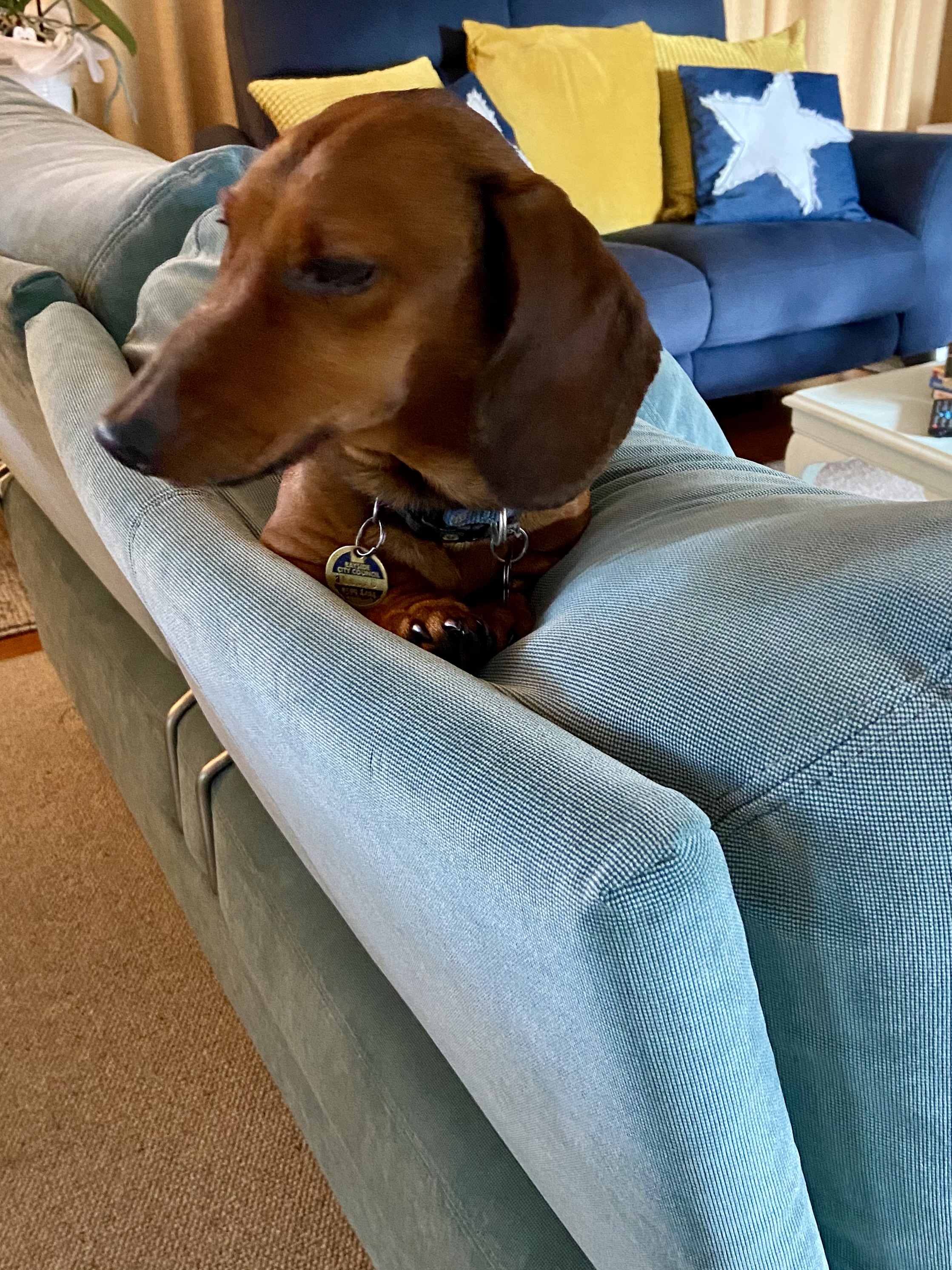
And, the first individual to test the sofa was my canine nephew, Rupert, who is staying with me and Bertie. Rupert gave it his seal of approval and adopted it as his look-out post. There are several morals to this tale:  patience is a virtue, there are good people out there, and always hold onto a tracking slip! Amen.

Back in Blighty Part 1

It’s always an adventure of sorts returning from Australia to family and friends in the UK! Due to the long, snaking passport queue and luggage delays, it took three hours to get from the plane to my sister’s front door in London. I had hoped to fly straight into my brother-in-law’s 70th birthday party and had rested as much as possible on the plane so I’d be in sparkling form on arrival. As it turned out the only sparkle was on the glasses I helped wash up; I arrived just as the last guests were leaving! Never mind, I was still part of it and happy to muck in and help clear up. And the wonderful consolation prize was meeting – and cuddling – my newest grandchild aka great-nephew, Douglas Finlay, aged just over two weeks.  I was- and remain – totally smitten!

A couple of days later my nearly 92-year-old mother met me at her local train station in Nottinghamshire. She’s still doing short local drives – just…We had an eventful first week together what with her malfunctioning hearing aids, a pesky bladder infection popping up (every time I come over, I seem to troop to the surgery with a urine sample!), and an outbreak of mice.  Mice are canny and opportunistic little blighters; we first detected them feasting on bird food in the garage, then suddenly they seemed to be everywhere, reminding me of that song about a mouse living in a windmill in Old Amsterdam. Like their Dutch forbears these mice must have been wearing clogs – judging from the scrabbling in the roof space – and the clip-clippety-clop on the stairs.  Not only did we spot one dashing under the grandfather clock in the hall, another one had clearly been upstairs to the spare bedroom and into my suitcase where it had snacked on a (wrapped and sealed) muesli bar. All a bit too close for comfort!

Among the highlights at Mum’s were having my Yorkshire-based brother and sister-in-law overnight and preparing lunch for them and my Australian nephew and his wife. While that entailed a fair bit of shopping and catering for Mum to plan (flap and worry about!), it all went brilliantly and no rodents were in evidence. I also enjoyed watching the Wimbledon Men’s Singles Final with Mum – in real time. AND I got her to sit still for more than 20 minutes – we were both gripped by the long and hard-fought match with the 20-year-old Spaniard Alcaraz beating four-time defending champion Dubrovnik (Mum does a very good line in Spoonerisms).

Back in London the big treat was a trip to Covent Garden with my sister and brother-in-law to see one of my favourite operas, The Marriage of Figaro. I first got into opera as a 17-year-old in Vienna where I was an au pair girl to a stuffy family with minor aristocratic leanings. Back then, I would purchase a standing place at the back for a few Austrian Schillings. My ticket to Figaro was a very generous early ‘milestone’ birthday present from my sister. There’s something hallowed about the Royal Opera House with all that plush red velvet, gold and gilt edging. The music is sublime, the sets beautifully crafted and the staff attentive and gracious. And, always a rebel despite outward appearances, I love that we smuggled in our Sainsbury’s sandwiches and surreptitiously ate them at the bar with our pre-ordered dinks during the interval. While we all know and love Il Nozze di Figaro, numb bum did start to set in during Act Four. You can’t help wondering if there’s one too many layers of subterfuge, hiding in the bushes and letters falling into the wrong hands!

A few days later I went with other friends to an open-air opera at Holland Park in Kensington. Itch is a modern opera about science, adapted from a book about chemistry written by DJ Simon Mayo for his son –  and we attended was the world premiere. Against the backdrop of a brilliant set comprising 118 cubes – as in the periodic table – the plot involves the discovery of a new undiscovered element, a radioactive rock that has the power to solve the global energy crisis but also destroy humanity. Referencing climate change and the Gaia Theory and greedy corporations, it becomes a battle between the chemistry-obsessed schoolboy, Itchingham Lofte, and a bunch of corporate baddies.  I really enjoyed it and the soaring arias – accompanied by the City of London Sinfonia –wouldn’t have been out of place in a classical opera. The only drawback was the lashing rain – while the Holland Park Opera auditorium is under a canopy, the sides are open and it was none too warm! As I write this, it’s now August – but the UK has had the wettest July for years. Just my luck.

After the opera, I stayed with my friends at the Army and Navy Club in Pall Mall. It wasn’t as formal as I had imagined, and it was a treat staying in central London. My room reminded me of a cabin on a cruise ship and had everything I needed. The club has a rich history; the founder and First President was wounded in the Battle of Waterloo and – and here I’m missing the detail – there is some connection with the Entente Cordiale signed between Britain and France in 1904. The walls are lined with prints and pictures from wars, battles and country pursuits from the 1800s onwards – ranging from WWI cartoons and fox hunting scenes to portraits of members of the Royal Family across the ages including one of the young Queen Victoria. And then, as you might imagine, there are various trophies of the stuffed variety – from a greater kudu head to an emperor penguin from Scott’s Antarctic Expedition.

I book-ended this second London visit with an after party for my brother-in-law’s 70th to make up for missing the first one. It was just about warm enough to sit outside and I loved catching up with friends over drinks and nibbles. The following morning, I was off to Devon to sample rural village life. More next time.

Getting my Brit Fix and Bridging the Divide

If you had told me when I moved to Melbourne in the early 2000s that a pandemic in 2020 would see Australia close its borders, pull up the drawbridge and ban international travel, I would probably have hightailed it back to the UK (I can hear my Mum saying she wishes I had!). Never did I imagine having to face enforced separation from my family and a country I love dearly with an indulgent rose-tinted, nostalgic fondness.

But I/we’ve managed magnificently: we’ve been suitably British and stoic – and even a bit Buddhist (well, I have; ‘this too shall pass’) – and made the best of it. And, as one with strong Luddite tendencies (yes, I still have a paper diary and LOVE it!) I acknowledge that technology and video calling has given us a lifeline and a rich sense of connectedness; in fact, as a family we’re more up to date with each other’s news than we used to be. I am one of four: there’s two of us here, and two of us there and we have a sibling video call every Friday.

And, thanks to the perseverance of my eldest brother Charlie, Mum uses an iPad and is FaceTime literate. Mum and I started out chatting twice a week, then – as COVID dragged on – I suggested a new way to bridge the divide. When Melbourne is nine hours ahead of the UK, I drop in at Mum’s at noon her time on a Sunday, and we listen (via her radio and our respective iPads), to her favourite programme on Radio 3, Private Passions. Each week presenter (and composer) Michael Berkeley explores the musical passions and lives of his guests. Sometimes we’re riveted by the subject and their musical choices, other times we drift off into chit chat, easy kitchen table tittle-tattle.  Quite often, Mum gives me an update on the birds on her birdfeeder, the state of her garden, what she is having for lunch or who has just walked past the window. It’s as if I am there in the room with her, and we treasure these special interactions.

Tuning into Private Passions with Mum

I’ve also had regular Brit Fixes thanks to plugging into BBC Sounds and listening to abridged versions of classic favourites such as Middlemarch – how did Dorothea stick it out with the GHASTLY Rev. Edward Casaubon? – Desert Island Discs, a Victoria Wood retrospective and, just recently, a reading of a beautifully nostalgic and touching story, written in 1931, of a family on their annual holiday to the seaside. There’s something wondrous about my physical self strolling along banksia- and wattle-fringed coastal paths with my dog Bertie, my headspace transported to Bognor Regis on Britain’s South-East coast, following the Stevens family strolling along the Promenade. Escaping the humdrum of everyday life, excitements back then included freedom from wearing ties, tight collars and stockings, and securing a bathing box with a balcony!

Other wonderful Brit Fix moments have included TV programme Secrets of the Museum – a behind the scenes tour of London’s V & A – looking at the extraordinarily detailed and delicate work of the curators and conservators. What joy to sit on my sofa, getting up close and personal with exquisite treasures, without the slow shoe shuffle past glass display cases, peering in at the small font captions. Another highlight was an episode of Rob Bell’s Walking the Lost Railways of Britain which took in the now disused railway station in Great Longstone, the Derbyshire village where my mother was born in 1931.

So far, so good. But as the months rolled on, I realised, with great sadness and a very heavy heart, that I was going to miss my niece Annabel’s wedding in July this year (it had already been postponed from July 2020) and Mum’s 90th in mid-September.

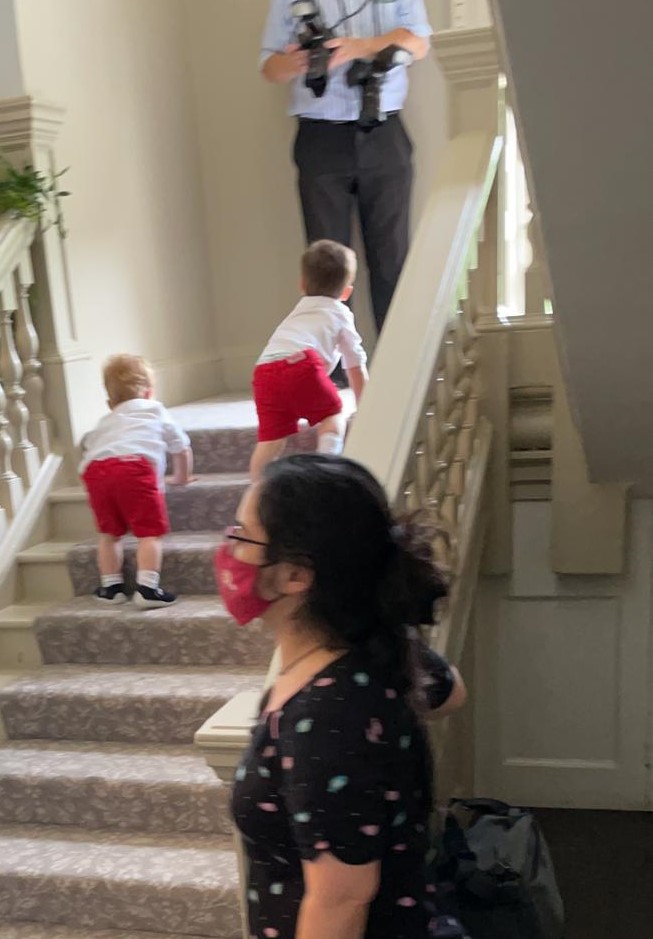
Once again, technology came to the rescue. My sister’s friend John gave me the most splendid (and I use that very British word deliberately) guided tour of Annabel and Jonny’s wedding in South London. We kicked off early and I had a bird’s eye view of the cake, the flowers, the cheeky bridesmaids and the page boys scampering about, the latter my nearly 2-year-old great-nephew twins, like little princes in their red shorts, white shirts and tartan bow ties.  I was there ‘live’ for the service, witnessed the exchange of vows, my niece radiantly happy and elegant, and Jonny resplendent in his kilt, cape and full tartan regalia, both brimming over with love. As they filed out, I had a quick chat with the just-married couple (making me the first person to address them as Mr and Mrs) and then stayed online while they were strewn with rose petal confetti, posed for photographs and then mixed and mingled. I had chats with many of the guests – from friends to family – until it got to 1am here and I had to remind them I was in my PJs and ready for bed!

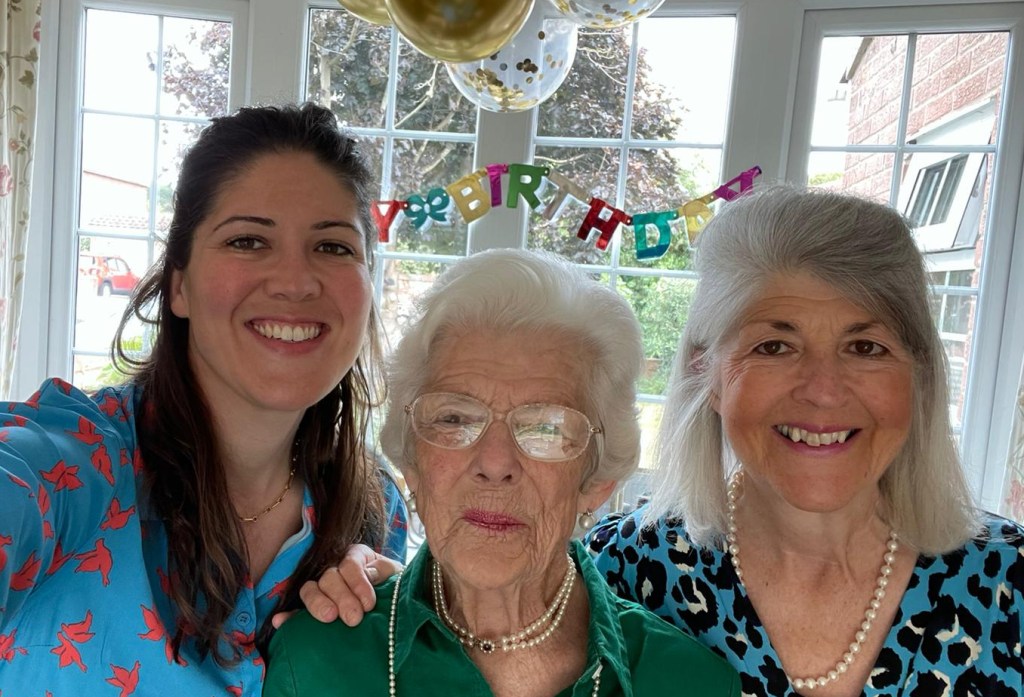
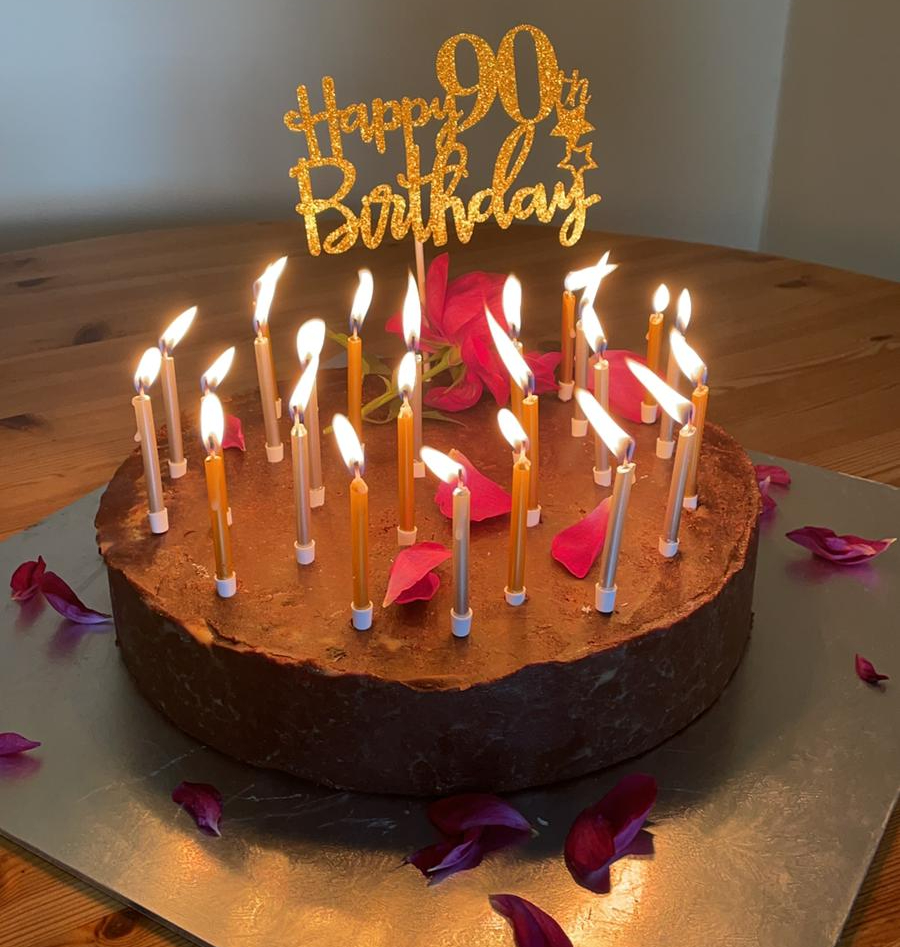
And then, the weekend before last, my brother Tim and I video-called into Mum’s 90th birthday celebrations – in fact, it was a four generation, three-country call from Mum’s breakfast table in Nottinghamshire to Tim and me tuning in from Melbourne, and my niece Georgie and the twins (the page boys) in suburban Paris! On the first call we watched Mum – in the swing and bright as a button from the get-go – open some of her cards and presents.

Four Way International Call

We tuned in again closer to her lunchtime party. This time, the newly-married Annabel, now Mrs Recaldin, was emcee. As bubbles and copious canapes were served, Annabel waltzed us around pointing out Mum’s many cards (35 and counting), the birthday banners and balloons and the assembled guests.  “Which of the grey-haired old dears do you mean?’ enquired Annabel as I asked to speak to some of Mum’s friends, “there are a few in the room!”

My brother, Charlie, toasted Mum with some heartfelt and touching words, acknowledging, too, the extraordinary kindness of her neighbours, George and Annette, who have been her rock and strength throughout the pandemic. “I’ve made it to 90,” replied Mum triumphantly, “and it doesn’t feel so bad!” Then, after thanking friends, family and neighbours for celebrating with her, she added: “I know I can be difficult sometimes…”  Thank Goodness for gin, piped up Charlie.

Having felt weepy on and off all weekend about missing Mum’s party, I went to bed with my heart aglow. I felt the love through the screen and across the divide, and was thrilled to see Mum, the belle of the ball, in her green linen dress and pearls. The word splendid comes to mind again. And next year I’ll be able to visit in person, catch up on hugs, lots of them, and kitchen table chat.

Adventures of a solo traveller: crossing Paris on one foot

I’m 50-something and have never been in ambulance – until last week that is.  And while I was no flashing light casualty – thank Goodness – it was a new adventure.  After five blissful days of reading, swimming and walking (oh yes, and eating very well) with my brother and his wife in Provence, I was on day two of a side trip to Avignon. And, for once, I hadn’t planned anything in advance but knew I wanted to make the most of the Festival.  The Avignon Festival is a huge two-week theatre festival originally founded in 1947. Running alongside the official ‘In’ Festival is the ‘Off’ Festival, offering hundreds of shows across theatre, dance, visual arts and music in multiple venues across the city.

Palais des Papes, Avignon

I was coming out of a performance of Molière’s L’Ecole des Femmes – in French no less – when I tripped on a step, caught my foot and wrenched my ankle back. Who knew it could be so excruciatingly painful, making me nauseous and dizzy? I tried not to f ‘n’ blind too loudly as I drew quite a crowd and the Red Cross volunteers came zipping over on their bikes.

Tearing those ligaments was more painful than breaking my wrist so I was very happy to discover that I hadn’t broken any bones when I was X-rayed in hospital. And on the plus side I’d basically got a free bone density test. Having spent all night in the Emergency Department of a French hospital with a family member last year, I knew what to expect: a long wait, some interesting characters – this time a woman delivering a three-hour monologue – and staff stretched to the limit. I felt hugely grateful to be otherwise well and able-bodied and not stuck in hospital in a war zone. And my sympathies were with the staff who were wearing T-shirts advertising they were on strike, no doubt for much-needed improved pay and conditions.

I was hungry when I got back in the taxi at 9.30 p.m. that night – lunch had been a bit of fruit and a biscuit on the run after doing a tour of the Palais des Papes.  One drawback to my Airbnb accommodation, just outside the city walls, was that it didn’t have a kitchen and was not well served by cafés and shops. I limped along until I found a shop with inviting pictures of avocados and tomatoes in the window, but when I got inside there were only dried goods, carbonated drinks, laundry powder, toiletries and ice creams. Channelling my inner Girl Scout, I bought a tin of tuna and four ice lollies in lieu of a bag of frozen peas to ice my ankle. It had to be that or the chicken nuggets. The only thing about ice lollies is that they melt quite quickly especially when stuck down one’s sock. Never mind, I put the remaining two in the mini bar fridge for the morning.

I lay awake with a throbbing foot that first night worrying how I would manage the train journey – in 31 hours’ time – from Avignon to Paris and Paris to London, what with my luggage, the long platforms and crossing Paris. I decided to start the day by icing my foot only to find the ice lollies had dissolved to a sticky orange puddle in the very un-cold fridge. Do minibar fridges ever work?!

Getting to the pharmacy was a bit laboured – while it seemed miles with a swollen and bruised foot, it wasn’t far enough to warrant a taxi or Uber. I stocked with an ankle support, arnica pills, painkillers and une canne anglaise (how interesting that crutches are called English canes!), the idea being that, when travelling, I could use one crutch to take the weight off my bad foot leaving one hand free to wheel my case. At least that’s what the travel insurance suggested when I had called at 3 a.m. to register my claim.

Then rather than sit in my room and fuss and fret, I asked my Airbnb host to give me a lift to the busy Place des Corps Saints as it would give me a choice of cafes and three theatres. And what a perfect place to hang out! Buzzing with life, people and performers plugging their shows either with flyers or bursts of song, trumpet notes, dances or outrageous costumes, it was one long spectacle. I treated myself to a hearty lunch (the highlight being the lavender-infused goats cheese panna cotta) in one café and then moved to a 1950s style bar for a cup of tea. That afternoon I went to see (foot conveniently propped up) an hour-long Offenbach ‘opera bouffe’– the Ile de Tulipan – a one-act comic operetta with some great duets that explores idea of gender, gender muddles and even the idea of same sex marriage. After a spell in another café, a pack of ice on my foot, I managed to get myself to one more show right around the corner from my accommodation. Il Nouvo Barbiere was full of farce, acrobatics and fun performed by some zany Italians – set, as the name suggests, in a barber shop. Perfect.

I didn’t manage to pre-book assisted travel for my return journey to London but, channelling my friend and erstwhile colleague Heather Ellis (see previous blog: https://wp.me/p3IScw-t0) who travelled solo by motorbike across Africa and the Silk Road, I decided to trust it would all work out, canne anglaise at the ready. And sure enough, the girl next to me on the platform in Avignon had only a small rucksack and offered to help with my case all the way through Paris and to Eurostar as she was also travelling through to the Gare du Nord.  What an angel. I was exhausted and sore on arrival in London but happy to have arrived back in one piece ready for a big family reunion weekend.  Avignon had worked out­ just a bit differently than envisaged: I’d seen some of the sites, had some interesting chats, seen five shows – each one un bon spectacle indeed – and had a free ride to hospital.

Scarecrows, Sprockers and State Visits

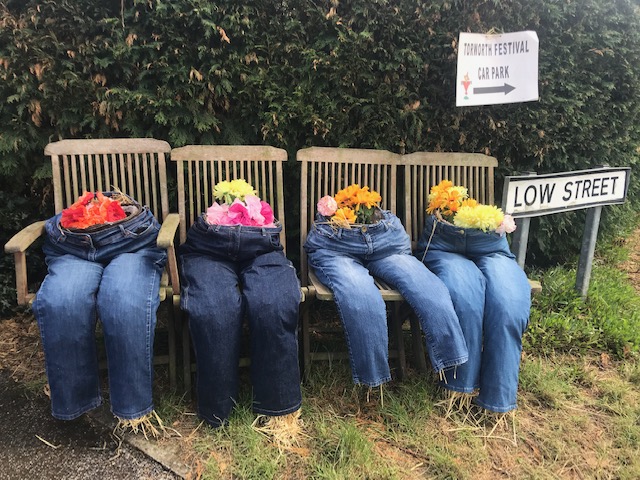
Have you ever thought about the history of scarecrows? I hadn’t but the 12th annual Ranskill and Torworth Scarecrow Festival – a village fundraiser close to where my mother lives in Nottinghamshire – prompted me to do some research. The Egyptians were the first to make wooden scarecrows in the likeness of deities to deter the birds from eating grain. In medieval Britain children would walk through the fields throwing stones at birds raiding the crops but when the Black Plague decimated the population in 1348, there weren’t enough people to work in the fields so they made scarecrows out of straw with turnips or gourds for heads.

I always think of that song in Joseph and his Technicolour Dreamcoat (still one of my favourite musicals of all time) Stone the Crows, the one that comes after Joseph interprets Pharaoh’s dream:

Well, stone the crows
This Joseph is a clever kid
Who’d have thought that 14 cows
Could mean the things
He said, they did

And who remembers Worzel Gummidge, the TV series from the 70s and 80s, based on the books by Barbara Euphan Todd with John Pertwee aka Dr Who as Worzel, the scarecrow? I’ve just read that the BBC is filming a new adaption to be screened later in the year. There’s something very lovable about a scarecrow who comes to life and befriends children, getting up to tricks and mischief.

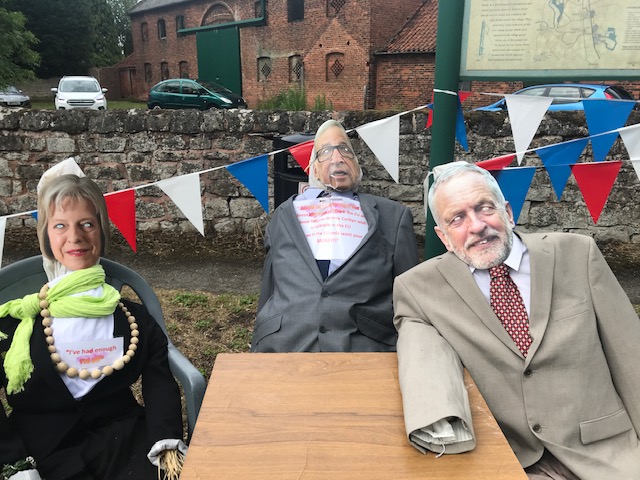
I didn’t count the scarecrows lining the roads around the two villages but there must have been a good fifty or more covering topics ranging from humour to history, cartoon characters, fiction, fantasy and fairy tale. Mum and I hopped on Wilfreda Beehive, a 1965 London Routemaster Bus, to view the exhibits in style.

Some of my favourites included three Spitting Image-style politicians: Theresa May, Jean Claude Juncker and Jeremy Corbyn, a policeman holding a hairdryer as a speed detector and a robed figure sitting on a chair entitled Mindfulness. Positioned atop trees and hedges along the route were knights on horseback, astronauts and children’s favourites such as Peppa Pig. A lot of fun.

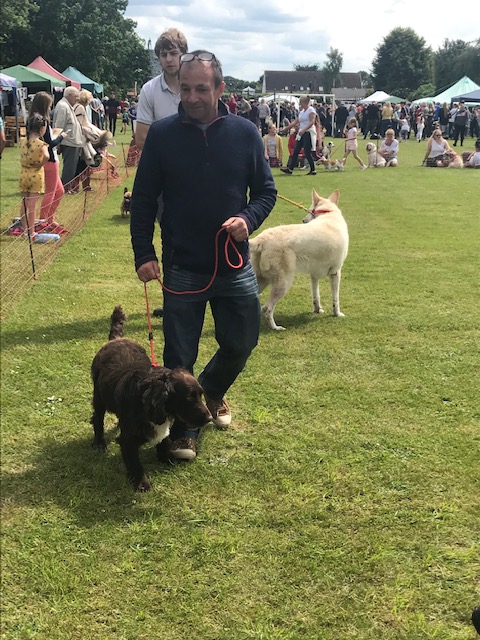
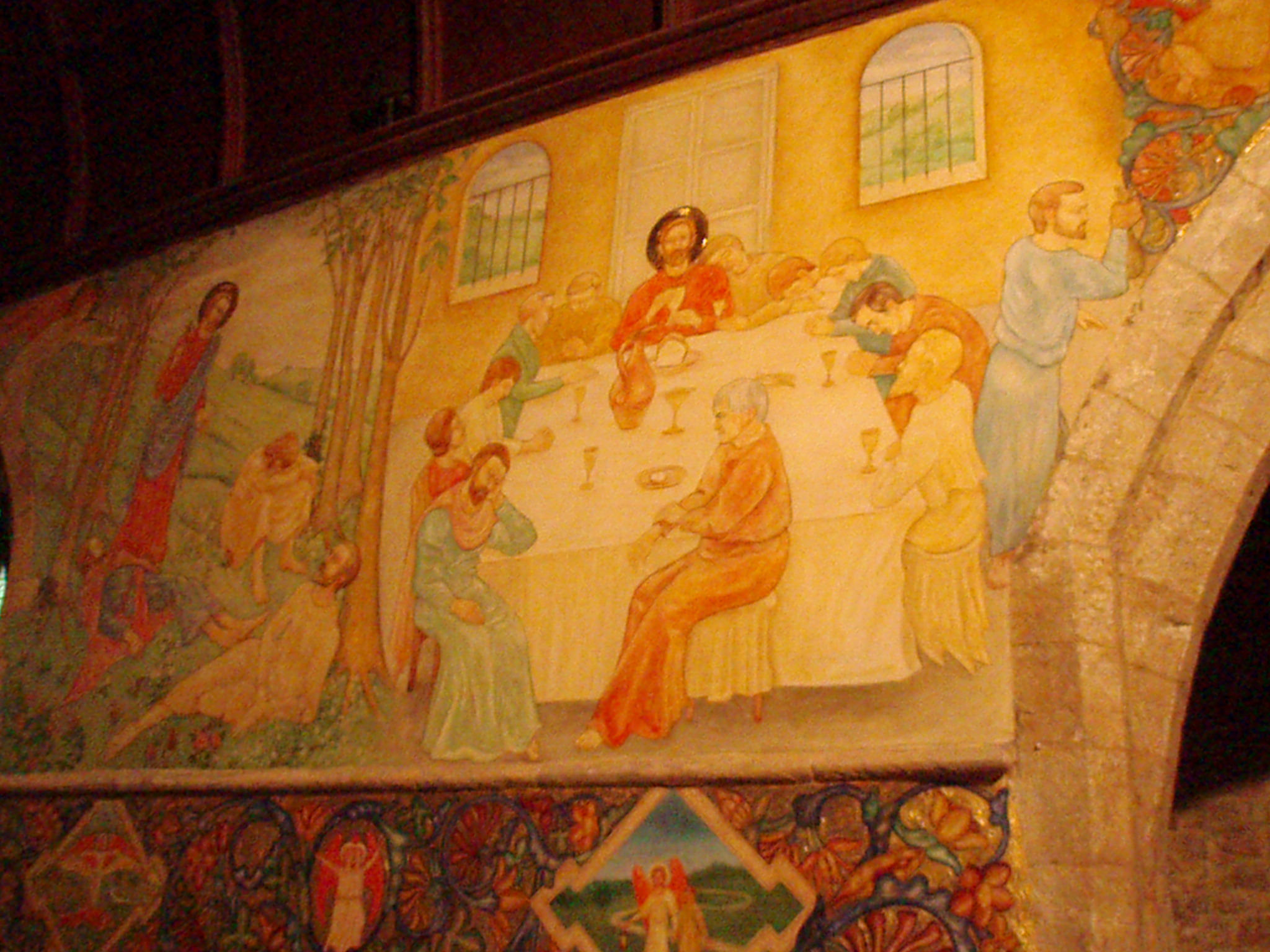
But there was more: amid the stalls selling hand-crafted bags and natural skincare products there was a dog show and competition with categories including Gundogs, Working Dogs and Hounds, Pedigree, Pastoral and Toy, Good Looking Boy/Girl and Most Appealing Eyes. Drawn to the spaniels, I met several Bertie lookalikes. They were, in fact, sprockers – a mix of cocker and spring spaniel. Bertie is the result (one of ten) of an accidental mating between a field spaniel and a cocker spaniel. What does make him? A focker, a flocker? The mind boggles. That same day I accompanied Mum to St Peter’s Church in nearby Clayworth, home to theTraquair Murals by renowned Scottish Arts and Crafts artist Anna Traquair (1852-1936). I reckon Mum goes more for the social connection than any deep-rooted faith. The somewhat happy clappy vicar – it was Pentecost Sunday (reminding me of our/Australia’s Pentecostal PM, Scott Morrison) – challenged us to reflect whether we were ready for God’s Kingdom on earth. The lady in the front pew assented with a vigorous YES and clapped her hands in the penultimate hymn. Mum, meanwhile, whispered all too loudly, that the service was going on way too long and she hoped there wouldn’t be yet another hymn. There was. I enjoyed a bit of time out to reflect, count my blessings (excuse the pun) and admire the fabulous murals.
Not to be defeated by the rain, we also visited Retford’s local museum housed in a handsome Georgian mansion. A mix of various private collections – china, glass etc – and displays of bygone eras, I enjoyed the Second World War Kitchen, the cabinet full of lotions, potions and medicines such as Dr MacLean’s Stomach Powder and the Victorian schoolroom. Although once a thriving market town (granted its first charter by Henry III in 1246) and then a coal-producing centre connected by a network of canals, it’s gone rather downhill and is now full of shops such as Primark and Poundstretcher.

There’ve been some afternoon naps – I’ve bagged what was Dad’s reclining chair and plugged in a little hot pad in an attempt to create a sun lounger experience. I’ve done lots of cooking and, to Mum’s delight, tried recipes that I have collected over the years with only one culinary flop so far. And all this against the backdrop of the ongoing Brexit debacle: no deal, a revised deal, a postponed deadline, proroguing Parliament, a General Election, scrapping Brexit or remaining. It’s chaos. And the way the Conservative party leader selection process is going, it looks like the UK and the US will each will be ruled by blond blusterers with bad haircuts. I met a lady on the train to London who was on the Conservative Executive Committee under Thatcher and was injured in the Brighton Hotel bombing in 1984. She knows Boris and insists that the buffoonery is all an act and that he is a shrewd player. Let’s hope she’s right!

Trump, of course, basked in the attention, pomp and ceremony surrounding his State Visit to the UK (labelling anti-Trump protests as fake news) to mark the extraordinarily emotional 75th Anniversary of the D-Day landings. Britain being Britain, he was highly criticised for his sartorial faux-pas with the vest of his white-tie outfit way too long under the jacket. Then there was the errant h in his spelling of the Prince of Whales and his vicious verbal attack on the Mayor of London. By contrast, the Queen so dignified and chipper and doing her bit for that so-called special relationship between the two countries.


From the Dreamliner to the Dales

I decided to change things a bit this year and booked Qantas Flight QF9, the Dreamliner, flying non-stop from Perth to London. I loved it and am a convert! The door to door journey from one continent to another shifted my perception of the distance, reducing it to more of a hop than a long haul. And what joy to avoid the hassle of a stopover and getting off the plane – often at an antisocial hour when sleep beckons most – and shuffling back through security, belt off, laptop out, liquids in plastic bags.

Boarding at 3.15 p.m. in Melbourne, I enjoyed a celebratory whisky and light lunch on the way to Perth and read the papers cover to cover.  Getting out at Perth airport is a breeze and there’s an open-air lounge where you can re-oxygenate and even hear birds flocking.

The next 17 hours flew by – literally. A couple of hours’ reading and then dinner before settling down for the night. I am always frazzled by the time I get on a long-haul flight, job or no job, which makes me nicely tired. I slept on and off – am I the only one to get a stiff neck?! – and didn’t check my watch until we were six hours away from London – nearly there then, I thought to myself. A bit more snoozing then I foot-tapped to a video of a Coldplay concert filmed in Sao Paolo before the plane landed in London.

Cut to a few days later when I got whacked with a bit of delayed jet lag and wanted to crawl back to bed as soon as I got up. Instead I spent nearly all day cancelling a long-planned trip to Wales with Mum (just too far, too complex and too exhausting at Mum’s stage of life and for me as the driver) and booking an alternative, more local, trip to the Yorkshire Dales. Endless conferring with my brother who lives in Yorkshire, viewing accommodation on Booking.com at crazily slow internet speeds, and phone calls to see if we could get rooms next door to each other etc. We decided on two locations: one night in the spa town of Harrogate and then three nights in a more rural location in Nidderdale.

We went through more chopping and changing, booking and cancelling – but I won’t bore you with the details. Suffice it to say that we booked into a Premier Inn in Harrogate, one of those impersonal, functional places that lacks soul. Dinner – charred to a cinder chicken and chorizo skewers and gloopy, rubber cheese lasagne for Mum – was inedible. Perhaps as subconscious karmic revenge, I managed to set the toaster on fire the next morning with my gluten-free bread! Thankfully, we had been to Harrogate institution Betty’s Tearoom for lunch and enjoyed a succulent and tasty kedgeree. And somehow – without a Sat Nav or detailed map, I had managed (with a few wrong turns) to negotiate the one-way system and found my way to a dress shop I had read about that specialises in 1950s dresses. Purchasing the dress of my dreams – a full swing dress complete with net petticoat and turquoise silk jacket to match was one the trip highlights! And we managed to get Mum to Marks & Spencer, hard-to-find parking meter, slippery wet pavements, brollies and shopping bags notwithstanding.

Mum at Betty’s

There were a few lowlights too. Arriving at our second destination, a country pub in the small village of Wath – accessed by a tiny humpback bridge reminding me of the Three Billy Goats Gruff song – we both sensed the place had a strange vibe. There was no reception but we located someone in the kitchens and she led us through a labyrinth of ramps, steps, swing doors and passages to our rooms. Red Flag number one: this place was not Mum friendly! While our rooms looked comfortable with their four-poster beds and chest-of-drawers, the old-style bathrooms only had showers over the bath. I had requested and been re-assured there was a walk-in shower for Mum. They apologised for stuffing up the booking and we agreed to move on.

We made a few calls to other places only to get a ‘no room at the inn’ response. Rather than panic, I resolved to trust that we would find somewhere and we drove over the moors to the popular village of Grassington, where we secured two rooms at a nice country hotel overlooking the square. Mum’s room was small and full of hard edges – tea tray, wooden bedposts – and an unpredictable shower that propelled me into overprotective mode. We drove each other mad at times! However, by 5 p.m. we had made a pot of Earl Grey in our room and enjoyed an energy-boosting complementary mini chocolate brownie. Dinner – wild halibut – was excellent too even if Mum’s hearing aids magnified the other diners’ voices and the clatter of crockery…

Rested and refreshed by the next morning, we woke up to sunshine – at last – and had a memorable day. We drove through narrow, twisty lanes bordered by green, green fields, ancient churches and moss-clad stone walls to Parcevall Hall.

The oldest part of the hall dates back to 1600 but the garden was created by Sir William Milner, a refined gentleman of Arts and Crafts sensibility and strong religious faith, in 1927. A series of stone terraces, beds brimming with summer pinks and purples bordered by immaculately cut yew hedges looked over out the vast expanse of Wharfedale and beyond. We sat in the Chapel Garden and listened to the soundtrack of birdsong and bleating lambs. Glorious.

Lunch afterwards in Appletreewick’s historic Craven Arms pub, full of fascinating memorabilia and collectibles – from old miners’ lamps to postcards of the Queen and a sample 1910 menu – rounded off a wonderful morning.

Our last day was a bit of a wash-out as the rain came down inducing a feeling of Cabin Fever. We got accommodation in Skipton at one of the only places with vacancies on a Friday night, a canal-side 1980s hotel with lots of exposed brick and endless fire doors. Dinner in the conservatory overlooking the canal gave rise to a few giggles: the wine waiter confessed to not knowing about, or even liking, wine, and the waitress described the salmon as coming with avioli – I think she meant aioli – and ‘loadsa other stooof” in her thick Yorkshire accent. The food when it came wasn’t bad at all, and we loved watching the ducks, swans and occasional barge passing by.  Nevertheless, when we got home at lunchtime on Saturday, it was a case of home sweet home!