Remembering adventures in Western Australia – Eye Candy Colin, coral reefs, Carnarvon, cancelled in Karratha and the Karijini National Park

A colleague recently travelled with his family to the Kimberley in Western Australia (WA), hiking in the remote bush. Hearing of his tales and seeing the photos reminded me of my travels and adventures in WA in 2003, and prompted me to dig out my photo album*. The characters I met were as colourful as the sea- and landscapes I explored. *please excuse the grainy photos photographed from said album.

On a mature gap year in Australia – my house in Oxford rented out – I had been staying with friends of friends in Freemantle, a suburb of Perth, camping in their garden.  A bit less Princess and the Pea than I am now, I shared the tent with a littler of Jack Russell puppies for company. I’d wake up with the puppies snuggled in my armpit, across my belly and around my head. How I adored them, particularly one of them whom I named Oscar.

From Perth I travelled north up to Exmouth with Australian Adventure Tours. The tour included sandboarding in Geraldton, marvelling at the Pinnacles, ancient limestones formations – some rather phallic-looking – as our guide Colin was (very) quick to point out, hanging out with bottlenose dolphins at Monkey Mia in the Shark Bay World Heritage Area and learning about the nearby Hamelin Pool stromatolites, layered sedimentary rock formations, single-celled organisms, that produce oxygen in a saltwater environment and were once the dominant lifeforce on earth! We passed through Carnarvon (my diary reading simply: Boiling! Banana plantations, NASA dish, supermarket and, according to Colin, the cheapest grog till Broome), swam with the whale sharks at Coral Bay, a wonderfully life-affirming – and energetic – experience, drank in orangey-red dawn and dusk skies and travelled on red dust dirt roads.


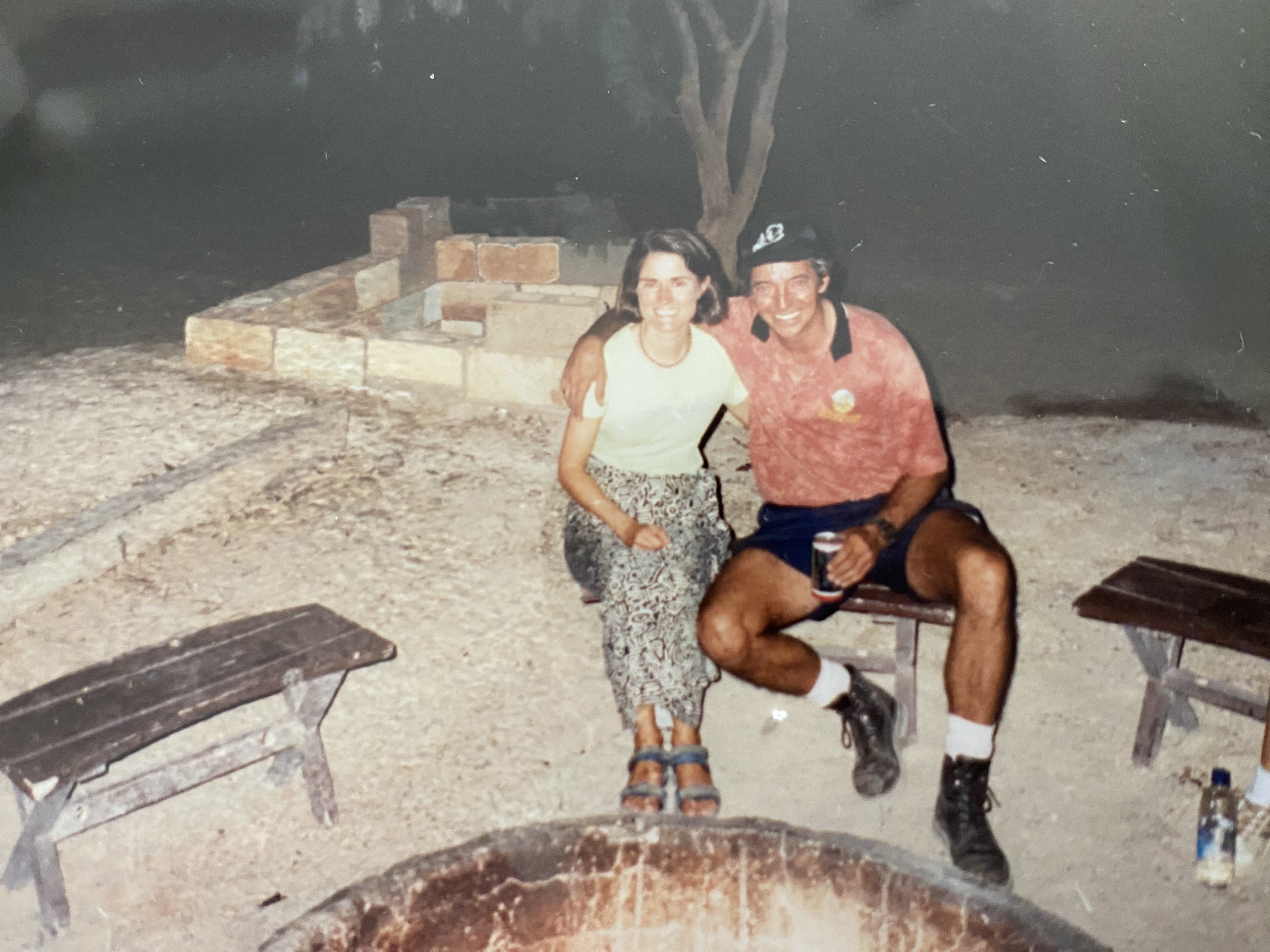
We stayed at various old homesteads and stations including Warroora Station (meaning Woman’s Place in the local Aboriginal language), where we made raisin damper, sat round the campfire, and where I did my best to keep Colin at bay.  I was the odd number on the tour; our party consisted of two gay girls from Tasmania, two rather inflexible German girls (they eschewed the damper at breakfast saying: “nein danke, only ever muesli in the morning”) and two sweet and giggly Japanese girls.

Colin was unapologetically Colin endlessly searching beaches for ‘Eye Candy’ and regaling us with apocryphal stories of past conquests such as Debbie from Essex.  He was sweet on me, insisting I sit next to him in the front of the van and dropping inuendo-laden hints, but I came away unscathed bar some campfire hugs. While he was a bit of a tour guide cliché, he created camaraderie, kept us all entertained and energised and loved his job.  

My next stop was the Ningaloo Reef Retreat (before it got upmarket and swanky). Ranger Dave with his bright eyes and rasta blond hair took out us to the turtle beds and kayaking on the Blue Lagoon. Sadly, even then, more than 20 years ago, there were sections of dead coral but what I remember more is the extraordinary diversity of marine life, the dazzling colours and quirky names of the fish. To name a few, we saw sailfin catfish, the harlequin snake eel, Tawny nurse sharks, Christmas Tree worms, fusiliers, humbugs, sweetlips and convict surgeon fish being chased by black damsels. A very different vibe from Colin’s tour, Dave was more Hippie Hippie Shake and exuded the kind of positive energy that comes from living close to nature. I also enjoyed the company of Mike, a curator of Indigenous art, a chain smoker of roll-ups with gappy teeth and wild and woolly grey-blond hair, and his wife Ilse, a linguist.

From Ningaloo Reef I took the overnight bus to Karratha, a mining town, to join a tour to the Karijini National Park. Due to arrive at 6.30 am, I had booked into a backpacker’s, and, as arranged, the manager came to meet me at the service station. I had stayed in some wonderful youth hostels in the south of WA – at Denmark, at Bunbury and Albany. Here, my room overlooked a courtyard full of cigarette stubs and empty beer cans, there were ants, chicken bones and food on the floor in the kitchen, and I’ll spare you the detail of the bathrooms.  Tired from a night on the bus, I couldn’t handle the nicotine-imbued squalor. Looking back, I realise this place was a budget option for mine workers and transient labourers rather than travellers.

The manager was furious when I complained it was dirty. She screamed at me, blaming me for getting her out of bed at 6 am and flung $30 of the $50 I had paid into my hand and booted me out the door. In today’s parlance, we’d say I’d been cancelled!  Smarting from the experience, I cut a tragic figure wheeling my case along the streets looking for alternative accommodation. But all was well as I pitched up at the Mercure and for $98 (bargain!) got a sparklingly clean room, TV, air-con, private bathroom and access to the pool. Bliss.

At 7.30 am the next morning, Andrew from Snappy Gum Safaris picked me up for the tour I’d booked to the Karijini National Park. We had to wait around a bit as his brother Brendan was still in the shower and nursing a hangover and sore leg from coming off his motorbike the night before. Something about the camber of the road. Yeah, right… And guess what? I was the only one on the tour, a fact which came back to haunt me.

Karijini is iron ore country. It is vast, remote and characterised by rust red dirt roads, cliffs, gorges and large termite mounds interspersed with splashes of green ranging from the grey green of the gum trees and the spinifex grass to the brilliant jade of the water in the rock pools. It’s like being inside a Fred Williams painting.

It’s a four-to-five-hour drive and, with a few stops along the way – a deserted homestead and a spidery drop dunny – we got to our first stop at lunchtime, the Hamersley Gorge, where Brendan and I had a dip in a water hole, the waterfall giving our shoulders a gentle massage. Sounds good doesn’t it but the brothers were distant and disengaged, cross that they were not making any money by taking one person on the tour.   While there was no male/female tension, they were keen to get their pound of flesh.

By early evening we crossed the dry riverbed of the Fortescue River towards the Rio Tinto Gorge (note how the big mining companies have claimed and named the land as theirs) and the Dales Gorge camp site, which was just a patch of red earth. Here they set up our swags and, for mine, hitched up a mosquito net to a tree branch.

Dinner was cheap sausages cooked over a fire served with salad and, to drink, bog standard cask wine or Victoria Bitter (VB).  My diary reports the boys ‘romped through the VB’ and complained about penny-pinching backpackers.  I was almost starting to miss cuddly Colin.

By chance a group of four tourists – an English girl, a Dutch girl and two Canadian blokes – came over after dinner and asked Andrew and Brendan if they knew the park and the various hikes. They boys went into a huddle with them while I sipped at my wine. Dollar signs in their eyes, they turned back to me after about ten minutes and asked how I’d feel about changing the itinerary to walk the much-more-exciting Miracle Mile the next day? It’d be the walk of a lifetime, the said. The tourists were keen to engage them as guides. Ching Ching.

Miracle Mile, why not?  It sounded good and I didn’t want to be the party pooper.  I slept reasonably well in my swag –  apart from being startled awake by one of the boys shouting in his beer-soaked sleep, after which I got a bit lost going for a pee in the spinifex. No mobile phone torches in those days!  

After a light breakfast, the day started gently with a trip to the Joffrey Falls, Knox Gorge lookout and Oxers lookout which is the meeting point of four gorges.

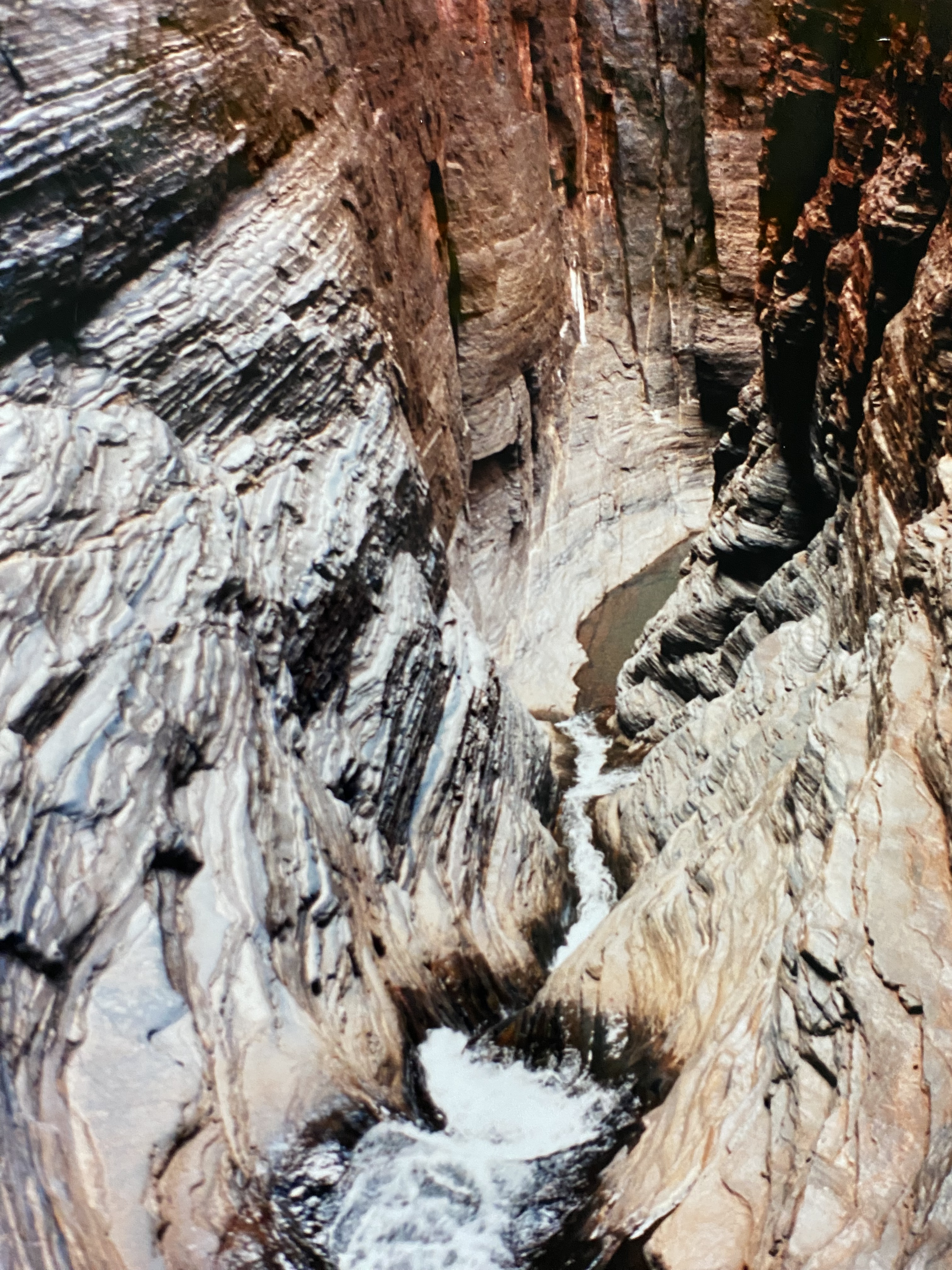
And then the adventure started. No wonder they had stuck to the catchy Miracle Mile moniker rather than detailing what it involves. The Miracle Mile is within the Hancock Gorge and the Joffre Gorge and involves walking along extremely narrow 20-metre gorge walls. While we did have helmets, there was no rope, and one wrong foot could have spelled disaster.  

It was physically and mentally demanding, but what made it most challenging for me was being the odd one out while the other four were a bonded team, walking together and encouraging each other on. I’ve always loved a bit of solitude and peace and quiet, but this was uninvited exile. I changed schools a lot as a child, and this reminded me of being the new girl and not having a gang to belong to.

At one point I slipped and grazed my knee, irritating Andrew, who was walking behind me. Shaking, I picked myself up and pushed on, desperate not to let the others see my fear – and suppressed fury! We crawled, climbed, clambered and inched our way along, in parts spreadeagled between gorge walls, jumping into rock pools below and swimming between gorges, floating our day packs on air beds. Andrew and Brendan set challenges and dares for the others, while I waited around – like a spare part at a wedding – getting cold (think damp bathers in shaded gorges), tired and hungry. When I got back to the car at the end, I bit into an apple only to crack a tooth!

The scenery was out of this world SPECTACULAR but I’m appreciating it more all these years later looking back at the photos in my album. My diary description from 11 May 2003 is underwhelming: Fab gorges, layering and rocks but wasn’t happy in my head as Phil (an ex) would say.  It was a tough character-forming experience, but one I will never forget. And as my German teachers would say: it’s all grist to the mill. Indeed, and 22 years on it makes a good story for my blog!

Vale Connie – a tribute from Charlottie

I’ve already written about how I first met Connie in 1995 when I was travelling in Australia – I was in my 30s and Connie in her 60s (see https://thisquirkylife.com/2017/09/12/how-spiders-got-me-writing/). In summary, I was taking time out between jobs and had been offered the use of a cottage in Noojee in Gippsland. Picturing a quaint, rose-covered dwelling where I’d have time to do my own thing, write poetry, meditate and relax, I had eagerly accepted.

It didn’t turn out like that – the cottage was more of a shack. And as I got ready for bed on night one, I noticed a large black shape on my bed. I now know it was a huntsman but back then I thought all Australian spiders were deadly. And this one, large, rubbery and hairy, was unlikely to be an exception. After dispatching the spider to the afterlife, I lay tensely on my mattress on the floor flinching every time the loose spidery threads of the coverless duvet brushed against with my face and arms. And looking around the room, I noticed spider webs decorating the windowsills and skirting boards like a dusting of snow.  Suffice it to say I had no sleep, not a wink. And stepping into the shower the next morning, there was a spider dangling from the bare light bulb. It started to feel positively Hitchcockian.

I decided flight was the only option. Rather than return to the safety and comfort of suburbia, and my brother’s house and pool in Bayside, I got out my notebook with phone numbers of friends of friends and rang Connie from a phone booth. My dear friend Helen in the UK had met Connie and Norman in a camp site in Darwin in the late ‘80s and given me their contact details.

Hearing the high-pitched hysteria in my voice and my garbled tale about killer spiders, Connie gently said: “Would you like to come and stay?”  And so it was that I was soon on a train to Kyneton (Central Victoria) where Connie met me off the train with a big hug as if we’d know each other for years. And we never looked back.

I was embraced by Connie and her husband Norman as one of the family from the get-go and joined in the rhythm of their daily life, mainstays of which included porridge and poached eggs for breakfast, drinks and nibbles in the evening and roasts for dinner. I am indebted to Connie, an excellent (and published) writer herself, for encouraging me to write my first short story, and for believing in me as a writer. It was winter and she set me up with a table and typewriter with an oil-filled radiator for warmth. I still have the story – The Swim – typed up on now-yellowing paper.

And in 2009 when I was making a living, albeit a modest one, from writing travel and lifestyle articles, she helped me edit my article about fishing on the UK’s River Test entitled Duffer’s Day Out for the travel section of The Australian.

I’ve never forgotten my stay with Connie and Norman in Kyneton. It was where I first tuned into Australian birds; they had a bird bath in the drive outside the kitchen window, and Connie identified the lorikeets, crimson rosellas, Australian magpies, wattle birds and pied currawongs. I learnt that the Australian magpie is not of the crow family like its Eurasian counterpart. And I grew to love its melodic warbling song, so unlike the cackling of the magpies I had grown up with. To do this day, I always think of Connie and tap into something grounding and quintessentially Australian when I hear the magpie’s song.  

After moving to Australia in 2004 I visited Connie and Norman several times in their new home in Shoalhaven Heads in NSW. And once again I slipped into their way of life, comforted by the unchanging routine of porridge and poached eggs for breakfast– often on the balcony in the early morning sun. Connie and I talked about family, books and writing, Norman tinkered with his boat, and I went for walks to the beach armed with a stick that Norman made for me to scare off any snakes that might be dozing nearby. Connie and I also went into Sydney to the Art Gallery of New South Wales.  I don’t remember exactly what we saw – it may have been paintings in the permanent collection – but it was a treat as Connie knew her art and helped me view the pictures from a more informed perspective.   

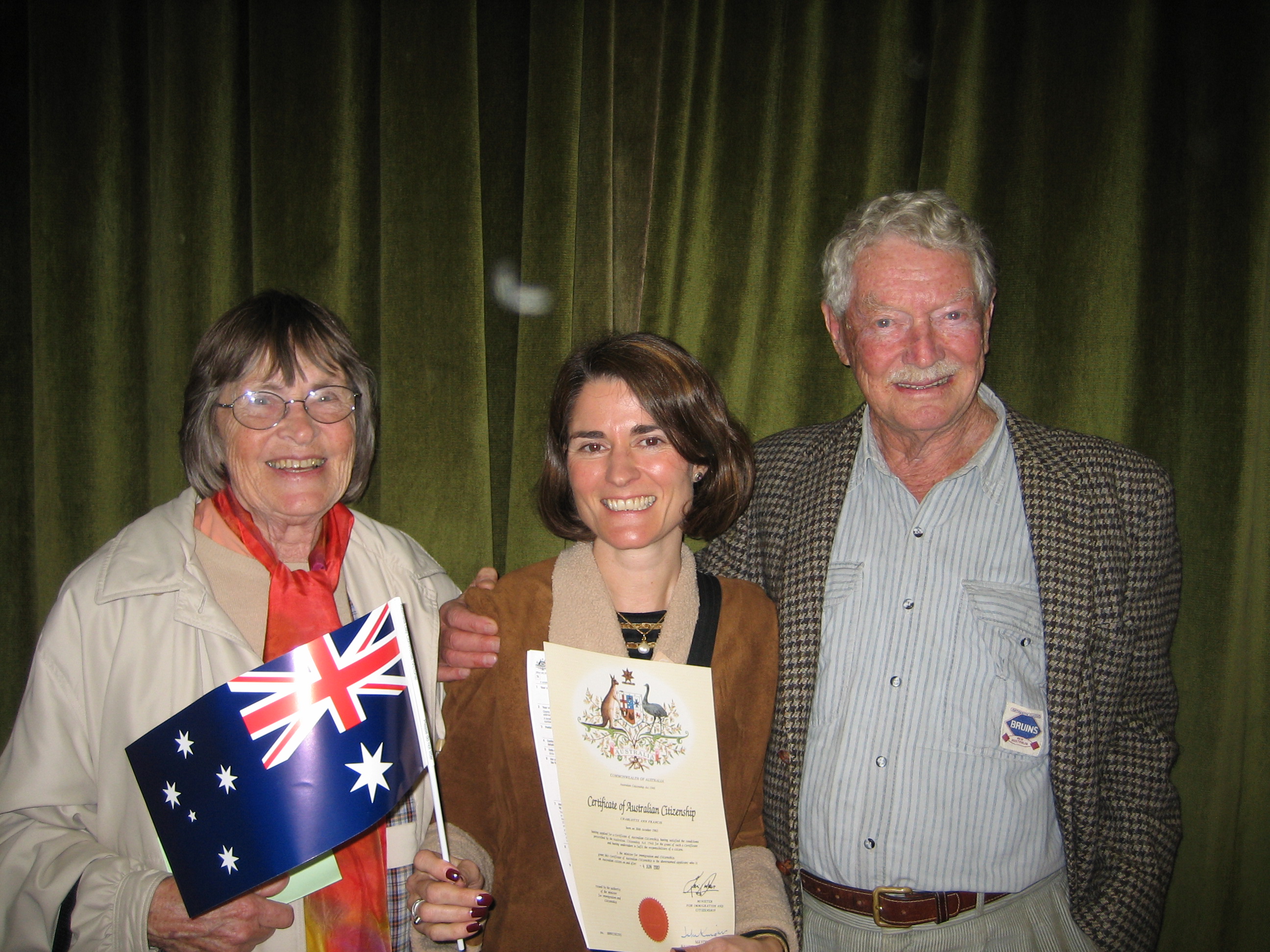
It was entirely fitting that Connie and Norman, such an integral part of my Australian ‘journey’, attended my Australian Citizenship Ceremony in June 2007. Other shared milestone celebrations included Norman’s 90th birthday party in Melbourne – a wonderful gathering of the family and extended family clan. And, over time, I can’t pinpoint exactly when, Connie began to call me Charlottie, a fitting hybrid name used exclusively by the Tout-Smith family. We also had fun and a lot of giggles playing with various English regional dialects and came up with Noite Loite, which is night light spoken with a West Country accent! Noite Loite became something of a recurring refrain in our conversations.

I last saw Connie in March 2024 in Adelaide where she had moved to live with her daughter Lynda. She was frail and suffering from cancer, and I knew it might be the last time I would see her. We played the game Bananagrams – Connie still a woman of letters and a dab hand at building words. At the same time, I felt that in Connie’s memory Helen and I may have become one and the same person – there was an element of confusion, one that presented an elegant closure of the circle. “I always did love you,” said Connie, and I, biting my lip not to cry, accepted her heartfelt words for both of us. Helen had her own formative experiences with Connie during an extended stay in Kyneton. Under Connie’s care and guidance, she encouraged Helen to join the local writer’s group and also to practise her art – one of her works was shown at an outdoor exhibition in Melbourne.

When her daughter Deb rang to tell me in late February that Connie had died peacefully in the early morning surrounded by her family, I recalled how I’d been spellbound on my dog walk that morning at the sight of several hot air balloons silhouetted against the rose-pink sky. Looking back, it feels like it was Connie’s spirit soaring home. I won’t say heavenwards as, although Connie was the daughter of a Reverend who served as a missionary in Fiji and Rotuman, she wasn’t religious.  

I was deeply saddened by the news of her death, but I was thrilled to be invited to Connie’s Celebration of Life event in mid-May. The event was held in Campbelltown, NSW, in the aged care facility where Connie’s 93-year-old sister lives.

With photographs from Connie’s life rotating on the screen – wonderful shots of her as a girl and beautiful young woman that I had never seen before – family and friends came together to celebrate all that she was and all that she contributed to the world.

I already knew Connie as an accomplished writer, a regular diarist, a keen reader, a cryptic crossword solver, a connoisseur of art, a good cook, a wife, mother, grandmother, sister, aunt and friend, a generous spirit with the warmest of smiles and biggest of hearts, but I hadn’t realised the depth of her creative life. And that’s, I suspect, because Connie was extremely modest. In Deb’s beautiful tribute I discovered that Connie was a talented piano player and received a diploma from the Associate in Music, Australia (AMusA), an award for outstanding candidates. And in later life she embarked on a Master of Fine Art at Melbourne University. While illness prevented her from completing it, she was able to use her expertise as a volunteer guide at Melbourne’s National Gallery of Art.

When her nephew reminisced about visits to Connie and Norman and mentioned the pattern of their lives – morning poached eggs and all – I reflected just how lucky I was that I had known Connie and Norman and been part of the family. Vale Connie.  I dedicate this blog to you as my dear friend, writing muse and inspiration. May you rest in peace.

In praise of the arts: hope, healing and humanity

Last (Australian) summer I got completely spooked by reading an apocalyptic novel – Leave the World Behind – by Rumaan Alam. Not my usual literary genre of choice, I had picked it up at my brother’s holiday house and couldn’t stop reading. It’s the story of a mysterious blackout along the East Coast of America and the collapse of civilisation. After finishing it I had a sleepless night worrying about the state of the world – everything from climate change, wars, plastics in the environment (and our bodies) to Trump getting back into the White House and AI into the wrong hands.

For me one of the best antidotes to Weltangst and negativity is engaging in the arts.  The arts connect us to joy, inspiration, beauty, creativity and to one another, expand our understanding of the world and humanity, enable us to dream and soar above the everyday – even if fleetingly. We may laugh, we may cry or be filled with awe and wonder.  The arts can also shock, provoke and act as a call to action.

During the endless Melbourne COVID lockdowns, tapping into all the wonderful plays, operas and musicals streamed free from the world’s stages was a silver lining. It also gave me hope and restored my faith in humanity, which was challenged by all the fear-mongering and survival of the fittest behaviours – remember the loo paper hoarding?!

An emerging body of research, strengthened since COVID, highlights the link between engaging/participating in the arts and mental health benefits. It makes it all the more regrettable that public arts funding gets slashed during periods of economic downturn. The cultural sector in the UK, for example, is suffering huge cuts. Interestingly – according to my research – Finland has the highest per capita public arts spending, and is also the country that ranks highest in the UN World Happiness Report – I rest my case.

There’s also opportunity for arts to inform and be integrated into social policy.  A good example of how this can work in action is Streetwise Opera, a UK charity that connects those living with homelessness with world-class artists to co-create bold new works, bringing together diverse voices and stories, improving the wellbeing, confidence and social connectedness of participants. It’s a great example of how an otherwise elite art form can be reinterpreted for social good.  See: https://streetwiseopera.org/

Another immersive, affordable and accessible way to experience the arts across multiple genres is to attend a Fringe Festival. In 2019 I happened to visit Avignon during the Avignon Festival in July and was drawn to Avignon Le Off (their name for the Fringe). I dashed around seeing French theatre (dusting off my A’level French), watching a naked yoga dance (which was rather beautiful and not remotely salacious), a clown-like comedy set in a barber’s shop, and a brilliant and hugely powerful two-person play written and performed by Tim Marriott (of Brittas Empire fame) about Mengele meeting the angel of death on a Brazilian beach. And everywhere I turned there was this artsy soup of drag queens, artists riding unicycles, singers, street artists and acrobats. Some of the works I saw there happened to be Adelaide Fringe shows. And in the magical way the universe works, a year later I ended up doing grant-seeking and advisory work for them.  

Fast forward a few years to August 2023, and I met a colleague from the Adelaide Fringe in Edinburgh when the Festival and Fringe were in full flow. Of course, Edinburgh is where the Fringe movement was born in 1947, when eight theatre groups turned up uninvited to perform at the Edinburgh International Festival.

While I mainly focussed on Fringe shows, I also attended a couple of Festival events. A standout was a chat between Iván Fischer, Director of the Budapest Festival Orchestra (BFO), and Edinburgh Festival Director, Nicola Benedetti, in the Usher Hall. We – the audience – lay or sat on the floor on bean bags and heard Fischer talk about – and demonstrate – how an orchestra can maintain contemporary relevance away from the formal staging of a classical concert.  Many of the musicians in the BFO play other forms of music, and we heard a selection: Monteverdi madrigals (with instrumentalists singing in the chorus), Argentinian Tango, Klezmer music and rousing wedding music from Transylvania.  An absolute treat.  

Other favourites were a one-man play, In Loyal Company, a true story of missing WWII soldier Arthur Robinson, written and performed by his great-nephew David William Bryan. A hugely energetic, visceral and totally captivating performance, you’re on board his ship in Singapore when it gets bombed, you sweat and shiver through dysentery in Malaya, and feel gutted when he finally returns to Liverpool after the war to find life has moved on in his absence.  Another very poignant play – Shanti and Naz –was about two best friends, one Hindu and one Sikh, during the time of partition in India. By complete contrast A Migrant’s Son (an Adelaide Fringe production) presents a true-life story of the Greek migrant experience to Australia. It’s a musical journey created and sung by Michaela Burger and is full of humour, heart and a few horrors along the way. Burger has a fabulous voice and was joined by a community choir as the chorus.

The New Revue was a sharp satire on (mainly British) current affairs which back then featured Rishi Sunak, BoJo, Keir Starmer, Suella Braverman and Paddington Bear.  How fortunate are those of us who live in democratic societies and enjoy freedom of speech and self-expression. A healthy and vibrant arts scene encourages the exchange of ideas, the exploration of stories and different art forms. There are all too many examples past and present of autocratic regimes suppressing the arts and subverting them for state propaganda.

I loved being in Edinburgh: the buzz and festival vibe; the many tartan and shortbread shops; the whisky; people-watching; pop-up shows and street artists; bagpipes; summer chill and cloud; ancient stone and cobbles; and, towering over it all, the great bastion of the castle. I reconnected with friends I hadn’t seen for many years and stayed in their delightfully rambling house in Morningside. I also stayed with Australian friends in the Borders, and probably drove them mad running around to so many shows.  

I did the same thing in Adelaide in February, partly as my clients at Adelaide Fringe generously gave me a bunch of comp tickets and also because it was Writers’ Week. I ran between the two – literally!

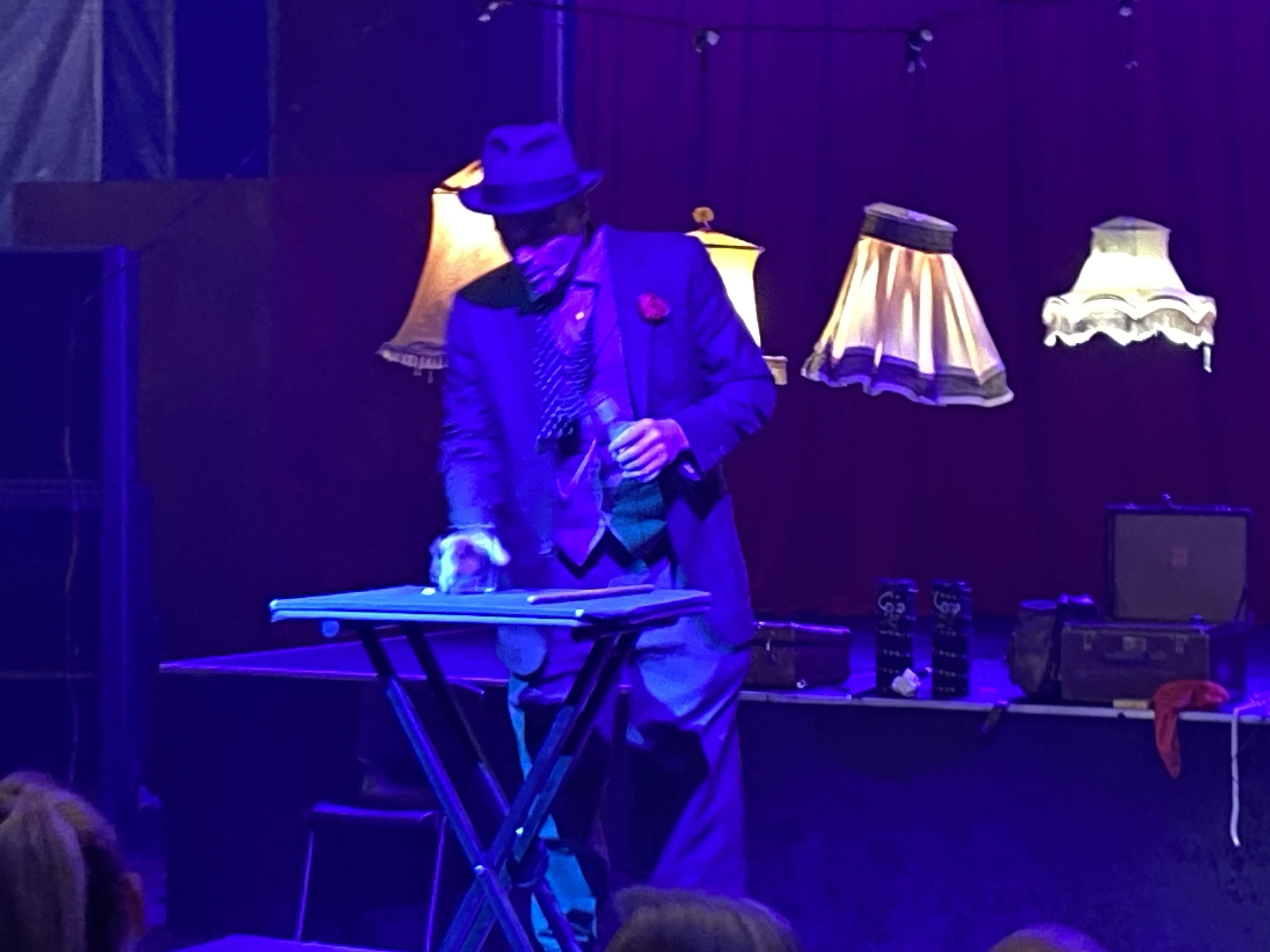
Highlights included a magic show, Charlie Caper, how DID he do it?  I strained to see the tricks and shortcuts but couldn’t. I loved the show and the old world feel conjured up (haha!) by his Fedora, three-piece suit, bow tie and the tasselled lamps. A stand-up comedy session in a converted railway carriage was raw and vulnerable while a Japanese circus, YOAH, was highly stylised and silent – all black and white and techno. Lolly Bag, a one-woman show by the talented Hannah Camilleri was a delight. Very quick, very original, and very funny, she played a whole a range of characters from a curmudgeonly car mechanic to a frazzled Year 8 class teacher, mixing improv and audience participation to great effect.  

Charlie Caper’s Magic Show

I also had the pleasure of seeing two more Tim Marriott plays – we have stayed in touch since I got chatting to him, his wife and dogs in Avignon. Appraisal was a gripping all-too-realistic and, in parts, darkly funny, two-person play about a toxic work culture, the abuse of power and position.  Watson, The Final Problem is based on Sir Arthur Conan Doyle’s Sherlock Holmes stories. With Big Ben chiming in the background and a Victorian-era room complete with hat stand, wooden chest, chair, desk and diary, we were transported to London, where Dr Watson looks back on his life and friendship with Sherlock Holmes. Tim Marriott’s masterful monologue took us on a rollercoaster ride culminating in the final demise of the detective at the hands of Moriarty at the Reichenbach Falls.

Cramming in – you know me – Writer’s Week events, it was a delight listening to Irish writer Anne Enright talking about families, Irish mothers and poets in relation to her new book The Wren, The Wren, and hearing what broadcasters Leigh Sales and Lisa Miller had to say about storytelling. I also attended an event at the Town Hall, where a group of writers each read a piece about family. My absolute favourite was by Martin Flanagan.  

On this 66th birthday he went back where he was born, the Queen Victoria hospital in Tasmania (now offices), to write a letter to his late mother. Warm, moving, fond and funny, it was clearly part of an ongoing conversation with her.  He recalled his friend Michael Long saying: “the silliest thing white fellas say is that you can’t talk to the dead.” Michael, whose mother died with he was 13, has a cup of tea with his mother every day. Martin concluded his birthplace reflection by saying to his mother: “I knew I’d find you here.” I found an extract from this tribute online if you’d like to read more. Go to: https://footyology.com.au/martin-flanagan-talking-to-mum/

That’s what I love about the arts, it all comes down to storytelling in one form or another: . “You’re never going to kill storytelling, because it’s built in the human plan. We come with it.” – Margaret Atwood,

What is the use of a house if you haven’t got a tolerable planet to put it on?” (Henry David Thoreau)

The other day as I was walking in my local suburb with the dog child, I noticed that yet another house had been bulldozed to the ground to make way for yet another new build. But this was no ordinary house and certainly not a tumbledown. Well-maintained, it was an elegant and gracious Victorian-style home enclosed by a bluestone wall with a polished brass number plate. In fact, it was smart enough to have statues in the garden. Like Hans Christian Andersen’s Little Match Girl – albeit in a Southern Hemisphere setting – I used to peek through the fence, admiring the porch with the tiled floor, the wrap-around veranda and the ornate cornices on the roof. This is the kind of house I would buy if I won the Lottery, I told myself.

I was aghast seeing it demolished and furious at the waste of materials – those lovely long sash windows – and the senselessness of it.  And this during the summer that Australia has been experiencing the worst bush fire season in its recorded history, with over 2000 homes destroyed. One the hand greedy developers and fickle homeowners and, on the other, individuals and families powerless to save their homes from being razed to the ground by ferocious fires.

Whatever your views about climate change and its impact on our environment, one thing is indisputable. The way we are living on planet Earth is not sustainable. We rape, pillage, plunder, pump out pesticides and plastic, spend, acquire, amass, throw away and then start over again. And we don’t learn from the past or heed the warnings. Think of Rachel Carson’s Silent Spring published in 1962, considered to be the book that kick-started the global grassroots environmental movement.

And I’ve just read – and very much enjoyed – John Steinbeck’s Travels with Charley: In Search of America. In 1960 Steinbeck set off in a truck converted to a camper van on an epic journey across America with his standard poodle, Charley, a colourful character in his own right.  It’s a wonderful tale full of rich and lyrical observations of the natural world – especially the giant redwoods in southern Oregon, amusing anecdotes about the different states he passes through, and chats over coffee and whisky with a cast of quirky characters he meets on the way. But it’s also deeply reflective and the themes he raises are still relevant today.He laments the amount of waste (including wrecked and rusting cars) in American cities, and the amount of packaging used in every day life: “I do wonder whether there will come a time when we can no longer afford our wastefulness – chemical wastes in the rivers, metal wastes everywhere, and atomic wastes buried deep in the earth or sunk in the sea.”  He talks of towns encroaching on villages and the countryside, supermarkets edging out ‘cracker-barrel’ stores. “The new American finds his challenge and his love in traffic-choked streets, skies nested in smog, choking with the acids of industry.” And he encounters political apathy – life seems to revolve more around baseball and hunting than discussions about the respective merits of Kennedy versus Nixon in an election year.  Sound familiar?

Steinbeck died in 1968, just eight years after writing this book, at the age of 66. I wonder what he would have made of the digital era. I suspect he might not have been much of a fan. “No region can hold out for long against the highway, the high-tension line and the national television.” And he rails against trailer homes, a tax efficient form of property ownership with an inbuilt form of one-upmanship as owners constantly upgrade to a better model. Overall, he comes away disenchanted.

“We have in the past been forced into reluctant change by weather, calamity, and plague. Now the pressure comes from our biologic success as a species. We have overcome all enemies but ourselves.”

How prescient, and how uncomfortable, especially given the recent outbreak of Coronavirus. Let’s face it, humans are the problem. Planet Earth can do without us, and most likely will cast us aside – as insignificant specks of dust – unless we learn to live in harmony with the ecosystems that support all life, giving us clean soils, air and water.

Rather than getting depressed and defeated, however, it’s vital that we use the current level of global discontent to campaign and advocate for change to policies and practices that reduce emissions and promote sustainability. And as we do that, let’s not lose sight of the many positive initiatives being undertaken by changemakers, entrepreneurs, inventors and scientists to tackle social and environmental challenges.  It’s not all bad: just this week I read that one of Britain’s largest builders, Bovis Homes, is incorporating “hedgehog highways’ into existing and future housing – hedgehogs walk more than a mile each night foraging for food, but numbers have dropped significantly due to habitat loss and pesticide use. A nice win for biodiversity!

For the love of reading

I’ve taken a bit of a break from my blog for various reasons, one being that I’ve always been a bit iffy about social media, not only the public nature of it, but the busy-ness and noisiness of it, the fact it never sleeps but churns on and on keeping us in thinking and doing mode, and over-stimulated. Not to mention fake news, ‘deepfake’ videos, trolling, interference in elections and data mining.  I tune out of the whole circus more often than not, leaving those pages to scroll on without me.

Given my ambivalence around 24/7 digital connectedness I was interested to read that author Patrick deWitt screens out the world while writing: “Wi-Fi feels like the death of solitude, of solitary thought. It feels like you’re in a room with people all the time. And I think if you’re going to write, you should have some quality time to yourself, daily.”

So the return to my blog is on my terms – I may not get round to reading many other blogs and posting likes and comments. And for now, my aim is not to boost my ‘traffic’ or attempt to generate income. I invite those that enjoy it to read it at their leisure. And I will write it as and when, perhaps in a more flow-y way.

One consistent anchor and pleasure throughout 2019 – when I took a chunk of time out from career and work to spend extended time with my family, particularly my elderly mother, and friends in the UK – was the luxury of having more time to read. Reading is a gentle, quiet pleasure that engages our heart, mind and imagination in a way no other medium does. Even if we choose to listen to an audio book, it’s less demanding than a Podcast or other streaming service.

I enjoyed resisting the pull of FOMO-tinged new releases and got down to some  classics. As a German language graduate, I was thrilled to finally read Thomas Mann’s Buddenbrooks – albeit in translation. Written in 1901 but set in the mid to late 1800s, it’s about four generations of a wealthy north German merchant family, and their eventual decline amid a changing world. It explores tensions between head and heart, business versus the arts, old and new, with exquisitely drawn characters reminding me of Dickens. When it came to George Eliot’s Middlemarch, described by Martin Amis and Julian Barnes as ‘the greatest novel in the English language, I cheated and listened to a wonderful dramatized adaption on BBC Radio 4. It proved the perfect bedtime accompaniment when I returned from my second UK trip at the end of the year when I was still suspended between worlds, half of me still in Mum’s kitchen, and half of me back here in Melbourne. What a relief when the caustic Reverend Edward Casaubon dies!

A few literary memoirs provided fascinating insights into how writers choose their subjects and the kind of world they inhabit. The best was Claire Tomalin’s A life of My Own. She has written outstanding biographies of subjects as varied as Mary Wollstonecraft, Charles Dickens and Thomas Hardy but is very sparing in the details of her own day to day life, exercises self-restraint around her emotional life and lacks self-pity. I found that so refreshing in the me-me-me era. The daughter of a French intellectual and a musical mother, her first husband, a journalist, is killed by a Syrian missile in Israel, one of her daughters, Susanna, a brilliantly gifted girl, commits suicide, and her son, Tom, is born with spina bifida. What she does describe are her dealings with the literary great and the good – including an affair with Martin Amis – and her work as literary editor of the New Statesman and The Sunday Times.

Another non-fiction highlight was historian Annabel Venning’s At War with the Walkers, an enthralling account of her family’s experience of World War II. Meticulously researched, it’s the saga of her grandfather Walter and his five siblings: Harold was a surgeon in London and his sister Ruth a nurse when the Blitz started; Peter is captured in the fall of Singapore, Edward fights the Germans in Italy, Bee marries an American airman and Walter battles the Japanese in Burma. I learnt so much, not just about the war (particularly in the Far East) but the rich social detail from the  escalating price of horses in 1939  due to petrol rationing to the extraordinarily rigid social hierarchy in the Indian Army: “Even if only one officer was dining in the mess at night, the regimental brass band had to turn out and play while the solitary diner had to wear full military regalia and observe all the mess customs…”

It’s many years since I read a Daphne du Maurier. The Parasites written in 1949 about three half siblings and their theatrical parents is as relevant as a study of human nature as it was then. Julie Myerson, in her 2005 introduction, sums it up brilliantly as: “a strange ambiguous love story set in a world of dark, Lutyens house, Morny soap (I remember that brand so well, French Fern and Lavender etc!) and brittle, fading theatrical glamour.”

My most recent read was SNAP by crime fiction author Belinda Bauer, a Christmas present from my dear friend Monica. Not my usual choice of genre, I loved this romp of a thriller set in Devon. It starts on the M5 when a mother of three children leaves them in the car on the hard shoulder while she goes to the emergency phone to report a breakdown. She never returns… Curmudgeonly detectives, eccentric neighbours and characters living in the shadows made this a perfect bit of escapism.

I can’t finish without including another treasured Christmas present: The Artful Dog – Canines from the Metropolitan Museum of Art – and one of my favourite quotes: Outside of a dog, a book is man’s best friend. Inside of a dog, it’s too dark to read.” Groucho Marx.


The Republic of Words 3 of 3: Writing, dogs and the meaning of life

The Friend by Sigrid Nunez, a book about writing and the relationship between animals and humans, was another perfect fit for me. It’s a novel but I thought it was a true story as it reads like a memoir and is, I discovered, the most autobiographical of Nunez’s book to date. It is a simple story but one that is multi-layered and full of literary allusions with an animal as the central character. It’s about a woman in New York – the narrator – who reluctantly inherits a dog – a Great Dane – when its owner, her friend, a womanising professor who has been married three times, commits suicide. Nunez, like the female narrator, both teaches and writes.  She has no social media accounts and leads a quiet life: “I became a writer because it was something I could do alone and hidden in my room.” She is an ‘old school’ writer who views the craft as a vocation and was surprised to find herself in the limelight as the winner of the 2018 National Book Award.

Nunez/the narrator has a dig at the proliferation of writers and quotes the deceased friend as agreeing with Garrison Keillor: “When everyone’s a writer, no one is,” a sentiment Nunez traces back to the pre-digital era: French critic Sainte-Beuve said in 1839: “To write and have something published is less and less special. Why not me too? everyone asks.” What would have Sainte-Beauve have made of self-publishing and blogging?

Anyone who has tried to write a book and bumped up against the self-doubt, angst and feeling of being a fraud will take comfort from learning that John Updike always felt he had got away with something when he saw his books in a store. For Virginia Woolf and Isak Dinesen the act of writing helped to ease pain and sorrow, whereas Philip Roth found writing frustrating and humiliating. And how surprising to learn that prolific writer Georges Simenon described writing as a vocation of unhappiness.  The most pertinent quote for me was from Rainer Maria Rilke: “If you were forbidden to write, would you die?”

I certainly don’t feel compelled to use my time out from work to write a novel, memoir or best seller – not at the moment anyway. For now, I am content to blog for the love of writing and to maintain the practice of crafting words. Although I do rather love the image of tapping away at a  book n a house by the beach with my dog at my feet…

The friend in the story refers not only to the deceased professor but to the Great Dane Apollo.  This is no saccharine story of puppy love, however. At first an unwelcome burden, the dog is a wise old soul who gradually becomes central to the narrator’s life – she even reads to him (something a holistic vet suggested I do to calm my dog Bertie!) – and manages to persuade her landlord to let her keep him in her tiny New York apartment. Much of the book is about the relationship between humans and animals: “They may know us better than we know them.” I also loved this: “I like that Aborigines say dogs make people human.” The Friend also references famous people who have owned dogs such as J. R. Ackerley (1896-1967) editor of BBC magazine The Listener. While he took a rather unhealthy interest in his dog’s heats and bodily functions (there’s a chapter in his book My Dog Tulip called Liquids and Solids), he spoke of his relationship with Tulip as a 15-year marriage, the happiest of his life. In similar vein the narrator in The Friend quotes a passer-by as saying: “Better a dog for a husband, than a husband who’s a dog.” Hear, hear, I say!

Although a fictionalised life lesson, I also enjoyed The Why Café by John Strelecky, partly because I read it in German – Das Café am Rande der Welt ­­– and tapped back into the language, and partly because it never harms to ponder the meaning of life! The narrative construct is that a stressed advertising executive runs out of petrol and finds himself in a café in the middle of nowhere. On the menu are three questions:

Why are you here?
Do you fear death?
Are you fulfilled?

Through conversations with the café owner, waitress and a patron, the book encourages readers to challenge their thinking. Are we being true to ourselves or doing what others wish us to do? Are we slogging away to earn money to amass belongings that we think will makes us feel happy? Are we keeping madly busy because we haven’t found our purpose or our calling? Are we waiting till retirement to do what we love? Do we swim with the tide or against it? What is our life purpose?

I sometimes wonder if writing is my calling or just something I love to do. Maybe dogs are my calling – or animals. Or maybe it’s writing funding applications to support animal welfare and conservation! I certainly find great solace in nature and love being away from screens and devices, chatter, noise and distraction. Walking out across the fields in Nottinghamshire yesterday, bright red poppies dotting the landscape and foamy cream hawthorn blooms bordering the path, I stood and ‘chatted’ with a cow, who stopped his meditational chewing and turned to look at me, its eyes full of knowingness. Mindful moments like those remind me how wondrous it is to be alive. And, for all the self-help and psychobabble, we don’t need to have all the answers. Another brilliant quote from The Friend by Rilke: “Have patience with everything that remains unsolved in your heart… live in the question.”


The Republic of Words 2 of 3: Timeless on the Silk Road by Heather Ellis

The second book in my Republic of Words series is Timeless on the Silk Road by Heather Ellis. If I were to sum up what this book is about in one word, it would be Trust. Capital intended. As a book about venturing into an unknown and uncertain future, I took great comfort from it. It strengthened my post-work resolve to let go of needing answers about what next and to simply wait and see.

You may be familiar with books that illustrate a spiritual path through story-telling. I remember reading The Celestine Prophecy back in the ’90s and I also read Paul Coelho’s The Alchemist, but I have to admit I’m not really a fan of spiritual teachings delivered via fiction. And that’s what I loved about Timeliness on the Silk Road, it’s the author’s lived experience of a solo motorbike journey along the 4000-km Silk Route from Europe through Russia and Central Asia to South East Asia. Told with extraordinary courage and honesty – it’s visceral, raw and unashamed not to mention compelling.

But this is no ordinary traveller’s tale. Following a solo motorbike trip across Africa in 1993, Heather is diagnosed with HIV.  The book starts in 1994 when she is working as a motorcycle courier in London and receives the devastating news of her diagnosis. Overcoming periods of doubt and despair, she is determined to embark on this her last journey – she is given five years to live – and to trust in the same universal energy that guided and protected her in Africa (I highly recommend her previous book, Ubuntu: One Woman’s Motorcycle Odyssey Across Africa). She says: ” I felt all those chance encounters and coincidences that came my way, often to save me in the nick of time, were more than just good luck. Maybe, just maybe, I would be saved again.”

Setting off from London on a grey November day on her trusty steed, her TT600, Heather lets go of any need to control how her journey pans out. And I admire that greatly! Packing for my trip to the UK recently – admittedly a longish trip involving many different people and events, not to mention the vagaries of the British weather – I tackled it, as I always do, like a military campaign leaving nothing to chance and planning for all eventualities. My hand luggage alone is carefully considered – from the  compression socks, eye mask and neck pillow to a small vial of oregano oil to ward off germs, some peppermint oil to pep me up the other end, some de-clogging aspirin and a homeopathic jet lag remedy, organic (no less) mouthwash, snacks, reading material and other lotions and potions to make me more comfortable. Had I travelled in Edwardian times, I would have probably had a suite of trunks. Packing lightly is not my forte.

Pernickety packing

There’s little room for creature comforts when all your luggage has to fit on a motorbike but Heather does take a stock of medication to treat Pneumocystis pneumonia (PCP) in the event she contracts the life-threatening lung infection. And she does have to use it quite early on in her trip. Small wonder that she has death musings in Delphi, Greece, or that a fellow worker in a café in Istanbul notes: “I feel you carry a big problem, and it weights heavy on you, but I know you are strong. Allah is with you.” Call it Allah or benevolent universal energy, Heather’s trust is challenged at times and her health starts to decline towards the end of the trip, but she never gives up. And the irony is that, away from the trappings of the modern world and living day to day, she doesn’t have access to the internet, where she’d have learnt about advances in HIV treatment.

Timeless on the Silk Road is a geographic and spiritual journey against a backdrop of majestic mountains, nomadic pastures and ancient cities. I was fascinated to learn more about the ‘Stans, countries that were once part of the Soviet Union: from the lost city of Merv in Turkmenistan, built on the site of a large oasis around 3000 BC but destroyed by Genghis Khan in 1221; Baku in Azerbaijan, the Paris of the region built on oil money; to the Chuysky Trakt, one of the world’s ten most scenic roads in the vast Altai Mountains between Mongolia and Russia.

Heather is an extraordinarily resilient woman and gets into some narrow scrapes fending off testosterone- and vodka-fuelled men in Georgia, sleeping (unknowingly) atop deadly spiders in Turkmenistan, coming close to being shot by a Tajik border guard, almost running out of food in Kazakhstan and playing cat and mouse with Chinese Government officials. And yet, miraculously, something always turns up – whether it’s the Turkish sheepdogs protecting her tent, the warm and generous hospitality of nomadic people’s in Krygyzstan and Siberia, meeting a kindly long-distance truck driver from Wales or three Russian horsemen in the Altai. At times, it reads like a modern-day fable tale punctuated by moments when time seems suspended – hence the title – such as when she witnesses a mesmerising sunset over the Caspian Sea from the bows of a rusted ferry. Inspiring, uplifting and life-affirming, this is a book that will prompt you to question your own journey through life. You can purchase this and Heather’s previous book Ubuntu via Amazon or in Australia from Readings bookshops. For author-signed copies (including postage) please go to Heather’s website at: https://www.heather-ellis.com/.

Reflections on Writing Part 2

Following the interest in my recent post about writing, I was inspired to share further reflections and other pearls of wisdom I have gleaned over the years.

For anyone who has gone through the process of trying to get published, whether a short story, feature article or a novel, this quote will resonate.

“Publishing a volume of verse is like dropping a rose petal down the Grand Canyon and waiting for the echo.” Don Marquis (novelist, poet and columnist 1878-1937)

Getting published requires enormous perseverance and you need to develop a thick skin.  Between 2013 and 2015 I made multiple submissions to both agents and publishers of a memoir-style book I was writing. I got close, and received some useful feedback, which, with the benefit of hindsight, validated the process. As I mentioned in a previous blog, I am now glad it didn’t get published – a lot of what I wrote was a kind of self-therapy – but I do give myself a pat on the back for putting myself out there at the time.

It strikes me now that it’s a bit like internet dating; you cast your net far and wide, and into an unknown and bottomless pit, to see what interest you attract. You might find a match, you might not.  You might have a bit of a flirtation only to find it comes to nothing or you may get rejected outright.

Whether online dating or writing to get published, you need to have a strong sense of self, who you are, what your values are, what you stand for, what you bring to the world and what you want to achieve.  One of my all-time favourite quotes is Oscar Wilde’s “Be yourself; everyone else is taken.” And then, on LinkedIn today, I spotted one of those inspirational quotes which, paraphrased would be something like: don’t be afraid to be yourself, be afraid of not being yourself.  Which brings me to an unattributed quote I once wrote down – I think it comes from an article I read in one of those New Age-y publications. And it very much resonates with me:

“If you are a budding artist, or a sportsman or anyone whose heart’s desire is to create more in this incredible world, then don’t listen to the doubts or insecurities of the mind. They are just voices in your head that keep you in separation from your true nature. That is all. By shifting your focus onto the peace within you, you become a vessel to express whatever wants to flow through you.”

Expressing who we are as writers, creators, employees, friends or lovers without feeling the need to change ourselves to fit an alternative agenda takes enormous courage. Another go-to read of mine which combines tips on writing with self-empowerment is Natalie Goldberg’s Writing Down the Bones (what a great title!). She advises:

“Learn to trust the force of your own voice. Naturally, it will evolve a direction and a need for one, but it will come from a different place than your need to be an achiever.”

And she encourages a visceral relationship with writing: “Basically, if you want to become a good writer, you need to do three things. Read a lot, listen well and deeply, and write a lot. Just enter the heat of the words and sounds and coloured sensations and keep your pen moving across the page.”

But even if we do have a strong sense of self-belief, tap into our inner creative and get some flow happening, writing can be a tough gig. I love the raw honesty in this Evelyn Waugh quote (taken from How to Write a Novel.)

“If only amateurs would get it into their heads that novel-writing is a highly skilled and lugubrious trade. One does not just sit jotting down other people’s conversation. One has for one’s raw material every single thing one has ever seen or heard or felt, and one has to go over that vast, smouldering rubbish heap of experience, half stifled by the fumes and dust, scraping and delving until one finds a few discarded valuables.’

Life in all its various guises, and how we experience it is indeed our raw material. The good times and the bad. It’s all material! I am reading a book about author H. G. Wells (author of War of the Worlds and The Time Machine) and his multiple affairs with young women. He was a proponent of Socialism and free love and a member of the Fabian Society and, amazingly, his second wife put up with all his amours. His book Anna Veronica published in 1909 was clearly inspired by his relationship with Amber Reeves. Rather than defuse the scandal about the affair, the book threw it into the spotlight. Amber’s husband, a lawyer,  (who gallantly married Amber when she was pregnant with H G’s child) threatened to sue Wells for libel, forcing him to sign an agreement not to see Amber for three years. Needless to say, Wells didn’t learn from the experience and repeated the same pattern with writer and feminist Rebecca West. If we are going to mine our life experiences to inform our writing, it’s a very fine line – beware defaming others –  and we have to tread carefully. Plus it can work both ways: other writers may weave us into their stories.

For Paul Auster living and writing are inseparable: “By living my life as a writer, I am living my life to the fullest. Even if I sit there crossing out sentences, tearing up pieces of paper, and I have not advanced one jot, I can still stand up from my chair and say: “Well, I’ve given it my best.”

Although I am not currently writing a book, writing is still part of my life; I write grants and proposals for work and I blog, but I also rely heavily on journalling and jotting down thoughts as a mental health exercise. It’s part of how I express myself.

“Writing practice embraces your whole life ( … ) It’s a place that you can come to wild and unbridled, mixing the dream of your grandmother’s soup with the astounding clouds outside your window.” Natalie Goldberg.


Luxury is not all it’s cracked up to be

I recently read I am, I am, I am by Irish writer Maggie O’Farrell, an account of her Seventeen Brushes with Death. In one of the episodes she’s at a luxury resort in East Africa as part of a press trip.  She brilliantly sums up the claustrophobic level of attention to guest needs, their every whim indulged, as she seeks refuge in the sea.

“No one is in danger of rushing towards me with an ice-bucket, a finger-bowl, a complimentary tray of hand-made chocolates.  No one is trying to clean the sea.”

Although in recent years, I’ve sometimes upgraded to Premium Economy flights and from shared house Airbnb accommodation to boutique hotel, for much of my life budget travel – think 2 to 3-star hostels and hotels, packed lunches (or sandwiches made at breakfast and smuggled out of hotel buffets), DIY holidays and everything BYO – has been the go.  Whereas I’ve always liked comfort and my ‘Princess and the Pea’ tendencies have increased when it comes to beds, I am also a big fan of learn as you go experiences.

I recently had a small taste of the luxury end of the market when I met up with my mother (we met halfway between the UK and Australia before flying on to Melbourne) at the Mandarin Oriental Hotel in Singapore. It’s large, sleek, formal and rather sombre with a glass lift at the heart of the place whirling guests between floors. Yes, the beds were super comfy and the high thread count sheets gloriously soft, but the much-advertised breakfast buffet, where everything from Indian to Asian, Western and American was on offer, offered quantity over quality. With many of the dishes sweating under a hot lamp, you could have got the same fare at a Little Chef motorway café in the UK. And although the staff were impressively attentive remembering our names, newspaper, dietary and tea and coffee preferences on the second day, it felt a little intrusive and a bit obsequious. Just because I had camomile tea on day one doesn’t mean I wanted it again on day two. I simply wanted to make my own choices and be left in peace.  At one point, a waiter adjusted the lid on my teapot as he came past our table.

The one time I managed to get down to the pool, a white fluffy towel and robe magically appeared along with a glass of iced water. But it started to rain when I got into the water which was fine by me, but not by the attendant who told me the rules forbade swimming in the rain. Luxury is not just suffocating, it can be bossy too!

The Singapore experience prompted me to look back on some of my memorable travel experiences, and none of them involved luxury.  Back in the 80s a school friend and I went to Galicia in Northern Spain. We arrived in the town of Pontevedra on a fiesta weekend to find a no room at the inn situation. The only room we could find was above a bar and it had a bare light bulb, sagging beds and the loo in the bathroom along the corridor had no seat. But we had a fabulous time; that night we met a charming couple José and Maribel who invited us to join them for dinner – they were cooking fresh sardines over repurposed oil drums. How deliciously fresh, meaty and smoky they were, complemented by the local rosé wine. Jose took us on a drive the next day and we stayed in touch for a few years after that.Later in the trip we travelled by overnight train in a sleeper compartment from La Coruña to Madrid. We’d come straight from the beach and our bikini bottoms were still gritty with sand. A man with a dark five o’clock shadow and reeking of garlic came into our compartment early in the night and claimed the third of four bunks.  After a few station stops where, each time, travellers would slide open the door to our compartment in search of a bed, garlic man got up, swearing a very Spanish joder (Google it!) and locked the door. Terrified as to his motives, we whispered frantic contingency plans, but soon realised that he simply wanted to get a good night’s sleep without disturbance.  Selfish maybe, but not a sexual deviant, his swearing was replaced by snores. No joder simply a bit of roncar!

A 1990s holiday in a rental house in the South of France with a bunch of friends relied on simple pleasures: self-catering, walks, reading, swimming in the lake, drinking wine and playing silly games in the evening. One night we went to a local festival of music and, after a few glasses of wine, ended up dancing with total abandon on the roof of our hire car. And then we visited a restaurant specialising in all things duck starting with jambon de canard (cured meat like parma ham) followed by duck pâté, pâté de foie gras and then roast duck. I’d never tasted foie gras before and wanted to know if they sold tins of it. I asked – in all innocence – “avez vous du foie gras dans un préservatif?” Which caused an explosion of mirth – I had asked whether they sold foie gras in condoms!


Playing ‘Who Are you?

And that’s my quibble with in-your-face luxury; all that pampering and pre-empting of one’s every need takes away the joy of discovery, the journeying, exploring and mishaps along the way. And I feel uncomfortable around the servile attitude of those delivering a luxury service. It all feels like a throwback to colonial times.

I’ll never forget the expert massage I received from a hill tribe woman in the Chang Mai region in Thailand back in the 80s. I was stiff from trekking and she walked on my back, pushed and pulled and smoothed out all the knots. It was bliss. Yet there were no dolphin music or pan pipes in the background, no white robes, scented candles or oils.  Simple pleasures.

In the words of Eugene Fodor: “You don’t have to be rich to travel well.”

Reflections on writing: only you can tell your story

I am always inspired when I hear writers talking about their craft. What always emerges is that there’s no hard and fast rule or approach. Like any creative pursuit, it’s highly individual and subjective. Although there is a plethora of information on writing – from blogs to podcasts, how-to manuals and modules, a formulaic approach will only take you so far. Working out why you want to write, what you want to say and why is an important part of the process.

typewriter-801921__340

How authors approach their writing differs according to their motivation. It could be therapeutic –personal journaling, for example, has become very popular as a way of expressing, releasing, even purging thoughts and emotions – and, more generally, making sense of the world. Some authors have been penning stories from a young age, it’s in their blood and part of who they are, while others are more strategic and have a business-like approach to writing a blockbuster.

Whatever the frequency or medium, one unifying theme I have observed is the importance of finding – and trusting – your own voice, being authentic, tapping into your heart and soul and mining your storehouse of emotions, experiences and memories. Included in Neil Gaiman’s top tips on writing is this one: “As quickly as you can, start telling the stories that only you can tell – because there will always be better writers than you, there will always be smarter writers than you, but you are the only you.”

Looking back, I realise that the first book I wrote in 2002-2004 was clearly a thinly disguised autobiography. Titled Unknown Territory, it wasn’t bad for a first effort – had it been published it would have slotted into the Chick Lit section of a bookshop. A few years later I picked it up again and decided to be more honest and write more directly about my personal journey. I framed it as an A-Z – a kind of ‘my life on a plate’. Some of it was good, some of it was a bit forced by dint of having to come up with content for each letter of the alphabet, and I glossed over the darker and more difficult episodes in my life as I was so hell bent on making it funny. I did get interest and some very positive feedback from publishers but the consensus was that I needed to plunge the depths and ditch the A-Z format.

Neil Gaiman talks about letting go of the inner critic and the perfectionist: “If you are making mistakes then you are making new things, trying new things, learning, living, pushing yourself, changing yourself, changing your world.”   I would say that writing my A-Z changed my perception of my world and enabled me to re-frame some of my past in a way that made it more palatable even though I didn’t fully allow myself to write out some of the rage and more raw emotions.  I am glad it didn’t get published but now acknowledge that it was valid as an exercise in catharsis.

notes-514998__340

Earlier this year I heard author Kate Grenville speak at Clunes Booktown. When talking about One Life: My Mother’s Story, she said: “Being truthful about the past is a pre-requisite for walking into the future.” That struck a chord with me and I wondered if I will ever have the urge to write a full-blown memoir, one that is uncompromisingly honest and free of the fear of being judged – or even worse, of upsetting some of my nearest and dearest.  Other advice Kate gave was to never start at the beginning of a story but where it gets interesting. Contrast that more intuitive approach to the planned writer who plots out the story and characters before writing.

Jane Harper, whose murder mystery The Dry has become a bestseller enrolled in a novel-writing course and in 12 weeks produced a 40,000-word draft. She takes a no-nonsense, roll up your sleeves approach to writing: “Writing is a skill that can be taught and learnt.” How refreshing to encounter a writer unencumbered by angst, anguish and sleepless nights. “I approach it logically,” she says, “and just take it step by step.”  Although Harper trained as a journalist and so, arguably, had a head start, writing a novel requires a different skill set. What comes across in the article I read is that Harper is efficient and organised and applied to herself to writing a novel as she would to any other task.  For her, the hard graft and discipline paid off, but for some too much effort kills off the creative spirit.

Also speaking at Clunes Booktown was Hannah Kent author of bestselling novel Burial Rites. She values the importance of routine but also – and I found this very heartening – allocates herself sick leave and annual leave. “You can show up too much.”

Once again, it’s about carving out our own niche and tapping into our own rhythm and association of thoughts and ideas. By all means take inspiration from other writers, but never fall into the trap of trying to imitate them either in style or writing practice. I like Neil Gaiman’s advice to be kinder to yourself: “Write more. And remember that everyone who writes anything good, wrote a lot of bad stuff first.”