Paris Part 2: Musée Jacquemart-André, Le Grand Mosquée, Saint Mammes, the Seine and soggy knickers…

First of all a PS to those who subscribe by email – please click on the ‘Read on Blog’ link at the top of the email to enjoy the benefit of the formatted blog rather than the WordPress newsletter version.

Picking up where I left off in my last post, I started off slowly on day two in Paris. After a bit of unpacking and general faffing, I enjoyed a good breakfast at my hotel, the Holiday Inn, Gare de Lyon. Others might not get excited about apple compote, but I love it (especially when I haven’t had to peel and stew the apples) and it’s not something you often find on breakfast bars! Combined with creamy yoghurt dispensed from a machine by pulling on a lever – which reminded me of Mr Whippy ice cream – and topped with nuts and seeds, it was a winner.  I also enjoyed one of the best gluten-free bread rolls I’ve had in a while with some fresh figs and goat’s cheese.

It was a fine morning, and once again I set off for the Jacquemart-André Museum, this time by metro, criss-crossing my way to Miromesmil.  I arrived to find there was a queue to get in unless you had already reserved tickets. The wait time was advertised as at least an hour thanks to a once-in-thirty-year retrospective of paintings by Georges de la Tour (1593-1652), a chiaroscuro painter influenced by Caravaggio.  Thank Goodness I hadn’t slogged my way there the night before only to be turned away – no room at the inn – and refused entry.  

In just under an hour, I had a ticket in my hand and was inside. The Jacquemart-André Museum is a sumptuous Belle Époque private mansion built at the end of the 19th century by wealthy banker Edouard André and his wife society portraitist Nélie Jacquemart. They married in 1888, did not have children and were avid collectors of fine art and treasures from around the world.  The museum is described as the finest private collection of artworks in Paris – and that’s no exaggeration.  

The place is full of big name artists from across the centuries. Right at the start of the tour in the Picture Gallery are two Canaletto paintings of Venice, in Nélie’s boudoir there are paintings by Gainsborough and Reynolds, and the library walls are hung with paintings by Dutch masters including Rembrandt, Franz Hals and Van Dyck.

Paintings in Nelie’s boudoir reflected in a mirror

There are no less than three works by Tiepolo:  a fresco at the top of the double marble staircase and a ceiling painting on the roof the mansion’s dining room, the Salon de Nélie. Both were transposed from a Venetian villa. The third Tiepolo is a ceiling painting in the study, a room furnished with chairs covered with Aubusson tapestries, a Japanese lacquer writing desk and a Louis XV desk stamped by the king’s favourite cabinetmaker.

Tiepolo ceiling painting in the Salon de Nelie

Edouard and Nélie loved to entertain – the picture gallery leads into the Grand Salon where the partition walls could be lowered into the ground via a hydraulic system that converted the Picture Gallery, the Grand Salon and the adjacent Music Room (and musician’s gallery above) into a single space – catering for up to a thousand guests. You can almost hear the frou frou of opulent gowns, lace and silk, the hum of chatter and the clink of champagne flutes.  And you can picture the men retiring to the smoking room which is furnished in the ‘Oriental’ style with treasures from Persia.

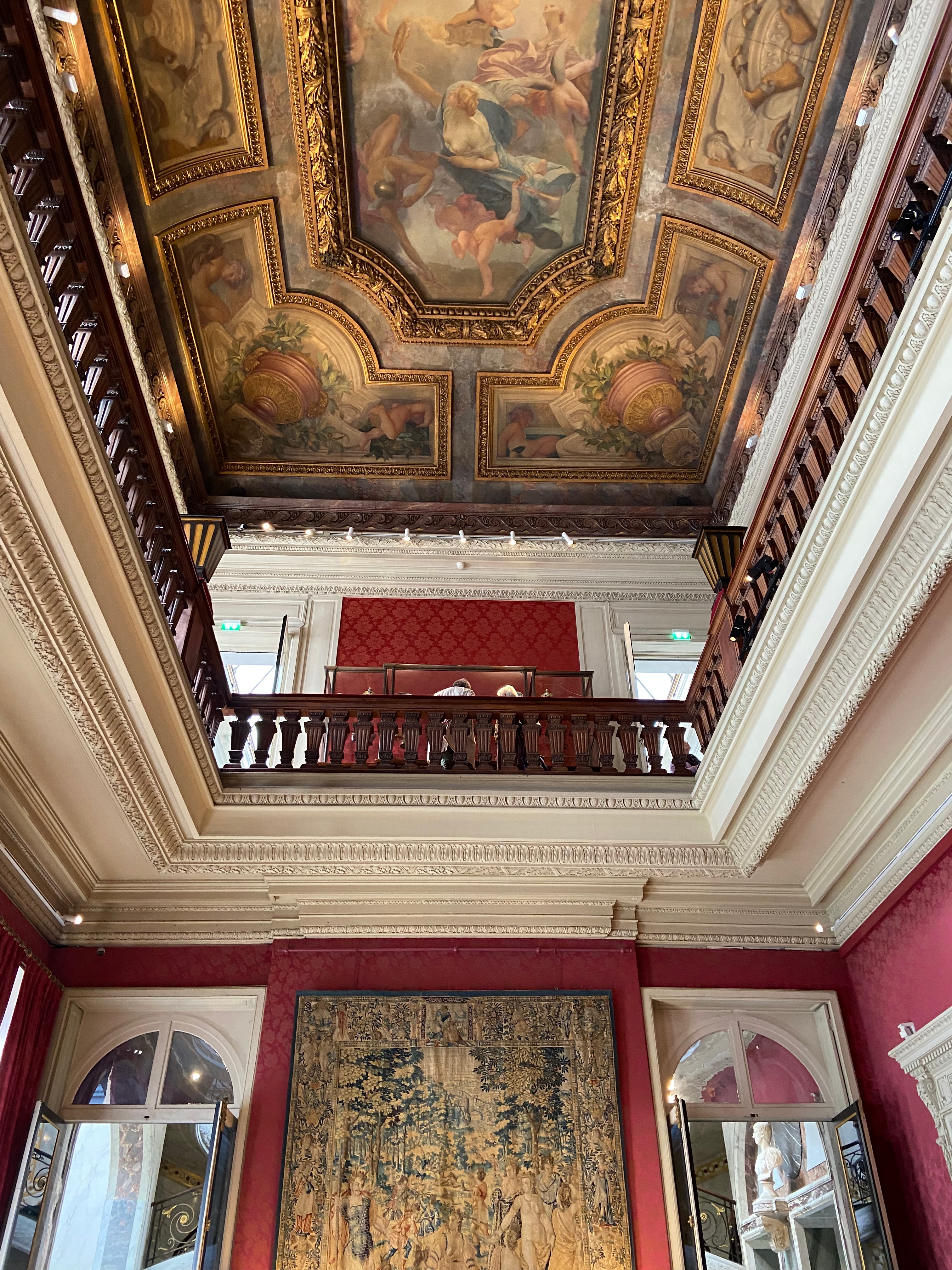
To keep their entertaining space unimpeded, Nélie and Edouard departed from the norm of having a centrally situated staircase – the double marble staircase is no less magnificent, but it’s located to the side of the building. To the left of the staircase is the Winter Garden, a status symbol at the time, a place to showcase plants from around the world.

The Italian galleries – the Venetian and the Florentine – are crammed with treasures: 15th century sculptures, bas-reliefs and paintings by the likes of Uccello and Botticelli.  I had a little break at lunchtime and managed to get a spot in the Salon de Nélie, in the annex overlooking the courtyard.
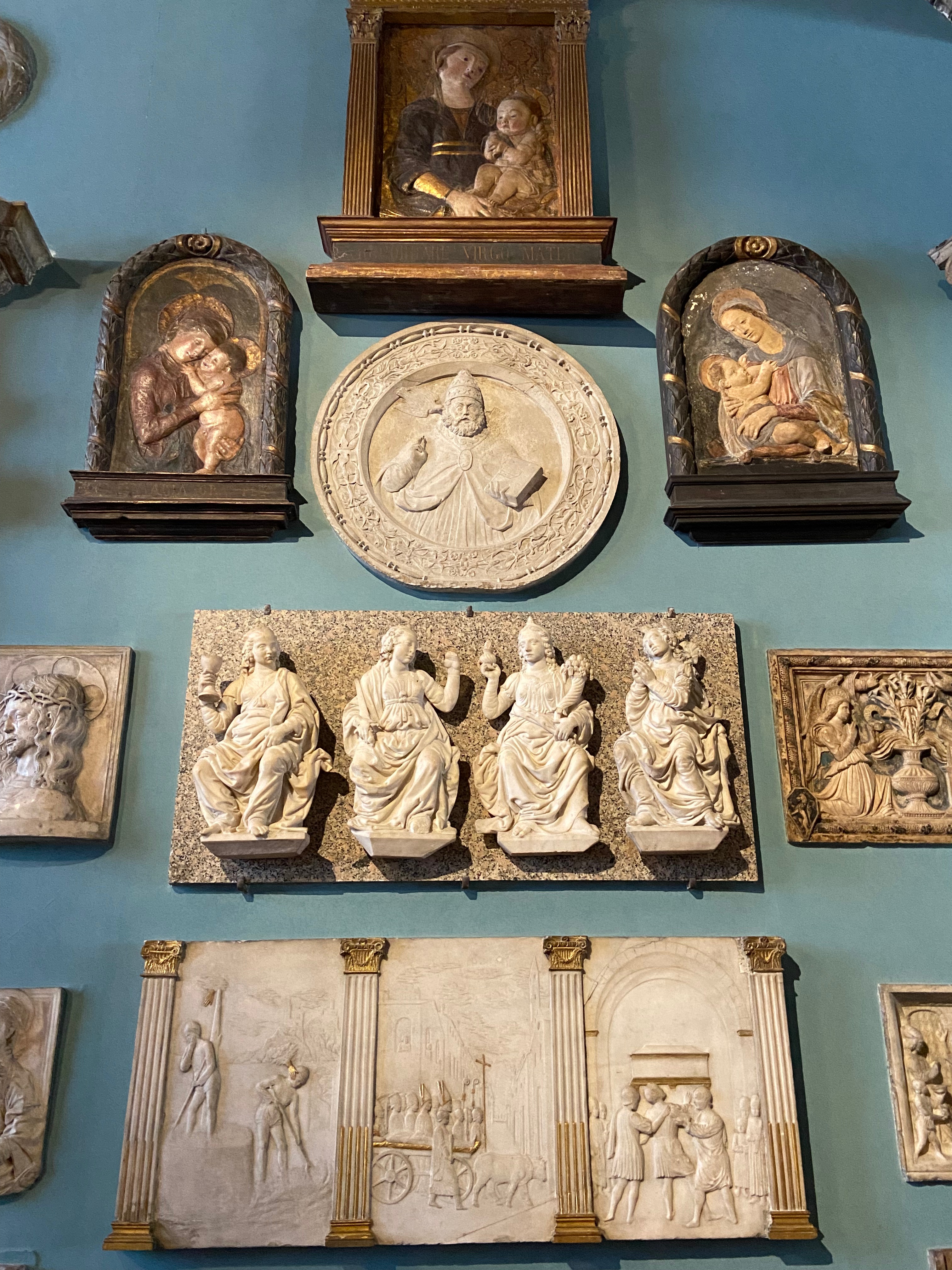
After lunch, I enjoyed browsing some of the 40 Georges de la Tour paintings. He focused on portraits of saints and people on the margins of society – blind musicians, beggars, old men and women, capturing them in a moment in time, his subjects imbued with grace and dignity, and often illuminated by a single candle flame or a shaft of light. I could have spent longer but it was getting towards mid-afternoon and I was due to meet friends from Oxford for drinks at 4.45pm. Time waits for no man not even Georges de la Tour, so I ran back to Miromesmil, sped-walked along the long passageways (if you want to get your steps up, travel on the Paris Metro!) connecting with the M1 line back to the Gare de Lyon. From there I dashed to the hotel to change and then, with a swipe of lippy, was back underground on my way to Châtelet where I changed line to get to Cité and to our meeting place near Notre Dame. I just made it.

It was pure chance that I overlapped with Hilary and John for one night in Paris and pure joy to see them and catch up on two year’s chat over drinks and pommes frites. To add to the fun, my niece, Georgie, a wonderful conversationalist and all-round bright spark, joined us just as the heavens opened and the wind picked up. We were sitting outdoors so we huddled under the awning but were soon rewarded with exquisite light and a double rainbow. From there, Georgie and I walked back to the Gare de Lyon and to Ground Control, a warehouse space behind the station with food stalls, bars, vintage fashion, a book stall and alive with the buzz of chatter from children, families, the lot. We drank a Hugo cocktail and tucked into a tasty and generous Greek share platter.

The next morning, Sunday, I was back at the Gare de Lyon, now my second home, and took a train out towards Fontainebleu to spend a day with Georgie, her husband Manu and the three boys. She met me at the station in Moret-Veneux with three-year-old Ralphie in tow. From there, it was a short drive to Veneux -les-Sablons, where we walked across an arched suspension bridge at the confluence of the Seine and the Loing over to the town of Saint-Mammès, which has a vibrant Sunday market with lots of local and organic produce and an entire stall devoted to goat’s cheese – heaven!

The rest of the day was spent with the family in Thomery, a wonderful spot on the Seine, known for its history of viticulture and use of walled vineyards. It’s forty-five minutes on the train from Paris but a hundred times more peaceful. No suitcases, sirens or heavy ‘circulation’! Georgie and Manu are renovating their house bit by bit – it’s full of character – and they live a very eco-oriented life.  

The long garden complete with Granny Flat (la dépendance), veggie patch, walnut trees and mown paths slopes down in the direction of the river.  It’s a bucolic idyll and the three boys – Ralphie’s twin brothers are now six – charge around the garden, their playground. So far, they are living a screen-free life (not even a TV), which I so admire, their imaginations free to roam, their attention unshackled by technology.

We all did a bit of drawing after lunch. Even I, who can’t draw a stick man, managed a decent flamingo thanks to a book that steps you through the process. A delightfully bonding family day – good for the soul – and I have bagged a spot in the dépendance for future trips. And next time I’m eager to try the walnut wine which was still at the macerating stage when I visited.

Monday, my last day in Paris, I explored Le Grand Mosquée, which is in the Latin Quarter near the Jardin des Plantes, the Botanic Garden.  It was built to honour the African, mostly Muslim, soldiers who fought in the First World War and was inaugurated in July 1926.   
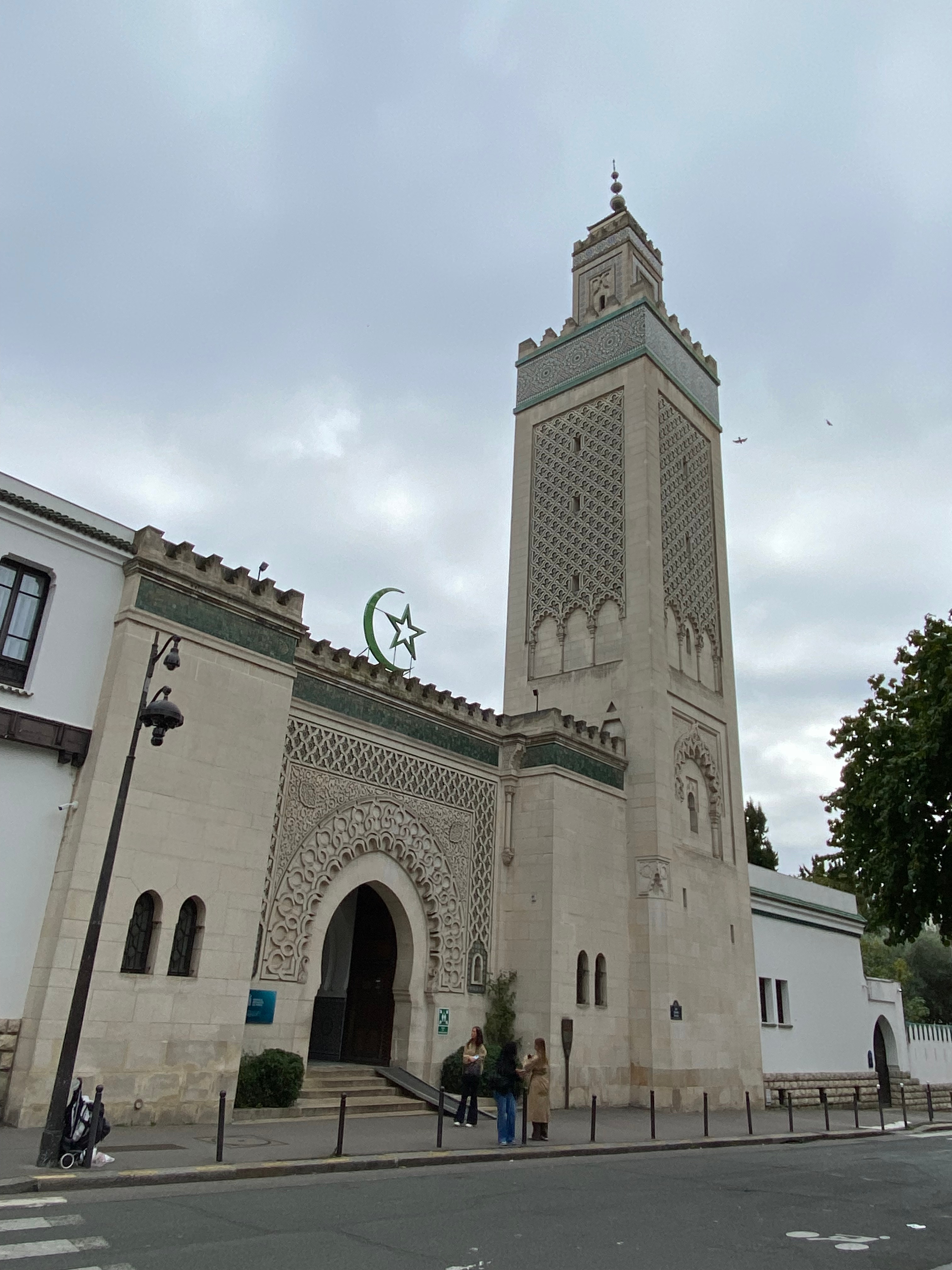
Reminding me of my March trip to Malaga and visit to the Alcazaba, the Grand Mosque is built in the Hispano-Moorish style with the familiar arches, decorative tiles, Arabic calligraphy, intricate geometric patterns, Mahgrebin carved cedar wood and lush courtyard garden with fountains. It’s wonderfully peaceful, a place for quiet contemplation and, unlike the museums, not crowded. I was flagging by lunchtime – jetlag maybe – so rather than have lunch at the mosque’s café, where you can get a full meal – tajines, couscous etc., – or mint tea and Arabic sweet treats, I decided to visit the ladies only hammam (steam bath).

In keeping with the mosque, the hammam is a tranquil space with detailed mosaics, arches and ornate plasterwork. Years ago, I was scrubbed to smithereens in a Moroccan hammam so this time I opted for a simple steam bath without the ‘gommage’ option (exfoliation).  The dress code is bathers or a bikini – topless is fine but you need some form of ‘bottoms’. I hadn’t planned to go to the hammam so didn’t have either – spontaneity has its drawbacks! So here I was topless in a Turkish bath trying – in faltering French – to navigate how it all worked and in what order – from the difficult-to-shut 1 Euro lockers to the wrist tag, plastic slippers and showering protocol.

I got myself into the main room which has a long marble ledge running down each side, divided into three alcoves for sitting or lying in and furnished with buckets and water taps. I lay down and semi-relaxed but it would have been better to have a friend to lounge about and laugh with. After a while I graduated to the furthest room, which is more like a sauna with stepped ledges – the higher you go the hotter it gets – and a cold-water dipping pool. This is where my M & S undies got the full immersion treatment!

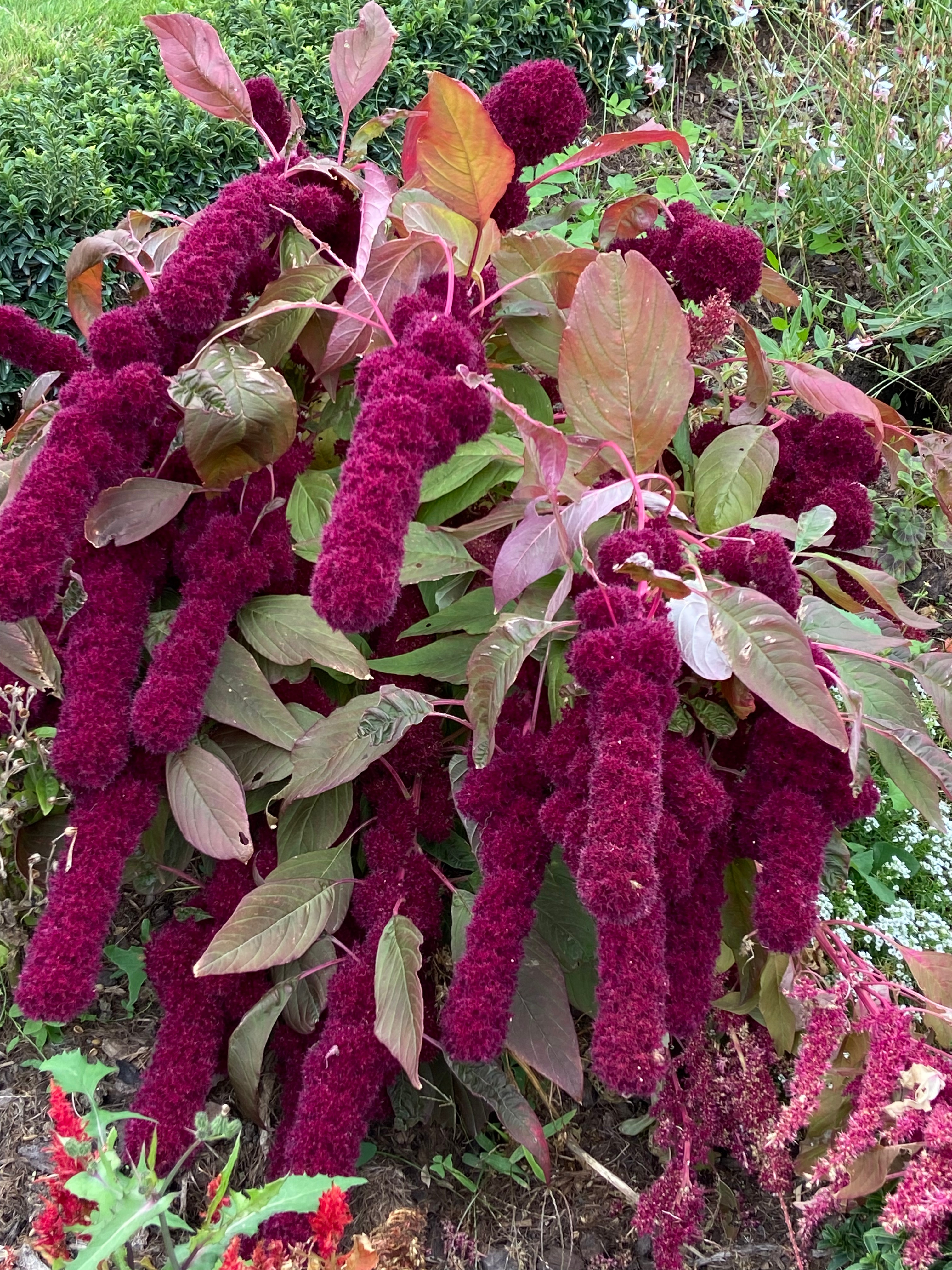
Once I was fully steamed and cooked, I progressed to an anteroom, where they bring you mint tea, which, although teeth-squeakingly sweet, is refreshing. I emerged feeling rejuvenated but, with damp knickers and damp hair, I soon lost the glow and warmth of the steam room as I was walking around the nearby Jardin des Plantes. On went the fingerless gloves and then I found a small café where I had a very overpriced but warming cup of tea, enough for me to enjoy all the autumn colours, pumpkin displays and curious woolly plants while I dried out!

Within three and a half hours of stepping off the plane from Australia via Hong Kong to Paris, I was shuffling along in the queue (which moved surprisingly fast) outside Notre Dame. Time-travel at its best, I had left Melbourne on a Thursday afternoon in the spring to arrive in Paris on a Friday morning, a warmish autumn day, shifting culture, language and centuries as I gazed up at the façade of one of the world’s most famous gothic cathedrals, the first stone of which was laid in 1163 during the reign of Louis VII.

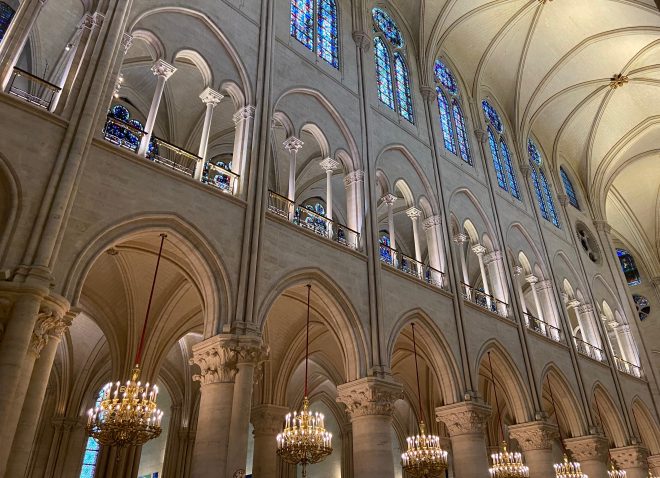
What a way to ‘land’ in Europe! Stepping through one of the intricately carved portals, the first thing I noticed was the quality of light – the resplendent nave and vaulted ceiling, the whiteness of the newly cleaned stone, the sparkling stained-glass windows – the reds and blues standing out in particular.  Reading up on Notre Dame, purists argue that it’s now too squeaky clean without centuries of accumulated candle smoke and grime, but I disagree. The restoration is – and continues to be – a triumph thanks to the craftmanship and expertise of the many artisans, conservationists, sculptors, stonemasons, stained-glass artists, carpenters and experts involved, not to mention the sourcing of 1,000 oak trees from approximately 200 forests across France for the roof and spire. The restoration is due to be completed in 2026.

I’m straying into cliché now but arriving during a service, the organ playing – incidentally all 8000 pipes were individually cleaned – and following along to the Lord’s Prayer in English – was a beacon of light moment, of hopefulness, in our ever more troubled and conflict-ridden world. The restoration of Notre Dame following the 2019 fire is an encouraging reminder of what can be achieved when political will combined with public, private and business funding unite around a single vision. And the fire has served as a reminder for us all – witness the queues to get in – how precious these ancient monuments are. I don’t know about you, but I took Notre Dame for granted – I certainly didn’t visit it last time I went to Paris in 2019.

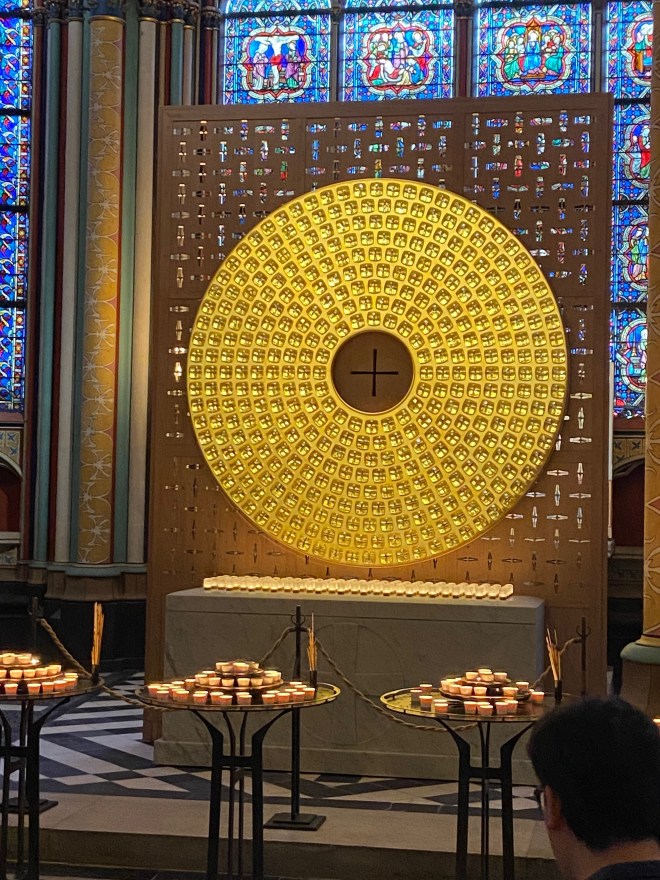
Being a bit of a swot, I rented an audio guide covering Notre Dame’s history. I discovered that the north rose window with its central image of Mary with the Christ Child still has most of the 13th century glass intact – extraordinary. The original Crown of Thorns is believed to reside at Notre Dame, brought to Paris from Jerusalem in 1263. The Crown of Thorns survived the fire, but its glass case was broken. The new reliquary designed by French artist Sylvain Dubuisson is stunning. I could have stayed for the monthly veneration service of the Holy Crown of Thorns but the jetlag was beginning to bite so I carried on with my tour admiring the contemporary tapestries hanging in the side chapels in the north aisle – my favourite Polynesia, the Sky and Polynesia, the Sea, woven in 1972 after the cut papers by Henri Matisse,  before moving onto the 14th century sculpted wall scenes from the life of Christ in the choir enclosure.

I was drawn to the newly created chapel for Eastern Christians (this was not included in my audio guide, but I have since learnt it was inaugurated in May 2025) displaying the eight icons that pay tribute to the founding figures of the great Eastern Churches. But I have to admit to not being sure about the new modern altar – a bronze bowl-like structure which looked more like a bath to me and had nothing of the sacred about it.

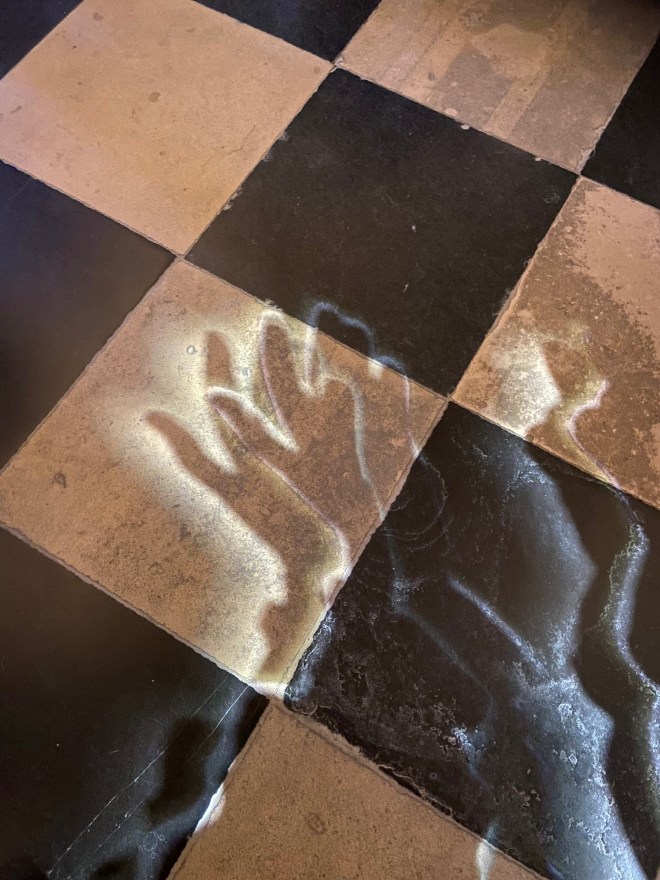
Much more mysterious was the how the play of light around the sculpture of the Virgin Mary holding the dead body of Jesus in her lap at the High Altar cast an almost spectral silhouette of Mary’s hands onto the black and white flagstones.  Similarly, the statue of Joan of Arc and the statue of the Virgin Mary, both of which avoided the fire, seemed to be ringed with an auric kind of white light. Quite magical.

After a pitstop in a café near Notre Dame – where a local told me I had to shut my menu to signal I had made my choice before anyone would take my order (great intel!) – I had a bit of a rest back at the Holiday Inn Gare de Lyons, where I was staying gratis thanks to my brother generously donating his points.

My plan for the evening was to visit the Jacquemart-André Museum in the Boulevard Haussman in the 8th arrondissement.  They have late night openings on Fridays with drinks and platters on offer at Le Nélie, the salon de thé.  I had it all mapped out, except I didn’t…

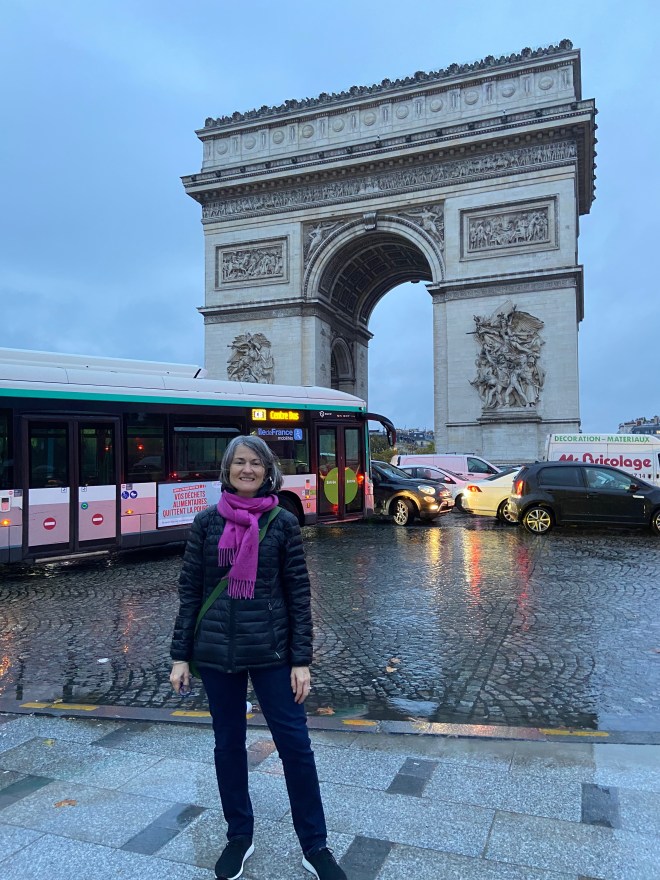
I had read that the nearest RER station was Charles de Gaulle-Étoile, which is true, but there’s a much closer metro stop. The best laid plans and all that… A transport volunteer at Charles de Gaulle-Étoile told me the museum was a good half-hour’s walk, or I could take the 22 bus. It was pouring with rain but, determined to get there, I went on up to street level and discovered I was at the Champs-Élysées, which was gridlocked with rush hour traffic. I found the 22 bus and jumped aboard only to find I needed to be ‘de l’autre côté’ but which autre côté? The Champs-Élysées roundabout is hectic at the best of times, and amid the cacophony of coups de klaxon (cue a smug moment remembering the words for car horn from my schoolgirl French), I felt I couldn’t distract the driver by asking which side he meant.

I got off the bus and back into the sheeting rain, where I took an “I woz ‘ere” photo for some fellow tourists and asked them to do the same for me. Then I took a deep breath and thought through my options. It was now getting towards 7.30pm – even if I found the right bus, the traffic was at a standstill and I’d be unlikely to get there till after 8pm. This was overly ambitious for my straight-off-the-plane day one.  Too hard basket was the conclusion. I retraced my steps and went back to the Gare de Lyon area where I indulged in a spot of people-watching over a simple but delicious dinner and a glass of rosé at a local bistro. A good decision move as it turns out. You’ll find out why in Part 2.

(more…)

A short sojourn in Paris Part 1: Notre Dame resplendent and risen from the ashes

A room to call my own: Paris

The truth is, people, that staying with family and friends for weeks at a time – while full of blessings, love, connection, reminiscing, giggles and wonderfulness- ­­­­doesn’t afford the same restorative and mind-clearing opportunities that, say, a walking holiday in the Tuscan hills or a week by the beach might. And only ex-pats who trot back and forth to their country of origin get it; others think we are moaning Minnies! But visiting lots of people you don’t see on a regular basis involves a deep dive into lots of lives with all their ups, downs, highs, lows and challenges. Sometimes I find myself lying awake at night reflecting on all these various lives; it can be a bit enmeshing and involving and I sometimes find it hard to detach myself.

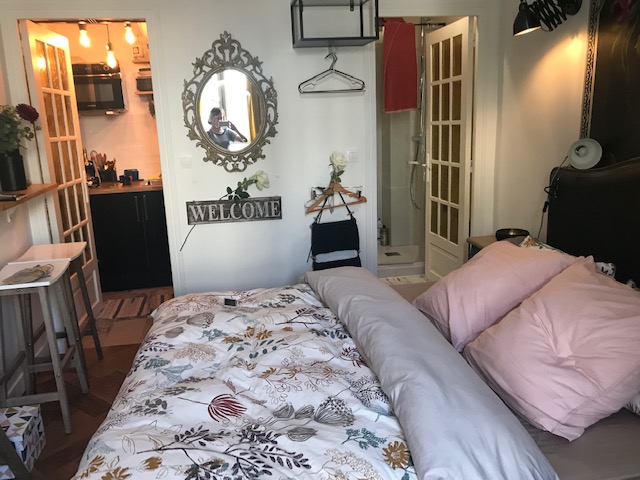
Enough of my preamble. Suffice it to say, I enjoyed having a base I could call my own for a few days in a tiny (and I mean tiny) one-room apartment in Vincennes in Paris, an eastern suburb just outside the Paris peripherique. From the outside it didn’t look that promising and my heart sank as I climbed the wooden staircase, plaster peeling off the walls, to the dark broom cupboard where I retrieved the key from the key safe. But, once inside, it was exactly as advertised; stylish, well equipped, comfortable and cosy with very clever use of the space and storage. The only thing it lacked was a fan, which given the intense heatwave, would have made sleep easier! On the upside, the severe canicule (heatwave) meant that the Forfait Anti-Pollution ticket on public transport made travel very cheap. And it was good to see a Government-backed scheme encouraging people to leave their cars at home.

Wandering out my first evening I took in my surroundings: a crêperie, a dressmaker’s/alteration place, a spirituality centre advertising a talk on life after death, a café, a plumber’s, a nail salon, a couple of independent grocer’s, some small dogs on leashes being dragged out for walks in the blistering heat, and even the railway sidings planted up with shrubs and flowers, the tall hollyhocks reminding me of an English border. What I love about Paris is that everywhere you look there’s something interesting; whether it’s a bright red geranium on a wrought-iron balcony, the ornate buildings – decorated with here a Roman head, there a lion or a swag of flowers, the characteristic round attic windows and the flatiron buildings.

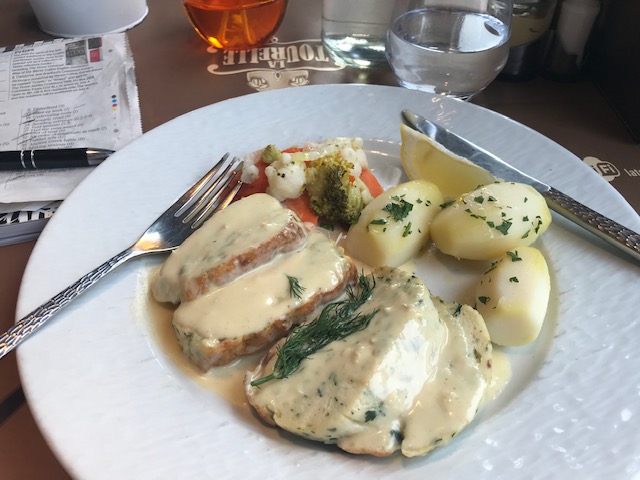
The first night I enjoyed a delectable dinner in a local brasserie, the hot mousseline de poisson (fish terrine) something I have never eaten in England or Australia but, then again, I am not a frequenter of French restaurants.

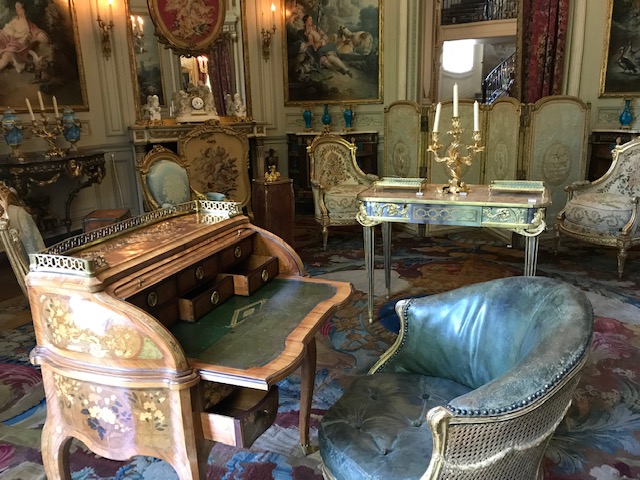
Unable to eat all three courses, I chose fruit salad for pudding and took it back to my garret for breakfast. That morning I indulged in a bit of very gentle tourism, before meeting a friend for lunch,  and visited the Musée Nissim Camondo, a small but exquisite house museum overlooking the Parc Monceau. The house, modelled on the Petit Trianon at Versailles, was built in 1911 by Count de Camondo, a member of a wealthy Jewish banking family, to house his collection of eighteenth-century art and furniture and objects from the reign of Louis X1V.

Some of my favourite pieces were the Gobelin and Aubusson carpets and tapestries, a marquetry desk made of over ten different woods, a roll-top desk inlaid with porcelain plaques (one of only ten in the world), the dining room laid up with a silver service presented by Catherine the Great to her lover, and the display of Sèvres porcelain, the Buffon collection, decorated with exotic birds dating from the late 1700s. The Camondo story, though, is a tragic one, the collection, which Moïse bequeathed as a museum on his death, is all that survives of the family. His son Nissim died in action in the first World War and his daughter Beatrice and her two children died in Auschwitz.

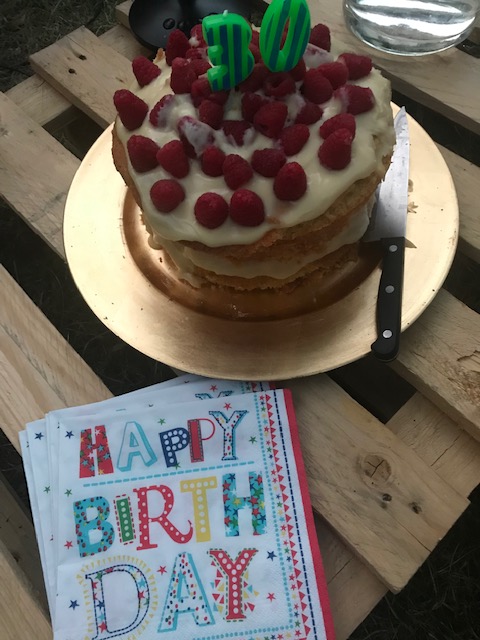
On Saturday night I headed to a birthday barbeque my niece, Georgie, and her husband, Manu,  were hosting in their garden in the green and leafy, once communist suburb, of Fontenay-sous-Bois. We oldies – my sister, her husband and I – enjoyed chatting to the youngsters but the pièce de resistance had to the the three-tiered cake – Victoria sandwich with fresh raspberries – that my sister had brought over from London on the Eurostar! The same beloved sister that met me for breakfast at Kings Cross Station at 7 a.m. the Sunday in May I flew in from Perth.  She’s a champ.On Sunday morning we headed off to the more ethnic 20th arrondissement to the Bellevilloise, an art nouveau cultural centre, once a cooperative – hence the warehouse-y feel – founded in 1877 also housing a café and restaurant. We were there for Georgie’s 30th birthday jazz brunch and we feasted like kings on the all-you-can-eat buffet. Even though weary from the night before and full of food, I insisted that we made a detour to the nearby Père Lachaise Cemetery, resting place of so many notable people and surely a perfect place for the spiritualists’ talk on life after death?
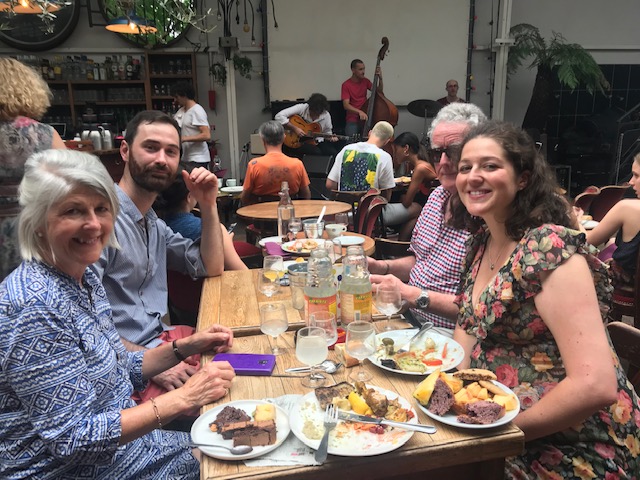
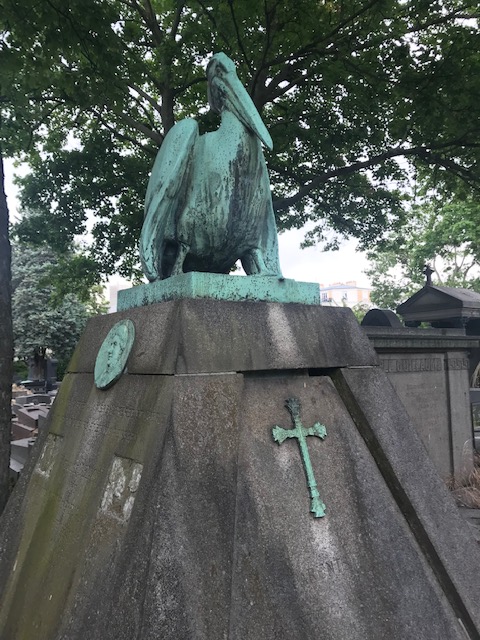
I dragged the family around with me, determined to the last – I’m like that – it’s an annoying perfectionist streak – tofind the tomb of at least one famous person.

My sister and I in Pere Lachaise

We did eventually find Oscar Wilde’s, although it didn’t really live up to the hype!  And for some years it’s been enclosed behind protective glass to prevent Wilde fans defiling it with lipstick-mouthed kisses. Ah well, at least we ticked it off! The most fascinating thing about Père Lachaise is that when it was first built in 1804, it was considered too far from the city and not well used so the administrators decided to attract more custom by moving the remains of some famous names starting with Molière and La Fontaine. Clearly a successful marketing strategy!

Not Oscar’s but another tomb that caught my eye

As I write this I am on the train – the wonderful TGV – heading towards Provence (tall cypresses that remind me of Van Gogh landscape visible in the distance). Provence means it’s time to pause, time to hang up my tools and let my mind go fallow. No more blogs for a bit – maybe I’ll even do a digital detox!

Unbuttoning about an ex

I once heard a therapist-type person talking on the radio about reframing events from our past and observing them from a different perspective. He compared the process to sorting your wardrobe: what do you keep; what has significance; what do you treasure; and what can be re-arranged or chucked out. Maybe you can transform an old outfit into a new one with a bit of creative thinking. It’s an interesting metaphor. The items in our wardrobe often have a story to tell, reframing aside.

One of the most loved and enduringly chic garments in my wardrobe is a purple Agnes B woollen jacket. It must be 25 years old. While it’s a bit worn around the cuffs, I had it re-lined a few years ago in lilac which made it look new again. Then a few months ago, I took it to the Dry Cleaners, instructing them to be extra careful with the fabric buttons, which were already hanging by a thread. Needless to say, the buttons came off and were worn down to the metal making it impossible to re-attach them. After all these years maybe it was time to farewell my beloved jacket, I reflected sadly. It didn’t occur to me that I could replace the buttons until the girl at the cleaners piped up that the Brighton Button Shop, a treasure trove of buttons, wools and haberdashery, was just up the road.

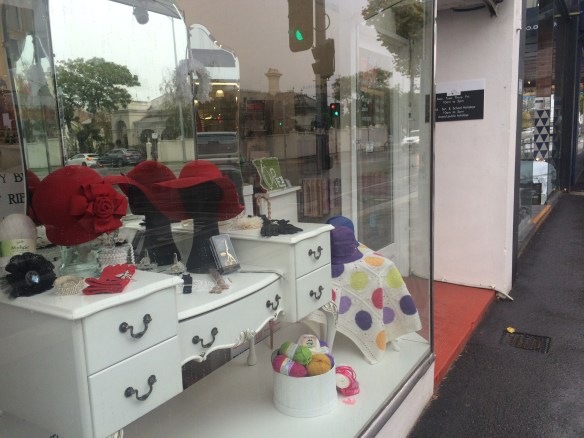
The Brighton Button Shop

The Brighton Button Shop

I got talking to Jenny, the current and only seventh owner in the shop’s 102-year history. A former finance worker, she bought the shop on something of a whim when her daughter was a baby, announcing to her husband one night that she had bought a lot of buttons. Back then, according to Jenny, the place looked more like an op shop- dark and cluttered. Always passionate about all things craft, she transformed the shop.

Putting my jacket on what was once her daughter’s change table, she immediately came up with some elegant suggestions for replacement buttons. Loving the personalised service and hearing her story, I felt inclined to share mine.
image

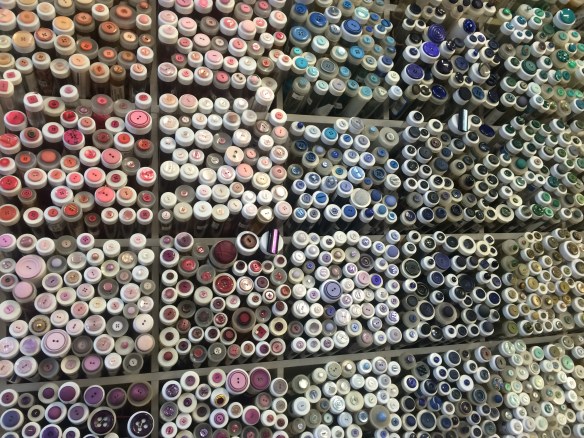
Buttons galore

Buttons galore

I was given the jacket by an American boyfriend. I don’t recall whether he gave me the jacket before or after a weekend in Paris. But, thinking it over, it must have been prior.

I was in my late twenties, living in London and going out with an American working mostly in Paris. What could be more story book perfect? I was in love with the idea of being in love and spending a romantic weekend in ‘Gay Paree’.

Things started badly. He had arranged for another couple to join us for dinner – forget the loved-up hand-holding à deux thing – at the well-known restaurant La Coupole. No sooner had we eaten our first course – think cream, butter, more cream, seafood and cheese – than Mr Preppy from Pennsylvania had his wallet stolen. The evening passed in a tense blur of anger, balled fists and phone calls to American Express.

That night I woke up with an upset stomach and had to dash to the bathroom. On my way back to bed I fainted and Mr P laughed, supposedly at the drama of it. But by the morning he found nothing to laugh about and was in a black mood; I had ruined his sleep and he was suffering.

By lunchtime he was speechless with fatigue and fury. We sat across from each other in a cafe toying with our food with nothing to say and nowhere to look. Feeling waves of passive aggression coming across the table, I had a sudden urge to tip the salad over his groomed head and watch the oily dressing slide down his perfectly shaven face, smoothed to glossiness with some kind of expensive lotion. If only I could get the key to our hotel room, I could do the deed, run back to the room, grab my bag and take off. But the key was in his Calvin Klein suit pocket and so I bit back the anger, smiled and offered placatory phrases and gestures, inwardly muttering YOU BASTARD!

After an afternoon nap, Mr P seemed quite restored and excited at the prospect of visiting his designer friends Gavin and Guillaume, who were renovating the flat of a rich champagne heiress. Gavin, dressed like an English country lord in tweeds and a woollen tank top, opened the door to the vast apartment and kissed Mr P delightedly on both cheeks. I managed a tight smile as he introduced me to Guillaume who was flipping through a book of fabric samples. “Enchanté,” he said getting to his feet and shaking my hand before hugging Mr P to his silk-shirted breast. As we toured the flat in all its vulgar opulence and ostentation, it became painfully obvious that Gavin and Guillaume were much more enamoured of Mr P than I was of him, or he of me. This was not quite the Gay Paree I had been dreaming of.

But now, after all these years, I can laugh at the whole episode. What’s more, I still have a beautiful jacket.