It’s been a week of reminiscing – meeting up with two university friends after a gap of 32 years and visiting Oxford, my home from 1997 to 2002. The amazing thing about meeting Victoria and Charlotte (la otra Carlotta – we all read modern languages at Bristol) was that we just picked up where we left off. And, yes, we’ve all aged but, conversely, we all looked exactly the same. What had changed was our choice of food and drink. Prosecco wasn’t the drink du jour back then, fancy grains like quinoa hadn’t come to the West and spiralized didn’t exist as a verb and certainly not when teamed with vegetables!
I received the warmest of welcomes from my friends Hilary and John in Oxford. Freshly picked roses and a selection of hand creams by my bed, a kettle and a supply of herb teas in my room along with a stack of interesting books including Rose Tremain’s memoir, Rosie. How I love my creature comforts! Drinks and nibbles in their stylish garden followed by a delightful dinner was the perfect prelude to a good sleep. Breakfast the next morning was beautifully laid-up with gluten-free cereal and bread, sliced mango and pomegranate and a pot of Cooper’s Oxford Marmalade. Luxury.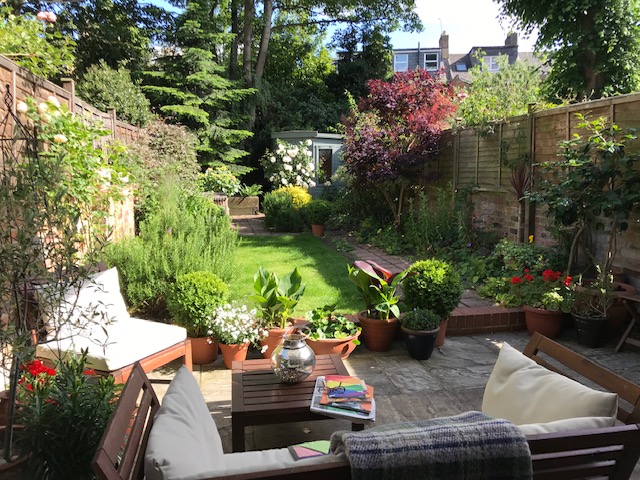
On Saturday morning Central Oxford was heaving with shoppers, tourists, students, day-trippers, school kids, buskers and performers – you name it. I met Juliette – I worked with her husband Giles at the Wildlife Trust and she and I used to sing in the same choir – and we wandered, chatting ceaselessly, through Christchurch Meadows where traditional England was in full swing: green striped lawns; punts gliding by; students in full regalia hurling themselves into the Isis to celebrate the end of exams; a cricket match in progress and cows grazing. We crossed over Magdalen Bridge and walked up a good stretch of East Oxford’s Cowley Road, known for its more Boho and multi-ethnic scene, to a park where Giles was DJ-ing between bands. I wish I had had more time to hang out at the Florence Park Festival and tap into the earthy, folksy, eco-friendly, funky vibe. I caught a bit of music over some polenta chips before bussing back to Central Oxford to give myself a little break before the next chat fest.

Another delightful dinner with friends Tom and Annemarie that evening, this time in Kidlington. And in a belated celebration of the summer solstice we sat outside after dinner overlooking a scruffy field, a donkey sanctuary (I also spotted a fox slope by), warmed by a crackling fire with the occasional bat flying over.
On Sunday I caught up with two girlfriends, Anne and Michele, and in the afternoon we all went for a walk through the fields (one of the things I miss most about living in Australia) starting in the village of Stonesfield and ending in Coombe. The walk so carefully planned by Anne ticked every box and more: green fields with red kites wheeling overhead; hedgerows dotted with fragrant elderflower and dog rose; a gently flowing river; country cottages adorned with blowsy climbing roses (lots of these); AND the ruins a 4th Century AD Roman villa in North Leigh, once one of the largest in Britain.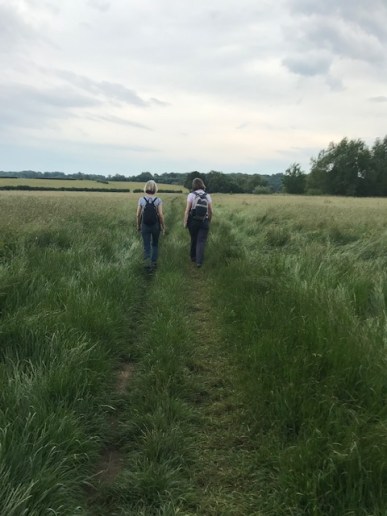
And the highlight: a section of a surviving Mosaic floor complete with patterns of leaves, knots, stylised pots and a swastika or ‘Greek Key’ pattern possibly serving as a maze to ward off evil spirits. The colours of the stone tesserae have faded, but it’s easy to imagine the original blues and reds and the wealthy Romans lounging around on couches, enjoying the underfloor heating.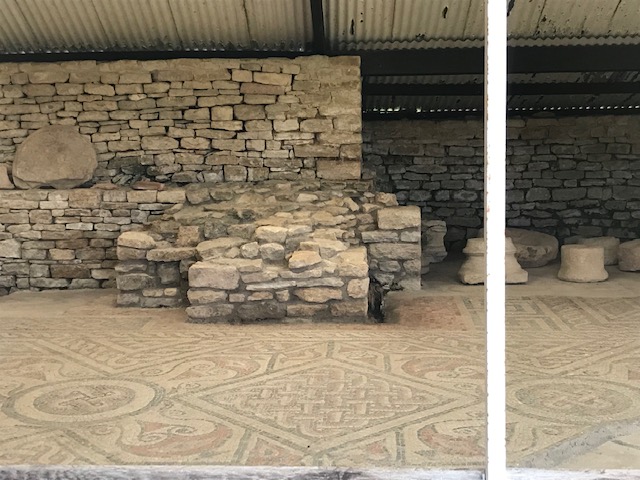
I could have done with underfloor heating in my Oxford terrace, a rather hotchpotch house full of quirks and wonky angles, and not nearly as light and airy as my house in Australia. The energy always felt a bit stagnant – not helped by rivers of condensation that poured down the north-facing front window in winter. I recall an alternative health practitioner – Dr J – who I consulted in my digestive disaster days attributing my health imbalances to geopathic stress! Something to do with underground nuclear testing since the Second World War causing splits in the earth’s crust. He said it was often present in people with syndromes and illnesses that failed to respond to other treatments, and who were living in damp or mouldy houses, plagued by wasps, bees or ants. That was my house to a tee including invasions by wasps and bees nesting in the attic in summer.
Driven by an overwhelming urge to visit my old house – lifting the lid on the past is seductive and is maybe a subconscious desire to take stock of the present – I knocked on the door on Sunday afternoon. Sadly, I had just missed the current owner but I managed to peek through the window and saw that she’s put in a new kitchen and got rid of the cat-scratched carpets and replaced them with polished boards. I caught up with the neighbours on each side, both still living in Islip Rd, and found out my house has also had a loft conversion. One can only hope that the makeover has driven out any geopathic radiation and ushered in feelgood vibes!
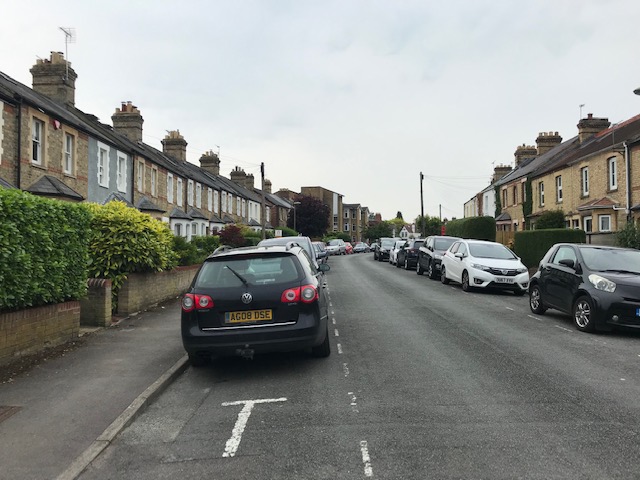
My house is/was the first on the left
Returning to my mother’s house talked out and ready for a rest – it gets very intense jumping into so many people’s different lives and absorbing and integrating information – I went to make a cup of tea after lunch only to find the kitchen windowsills teaming with ants. Geopathic Stress?! Probably not, I’d put it down to Climate Change and the strange weather and humidity. I am off to Paris this weekend where the temperatures are going to be in the late 30s, quite a change from today’s cloudy 19 degrees!


 That same day I accompanied Mum to St Peter’s Church in nearby Clayworth, home to theTraquair Murals by renowned Scottish Arts and Crafts artist Anna Traquair (1852-1936). I reckon Mum goes more for the social connection than any deep-rooted faith. The somewhat happy clappy vicar – it was Pentecost Sunday (reminding me of our/Australia’s Pentecostal PM, Scott Morrison) – challenged us to reflect whether we were ready for God’s Kingdom on earth. The lady in the front pew assented with a vigorous YES and clapped her hands in the penultimate hymn. Mum, meanwhile, whispered all too loudly, that the service was going on way too long and she hoped there wouldn’t be yet another hymn. There was. I enjoyed a bit of time out to reflect, count my blessings (excuse the pun) and admire the fabulous murals.

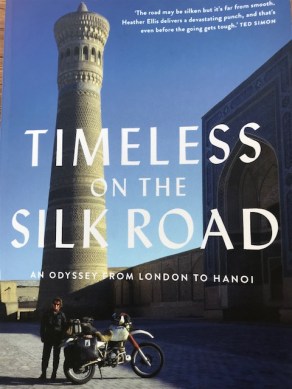

 The other migrants are the eels of stewed and jellied fame, whose complex lifestyle sees them travel across the Atlantic Ocean before they reach the coasts of Europe as young eels, from where they head up rivers and streams and, as mature eels, migrate over 3000-miles back to their spawning grounds in the Sargasso Sea. The author Melanie McGrath has done extensive research both of people and place, and I learnt that eels have been eaten since Anglo Saxon times. As well as being the food of the poor, they have a reputation as an aphrodisiac. One Aldgate eel dealer used to cry out: “Everyone’s a baby.”


 The Canary Island Pine is in Brighton’s Billilla Gardens, an English-style nineteenth century garden with lawns, trees (many of them non-natives), flower beds and a water fountain surrounding the Art Nouveau mansion built in 1878. Now owned by the Council but leased to a Jewish Orthodox school, the gardens are open to the public. Other ‘migrant’ trees include two Bunya Bunya pines and a Canary Island Date Palm. Before the Suez Canal opened, the Canary Islands were a stopping-off point for sailors to the New World. Hence Carmel’s reference to trees as metaphors for Australia as a “nation enriched by displaced and transplanted peoples.”
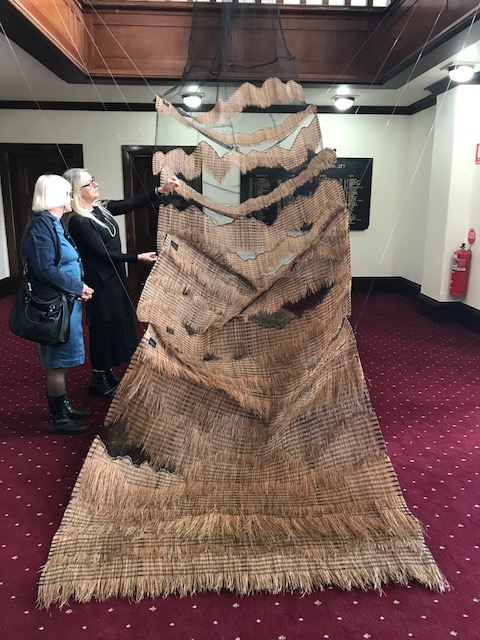
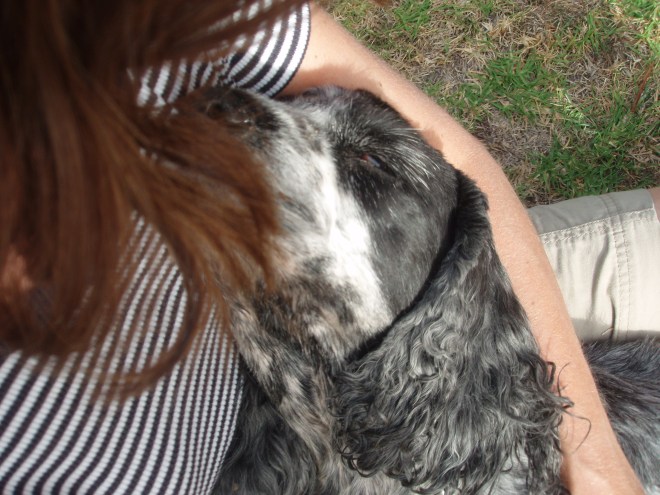
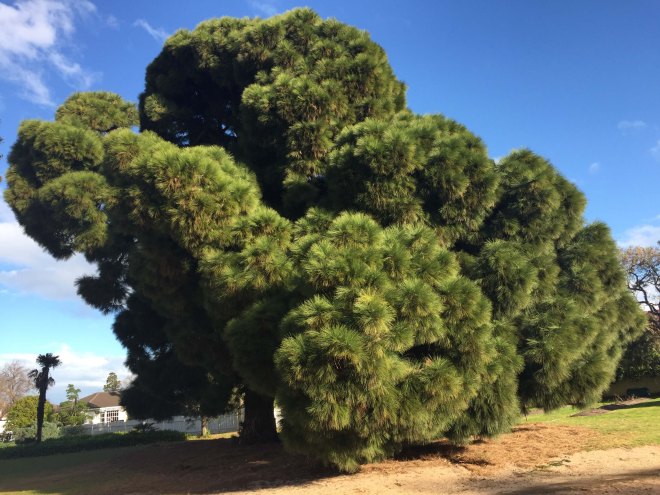 I have wandered many a time in the lush and leafy gardens, sometimes with my dog Bertie, or on summer days I sometimes go alone and lie under a tree with a book with just the rustling of trees for company. You can’t fail to spot the iconic Canary Island Pine with its distinctive shape. From the side it resembles the bustle on a Victorian dress with its backward curve. I love the way it commands the space. Sitting on a deep carpet of pine needles and weaving a row or two with Carmel, I discovered that the tree owes its singular form to a lightning strike in 1918 and that it is listed on the National Trust Register of Significant Trees. You can see the scars where the tree has lost branches, but I’d never lingered long enough to notice the jewel-like beads of sticky resin.
 Standing under the broad canopy of the tree and looking up offers a quite different perspective; the mosaic of sky peeking through the gaps in the branches, the sparkling droplets of resin sparkling against the reddish bark and the vivid green of the pine needles.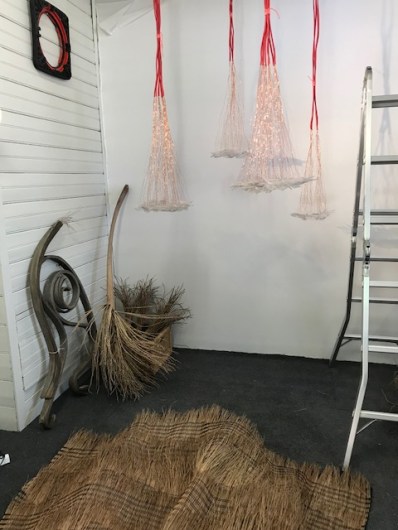






 This Quirky Life