Tearooms and Treasures

It was a fairly emotional reunion with my father after nearly two years (Mum came out to Melbourne to see me in January). He hugged me and made some jokey reference to my living in Australia, a comment that was laden with regret at being a long-distance parent. He kept on saying how lovely it was to be able to experience the real flesh and blood version of me, rather than a voice on the end of the phone.

There’s a lot less of Dad to hug nowadays; he’s had a few falls since I last saw him and is pretty frail and a bit wobbly on his feet. But he’s the proud owner of what we call a ‘pusher’, one of those Zimmer-type frames on wheels which allows him to totter off to the village shop to get the papers, and he’s still got a wonderful sense of humour, is very dapper and up to speed with what’s going on in the world.

One way we’ve bonded is over meals, so I’ve done a bit of creating in the kitchen, and one lunch time made Heston’s prawn cocktail, which went down a treat and took us down yet another memory lane; we used to go out for dinner at a local inn called the Normanton in the 70s where prawn cocktail was a firm favourite.

Midweek saw us drive over to Derbyshire to meet up with a former work colleague of Dad’s for a pub lunch in the village where I was born! It was a glorious drive along steep country lanes darkened one minute by heavy rain clouds and the next lit up by flashes of bright sun. Derek, who has recently been bereaved, worked with Dad at Whitbread East Pennines. Back then Whitbread was a brewing company but they are now a hotel and leisure chain. Dad and Derek are both in their 80s and loved reminiscing about the good old days. Derek remembers that I sometimes went to the brewery after school and did my homework in his office. Another emotional reunion!

On Thursday Mum and I did a day trip by train to Lincoln. Once again it was a mild day – is this global warming or what? – and, on arrival, we walked straight along the High Street through the arches of the ancient Guildhall building and up the steep and narrow cobbled streets to the cathedral. What a climb it was.  I am so proud of Mum at 83 for managing both the distance and the gradient. Go Mum! We rewarded ourselves with a cuppa in a charming little tea room – all chiming clocks, copper kettles and timber beams – when we got to the top. As we sat down to a pot of earl grey served in Royal Albert china (the one with the roses and gold rim), I reflected that it really is the simple things in life that make me happy.

mum

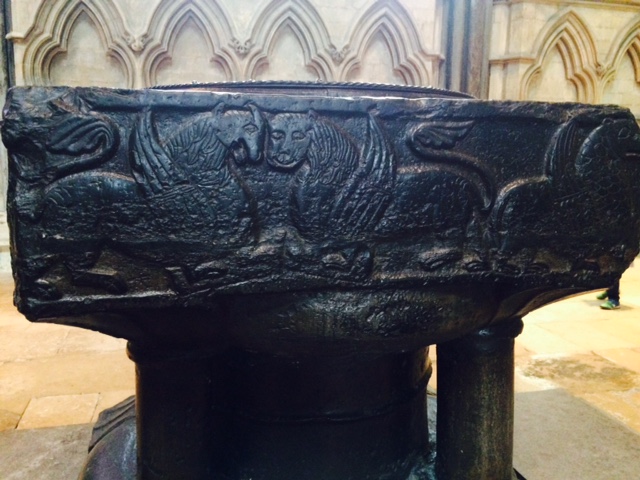
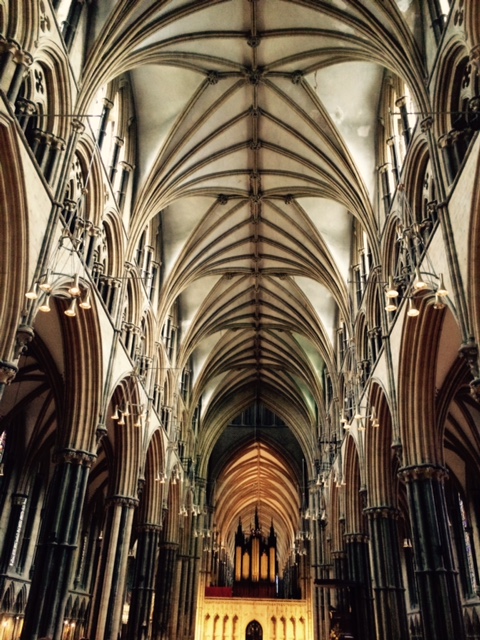
The cathedral is, in a word, magnificent. Built in the shape of a cross to mirror Christ’s journey, it’s huge, vast and magisterial with lofty vaulted ceilings directing all the attention heavenward. Commissioned by William the Conqueror (there’s also an 11th century castle nearby) in 1072 and finished around 1245, it’s a fine example of gothic architecture, and is full of treasures: a 12th century marble font adorned with mythical beasts enacting the battle between good and evil; a series of striking modern wooden carvings depicting the Stations of the Cross; St Hugh’s Choir, a church within a church where every pew and choir stall is intricately carved with figures and symbols; Eleanor of Castile’s Tomb; and in a small side chapel, a series of murals by Duncan Grant (one of the Bloomsbury set) from the 50s depicting my favourite thing, the English countryside.
FullSizeRender

Lincoln 3Lincoln 2


By lunchtime we’d worked up a good appetite and had a delicious lunch in the Wig and Mitre pub. Then we ambled back down to the train station via little boutiques and arty shops, a shambolic antique shop that smelled of cat pee and was full of curiosities but no bone china mugs! No single ones anyway, to add to my collection of non-matching English bone china mugs. The irony is that since I moved to Australia, I can’t get enough of English antiques, history or heritage! So I was delighted to find a little Toby Jug in a charity shop for the princely sum of £2.50. Then it was straight to Marks and Spencers where I got so engrossed in buying new bras that we ended up running to the station. Poor, long-suffering Mum doing  her best to keep up. But it gets worse. Platform 4A looked identical to 5A (I won’t explain why, but it did) and even had the same two carriage little chugger (my word for those small trains) ready and waiting.  So we jumped on, fairly breathless at this point. It seemed strange that it didn’t leave on time. Then a man got on and asked if the train was going to Newark and when his fellow passengers nodded, I suddenly realised our (my) error. We were up and off the train in seconds, only to find our train had left three minutes ago. Mum was very good about it. Luckily we only had an hour to wait till the next train. Better than ending up in Newark though. I got Mum a cup of tea at the station cafe and dashed back to Marks and Spencer’s. Any opportunity…

The hour passed very quickly but I was back in time to get the right train equipped with several new bras, one Toby Jug and sweet, sweet memories of a fabulous day of all that Blighty does best.

I will leave you with a picture of a section of Duncan Grant’s fabulous mural:
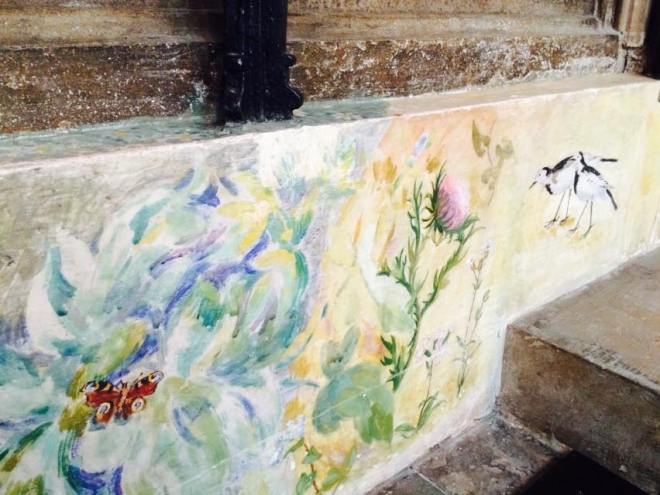
Duncan Grant Mural

Back in Blighty

Well, I made it over here in one piece. The flight was LONG as it always is but I stuck to my plan of seeing it as a mini holiday. The food was pretty mediocre but I watched three films, a light Spanish comedy, Ocho Apellidos Vascos, Words and Pictures, a rather hard work film with Clive Owen and Juliette Binoche, and The Grand Budapest Hotel, which I loved. I also continued to read Slipstream, Elizabeth Jane Howards’s autobiography. Howard, who died recently, was an author married to the naturalist Peter Scott and then, latterly, after multiple affairs with married men, to Kingsley Amis. The book is full of encounters with literary figures, artists, playwrights and the like – from Charlie Chaplin, Laurie Lee, John Betjeman, Laurens Van der Post, members of the royal family and other glitterati. The rest of the time I slept and dozed and longed to lie down. I’m normally very organised but had run around all day like a mad thing only taking Bertie to the dog sitter a few hours before I was due to leave so I was still watering my lemon tree and washing up when the taxi came. No wonder I felt a bit tense and stiff by the time I got on the plane!

I’m now back in Nottinghamshire, the county we’ve all heard of thanks to the forest-dwelling tax evader, Robin, he of the Hoodie, with my parents. I did spend some of my childhood years in Nottinghamshire, but I don’t feel any particular allegiance to it or that it’s what the Spanish call ‘mi tierra’, which, literally translated, means my homeland or my country, but on a deeper level conveys a sense of soul connection with a place.

I flew into Manchester airport, where Eddie from Mum’s village met me, along with his dear little dog Scruffy who was rescued from a Spanish village. We travelled over the Pennines (following at one point the Tour de France route) passing through wild expanses of moorland cloaked in bracken and heather, now turning brown and gold as autumn moves into winter. It was unseasonably mild and sunny and the trees look magnificent in shades of russet, copper and gold. We passed through tiny villages with names such as Tintwhistle and Stone and past fields bordered by hedgerows and dry stone walls. I’d forgotten about hedges but now I’ve seen and remembered them, I realise how much I’ve missed them! Hedges are havens for wildlife – according to the Royal Society of the Protection of Birds, Hedges may support up to 80% of British woodland birds, 50% of British mammals and 30% of butterflies.

A good native hedgerow is made up of a mix of plants such as Hawthorn, Blackthorn, Crab apple, Guelder rose, Dog rose, Wild privet, Honey suckle, Hazel, Field maple and Holly. As a child I used to look for birds’ nests in the hedges and watch the parents flying in and out until the babies flew. Even in my mother’s garden we get a great selection of birds; this morning we saw goldfinches, blue tits, robins and green finches all darting around on her bird feeders. Although Australia has a rich diversity of birds, I only seem to get mynas, an introduced species, wattle birds (they can be very noisy too) and pigeons in my Melbourne suburban garden.

Much as I love Australia, the life I have created there and all my wonderful friends, I really miss the British countryside. It’s definitely mi tierra, my spiritual home. There’s something about the soft, green, gently rolling landscape that gets under my skin; it reminds me of family walks on Sunday afternoons, picnics by rivers, bike rides along country lanes, village fetes with tombolas and teas and long summer evenings when it’s light till ten o’clock.

I read an article a few years back about Sidney Nolan who moved to England in 1955 and then to the borders of Wales where he settled in 1983. He painted Australian landscapes from afar, but also travelled widely outside Europe to Africa, China and Antarctica, returning regularly to Australia to connect with the quality of light and the shape of the trees. When people talk of homesickness, perhaps what they are really getting at is a yearning for the topography of their native country. Every time I return to English I feel like doing a Pope John Paul II and kissing the ground.

I have very intermittent internet access and so am writing this from the library in Retford near where my mother lives. It’s a small market town, worlds apart from Melbourne in every way, but I’m rather fond of it. There are no shops to speak of – not even a Marks and Spencers – but there is a great little market on Thursdays and Saturdays. On Saturday I bought a wonderful 1950s style cloche hat with a flower on the front ready for Krakow and Zurich, and a red leather collar for Bertie. The hat cost just £10 and the collar £3.50; everything seems much cheaper here. My brother tells me that the cost of living is indeed higher in Australia but so are wages. Not mine, I fear! Next time I come over I’m going to bring an empty suitcase and load up with goodies.

Taking off and unplugging

I’m about to take off back to Blighty and I’m nearly – but not quite – ready. However much I plan in advance, it always builds up to a pre-trip devil-in –the-detail whirl. I tend to sweat the small stuff first – decanting lotions and potions into small bottles, loading up my Kindle, wrapping presents, buying and packing my favourite herbal teas which, ironically, are made in England. Yes, it’s definitely a case of ‘Coals to Newcastle’ but my mother’s local (rural) town definitely won’t have them. I’ve taken some recipes to try out so I can cook for friends and relatives, loaded up my USB stick with photos, documents and work-related stuff, sorted all my hard copy travel documents into folders, made up my regulation plastic bag of toiletries for the plane, cleaned out the fridge, given my indoor plants to a friend, measured out 72 cups of Bertie’s food (he’s off to a homestay place and I’m already welling up about the thought of saying goodbye to him), and tried to fix my garden sprinklers so my pots don’t dry out and die. I’m flying out tonight so better get some clothes in the suitcase sometime soon. ..

At a time of heightened fear in the media and amid all the rhetoric being spouted by our politicians, It’d be easy to succumb to worrying about security on the flight, Ebola, terrorism, mechanical failure – or even losing my luggage. Who hasn’t had troubled dreams about losing their luggage?! But I refuse to be infected by all the negativity and am planning to get on the plane and RELAX. Long haul fights can be mini holidays in themselves if you can get into the right headspace.

It may be the most unnatural thing for the body to be cooped up in a pressurised cabin full of recycled air, in uncomfortably close proximity to other people, with limited opportunity for movement and far too many rounds of heated-up food and stewed tea, BUT when else do we get the opportunity to do NOTHING but read, doze, watch films and doodle? Well,that used to be the case. What bliss when you couldn’t use your electronic devices during the flight. You could well and truly SWITCH OFF. That’s all changed now. I am not flying Qantas but have just checked their website, which states:
“There are plenty of ways to keep in touch while you are flying with Qantas. You can now use your personal electronic devices such as smart phones, tablets and music players in flight mode, for the duration of each flight, providing uninterrupted access to work and entertainment. On all A380, B747-400 and A330-300 aircraft you can send and receive text messages, make inflight telephone calls and perform seat to seat calls all from the comfort of your seat.”

What a shame! Is there no respite from the frenetic round of communicating, commenting, chatting, texting and tweeting? I’m happy to have uninterrupted down time and to enjoy the freedom that comes with being in a cyber-free cocoon.

My mother’s house is a technology free zone, which again, is no bad thing. I’m going over to spend time with her and Dad, not to be glued to electronic devices. I’ll have to ration my time online for blogging and emails as I’ll be hot-spotting via my phone. Mind you, however much I rant and rave about the joys of unplugging, I also recognise that access to the internet is vital for researching new destinations and travel arrangements. In 1985 – or thereabouts – I spent half a year in Spain during the third year of my language degree at Bristol. I had phoned ahead to book into a three-star hotel for my first few nights, there being no email or online bookings in those days. I arrived in Granada in mid-October about ten o’clock at night, loaded up with four months of luggage. The hotel claimed to know nothing about my booking – they were fully booked as it was a fiesta weekend – so they turned me away.

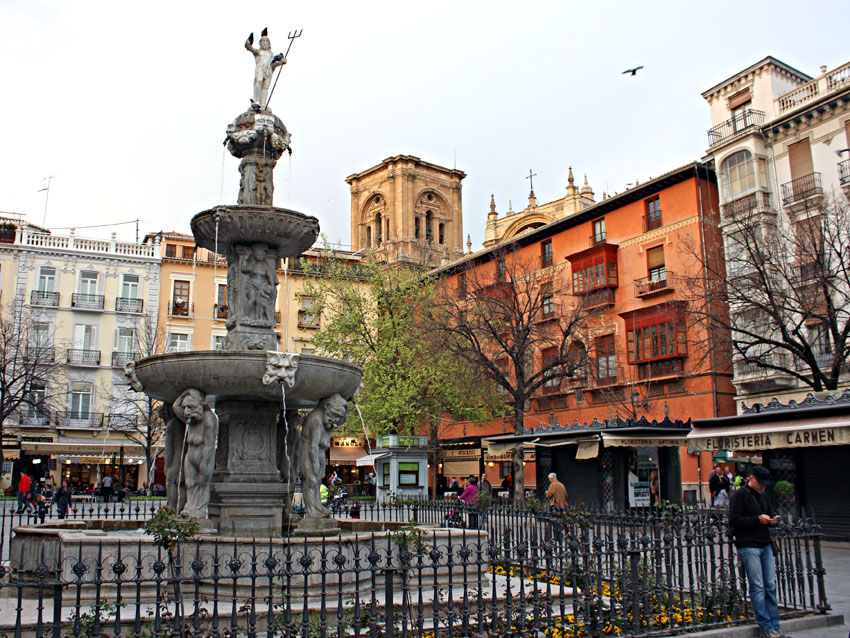
The Plaza Bibarrambla, Granada

The Plaza Bibarrambla, Granada

I met a fellow student, who had also just arrived from England, and we lugged our suitcases around knocking on hotel doors getting the same response everywhere. It was now getting towards midnight and a park bench was looking like our only option. Finally we found a cheap hostal residencia in the Plaza Bibarrambla. Run by a woman who seemed to spend all day in her dressing gown sweeping the steps, the beds sagged in a well worn banana shape, a bare light bulb in the ceiling flickered and crackled, and the communal bathrooms had chilly concrete floors and strict rules about not putting paper down the loo. It was super basic and the other guests could have stepped straight out of a Picaresque novel, but the place nevertheless had some charm, and offered fabulous views over the square. I wonder if it’s still there?

Giving My House an Airing

One of the reasons I renovated was to make my house more guest-friendly; that’s why I made a second bathroom out of a laundry cupboard and a ‘powder room,’ and created an ensuite bathroom to my room. Having two bathrooms avoids awkward nocturnal meetings in the corridor or having to queue up in your own house to brush your teeth. It’s nice to have left all that behind along with exams, backpacking and dormitories.

I’m now getting my house ship-shape for the Airbnb photo shoot, a free service offered by the hugely successful online accommodation business, which connects travellers with people in over 190 countries who have a spare room or entire property to rent out. Airbnb launched in 2008 and by 2012 had reached five million bookings. In 2014 Airbnb was valued at $10 billion, making it worth more than the worldwide portfolio of Hyatt Hotels. Impressive stuff! According to the webinar I tuned into, it’s all about building ‘virality’ (not to be confused with virility) into the DNA of your product. But that’s another story.

My Airbnb symbol - spot the beach huts!

My Airbnb symbol – spot the beach huts!

What I love about Airbnb is that you can escape the stuffy sameness of hotel accommodation and find a place that has character, is homely and enables you to meet and share stories with local residents. In December 2012 I stayed in a spacious and stylish flat in a trendy district of Copenhagen. Although I didn’t see her much (she had just met a new man), I got on really well with my host, a freelance photographer. She was great fun, helped me with my onward travel arrangements, offered me home-made marinated herring (you can’t go to Denmark and NOT try herring) on my last night and let me cuddle her pet rabbit. Although I fancy myself as something of an animal whisperer, (not counting the belligerent donkey in Greece who deliberately nudged a boulder in my direction), the rabbit took fright and shot into its burrow-like enclosure. Never mind.

That’s why I’ve decided to ask the Airbnb photographers to include a picture of Bertie in one of the shots, so prospective visitors know that this house has a resident hound, one who loves to be part of the action. I was initially worried that Bertie’s excitable nature was going to make it difficult with guests coming and going. But, thanks to a recent one on one training session, the boy is beginning to understand that jumping up is not cool but that sitting down definitely is, and earns him a few edible treats. He does still bark in tandem with the neighbours’ dogs (they don’t seem to understand that dogs, especially those designed to herd sheep need regular exercise, ARGH!) but if I catch him and shake the jar of coins before he flies out the laundry door flap and barks up a storm, he stays by my side ever hopeful that a biscuit will magically drop out of my pocket. I never go anywhere nowadays without dog poo bags and treats…

He does still bark furiously at the possums and gets so worked up that he tries to climb the fence, so I only let him out a couple of times before bed. I’m hoping that my guests will be so enchanted by Australia’s nocturnal native animals that they will overlook the occasionally canine cacophony. I can always offer earplugs as part of the package.

Barking at possums - who me?!

Barking at possums – who me?!

P.S. on the Tyranny of Lists

It seems I was rushing so much to tell you about how much I had been rushing that I made some excellent typos! Which were kindly and gently pointed out to me by a lovely friend and loyal reader. Even though I printed off my post and read it aloud before sending, they still slipped through the net. Moral of the story for me is never to work on a post before dinner time when the working day is over, my stomach is rumbling and I am thinking about food!

But, of course, I meant I was ringing the AUSTRIAN railways, not the Australian ones, where speaking German wouldn’t get me very far, however much I got the grammar right! There were a couple of other clangers, but the main other change is that my friend in Japan tells me that WWOOF actually means Willing Workers on Organic Farms not that long-winded explanation I found on Google!

Over and out it’s time for breakfast and Bertie’s walk! Until next time.

The tryanny of lists

I’m really no good at DIY but I am good at lists and ticking them off. Although there’s always a list forming in my head, I have been a bit less ‘listy’ of late, so it was with renewed fervour that I raced through a to-do list this week, so much so that I couldn’t stop.

Life always gets a bit intense before I go overseas – I’ve got about 12 sleeps to go – and the devil is definitely in the detail. Today I tried to print off my train ticket from Vienna to Zurich (a bargain 49 Euros for a seven and a half hour scenic journey – if you can work out how to print off the ticket…). So drawing on my (rusty) university German, I called the OBB, the Austrian railway, and got through to a most charming woman. I managed to explain the problem and found out that I had chosen the pick up at the counter option rather than online printing. Everything was going swimmingly until I realised I didn’t know how to end the conversation. Luckily the woman got in before me and I remembered it’s Auf Wiederhoeren – meaning until we hear each other again – rather than Auf Wiedersehen (as in pet, anyone remember the British comedy?) – until we meet again. Another thing for the list: brush up my Deutsch!

Back to the DIY: one of my jobs has been to re-paint a couple of shelves in the bathroom as the paint had peeled off in two sections where a bottle of essential oil had spilt. I duly went into the shed for the vile oil-based enamel paint that the rip-off painters (see https://thisquirkylife.com/2014/06/24/renovations-stopped-play/) had used back in July. Then I put on some really old clothes, set up the dust sheets, did a bit of light sanding, pulled on a pair of special gloves (last time I got paint all over my hands and even my nose!) and did a reasonable job only spilling a bit of paint on the glass shower screen. Once completed, I felt proud to have done the job and celebrated by taking Bertie to the park. I met a fellow dog walker and apologised for smelling of turps. She said she couldn’t smell anything but noticed I had quite a bit of paint in my hair… It never ceases to amaze me that I am perfectly competent in many areas of my life but develop Mr Bean-like tendencies when it comes to home maintenance.

In between the freelance writing, I’ve also done some cooking (got my former (elderly) neighbours for morning tea this weekend), cleaned my high maintenance black and white bathroom floors, went to ALDI, op shops, second-hand furniture shops, prepared my spare room for next week’s Airbnb photo shoot, cleaned up my garden and leaf-strewn carport and took photos of my house to show folks back home. I also put up three small pictures in my guest bathroom (a few holes short of precise but my bodged attempts were easily covered) and then zipped off to JB HI-FI for new back-up drive (the old one died) and an HDMI cable so I can watch films playing on my computer on the TV screen. All very satisfying stuff but rather helter skelter, achievement-driven and rushed. So I’ve been delighted by the series of beautifully written and well observed blog posts from a friend who is a WWOOFER (Willing Workers On Organic Farms) in Japan. She’s living with a very eco-minded family who have a deep connection to the land, observe rituals and live with precision, total attention and mindfulness, qualities that are uncommon in today’s ego-driven materialist world. Her blog is called A Man, A Woman and Four Languages, and I thoroughly recommend it.

“Yesterday evening I was given a lethal hatchet knife to slice up spring onions. But my 3mm slices weren’t good enough; 1mm was what was required. Not for the first time I felt very uncivilised. So, this morning, when Rie asked me to arrange some umeboshi plums from the bin where they’d been soaking in brine, to a flat basket, to dry, I made sure that they were arranged exactly as briefed. Which meant really slowing down, and concentrating. It’s the same with the gardening, because of the approach to weed control

How do they get anything done when it all takes so long? I asked her over email. She replied “most of their life centres on the basics of growing, cooking, cleaning, washing, heating, maintaining. And these tasks aren’t chores to be completed as fast as possible; they are the stuff of life, i.e. the end as much as the means. ….doing jobs as quickly as possible isn’t the point.

I really must hurry up and look at self-publishing my book titled, SLOWING Down in the Fast Lane: From Adventure to Zen and Everything in Between.

I’ve had a win!

I am very excited to share that my short story ‘A Brief Encounter’- adapted from my book Slowing in the Fast Lane: From Adventure to Zen and Everything in Between has been published on the Radio National website as part of their ‘Pocketdocs’ competition. The guidelines were that it had to be a story on the theme “I met a stranger” and be less than 500 words. The story I sent in was adapted from my D is for Dogs chapter, and, like all the stories in my humorous, memoir-style collection, is true and unembellished in any way.

You can read it here:

http://www.abc.net.au/radionational/programs/360/projects/pocketdocs-2014/5768322

Like many writers I spend hours tapping away into the silence, into the void, racked with self-doubt so successes like this really encourage me to keep going and to honour my voice and way of writing. The RN editor commented on my strong voice.

What’s more, a good fried of mine, Felicity, herself a published author (mentioned in an earlier post on bee-keeping), recently read my book from beginning to end and really loved it. Armed with these two pieces of positive feedback, I am inspired to have another go at getting it published or to self-publish. Watch this space!

A meeting of hearts


“The best and most beautiful things in this world cannot be seen or even heard, but must be felt with the heart.” Helen Keller

I aim to live as much from my heart – feeling my way through life – as from my (very busy) head . But, inevitably, living in such a mind-dominant world, my head often wins out. And I’m definitely with the Ancient Greeks who thought that the heart was the seat of intelligence and organ closest to the soul. On a physical level, our hearts are one of the most important organs in the body beating approximately 72 times per minute moving blood, oxygen, nutrients and waste materials in and out of our cells. But how many of us take our hearts for granted? I know I do.

So you can imagine how humbling it was to meet a young boy not yet six years old, let’s call him Tom, who recently had a heart transplant at the Royal Melbourne Children’s Hospital. Tom was born with what’s known as a TGA heart, TGA meaning transposition of the great arteries. In other words the right side of his heart was doing what the left side should have been doing and vice versa.

This brave little heart warrior (that’s what HeartKids call children with congenital heart defects) underwent major open heart surgery just a few weeks after being born. His young life has been filled with trips to doctors, specialists and hospitals in a constant round of check-ups, cardiographs, echocardiograms, radiography and blood tests. By 2013 he had undergone four lots of surgery, the last one to replace a smaller pacemaker with a larger one.

But earlier this year his heart was showing signs of failure and Tom and his family moved into Ronald McDonald House in Melbourne to wait for a donor heart to come up. I am happy to report that a heart did become available and the operation was successful. Tom has now had two clear biopsies and might soon be able to go home and start school.

I met Tom’s grandmother, Susie, when visiting mutual friends at the end of last year. So when she called and asked to come and stay for a few weeks during Tom’s recovery phase I was only too happy to help out. In fact, she was my first post-renovation guest and so my small but perfectly formed spare bathroom came into play. And, this last weekend Susie brought Tom to stay for a night. It was a short visit – and Bertie dog had to go for a sleepover with his cousin, my brother’s dog, Rocky – but one I will treasure for a long time.

I had seen pictures of Tom before his operation and he looked frail, pale and delicate. So how wonderful it was to see a strong young boy now weighing about eight more kilos and bursting with strength and energy. This little man is a solid mass of muscle and, I kid you not, could easily wrestle me to the ground. Not that we put it to the test.

Instead we got straight down to the important things in life and played games and ordered fish and chips for dinner. My mother laughed at me when I shipped over some of my childhood books and games from England: “What will you do with them?” she asked. “They’re for when little people come to visit, of course,” I replied rather impatiently. Tom loved my game Mousie-Mousie (vintage 1960s) even if half the counters were missing, the mice now have rather twisted tails and we made up the rules. Tom had his own games too, all packed in his Thomas the Tank Engine suitcase along with this Spiderman PJs, and so we played Snakes and Ladders and Monkeys before nipping out to the fish shop.

photo (6)
Before breakfast the next morning, I read to Tom and reconnected to some of the wonderful books published by Frances Lincoln Ltd, in London where I worked back in the 90s. Animal Parade is wonderful read-aloud animal alphabet book and The Leopard’s Drum, a stunningly illustrated African creation story.
photo (3)

Tom tucked into a cooked breakfast of bacon, eggs and mushrooms and was as bright as a button. He kept up a steady stream of questions – how old was I? (THAT old, he questioned, adding a nine for good measure), where did I work? (home? Why didn’t I work at Woollies? I think he must have been chatting to my family who don’t think freelance writing is a proper job!) and when would he see me again? Tom and his family had travelled to Melbourne from out of state, so it may be a while before I get to play Snakes and Ladders with him again.

He gave me a big kiss and a hug when he said goodbye and when I went back into my house, I shed a little tear (well quite big actually) for all that he’s gone through, for all that he is and for all that is growing up to be; a fabulous and spirited little boy.

Food for Thought

Further to yesterday’s post, I am sharing another blogger’s ‘three simple rules in life.” Perfect for a Tuesday nearly afternoon.

Life Lessons at the School of Life

“Lost for words, copywriter ditches job and calls it a day.”

I wrote this mock headline as part of a wonderful class – How to Stay Calm – at the School of Life in Melbourne. The exercise was to coin a headline summarising a situation where we lost our cool and did more than just feel our anger, we acted upon it.

For those who haven’t come across it before, the School of Life was started by philosopher, TV presenter and author Alan de Botton and has its headquarters in London. To quote from their website: The School of Life is devoted to developing emotional intelligence through the help of culture. We address such issues as how to find fulfilling work, how to master the art of relationships, how to understand one’s past, how to achieve calm and how better to understand and, where necessary change, the world.

Melbourne’s School of Life is located at the Spencer St end of Bourke St and has a small cafe framed by natural wood bookshelves stacked with everything from the classics and contemporary literature to self-help, philosophy and the humanities. The lecture-style classroom leads off the cafe and is also book-lined, intimate and inviting.

Copyright: School of Life

Copyright: School of Life

For three hours last Wednesday Elise Bialylew, founder of Mindful in May (www.mindfulinmay.org), led us in a wonderfully rich discussion drawing on the works of some of the great philosophers and thinkers from Kierkegaard to Buddha as well as contemporary thinkers, psychologists, neuroscientists, futurists and researchers.

I’ve explored all sorts of therapies, attended different types of retreats and experimented with various styles of meditation and ways to stay balanced, but there’s always more to learn and re-learn. It’s not as if we were taught how to manage or relate to our emotions at school or university, at least not when I was in the education system. Elise reminded us that emotional wellbeing is a skill and takes practice just like a sport. So, as well as going to the gym, we need to make time for training our minds.

OLYMPUS DIGITAL CAMERA

Emerging research shows that mindfulness – training our minds to focus on one thing at a time and staying in the present moment – can actually develop our pre-frontal cortex. This is heartening as our brains haven’t kept up with the pace of change and evolved to cope with the demands of modern life. But a little mind training can help update the software. Want to know more? Try reading Daniel Siegel’s The Mindful Brain or do what I did and download some guided meditations onto my phone. I love guided meditations as I find it much easier to still my mind and focus.

During the class we also reflected on what it is to be human, and the fears that we all share. According to Buddhism, mankind’s five greatest fears are: fear of death; fear of illness; fear of losing your mind; fear of loss of livelihood; and fear of public speaking. Who hasn’t experienced one or all of those at some stage in their life?

Given our inherent human vulnerability – it’s time we learnt to listen to the likes of researcher and author Brené Brown who writes that owning our vulnerability can be a strength and actually connects us to others – the last part of the class focused on five key prescriptions for living. (If you’ve not yet discovered Brené Brown, I highly recommend one of her TEDTalks http://www.ted.com/talks/brene_brown_listening_to_shame?language=en) –

The Five Prescriptions

1. Acceptance – survival stories – Elise recounted the story of a shipwreck survivor entitled the Sinking of the Trashman which is part of a collection of extraordinary stories called The Moth (more about the Moth in a future blog). What emerged from this tale of survival was a belief in a higher power, a conscious choice of focus (expressed as a sense of wonder at the sky, the stars etc), a talisman (she threw a black pearl into the sea as kind of offering), a determination to focus on positive memories even in the face of death (two crew members were eaten by sharks), a great deal of resilience and lots of common sense practicality; for example, she used seaweed for insulation.

2. Discernment – mindful awareness – a recent study showed that five hours of mindfulness actually changed the body’s genetic expression and can help with inflammation and chronic pain. What’s more, it can even boost production of an enzyme that protects against ageing. Forget botox and collagen…

3. Surrender to the Ascetic or Aesthetic – perhaps losing oneself in nature or becoming absorbed in a work of art.

4. Compassion – empathy and identifying with others – which can sometimes mean simply holding the space for another person rather than trying to fix them. But equally important – and it’s not valued in our culture – is self-compassion. How can be kind to others when we insist on beating ourselves up and criticising ourselves?

5. Communion and Connection –this is about connecting to others. I’m reminded of that famous John Donne poem – ‘No Man is an Island’. Where would we without friends and community?

No man is an island,
Entire of itself,
Every man is a piece of the continent,
A part of the main.