Whatever the history of Valentine’s Day – and there are conflicting versions – the month of February has come to be associated with romance, love hearts, lots of coochy-cooing, red roses, chocolates, gift giving and specially themed dinners, not to mention Hallmark greeting cards.
So I thought it was a good time to revisit the thorny (that’s the trouble with the roses…) issue of dating and how to find love. Friends who have been married for many years or ensconced in long-term relationships – perhaps envying me my freedom and flexibility – tell me not to bother: “You don’t want to tie yourself down.” Then Dad’s partner used to worry that I wouldn’t want to iron a man’s shirts and put dinner on the table each night. I didn’t have the heart to tell her he would iron his own shirts and that we would most likely share the cooking.
Just because romance may have been killed off or long ago faded for some shouldn’t spoilt it for the rest us. I haven’t yet abandoned the pursuit of romance, frills, bows, bells and all – just spare me the Valentine’s schmaltz.
Past child-bearing age and the pressures of juggling work and a young family, romance for the 50-something can be wonderfully rich and satisfying with opportunities for love, passion, companionship, shared travel and joint voyaging through all that life has to offer. There’s a more mature model on offer with less to prove and more to enjoy.
According to the Australian Bureau of Statistics divorce rates have increased among the 55-plus age bracket – a trend that is being driven mostly by women (so what’s new?) – but what this means is that there is a pool of second-time-arounders coming back onto the market. During a brief flirtation with internet dating a year ago, most of the men I met had very recently separated – some were still dividing up the spoils down to the pots and pans – and clearly nursing wounded egos hence their rush to go online and re-partner. But I did also meet others who had let themselves settle and adjust. Just none that I felt like pursing.
There’s no question that there are men out there, but is it possible to by-pass all the frog-kissing, data-trawling, profile-perusing trials and tribulations of online dating and find love in the real world? I’ve decided to conduct a social experiment and find out.

I went to a party recently and got chatting to a woman in her late 50s. She told me she’d been widowed, sold the suburban family house and bought a flat with fabulous city views. Noticing she had a new partner, I asked how they had met. Although they were introduced by a mutual friend, Angie had dabbled in online dating and instanced one man who had suggested, as a first meeting, a rendezvous at the airport on the way to a holiday in Hawaii! Talk about speed dating!
They suggested I take up golf – the idea being that there are always men on hand to help and advise with one’s technique. This puts a new spin on swingers, just that these ones would be in collared Polo shirts, checked trousers and studded shoes. Golf is just not me – from the clothes to the clubiness. Although if a potential partner were a keen golfer, I’d be sure to get some space and time to myself. I am not looking to trade flying solo to being joined at the hip 24/7. I’ve written in previous blogs about maintaining some degree of independence, perhaps living in separate houses but as a committed couple – at least to start with; it’s known as LAT – Living Apart Together.

A friend suggested I downloaded Bumble, an app designed by women for women. Women make the first swipe (to the right) and men have 24 hours to respond. As with Tinder, it’s a location-based app that relies heavily on appearances and, I think, tends to attract men keen on a fling rather than a deeper connection. “Not your average 50-year-old – take me for a spin around the block,’ says one and another, “let’s see if there’s chemistry for a fling or more.” Some advertise that they are passionate and sensual, or good kissers.
Radio National’s Life Matters program is running a series on Online Dating, and last week it was dedicated to the over 50s. One woman, who did succeed in finding love, believes that the profile and how it is written is all-important – forget photo-based apps. For her, one spelling mistake or errant comma spells a no. I’m inclined to agree. And I liked her idea of meeting a date in an art gallery – it’s a good testing ground and on neutral territory. How a potential partner responds to an exhibition provides a good insight into their personality too.
But what is the likelihood of meeting an available man – I seem to have been a magnet for married men all my life – by chance in a gallery and getting cosy over the captions? Which brings me back to options in the real world and my determination to try a few. Hanging out in cafes with my dog and an interesting book is not new, but I will aim to frequent different cafes in different neighbourhoods (interestingly, a friend recently sent me an article detailing which Melbourne suburbs have the highest density of singletons).
Then a girlfriend and I plan to go to book launches and other events that have a social component, the kind of functions where you can start a conversation with someone based on what you have just seen or heard. Solo travel can be exciting on all levels too, and there’s a you-never-know element. I got chatted up by a 30-year-old barman in Frankfurt a few years ago – he was a bit of a lush and a bit louche to boot but it did my ego the world of good and reminded me that anything is possible.
In a concession to Cupid, I considered going to a Valentine’s Day event billed as a ‘Single, Mingle’ hosted by Bumble. With menu items including a kiss booth, photo booth, match-making and speed-dating it sounded much more 20s to 40s than my vintage. I emailed to ask about the age range and a week later got a reply: “unfortunately we have been unable to provide further details to users about this as of yet.” I decided against it.
Instead I am going to a German Meet-Up group which will get my brain cells into gear if nothing else. Last time I was having a deep and meaningful chat with Fritz (not his real name) who told me he was an introvert and came across as a bit lonely. I was enjoying our chat until someone came up and asked how his wife was. Plus ca change as the French would say.
Ah well, if the real world bears no fruit, I might have to eat my words, swing a golf club or two, swipe an App or craft a word-perfect profile. Watch this space.

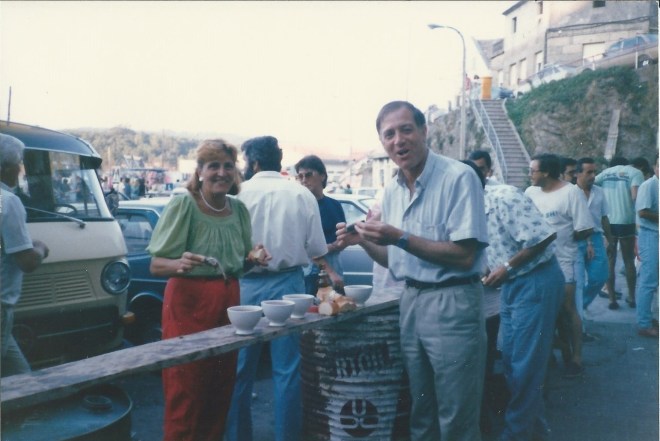 Later in the trip we travelled by overnight train in a sleeper compartment from La Coruña to Madrid. We’d come straight from the beach and our bikini bottoms were still gritty with sand. A man with a dark five o’clock shadow and reeking of garlic came into our compartment early in the night and claimed the third of four bunks. After a few station stops where, each time, travellers would slide open the door to our compartment in search of a bed, garlic man got up, swearing a very Spanish joder (Google it!) and locked the door. Terrified as to his motives, we whispered frantic contingency plans, but soon realised that he simply wanted to get a good night’s sleep without disturbance. Selfish maybe, but not a sexual deviant, his swearing was replaced by snores. No joder simply a bit of roncar!
 By Christmas Day I had undergone something of a 360-degree transformation. When I walked my dog in the morning, I felt my feet on the ground, listened to the rustling of the trees and the orange of the canna lilies and the purply blue of the agapanthus flowers jumped out at me. I spent a joyous day with my mother and my brother and his family celebrating in the traditional way.





 He bought the house in 1639 but didn’t manage to pay off the 13000 Gilder mortgage. The house was reconstructed from the inventory that was drawn up when he went bankrupt in 1656 and had to move out. As well as his box bed, I was fascinated by the collection of objects which he used as models for his paintings such as Venetian glassware, marble busts, seashells, dried animals and exotic weapons. Considered one of the great artists of all time, Rembrandt was, apparently, a moody man, and enjoyed a scandalous love life involving extra-marital affairs with his nanny and then a 20-year old girl.
 From his famous Potato Eaters peasant painting through to his self-portraits, orchards in bloom, Sunflowers, and the emotionally-imbued landscapes of waving wheat, blue skies, gardens and rural scenes of his final days in Auvers-sur-Oise, this was the highlight of my trip. Getting up close and personal with his paintings was to experience their intensity of colour, depth of expression and extraordinary beauty. As Van Gogh himself said: “Paintings have a life of their own that derives from the painter’s soul.”














 As war loomed in the 1930s, lifesavers became linked with military service as they were trained for ‘battle’ in the surf and male lifesavers became poster boys – literally– for ads marketing Australia to tourists. It was all about manhood, military service, muscles and virility.
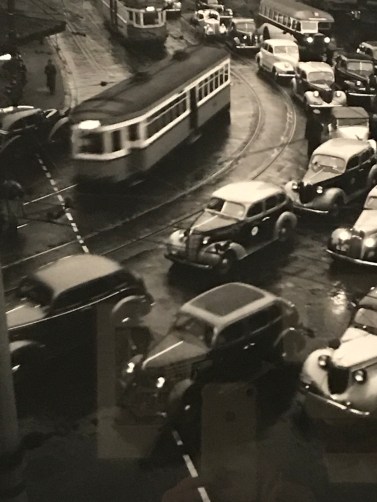
 Of course, no exhibition of this inter-war period would be complete without reference to the Great Depression. In contrast to the negligees, glamorous gowns, airbrushed posters, radios, fridges, cars and speedy trains with restaurant cars, there was huge unemployment (levels reached nearly 32 per cent in 1932) and poverty. A series of photos and black and white grainy film depict life in the slums in the cities, while works by artists such as Arthur Boyd and Albert Tucker express anxiety and existentialism.
 This Quirky Life