How making the most of a Melbourne winter saved me from travel envy

Over the winter friends and family have shared northern hemisphere holidays photos – lots of wish-you-were-here vibes. There’ve been pictures of sardines grilling in Southern Spain, Gothic churches in Germany, flower-lined canals in Utrecht, dazzling white-washed vistas in Santorini, yodel-inducing Swiss alpine scenes, lush green coastal paths in Devon, quirky markets and Lord’s Cricket Ground in London and windswept beaches at the northernmost tip of Denmark.

I’ve enjoyed looking at the pictures and have imagining myself there in mind and body, but I haven’t felt an ounce of envy. I’ve been just fine and dandy staying put in Melbourne. The Melbourne winter can bite, especially the wind, but it’s mild compared to a UK winter. Although I feel the cold, there’s nothing more energising than a rain- and wind-lashed walk on the beach with the dog children – Rupert, the dachsie, my canine nephew, has ‘over-wintered’ with me and Bertie.

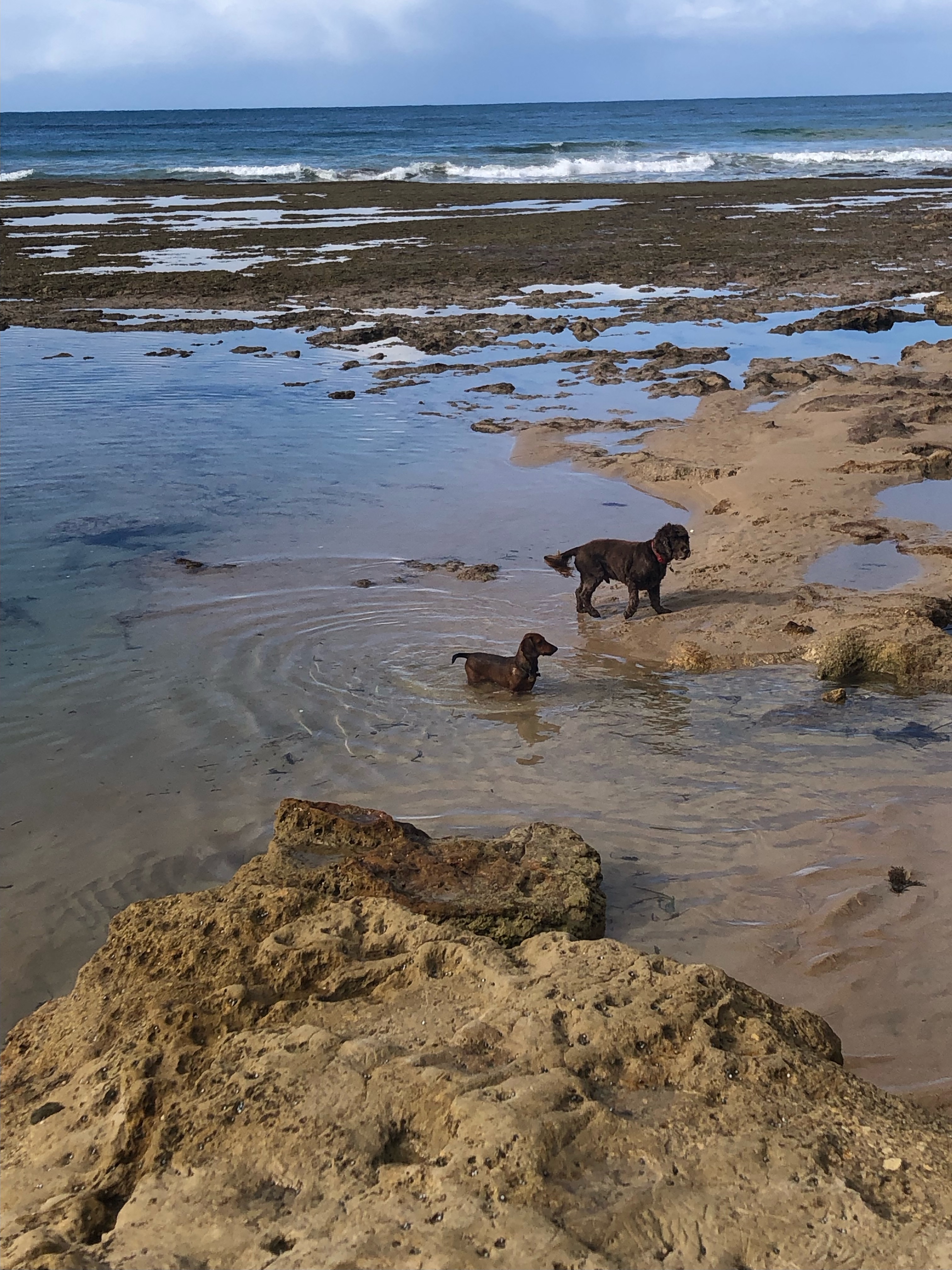
I enjoy the seasonal variation – summer can be very intense requiring a lot of sunscreen slip, slop, slap – and finding warmth in soups, stews, candles, hot baths and snuggling with the dogs on the sofa. There are grey days in the mix which make me feel right at home but there are also some glorious sunny days in the high teens, when there’s no better place to hang out than in my courtyard garden.

Immersing myself in artsy things has provided another form of nourishment these last few months. One of the zanier exhibitions my friend Kaliopi and I went to was Swingers – The Art of Mini Golf. I had no idea that mini golf had its origins in feminism. In the 19th Century a group of Scottish women, rebelling at being told that swinging a golf stick was unladylike, commissioned a 9-hole putting-only course which became known as the Himalayas due to the uneven terrain. The course still exists today, alongside St Andrews Golf Course near Edinburgh.

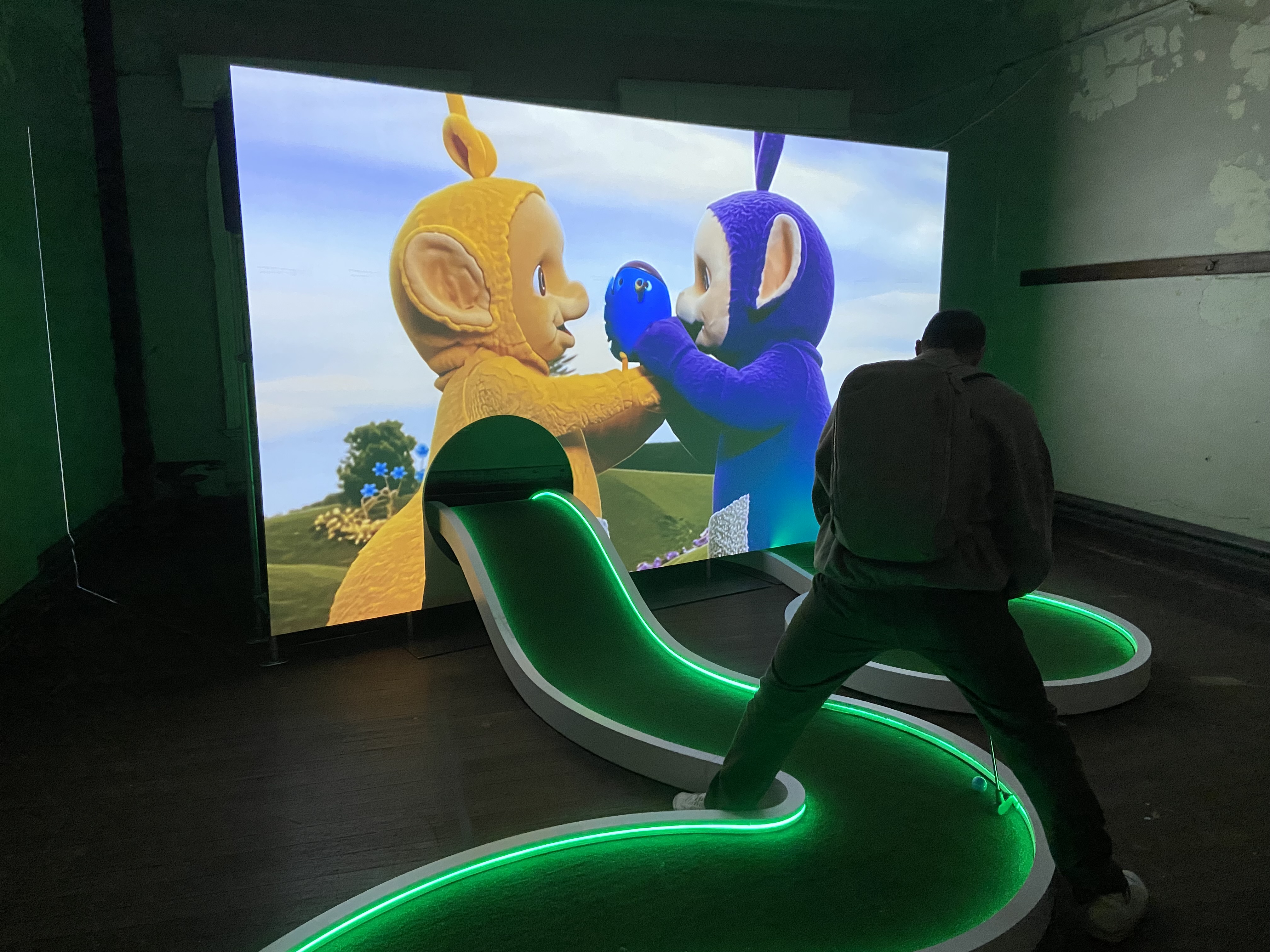
Swingers is an interactive exhibition staged in the former Victorian Rail Institute ballroom upstairs at Flinders Street Station. We navigated the nine-hole golf course created by nine female and gender-diverse artists. My favourite was the first hole, a big, bold and colourful desert scene by Yankunytjatjaraartist Kaylene Whiskey, complete with Greyhound bus and featuring Cathy Freeman and Dolly Parton. Putting is harder than it looks – you’re never going to get me playing golf – but we navigated the course as best we could.

Other works included videos of the Teletubbies, an eerie Carnival Clown face, spooky scenes reminiscent of the Mexican Day of the Dead and, at one of the holes, we had to attach a latex animal tail and swing it with our bodies to putt the ball. Well, what can I say, maybe if you’re as flexible as a hula hoop dancer… Much hilarity ensued but it did nothing for our technique.
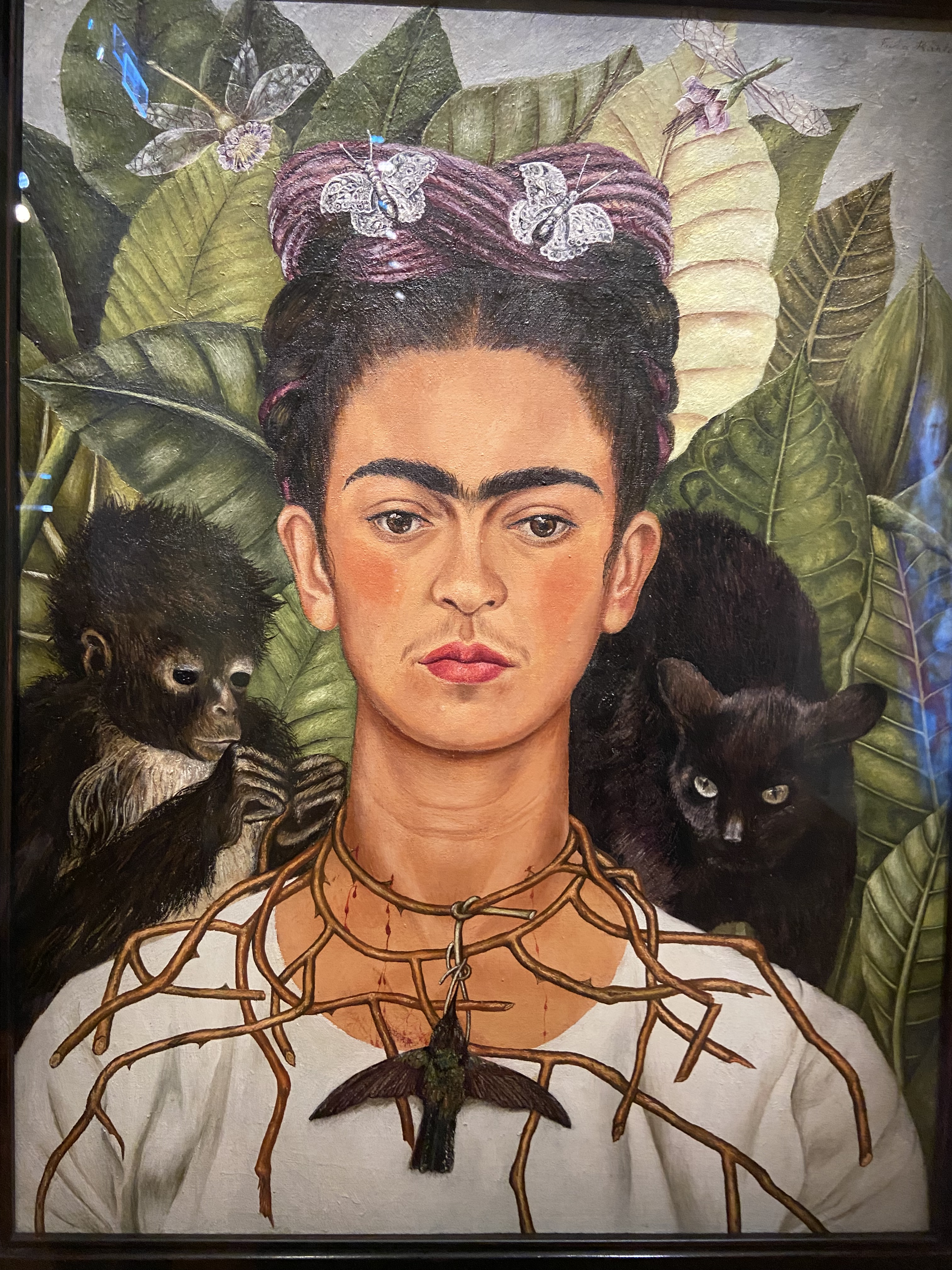
Another big pop of colour came courtesy of another feminist – in July I went up to Bendigo in regional Victoria to see Frida Kahlo: in her own image. As well as her paintings, self-portraits and the fabulous costumes, jewellery and flowers that she wore are some of her personal items that were sealed in a bathroom for 50 years after her death. These include lipsticks, powder compacts, medicines and herbal tinctures. As well as polio aged six, she suffered a horrendous accident in 1925 leading to life-long injuries when a streetcar collided with the bus she was travelling in. During her recovery she began to paint and used mirrors and an easel positioned over her bed. She underwent multiple surgical interventions, lived with chronic pain and had to wear a corset every day from 1944.

What shines through is her resilience, her deep love of animals and the natural world, her courage not only to channel her pain and disability into art but her readiness to challenge the prevailing societal and political norms. She was the daughter of a German/Hungarian father and a Mexican mestiza mother and, rather than follow the European-influenced fashions of the time, she honoured her Indigenous heritage and wore the traditional blouses, skirts and shawls from the Tehuantepec Isthmus, a matriarchal society. And although her life was cut short by gangrene in 1953, she lived to the full. She and Diego Rivera had an up and down marriage, they both had affairs – Frida even had a brief affair with Leon Trotsky. She was a member of the Mexican Communist party and painted one of her plaster corsets with a hammer and sickle.
Continuing with all things Hispanic, and following my March trip to Malaga, I saw five exquisite films at the Spanish Film Festival and luxuriated in the cadence and rhythms of the language. My two favourites were Wolfgang, a warm-hearted comedy about a nine-year-old highly intelligent boy with autism spectrum disorder, who re-establishes a relationship with his father following the death of his mother. And Ocho, a love story set across eight decades and eight defining moments in Spain’s history including the Civil War which split friends and families apart. A masterful and magical movie from the 2025 Malaga Film Festival.

A creole mass – Missa Criolla by Argentinian Ariel Ramirez – in a city church was a revelation. In place of the traditional Latin Mass, this was a folksy mass featuring dance, instrumental and song forms from Argentina blending Indigenous, African and European influences. The concert included other gems ranging from Spanish classical guitar pieces and a Peruvian hymn in the Quechua language to an Afro-Brazilian chant by Villa-Lobos, and Libertango, a piece composed by Argentinian tango composer Piazzolla. You’ll likely know the famous instrumental version, but we heard the choral adaption by Oscar Escalada with voices playing the parts of instruments.

I came out of the concert with an Andean beat pulsing in my veins, the maracas sounding in my ears and added South America to my travel wish list.  There’s been a strong Hispanic thread this winter. A few months ago, I went to a jazz club in north Melbourne to hear the Brazjaz Ensemble headed up by Carlos Ferreira, a Samba specialist from Rio de Janeiro. It was the real deal – mellow, moody and intense – and the newly graduated (2022) flautist, Yael Zamir, gave an extraordinary performance. The set included about five songs, two of which I recognised from a CD I used to play in my London days in the 90s.  

I’m a big fan of escapist musicals – it’s easier than meditation – that transport me to a make-believe world. Beetlejuice with Eddie Perfect was no exception. It’s a dark comedy about ghosts, zombies, life and death with a great score including a couple of Harry Belafonte favourites – Day-O and Shake Senora.

I went with my friend Angela and her daughter Alice, and we indulged in a Beetlejuice-themed high tea beforehand which included ghoulish lime green cocktail, black and white sugar snakes, dark chocolate and pepper scones, shrunken head tarte and a smoking concoction that added to the mystique.

This Sunday, I celebrated the last day of winter by going up to Kyneton to see Alice – a rising star – perform in Mary Poppins with Sprout Theatre, a youth musical company in the Macedon Ranges.  A wonderfully high energy production performed by a cast of talented young people ranging from tiny tots in the junior class to teenagers in the senior classes. Beautifully staged and choreographed, it was a knockout with great singing and dancing including coordinated moves and can-can kicks that must have taken a fair bit of rehearsing. As a two left feet person, I was impressed.  Absolutely supercalifragilisticexpialidocious!

Mary Poppins is one of my all-time favourite musicals, and its story and messages are as relevant today as they ever were; family is more important than work and money, find the silver linings and positives “Just a spoonful of sugar”, and believe in the power of creativity and imagination: “Anything can happen if you let it.” Sound advice!

Remembering adventures in Western Australia – Eye Candy Colin, coral reefs, Carnarvon, cancelled in Karratha and the Karijini National Park

A colleague recently travelled with his family to the Kimberley in Western Australia (WA), hiking in the remote bush. Hearing of his tales and seeing the photos reminded me of my travels and adventures in WA in 2003, and prompted me to dig out my photo album*. The characters I met were as colourful as the sea- and landscapes I explored. *please excuse the grainy photos photographed from said album.

On a mature gap year in Australia – my house in Oxford rented out – I had been staying with friends of friends in Freemantle, a suburb of Perth, camping in their garden.  A bit less Princess and the Pea than I am now, I shared the tent with a littler of Jack Russell puppies for company. I’d wake up with the puppies snuggled in my armpit, across my belly and around my head. How I adored them, particularly one of them whom I named Oscar.

From Perth I travelled north up to Exmouth with Australian Adventure Tours. The tour included sandboarding in Geraldton, marvelling at the Pinnacles, ancient limestones formations – some rather phallic-looking – as our guide Colin was (very) quick to point out, hanging out with bottlenose dolphins at Monkey Mia in the Shark Bay World Heritage Area and learning about the nearby Hamelin Pool stromatolites, layered sedimentary rock formations, single-celled organisms, that produce oxygen in a saltwater environment and were once the dominant lifeforce on earth! We passed through Carnarvon (my diary reading simply: Boiling! Banana plantations, NASA dish, supermarket and, according to Colin, the cheapest grog till Broome), swam with the whale sharks at Coral Bay, a wonderfully life-affirming – and energetic – experience, drank in orangey-red dawn and dusk skies and travelled on red dust dirt roads.


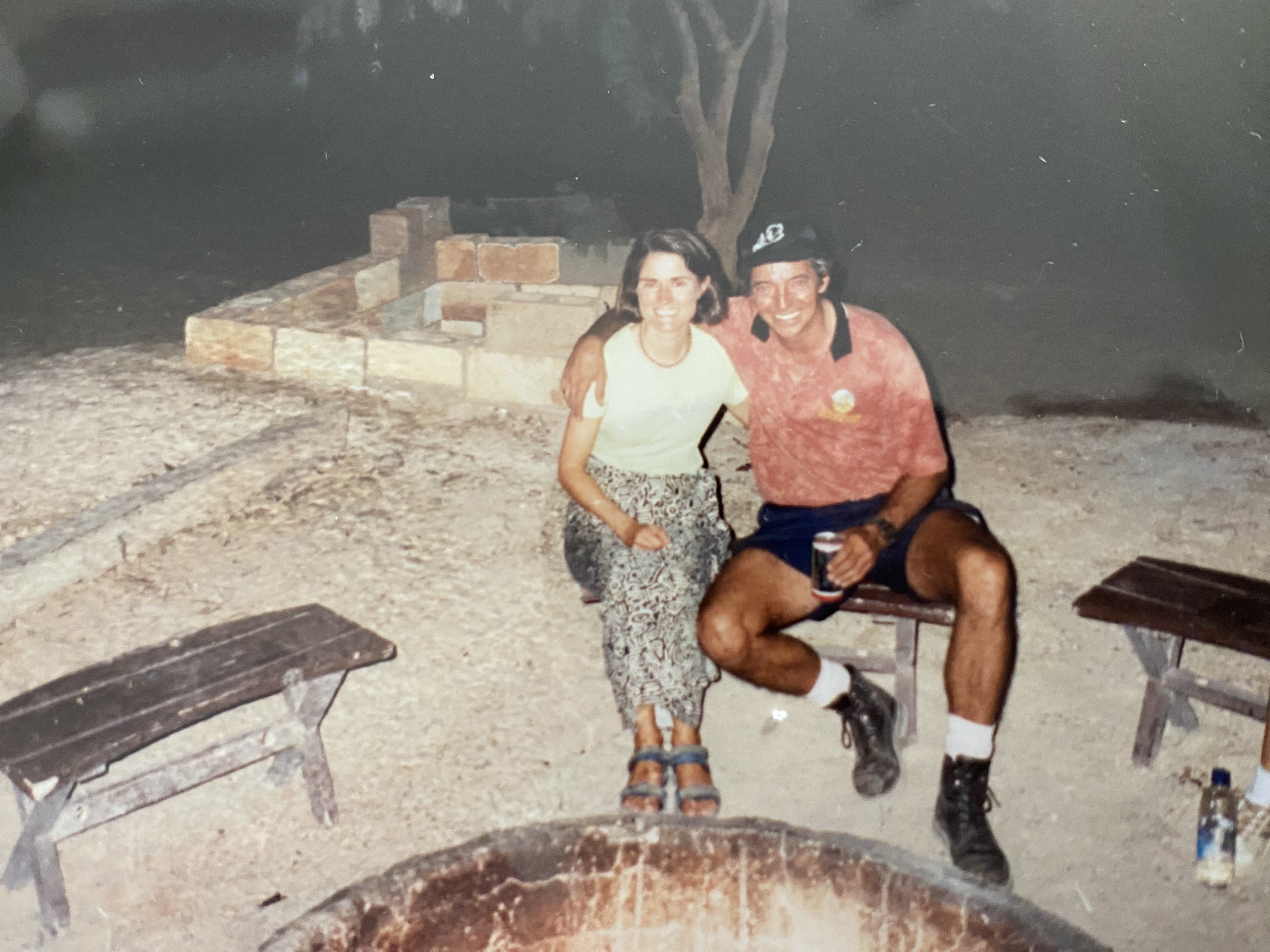
We stayed at various old homesteads and stations including Warroora Station (meaning Woman’s Place in the local Aboriginal language), where we made raisin damper, sat round the campfire, and where I did my best to keep Colin at bay.  I was the odd number on the tour; our party consisted of two gay girls from Tasmania, two rather inflexible German girls (they eschewed the damper at breakfast saying: “nein danke, only ever muesli in the morning”) and two sweet and giggly Japanese girls.

Colin was unapologetically Colin endlessly searching beaches for ‘Eye Candy’ and regaling us with apocryphal stories of past conquests such as Debbie from Essex.  He was sweet on me, insisting I sit next to him in the front of the van and dropping inuendo-laden hints, but I came away unscathed bar some campfire hugs. While he was a bit of a tour guide cliché, he created camaraderie, kept us all entertained and energised and loved his job.  

My next stop was the Ningaloo Reef Retreat (before it got upmarket and swanky). Ranger Dave with his bright eyes and rasta blond hair took out us to the turtle beds and kayaking on the Blue Lagoon. Sadly, even then, more than 20 years ago, there were sections of dead coral but what I remember more is the extraordinary diversity of marine life, the dazzling colours and quirky names of the fish. To name a few, we saw sailfin catfish, the harlequin snake eel, Tawny nurse sharks, Christmas Tree worms, fusiliers, humbugs, sweetlips and convict surgeon fish being chased by black damsels. A very different vibe from Colin’s tour, Dave was more Hippie Hippie Shake and exuded the kind of positive energy that comes from living close to nature. I also enjoyed the company of Mike, a curator of Indigenous art, a chain smoker of roll-ups with gappy teeth and wild and woolly grey-blond hair, and his wife Ilse, a linguist.

From Ningaloo Reef I took the overnight bus to Karratha, a mining town, to join a tour to the Karijini National Park. Due to arrive at 6.30 am, I had booked into a backpacker’s, and, as arranged, the manager came to meet me at the service station. I had stayed in some wonderful youth hostels in the south of WA – at Denmark, at Bunbury and Albany. Here, my room overlooked a courtyard full of cigarette stubs and empty beer cans, there were ants, chicken bones and food on the floor in the kitchen, and I’ll spare you the detail of the bathrooms.  Tired from a night on the bus, I couldn’t handle the nicotine-imbued squalor. Looking back, I realise this place was a budget option for mine workers and transient labourers rather than travellers.

The manager was furious when I complained it was dirty. She screamed at me, blaming me for getting her out of bed at 6 am and flung $30 of the $50 I had paid into my hand and booted me out the door. In today’s parlance, we’d say I’d been cancelled!  Smarting from the experience, I cut a tragic figure wheeling my case along the streets looking for alternative accommodation. But all was well as I pitched up at the Mercure and for $98 (bargain!) got a sparklingly clean room, TV, air-con, private bathroom and access to the pool. Bliss.

At 7.30 am the next morning, Andrew from Snappy Gum Safaris picked me up for the tour I’d booked to the Karijini National Park. We had to wait around a bit as his brother Brendan was still in the shower and nursing a hangover and sore leg from coming off his motorbike the night before. Something about the camber of the road. Yeah, right… And guess what? I was the only one on the tour, a fact which came back to haunt me.

Karijini is iron ore country. It is vast, remote and characterised by rust red dirt roads, cliffs, gorges and large termite mounds interspersed with splashes of green ranging from the grey green of the gum trees and the spinifex grass to the brilliant jade of the water in the rock pools. It’s like being inside a Fred Williams painting.

It’s a four-to-five-hour drive and, with a few stops along the way – a deserted homestead and a spidery drop dunny – we got to our first stop at lunchtime, the Hamersley Gorge, where Brendan and I had a dip in a water hole, the waterfall giving our shoulders a gentle massage. Sounds good doesn’t it but the brothers were distant and disengaged, cross that they were not making any money by taking one person on the tour.   While there was no male/female tension, they were keen to get their pound of flesh.

By early evening we crossed the dry riverbed of the Fortescue River towards the Rio Tinto Gorge (note how the big mining companies have claimed and named the land as theirs) and the Dales Gorge camp site, which was just a patch of red earth. Here they set up our swags and, for mine, hitched up a mosquito net to a tree branch.

Dinner was cheap sausages cooked over a fire served with salad and, to drink, bog standard cask wine or Victoria Bitter (VB).  My diary reports the boys ‘romped through the VB’ and complained about penny-pinching backpackers.  I was almost starting to miss cuddly Colin.

By chance a group of four tourists – an English girl, a Dutch girl and two Canadian blokes – came over after dinner and asked Andrew and Brendan if they knew the park and the various hikes. They boys went into a huddle with them while I sipped at my wine. Dollar signs in their eyes, they turned back to me after about ten minutes and asked how I’d feel about changing the itinerary to walk the much-more-exciting Miracle Mile the next day? It’d be the walk of a lifetime, the said. The tourists were keen to engage them as guides. Ching Ching.

Miracle Mile, why not?  It sounded good and I didn’t want to be the party pooper.  I slept reasonably well in my swag –  apart from being startled awake by one of the boys shouting in his beer-soaked sleep, after which I got a bit lost going for a pee in the spinifex. No mobile phone torches in those days!  

After a light breakfast, the day started gently with a trip to the Joffrey Falls, Knox Gorge lookout and Oxers lookout which is the meeting point of four gorges.

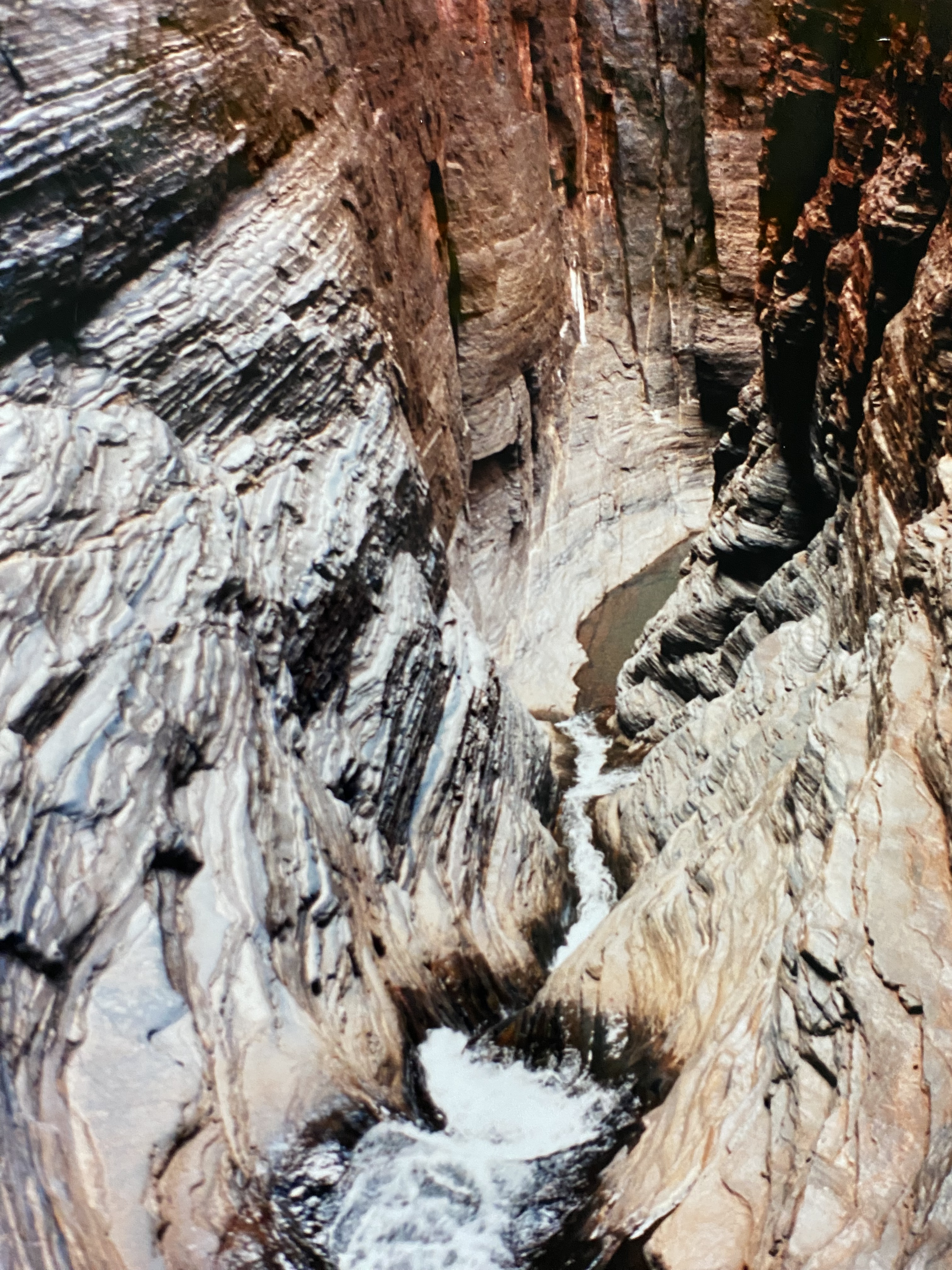
And then the adventure started. No wonder they had stuck to the catchy Miracle Mile moniker rather than detailing what it involves. The Miracle Mile is within the Hancock Gorge and the Joffre Gorge and involves walking along extremely narrow 20-metre gorge walls. While we did have helmets, there was no rope, and one wrong foot could have spelled disaster.  

It was physically and mentally demanding, but what made it most challenging for me was being the odd one out while the other four were a bonded team, walking together and encouraging each other on. I’ve always loved a bit of solitude and peace and quiet, but this was uninvited exile. I changed schools a lot as a child, and this reminded me of being the new girl and not having a gang to belong to.

At one point I slipped and grazed my knee, irritating Andrew, who was walking behind me. Shaking, I picked myself up and pushed on, desperate not to let the others see my fear – and suppressed fury! We crawled, climbed, clambered and inched our way along, in parts spreadeagled between gorge walls, jumping into rock pools below and swimming between gorges, floating our day packs on air beds. Andrew and Brendan set challenges and dares for the others, while I waited around – like a spare part at a wedding – getting cold (think damp bathers in shaded gorges), tired and hungry. When I got back to the car at the end, I bit into an apple only to crack a tooth!

The scenery was out of this world SPECTACULAR but I’m appreciating it more all these years later looking back at the photos in my album. My diary description from 11 May 2003 is underwhelming: Fab gorges, layering and rocks but wasn’t happy in my head as Phil (an ex) would say.  It was a tough character-forming experience, but one I will never forget. And as my German teachers would say: it’s all grist to the mill. Indeed, and 22 years on it makes a good story for my blog!

Now is the time

How heart-shakingly moving was Amanda Gorman’s poem The Hill We Climb which she read at Joe Biden’s presidential inauguration. For me, it summed up so powerfully and with such grace and eloquence the choices that stand before us in the COVID era. While she was speaking of America, and against the background of the storming of the Capitol on 6th January, her wise words apply to all of us wherever we live. What also stood out for me – and gave me hope – was that Biden is a man of soul, of the heart, capable of compassion and empathy; the polar opposite to the morally-corrupt, orange-faced ego-maniac Reality TV business tycoon who previously held office. I won’t even mention his name.

It’s ironic in some ways that we mourn the pre-COVID world. So much of that world was already broken and unsustainable; the pandemic has magnified the challenges we face with global warming, food (in)security, factory farming, inadequate systems to deal with the rising mountains of waste, inequity on so many levels (the politics of vaccine distribution to developing nations just one example) and power-hungry corporations putting profit before people and planet.

And then the senseless destruction of forests in so many parts of the world. Since 2016 one football pitch of forest is lost every second. Not only are trees vital sinks for carbon, but emerging science indicates that trees are social creatures that communicate and support each other via an interconnected fungal highway. Who hasn’t experienced a sense of soul amid towering trees in a forest cathedral? I read an article in The Melbourne Age this weekend instancing how a tree on the brink of death bequeaths a substantial share of its carbon to its neighbours. How magnificent is that?

One of the benefits – if we can call it that – of COVID restrictions putting the brakes on ‘normal’ life (and my heart goes out to all those in the UK and other parts of the world faced with wide-scale community transmission, over-whelmed hospitals and high death rates, particularly those who don’t have the economic or social luxury of being able to socially-isolate) – is time to reflect, to slow down, to live more simply, to look out for our neighbours – get to know our neighbours even – to appreciate the small things, and importantly, to revere the natural world that sustains us. And I say revere deliberately.

In a pre-COVID post in February 2020, I wrote that Planet/Mother Earth can do without us and will cast us aside if we don’t look care for her. Recently I watched David Attenborough’s Witness Statement: A Life on Our Planet – on Netflix in which he went through the decades of his life demonstrating humanity’s impact on the planet as measured by population growth and the decline in wild spaces and biodiversity. It’s a compelling call to action. We have overrun the world he says, with nothing to stop us. We are intelligent but not wise, apart from nature, not a part of nature. Since that was filmed, COVID has swept across the world. If COVID doesn’t stop us from plundering the planet, polluting and over-consuming, nothing will. If we fail to clean up our act, more zoonotic viruses are waiting in the wings. Surely, that’s enough of a deterrent?

Now is our chance to change how we live our lives and how we interact with others and our environment, being kinder to ourselves, each other and the planet. Some say we’re doomed – human beings are inherently greedy, corrupt and selfish; history is merely repeating itself. Isn’t that a lazy let-out clause; a way of propping up the status quo?

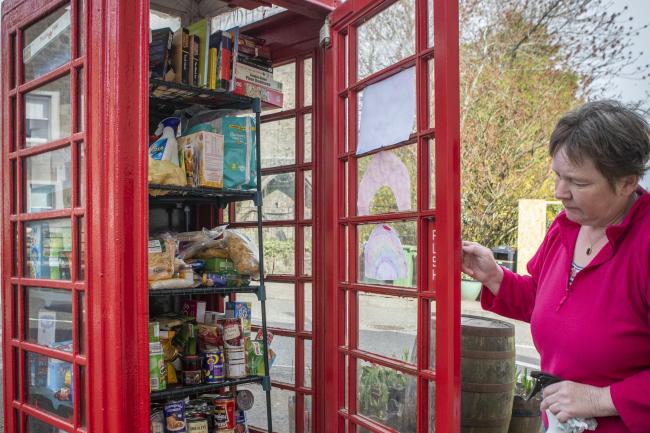
We mainly read the gloom and doom stuff in the news – and there’s plenty of it – but we hear less about the initiatives to increase sustainability and ethics in the fashion industry, clever waste recycling, renewable energy and rewilding projects or community support schemes (one of my favourites the conversion of a red phone box in an English village into a community food larder). What a lot of schemes lack is the scale and infrastructure to achieve systemic change, but there’s opportunity for that to change. If we care enough and dare enough, we can all be part of that change through the choices, decisions and values we live by.

Tuning into the digital version of the Melbourne Writers’ Festival last August, I was struck by the words of film-maker Damon Gameau and his efforts to humanise climate change through story-telling, and his positivity: “we need to reframe the crisis as an opportunity and privilege to be alive at this time” and “Optimism is the basis of solutions for a sustainable future.” Like many commentators he instanced how major global events in the past brought about advancements, from the social changes triggered by the Black Plague to the creation of the NHS and welfare state in Britain after the Second World War.

Hope, like trees in the forest, nourishes the soul. One of my mother’s favourite phrases is: ‘Hope springs eternal’ (from Alexander Pope’s Essay on Man). Another of her favourites is the poem Leisure by William Henry Davies: “What is this life if, full of care/We have no time to stand and stare.” With life turned upside down and without being able to plan ahead with any certainty, it’s become a bit easier to live more mindfully and in the moment– with more time to stand, stare, smell the roses and meditate. Even a few minutes of micro meditation can take you out of your head and back into your heart.  The trick, I have found, is to cultivate a practice of gratitude and to trust that there is some grand design behind the current global shake-up.


Lockdown gave me the time, space and single-minded focus to build a freelance practice as a grants specialist. And in a pleasantly organic and synchronistic way, organisations and projects that are close to my heart have found me. At the end of last year I supported five arts and entertainment organisations to win Federal Government grants – such a boost for artists whose livelihoods and performance opportunities have been decimated by COVID. Since then, there’s been youth mental health, environmental education and projects to re-purpose food waste. I feel as if I have found my professional feet and carved out my own niche and signature brand.

As a homebody, lockdown was less challenging for me than some. And that’s where the gratitude came in. Finally, I had time to give my garden more love, and to tackle jobs that had been on my domestic to-do list for years. I didn’t clear out a single cupboard but I did install a Vertical Garden in my courtyard and plant out various cuttings I had collected from friends’ gardens.

I painted my various garage sale and nature strip finds (for non-Australians, this has nothing to do with nudity; the nature strip is the grass verge bordering the pavement where people put out ‘hard rubbish’ to be collected by the Council!). While it’s illegal to pinch things from the hard rubbish, I see it as neighbourhood recycling, and it saves items going to landfill. A win-win. A neighbour, Jill and I, alert each other when we spot see something languishing by the side of the road that is crying out for a good home…

More than ever, I learnt to savour the small things: a cuddle with Bertie, a new green shoot in my garden, the first cup of tea in the morning, cloud formations in the sky, the changing colours of the ocean, the magpies carolling, an engrossing book or fascinating podcast. My home-based staycation over the Christmas holidays was a series of simple savoured moments adding up to quite a feast.

None of us knows what lies ahead. All we can do is to keep caring, keep learning, keep hopeful and keep putting one foot in-front of the other. I’ll leave you with a few lines from Amanda Gorman.

But one thing is certain:
If we merge mercy with might,
and might with right,
then love becomes our legacy
and change our children’s birthright
So let us leave behind a country
better than the one we were left with


Spikes, tights and fairy lights: a bit of lockdown lightheartedness

One thing about the Covid-19 lockdowns (we are in lockdown take two in Melbourne) is that the dog child and I are confined to barracks every evening. And in winter that means possum o’clock begins around 6 pm when the pesky little critters emerge from their daytime resting spots and start scampering about, taunting my spaniel Bertie by using my fence as a runway, and me, by chomping on a few shrubs into the bargain.

possum-nibbled shrub

Bertie is by nature a hunting dog so the appearance of these squirrel-like nocturnal visitors drives him into a frenzy of frustration.  Whenever I hear him squeaking and shrieking, I dash out to find him hopping around on his back legs, hurling himself at the fence. Safely perched at the top of the trellis, the possums stare complacently at Bertie as if to say ‘bark all you want, you’ll never get us.’ Schadenfreude in action.

I’m not so worried about the noise of his barking, although it is pretty disruptive, but more concerned that his efforts to scale the fence are damaging his already stiff back. Even as a pup he’d sometimes limp a bit in his left hip. And he’s always sat with his right leg sticking out at an angle – presumably to relieve the stiffness on the other side. While an X-ray showed he doesn’t have hip dysplasia as such, there is wear and tear in the back and hip area. And if you try and massage that area or apply pressure, he’s not impressed.

Having said that, noise abatement has been part of my game plan. For the last year I’ve had pesky noise-phobic neighbours – renters rather than owners, thank Goodness. The first time I met them the conversation was ALL about them, their health, trials and tribulations.  As if in warning, they said they hoped my dog didn’t bark, and that in previous houses they’d had to write to the Council about dogs that yapped all day. Bertie does have an impressive bark but it’s never continuous, more a response to certain stimuli – a bird on the roof, a possum, a knock at the door etc.

As I write this, I’ve decided to devote a future post to these crazy neighbours who have applied an accusatory and forensic approach to each and every noise – be it my heating, a sporadic Bertie bark, the neighbour’s air-con or occasional loud parties, construction noise or the guy over the other side playing music. They write letters, they climb up on ladders to peer over the fence, and they throw eggs. They are due to vacate – after much wrangling and a VCAT case – in August ­, so watch out for my celebratory blog then. Stressful at the time but amusing and cathartic looking back…

Suffice it to say I’ve had ample motivation to do my utmost to deter the possums and divert them to someone else’s garden. A few years back I installed a sonic possum deterrent– it may have helped for a while but I reckon the possums grew accustomed to it. I re-positioned it recently and at one point turned up the volume. Then I got calls from Mrs Noise Phobe asking if I could hear a strange whirring noise around midnight. Had I got a new possum deterrent? I denied everything, but did turn it down. The minute they move out, I’m going to crank it up again!

Then a friend recommended solar-powered coloured fairy lights as a way of keeping possums away. I duly trooped off to Bunnings, and my hero brother helped me string them along the fence. Clearly, there’s got to be enough solar gain in the day to keep them flashing at night (oh yes, I have set them to epileptic fit-inducing flash). Still the little buggers scampered across the fence, driving Bertie berserk. Next, I resorted to Old Wives’ Tale remedies and, keeping some hair from Bertie’s last groom, stuffed it into a stocking which I suspended from the fence. That only compounded the problem as he mistook the dangling black shape for a possum, and barked at it!

Some nights if I caught the possums red-handed in a stand-off with Bertie, I’d train the hose on them or poke them with a long pole. And please don’t go Animal Rights-y on me. I’m not harming them, simply encouraging them to hang out elsewhere. Suffice it to say, none of the above proved to be sustainable solutions. Back to Dr Google. This time I invested in humane possum spikes 2cm high and 4.5cm wide, which I positioned at strategic points along the fence. That didn’t work either. Perhaps if I had covered the whole fence it would have been more successful, but, then again, the possums didn’t seem to mind to walking on then.

Back to the drawing board and to the possum spike company, who were only too happy to cash in on trying to solve what is clearly my (insert marketing speak) ‘pain point’ as a customer. Taking advantage of the end of year sale, I ordered a different type of spike. Tall, resembling 6-inch icicles, and made of Perspex, these are the real deal. My brother, bless him, came over and put them along the entire length of the fence. For the first few nights it was quieter. But possums are resourceful – I reckon there’s a movie in this along the lines of Wallace and Gromit’s The Curse of the Were-Rabbit or Roald Dahl’s Fantastic Mr Fox – and, soon after, I spotted a possum crawling along my fence underneath the spikes, and another using the side of the spikes as a climbing frame.

I reckon they got in through the gaps down the side of the fence adjoining the noise phobes’ garden – so I have strung up netting and filled in the gaps. It is quieter on the Western Front now. Bertie can still hear the possums on the other side of the fence but he’s less frenzied when he’s no longer eye-balling them. It’s only a matter of time, of course, before they discover they can leap from my other neighbour’s gutter onto my shed and along the fence underneath the spikes – but till then we’ll keep on with our spikes, sonic possum deterrent and flashing lights. Never a dull moment over here!

For the love of reading

I’ve taken a bit of a break from my blog for various reasons, one being that I’ve always been a bit iffy about social media, not only the public nature of it, but the busy-ness and noisiness of it, the fact it never sleeps but churns on and on keeping us in thinking and doing mode, and over-stimulated. Not to mention fake news, ‘deepfake’ videos, trolling, interference in elections and data mining.  I tune out of the whole circus more often than not, leaving those pages to scroll on without me.

Given my ambivalence around 24/7 digital connectedness I was interested to read that author Patrick deWitt screens out the world while writing: “Wi-Fi feels like the death of solitude, of solitary thought. It feels like you’re in a room with people all the time. And I think if you’re going to write, you should have some quality time to yourself, daily.”

So the return to my blog is on my terms – I may not get round to reading many other blogs and posting likes and comments. And for now, my aim is not to boost my ‘traffic’ or attempt to generate income. I invite those that enjoy it to read it at their leisure. And I will write it as and when, perhaps in a more flow-y way.

One consistent anchor and pleasure throughout 2019 – when I took a chunk of time out from career and work to spend extended time with my family, particularly my elderly mother, and friends in the UK – was the luxury of having more time to read. Reading is a gentle, quiet pleasure that engages our heart, mind and imagination in a way no other medium does. Even if we choose to listen to an audio book, it’s less demanding than a Podcast or other streaming service.

I enjoyed resisting the pull of FOMO-tinged new releases and got down to some  classics. As a German language graduate, I was thrilled to finally read Thomas Mann’s Buddenbrooks – albeit in translation. Written in 1901 but set in the mid to late 1800s, it’s about four generations of a wealthy north German merchant family, and their eventual decline amid a changing world. It explores tensions between head and heart, business versus the arts, old and new, with exquisitely drawn characters reminding me of Dickens. When it came to George Eliot’s Middlemarch, described by Martin Amis and Julian Barnes as ‘the greatest novel in the English language, I cheated and listened to a wonderful dramatized adaption on BBC Radio 4. It proved the perfect bedtime accompaniment when I returned from my second UK trip at the end of the year when I was still suspended between worlds, half of me still in Mum’s kitchen, and half of me back here in Melbourne. What a relief when the caustic Reverend Edward Casaubon dies!

A few literary memoirs provided fascinating insights into how writers choose their subjects and the kind of world they inhabit. The best was Claire Tomalin’s A life of My Own. She has written outstanding biographies of subjects as varied as Mary Wollstonecraft, Charles Dickens and Thomas Hardy but is very sparing in the details of her own day to day life, exercises self-restraint around her emotional life and lacks self-pity. I found that so refreshing in the me-me-me era. The daughter of a French intellectual and a musical mother, her first husband, a journalist, is killed by a Syrian missile in Israel, one of her daughters, Susanna, a brilliantly gifted girl, commits suicide, and her son, Tom, is born with spina bifida. What she does describe are her dealings with the literary great and the good – including an affair with Martin Amis – and her work as literary editor of the New Statesman and The Sunday Times.

Another non-fiction highlight was historian Annabel Venning’s At War with the Walkers, an enthralling account of her family’s experience of World War II. Meticulously researched, it’s the saga of her grandfather Walter and his five siblings: Harold was a surgeon in London and his sister Ruth a nurse when the Blitz started; Peter is captured in the fall of Singapore, Edward fights the Germans in Italy, Bee marries an American airman and Walter battles the Japanese in Burma. I learnt so much, not just about the war (particularly in the Far East) but the rich social detail from the  escalating price of horses in 1939  due to petrol rationing to the extraordinarily rigid social hierarchy in the Indian Army: “Even if only one officer was dining in the mess at night, the regimental brass band had to turn out and play while the solitary diner had to wear full military regalia and observe all the mess customs…”

It’s many years since I read a Daphne du Maurier. The Parasites written in 1949 about three half siblings and their theatrical parents is as relevant as a study of human nature as it was then. Julie Myerson, in her 2005 introduction, sums it up brilliantly as: “a strange ambiguous love story set in a world of dark, Lutyens house, Morny soap (I remember that brand so well, French Fern and Lavender etc!) and brittle, fading theatrical glamour.”

My most recent read was SNAP by crime fiction author Belinda Bauer, a Christmas present from my dear friend Monica. Not my usual choice of genre, I loved this romp of a thriller set in Devon. It starts on the M5 when a mother of three children leaves them in the car on the hard shoulder while she goes to the emergency phone to report a breakdown. She never returns… Curmudgeonly detectives, eccentric neighbours and characters living in the shadows made this a perfect bit of escapism.

I can’t finish without including another treasured Christmas present: The Artful Dog – Canines from the Metropolitan Museum of Art – and one of my favourite quotes: Outside of a dog, a book is man’s best friend. Inside of a dog, it’s too dark to read.” Groucho Marx.


London: Hamming it up in…Ham

My ankle now healing I am now more mobile if not entirely comfortable, and more or less beyond the RICE (Rest, Ice, Compress and Elevate) period – at least the ICE bit, not that I could follow that neat little anagram on my travels in France; I’d have needed a lackey to fetch me cold packs or to carry me around in a sedan chair!

So it made me smile when I met up with my oldest and dearest friend Monica last week and saw she was also sporting a bandage around her ankle. She has a bit of a history with ankles – I once pushed her around the Royal Academy in a wheelchair – and this time she’s broken a bone and so her foot is (as one of my nieces would say) well puffy. Puts mine in the shade in fact. Suffice it to say, however, that we were as one moving at the same non-brisk pace, every now and then having a stork-like rest on one foot.

We started our day out at Petersham Nurseries near Richmond in London, an upmarket (shorthand for pricey), artsy, vintage-y nursery surrounded by grassy meadows along the Thames. We had lots to talk about over our artisan tea in the café, the walls framed by cascades of fuchsia-coloured bougainvillea in full bloom.

From there it was a short hop to Ham House, a Jacobean mansion gifted to courtier William Murray by Charles I. Educated with the King, Murray was a ‘whipping boy’ and took the lashings for any of the king’s behavioural transgressions – it was meant to serve by example. Talk about a scapegoat. The least the King could do, later in life, was to make Murray one of the Gentlemen of the Bedchamber and reward him with a sumptuous mansion!

Before visiting the house, we had lunch in the Orangery café situated in the walled kitchen garden, a riot of colour and lushness with purple lavender borders contrasting with the orange nasturtiums and yellow sunflowers. Ham House was considered one of the grandest in Stuart England, and is now hailed as ‘the most complete survival of 17th century fashion and power’. Not only that, it’s reputed to be one of the most haunted too. I was disappointed not to see an aristocratic spectre or even an ectoplasmic footman!

Ascending the intricately carved wooden staircase you come to a series of rooms including the Long Gallery lined with aristocratic portraits including one by Van Dyck of Charles I, a library with a screen made of a double-sided map dated 1743 in which Australia and New Zealand are drawn as one landmass, and my favourite, The Green Cabinet Room, with walls covered in green damask and hung with small paintings and miniatures, one of Elizabeth I dated 1590. Another portrait of note was of Erasmus (school of Holbein) with an intricate frame carved by Grinling Gibbons.

Monica and her husband Jonathan (we met at university) live nearby, and to my delight, Jonathan joined us unexpectedly. By 3.30 pm a volunteer guide started to close the blinds and to shut up the house to protect the paintings – interestingly, the Green Chamber was designed with a curtain rail and protective silk curtains, now restored by the National Trust. Like kids running away from the Bogey Man, we rushed to stay one step ahead.  That was all we needed to revert to our long-standing default of hamming it up – silly faces, voices and giggling – as we sped-read the information cards in each room, here a Japanese lacquer cabinet, there an exquisite monogrammed parquetry floor, here a leather stamped wall, there a bedchamber decorated in honour of Charles I’s wife, Catherine of Braganza. By the time we got below stairs to the servants’ quarters – complete with the Duchess’s bathing room with its round wooden bathtub – we were off the hook. Phew. That’s what I love about old friends; you simply pick up where you left off.

Our final stop was The Still, perfumed with dried lavender and other herbs, the shelves lined with ointments for gout containing pig fat and a bottle of dew harvested in spring this year. In bygone eras, May dew was considered a cure-all and beauty treatment for women, and for men, washing their hands in dew was said to strengthen their skills in knots, locks and net-mending.

I looked up the origin of the word hamming it up as I thought it might be Shakespearean but my research indicates that it means “overacting inferior performer,” dates from America, circa 1882,  and refers to ham fat used to remove stage make-up. Who knew!

But I did get a double Shakespeare fix, once in the British Library, repository of the Shakespeare’s First Folio dated 1623, and then at an open- air production of Midsummer Night’s Dream in Regents Park with my sister and brother-in-law. Booking an al fresco event in England is always a gamble but we hit the heatwave week, perfect for a sumptuous picnic accompanied by a fine English rosé wine, and then watching the play with the setting sun as a backdrop. What a treat to see mischievous Puck, Titania in her fairy bower and the elves on a stage fringed with reeds and surrounded by oak trees. And one of my favourite lines spoken by Helen to Demetrius (who scorns her): “And even for that do I love you the more. I am your spaniel.” Seems spaniels have a long history of being faithful and adoring!

Today my niece and I are off to see a wartime comedy by Terrence Rattigan at Richmond’s Orange Theatre, a theatre in the round. Heatwave permitting, we also plan to do a guided tour of Sandycombe Lodge, one of the houses designed and built by J. M.W. Turner in Twickenham, amid the Thames-side landscape that inspired him.  My long-cherished plan of making the most of my self-awarded time-out in the European summer is going to plan!

Scarecrows, Sprockers and State Visits

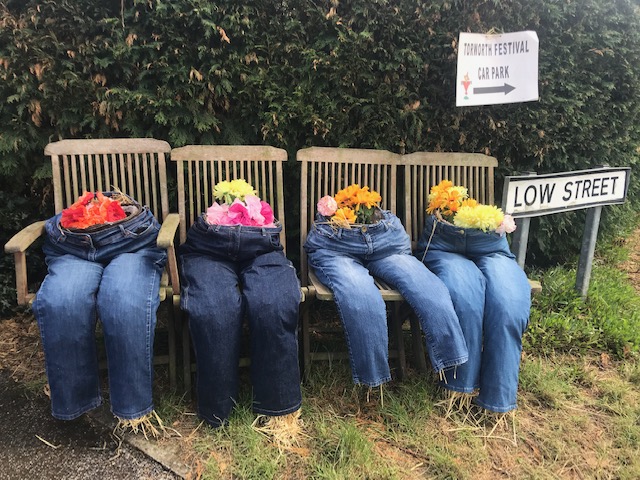
Have you ever thought about the history of scarecrows? I hadn’t but the 12th annual Ranskill and Torworth Scarecrow Festival – a village fundraiser close to where my mother lives in Nottinghamshire – prompted me to do some research. The Egyptians were the first to make wooden scarecrows in the likeness of deities to deter the birds from eating grain. In medieval Britain children would walk through the fields throwing stones at birds raiding the crops but when the Black Plague decimated the population in 1348, there weren’t enough people to work in the fields so they made scarecrows out of straw with turnips or gourds for heads.

I always think of that song in Joseph and his Technicolour Dreamcoat (still one of my favourite musicals of all time) Stone the Crows, the one that comes after Joseph interprets Pharaoh’s dream:

Well, stone the crows
This Joseph is a clever kid
Who’d have thought that 14 cows
Could mean the things
He said, they did

And who remembers Worzel Gummidge, the TV series from the 70s and 80s, based on the books by Barbara Euphan Todd with John Pertwee aka Dr Who as Worzel, the scarecrow? I’ve just read that the BBC is filming a new adaption to be screened later in the year. There’s something very lovable about a scarecrow who comes to life and befriends children, getting up to tricks and mischief.

I didn’t count the scarecrows lining the roads around the two villages but there must have been a good fifty or more covering topics ranging from humour to history, cartoon characters, fiction, fantasy and fairy tale. Mum and I hopped on Wilfreda Beehive, a 1965 London Routemaster Bus, to view the exhibits in style.

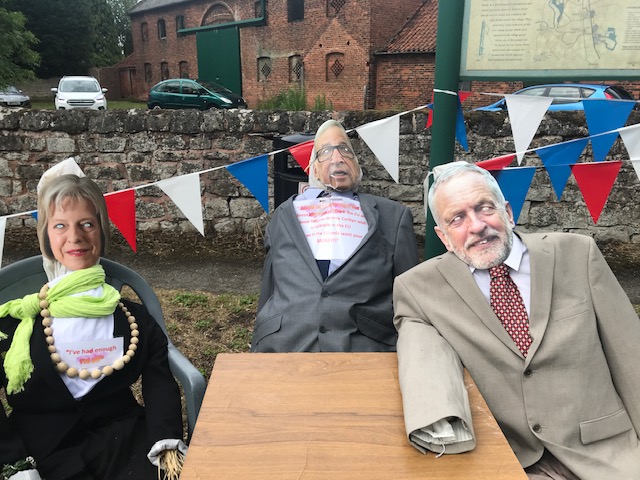
Some of my favourites included three Spitting Image-style politicians: Theresa May, Jean Claude Juncker and Jeremy Corbyn, a policeman holding a hairdryer as a speed detector and a robed figure sitting on a chair entitled Mindfulness. Positioned atop trees and hedges along the route were knights on horseback, astronauts and children’s favourites such as Peppa Pig. A lot of fun.

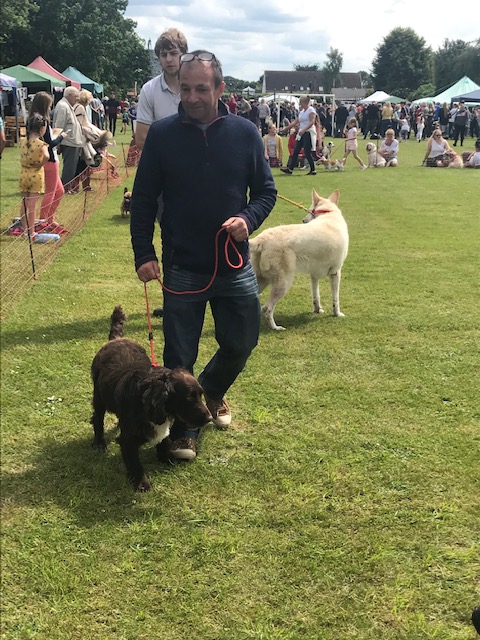
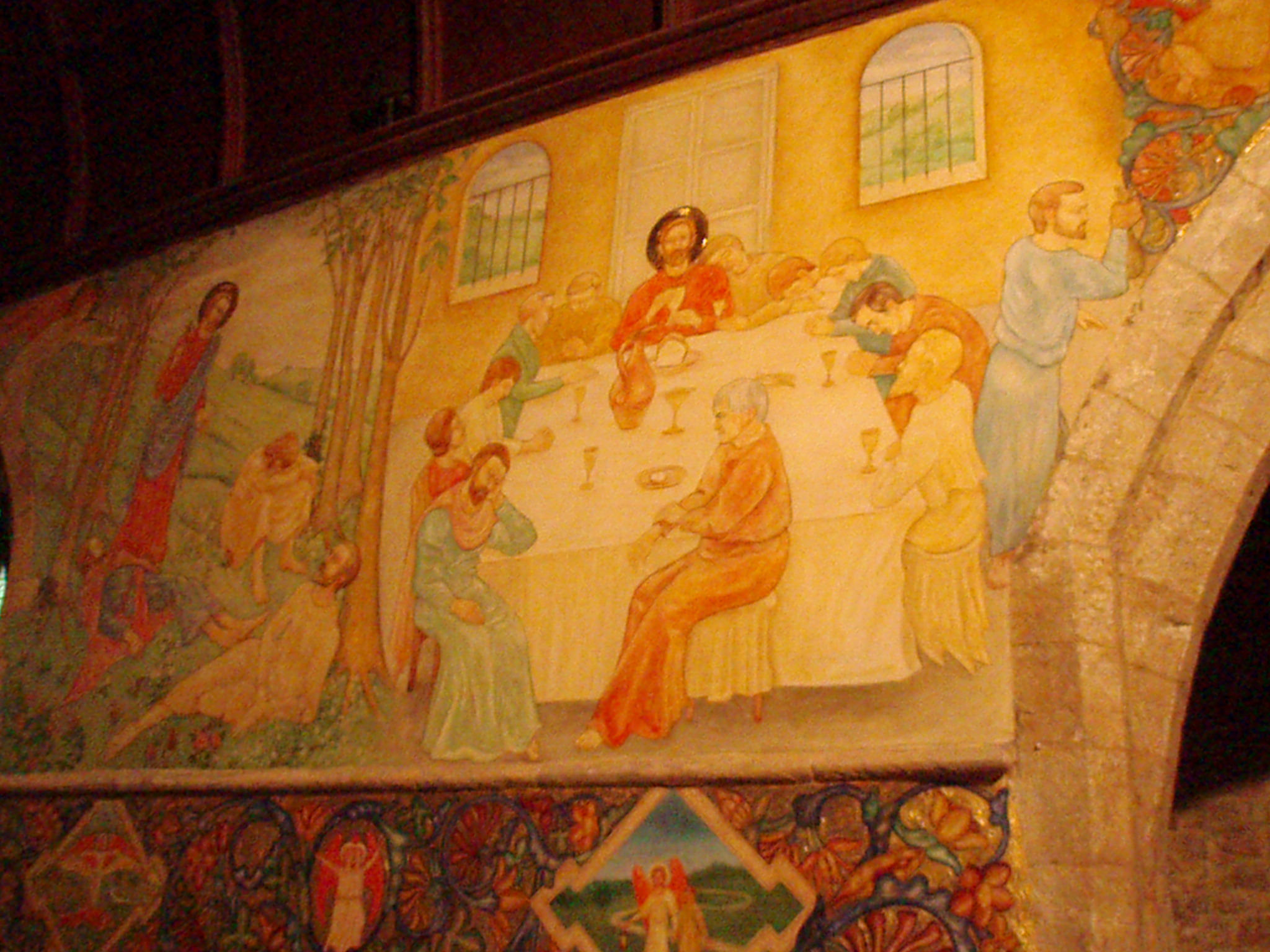
But there was more: amid the stalls selling hand-crafted bags and natural skincare products there was a dog show and competition with categories including Gundogs, Working Dogs and Hounds, Pedigree, Pastoral and Toy, Good Looking Boy/Girl and Most Appealing Eyes. Drawn to the spaniels, I met several Bertie lookalikes. They were, in fact, sprockers – a mix of cocker and spring spaniel. Bertie is the result (one of ten) of an accidental mating between a field spaniel and a cocker spaniel. What does make him? A focker, a flocker? The mind boggles. That same day I accompanied Mum to St Peter’s Church in nearby Clayworth, home to theTraquair Murals by renowned Scottish Arts and Crafts artist Anna Traquair (1852-1936). I reckon Mum goes more for the social connection than any deep-rooted faith. The somewhat happy clappy vicar – it was Pentecost Sunday (reminding me of our/Australia’s Pentecostal PM, Scott Morrison) – challenged us to reflect whether we were ready for God’s Kingdom on earth. The lady in the front pew assented with a vigorous YES and clapped her hands in the penultimate hymn. Mum, meanwhile, whispered all too loudly, that the service was going on way too long and she hoped there wouldn’t be yet another hymn. There was. I enjoyed a bit of time out to reflect, count my blessings (excuse the pun) and admire the fabulous murals.
Not to be defeated by the rain, we also visited Retford’s local museum housed in a handsome Georgian mansion. A mix of various private collections – china, glass etc – and displays of bygone eras, I enjoyed the Second World War Kitchen, the cabinet full of lotions, potions and medicines such as Dr MacLean’s Stomach Powder and the Victorian schoolroom. Although once a thriving market town (granted its first charter by Henry III in 1246) and then a coal-producing centre connected by a network of canals, it’s gone rather downhill and is now full of shops such as Primark and Poundstretcher.

There’ve been some afternoon naps – I’ve bagged what was Dad’s reclining chair and plugged in a little hot pad in an attempt to create a sun lounger experience. I’ve done lots of cooking and, to Mum’s delight, tried recipes that I have collected over the years with only one culinary flop so far. And all this against the backdrop of the ongoing Brexit debacle: no deal, a revised deal, a postponed deadline, proroguing Parliament, a General Election, scrapping Brexit or remaining. It’s chaos. And the way the Conservative party leader selection process is going, it looks like the UK and the US will each will be ruled by blond blusterers with bad haircuts. I met a lady on the train to London who was on the Conservative Executive Committee under Thatcher and was injured in the Brighton Hotel bombing in 1984. She knows Boris and insists that the buffoonery is all an act and that he is a shrewd player. Let’s hope she’s right!

Trump, of course, basked in the attention, pomp and ceremony surrounding his State Visit to the UK (labelling anti-Trump protests as fake news) to mark the extraordinarily emotional 75th Anniversary of the D-Day landings. Britain being Britain, he was highly criticised for his sartorial faux-pas with the vest of his white-tie outfit way too long under the jacket. Then there was the errant h in his spelling of the Prince of Whales and his vicious verbal attack on the Mayor of London. By contrast, the Queen so dignified and chipper and doing her bit for that so-called special relationship between the two countries.


The Republic of Words 3 of 3: Writing, dogs and the meaning of life

The Friend by Sigrid Nunez, a book about writing and the relationship between animals and humans, was another perfect fit for me. It’s a novel but I thought it was a true story as it reads like a memoir and is, I discovered, the most autobiographical of Nunez’s book to date. It is a simple story but one that is multi-layered and full of literary allusions with an animal as the central character. It’s about a woman in New York – the narrator – who reluctantly inherits a dog – a Great Dane – when its owner, her friend, a womanising professor who has been married three times, commits suicide. Nunez, like the female narrator, both teaches and writes.  She has no social media accounts and leads a quiet life: “I became a writer because it was something I could do alone and hidden in my room.” She is an ‘old school’ writer who views the craft as a vocation and was surprised to find herself in the limelight as the winner of the 2018 National Book Award.

Nunez/the narrator has a dig at the proliferation of writers and quotes the deceased friend as agreeing with Garrison Keillor: “When everyone’s a writer, no one is,” a sentiment Nunez traces back to the pre-digital era: French critic Sainte-Beuve said in 1839: “To write and have something published is less and less special. Why not me too? everyone asks.” What would have Sainte-Beauve have made of self-publishing and blogging?

Anyone who has tried to write a book and bumped up against the self-doubt, angst and feeling of being a fraud will take comfort from learning that John Updike always felt he had got away with something when he saw his books in a store. For Virginia Woolf and Isak Dinesen the act of writing helped to ease pain and sorrow, whereas Philip Roth found writing frustrating and humiliating. And how surprising to learn that prolific writer Georges Simenon described writing as a vocation of unhappiness.  The most pertinent quote for me was from Rainer Maria Rilke: “If you were forbidden to write, would you die?”

I certainly don’t feel compelled to use my time out from work to write a novel, memoir or best seller – not at the moment anyway. For now, I am content to blog for the love of writing and to maintain the practice of crafting words. Although I do rather love the image of tapping away at a  book n a house by the beach with my dog at my feet…

The friend in the story refers not only to the deceased professor but to the Great Dane Apollo.  This is no saccharine story of puppy love, however. At first an unwelcome burden, the dog is a wise old soul who gradually becomes central to the narrator’s life – she even reads to him (something a holistic vet suggested I do to calm my dog Bertie!) – and manages to persuade her landlord to let her keep him in her tiny New York apartment. Much of the book is about the relationship between humans and animals: “They may know us better than we know them.” I also loved this: “I like that Aborigines say dogs make people human.” The Friend also references famous people who have owned dogs such as J. R. Ackerley (1896-1967) editor of BBC magazine The Listener. While he took a rather unhealthy interest in his dog’s heats and bodily functions (there’s a chapter in his book My Dog Tulip called Liquids and Solids), he spoke of his relationship with Tulip as a 15-year marriage, the happiest of his life. In similar vein the narrator in The Friend quotes a passer-by as saying: “Better a dog for a husband, than a husband who’s a dog.” Hear, hear, I say!

Although a fictionalised life lesson, I also enjoyed The Why Café by John Strelecky, partly because I read it in German – Das Café am Rande der Welt ­­– and tapped back into the language, and partly because it never harms to ponder the meaning of life! The narrative construct is that a stressed advertising executive runs out of petrol and finds himself in a café in the middle of nowhere. On the menu are three questions:

Why are you here?
Do you fear death?
Are you fulfilled?

Through conversations with the café owner, waitress and a patron, the book encourages readers to challenge their thinking. Are we being true to ourselves or doing what others wish us to do? Are we slogging away to earn money to amass belongings that we think will makes us feel happy? Are we keeping madly busy because we haven’t found our purpose or our calling? Are we waiting till retirement to do what we love? Do we swim with the tide or against it? What is our life purpose?

I sometimes wonder if writing is my calling or just something I love to do. Maybe dogs are my calling – or animals. Or maybe it’s writing funding applications to support animal welfare and conservation! I certainly find great solace in nature and love being away from screens and devices, chatter, noise and distraction. Walking out across the fields in Nottinghamshire yesterday, bright red poppies dotting the landscape and foamy cream hawthorn blooms bordering the path, I stood and ‘chatted’ with a cow, who stopped his meditational chewing and turned to look at me, its eyes full of knowingness. Mindful moments like those remind me how wondrous it is to be alive. And, for all the self-help and psychobabble, we don’t need to have all the answers. Another brilliant quote from The Friend by Rilke: “Have patience with everything that remains unsolved in your heart… live in the question.”


Here we go a-truffling

When I booked onto a truffle hunt with my dog Bertie, I pictured him scampering around in the orchard and sniffing out a mature Tuber Melanosporum aka a Perigord Black Truffle. That’s because Field Spaniels – Bertie is half Field and half Cocker Spaniel – are being bred specifically for the truffle industry. Field Spaniels are renowned for their hunting skills and exceptional noses. When Bertie was a puppy and we attended puppy pre-school at the vets, he quickly located where the treats were. While the other dogs wriggled around on people’s knees, Bertie maintained a hypervigilant eye and nose on the prize.  His olfactory system never sleeps – even a short trip around the block will usually yield an edible find. He once shot off across the beach­ – leaving me panicked that he would run onto the road – hot on the scent of a sausage sizzle hosted by a party of Rotarians. He would have made an excellent sniffer dog. In fact, he could have excelled in many different nose-based careers.

As it is, he is a much-loved and over-indulged pet. Which is why we booked onto a Truffle Hunt organised by a company called Gourmet Pawprints offering ‘pawfect’ food and wine experiences for people who like to take their dogs along for the ride. As befits a canine-centric business, the dogs are guaranteed a window seat on ‘Bella the Bus’ (Kerry, the owner of Gourmet Pawprints, not only runs the business but also drives the bus!) and are greeted with a goody bag of treats. Bert sat across from Penny, a skittish but adorable Dalmatian (one of two on the trip), and Iggy, a well-behaved black lab. At one point, Penny barked which lead to a Mexican wave of barks across the bus, reminding me of a classic read from my childhood, The Starlight Barking by Dodie Smith.

I once dreamt that Bertie accompanied me on a trip back to Britain. In my dream there were sofa beds – you know the ones with the pull-out metal frame – and the dogs slept underneath.  Wishful thinking on both accounts; you’d only find a sofa-sized bed in First Class (dream on Charlotte) and from a cost and quarantine perspective, taking Bertie on holiday to Britain would be totally impractical. I do love to imagine him, however, running across babbling brooks and green fields criss-crossed by dry stone walls in somewhere like Derbyshire (where I was born) or Yorkshire.  But travelling up to Daylesford by bus – Bertie kindly let me share his double seat on the way back – on a Wuthering Heights-type wet and wintry day came a close second.

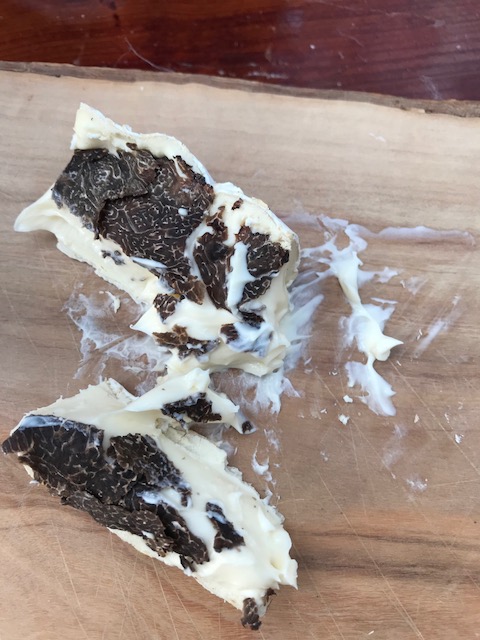
Our destination was Black Cat Truffles just outside Creswick, and we were greeted with oozingly rich truffle-infused d’affinois cheese and a glass of sparkling wine – just an hour earlier we had had chocolate brownies and coffee in Ballan! We learnt that truffles are the edible fruiting bodies of fungi that grow underground in a symbiotic relationship with the roots of host trees such as hazlenut and oak, most typically in low nutrient soils with a high pH level. At Black Cat the orchard is planted with French and English Oaks and the truffle dog is a trained Labrador named Ella. She had already sniffed out where the mature truffles were located, and the owners Andres and Lynette had marked the trees with a ribbon.

Thankfully the rain let up and ushered in a brief sunny spell just long enough for us to get up close and personal with the truffles. We were invited to kneel and sniff the soil before digging up a few spectacular specimens; mine was the size of a cauliflower and would have commanded a price of about $1000 on the market.  It’s hard to capture the distinctive aroma of a truffle in words; it’s strong, woody, earthy, pungent, heady and sticky sweet.

Needless to say, none of the dogs got a look-in when it came to walking around the truffière. The environment in the orchard needs to be carefully controlled and protected – we had to dip our boots in disinfectant. Instead the dogs got their own special treasure hunt in an adjacent paddock and had fun unearthing treats.

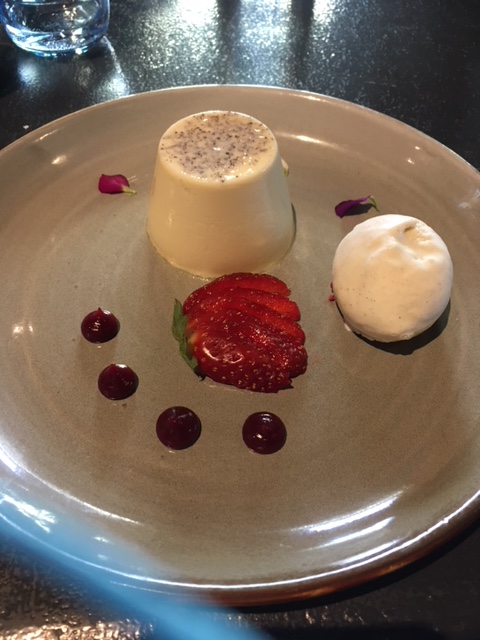
After sampling and/or buying truffle butter, truffle salt and truffle honey in the shop, it was time to move on for lunch at the Farmer’s Arms in Creswick. The entire menu – bar the wine – was truffle-infused from the charcuterie platter to the main course of barramundi or beef cheek. But it was the honey truffle panna cotta with a berry coulis that stole the show. The sweetness of the honey and the earthiness of the truffle shavings (spot the black dots in the photo) were perfect foils for the cooked cream.

While we had been feasting, the dogs were treated to massages and edible treats on the bus. With the dogs relaxed after their pampering session, and the humans sated and soporific after rich food and fine wine, there was much dozing on the way home. That’s what’s so enjoyable about a tour; it’s all done for you and you can sit back and let the day unfold – no map-reading, thinking or organising needed. Pawfect indeed.

Experiments with off-line living: more meeting up than hooking up

When was the last time you unleashed your inner child and pretended to be a blind dog, an alien from Outer Space or a French person struggling to make themselves understood? These were just some of the scenarios we were given to act out at a Theatre Games and Improvisation Meetup on the weekend. As a child I loved dressing up and putting on plays with whomever else I could rope in, and I had a bit of a knack for mimicry and accents. But that was then. On Saturday afternoon I struggled to tap into that playful vibe – it felt like being in the classroom on the first day at a new school – although I was warming up by the end. The degree to which I engaged was also partly determined by the group I was in; we were in the same group of four for the whole two hours. And my group was on the reticent side.

It was interesting to observe the dynamic and watch the more ‘Am Dram’ types take centre stage with their suite of accents and gestures, while others played out more slapstick scenes without much sublety. I observed the bolder ones and wondered what their day job was and whether this was the ultimate release; the chance to let go of corporate or even family constraints. It reminded me of the Karaoke party I hosted for my choir last year. Some people tapped into their inner rock star or channelled Madonna, hamming it up and belting it out, while others sat on the side lines. However buried, I think most of us have a desire to clown around as it gives us the freedom to tap into an alter ego.

I went to the Improvisation Meetup not only to unleash the thespian in me, but also as part of my ongoing experiment with adventures in off-line living. It’s not so much about meeting a partner and avoiding online dating, but more about expanding my world and living to the full. But maybe by doing what I love to do and not actively searching, I might meet someone like-minded in the process.

In March I went to a Cryptic Crossword 101 at the NGV. I’ve always wondered what the clue to solving the clues is. A Friday afternoon event, it was full of retirees, mainly women! However, there were a few younger people including the two engaging male presenters, one of them very dishy in a swarthy Hispanic kind of way. As it turned out, he also does cryptic crosswords in Spanish, one of the few languages apart from English with a vocabulary extensive enough. And for fans of factoids, British-born Arthur Wynne created the first crossword in 1913, and it was published in New York World.  Talking to the dishy Hispanic after the event, I found out that you can do Spanish crucigramas online. That might be a stretch even though my Spanish is pretty good. I still haven’t mastered the art in English.

Visiting my favourite beach café a few weeks ago, I got chatting to a couple of older blokes – way too long in the tooth for me – who were pouring over a crossword puzzle. I confessed that my brief 101 hadn’t equipped me to crack the clues – I reckon it takes not only a great deal more practice but also, possibly, a more lateral-thinking brain. But, hey, I now have a new string to my bow. Where once I might have ‘posed’ in a café with my book and beautiful dog child, I can now add the crossword to my arsenal of conversation starters.

Needless to say, there are also crossword Meetups. Incidentally, did you know that Meetups emerged from the community response to 9/11 in New York when people reached out to help one another? I didn’t. I’m quite a regular at the German Language Group Meetups.  I went to a wonderful exhibition of poster versions of black and white photos (the originals are in Berlin) from 1970s East Germany at Melbourne’s Goethe Institute, the only place outside Germany where they are showing. As with all Meetup groups, there’s always an eclectic mix of people from all walks of life. At a German social at the Hophaus I met a young man, impeccably dressed and well mannered, who does the marketing for Viagra, helping to maintain sales over the generic brands. I had thought the key consumers would be men of my vintage but, no, it’s younger men who want to last for longer. It’s always intriguing finding out how people earn their living. At the same group there was an academic, a shy Frenchman with lots of piercings who translates films and a psychologist who works in drug addiction.

I still think it might be my dog Bertie who leads me to someone interesting.  There was a new man on the beach this summer who caught my eye. He had an open, honest and smiley face – a boyishness about him – and lightly curly hair that matched his dog’s, one of the ‘oodles. And, importantly, no gold band on the third finger of his left hand. A fellow dog-walker, Suzanne, thought he might bat for the other side, something about the timbre of his voice and the pink floral towel, so she did some investigating for me. One should, of course, never judge a book by its cover; ring or no ring, he is, in fact, married.   In a nutshell, dear reader: been there, done that. Nein Danke.

Never mind, a few days later Bertie raced off to a rocky outcrop flanking the beach. Worried that he might repeat his trick of a few years ago of getting a bait-loaded fish hook in his mouth, I dashed after him and narrowly avoided colliding with an attractive silver-haired man changing after a swim. Apologising for invading his privacy, we had a chat and I picked up a German accent – well done Bertie for taking me over there! The man was Swiss German and had a strong accent and a good sense of humour, not something always associated with the Swiss. And I didn’t spot a wedding ring. Chances are that he’s married too but I enjoyed our brief chat and practising a bit of German. And it reinforced my belief that you never know who and what you might encounter in the real world. Onwards and upwards.