When I studied history at school it was often delivered parrot fashion – reciting dates, battles, Kings and Queens – or from musty-smelling books wrapped in brown paper. There were occasional highlights such as making a book about the Romans and their customs (I still have my little cardboard effort somewhere) but, on the whole, it was one-dimensional and flat. But now I can’t get enough of it. Piecing together, and making sense of, the present through studying who and what went before is endlessly fascinating.
Visiting the island of Malta in November I was captivated by a timeline in the museum of archaeology in the capital, Valletta. That morning I had visited a 6000-year-old underground burial chamber at the Hal Saflieni Hypogeum. Only discovered by chance in 1902 by construction workers, scientists estimate that more than 6000 people were buried here. And, to put it in perspective, the tombs pre-date Stonehenge, the Acropolis and the Colosseum.
For three days I became a timeline obsessive, immersed in the multi-layered history of this rocky Mediterranean island, each of the many occupiers leaving their mark on the culture, language and architecture from the Romans to the Carthaginians, the Arabs, Italians, Sicilians, the Knights of St John, who arrived from Rhodes in 1530, the French (during the Napoleonic occupation) and, of course, the British. It was a British colony from 1814 to 1964, and served as a strategic military base in the Second World War.


Malta was love at first sight for me. As the taxi from the airport negotiated Valletta’s labyrinth of narrow streets near my hotel, I was enchanted by the painted wooden box-frame balconies, like mini greenhouses, on the sides of buildings, the retro shopfronts, the many churches, statues of saints seemingly on every street corner and the plethora of plaster saints adorning doors along with brass door knockers designed variously as dolphins, lions, mythical figures or in the shape of the Maltese Cross.


One of my favourite places was the Casa Rocca Piccola, a privately owned palace that has been in the de Piro family for nine generations. Full of treasures including an 18th Century sedan chair, a Venetian glass chandelier, a cabinet of fans, a private chapel, a portable chapel (the kind the aristocracy took to their summer residences), silverware, several Maltese clocks – these were only owned by the aristocracy who had staff to wind them several times a day – and the ‘summer’ dining room laid up for a banquet with fine lacework mats, silverware, candelabras and cut glass.


From there it was an orgy of Baroque gold at St John’s Co-Cathedral with its frescoed barrel vault ceiling and marble tombs underfoot, each one commemorating a Knight of the Order. I got a bit bogged with the audio guide meaning I took too long working out which side chapel was which. By the time I got to the Oratory with the two Caravaggio paintings it was closing time. No sympathy from the guard who suggested I took photos of the paintings with my phone, presumably so I could enjoy them over my dinner for one later! Damn!

In Mdina, once the capital of Malta, and derived from the Arabic word Medina, I skipped the Cathedral – no more audio guides – and instead sat for ten minutes in the Carmelite church admiring the stained-glass windows and relaxing into the pealing of the midday bells. Then, by chance, I discovered Palazzo Falson, a private museum housing the collection of Frederick Golcher OBE (1889-1962), a philanthropist, artist and researcher of Swedish descent, educated in Britain. I marvelled at the collection of Bohemian glass including a double-ended Victorian scent bottle (perfume one end and smelling salts the other), the snuff boxes, fob watches, model ships, Dutch still life paintings, table top cabinets inlaid with marquetry, and closer to home in the UK, Staffordshire figures.


One room at the Palazzo Falson was given over to weapons and armour, but nothing compares to the Palace Armoury in Valletta which ranks among the world’s greatest arms collections, and spans the reign of the Knights from the 15th Century till the arrival of Napoleon in 1798. Fashions changed, and as designs got more sophisticated suits of armour allowed for greater movement. Actual armour and weapons used in the Great Siege (against the Turks) in 1565 sit alongside shields, swords and muskets captured from the Ottomans. Fascinating stuff.
Every time I return to Britain, I wallow in history and often visit a castle or historic building – it’s kind of de rigueur! This time, I got to stay in a Grade II early 17th Century stately home in Yorkshire. Goldsborough Hall gets a mention in the recent Downton Abbey film; HRH Princess Mary, the Queen’s cousin, lived here in the 1920s. I was there for the wedding of my niece Anna to Simon. The service was in the delightful adjoining church of St Mary the Virgin, where, regal, relaxed and radiant, my niece swept in to Pachelbel’s Canon in D Major.


From there – dodging the rain – it was back to the hall for drinks in the Library complete with oak panelling, stag heads, Chesterfield sofas and copies of Country Life dotted around. After much feasting, drinking, dancing and merrymaking, we ascended the oak staircase framed by stained glass windows to our various rooms. My bedroom was named The Duke of York, thankfully not after the current Duke of York, he of Pizza Express in Woking notoriety, but after Albert (aka Bertie), second son of George V, who later became George V1, the king with the stammer featured in the film The King’s Speech. Luckily my brother, Charlie, had no such problems and delivered a masterfully crafted Father of the Bride speech; clever, moving and funny.


The next morning it was wonderful to wake up to views over parklands and grounds laid out in the style of Capability Brown during the 1750s. A right royal occasion indeed, and suitably historic on all levels.


 He laments the amount of waste (including wrecked and rusting cars) in American cities, and the amount of packaging used in every day life: “I do wonder whether there will come a time when we can no longer afford our wastefulness – chemical wastes in the rivers, metal wastes everywhere, and atomic wastes buried deep in the earth or sunk in the sea.” He talks of towns encroaching on villages and the countryside, supermarkets edging out ‘cracker-barrel’ stores. “The new American finds his challenge and his love in traffic-choked streets, skies nested in smog, choking with the acids of industry.” And he encounters political apathy – life seems to revolve more around baseball and hunting than discussions about the respective merits of Kennedy versus Nixon in an election year. Sound familiar?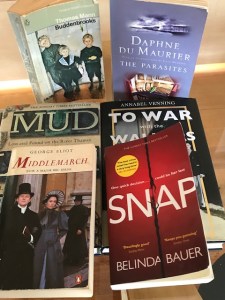




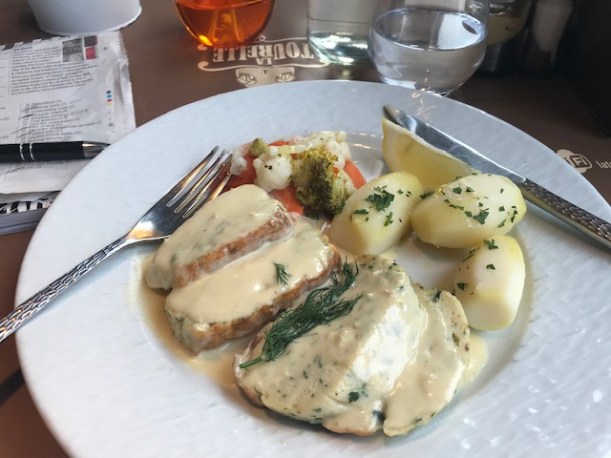
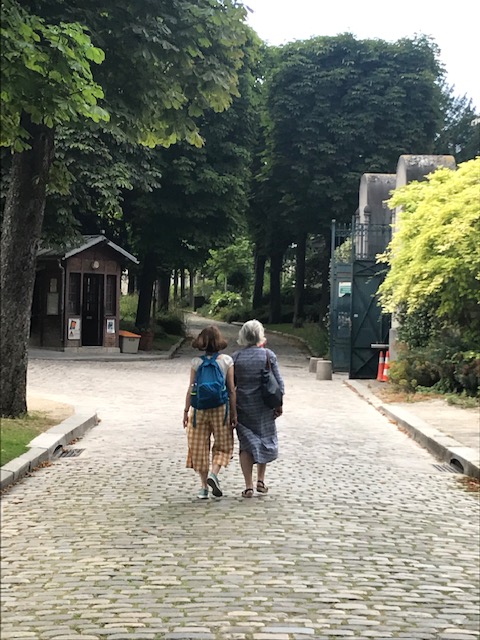
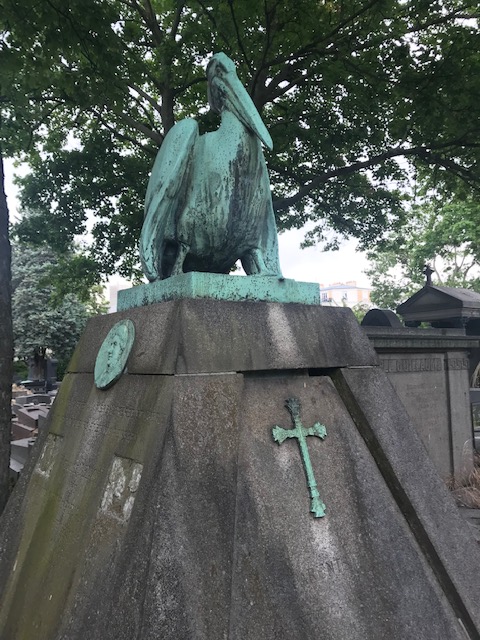
 On Sunday morning we headed off to the more ethnic 20th arrondissement to the Bellevilloise, an art nouveau cultural centre, once a cooperative – hence the warehouse-y feel – founded in 1877 also housing a café and restaurant. We were there for Georgie’s 30th birthday jazz brunch and we feasted like kings on the all-you-can-eat buffet. Even though weary from the night before and full of food, I insisted that we made a detour to the nearby Père Lachaise Cemetery, resting place of so many notable people and surely a perfect place for the spiritualists’ talk on life after death?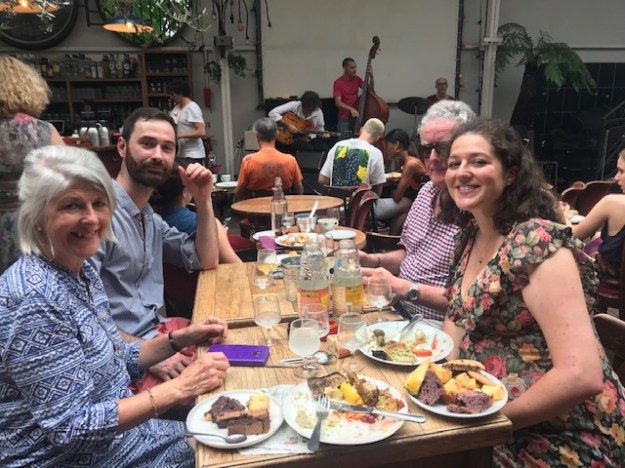



 That same day I accompanied Mum to St Peter’s Church in nearby Clayworth, home to theTraquair Murals by renowned Scottish Arts and Crafts artist Anna Traquair (1852-1936). I reckon Mum goes more for the social connection than any deep-rooted faith. The somewhat happy clappy vicar – it was Pentecost Sunday (reminding me of our/Australia’s Pentecostal PM, Scott Morrison) – challenged us to reflect whether we were ready for God’s Kingdom on earth. The lady in the front pew assented with a vigorous YES and clapped her hands in the penultimate hymn. Mum, meanwhile, whispered all too loudly, that the service was going on way too long and she hoped there wouldn’t be yet another hymn. There was. I enjoyed a bit of time out to reflect, count my blessings (excuse the pun) and admire the fabulous murals.




 This Quirky Life